


Siri AI's Enterprise Ascent: Essential Voice Assistant Strategies
The legal landscape is perpetually reshaped by technological innovation, and few advancements hold as much transformative potential as artificial intelligence. The recent announcement from Apple regarding its profoundly more capable Siri AI, as highlighted by VentureBeat, marks a pivotal moment, signaling its evolution into a robust enterprise application layer.
This isn't merely an incremental upgrade to a consumer-facing tool; it represents a fundamental shift in how businesses, including law firms, can interact with digital ecosystems. For decades, voice assistants were largely relegated to setting timers or checking weather, but the new Siri AI, powered in part by sophisticated models like Google's Gemini, introduces an entirely new paradigm of contextual understanding and proactive assistance.
This development compels legal professionals to reconsider the role of AI voice assistants in their daily operations, moving beyond basic commands to embrace a future where voice becomes a primary interface for complex legal workflows and client interactions.
This emergent era of intelligent voice technology presents a compelling narrative for law firms navigating an increasingly competitive and tech-driven market.
Consider the journey of Sarah Chen, managing partner at "Lex Nova Law," a burgeoning firm known for its early adoption of legal tech. Chen, who once viewed Siri as a novelty, now sees its enterprise capabilities as a potential game-changer. "The idea that an AI voice assistant could seamlessly manage client intake, schedule appointments, and even draft initial communications, all while integrating with our existing case management system, is no longer futuristic — it's becoming a present reality," Chen remarked at a recent legal tech summit.
This sentiment echoes a broader industry awakening, where the promise of a truly intelligent, always-on assistant is finally materializing. The question for firms like Lex Nova Law, and indeed for the entire legal sector, is not *if* to adopt these technologies, but *how* to strategically implement them to gain a sustainable competitive advantage and elevate client service.
This comprehensive guide explores the profound implications of advanced AI voice assistants for law firms, offering a roadmap for integration and optimization.
Ready to transform your firm's operations with cutting-edge AI voice technology? Discover how HODOS 360's AI Voice Assistants can streamline client communication and enhance efficiency.
The New Enterprise Layer: Apple's Siri AI and Legal Innovation
The recent unveiling of Apple’s enhanced Siri AI, featuring what many analysts describe as an entirely new enterprise app layer, has sent ripples across the technology and business sectors. This is not the Siri of yesterday, limited by rudimentary script-based responses. Instead, this profoundly more capable iteration leverages advanced machine learning models, including components from Google's formidable Gemini, to offer a contextual understanding and proactive problem-solving previously unimaginable.
Apple CEO Tim Cook emphasized this strategic shift at the latest Worldwide Developers Conference (WWDC), noting that the new Siri is designed to integrate deeply with applications and user intent, making it a powerful tool for complex professional environments. For law firms, this means moving beyond simple dictation to a voice assistant that can genuinely act as an intelligent co-pilot, anticipating needs and executing multi-step tasks.
The implications for legal practice are substantial. Imagine an AI voice assistant that can not only schedule a deposition but also pull relevant case documents, cross-reference calendar availability with opposing counsel, and even suggest optimal times based on historical data. This level of integrated intelligence transforms a mere assistant into a strategic asset.
According to a 2024 report by Gartner, enterprise adoption of conversational AI is projected to reach 75% by 2027, driven by demands for increased efficiency and personalized customer experiences. Law firms, traditionally cautious adopters of new technology, are now facing undeniable pressure to innovate. The "stickiness" of Apple's ecosystem, combined with Siri's new capabilities, introduces a user-friendly entry point for attorneys who may be hesitant to engage with overtly complex AI platforms.
Learn more about Autonomous AI Marketing: The Ultimate Guide for Law Firms. The goal is to make sophisticated legal workflows feel as intuitive as asking a question.
This shift represents a significant challenge to traditional operational models within law firms, prompting a re-evaluation of how administrative and client-facing tasks are performed.
The competitive tension among technology giants like Apple and Google, each vying for supremacy in the AI space with their respective models and capabilities, ultimately benefits the end-user – in this case, the legal enterprise. Firms that embrace these smarter assistants early will likely gain a substantial edge in client acquisition and retention.
For instance, a firm utilizing an advanced AI voice assistant for 24/7 client intake can capture leads instantly, qualify them efficiently, and even book initial consultations without human intervention, ensuring no potential client is lost due to after-hours inquiries. This proactive engagement aligns with modern client expectations for immediate and accessible legal services, a sentiment echoed in the latest ABA Legal Technology Survey Report, which consistently highlights the importance of responsive client communication.
The integration of such a powerful voice model into a widely used ecosystem like Apple's is not just about convenience; it’s about creating an entirely new operational layer. This layer allows for seamless interaction between disparate legal applications, from case management systems to document automation platforms.
Consider the scenario where a busy attorney, en route to court, can verbally instruct their AI voice assistant to pull up a specific brief, summarize its key arguments, and then draft an email update to a client, all hands-free. This profound enhancement in capabilities moves voice AI from a niche tool to a central hub for legal productivity.
Firms that leverage this new enterprise layer will find themselves more agile, more responsive, and ultimately, more profitable in a rapidly evolving legal market.
Beyond Basic Commands: Transforming Law Firm Operations with Advanced Voice AI
The era of rudimentary voice commands is rapidly being supplanted by a new generation of AI voice assistants capable of understanding nuanced legal queries, executing complex workflows, and providing proactive support. This evolution is particularly crucial for law firms, where efficiency and precision are paramount.
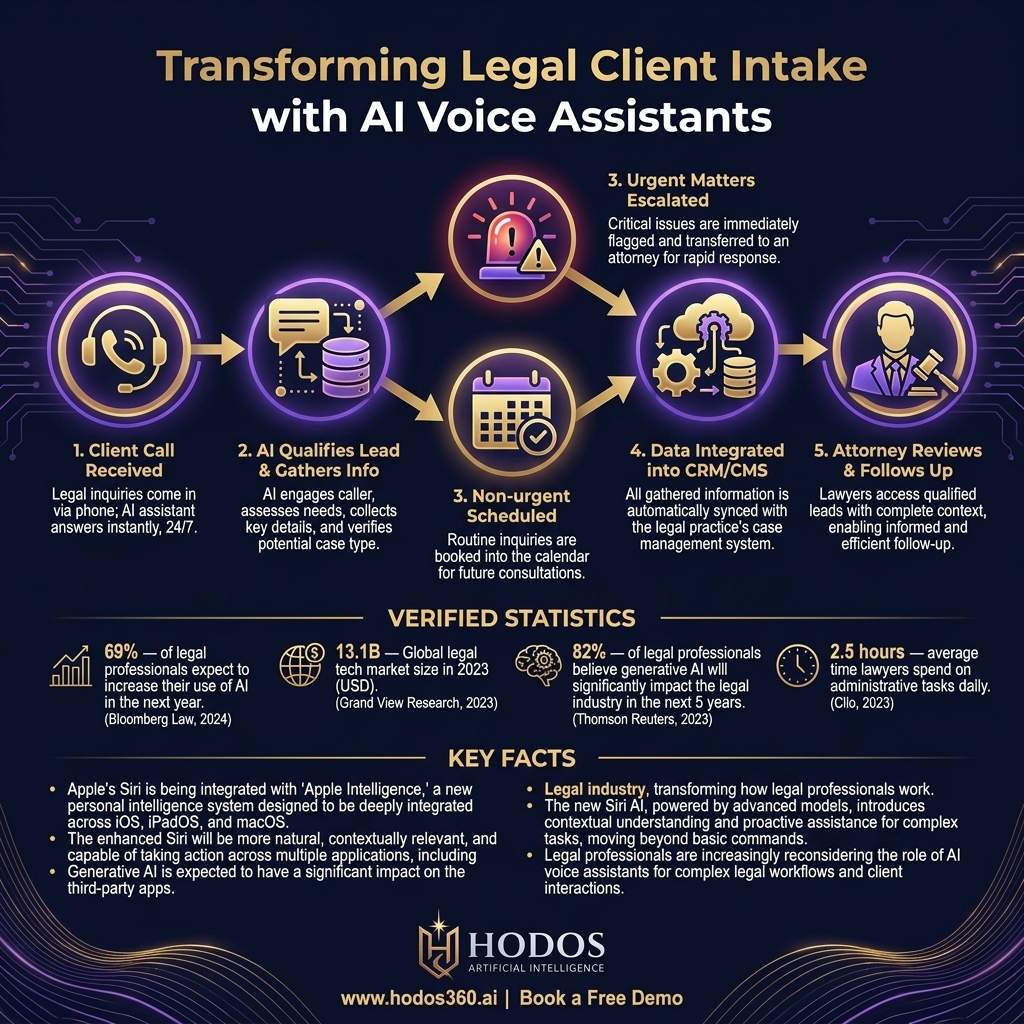
Advanced voice AI, like the newly capable Siri AI or sophisticated third-party solutions, can profoundly transform daily operations, moving beyond simple dictation to become an indispensable component of a modern legal practice. The key lies in their ability to integrate seamlessly with existing legal tech infrastructure, such as case management systems and document automation platforms, creating a truly intelligent and responsive environment.
One of the most immediate and impactful applications of advanced AI voice assistants in law firms is in client intake and communication. Imagine a prospective client calling your firm after hours. Learn more about AI Legal Platform: Essential Security for Law Firms. Instead of reaching an answering machine or an outsourced service with limited legal context, they interact with an AI voice assistant that can intelligently qualify their needs, gather essential information (e.g., practice area, urgency, contact details), and even schedule an initial consultation directly into the firm's calendar.
This 24/7 availability ensures no lead is missed and provides an exceptional first impression. Firms leveraging this technology report significant improvements in lead conversion rates and client satisfaction, demonstrating a clear return on investment. The ability of these systems to handle multilingual support further broadens a firm's reach, catering to a diverse client base without requiring additional human resources.
Streamlining Administrative Workflows and Document Automation
Beyond client-facing interactions, advanced AI voice assistants are revolutionizing internal administrative workflows. Attorneys and paralegals can verbally dictate notes, draft emails, and update case files, all while on the go. This hands-free operation significantly reduces the time spent on manual data entry and administrative tasks, freeing up valuable time for billable work.
For instance, an attorney concluding a client meeting can simply tell their AI voice assistant to "summarize meeting notes, create follow-up tasks for John, and update the client's file with a status report," and the system can execute these actions, often generating the initial drafts for review.
This level of automation is critical for firms striving to maximize productivity and minimize overhead.
Furthermore, the integration of AI voice assistants with document automation platforms is profoundly enhancing efficiency. Learn more about Claude AI for Legal: The Ultimate Guide to Contract Review. Instead of manually inputting client data into templates, legal professionals can use voice commands to populate legal documents, generate contracts, or prepare court filings.
The voice model can intelligently extract relevant information from case notes or client intake forms and accurately insert it into pre-approved templates, reducing errors and saving countless hours. This capability is particularly beneficial for high-volume tasks such as drafting standard agreements, wills, or corporate resolutions.
The shift from manual, click-intensive processes to intuitive voice commands represents a significant leap forward in legal workflow optimization, allowing legal teams to focus on strategic legal analysis rather than repetitive administrative burdens.
Elevate your firm's efficiency and client service with HODOS 360's AI Voice Assistants. Book a free demo today to see them in action!
Navigating the AI Voice Assistant Landscape: Opportunities and Challenges for Law Firms
The integration of AI voice assistants into law firm operations, while promising, is not without its complexities. Firms must strategically navigate a landscape fraught with both unparalleled opportunities and significant challenges, particularly concerning data security, privacy, and ethical considerations. The allure of enhanced efficiency and improved client engagement is strong, but responsible adoption requires a thorough understanding of the underlying technologies and their implications.
As the capabilities of models like Apple’s Siri AI and Google’s Gemini continue to advance, so too does the need for robust governance frameworks within legal practice.
One of the primary opportunities lies in the sheer scalability and availability offered by AI voice assistants. A virtual assistant can handle an unlimited number of simultaneous inquiries, operate 24/7, and provide consistent, branded communication, something impossible for human staff alone.
Learn more about AI Voice Calls: The Essential Guide for Modern Law Firms. This expands a firm's capacity without increasing headcount, directly impacting profitability. Moreover, the data collected by these assistants during client interactions can be anonymized and analyzed to provide valuable insights into client needs, common queries, and service gaps, informing marketing strategies and service offerings.
This analytical capability transforms raw interactions into actionable business intelligence, allowing firms to proactively adapt to market demands.
Ethical Considerations and Data Security in Voice AI Adoption
However, the adoption of AI voice assistants in legal settings raises critical ethical and data security concerns that demand meticulous attention. Law firms are bound by strict confidentiality obligations, such as ABA Model Rule 1.6 (Confidentiality of Information), which mandates the protection of client information.
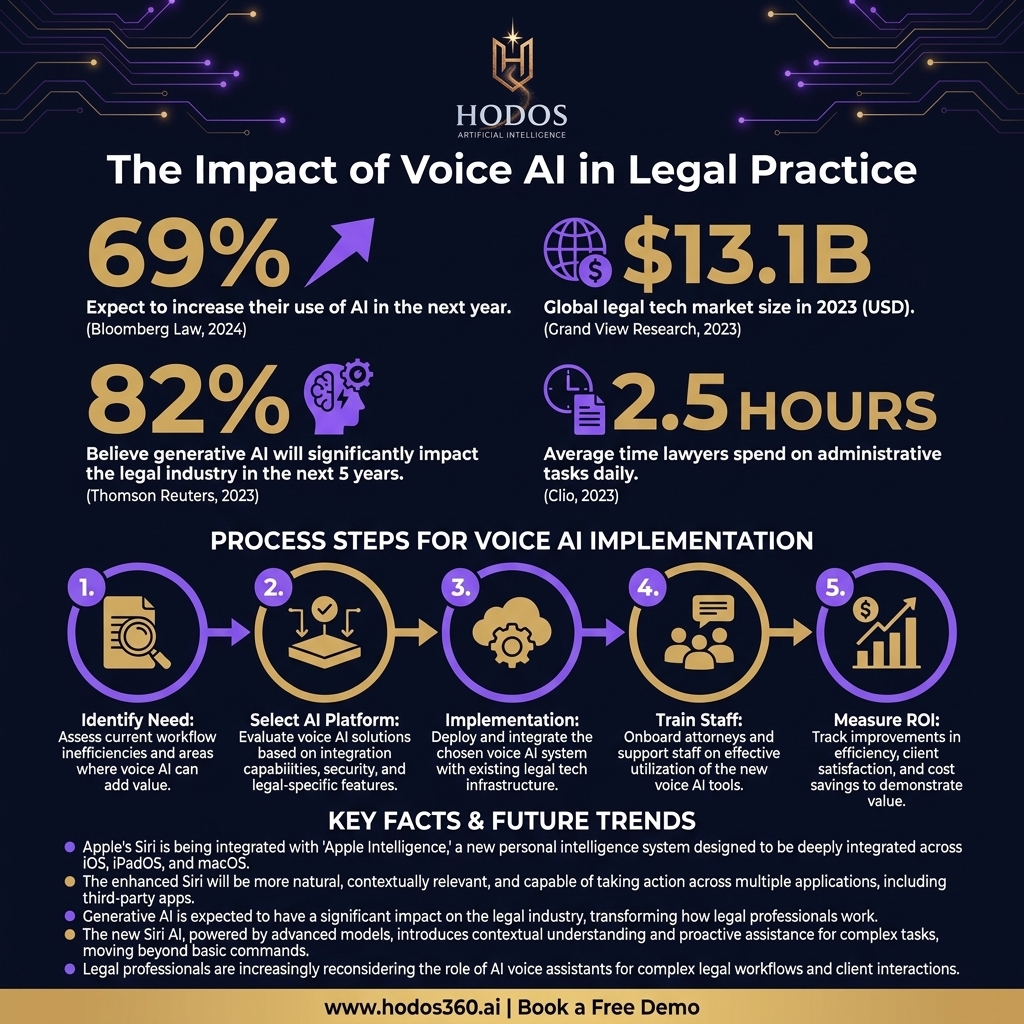
Utilizing third-party voice model services, even those from reputable providers like Apple or Google, necessitates a deep understanding of how data is processed, stored, and secured. Firms must ensure that any AI voice assistant implemented complies with data privacy regulations (e.g., GDPR, CCPA) and that client communications remain privileged and confidential.
This often involves negotiating robust data processing agreements with vendors and ensuring data is processed on-device where possible, as Apple emphasizes with its on-device processing for Siri AI.
Another challenge involves the accuracy and potential for bias in AI systems. While AI voice assistants are becoming increasingly sophisticated, they are not infallible.
Learn more about Ultimate AI in MarTech: Predictive Power for Law Firms. Misinterpretations of complex legal terminology, cultural nuances, or even strong accents could lead to errors in documentation or communication, potentially violating ABA Model Rule 1.1 (Competence). Firms must implement rigorous oversight mechanisms, including human review of AI-generated content and interactions, especially in high-stakes legal matters.
Training and continuous monitoring of the voice model are essential to mitigate these risks. Furthermore, firms must consider the potential for "hallucinations" – instances where the AI generates plausible but incorrect information – and establish clear protocols for verification. Navigating these complexities requires a proactive and informed approach, ensuring that the benefits of AI voice assistants are realized without compromising professional responsibility or client trust.
Real-World Impact: Case Studies of Voice AI in Legal Practice
While the advanced AI voice assistants are relatively new to the legal enterprise, early adopters are already demonstrating tangible benefits and providing valuable insights into best practices. The transition from theoretical potential to practical application is unfolding rapidly, showcasing how sophisticated voice model technology can drive measurable improvements in efficiency, client satisfaction, and overall firm profitability.
These real-world examples serve as compelling evidence that the future of legal practice is inextricably linked with intelligent automation.
Consider the case of "Pro Se Protect," a mid-sized law firm specializing in family law and personal injury. Facing a deluge of after-hours calls and a high volume of initial inquiries that often didn't convert, they implemented an AI voice assistant solution.
Before, their call answer rate after 5 PM was below 30%, and lead qualification was inconsistent. After integrating the AI, powered by a sophisticated voice model that could understand complex queries and route calls intelligently, their after-hours answer rate soared to 95%. The AI assistant was capable of pre-qualifying leads, identifying urgent matters, and even booking appointments directly into the attorneys' calendars.
"We saw a 20% increase in qualified leads converted to clients within the first six months," says David Lee, Pro Se Protect's managing partner. "It's like having an always-on, highly efficient paralegal dedicated solely to client intake, allowing our human staff to focus on billable work.
The AI voice assistant has truly been a game-changer for our growth."
Another compelling example comes from "Global Legal Connect," an international corporate law firm with offices across multiple time zones. They struggled with coordinating client communications and scheduling across diverse regions. Learn more about AI Document Workflows: Revolutionize Your Firm in 2026 for Maximum ROI.
By deploying a multilingual AI voice assistant that integrated with their global calendar and CRM, they significantly streamlined operations. The assistant could handle inquiries in English, Spanish, and Mandarin, booking meetings, providing status updates, and even translating simple requests on the fly. This not only improved client responsiveness but also reduced the administrative burden on their support staff.
"Our partners and clients appreciate the seamless, 24/7 support," explains Maria Rodriguez, CTO of Global Legal Connect. "The AI voice assistant acts as a central communication hub, ensuring that regardless of time zone or language, our clients always feel connected and supported. It’s an entirely new level of service that differentiates us in a competitive market."
These examples underscore a crucial point: the value of AI voice assistants extends far beyond mere cost savings. They enable firms to deliver a superior client experience, enhance operational resilience, and unlock new growth opportunities. The ability to manage a higher volume of interactions with greater precision and speed, coupled with the potential for deeper data insights, positions firms that adopt these technologies at the forefront of legal innovation.
As the capabilities of these platforms continue to expand, driven by advancements from companies like Apple and Google, the gap between tech-forward firms and their traditional counterparts will only widen. The narrative of legal tech is no longer about incremental improvements but about fundamental transformations driven by intelligent automation.

Key Takeaways and Next Steps for Law Firms Embracing Voice AI
The emergence of advanced AI voice assistants, particularly with Apple's new Siri AI signaling a major enterprise push, marks an undeniable turning point for the legal industry. The days of viewing voice technology as a mere novelty are over; it is now an essential component for firms aiming to enhance efficiency, elevate client service, and maintain a competitive edge.
The journey towards integrating these powerful tools into your practice requires strategic planning, a commitment to understanding the technology, and a proactive approach to addressing both opportunities and challenges.
Key Takeaways: * Siri AI's Enterprise Evolution: Apple's enhanced Siri, leveraging powerful voice model technology, is transforming into a sophisticated enterprise application layer, offering more than just basic commands but a truly intelligent assistant for complex workflows.
* Operational Transformation: Advanced AI voice assistants can profoundly streamline law firm operations, from 24/7 client intake and lead qualification to automated scheduling, document population, and hands-free administrative tasks. * Competitive Imperative: Firms adopting these smarter assistants are gaining significant advantages in client acquisition, retention, and overall efficiency, setting a new standard for legal service delivery.
* Ethical Vigilance: Implementing voice AI necessitates careful consideration of data security, client confidentiality (per ABA Model Rule 1.6), and potential biases, requiring robust policies and human oversight. * Strategic Integration: Success hinges on integrating AI voice assistants seamlessly with existing legal tech infrastructure, such as case management systems and document automation tools, to create cohesive and efficient workflows.
* Measurable ROI: Early adopters are reporting tangible benefits, including increased lead conversion, improved client satisfaction, and substantial time savings, underscoring the clear return on investment.
For law firms ready to harness the power of this new enterprise app layer, the next steps are clear.
Begin by assessing your firm's current operational bottlenecks and identifying areas where an AI voice assistant can provide the most immediate impact, such as client intake or administrative support. Research and pilot solutions that offer robust security features, seamless integration capabilities, and a proven track record in the legal sector.
Prioritize vendors that understand the unique demands and ethical obligations of legal practice. Platforms like HODOS 360 offer comprehensive AI Voice Assistants designed specifically for law firms, providing 24/7 phone answering, lead qualification, appointment booking, and multilingual support, all powered by advanced AI. By strategically embracing these innovations, your firm can not only adapt to the future but actively shape it, delivering unparalleled service and achieving sustainable growth in the digital age.
Frequently Asked Questions
Q1: What exactly is Apple's new Siri AI, and how does it differ from the old one?+
A1: Apple's new Siri AI is a profoundly more capable and intelligent voice assistant, moving beyond simple commands to offer contextual understanding and proactive assistance. It leverages advanced large language models, including components from Google's Gemini, and emphasizes on-device processing for enhanced privacy. This allows it to act as a deeper enterprise app layer, integrating with various applications to execute complex, multi-step tasks for legal professionals.
Q2: How can AI voice assistants specifically benefit a law firm's client intake process?+
A2: AI voice assistants can revolutionize client intake by providing 24/7 phone answering, ensuring no potential lead is missed. They can intelligently qualify leads, gather essential client information, answer common FAQs, and even book appointments directly into the firm's calendar. This automation frees up human staff, improves responsiveness, and enhances the overall client experience from the very first interaction, leading to higher conversion rates.
Q3: What are the main ethical and data security concerns when using voice AI in legal practice?+
A3: The primary concerns include client confidentiality (ABA Model Rule 1.6), data privacy, and the accuracy/bias of AI systems. Firms must ensure that AI voice assistants comply with privacy regulations, that client data is processed securely, and that communications remain privileged. Human oversight is crucial to verify AI-generated content and mitigate potential errors or biases, upholding professional competence (ABA Model Rule 1.1).
Q4: Can AI voice assistants help with document automation in law firms?+
A4: Yes, absolutely. AI voice assistants can integrate with document automation platforms, allowing legal professionals to verbally command the creation and population of legal documents. They can extract relevant information from case notes or client intake forms and accurately insert it into pre-approved templates for contracts, filings, and other legal documents, significantly reducing manual data entry and improving efficiency and accuracy.
Q5: What kind of ROI can law firms expect from implementing advanced voice AI?+
A5: Law firms can expect a significant ROI from implementing advanced AI voice assistants. This includes increased lead conversion rates due to 24/7 availability and efficient qualification, substantial time savings from automating administrative tasks and document generation, and improved client satisfaction through enhanced responsiveness. Reduced overhead costs and the ability to scale operations without increasing headcount also contribute to a strong financial return.