


Siri AI Evolution: Ultimate Guide for Law Firms
For years, the promise of a truly intelligent voice assistant has hovered just out of reach for many, particularly in specialized professional domains like law. While consumer-grade voice AI like Apple's Siri has offered convenience for setting reminders or checking weather, its application in the rigorous, privacy-sensitive, and highly nuanced legal sector has been largely superficial.
This narrative, however, is on the cusp of a dramatic rewrite. Following persistent rumors and now concrete reports, Apple is relaunching Siri, integrating it deeply with a new, powerful framework dubbed Apple Intelligence. This isn't merely a cosmetic update or a minor feature bump; it represents a foundational shift, promising a generation of AI capabilities that could fundamentally change how legal professionals operate.
The implications for law firms are profound, extending far beyond the consumer experience. Imagine a voice assistant capable of not just scheduling a meeting, but intelligently understanding the context of a client's case, drafting initial client intake forms based on a phone conversation, or even navigating complex legal databases with verbal commands.
This level of sophisticated interaction, once relegated to science fiction, is rapidly becoming a reality. The competitive landscape for law firms is intensifying, with early adopters of advanced AI tools gaining significant advantages. Those who embrace this new generation of Siri AI and integrate it with purpose-built legal platforms will be best positioned to deliver unparalleled efficiency and client service, leaving firms tethered to traditional methods struggling to keep pace.
The journey from a simple digital assistant to a strategic legal ally is now underway, driven by Apple's renewed commitment to pushing the boundaries of artificial intelligence.
This pivotal moment, marked by Apple's significant investment in its AI infrastructure and the highly anticipated redesign of Siri AI, necessitates a deep dive for legal professionals.
The shift from a reactive, command-driven assistant to a proactive, context-aware intelligence engine will reshape workflows, client interactions, and even the very design of legal service delivery. Law firm leaders like Sarah Chen, managing partner at Chen & Associates, have long advocated for AI solutions that genuinely understand legal context, stating at LegalTech NYC 2026, "The real game-changer isn't just automation, but intelligent automation that anticipates our needs and understands the nuances of legal language."
This article will explore the transformative potential of the relaunched Siri AI for law firms, examining how it can be leveraged to enhance every facet of legal practice, from client intake and case management to operational efficiency, while also addressing the critical considerations of data privacy and ethical implementation.
The New Generation of Siri AI: What Law Firms Need to Know
The announcing of Apple's reimagined Siri AI, deeply integrated with its overarching Apple Intelligence framework, marks a pivotal moment for technology adoption in the legal sector. This isn't just an aesthetic refresh, though reports indicate a significant visual design overhaul, with new colors and a sophisticated interface that is nearly identical across devices, from iPhone to macOS.
The true power lies beneath the surface, in the enhanced contextual understanding and proactive capabilities driven by on-device and cloud-based large language models. This new generation of Siri AI is engineered to learn from user interactions, predict needs, and execute multi-step commands with unprecedented accuracy.
For law firms, this translates into a potential digital assistant that can move beyond simple dictation to genuinely assist with complex legal tasks, understanding the specialized terminology and procedural intricacies that define legal work. The shift in Apple's strategy, moving from a general-purpose assistant to one that can be deeply personalized and integrated with professional applications, is a direct response to the growing demand for intelligent automation across industries, including law.
This advanced intelligence means Siri AI can now process and synthesize information from various sources, including emails, documents, and calendar entries, to provide more relevant and timely assistance. For instance, a lawyer could verbally request a summary of communications related to a specific client matter, and Siri AI could pull data from their firm's case management system, email archives, and document repositories, presenting a concise overview.
This level of data aggregation and intelligent summarization is a significant leap from previous iterations. Craig Federighi, Apple's Senior Vice President of Software Engineering, emphasized at a recent press briefing, "Our goal was to deliver an intelligence that feels intuitive, personal, and profoundly helpful, extending its utility into every aspect of professional life."
The enhanced security protocols, a cornerstone of Apple's ecosystem, also mean that much of this processing can occur on-device, addressing some of the critical data privacy concerns often raised by legal professionals regarding cloud-based AI solutions. This on-device processing capability is a key differentiator, offering a layer of confidentiality essential for legal data.
The strategic importance of this relaunch for law firms cannot be overstated. With the new Siri AI, attorneys and legal staff can anticipate a more seamless integration of voice commands into their daily workflows. Learn more about AI Website Builder: Strategic Insights for Law Firms.
Imagine dictating a complex legal brief, not just word-for-word, but instructing the AI to reference specific statutes, pull relevant case precedents, and even format citations according to court rules. This goes far beyond the capabilities of even the most sophisticated legal dictation software. The ability of the new Siri AI to understand nuanced legal questions and provide contextually appropriate responses could significantly reduce the time spent on administrative tasks and preliminary research, freeing up valuable billable hours.
This shift in capability means law firms must now seriously re-evaluate their technology stack and consider how this powerful new tool can be integrated to maximize efficiency and elevate service delivery. The era of the truly intelligent legal assistant, accessible through a familiar interface, is no longer a distant future but an immediate reality demanding attention and strategic planning.
Furthermore, the improved natural language processing (NLP) capabilities of the new generation of Siri AI mean that interactions will feel less like giving commands to a machine and more like conversing with a knowledgeable assistant. This enhanced conversational fluidity is crucial for legal environments where precise language and nuanced understanding are paramount.
The system is designed to learn from a user’s communication style and preferences, becoming more efficient and personalized over time. This adaptive learning is particularly beneficial in a legal context, where individual attorneys often have specific drafting styles or preferred research methodologies. The new Siri AI can adapt to these individual needs, making it an invaluable tool for personalized legal support.
As Dario Amodei, CEO of Anthropic, highlighted in a recent interview, the future of AI lies in its ability to be both powerful and deeply personal, a vision Apple appears to be pursuing with its Apple Intelligence framework.
Beyond Consumer Convenience: Enterprise-Grade Voice for Legal
While the consumer applications of the relaunched Siri AI will undoubtedly garner significant attention, its true disruptive potential for the legal industry lies in its capacity to evolve into an enterprise-grade voice assistant. The legal sector demands more than just convenience; it requires robust security, unimpeachable data privacy, and an exacting level of accuracy that traditional consumer AI often struggles to deliver.
The new generation of Siri AI, with its on-device processing capabilities and tighter integration with professional software, begins to address these critical requirements. However, raw AI power alone isn't sufficient. Law firms must look to specialized platforms that can harness this foundational technology and tailor it to the unique demands of legal practice, ensuring compliance with strict regulatory frameworks and ethical obligations.
This means moving beyond generic voice commands to systems that understand legal jargon, client confidentiality, and the intricacies of case management.
Integrating the advanced capabilities of Siri AI into a legal context involves significant considerations for data governance and client confidentiality. Learn more about AI to Create a Website: The Ultimate Guide for Law Firms.
The report from the ABA's Legal Technology Resource Center frequently emphasizes that while AI offers immense promise, ethical deployment, particularly concerning sensitive client data, remains paramount. Firms must ensure that any voice AI solution, even one powered by sophisticated Apple Intelligence, adheres to the same stringent data security protocols as their other digital tools.
This includes encryption, access controls, and compliance with regulations such as the Health Insurance Portability and Accountability Act (HIPAA) for healthcare-related legal practices, or the European Union's General Data Protection Regulation (GDPR) for international firms. The development of specialized legal AI platforms like HODOS 360’s AI Voice Assistants is precisely designed to bridge this gap, providing the necessary layers of security and compliance atop powerful foundational AI models, ensuring that the benefits of voice technology can be safely and ethically realized within a legal context.
This specialized approach guarantees that the convenience of voice interaction doesn't come at the cost of professional responsibility.
Transforming Client Intake and Communication with Advanced Voice AI
The initial point of contact with a potential client is often the most critical, setting the tone for the entire legal relationship. Here, the enhanced capabilities of Siri AI, when integrated with a specialized legal platform, promise to be a true game-changer. Traditional client intake processes can be cumbersome, requiring manual data entry, multiple phone calls, and often, delays that can frustrate potential clients.
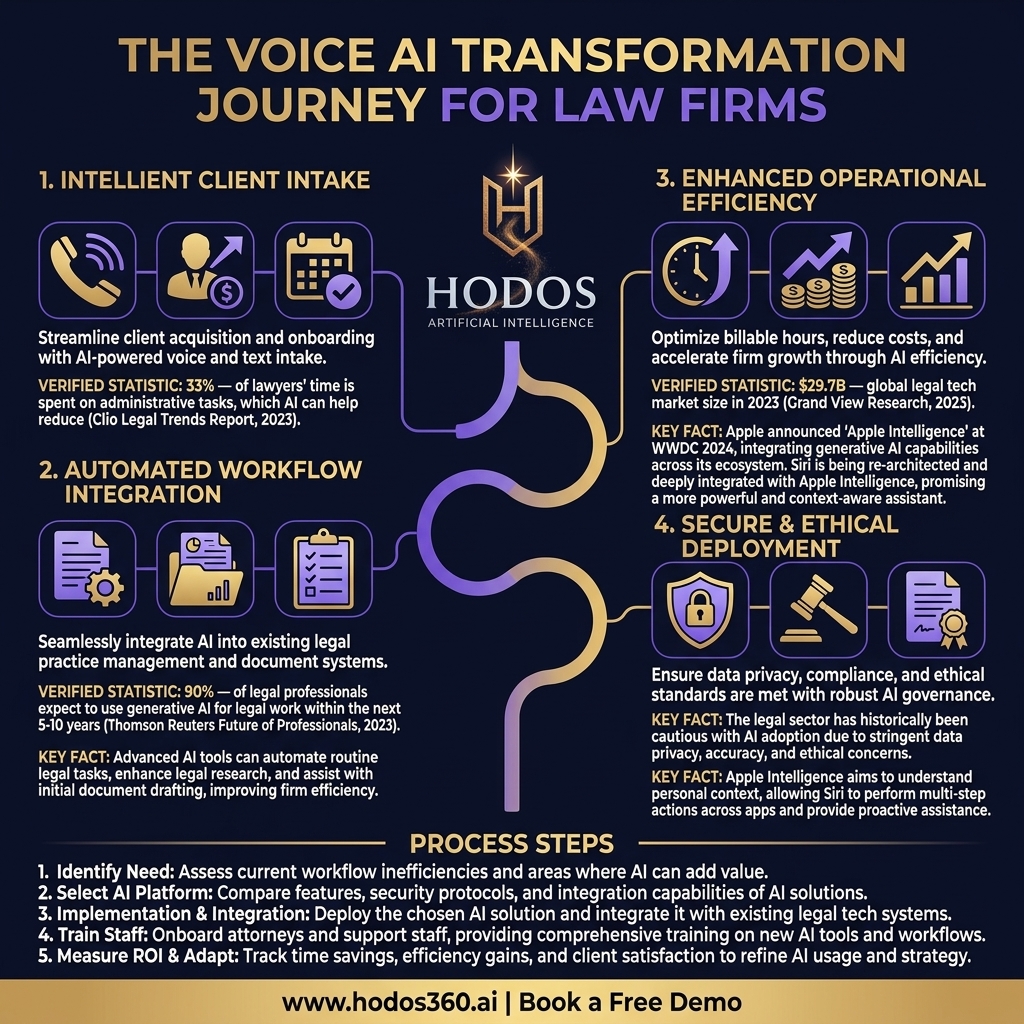
With the new generation of Siri AI, firms can deploy intelligent voice assistants capable of 24/7 phone answering, ensuring no lead is missed. These AI Voice Assistants can conduct initial lead qualification with remarkable accuracy, asking targeted questions to ascertain the nature of the inquiry, the urgency, and basic client information.
This immediate, intelligent response drastically improves the client experience, particularly for individuals seeking legal help during off-hours or in urgent situations.
Beyond simple answering, the advanced natural language understanding of Siri AI enables these voice assistants to engage in more sophisticated conversations. They can guide callers through a series of questions, capturing essential details for case pre-screening, explaining service offerings, and even handling preliminary appointment booking directly into the firm’s calendar system.
The multilingual support capabilities, a feature Apple has consistently improved, mean that law firms can effortlessly serve a broader demographic, breaking down language barriers that might otherwise deter potential clients. This seamless, intelligent interaction from the very first touchpoint not only enhances client satisfaction but also significantly streamlines the workload for administrative staff, allowing them to focus on more complex tasks.
A report from Clio's 2023 Legal Trends Report indicated that firms leveraging automation in client intake saw a 20% increase in new client conversions, underscoring the tangible benefits of such technological adoption.
Consider the competitive advantage this offers. Learn more about AI-Powered Web Development: Essential SaaS Optimization for Law Firms.
While some firms still rely on voicemail or outsourced answering services, firms leveraging next-generation Siri AI integration can offer an immediate, intelligent, and personalized experience. This isn't just about answering calls; it's about providing an initial consultation experience that feels both human and highly efficient.
For example, a prospective client calling about a personal injury claim could be guided by the voice assistant to provide details about the incident, gather contact information, and even schedule an initial consultation with the appropriate attorney, all without human intervention until the lawyer is ready to review the pre-qualified lead.
This level of automation, powered by robust Apple Intelligence, ensures that attorneys receive well-vetted leads, complete with preliminary information, allowing them to prepare more effectively for initial meetings and significantly reducing conversion time.
Moreover, the capacity for sentiment analysis, a burgeoning feature within advanced AI, could allow voice assistants to gauge a caller's emotional state and route urgent or distressed calls to human agents immediately.
This blend of AI efficiency and human empathy is crucial in the legal field. The new Siri AI capabilities can be configured to capture specific keywords and phrases relevant to legal practice areas, ensuring that critical information is never missed. This precision in data capture is vital for legal intake, where every detail can be significant.
Firms that embrace this technology, like those utilizing HODOS 360’s AI Voice Assistants, are not just adopting a tool; they are redefining their client acquisition strategy, ensuring they are always available, always intelligent, and always prepared to deliver exceptional service from the very first interaction.
This strategic adoption positions them at the forefront of legal innovation, attracting and retaining clients in an increasingly competitive market.
- ✓24/7 Availability: Ensure no potential client call is missed, regardless of time zones or office hours, maximizing lead capture.
- ✓Intelligent Lead Qualification: AI-powered voice assistants ask targeted questions to pre-qualify leads, saving attorney time and focusing efforts on high-potential cases.
- ✓Automated Appointment Booking: Seamlessly schedule consultations directly into firm calendars, reducing administrative overhead and client friction.
- ✓Multilingual Support: Break down language barriers, allowing firms to serve a diverse client base and expand market reach.
- ✓Enhanced Client Experience: Provide immediate, professional, and personalized interactions from the first touchpoint, fostering trust and satisfaction.
- ✓Efficient Call Routing: Direct calls to the most appropriate department or attorney based on client needs and urgency, optimizing internal resource allocation.
- ✓Data-Driven Insights: Capture valuable data from client interactions, providing insights into common queries, lead sources, and service demand.
The Imperative of Specialized Legal Voice Assistants
While Apple's advancements in Siri AI and Apple Intelligence are undeniably impressive, the legal industry's unique demands necessitate more than a general-purpose voice assistant. The complexities of legal language, the stringent requirements for data security and confidentiality, and the ethical obligations inherent in legal practice mean that off-the-shelf solutions often fall short.
Generic voice AI, while capable of understanding everyday commands, frequently struggles with legal jargon, statutory references, and the nuanced context of case law. For instance, a simple request to "find all precedents on tort reform" requires an understanding of specific legal databases, jurisdictional variations, and the ability to distinguish between different types of legal documents, a task far beyond the scope of a standard consumer AI.
This is where specialized legal voice assistants, built upon powerful foundational AI like the new Siri AI but specifically trained on legal datasets, become not just beneficial, but imperative.
These specialized legal voice assistants are designed to integrate seamlessly with a firm's existing legal tech ecosystem, including case management systems, billing software, and document automation platforms.
They are trained on vast corpora of legal texts, including statutes, regulations, judicial opinions, and legal scholarship, enabling them to understand and process legal information with a high degree of accuracy and contextual relevance. For example, a specialized voice assistant could be instructed to "draft a motion to compel discovery, referencing the relevant Federal Rules of Civil Procedure and our firm's standard template."
This level of specific, action-oriented legal automation is what truly transforms daily operations. Sam Altman, CEO of OpenAI, has often spoken about the need for domain-specific AI, stating, "General intelligence is powerful, but true impact comes when that intelligence is applied and refined for specific industries and their unique problems."
This perspective underscores why law firms must seek out solutions that tailor general AI capabilities to their particular needs.
Furthermore, the ethical considerations surrounding AI in legal practice are profound. The American Bar Association's Model Rules of Professional Conduct, particularly Rule 1.6 on Confidentiality of Information and Rule 1.1 on Competence, place significant obligations on attorneys regarding the use of technology.
Using a generic voice AI that might inadvertently store client data on insecure servers or misinterpret sensitive information poses substantial risks. Learn more about Low-Code No-Code AI: Transformative Tools for Law Firms. Specialized legal voice assistants are built with these ethical frameworks in mind, incorporating features like secure, encrypted data handling, compliance with data residency requirements, and audit trails for AI interactions.
They are designed to assist, not replace, human judgment, providing tools that augment an attorney's capabilities while respecting professional responsibilities. Firms must perform due diligence to ensure any AI solution aligns with these ethical mandates, safeguarding client interests and maintaining professional integrity.
The development and adoption of such specialized platforms are critical for law firms looking to fully leverage the advancements in Siri AI without compromising their professional obligations.
These platforms provide the necessary guardrails and domain-specific intelligence that transform a general-purpose tool into a trusted legal asset. Without this specialization, the promise of advanced voice AI in the legal sector remains largely unfulfilled, limited by the inherent generalities of consumer technology. The investment in a specialized solution is an investment in ethical, efficient, and future-proof legal practice, ensuring that the firm remains compliant and competitive.
For instance, a firm might use a specialized voice assistant to quickly find an obscure ruling from the U.S. Court of Appeals for the Ninth Circuit, a task that would be nearly impossible for a generic voice AI but routine for one trained on legal databases.
Navigating Data Privacy and Ethical AI in Voice Interactions
The integration of advanced Siri AI into legal workflows, while offering unprecedented efficiencies, also introduces critical challenges related to data privacy and ethical AI deployment. Law firms handle some of the most sensitive and confidential information, making robust data security non-negotiable. The European Union's AI Act, set to be fully enforced in the coming years, provides a comprehensive framework for AI governance, emphasizing transparency, accountability, and the protection of fundamental rights.
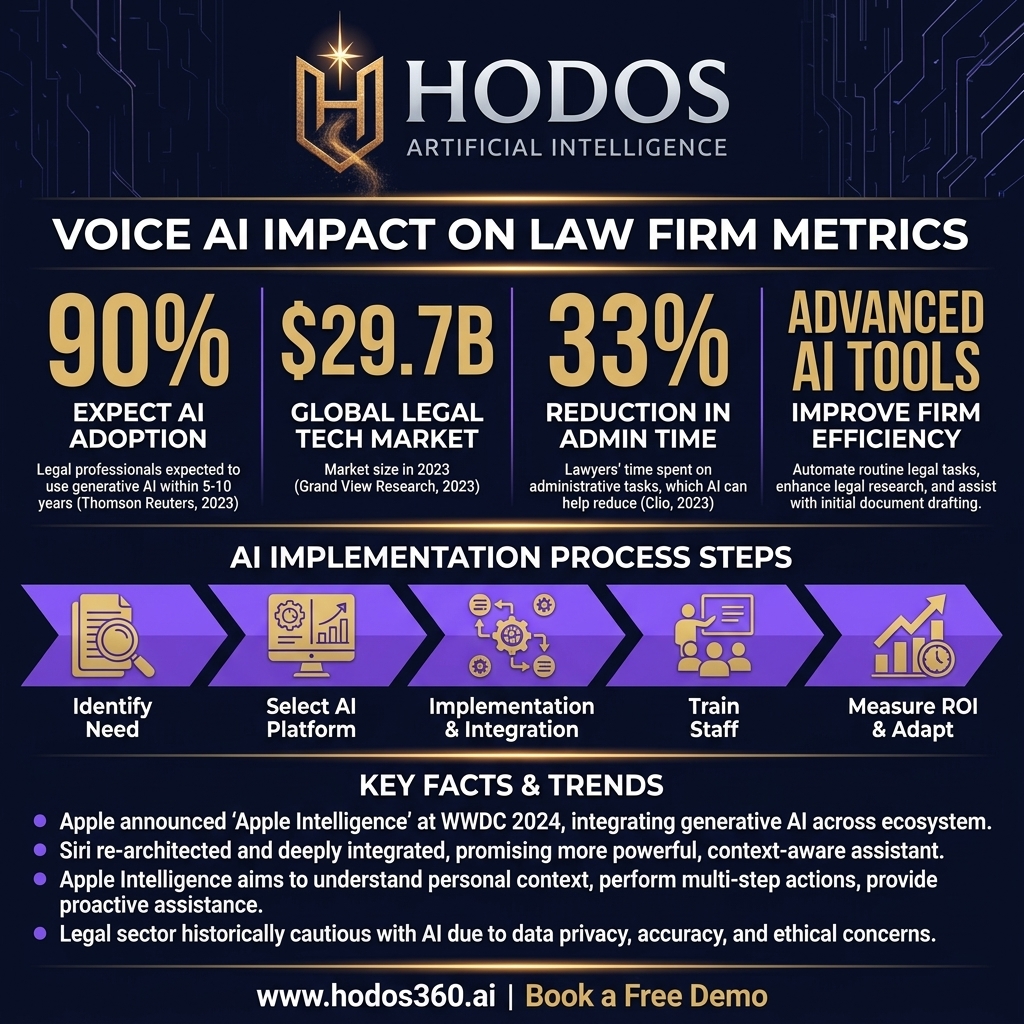
While this legislation directly impacts firms operating within the EU, its principles are rapidly becoming a global benchmark for responsible AI use. Firms must ensure that any voice AI solution, regardless of its underlying Apple Intelligence, adheres to these evolving regulatory landscapes, particularly concerning how voice data is collected, processed, stored, and secured.
This means scrutinizing vendor practices, understanding data flow architectures, and implementing clear consent mechanisms for clients interacting with AI voice assistants.
Beyond regulatory compliance, firms must also consider the ethical implications of using AI in client interactions. The potential for bias in AI, even in advanced systems, is a well-documented concern.
Learn more about Legal AI Trust: An Essential Guide for Law Firms. Voice recognition technologies can sometimes exhibit biases related to accents, dialects, or speech patterns, potentially leading to misinterpretations or discriminatory outcomes. Firms must implement rigorous testing and oversight mechanisms to mitigate such risks, ensuring equitable and fair treatment for all clients.
Furthermore, the question of attorney-client privilege in AI-mediated communications requires careful consideration. The ABA Standing Committee on Ethics and Professional Responsibility has issued guidance on the use of technology, emphasizing the attorney's duty to maintain confidentiality and competence. Firms leveraging voice AI must develop clear internal policies and provide adequate training to ensure that the technology is used in a manner consistent with these professional obligations.
The goal is to harness the power of AI while upholding the foundational principles of justice and client advocacy, ensuring that the generation of AI tools serves, rather than compromises, the integrity of the legal profession.
Operational Efficiency: Automating Legal Workflows with Siri AI Integration
Beyond client-facing applications, the enhanced Siri AI capabilities, when integrated into a comprehensive legal management system, hold immense potential for revolutionizing internal operational efficiency. Imagine a world where attorneys and paralegals can manage their caseloads, schedule appointments, and even initiate document creation with simple voice commands, all powered by the new generation of Apple Intelligence.
This goes far beyond basic calendar reminders; it encompasses sophisticated task automation, intelligent document retrieval, and streamlined communication within the firm. For instance, an attorney could verbally instruct their system to "add a new task to the 'Smith v. Jones' case for drafting interrogatories, due next Friday," and the system, integrated with their case management software, would automatically create the task, assign it, and link it to the relevant matter.
This level of proactive, intelligent assistance drastically reduces the time spent on administrative overhead, allowing legal professionals to focus on high-value, billable work.
Document automation, a cornerstone of modern legal practice, receives a significant boost with advanced voice AI integration. Attorneys can initiate the drafting of common legal documents—from engagement letters to standard pleadings—by simply stating their requirements.
The voice assistant, leveraging the underlying Apple Intelligence, can pull relevant client data, populate templates, and even suggest clauses based on the context of the case. This not only accelerates document creation but also minimizes errors inherent in manual data entry. A report by Gartner projected that by 2027, generative AI will automate 70% of routine legal tasks, significantly impacting legal productivity.
Firms that embrace this voice-first approach to document automation, ensuring the design of their workflows accommodates this new interaction paradigm, will see substantial gains in productivity and cost savings. Learn more about AI Voice Assistants: Essential Balance for Law Firms. This efficiency gain is not just incremental; it’s transformative, allowing firms to handle a higher volume of cases without proportionally increasing staff, directly impacting profitability.
Furthermore, the integration of Siri AI with firm-wide communication platforms can foster a more collaborative and responsive work environment. Attorneys can dictate memos, update team members on case progress, or request information from colleagues, all through voice commands. The system can intelligently transcribe, summarize, and route these communications, ensuring that critical information reaches the right people at the right time.
The ability to quickly retrieve case files, research notes, or client correspondence using natural language queries, even from a mobile device running iOS or a desktop on macOS, means that legal professionals have instant access to the information they need, wherever they are. This omnipresent access, driven by the powerful generation of Siri AI, enhances agility and responsiveness, crucial attributes in today's fast-paced legal landscape.
The competitive advantage of being able to quickly access and act on information is undeniable, and voice AI is poised to deliver this.
The strategic adoption of voice AI for operational efficiency is not just about adopting new tools; it's about reimagining the entire workflow of a law firm.
Firms like Allen & Overy, known for their innovative approach to legal tech, have already begun exploring advanced AI integrations, with their partnership with Harvey AI setting a precedent for leveraging sophisticated models to augment legal research and drafting. The new Siri AI provides a more accessible entry point for firms of all sizes to tap into similar efficiencies.
By integrating these advanced voice capabilities with comprehensive legal management systems, firms can automate routine tasks, streamline communication, and empower their legal professionals to focus on strategic thinking and client advocacy. This is the essence of smart growth: leveraging technology to amplify human talent, ensuring the firm is not just productive, but truly innovative in its service delivery, moving towards a future where the design of legal work is inherently more efficient and intelligent.
The Future of Legal Practice: A Voice-First Approach
The vision for the future of legal practice increasingly points towards a voice-first approach, where interactions with technology are as natural and intuitive as human conversation. The advancements in Siri AI, particularly its deep integration with Apple Intelligence, are accelerating this transition. Imagine a legal office where attorneys navigate complex case files, dictate nuanced legal arguments, and manage their schedules without ever touching a keyboard or mouse.
This isn't about replacing human interaction; it's about augmenting it, freeing legal professionals from repetitive, mundane tasks and allowing them to dedicate more time to strategic thinking, client counseling, and courtroom advocacy. This new generation of voice AI promises to reshape the daily lives of lawyers, making legal practice more efficient, less prone to administrative errors, and ultimately, more fulfilling.
The shift from a screen-centric workflow to a voice-centric one represents a fundamental change in human-computer interaction, one that is particularly well-suited for the demanding, multi-tasking environment of a law firm.
This future is not just about convenience; it's about competitive necessity. As the legal market becomes increasingly saturated and client expectations for efficiency and responsiveness grow, firms that embrace innovative technologies like advanced voice AI will gain a significant edge.
The ability to rapidly process information, automate routine tasks, and provide seamless client service will differentiate leading firms. Jensen Huang, CEO of NVIDIA, has often spoken about the transformative power of accelerated computing and AI, stating, "Every industry will be supercharged by AI." The legal sector is no exception.
Firms that proactively adopt and integrate these technologies will not only improve their bottom line but also enhance their reputation as forward-thinking and client-centric. This strategic adoption, leveraging the power of Siri AI within a robust legal tech framework, is crucial for staying relevant and thriving in the evolving legal landscape.
The design of future legal services will undoubtedly feature voice AI prominently, making it an indispensable tool for every legal professional.

Key Takeaways and Charting Your Firm's Voice AI Strategy
Apple's relaunch of Siri AI, powered by the groundbreaking Apple Intelligence framework, marks a significant inflection point for the legal industry. This new generation of voice AI moves beyond simple commands to offer sophisticated, context-aware assistance that can fundamentally change how law firms operate. From transforming client intake and communication to streamlining internal workflows and enhancing operational efficiency, the potential for impact is immense.
Firms that proactively engage with these advancements, understanding both the opportunities and the ethical considerations, will be best positioned to thrive in an increasingly competitive landscape. The emphasis on on-device processing and robust security protocols within Apple's new design for Siri AI addresses many of the initial hesitations legal professionals had regarding data privacy with general AI solutions, making this a more viable and attractive option for integration.
For law firm owners and attorneys, the path forward involves a strategic evaluation of how advanced voice AI can be integrated into their existing technology stack. This is not about a wholesale replacement of current systems but rather an intelligent augmentation. Start by identifying pain points in client intake, administrative tasks, or internal communication that could benefit most from voice automation.
Explore specialized legal tech platforms that can harness the power of foundational AI, like Siri AI, and tailor it to the unique demands of legal practice. Platforms such as HODOS 360 offer a suite of AI-powered services, including AI Voice Assistants, specifically designed to meet the rigorous demands of law firms, ensuring secure, compliant, and highly efficient integration.
This comprehensive approach ensures that the firm can fully leverage the capabilities of the new generation of Siri AI to deliver superior results for both clients and internal operations.
Ultimately, the future of legal practice is intertwined with intelligent automation. The legal professionals who embrace this new era, leveraging tools like the relaunched Siri AI within a secure and specialized framework, will not only enhance their firm's efficiency and profitability but also elevate the quality of legal service they provide.
The time to assess, plan, and integrate advanced voice AI is now, ensuring your firm is prepared to navigate and lead in this exciting new generation of legal technology. The competitive landscape is evolving rapidly, and staying ahead means embracing the intelligent tools that are set to redefine legal workflows on iPhone, macOS, and beyond.
Don't let your firm be left behind; seize the opportunity to innovate and transform your practice with the power of voice AI.
Frequently Asked Questions
How will the relaunched Siri AI specifically benefit law firms?+
The relaunched Siri AI, powered by Apple Intelligence, offers significant benefits by enhancing contextual understanding and proactive capabilities. For law firms, this means streamlined client intake with 24/7 intelligent answering, automated appointment booking, and efficient lead qualification. Internally, it can automate routine tasks like document drafting, calendar management, and information retrieval, freeing up attorneys for high-value work and improving overall operational efficiency.
What is 'Apple Intelligence' and how does it relate to Siri AI?+
Apple Intelligence is Apple's new overarching AI framework that deeply integrates into iOS, iPadOS, and macOS. It powers the next generation of Siri AI, providing enhanced contextual awareness, personalization, and advanced generative AI capabilities. This framework allows Siri to understand complex queries, perform multi-step actions, and learn from user interactions, making it far more powerful and useful for professional applications than previous iterations.
Are there data privacy concerns for law firms using advanced voice AI like Siri?+
Yes, data privacy is a paramount concern for law firms. While Apple's new Siri AI emphasizes on-device processing and robust security, specialized legal AI platforms are crucial to ensure compliance with regulations like GDPR, HIPAA, and attorney-client privilege. Firms must carefully vet AI solutions, implement clear consent mechanisms, and ensure data handling practices align with ethical obligations and professional conduct rules to safeguard sensitive client information.
How can law firms integrate Siri AI with their existing legal tech systems?+
Law firms can integrate advanced Siri AI by leveraging specialized legal tech platforms designed for this purpose. These platforms act as a bridge, connecting Siri's foundational AI capabilities with existing case management, billing, and document automation systems. This allows for voice-activated workflows, intelligent data retrieval, and automated task management, ensuring seamless operation within the firm's established digital ecosystem while maintaining security and compliance.
What ethical considerations should law firms keep in mind when adopting voice AI?+
Ethical considerations include maintaining client confidentiality (ABA Model Rule 1.6), ensuring competence in technology use (ABA Model Rule 1.1), and addressing potential biases in AI. Firms must implement robust oversight, conduct thorough testing to mitigate bias, and establish clear policies for AI interaction. The goal is to use voice AI to augment legal practice responsibly, upholding professional standards and ensuring fair, equitable service delivery.