


Voice AI: Essential Guide to Scaling Safely for Law Firms
Just a few years ago, the idea of an AI answering a law firm's phones, qualifying leads, and even booking appointments felt like science fiction. Yet, today, this is the reality for forward-thinking legal practices. Consider the story of Eleanor Vance, a managing partner at a mid-sized litigation firm in Dallas, who, just last year, faced a critical challenge: a surging influx of potential client inquiries that routinely overwhelmed her administrative team.
Calls were missed, leads went cold, and the firm’s growth felt bottlenecked by human capacity. Vance recounted, "We were leaving money on the table, and worse, potentially letting clients in distress slip through the cracks simply because we couldn't answer every call promptly." This common scenario underscores the pressing need for scalable, intelligent solutions in an increasingly competitive legal landscape.
The conversation around enterprise voice AI, once confined to tech giants, is now a crucial boardroom discussion for law firms aiming for sustained growth and superior client experience.
The recent article from The AI Journal, "How to Scale Enterprise Voice AI Safely: Implementation, Governance, and Best Practices," resonates deeply within the legal sector.
It highlights that while the promise of voice AI is immense—offering 24/7 client engagement, multilingual support, and efficient call routing—its deployment comes with significant ethical, security, and operational considerations. For law firms, where confidentiality and trust are paramount, merely adopting new technology isn't enough; it must be done with meticulous planning and robust safeguards.
The stakes are high: the ability to transform client intake and service delivery without compromising the fundamental duties of legal professionals. Firms like Vance's are seeking a clear, actionable guide to leverage this transformative technology responsibly, ensuring that innovation aligns seamlessly with their professional obligations and client expectations.
This guide aims to demystify the process, offering a comprehensive roadmap for legal leaders.
The Untapped Potential of Voice AI in Legal Services
The legal industry, traditionally conservative in its technological adoption, is now experiencing a profound shift driven by artificial intelligence. Voice AI stands out as a particularly impactful innovation, poised to redefine how law firms manage client interactions and internal operations. According to a McKinsey & Company 2024 report on AI in professional services, firms adopting AI tools are projected to see a 25-30% increase in operational efficiency within five years.
This isn't just about answering phones; it's about intelligent lead qualification, seamless appointment booking, and providing immediate, multilingual support to a diverse client base. Imagine a prospective client calling after hours, receiving not a voicemail, but an intelligent voice assistant that can gather preliminary case details, check for conflicts of interest, and schedule a consultation for the next morning.
This capability significantly reduces friction in the client intake process, a notorious bottleneck for many firms.
Beyond initial contact, voice AI can transform routine client queries. Learn more about Essential AI Web Development: Harvard's Free Courses for Law Firms. Instead of administrative staff spending valuable time answering frequently asked questions about billing, case status updates, or document requirements, a sophisticated voice assistant can provide instant, accurate information, freeing up human resources for more complex legal tasks.
Legal tech leaders like Jack Newton, CEO of Clio, have consistently emphasized the importance of client-centered technology, noting at LegalTech NYC 2026 that "the future of legal services hinges on making legal help more accessible and client interactions more seamless." While Clio has focused on practice management, the logical next step for integrated legal tech is extending AI directly to client communication channels.
This evolution allows firms to maintain a high standard of responsiveness, significantly impacting client satisfaction and retention, while also empowering attorneys to focus on core legal work rather than administrative overhead. The strategic adoption of voice AI is no longer a luxury but a competitive imperative for firms looking to scale and innovate.
Navigating the Complexities: Implementation Strategies for Enterprise Voice AI in Law Firms
Implementing enterprise voice AI in a legal environment presents unique challenges that require a strategic, phased approach. Unlike generic customer service applications, legal voice AI must integrate deeply with existing case management systems, billing platforms, and client relationship management (CRM) tools. The initial phase involves a thorough assessment of current workflows and identifying pain points where voice AI can deliver the most significant impact.
For instance, Greenberg Traurig, a firm known for its measured approach to technology, has historically emphasized robust due diligence before adopting new platforms, a strategy that is particularly apt for AI. Their internal tech teams focus on ensuring new tools enhance, rather than disrupt, their established legal processes.
This meticulous planning is crucial to avoid common pitfalls like data siloing or system incompatibility, which can undermine the investment in AI technology.
Furthermore, successful implementation hinges on change management and user adoption. Attorneys and staff, accustomed to traditional communication methods, may initially be hesitant or skeptical.
Learn more about AI Legal CRM: Essential Strategies for Exposed Firm Data. Providing comprehensive training, demonstrating the clear benefits, and involving key stakeholders in the pilot phases can mitigate resistance. Firms should consider starting with less sensitive, high-volume tasks, such as initial client screening or appointment setting, before expanding to more complex interactions.
This incremental rollout allows for continuous feedback, refinement of the AI's natural language processing (NLP) capabilities, and gradual acclimatization of the human team. The goal is to create a symbiotic relationship where voice AI augments human capabilities, rather than replacing them, fostering a culture of innovation and efficiency within the firm.
HODOS 360’s integrated AI Law Firm Management System can provide a foundational platform for such seamless integration, ensuring that voice AI solutions communicate effectively with your firm’s core operational tools.
Phased Rollout and User Adoption
A crucial element of safe and effective AI deployment is a structured phased rollout. This involves deploying the voice AI system in stages, starting with a limited scope or specific department, gathering user feedback, and iteratively improving the system before a broader launch. This approach was heavily discussed at the recent LegalTech NYC 2026 conference, where experts like **Dr.
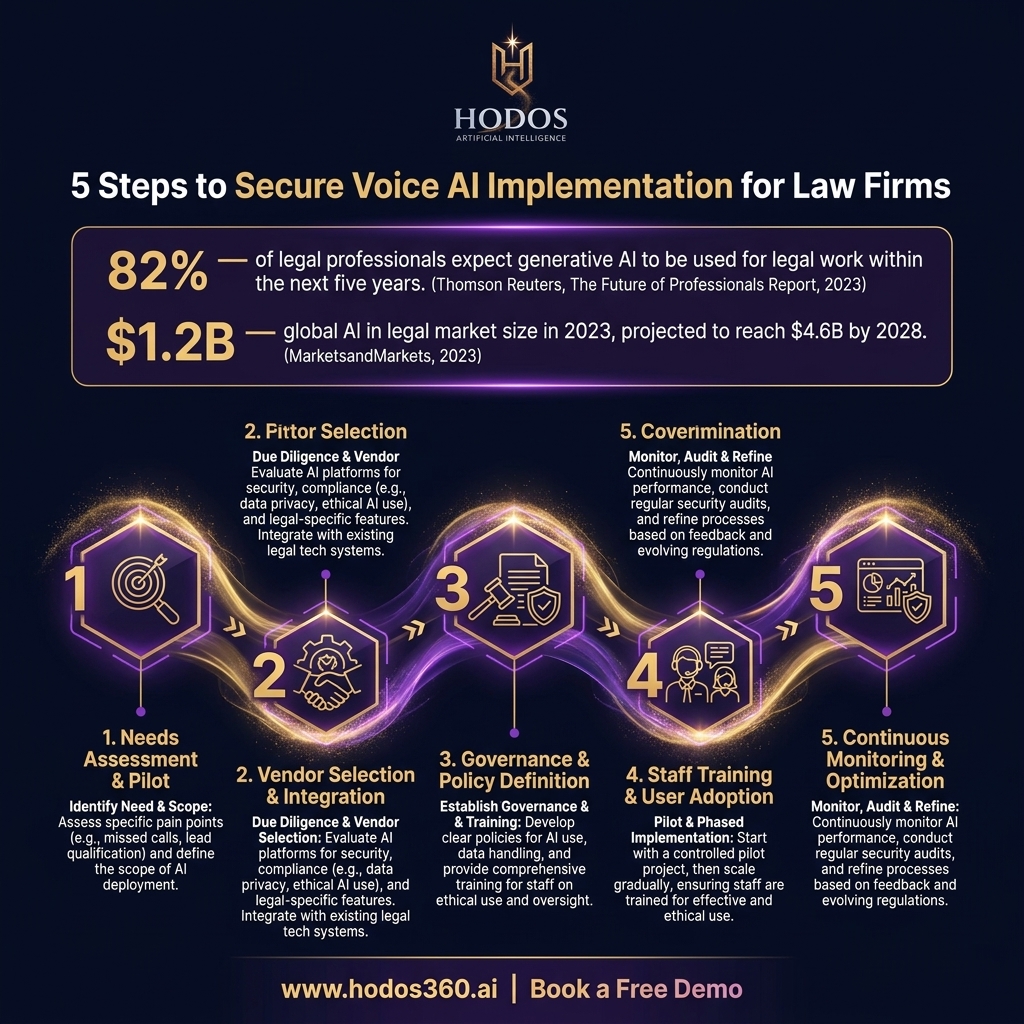
Emily Chang, CTO of LegalMind AI**, emphasized that "pilot programs are not just about testing technology; they're about testing human-AI collaboration." Firms should establish clear metrics for success during each phase, such as reduced call wait times, improved lead conversion rates, or higher client satisfaction scores.
Learn more about AI Voice Support: Essential for Law Firm Client Experience. Furthermore, cultivating a culture of feedback, where legal professionals feel empowered to report issues and suggest improvements, is vital. This iterative process ensures that the voice AI solution evolves to meet the specific needs of the firm and its clients, fostering widespread acceptance and maximizing its impact.
- ✓Initial Assessment: Identify high-volume, low-complexity tasks suitable for voice AI automation (e.g., initial intake, FAQs).
- ✓Pilot Program: Deploy the AI in a controlled environment with a select group of users and clients to gather early feedback.
- ✓Integration Strategy: Ensure seamless connection with existing legal tech infrastructure (case management, CRM, billing).
- ✓Staff Training: Provide comprehensive training for legal professionals on how to interact with and leverage the voice AI effectively.
- ✓Feedback Loop: Establish continuous mechanisms for user and client feedback to drive iterative improvements and refinements.
- ✓Performance Metrics: Define clear KPIs (Key Performance Indicators) to measure the AI's efficiency, accuracy, and client satisfaction.
- ✓Scalability Planning: Design the system to handle increasing call volumes and expand capabilities as the firm grows and needs evolve.
Establishing Robust Governance for Secure Voice AI Deployment
The safe and ethical deployment of voice AI within a law firm is inextricably linked to robust governance frameworks. For legal professionals, the core principles of confidentiality, competence, and client best interests, enshrined in rules like ABA Model Rule 1.6 (Confidentiality of Information) and 1.1 (Competence), dictate a rigorous approach to new technologies.
The greatest concern often revolves around data privacy and the handling of sensitive client information. Firms must establish clear policies on how voice AI systems record, store, process, and delete client data. This includes ensuring compliance with various data protection regulations, such as the General Data Protection Regulation (GDPR) for firms with international clients or various state data privacy laws within the U.S. Without a clear governance strategy, firms risk not only data breaches but also severe reputational damage and potential ethical violations.
This is not merely a technical challenge but a legal and ethical imperative, requiring collaboration between IT, legal ethics committees, and firm leadership to define acceptable use and safeguards.
Furthermore, the issue of bias in AI systems is a significant governance concern. Learn more about Essential Guide: Customer Support Voice AI for Law Firms.
Voice AI models are trained on vast datasets, and if these datasets are unrepresentative or contain inherent biases, the AI can perpetuate or even amplify those biases in its interactions. For a law firm, this could lead to discriminatory outcomes in lead qualification, potentially disadvantaging certain demographics.
As Dario Amodei, CEO of Anthropic, a leading AI safety research company, frequently highlights, "the development of powerful AI must go hand-in-hand with robust safety and ethical frameworks." Firms must implement regular auditing processes to monitor the AI's performance for fairness and accuracy, ensuring that its responses align with the firm's values and legal obligations.
This proactive approach to governance is what differentiates responsible enterprise voice AI adoption from merely deploying a new tool, safeguarding both the firm and its clients against unforeseen risks and ensuring the impact is positive and equitable. HODOS 360’s AI Voice Assistants are built with these rigorous governance principles in mind, offering secure and compliant solutions for law firms.
Data Privacy, Confidentiality, and Regulatory Compliance
Protecting client data is paramount. Law firms deploying voice AI must implement stringent measures to ensure data privacy and confidentiality. This includes end-to-end encryption for all voice interactions and data storage, anonymization of sensitive client details where possible, and strict access controls. Compliance with legal and ethical mandates, such as ABA Model Rule 1.6, which obligates lawyers to protect client confidences, is non-negotiable.
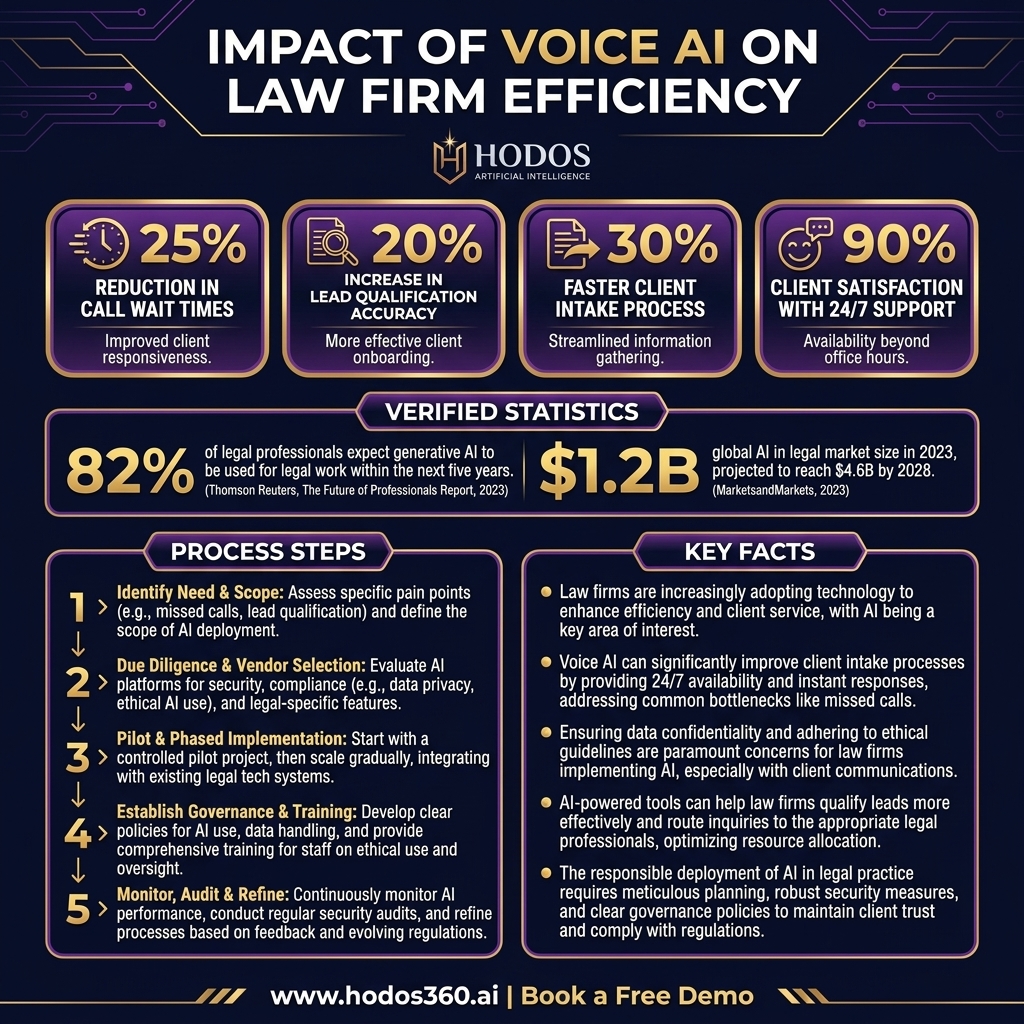
Learn more about AI Legal Drafting: The Ultimate Guide to Relativity's Gavel Acquisition. Firms must also carefully vet third-party AI providers to ensure their data handling practices align with legal and ethical standards. The EU AI Act, which is setting global precedents for AI regulation, emphasizes transparency and risk management, compelling firms to understand the data lifecycle within their AI systems.
A comprehensive data governance plan should outline data retention policies, breach response protocols, and regular security audits to mitigate risks and maintain client trust, ensuring the secure operation of the voice AI.
Best Practices for Maximizing Impact and Ensuring Ethical Voice AI Use
Beyond implementation and governance, maximizing the positive impact of voice AI in a law firm requires adherence to several best practices focused on ethical use and continuous improvement. One critical aspect is maintaining human oversight. While voice AI can automate many tasks, it should always function as an assistant, not a replacement for human judgment.
Complex legal questions, nuanced client emotions, and ethical dilemmas still require the expertise and empathy of a human lawyer. Firms should design their voice AI workflows to seamlessly escalate interactions to human staff when necessary, ensuring that clients always have access to a legal professional.
This hybrid model not only enhances client satisfaction but also reinforces the firm's commitment to personalized service, distinguishing it from purely automated solutions. The ethical framework must guide every decision, from initial design to ongoing operation, to ensure the AI serves the firm's mission responsibly.
Another key best practice involves continuous monitoring and refinement of the voice AI system. Learn more about AI Marketing Agents: Essential for Law Firm Growth. The legal landscape, client needs, and technological capabilities are constantly evolving, and the AI must adapt accordingly. This means regularly reviewing performance metrics, analyzing client feedback, and updating the AI's knowledge base and conversational flows.
For example, if the AI frequently struggles with certain types of inquiries, its training data or algorithms may need adjustment. Firms should also invest in training their human staff to effectively collaborate with the AI, understanding its capabilities and limitations. This includes developing clear protocols for when to intervene, how to leverage AI-generated insights, and how to maintain the human touch in client interactions.
By embracing a culture of continuous learning and adaptation, law firms can ensure their voice AI remains a valuable asset, delivering consistent value and maintaining a high standard of ethical operation, thereby transforming their service delivery model for the better.
Measuring ROI and Continuous Improvement
To justify the investment in voice AI, law firms must establish clear metrics for measuring its Return on Investment (ROI). This goes beyond simply tracking cost savings. Key performance indicators (KPIs) should include reduced client call wait times, increased lead conversion rates from initial inquiries, improved client satisfaction scores (e.g., Net Promoter Score), and a quantifiable reduction in administrative overhead.
Regular analysis of these metrics allows firms to identify areas for optimization and demonstrate the tangible impact of the technology. For instance, if lead qualification improves by 15% within six months of deployment, that's a clear indicator of success. Continuous improvement also involves iterative updates to the AI's scripts and understanding, informed by real-world interactions and evolving legal requirements, making the AI guide a living document.

The Future is Calling: Strategic Integration for Legal Innovation
The integration of voice AI is not merely a tactical upgrade but a strategic imperative for law firms aiming to thrive in the modern legal ecosystem. As the legal profession continues to evolve, clients expect faster, more accessible, and more personalized services. Firms that embrace enterprise voice AI responsibly will gain a significant competitive advantage, differentiating themselves through superior client engagement and operational efficiency.
This isn't about replacing the invaluable human element of legal practice, but rather about augmenting it, freeing up legal professionals to focus on the intricate, high-value work that only they can do. The future of law firms lies in intelligent automation, allowing them to scale their operations without compromising quality or ethical obligations.
By leveraging voice AI for routine tasks, firms can reallocate resources to complex legal analysis, strategic client counseling, and business development, ultimately enhancing their overall value proposition.
For law firms looking to navigate this transformative landscape, the right technology partner is crucial. Platforms that offer a holistic suite of AI-powered solutions, from AI Law Firm Management Systems to AI Voice Assistants, provide the necessary tools for comprehensive digital transformation.
Investing in these technologies, coupled with a commitment to robust governance and ethical use, positions firms not just to adapt to change but to lead it. The journey to safely scale enterprise voice AI is a testament to a firm's dedication to innovation, client service, and sustainable growth.
By meticulously planning implementation, establishing stringent governance, and adhering to best practices, law firms can harness the full potential of voice AI, ensuring a future where technology empowers legal excellence and makes a significant impact on justice delivery. It's time for law firms to answer the call of the future with confidence and strategic foresight.
Frequently Asked Questions
How does voice AI ensure client confidentiality in law firms?+
Voice AI systems for law firms must incorporate robust security measures, including end-to-end encryption for all communications and data storage. Data anonymization protocols should be in place where feasible, and strict access controls limit who can access sensitive information. Additionally, compliance with ABA Model Rule 1.6 and relevant data privacy regulations like GDPR or state laws is paramount, often involving secure, private cloud environments and regular security audits to protect client confidences.
What are the initial steps for a law firm to implement voice AI?+
The initial steps involve a thorough assessment of current client communication workflows to identify high-volume, repetitive tasks suitable for automation, such as initial client intake or FAQ answering. Firms should then research AI providers, focusing on those with legal industry experience and strong security protocols. A pilot program with a small scope helps test the system, gather feedback, and refine the AI's performance before a broader rollout. This phased approach ensures a smoother transition and greater user adoption.
Can voice AI replace human legal professionals?+
No, voice AI is designed to augment, not replace, human legal professionals. Its primary role is to handle routine, high-volume tasks, freeing up attorneys and staff for more complex legal work, strategic counseling, and client relationship building. Voice AI excels at lead qualification, appointment booking, and answering common questions, but nuanced legal advice, ethical decision-making, and empathetic client interaction remain firmly in the human domain. It fosters a hybrid model, enhancing efficiency while preserving the human touch.
What ethical considerations should law firms address when using voice AI?+
Ethical considerations include ensuring data privacy and confidentiality (ABA Model Rule 1.6), mitigating algorithmic bias to prevent discriminatory outcomes, maintaining transparency with clients about AI interaction, and ensuring human oversight for critical decisions (ABA Model Rule 1.1). Firms must also consider the potential for unauthorized practice of law if the AI provides legal advice without human attorney supervision. A clear ethical framework and continuous monitoring are crucial to responsible AI deployment.
How can law firms measure the ROI of voice AI implementation?+
Measuring ROI involves tracking key performance indicators such as reduced call wait times, increased lead conversion rates from initial inquiries, improved client satisfaction scores, and quantifiable reductions in administrative costs and staff workload. Firms should also monitor the time saved by attorneys on routine tasks, allowing them to focus on revenue-generating activities. Regular analysis of these metrics provides tangible evidence of the voice AI's effectiveness and helps justify the investment, ensuring a positive impact.