


Voice Search Growth: Essential Legal Firm Strategies
In a competitive legal landscape where client acquisition is paramount, the subtle shift in how people search for information—and increasingly, for legal counsel—is creating a seismic impact. Just last week, SQ Magazine’s “Voice Search Statistics 2026” report highlighted a remarkable surge in voice search adoption, indicating that a significant percentage of global internet users now rely on voice commands daily.
This isn't merely a convenience; it's a fundamental change in user behavior that demands immediate attention from law firms. Imagine a potential client, stuck in traffic or multitasking at home, asking their smart device, "Find a personal injury lawyer near me." Is your firm ready to be the answer?
The evolution of voice search from a novelty to a mainstream interface has been swift and profound. Early skepticism about its accuracy and utility has been largely dispelled by advancements in natural language processing and machine learning. Today, voice assistants like Amazon Alexa, Google Assistant, and Apple Siri are deeply embedded in daily life, powering billions of devices worldwide.
For law firms, this trend presents both a formidable challenge and an unprecedented opportunity. Firms that proactively optimize for voice search and integrate AI voice assistants into their operations stand to capture a significant competitive edge, streamlining client intake, enhancing client experience, and ultimately driving substantial growth.
This isn't about futuristic speculation; it's about present-day strategic imperative, as articulated by industry leaders like Brad Smith, Vice Chair and President of Microsoft, who consistently emphasizes AI's transformative power across all sectors, including legal. The question is no longer *if* voice AI will impact your practice, but *how* quickly you will adapt to leverage its full potential.
The Rise of Voice Search in Legal Practice
The latest Voice Search Statistics 2026 confirm what many in legal tech have observed firsthand: user adoption is accelerating beyond previous projections. SQ Magazine's report, echoing data from sources like the Thomson Reuters Institute and the ABA Journal, illustrates that conversational queries are increasingly dominating local search results.
For law firms, this translates into a critical shift in how potential clients discover and engage with legal services. Consider the firm of 'LexCorp Legal,' a hypothetical mid-sized practice in Chicago. For years, their digital strategy revolved around traditional text-based SEO, meticulously optimizing for keywords like “Chicago divorce attorney” or “corporate litigation Chicago.”
While effective in its time, managing partner Eleanor Vance recently noted a plateau in organic lead generation. "Our website traffic was stable," Vance explained at a recent LegalTech NYC panel, "but the *quality* of incoming leads, particularly for local services, felt diminished. We weren't connecting with clients who needed immediate, location-specific help, the kind of help people often seek with a quick voice command."
This narrative of evolving search behavior is common, highlighting a growing disconnect between traditional SEO and the new reality of voice-first interactions.
This shift isn't just about search volume; it’s about intent. Learn more about Law Firm Return on Investment: Maximize AI in 2026. Voice search users often pose longer, more conversational, and highly specific questions, often seeking immediate solutions or local services.
Phrases like “What are the steps to file for bankruptcy in Illinois?” or “best real estate lawyer near me available now” are becoming commonplace. This requires law firms to move beyond generic keyword stuffing and towards a strategy that anticipates natural language queries and provides direct, concise answers.
The stakes are high: firms that fail to optimize for this new mode of discovery are effectively invisible to a burgeoning segment of the market. Data from Google Analytics consistently shows that queries with local intent, often expressed via voice, convert at a higher rate, underscoring the urgency for legal professionals to adapt their digital presence.
The usage of smart speakers and mobile devices for these queries is particularly pronounced, making mobile-first and voice-first optimization not just beneficial, but essential.
Understanding the Nuances of Voice Search SEO
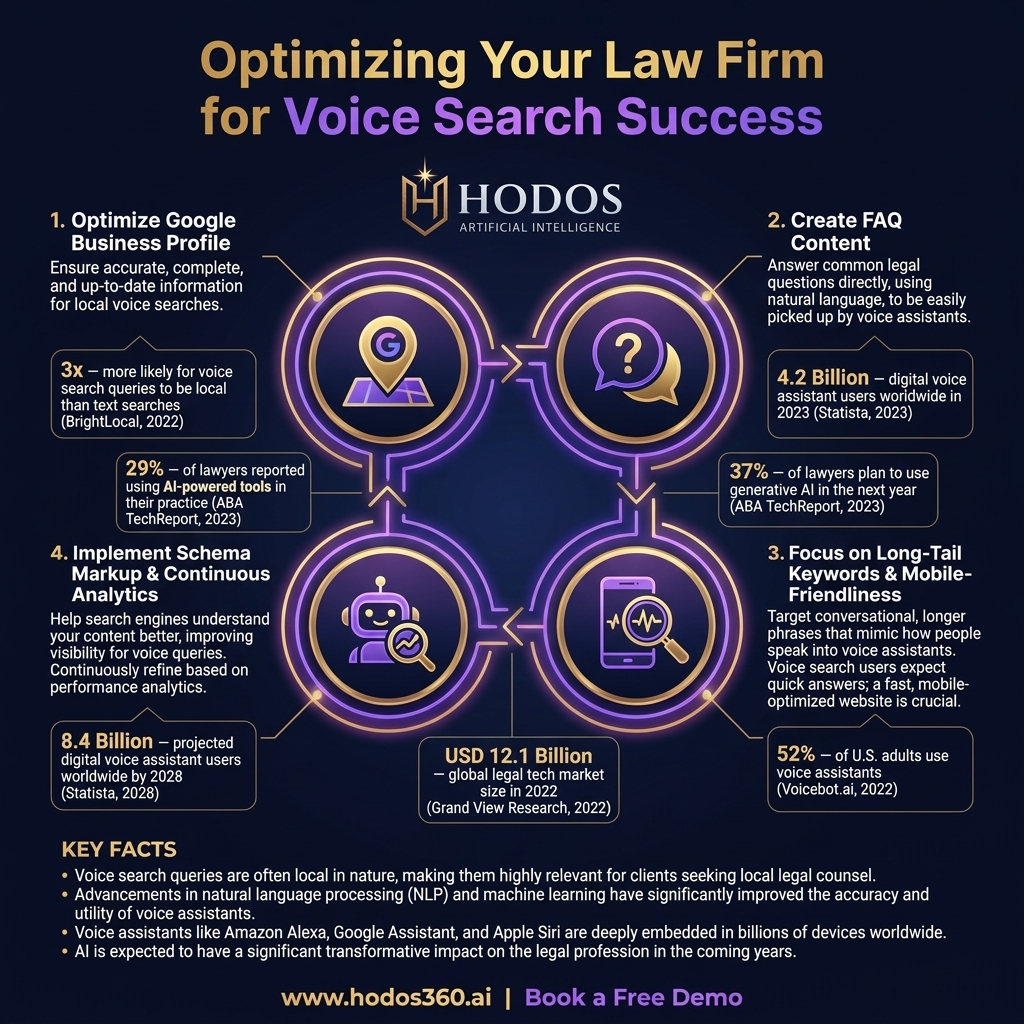
Optimizing for voice search SEO is distinct from traditional text-based strategies. It prioritizes natural language, question-based queries, and a conversational tone. While traditional SEO focuses on keywords, voice SEO emphasizes long-tail keywords, semantic search, and providing direct answers. For example, instead of just targeting "divorce lawyer," a voice-optimized strategy would aim for queries like "What are the legal requirements for divorce in [city]?"
or "Can I get a free consultation with a divorce lawyer near me?" This requires law firms to create content that directly addresses these questions, often in an FAQ format or within blog posts designed to provide comprehensive, yet succinct, answers. Furthermore, local SEO signals become even more critical, as many voice searches have a strong 'near me' component, driving users to local businesses that are accurately listed and reviewed across various online directories.
Another crucial aspect is the increasing reliance on featured snippets and position zero results. Voice assistants often pull answers directly from these top-ranking, concise content blocks. Learn more about AI Marketing: The Ultimate Guide to Law Firm Growth & Automation. Law firms must structure their website content to be easily digestible and answer-oriented, increasing their chances of being chosen as the definitive response by a voice assistant.
This involves clear headings, structured data markup, and content that directly answers common legal questions. As Dean Andrew Perlman of Suffolk Law School often remarks, the legal profession has a responsibility to make legal information accessible. Voice search, when optimized correctly, serves as a powerful conduit for this accessibility, bridging the gap between complex legal needs and immediate, understandable solutions.
The trends indicate that this user preference for direct answers will only intensify, making this optimization a continuous, evolving process.
Beyond SEO: The Power of AI Voice Assistants for Law Firms
While voice search SEO is critical for discovery, the true transformative power lies in leveraging AI voice assistants to directly manage client interactions. Imagine a scenario where a potential client calls your firm after hours, or during a busy workday when all lines are tied up.

Instead of reaching voicemail or a generic answering service, they are greeted by an intelligent AI voice assistant capable of sophisticated lead qualification, appointment booking, and even multilingual support. This is precisely the kind of innovation that HODOS 360’s AI Voice Assistants bring to the table.
These aren't just glorified IVR systems; they are intelligent conversational AI platforms designed to mimic human interaction, understand nuanced inquiries, and perform complex tasks. This capability addresses a fundamental tension in legal practice: the need for constant client accessibility versus the reality of limited human resources.
Consider the case of 'Nexus Legal Partners,' a rapidly growing firm specializing in immigration law. Learn more about AI Deposition Prep: The Ultimate Guide to Winning Strategies. Prior to integrating an AI voice assistant, they struggled with missed calls from potential clients in different time zones and language barriers.
Partner David Kim noted, "We were losing valuable leads because our human receptionists couldn't cover 24/7, and translating services were clunky. Our user adoption of AI voice assistants changed everything." Now, their HODOS 360 AI Voice Assistant handles initial inquiries, qualifies leads based on specific criteria, and even schedules consultations directly into their firm's calendar.
This frees up administrative staff to focus on higher-value tasks, significantly improves client intake efficiency, and ensures that no potential client is left unheard. This level of automated, intelligent client interaction is a game-changer for law firms looking to scale and enhance their service delivery without exponentially increasing overhead.
Enhancing Client Experience and Operational Efficiency
The benefits of AI voice assistants extend far beyond initial lead capture. They play a pivotal role in enhancing the overall client experience and driving significant operational efficiencies. By providing instant, accurate answers to frequently asked questions, such as firm hours, service areas, or document requirements, these assistants empower clients with immediate information, reducing frustration and building trust.
This proactive communication aligns with modern client expectations for instant gratification and transparent access to information. Furthermore, the ability of AI voice assistants to route calls to the appropriate department or attorney based on the client's specific needs ensures a smoother, more personalized experience from the very first interaction.
This minimizes wait times and ensures clients reach the right expert quickly, a critical factor in a high-stakes profession like law.
Moreover, the data collected by these AI interactions provides invaluable insights into client needs and common queries. Learn more about Scaling Legal AI: Essential Strategies to Prevent Tool Sprawl.
Law firms can analyze these trends to refine their marketing messages, improve website content, and even identify emerging legal needs. For instance, if the AI constantly fields questions about a new regulatory change, the firm knows to create more content or offer specific services around that area.
This continuous feedback loop driven by conversational AI can inform strategic decisions, ensuring the firm remains agile and client-centric. The usage of such advanced assistants fundamentally transforms the traditional law firm operational model, moving towards a more responsive, data-driven, and client-focused approach, which is increasingly becoming the benchmark for success in the legal industry.
Navigating Ethical Considerations and Data Privacy with Voice AI
As law firms embrace voice search and AI voice assistants, critical ethical considerations and data privacy concerns inevitably arise. The legal profession, bound by stringent rules of confidentiality and professional conduct, must approach these technologies with meticulous care. The collection, storage, and processing of voice data, which often contains sensitive personal and potentially privileged information, demand robust security protocols and clear client consent.
Meredith L. Williams, a partner at Nelson Mullins and a leading voice in AI ethics for law, frequently emphasizes the need for firms to understand the underlying technology's data handling practices. "It's not enough to simply adopt an AI tool," Williams stated at a recent ABA TechShow panel.
"Firms must conduct thorough due diligence on vendors, ensuring compliance with data protection regulations like GDPR, CCPA, and, crucially, the ABA Model Rules of Professional Conduct, particularly Rule 1.6 on Confidentiality of Information."
Firms must implement transparent policies regarding how voice interactions are recorded, stored, and utilized.
Learn more about AI Voice Assistant: Apple's Essential Siri Reboot Unpacked. Clients should be fully informed about the nature of their interactions with AI assistants and provided with clear options for opting out or requesting data deletion. This is not merely a legal requirement but an ethical imperative to maintain the sacred trust between attorney and client.
Furthermore, the potential for algorithmic bias in AI systems, even in voice assistants, must be acknowledged and mitigated. Biases embedded in training data could inadvertently lead to discriminatory outcomes in lead qualification or information dissemination. Regular audits and a commitment to fairness in AI deployment are essential.
The worldwide adoption of AI necessitates a global standard for ethical AI, and law firms, as custodians of justice, are at the forefront of this crucial conversation.
Ensuring Compliance with Legal and Ethical Frameworks
Compliance with legal and ethical frameworks is non-negotiable when deploying voice search and AI voice assistants in a legal context. The ABA Model Rules of Professional Conduct, specifically Rule 1.1 (Competence) and Rule 1.6 (Confidentiality of Information), directly apply to a lawyer's use of technology.
Lawyers have a duty to understand the risks and benefits of technology used in practice and to safeguard client information. This means ensuring that any AI voice assistant platform chosen by a firm employs end-to-end encryption, secure data centers, and adheres to the highest industry standards for data protection.
Furthermore, firms must establish clear internal protocols for staff regarding the handling of sensitive information through AI interfaces and ensure that client consent is explicitly obtained for the recording and processing of voice data.
The emerging regulatory landscape, exemplified by the EU AI Act, signals a global move towards stricter governance of AI technologies.
While the Act primarily targets high-risk AI systems, its principles of transparency, human oversight, and accountability offer a valuable blueprint for all AI deployments. Learn more about AI Voice Assistants: Essential for Modern Law Firms. Law firms should proactively monitor these developments and adapt their internal policies to remain compliant.
As technology evolves, so too must ethical guidelines, requiring continuous education and vigilance from legal professionals. This proactive approach not only mitigates risk but also positions the firm as a leader in responsible technological adoption, reinforcing client trust in an increasingly digital world. The guide to ethical AI use in legal practice is constantly being written, and firms must actively participate in its development.
Future Forward: Integrating Voice AI for Competitive Advantage
The future of legal services is undeniably intertwined with advanced AI, and voice search is a significant part of that equation. Law firms that strategically integrate voice AI into their broader digital transformation initiatives will forge a formidable competitive advantage. This isn't just about answering phones; it's about building a seamless, intelligent client journey from initial inquiry to case resolution.
Imagine a future where an AI voice assistant not only qualifies a lead but also gathers preliminary case details, sets up secure document sharing, and even provides status updates on routine matters, all under attorney supervision. This level of automation, powered by sophisticated conversational AI, will free up attorneys to focus on complex legal strategy and client advocacy, rather than administrative overhead.
Beyond client-facing applications, voice AI holds promise for internal legal workflows. Voice-to-text transcription for dictation, voice-activated document retrieval, and hands-free control of legal tech platforms could significantly boost attorney productivity. Firms like 'Innovate Law Group,' led by managing partner Sarah Chen, are already experimenting with these integrations.
"Our goal is to make every interaction, internal or external, as efficient and intuitive as possible," Chen stated at a recent industry conference. "Voice AI is a natural extension of that philosophy. We're looking at how it can integrate with our case management systems to streamline data entry and even assist with initial legal research queries."
The potential for voice AI to act as an intelligent layer across all aspects of a law firm's operations signals a profound shift towards hyper-efficient, client-centric legal service delivery. The trends clearly indicate that firms embracing this comprehensive approach will redefine industry benchmarks.
Building a Future-Ready Legal Practice with AI
Building a future-ready legal practice means embracing a holistic approach to AI integration, with voice search and voice assistants as key components. This involves not only optimizing your digital presence for voice queries but also strategically deploying AI voice assistants to enhance client service and operational efficiency.
Firms must invest in robust AI platforms that offer scalability, security, and seamless integration with existing legal practice management systems. The market is seeing rapid innovation, with companies like HODOS 360 offering comprehensive solutions that span AI Law Firm Management, AI Marketing, AI Voice Assistants, and Web & Mobile Development.
This integrated approach allows firms to create a cohesive digital ecosystem where voice AI acts as a central hub for client engagement and data flow.
The competitive landscape is defined by those who innovate and those who lag. Firms that harness the power of voice AI will not only attract more clients but also deliver a superior, more efficient legal experience.
The adoption of these technologies is no longer optional; it's a strategic imperative for long-term sustainability and growth. The journey requires vision, investment, and a willingness to adapt, but the rewards—increased efficiency, enhanced client satisfaction, and a dominant market position—are substantial. As the legal industry continues its digital transformation, voice AI will undoubtedly emerge as one of the most powerful tools in a law firm's arsenal, enabling them to better optimize their operations and truly connect with the modern client.
- ✓Optimize for Natural Language Queries: Focus on long-tail, conversational keywords and question-based content.
- ✓Prioritize Local SEO: Ensure accurate and consistent NAP (Name, Address, Phone) information across all online directories, especially for 'near me' searches.
- ✓Create Answer-Oriented Content: Develop FAQs, blog posts, and website sections that directly answer common legal questions concisely.
- ✓Leverage Featured Snippets: Structure your content to be easily extracted by search engines for position zero results.
- ✓Implement AI Voice Assistants: Deploy intelligent AI for 24/7 lead qualification, appointment booking, and multilingual client support.
- ✓Ensure Data Privacy & Security: Choose AI vendors with robust security protocols and comply with all relevant data protection laws and ethical guidelines.
- ✓Integrate AI Across Workflows: Explore how voice AI can enhance internal operations, from dictation to document retrieval, for increased efficiency.

Key Takeaways and Next Steps
The undeniable surge in voice search adoption, coupled with the growing sophistication of AI voice assistants, marks a pivotal moment for the legal industry. Firms that recognize this paradigm shift and proactively integrate these technologies are not just modernizing; they are future-proofing their practice. From optimizing their online presence to capture conversational queries to deploying AI-powered client engagement tools, the path to competitive advantage is clear.
It demands a strategic vision that embraces innovation, prioritizes client experience, and rigorously adheres to ethical standards and data privacy mandates. The legal profession has always adapted to new frontiers, and the voice AI revolution is no different. Firms must now move beyond contemplation and towards decisive action.
For law firms ready to embrace this future, the next steps involve a comprehensive evaluation of current digital strategies and a commitment to integrating advanced AI solutions. Platforms like HODOS 360 offer a full suite of services, including AI Voice Assistants, that are specifically designed to meet the unique needs of legal practices.
By leveraging these tools, firms can ensure they are not only discoverable through voice search but also capable of providing an unparalleled, always-on client experience. This strategic adoption of AI will not only streamline operations and attract new clients but also solidify a firm's reputation as a forward-thinking leader in a rapidly evolving legal landscape.
The time to act on the trends of voice AI is now, ensuring your firm is heard loud and clear in the digital conversation.
Frequently Asked Questions
What is voice search and why is it important for law firms?+
Voice search uses spoken commands to find information online, powered by AI assistants like Siri or Google Assistant. It's crucial for law firms because a growing number of potential clients use it for local, urgent legal queries. Optimizing for voice search ensures your firm is discoverable through these natural language interactions, capturing leads who prefer this convenient method.
How do AI voice assistants differ from traditional answering services?+
Traditional answering services are human-operated and follow scripts, often limited to basic message taking. AI voice assistants, like those from HODOS 360, leverage advanced natural language processing to understand complex queries, qualify leads, book appointments, and provide multilingual support 24/7, acting as an intelligent extension of your firm without human limitations.
What are the key elements of optimizing a law firm's website for voice search?+
Key elements include focusing on long-tail, conversational keywords, creating content that directly answers common legal questions (e.g., FAQs), optimizing for local 'near me' searches with accurate NAP data, and structuring content for featured snippets. The goal is to provide concise, direct answers that voice assistants can easily extract and deliver to users.
What ethical considerations should law firms be aware of when using voice AI?+
Law firms must prioritize client confidentiality (ABA Model Rule 1.6) and data privacy when using voice AI. This involves ensuring secure data handling, obtaining explicit client consent for recordings, and transparent policies on data usage. Firms must also be vigilant about potential algorithmic bias and comply with emerging AI regulations to maintain professional and ethical standards.
How can AI voice assistants improve client intake and lead qualification for law firms?+
AI voice assistants can significantly improve client intake by providing instant, 24/7 responses to inquiries, qualifying leads based on predefined criteria, and automatically scheduling appointments. This automation ensures no lead is missed, streamlines the initial client journey, and frees up administrative staff, leading to higher conversion rates and a more efficient intake process.