


Ultimate AI Agent Builder: Essential Tools for Law Firms
Just a few years ago, the concept of autonomous software agents handling intricate legal tasks seemed like science fiction. Today, however, we are firmly in an era where AI agent builders are not just theoretical but are actively redefining the operational landscape for law firms worldwide.
Consider the case of 'Lexi,' a hypothetical AI agent deployed by a mid-sized corporate law firm, Sterling & Finch. Lexi doesn't just review contracts; she identifies anomalies based on historical litigation data, flags potential compliance risks against dynamic regulatory databases, and even drafts initial responses to standard client queries, all while learning from attorney feedback.
This isn't a future vision; it's the present reality, driven by increasingly sophisticated AI agent builder tools that empower firms to move beyond mere automation to true intelligent autonomy.
The strategic imperative for law firms to embrace these advanced AI agent tools is becoming undeniable.
The legal market, valued at over $800 billion globally, is experiencing immense pressure from clients demanding greater efficiency, transparency, and cost-effectiveness. Firms that hesitate to integrate intelligent automation risk falling behind competitors who are already leveraging AI to streamline operations, enhance client engagement, and unlock new revenue streams.
The recent Hostinger report highlighting the '15 best AI agent builder tools in 2026' underscores this rapid evolution, showcasing a vibrant ecosystem of platforms designed to put powerful AI capabilities directly into the hands of legal professionals. From automating intricate due diligence processes to managing client intake with unprecedented precision, AI agents are proving to be indispensable assets in the modern legal toolkit.
The question is no longer *if* law firms will adopt these technologies, but *how* strategically they will integrate them to maintain their competitive edge and deliver superior legal services.
The Strategic Imperative: Why Law Firms Need AI Agent Automation
The legal industry is at a crossroads, facing a confluence of economic pressures, evolving client expectations, and a burgeoning wave of technological innovation. According to the 2024 ABA Legal Technology Survey Report, nearly 60% of law firms are actively exploring or implementing AI solutions, a significant jump from previous years, indicating a widespread recognition of AI's transformative potential.
However, many firms are still grappling with how to move beyond basic AI tools to more sophisticated, agentic automation. The true value proposition of AI agent builder tools lies in their ability to orchestrate complex, multi-step workflows autonomously, freeing up highly skilled legal professionals from repetitive, time-consuming tasks.
This shift is not merely about efficiency; it's about reallocating human capital to higher-value activities that require nuanced judgment, strategic thinking, and client relationship building.
Leading the charge are firms like Allen & Overy, which famously partnered with Harvey AI, an AI agent development startup, to deploy a generative AI tool across its global operations.
Learn more about OpenAI Codex: Essential Guide to Faster Legal Web Development. This collaboration exemplifies a proactive approach to integrating advanced AI, allowing A&O lawyers to accelerate legal research, due diligence, and contract analysis. Harvey AI's platform acts as a sophisticated AI agent builder, enabling the firm to customize and deploy agents tailored to specific legal domains and client needs.
This move isn't just about adopting a new tool; it's about fundamentally rethinking how legal services are delivered. As Catherine McGregor, Global Head of Legal Operations at A&O, stated at LegalTech NYC 2026, "Our partnership with Harvey isn't just about speed; it's about augmenting our lawyers' capabilities, allowing them to focus on the truly strategic aspects of their work, ultimately delivering better outcomes for our clients."
This proactive adoption creates a significant competitive advantage, setting a new benchmark for operational excellence in the legal sector.
Redefining Legal Workflows with Intelligent Agents
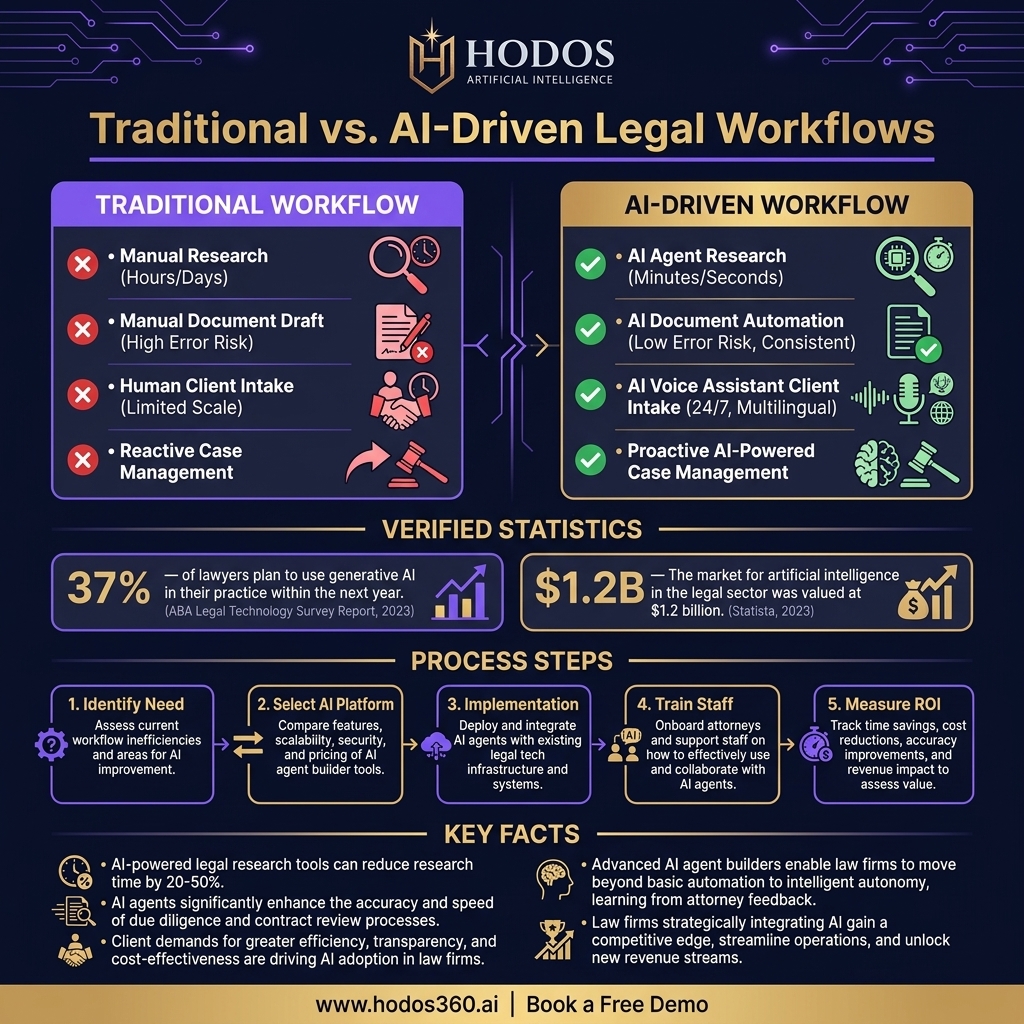
The impact of intelligent AI agents extends across virtually every facet of legal practice. From initial client intake to final case resolution, these agents are capable of handling tasks that once required significant human intervention. For instance, an AI agent can be configured to monitor regulatory changes, automatically flagging new statutes or case precedents relevant to a firm's practice areas.
In litigation, agents can analyze vast datasets of discovery documents, identifying patterns, inconsistencies, and key evidence far more rapidly and accurately than human counterparts. Similarly, in corporate law, AI agents can perform real-time due diligence on M&A targets, assessing risks associated with contracts, intellectual property, and compliance.
This level of granular, autonomous automation transforms what was once a linear, often manual, process into a dynamic, data-driven workflow. Learn more about AI Document Workflows: Unleash Efficiency & ROI in 2026. It's about augmenting human intelligence with machine precision, creating a synergy that drives unprecedented levels of efficiency and accuracy.
Firms that leverage these capabilities are not just working smarter; they're fundamentally changing the economics of legal service delivery, offering faster, more comprehensive, and ultimately more valuable solutions to their clients.
Ready to transform your firm's operations with cutting-edge AI? Discover how HODOS 360's AI-powered solutions can build custom workflows and intelligent agents tailored to your unique needs.
[Book a Free Demo Today!]
Navigating the AI Agent Builder Landscape: Key Platforms and Features
The market for AI agent builder tools is diverse and rapidly expanding, offering a spectrum of solutions from sophisticated developer-first frameworks to intuitive no-code platforms. Understanding this landscape is crucial for law firms looking to make strategic investments. On one end, you have powerful open-source frameworks like AutoGen, developed by Microsoft Research, which allows developers to build complex multi-agent conversations for diverse tasks.
This offers unparalleled flexibility but requires significant technical expertise. On the other end, low-code and no-code AI agent builders are democratizing access to this technology, enabling legal operations professionals to design and deploy agents without extensive coding knowledge. Platforms like Gumloop and Vellum, often praised for their clean UIs and ability to handle complex logic, exemplify this trend, allowing firms to go from idea to production for text-based agents swiftly.
These tools often feature visual workflow composers, template libraries, and run previews, making the development process more accessible.
When selecting an AI agent builder for legal applications, several key features are paramount. Security and data privacy are non-negotiable, given the sensitive nature of legal information.
Learn more about Voice AI: An Essential Leap for Law Firms' Client Engagement. Firms must prioritize platforms that offer robust encryption, access controls, and compliance certifications. Integration capabilities are also critical; an effective AI agent should seamlessly connect with existing law firm management systems, document management solutions, and communication platforms.
Customization is another vital aspect, allowing firms to tailor agents to specific practice areas, client requirements, and internal protocols. For instance, an agent designed for M&A due diligence will have different knowledge bases and decision trees than one focused on intellectual property litigation. The ability to fine-tune large language models (LLMs) and incorporate proprietary data ensures that the agents operate with the firm's unique expertise and voice.
Finally, scalability and ongoing support from the software provider are essential for long-term success, ensuring the AI agent can evolve with the firm's needs and the legal landscape.
From Concept to Code: Building Custom Legal Agents
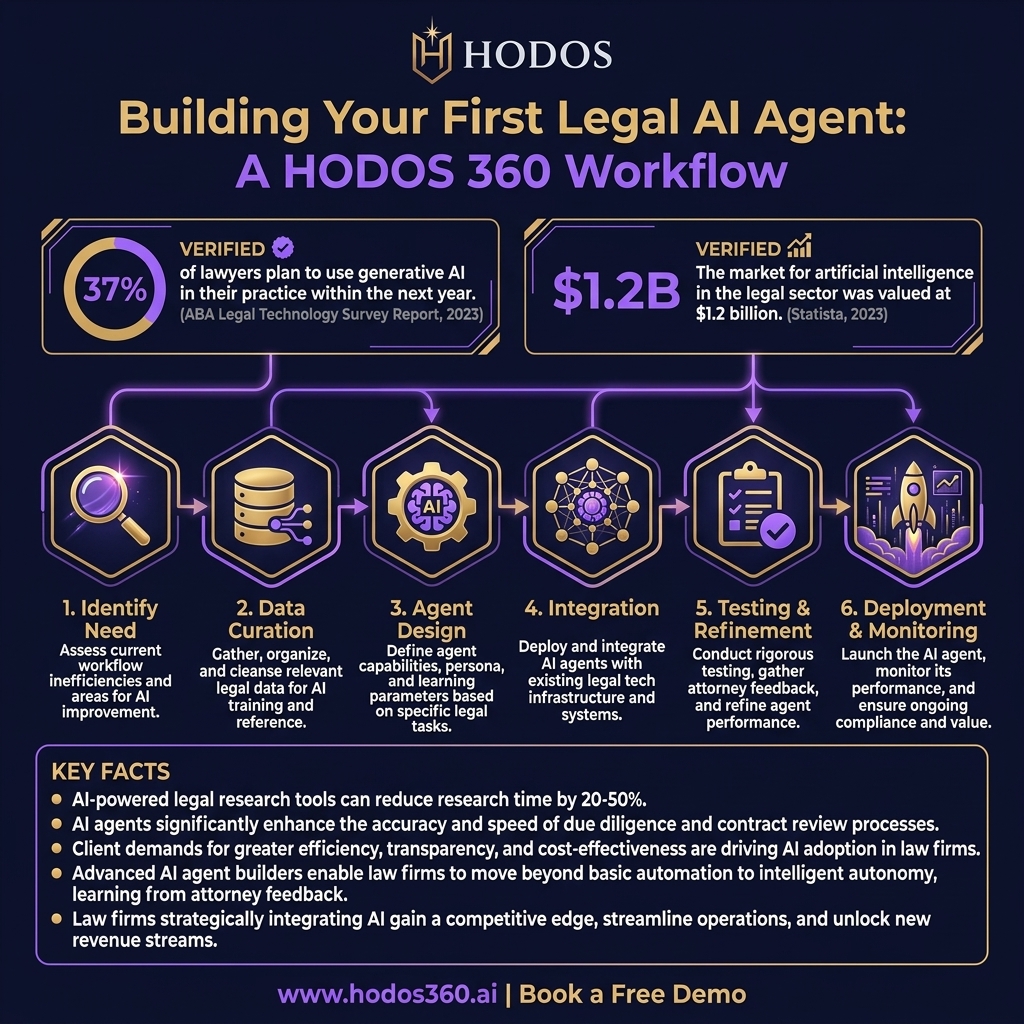
The process of building and deploying a custom legal AI agent is an iterative journey that blends legal expertise with technological proficiency. It typically begins with a clear problem statement: What specific legal task or workflow needs to be optimized? Is it automating the initial review of non-disclosure agreements, streamlining patent search, or enhancing client intake for personal injury cases?
Once the objective is defined, the next critical step involves data curation and preparation. High-quality, relevant legal data—contracts, case law, internal precedents—is the lifeblood of any effective AI agent. This data must be meticulously cleaned, annotated, and structured to train the underlying models accurately. Firms can leverage their extensive internal archives, ensuring the agent learns from their specific operational context and expertise.
With data in hand, legal professionals, often in collaboration with AI specialists, can begin designing the agent's architecture using an AI agent builder. This involves defining the agent's roles, the sequence of tasks it will perform, the decision logic it will follow, and the conditions under which it will escalate to human review.
Learn more about Legal AI ROI: Maximizing Law Firm Value in 2026. For instance, an agent for document automation might identify key clauses, extract specific data points, and then generate a summary, all while flagging any deviations from predefined legal standards. Platforms with visual workflow composers greatly simplify this process, allowing users to drag and drop components to build complex agentic chains.
Rigorous testing and validation are paramount before deployment. This includes evaluating the agent's accuracy, identifying and mitigating potential biases, and ensuring its outputs align with legal standards and firm policies. Through continuous feedback loops and fine-tuning, these AI agents evolve, becoming increasingly sophisticated and indispensable components of a modern law firm's operational framework.
The Ethical and Practical Considerations of Deploying AI Agents
While the promise of AI agent builder tools is immense, their deployment in the legal sector comes with significant ethical and practical considerations that firms must navigate carefully. The American Bar Association (ABA) Model Rules of Professional Conduct, particularly Rule 1.1 on Competence, implicitly require attorneys to understand the benefits and risks associated with relevant technology.
This extends to understanding how AI agents function, their limitations, and the potential for errors or "hallucinations." As Professor Frank Pasquale of Brooklyn Law School often highlights, the black-box nature of some advanced AI models can make it challenging to explain their reasoning, posing issues for accountability and transparency.
Firms must establish clear protocols for human oversight, ensuring that an attorney always reviews critical outputs from an AI agent before they are used in client matters or court filings.
Data privacy and confidentiality, enshrined in ABA Model Rule 1.6, are paramount. Deploying AI agent platforms necessitates robust data governance strategies, ensuring that client information is protected from unauthorized access, breaches, or misuse.
The EU AI Act, set to be fully enforced in 2026, provides a global precedent for regulating AI systems, categorizing them by risk level and imposing strict requirements for high-risk applications, which could include certain legal AI agents. Learn more about AI Website Coding: An Essential Guide for Law Firms.
Law firms must ensure their AI software and agents comply with such regulations, as well as jurisdictional data protection laws like GDPR and CCPA. Furthermore, the potential for algorithmic bias, stemming from biased training data, is a serious concern. An AI agent trained on historical legal data reflecting societal biases could perpetuate or even amplify discriminatory outcomes.
Firms must actively audit their AI systems for bias and implement strategies to mitigate it, ensuring fairness and equity in the legal services provided. The ethical deployment of AI agents is not just a compliance issue; it's a matter of maintaining public trust and upholding the core values of justice.
Real-World Impact: Success Stories and Competitive Edge
The narrative of AI agent builders in law firms is increasingly shifting from speculative potential to demonstrable impact. Firms that have strategically embraced these tools are reporting tangible benefits that translate directly into competitive advantage. For instance, a recent case study published by Thomson Reuters highlighted a regional firm, 'Innovate Legal,' that implemented an AI agent for initial contract review and comparison.
By leveraging a custom-built agent via a popular low-code platform, Innovate Legal reduced the time spent on first-pass contract analysis by over 70%, allowing their senior associates to focus on complex negotiations and strategic advice. This efficiency gain not only improved turnaround times for clients but also significantly reduced operational costs, leading to a 15% increase in profit margins for relevant practice areas within the first year.
Beyond efficiency, AI agent platforms are enabling firms to offer enhanced services and attract new clients. Learn more about Legal AI Gap Widens: Strategic Imperative for Law Firms 2026. Consider the example of a boutique immigration law firm that deployed an AI voice assistant (powered by an underlying AI agent) to handle 24/7 lead qualification and appointment booking.
This agent, developed using a sophisticated AI agent builder, can answer common queries, pre-qualify potential clients based on specific criteria, and schedule consultations, all in multiple languages. This capability transformed their client intake process, converting leads at a higher rate and providing a superior, round-the-clock service experience that traditional firms cannot match.
The firm's managing partner, Maria Rodriguez, noted, "Our AI assistant isn't just a chatbot; it's a tireless, multilingual member of our teams that ensures we never miss an opportunity to connect with potential clients, dramatically improving our market reach and responsiveness." This kind of innovation, driven by accessible AI agent builder tools, is creating a clear divide between firms that lead with technology and those that lag, underscoring the critical importance of a first-mover advantage in this rapidly evolving legal tech landscape.
HODOS 360's Role in Empowering Legal Innovation
At HODOS 360, we understand the unique challenges and opportunities facing law firms in this AI-driven era. Our Web & Mobile Development service is specifically designed to empower legal practices to leverage the full potential of AI agent builder tools and integrate them seamlessly into their digital presence.
We go beyond generic website building, focusing on creating AI-powered websites and mobile experiences that act as intelligent front-ends for your firm's custom AI agents. Imagine a client portal where an AI agent assists with document submission, answers FAQs, and provides case updates automatically, all while being integrated with your AI Law Firm Management System.
Or consider an AI Voice Assistant on your website or phone lines, acting as a sophisticated intake agent, qualifying leads, and booking appointments, directly feeding into your client management workflows. Our expertise in responsive design and SEO optimization ensures that these advanced AI platforms are not only functional but also highly visible and user-friendly, driving higher conversion rates and enhancing your firm's digital footprint.
We help law firms transform their online presence into a powerful, automated extension of their legal teams, providing a distinct competitive edge.
- ✓Streamlined Client Intake: Automate initial client queries, information gathering, and lead qualification with AI agents, ensuring no potential client is missed and data is accurately captured.
- ✓Enhanced Document Automation: Leverage AI agents to draft, review, and analyze legal documents, identifying key clauses, discrepancies, and compliance issues at unprecedented speeds.
- ✓Optimized Legal Research: Deploy agents to conduct comprehensive legal research, summarizing relevant case law, statutes, and academic articles, saving hundreds of hours.
- ✓Proactive Case Management: Utilize AI agents to monitor case deadlines, track progress, and generate alerts for critical actions, minimizing risks and improving workflow efficiency.
- ✓Personalized Client Communication: Implement AI agents to provide instant, tailored responses to common client questions, improving satisfaction and freeing up staff for complex inquiries.
- ✓Regulatory Compliance Monitoring: Configure agents to continuously scan for changes in laws and regulations relevant to your practice, ensuring your firm remains compliant and proactive.

Key Takeaways and Next Steps
The era of AI agent builders is not just an incremental improvement in legal technology; it represents a fundamental paradigm shift in how law firms operate and deliver value. From automating mundane tasks to providing sophisticated insights, these tools are empowering legal professionals to focus on the strategic, human-centric aspects of their work.
The competitive landscape demands that firms move beyond passive observation to active engagement, exploring how these powerful platforms can be integrated into their unique operational frameworks. Firms that strategically implement AI agents will not only achieve greater efficiency and cost savings but will also redefine their service offerings, enhance client satisfaction, and secure a formidable competitive edge in an increasingly digital legal market.
For law firm owners and attorneys, the next steps are clear: begin with identifying specific, high-impact workflows that can benefit from AI agent automation. Research the diverse range of AI agent builder tools available, prioritizing platforms that offer robust security, seamless integration, and strong customization capabilities.
Critically, foster a culture of responsible AI adoption within your firm, emphasizing human oversight, ethical considerations, and continuous learning. The journey into AI-powered legal practice is not a destination but an ongoing evolution. By embracing these innovative tools today, law firms can future-proof their practice, attract top talent, and deliver unparalleled legal services in a rapidly changing world.
The future of legal practice is here, and it's powered by intelligent agents. Explore how your firm can lead the way.
Frequently Asked Questions
What is an AI agent builder and why is it relevant for law firms?+
An AI agent builder is a platform or framework that allows users to design, develop, and deploy autonomous software agents powered by artificial intelligence. For law firms, these tools are crucial because they enable the automation of complex legal workflows, such as contract review, legal research, client intake, and case management, significantly boosting efficiency, reducing operational costs, and freeing up attorneys for higher-value, strategic work. They transform repetitive tasks into automated processes.
How do AI agents enhance legal workflow automation?+
AI agents enhance legal workflow automation by performing multi-step tasks autonomously, orchestrating complex processes, and making data-driven decisions. For example, an agent can automatically extract key clauses from contracts, compare them against legal standards, and flag discrepancies for human review. This streamlines processes like due diligence, document generation, and compliance monitoring, leading to faster turnaround times and greater accuracy than traditional manual methods.
What are the key features to look for in an AI agent builder for legal use?+
When selecting an AI agent builder for legal applications, prioritize robust data security and privacy features, seamless integration with existing legal tech systems (like DMS and practice management software), high customization capabilities for specific legal tasks, and strong support for ethical AI deployment, including bias detection and human oversight mechanisms. User-friendly interfaces for low-code/no-code development are also beneficial for broader firm adoption.
What ethical considerations should law firms address when using AI agents?+
Law firms must address several ethical considerations, including ensuring human oversight to prevent AI 'hallucinations' or errors, maintaining client confidentiality and data privacy (adhering to rules like ABA Model Rule 1.6), mitigating algorithmic bias to ensure fair outcomes, and complying with evolving AI regulations like the EU AI Act. Transparency in how AI agents are used and maintaining professional competence (ABA Model Rule 1.1) are also critical.
Can AI agents interact directly with clients?+
Yes, AI agents can be designed to interact directly with clients, particularly for tasks like 24/7 lead qualification, answering common FAQs, booking appointments, and providing automated case updates. These agents, often deployed as AI voice assistants or chatbots on firm websites, enhance client service by offering instant responses and support, improving client satisfaction and efficiency. However, critical legal advice and sensitive interactions should always involve human attorneys.