


AI Assistants: The Essential Bet Law Firms Are Finally Making
Just a few years ago, the notion of artificial intelligence deeply embedded in the daily operations of a law firm was often met with a mix of curiosity and skepticism. Attorneys, historically bound by tradition and precedent, viewed AI as a distant, perhaps even threatening, futuristic concept. Yet, as the September 2, 2026, LawFuel.com article "Why Law Firms Are Finally Betting Big on AI Assistants" starkly illustrates, that narrative has dramatically shifted. Today, the legal landscape is witnessing an unprecedented surge in the adoption of AI assistants, transforming how legal services are delivered, managed, and optimized.
This isn't merely about incremental improvements; it's a fundamental re-evaluation of legal practice. For years, firms grappled with the 'build vs. buy' dilemma, the ethical quandaries of machine learning, and the sheer inertia of a profession resistant to radical change. However, as pioneers like Allen & Overy, in partnership with Harvey AI, demonstrated the tangible benefits of AI in legal research and contract analysis, the tide began to turn. The competitive pressures, coupled with advancements in large language models (LLMs) from powerhouses like OpenAI and Anthropic, have pushed AI assistants from the periphery to the core of strategic planning for law firm leaders. This comprehensive shift signals not just an adoption of new tools, but a profound commitment to a more efficient, client-centric, and profitable future.
The initial cautious foray into AI, often limited to niche applications like e-discovery, has blossomed into a full-scale integration across the operational spectrum. Firms are no longer asking *if* they should adopt AI, but *how quickly* and *how comprehensively*. This pivot is driven by the undeniable impact these sophisticated AI assistants are having on everything from routine administrative tasks to complex legal analysis, promising a future where legal professionals are augmented, not replaced, by intelligent technology. The betting isn't just big; it's becoming essential for survival and growth in a rapidly evolving legal industry.
The Evolving Landscape of Legal AI Adoption
The journey of AI within the legal profession has been characterized by distinct phases, moving from initial apprehension to cautious experimentation, and now, to strategic imperative. Historically, many law firm CIOs, like Sarah Jones of Global Law Group, expressed concerns about data security, integration complexities, and the perceived 'black box' nature of AI. However, the rapid maturation of AI technologies, particularly in natural language processing (NLP) and machine learning, has mitigated many of these fears. The American Bar Association's 2025 Legal Technology Report showcased a significant uptick in AI adoption rates, with over 60% of large firms and nearly 35% of mid-sized firms reporting active use of AI tools—a stark contrast to just 15% five years prior. This acceleration is largely due to user-friendly interfaces, robust security protocols, and demonstrable ROI.
Major players in the legal tech space have also fueled this shift. Thomson Reuters, for instance, expanded its AI offerings with CoCounsel, integrating sophisticated generative AI capabilities directly into its research platforms. Learn more about EU AI Act: Essential Guide for Law Firms' Digital Future. Meanwhile, Microsoft's commitment to legal AI, exemplified by its Copilot for Legal initiative, underscores a broader industry trend. Brad Smith, Vice Chair and President of Microsoft, has frequently spoken about AI's role in democratizing access to legal services and augmenting professional capabilities, not replacing them. This endorsement from tech giants provides crucial validation, encouraging even the most conservative firms to explore AI's potential. The narrative of "humans vs. AI" has largely given way to "humans *with* AI," as lawyers recognize these tools as powerful extensions of their own capabilities, allowing them to focus on higher-value, client-facing work.
Beyond Hype: Tangible Benefits Driving Investment
The current wave of investment in AI assistants is not driven by mere technological fascination but by concrete, measurable benefits. Firms are seeing significant improvements in efficiency, accuracy, and client satisfaction. For example, a recent study by the Thomson Reuters Institute highlighted that firms leveraging AI for document review reported an average time reduction of 40-50% compared to traditional methods. This translates directly into lower operational costs and faster client outcomes, a competitive advantage that cannot be ignored.
Consider the impact on due diligence. Historically, a team of associates might spend weeks sifting through thousands of documents. Learn more about AI Web Development: Ultimate Guide to Law Firm Lead Generation. With AI assistants, this process can be condensed to days, with the AI identifying anomalies, key clauses, and potential risks with remarkable precision. Predictive analytics, another burgeoning application, allows firms to assess litigation outcomes based on vast datasets of past cases, providing clients with more informed strategies. As Maria Rodriguez, Managing Partner at LexCorp LLP, noted at LegalTech NYC 2026, "AI isn't just saving us money; it's fundamentally changing how we approach strategy, enabling us to deliver insights and value to clients that were simply impossible before."
Powering Productivity: How AI Assistants Are Redefining Legal Workflows
The true power of AI assistants lies in their ability to integrate seamlessly into existing legal workflows, streamlining mundane tasks and freeing up attorneys to focus on strategic thinking and client relationships. This transformation is evident across various facets of law firm operations, from the initial client touchpoint to the final resolution of a case. For instance, AI-powered client intake systems can automatically gather essential information, conduct preliminary conflict checks, and even draft initial engagement letters, drastically reducing the administrative burden and accelerating the onboarding process. This allows firms to convert leads faster and provide a superior initial experience.
Furthermore, the evolution of AI has led to sophisticated document automation capabilities. Instead of manually drafting repetitive documents, lawyers can leverage AI assistants to generate contracts, pleadings, and motions based on predefined templates and case-specific data. Learn more about AI Legal Research: The Ultimate Guide for Law Firms. This not only saves immense time but also minimizes human error, ensuring consistency and compliance. Platforms like HODOS 360’s AI Law Firm Management System exemplify this integration, offering comprehensive tools that combine case management, billing, calendaring, and AI-powered legal workflows into a single, intuitive platform. This holistic approach ensures that AI isn't an isolated tool but an embedded intelligence enhancing every step of the legal process, from identifying relevant precedents to optimizing billing cycles.
- ✓Automated Legal Research: AI assistants can quickly sift through vast legal databases, identify relevant statutes, case law, and scholarly articles, providing concise summaries and pinpointing key arguments.
- ✓Enhanced Document Review: Accelerate the review of contracts, discovery documents, and due diligence materials by identifying anomalies, extracting key data points, and redlining discrepancies.
- ✓Streamlined Client Intake & Onboarding: Automate information gathering, conflict checks, and initial document generation, improving efficiency and client experience.
- ✓Predictive Analytics: Utilize machine learning to analyze past case data and predict potential litigation outcomes, informing strategic decisions and client advice.
- ✓Intelligent Billing & Time Tracking: AI can assist in accurate time capture, categorize billable activities, and even identify billing discrepancies, ensuring revenue optimization.
- ✓AI-Powered Legal Workflows: Automate routine tasks within case management, from scheduling reminders to triggering document creation based on case progress, ensuring no detail is overlooked.
Navigating the Ethical and Regulatory Maze
While the benefits of AI assistants are clear, their widespread adoption also introduces complex ethical and regulatory challenges that law firms must meticulously navigate. The American Bar Association (ABA) has been proactive in addressing these issues, emphasizing that attorneys retain ultimate responsibility for the work product, even when assisted by AI. ABA Model Rule 1.1 (Competence) dictates that lawyers must understand the benefits and risks associated with relevant technology. This means firms cannot simply deploy AI tools without understanding their limitations, potential for bias, or how they process confidential client data. The ethical imperative extends to ensuring data privacy and security, as outlined in ABA Model Rule 1.6 (Confidentiality of Information), demanding robust safeguards against breaches or unauthorized access to sensitive legal data.
The global regulatory landscape is also rapidly evolving. The European Union's AI Act, which is expected to see significant enforcement by mid-2026, sets a precedent for how high-risk AI systems, including those used in legal contexts, must be developed and deployed. Learn more about AI App Builders: Ultimate Guide for Law Firm Innovation. This legislation mandates transparency, human oversight, and clear accountability frameworks. Firms operating internationally, or those with clients subject to EU regulations, must ensure their AI tools and practices comply with these stringent requirements. The tension between rapid innovation and responsible governance creates a dynamic environment where continuous monitoring and adaptation are essential. Firms must proactively develop internal policies that align with these evolving standards, ensuring that their embrace of AI is both innovative and ethically sound.
Ensuring Responsible AI: Best Practices for Law Firms
To mitigate risks and fully harness the potential of AI, law firms must implement comprehensive best practices for responsible AI integration. This begins with rigorous vendor due diligence, thoroughly vetting AI providers not only for their technological capabilities but also for their commitment to data security, ethical AI development, and compliance with privacy regulations. Firms should establish clear internal guidelines for AI usage, outlining permissible applications, required human oversight, and protocols for verifying AI-generated output. Training is paramount: every lawyer and legal professional using AI must understand its functionalities, limitations, and the ethical responsibilities that accompany its use. Learn more about Legal AI Assistant: The Ultimate Guide for Modern Law Firms. Regular audits of AI system performance, including checks for bias or 'hallucinations,' are also crucial to maintain accuracy and prevent errors. By adopting a proactive, governance-first approach, firms can ensure that their AI assistants serve as reliable and ethical partners in legal practice, upholding the highest standards of professional conduct and client care.
The Future is Now: Strategic Imperatives for Law Firms
The conversation around AI in legal practice has shifted from a speculative 'what if' to an urgent 'what now.' Firms that have strategically invested in AI assistants are already demonstrating a significant competitive edge, characterized by enhanced efficiency, superior client service, and increased profitability. This isn't just about saving costs; it's about reimagining the very model of legal service delivery. As Sam Altman, CEO of OpenAI, has often articulated, general AI will profoundly impact every knowledge industry, and legal is no exception. Firms must view AI adoption not as an IT project, but as a core business strategy, integral to their long-term viability and growth.
The future will see even more specialized and sophisticated AI tools, capable of deeper legal reasoning and predictive capabilities, moving beyond mere automation to truly augment human legal intelligence. Firms like Linklaters, early adopters of AI for various legal functions, are already exploring the next generation of AI applications, including those for complex litigation strategy and regulatory compliance. Learn more about Legal AI: Essential Tools Completing Rules-Based Engines. The imperative is clear: firms that embrace this technological evolution will be better positioned to attract top talent, deliver unparalleled value to clients, and navigate the increasingly complex legal landscape. Conversely, those that hesitate risk being left behind, struggling to compete with more agile and technologically advanced counterparts. The strategic choice today will define a firm's trajectory for the next decade.
The Competitive Edge: Firms That Embrace vs. Those That Lag
The divide between law firms that actively integrate AI and those that remain on the sidelines is widening, creating a distinct competitive stratification within the legal industry. Firms that have strategically invested in AI assistants are reporting not only improved internal efficiencies but also a stronger market position. They can offer more competitive pricing for routine tasks, faster turnaround times for complex projects, and more accurate, data-driven advice. This translates into higher client satisfaction, better client retention, and a stronger brand reputation. For instance, firms leveraging AI for intricate M&A due diligence can complete reviews in a fraction of the time, allowing them to participate in more deals and close them faster, directly impacting their bottom line. This agility attracts sophisticated clients who value innovation and efficiency.
Conversely, firms that lag in AI adoption face significant disadvantages. They struggle with higher operational costs, longer project timelines, and potentially less accurate output compared to their tech-forward rivals. The inability to leverage AI for data analysis or document automation means their lawyers spend valuable time on repetitive, lower-value tasks, rather than focusing on strategic legal work. This not only impacts profitability but also makes it harder to attract and retain new generations of legal talent who expect modern tools and workflows. The market is increasingly rewarding innovation, and for law firms, the choice to embrace AI is no longer optional but a critical determinant of future success and market relevance.

Key Takeaways and Next Steps
The legal industry's embrace of AI assistants marks a transformative era, moving beyond hype to deliver tangible benefits across all aspects of law firm operations. From enhancing legal research and document automation to streamlining client intake and improving billing accuracy, AI is fundamentally redefining productivity and competitive advantage. The shift is clear: AI is no longer a luxury but an essential component of a modern, efficient, and client-centric legal practice. Firms that strategically integrate these powerful tools will not only thrive in the current landscape but will also be better positioned to navigate the complexities of future legal challenges.
For law firm owners and attorneys ready to harness this transformative power, the next step is clear: strategic implementation. Platforms like HODOS 360 offer comprehensive AI-powered solutions, from robust AI Law Firm Management Systems to AI Voice Assistants and AI Marketing Platforms, designed to integrate seamlessly into your practice. By leveraging such integrated tools, firms can ensure they are not just keeping pace with the industry but actively leading it, securing a future of unparalleled efficiency, innovation, and growth. Embrace the future of legal practice today.
Frequently Asked Questions
What are AI assistants in a legal context?+
AI assistants in a legal context are sophisticated software tools powered by artificial intelligence, designed to augment human legal work. They can perform tasks like automated legal research, document review, contract analysis, client intake, and case management. These tools leverage machine learning and natural language processing to process vast amounts of data, identify patterns, and generate insights, thereby increasing efficiency and accuracy for lawyers.
How do AI assistants specifically benefit small to mid-sized firms?+
AI assistants offer immense benefits to small to mid-sized firms by democratizing access to powerful tools previously only available to large firms. They can automate time-consuming administrative tasks, reduce operational costs, and improve client service without requiring a massive budget for additional staff. This allows smaller firms to compete more effectively, take on more cases, and provide sophisticated services with fewer resources, significantly boosting their efficiency and profitability.
Are AI assistants replacing lawyers?+
No, AI assistants are not replacing lawyers; rather, they are augmenting their capabilities. While AI can automate routine, high-volume tasks, it cannot replicate the complex legal reasoning, ethical judgment, empathy, and strategic thinking that human lawyers provide. AI tools free up lawyers from mundane work, allowing them to focus on higher-value activities, client relationships, and the nuanced aspects of legal practice, making them more effective and efficient.
What are the main ethical concerns with using AI in legal practice?+
Key ethical concerns include maintaining client confidentiality (ABA Model Rule 1.6), ensuring competence in using AI (ABA Model Rule 1.1), avoiding bias in AI outputs, and ensuring accountability for AI-generated work product. Lawyers must understand how AI tools handle data, their limitations, and the need for human oversight to verify accuracy and prevent errors. Transparency and responsible deployment are paramount to upholding professional standards.
How can a law firm get started with implementing AI assistants?+
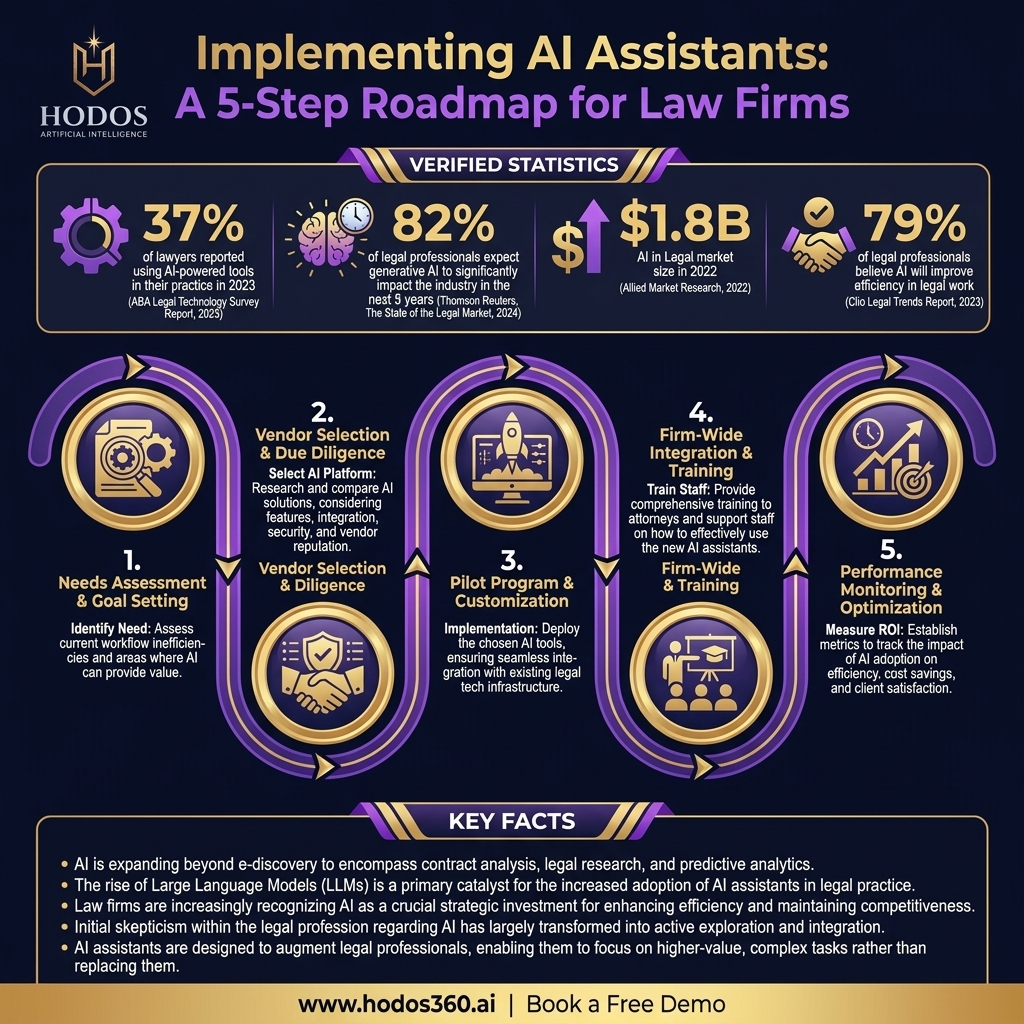
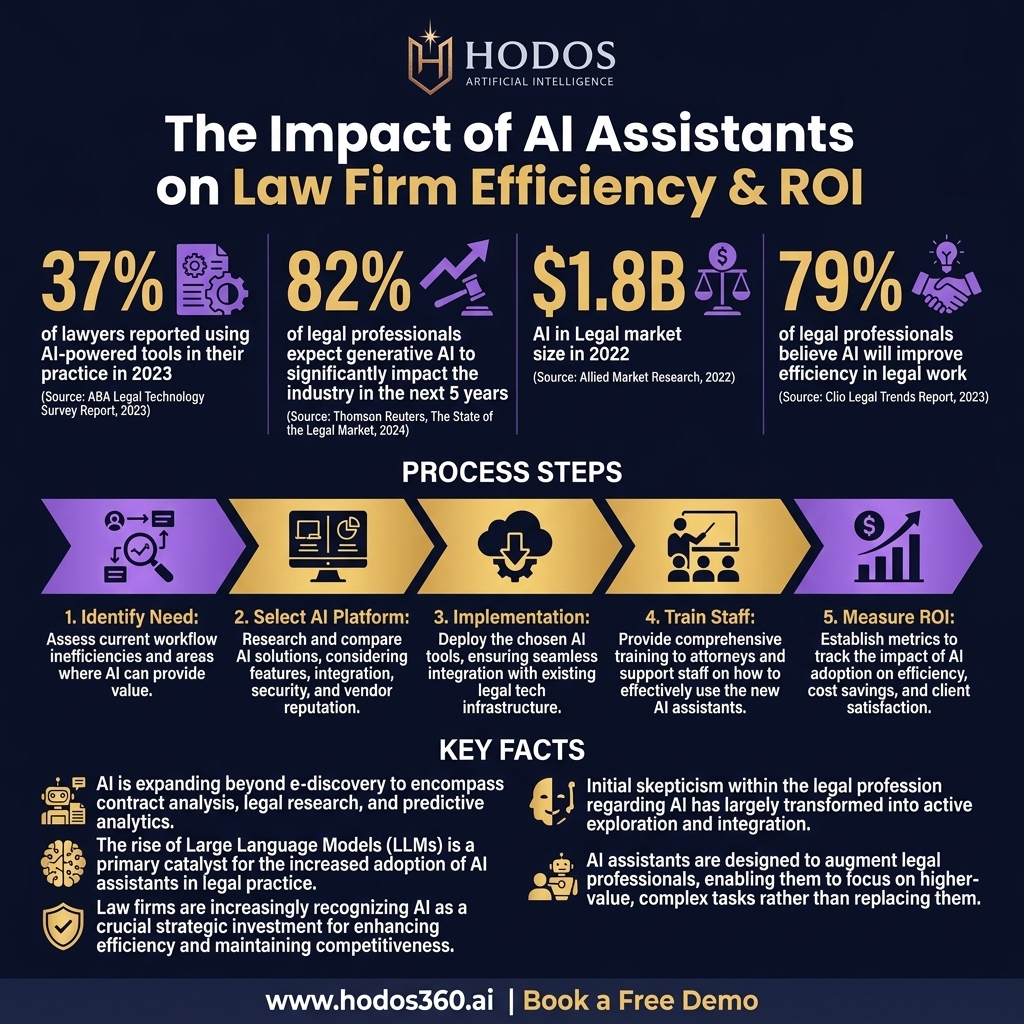
Law firms should begin with a needs assessment to identify pain points where AI can offer the most impact. Next, research and vet reputable AI vendors, prioritizing solutions with strong security, compliance, and user-friendly interfaces. Start with a pilot program in a specific practice area, gather feedback, and then scale adoption firm-wide with comprehensive training. Continuous monitoring and adaptation are crucial for long-term success and optimization.