

AI Assistants: Essential for Law Firm Web Engagement & Growth
The digital front door of a law firm is no longer just a static brochure; it’s an interactive gateway where first impressions are forged and client relationships begin. In an era where immediate access and personalized experiences define consumer expectations, traditional legal websites often fall short, leaving potential clients navigating complex information alone. This challenge is precisely where advanced AI assistants are making their mark, fundamentally reshaping the paradigm of online legal engagement. The recent buzz around platforms like AIOHM integrating AI assistants directly into WordPress highlights a broader industry trend: the move towards intelligent, responsive web experiences that proactively serve visitors. This isn't merely about adding a chatbot; it's about embedding a sophisticated layer of intelligence that understands user intent, provides instant, relevant information, and streamlines the initial client journey.
For law firms, this evolution represents both a formidable challenge and an unprecedented opportunity. The tension between maintaining professional gravitas and adopting cutting-edge technology is palpable. Firms that hesitate risk being outmaneuvered by agile competitors leveraging these tools to capture and convert leads more effectively. Conversely, those that embrace AI assistants stand to gain significant advantages in client acquisition, operational efficiency, and overall market positioning. Consider the firm of ‘LexCorp LLP’ which, before integrating AI, saw a 40% drop-off rate on their 'Contact Us' page due to slow response times. Their partners, accustomed to traditional outreach, initially resisted, fearing a loss of human touch. However, as client expectations shifted, driven by seamless experiences in other sectors, LexCorp realized that their web presence needed to evolve from a passive information hub to an active engagement platform. This shift is not just technological; it’s strategic, demanding a re-evaluation of how law firms connect with their digital audience in a rapidly digitizing world. It’s about leveraging the power of generative AI to not just answer questions, but to anticipate needs and guide potential clients through their legal challenges with unprecedented ease and speed. Ready to revolutionize your firm's online presence? Learn more about HODOS 360’s AI-powered web solutions.
The Rise of AI Assistants in Legal Web Development
The integration of AI assistants into web development marks a significant inflection point for the legal sector. No longer confined to rudimentary chatbots, today's AI assistants, fueled by advancements from titans like OpenAI under Sam Altman and Anthropic led by Dario Amodei, are capable of nuanced conversations, complex information retrieval, and even content generation. This paradigm shift means law firm websites can now offer more than static pages; they can host virtual assistants that act as 24/7 digital receptionists, initial query handlers, and personalized navigators. This capability directly addresses a critical pain point for law firms: the high volume of routine inquiries that consume valuable staff time and often delay responses to urgent client needs. According to the 2023 ABA TechReport, only 30% of law firms effectively utilize their websites for client intake, a number poised to surge with more intelligent AI integration.
Historically, law firms have been cautious adopters of new technologies, often prioritizing security and tradition over innovation. However, the sheer competitive pressure and evolving client expectations are forcing a reckoning. Firms like Allen & Overy, early partners with legal AI pioneer Harvey AI, demonstrated the competitive edge gained from embracing advanced AI solutions, even if initially focused on internal operations. The shift towards client-facing AI on websites is a natural progression. It’s about meeting clients where they are – online – and providing the immediate, accurate support they’ve come to expect from digital interactions across all industries. Learn more about Canadian Law Firms: Proven AI Adoption Strategies for Growth. This is not a futuristic concept; it’s a present-day imperative, with companies like HODOS 360 leading the charge in developing bespoke AI-powered web solutions specifically for the legal industry. These solutions move beyond simple FAQs, offering genuine conversational interfaces that can understand legal terminology and client distress, routing complex queries to human attorneys while efficiently handling the mundane.
This evolution is particularly critical for smaller and mid-sized law firms, where resources are often stretched thin. A sophisticated AI assistant on their website can level the playing field, providing a client experience comparable to that of larger firms without the prohibitive overhead. It automates customer engagement, ensuring that every website visitor receives prompt attention, whether it's booking an initial consultation, inquiring about specific practice areas, or accessing basic legal information. This automation frees up legal professionals to focus on high-value tasks, legal analysis, and client-specific counsel, rather than administrative duties. The ability of these virtual assistants to analyze user behavior and preferences also allows for dynamic content presentation, tailoring the website experience to individual needs, a level of personalization previously unattainable for most legal practices. This strategic deployment of AI fundamentally transforms the law firm's digital footprint into a proactive, intelligent extension of their legal services.
Personalizing the Client Journey
The true power of AI assistants in web development lies in their capacity for personalization. Gone are the days of one-size-fits-all website experiences. Modern AI, particularly generative AI, can dynamically adapt content, suggest relevant articles, and guide visitors based on their specific queries and browsing history. For a law firm, this means a potential client searching for 'divorce attorney' might be immediately greeted with a personalized message, directed to relevant resources on family law, and offered an expedited booking for a consultation, all facilitated by an intelligent virtual assistant. This level of tailored engagement dramatically improves the user experience and increases the likelihood of conversion. Learn more about Voice AI: The Essential Shift for Modern Law Firms. McKinsey Global Institute's research consistently shows that personalization can reduce acquisition costs by up to 50% and increase revenue by 5-15%, demonstrating a clear ROI for legal practices investing in these technologies. The ability to analyze user behavior in real-time allows AI assistants to anticipate needs and offer proactive support, transforming a passive website visit into an active, guided client journey. This proactive engagement is crucial for converting casual browsers into committed clients, especially in competitive legal markets.
Transforming Client Engagement with AI-Powered Websites
AI-powered websites fundamentally redefine client engagement by offering immediate, intelligent interaction at every touchpoint. Imagine a potential client landing on a law firm's site at 2 AM, seeking urgent advice on a personal injury claim. Instead of encountering an unresponsive contact form or a generic FAQ page, they are met by a sophisticated AI assistant capable of understanding their situation, gathering initial details, explaining basic legal concepts, and even booking an immediate virtual consultation for the next morning. This 24/7 availability and intelligent support are game-changers for customer support, ensuring that no lead is lost due to timing or lack of immediate human availability. The AI assistant acts as a tireless first line of defense, capturing critical information and qualifying leads before they ever reach a human attorney. This dramatically improves the efficiency of the intake process and ensures that legal professionals can focus their time on truly qualified prospects.
Furthermore, these AI virtual assistants excel at automating repetitive tasks that typically bog down legal support staff. From answering common questions about firm hours and fee structures to providing updates on general legal processes, AI can handle a significant portion of routine inquiries. This automation not only boosts productivity but also enhances client satisfaction by providing instant gratification. Firms that adopt these technologies report a noticeable increase in client satisfaction scores, as clients appreciate the speed and convenience of getting answers when they need them. This shift allows human legal professionals to dedicate their expertise to complex problem-solving and deep client relationships, the areas where human nuance and judgment are irreplaceable. Learn more about AI Marketing: The Essential Guide to Legal Personalization. The impact on client retention and loyalty is profound, as firms can maintain consistent, high-quality engagement throughout the client lifecycle, from initial inquiry to case resolution and beyond.
Beyond simple Q&A, AI assistants integrated into web platforms can facilitate more complex interactions, such as document collection and preliminary case assessment. A client might upload initial documents or fill out a guided questionnaire, with the AI intelligently prompting for necessary information and organizing it for review by an attorney. This streamlined data collection process significantly reduces the administrative burden on both the client and the firm, accelerating the case initiation process. For instance, a small business seeking intellectual property advice might use an AI assistant to outline their needs, upload relevant patents, and even receive preliminary guidance on common IP challenges, all before a human attorney reviews the full brief. This pre-qualification and data gathering ensure that when a human attorney does engage, they are already equipped with a comprehensive understanding of the client's needs and context, making the consultation far more productive and efficient.
This proactive and intelligent engagement strategy is not just about efficiency; it's about building trust and demonstrating a commitment to client service in the digital age. Firms that offer a seamless, responsive online experience are perceived as modern, client-centric, and technologically advanced, differentiating them in a crowded legal market. The ability to provide consistent, high-quality interactions, irrespective of time zones or office hours, significantly enhances a firm's reputation and expands its reach. This is particularly relevant in cross-border practices or for firms with a national client base, where 24/7 multilingual support from an AI assistant can bridge geographical and linguistic divides, ensuring that every potential client feels heard and understood. This leads to better lead qualification and ultimately, higher conversion rates, directly impacting the firm's bottom line.
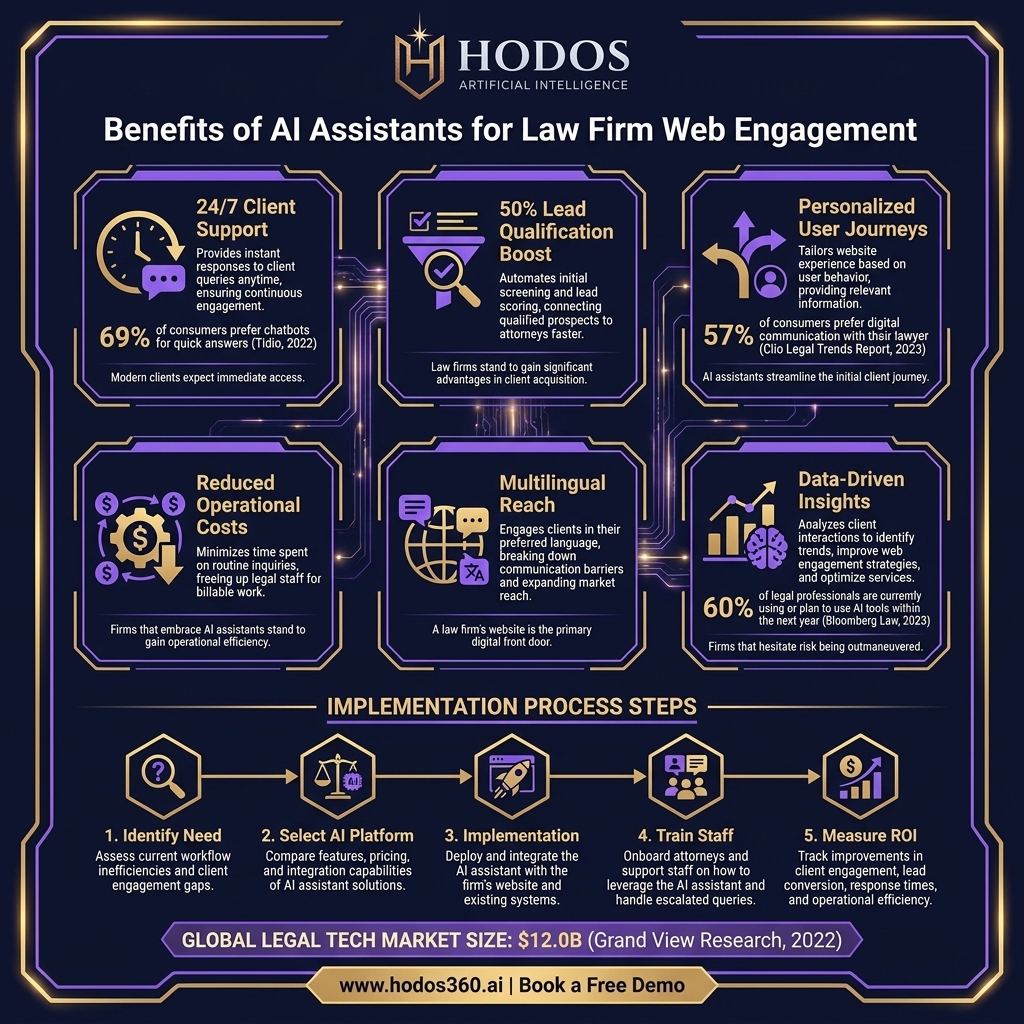
- ✓24/7 Availability: AI assistants provide round-the-clock support, ensuring potential clients receive immediate responses regardless of business hours, significantly reducing missed opportunities.
- ✓Automated Lead Qualification: By asking targeted questions, AI can pre-qualify leads, gathering essential information and directing only the most promising prospects to human attorneys, optimizing resource allocation.
- ✓Personalized Content Delivery: AI analyzes user behavior and queries to deliver highly relevant content, legal resources, and service recommendations, enhancing the user experience and increasing engagement.
- ✓Multilingual Support: Breaking down language barriers, AI assistants can communicate effectively in multiple languages, expanding a firm's reach to diverse client bases and improving accessibility.
- ✓Efficient Appointment Booking: AI can seamlessly integrate with calendars to schedule consultations, reducing administrative overhead and ensuring a smooth transition from inquiry to meeting.
- ✓Data-Driven Insights: AI collects and analyzes interaction data, providing law firms with valuable insights into client needs, common queries, and website performance, enabling continuous improvement.
- ✓Reduced Operational Costs: By automating routine inquiries and administrative tasks, AI assistants free up staff time, leading to significant cost savings and increased productivity across the firm.
Beyond Chatbots: Advanced AI Virtual Assistants for Law Firms
The distinction between simple chatbots and advanced AI virtual assistants is critical for law firms considering this technology. While basic chatbots follow predefined scripts, modern AI virtual assistants leverage sophisticated natural language processing (NLP) and generative AI, similar to the foundational models developed by Google and Microsoft for their Copilot initiatives. These advanced systems can understand context, infer intent, and even learn from interactions, making them incredibly versatile. For example, a virtual assistant can not only answer a question about probate law but also identify if the user is a beneficiary, an executor, or a potential client needing estate planning, then tailor its responses and guidance accordingly. This deep understanding enables the AI to act as a true digital legal guide, offering more than just information; it provides relevant pathways to resolution.
One of the most compelling applications of these advanced AI assistants is in automating the initial stages of legal research and information gathering for clients. While they cannot provide legal advice, they can direct clients to authoritative sources, explain procedural steps, and clarify common legal jargon in an accessible manner. Consider the scenario where a user is trying to understand the implications of a new piece of legislation, such as the EU AI Act now being enforced. An advanced AI assistant could summarize key provisions, link to official government resources, and explain how it might impact a client's business, all while flagging that specific legal advice requires human consultation. This capability empowers clients with knowledge and builds trust, positioning the law firm as a helpful and knowledgeable resource even before formal engagement. This level of informational support is a significant leap beyond what traditional websites or basic chatbots can offer, demonstrating the true power of generative AI in enhancing client services.
Furthermore, these AI assistants are not just for external client-facing roles. They can also serve as invaluable tools for internal firm productivity. Imagine an AI assistant that helps attorneys quickly locate specific clauses in a vast document repository, or summarizes key points from recent court rulings relevant to an ongoing case. Learn more about AI Marketing Intelligence: The Ultimate Guide for Law Firms. While the focus here is on external web engagement, the underlying AI technology often has dual-use potential, enhancing efficiency across the entire legal workflow. This holistic approach to AI integration, from client intake to internal case management, is what differentiates leading legal tech platforms. The ability to seamlessly integrate with existing firm management systems, as offered by HODOS 360, means that information gathered by the AI assistant during initial web interactions can be directly fed into the firm’s case management system, ensuring continuity and reducing redundant data entry, a common source of inefficiency in legal practices. This integration transforms the AI assistant from a standalone tool into an integral part of the firm's operational backbone.
The ethical considerations surrounding the deployment of advanced AI assistants are paramount. Law firms must ensure compliance with professional responsibilities, particularly concerning confidentiality (ABA Model Rule 1.6), competence (ABA Model Rule 1.1), and unauthorized practice of law (ABA Model Rule 5.5). The AI must be carefully trained and configured to avoid giving legal advice, instead focusing on providing information, guiding users, and facilitating contact with human attorneys. Transparency about the AI's role is also crucial for maintaining client trust. For instance, the State Bar of California has issued guidance emphasizing the need for clear disclosures when AI is used in client communications, ensuring clients understand they are interacting with an automated system. Firms must also be vigilant about data privacy and security, as AI systems process sensitive client information. Robust security protocols and adherence to regulations like GDPR or CCPA are non-negotiable. The development of AI within a legal context, therefore, requires a delicate balance between leveraging technological advantages and upholding the highest standards of professional conduct and client protection.
Automating Routine Inquiries and Lead Qualification
A significant benefit of deploying AI assistants on law firm websites is their unparalleled ability to automate routine inquiries and rigorously qualify leads. The average law firm receives dozens, if not hundreds, of general questions daily—“What are your hours?”, “Do you handle real estate law?”, “How much does a consultation cost?” These are essential questions but consume valuable staff time. An AI assistant can handle these instantly and accurately, freeing up paralegals and administrative staff for more complex tasks. This automation doesn't just save time; it ensures consistency in responses and eliminates potential human error. Furthermore, AI can be programmed to ask specific qualifying questions, filtering out non-viable leads and identifying high-priority prospects based on criteria such as case type, urgency, and potential value. Learn more about Voice AI: Essential Strategies for Law Firms' Future. This means attorneys spend their time engaging with individuals who are genuinely in need of their specific services, dramatically increasing conversion rates and improving overall firm productivity. This strategic use of AI ensures that every client interaction, from the first digital touchpoint, is optimized for efficiency and effectiveness. Discover how HODOS 360 can elevate your firm's lead qualification processes.
Implementing AI Assistants: Strategic Considerations for Legal Practices
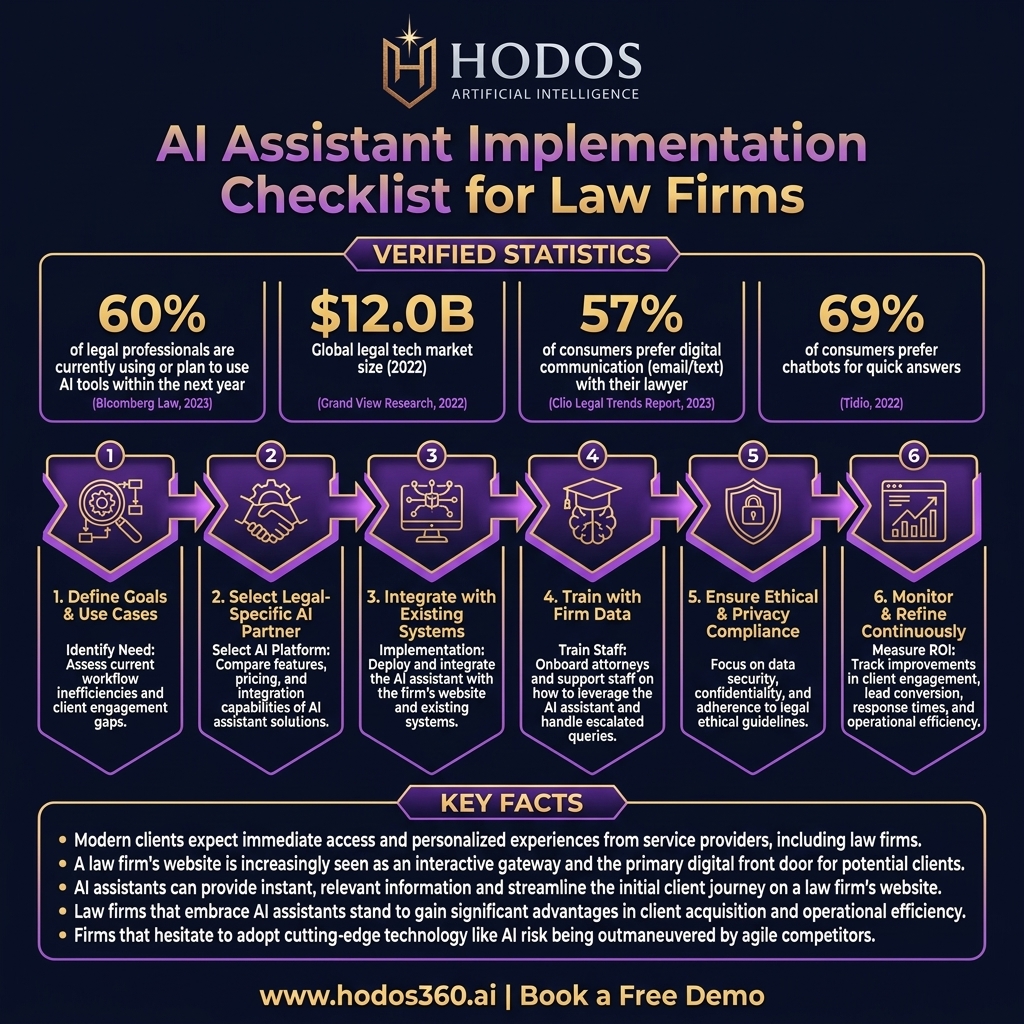
Implementing AI assistants effectively requires a strategic approach that goes beyond simply installing new software. Law firms must carefully consider their specific goals, target audience, and existing technological infrastructure. A crucial first step is to identify which aspects of client engagement and website interaction would benefit most from automation. Is it initial client intake, answering FAQs, appointment scheduling, or providing preliminary information on specific legal topics? Defining these use cases will guide the selection and training of the AI assistant. For instance, a firm specializing in immigration law might prioritize multilingual support and complex document submission guidance, while a personal injury firm might focus on rapid lead qualification and urgent appointment booking. The success of AI implementation hinges on aligning the technology with the firm's strategic objectives and client needs, ensuring that the AI truly augments, rather than complicates, the client experience.
Another vital consideration is the quality and relevance of the data used to train the AI assistant. Legal language is nuanced and precise, and an AI must be trained on a robust dataset of legal queries, terminology, and firm-specific information to be truly effective. Generic AI models may lack the specificity required for legal contexts, leading to inaccurate or unhelpful responses. Firms should partner with legal tech providers who understand these intricacies and can offer AI solutions tailored to the legal domain. This often involves a collaborative process where the firm provides its specific knowledge base, and the provider fine-tunes the AI to reflect the firm's unique voice, practice areas, and service offerings. This bespoke training ensures that the AI assistant operates as an intelligent extension of the firm, maintaining brand consistency and delivering accurate, relevant information to potential clients.
Furthermore, the integration of AI assistants with existing legal tech stacks is paramount for seamless operations. Learn more about AI-Native Law Firms: The Ultimate Guide to Modern Legal Practice. An AI assistant should not operate in a silo; it needs to connect with the firm’s case management system, billing software, and calendar tools to truly maximize its value. This interoperability ensures that data collected by the AI during initial client interactions can flow directly into the firm’s internal systems, minimizing manual data entry and reducing the risk of errors. For example, if an AI assistant qualifies a lead and schedules an appointment, that information should automatically populate the firm’s CRM and attorney calendars. This level of integration, a core offering of HODOS 360’s AI-powered Web & Mobile Development services, creates a cohesive and efficient ecosystem, transforming disparate tools into a unified, intelligent platform. Without robust integration, the potential of AI assistants remains largely untapped, leading to fragmented workflows and diminished returns on investment.
Finally, ongoing monitoring and refinement are essential for the long-term success of AI assistant deployment. AI models are not set-it-and-forget-it solutions; they require continuous learning and optimization based on real-world interactions. Firms should regularly review AI performance, analyze interaction logs, and gather client feedback to identify areas for improvement. This iterative process ensures that the AI assistant remains effective, adapts to evolving client needs, and stays current with changes in legal practice or firm offerings. The initial deployment is just the beginning; the true value is unlocked through continuous improvement and adaptation. Firms that treat AI implementation as an ongoing journey, rather than a one-time project, will be best positioned to harness the full potential of these transformative technologies for sustained growth and enhanced client engagement, ensuring their web presence remains cutting-edge and highly effective.
Ethical AI Deployment and Data Privacy
The ethical deployment of AI assistants in legal web development is not merely a compliance issue; it's a foundational element of client trust and professional responsibility. Law firms must meticulously adhere to ethical guidelines, particularly concerning client confidentiality and the avoidance of unauthorized legal practice. It is imperative that AI assistants are designed and explicitly communicated as informational tools, never as substitutes for qualified legal counsel. Clear disclaimers should be prominently displayed, informing users they are interacting with an AI and that specific legal advice requires a human attorney. Furthermore, robust data privacy measures are non-negotiable. With sensitive client information potentially being processed, firms must ensure that AI systems comply with all relevant data protection regulations, such as the General Data Protection Regulation (GDPR) or the California Consumer Privacy Act (CCPA), and implement stringent security protocols to safeguard client data against breaches. Adhering to ABA Model Rules on competence and communication means firms must understand the capabilities and limitations of their AI tools and clearly convey these to clients, fostering transparency and maintaining professional integrity.

Key Takeaways and Next Steps
The legal industry stands at the precipice of a digital transformation, with AI assistants emerging as a critical component of modern law firm web engagement and operational efficiency. The narrative of legal tech is no longer one of cautious experimentation but of strategic imperative, driven by evolving client expectations and the competitive landscape. As demonstrated by the rapid adoption of generative AI in various sectors, firms that embrace intelligent web solutions will gain a significant advantage in client acquisition, lead qualification, and overall practice management. The days of passive websites are over; the future belongs to dynamic, AI-powered platforms that offer personalized, 24/7 support. HODOS 360's Web & Mobile Development service is designed to empower law firms with these cutting-edge capabilities, enabling them to build highly responsive, AI-integrated websites that not only attract but also effectively engage and convert prospective clients. By strategically implementing AI assistants, law firms can streamline operations, enhance client satisfaction, and position themselves for sustainable growth in an increasingly digital world. Don't be left behind; explore how AI can transform your firm's digital presence today.
Frequently Asked Questions
What specifically can an AI assistant do for my law firm's website?+
An AI assistant can automate client intake, answer common FAQs about your firm and practice areas, qualify leads by asking targeted questions, schedule appointments, and provide 24/7 multilingual support. It acts as a digital first point of contact, enhancing customer engagement and freeing up your staff for more complex legal work.
How do AI assistants differ from traditional chatbots?+
Unlike traditional chatbots that follow predefined scripts, advanced AI assistants leverage generative AI and natural language processing to understand context, infer user intent, and engage in more dynamic, human-like conversations. They can learn from interactions and provide more personalized and relevant information, going beyond simple rule-based responses.
Are there ethical concerns with using AI assistants for legal clients?+
Yes, ethical considerations are crucial. Firms must ensure AI assistants do not provide legal advice, maintain client confidentiality, and adhere to data privacy regulations like GDPR or CCPA. Transparency is key; clients should be aware they are interacting with an AI. Compliance with ABA Model Rules (e.g., Competence, Confidentiality) is paramount.
Can AI assistants integrate with my existing law firm management software?+
Effective AI assistants are designed for seamless integration. They can connect with your firm's case management systems, CRM, billing software, and calendars. This ensures that data collected during initial web interactions flows directly into your internal workflows, reducing manual data entry and enhancing overall operational efficiency.
What kind of ROI can I expect from implementing AI assistants on my website?+
Firms can expect significant ROI through improved lead qualification, reduced operational costs from automated tasks, increased client satisfaction due to 24/7 support, and higher conversion rates from personalized engagement. Studies by McKinsey suggest personalization can reduce acquisition costs and increase revenue, making it a strategic investment.