


AI Billable Hours: The Ultimate Guide to Legal Firm Evolution
The legal profession, long anchored to the billable hour, finds itself at a pivotal juncture. As the Wisconsin Law Journal recently highlighted, "AI puts pressure on law firms’ billable hour model," signaling a shift that extends far beyond mere technological adoption. Consider the story of Sarah Chen, a managing partner at a mid-sized litigation firm in Chicago. For years, her firm navigated increasing client demands for cost predictability and faster turnarounds. When a key corporate client questioned a large e-discovery bill, asking why tasks that AI could perform in hours were still taking weeks, Sarah realized the ground was truly shifting beneath their feet.
This isn't merely about automating mundane tasks; it's about fundamentally redefining how legal value is created and compensated. The pressure on traditional AI billable hours is immense, forcing firms to confront long-held practices. Yet, this challenge presents an unparalleled opportunity for innovation. Firms that proactively integrate artificial intelligence are not just surviving; they are thriving, demonstrating enhanced efficiency, greater client satisfaction, and ultimately, superior profitability. The question is no longer *if* AI will impact billing, but *how* firms will strategically adapt to this new paradigm. Discover how your firm can navigate this transformation and emerge stronger.
The Shifting Sands of the Billable Hour: A New Paradigm
For decades, the billable hour served as the bedrock of legal compensation, a seemingly logical measure for complex, time-intensive work. Its origins, solidified in the mid-20th century, aligned with a legal landscape where information retrieval was manual and expertise was directly proportional to hours spent. However, client sentiment has been steadily eroding this foundation. A 2023 Thomson Reuters Legal Executive Institute report revealed that a significant majority of corporate legal departments prioritize budget predictability and value over hourly rates, expressing frustration with opaque billing practices and the perceived inefficiency of traditional legal processes. This mounting dissatisfaction has laid the groundwork for a disruptive force: Artificial Intelligence.
Generative AI, in particular, isn't just an incremental improvement; it's a paradigm shift. As Sam Altman, CEO of OpenAI, has often articulated, AI is set to redefine knowledge work, making complex tasks accessible and efficient in ways previously unimaginable. For law firms, this translates into a direct challenge to the very concept of 'time spent' as the primary metric of value. Tasks like contract review, legal research, and due diligence, once requiring hundreds of billable hours, can now be executed with remarkable speed and accuracy by AI. Learn more about AI Adoption: The Ultimate Guide for Law Firm Success. This efficiency, while beneficial for clients, places immense *pressure* on firms to justify traditional hourly rates for work that is increasingly automated.
Firms that ignore this shift do so at their peril. The market is already rewarding those who embrace efficiency. According to the American Bar Association (ABA) Model Rule 1.5 regarding fees, lawyers must ensure their fees are reasonable. As AI dramatically reduces the time required for certain tasks, the 'reasonableness' of a high hourly charge for an AI-assisted task comes under scrutiny. This demands a re-evaluation of fee structures, pushing firms towards models that align with the true value delivered, rather than merely the time taken. The transformation is not just technological; it's ethical and economic, forcing firms to confront the evolving expectations of their clients and the very definition of legal service.
The Rise of AI-Powered Legal Workflows
The integration of AI into legal workflows is profoundly *transforming* how attorneys operate, directly impacting AI billable hours. Platforms like Harvey AI, famously partnered with Allen & Overy, demonstrate how generative AI can automate initial drafts of legal documents, summarize complex cases, and conduct comprehensive legal research in minutes rather than days. This drastically *reduces* the time lawyers spend on traditionally billable, yet often repetitive, tasks. For example, a senior associate might have spent 40 hours on a first-pass contract review; with AI, that same task might take 5 hours of human oversight and refinement, significantly lowering the total billable hours for the client.
Beyond specialized AI tools, comprehensive AI-powered legal management systems are central to this evolution. Platforms like HODOS 360's AI Law Firm Management System integrate case management, billing, client intake, and document automation, streamlining operations from end-to-end. Learn more about Legal AI ROI: Maximizing Law Firm Value in 2026. This holistic approach ensures that every aspect of a firm's work benefits from AI-driven efficiency. Data from Clio, a prominent legal tech provider, consistently shows that firms leveraging integrated practice management software report higher realization rates and improved client satisfaction, largely due to better workflow management and transparent billing. By automating administrative burdens and optimizing legal processes, these systems empower attorneys to focus on higher-value strategic work, shifting the emphasis from quantity of hours to quality of outcomes.
Generative AI's Impact on Legal Workflows and Efficiency
The true disruptive power of generative AI lies in its ability to not just automate, but to *create*. This capability is reshaping legal workflows by taking on tasks that previously demanded significant human intellect and time. Consider the exhaustive process of due diligence in mergers and acquisitions. Historically, this involved teams of lawyers sifting through thousands of documents, identifying risks, and summarizing findings. With generative AI, this process is dramatically accelerated. AI models can quickly review vast data sets, identify relevant clauses, flag anomalies, and even draft initial risk reports, reducing the time commitment from weeks to days, or even hours. This efficiency directly impacts the potential for AI billable hours, pushing firms to rethink their value proposition.
Jensen Huang, CEO of NVIDIA, often speaks of AI as the ultimate 'productivity engine,' and its application in legal is a prime example. Learn more about Legal AI Adoption: An Essential Roadmap for Law Firms. From automating the creation of routine legal correspondence to generating first drafts of complex pleadings or advisory memos, generative AI frees up attorney time. A 2024 report by McKinsey & Company on AI's impact on professional services projected productivity gains of 15-20% for tasks involving information processing and communication, areas central to legal practice. This means that tasks once requiring a partner's detailed review and several associate-hours can now be done with a more efficient, AI-augmented process, shifting the focus from 'time spent' to 'value delivered' and 'outcomes achieved.'
Beyond document generation, AI is enhancing efficiency in litigation strategy and prediction. Advanced analytics, powered by AI, can analyze vast repositories of case law, judicial behavior, and settlement data to predict potential outcomes, identify winning arguments, and even recommend optimal settlement ranges. This proactive, data-driven approach significantly streamlines the litigation process, saving clients considerable costs and reducing the overall billable hours associated with protracted legal battles. Firms that master these AI-driven strategies gain a significant competitive edge, attracting clients who prioritize speed, predictability, and results.
Reimagining Value: Beyond the Traditional Billable Hour Model
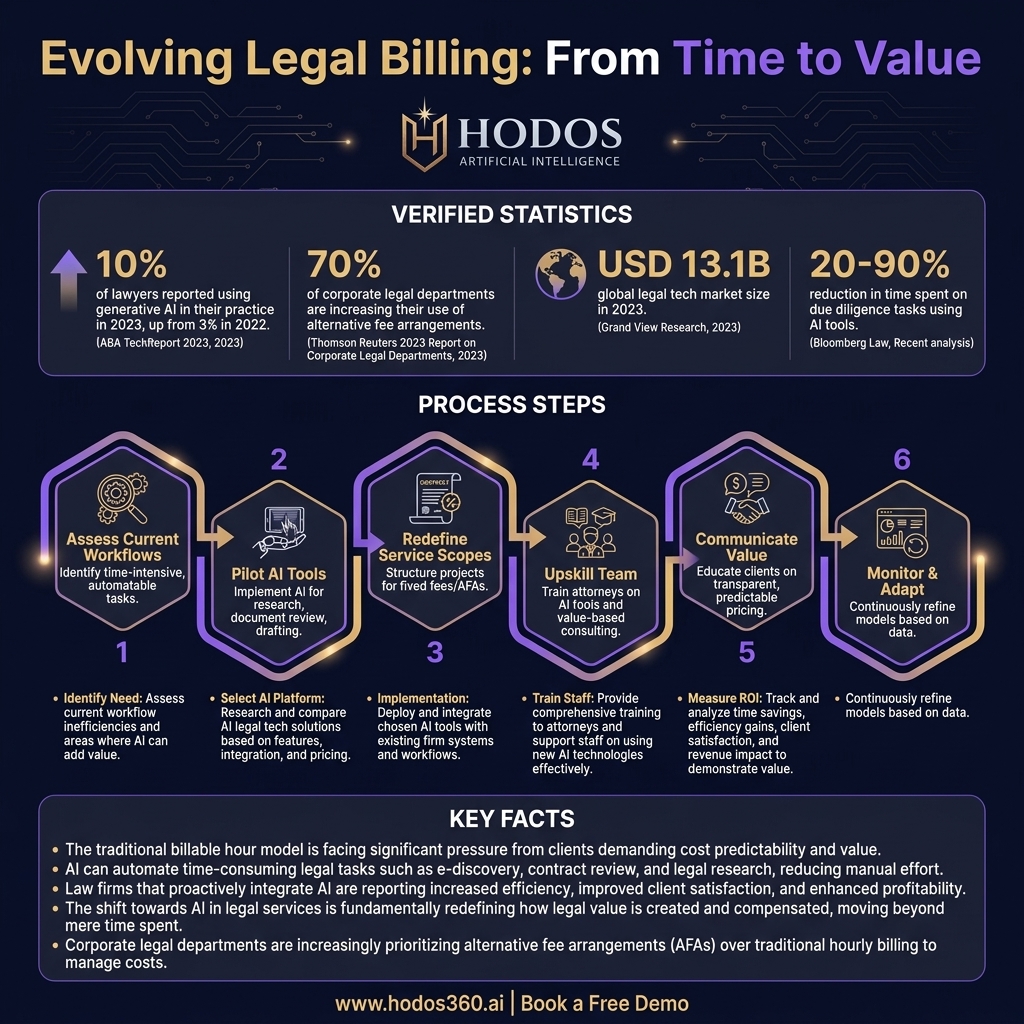
As AI fundamentally alters the cost and time associated with legal tasks, the traditional billable hour becomes increasingly untenable for many services. This necessitates a profound shift in how law firms conceive of and charge for their value. The future lies in alternative fee arrangements (AFAs) that prioritize predictability, efficiency, and demonstrable results for the client. These include fixed fees for defined projects, subscription models for ongoing advisory services, contingency fees for certain litigation, and increasingly, true value-based pricing that aligns the firm's compensation directly with the client's desired outcome. Firms like nimble boutiques and even some larger innovators are already experimenting with these models, gaining market share by offering greater transparency and cost certainty.
The adoption of AFAs is not merely a response to client pressure; it's a strategic move to future-proof the firm. When a task that previously took 20 hours can now be completed in 2 hours with AI, billing 20 hours becomes ethically questionable and competitively unviable. Learn more about AI Voice Assistants: The Essential Evolution of Legal Client Interaction. Instead, a firm can offer a fixed fee for that outcome, knowing their internal efficiency (thanks to AI) allows them to deliver it profitably. This transforms the firm's focus from tracking time to optimizing processes and delivering superior results. The conversation shifts from 'how long did this take?' to 'what problem did we solve and what value did we create?' This is the essence of reimagining value in an AI-driven legal landscape.
Transitioning to these models requires a deep understanding of internal costs and the ability to accurately scope projects—areas where AI itself can provide significant assistance. By analyzing historical project data and predicting task durations, AI tools can help firms set more accurate fixed fees, mitigating risk and ensuring profitability. The firms that embrace this strategic pivot are not just adapting; they are actively shaping the future of legal service delivery, building stronger, more transparent relationships with clients, and ultimately, securing their long-term viability in a market that increasingly values innovation and efficiency over outdated billing conventions.
Adopting Alternative Fee Arrangements (AFAs)
Successfully adopting AFAs requires a deliberate strategy and clear communication. Firms must first conduct an internal audit of their services to identify which tasks are amenable to fixed fees, subscriptions, or value-based pricing. This often involves leveraging AI-powered legal workflows to accurately estimate the time and resources required for project completion. For instance, a firm might offer a fixed fee for drafting a standard commercial contract, knowing that their AI document automation tool (part of HODOS 360's offerings) can generate a high-quality first draft in minutes, allowing attorneys to focus on customization and negotiation. Transparency with clients is paramount; clearly defining the scope of work and the deliverables under an AFA builds trust and manages expectations.
Moreover, firms should invest in client intake processes that facilitate detailed scope definition, minimizing 'scope creep' which can undermine the profitability of AFAs. Learn more about Essential AI Web Development: DXP Strategy for Law Firms. This is where systems offering streamlined client intake are invaluable, ensuring all parameters are agreed upon upfront. The shift also requires a cultural change within the firm, encouraging attorneys to think in terms of outcomes and efficiency rather than hours logged. Training programs that focus on project management, client communication, and the strategic use of AI tools are essential to empower legal professionals to thrive under these new billing models. The goal is to move beyond simply reacting to client demands and proactively offer innovative, value-driven solutions.
Strategic Implementation: Leveraging AI for Sustainable Growth
For law firms, the integration of AI is not a fleeting trend but a fundamental imperative for sustainable growth. A strategic roadmap for AI adoption is crucial, moving beyond pilot projects to firm-wide transformation. This involves careful selection of AI tools that align with specific firm needs—from document automation to AI marketing platforms and AI voice assistants for client interaction. Dario Amodei, CEO of Anthropic, emphasizes the importance of responsible AI development, a principle that extends to legal firms ensuring ethical deployment and human oversight. Firms that prioritize a thoughtful, phased implementation gain a significant competitive advantage, positioning themselves as forward-thinking leaders in a rapidly evolving market.
Investing in AI is also an investment in attorney development. The role of the lawyer is evolving from a task-doer to a strategic advisor, leveraging AI for efficiency while focusing on complex problem-solving, client relationships, and nuanced legal judgment. This requires continuous training and upskilling for all legal professionals, ensuring they are proficient in utilizing AI tools and understanding their implications. Learn more about Essential AI Web Development: Harvard's Free Courses for Law Firms. Firms should foster a culture of innovation, encouraging experimentation and knowledge sharing. This proactive approach not only enhances efficiency and profitability but also improves attorney satisfaction by reducing time spent on repetitive, low-value tasks, allowing them to engage in more intellectually stimulating work.
Furthermore, strategic AI implementation extends to client acquisition and retention. An AI marketing platform can generate targeted content, automate social media outreach, and track ROI, ensuring marketing efforts are efficient and effective. Similarly, AI-powered website building and responsive website development ensure a strong digital presence that converts leads. By showcasing a commitment to cutting-edge technology and transparent, value-driven services, firms can attract a new generation of clients who expect efficiency and innovation. This holistic approach to AI integration, touching every facet of firm operations, is the bedrock of long-term success in the modern legal landscape.
Ethical Considerations and Client Trust
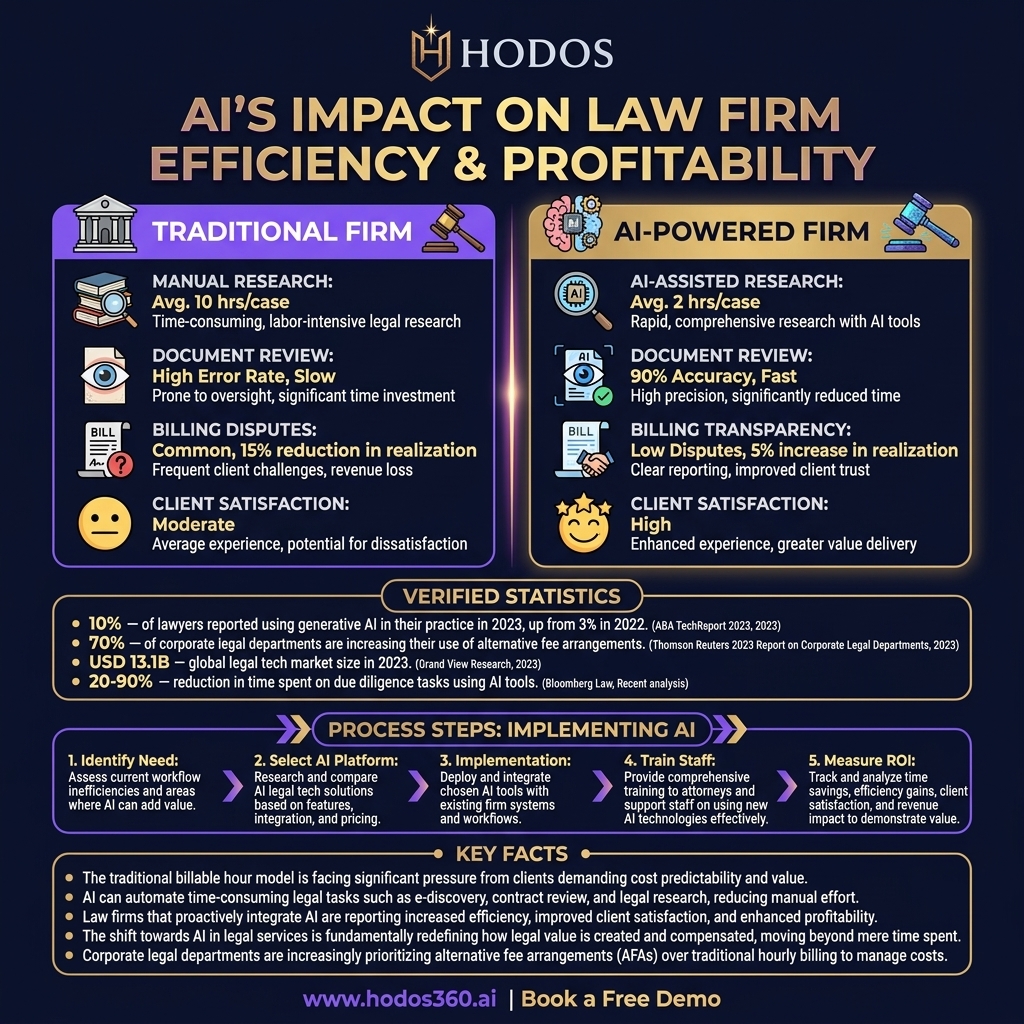
The ethical implications of AI in legal practice, particularly concerning billing, are paramount. Lawyers have a professional duty to ensure their fees are reasonable and to communicate clearly with clients about how those fees are calculated, as outlined in ABA Model Rule 1.5 (Fees). With AI reducing the time required for certain tasks, firms must be transparent about their use of technology and how it impacts the bill. Simply billing the same hourly rate for an AI-assisted task as for a fully human-executed one could be seen as unethical or even fraudulent if not properly disclosed and justified. The EU AI Act, expected to be enforced in 2026, also sets precedents for transparency and accountability in AI systems, which legal firms must heed.
Maintaining client trust is central to any firm's success. This means being upfront about AI tools, explaining their benefits in terms of efficiency and cost savings, and emphasizing that human oversight and judgment remain critical. For example, when using an AI tool for contract review, a firm might explain that the AI performs the initial pass, but a human attorney conducts the final review and provides strategic advice. This ensures that clients understand the value proposition, recognizing that they are paying for expertise and outcomes, not just raw hours. Firms must develop clear internal policies for AI usage, data privacy, and ethical billing practices to navigate this evolving landscape responsibly.
- ✓Assess Current Workflows: Identify repetitive, time-consuming tasks ripe for AI automation.
- ✓Invest in Integrated AI Platforms: Adopt comprehensive systems like HODOS 360's AI Law Firm Management for seamless operations.
- ✓Explore Alternative Fee Arrangements: Experiment with fixed fees, subscriptions, and value-based pricing models.
- ✓Prioritize Attorney Upskilling: Train legal professionals on AI tools, prompt engineering, and value-driven client communication.
- ✓Enhance Transparency: Communicate clearly with clients about AI usage and its impact on billing and service delivery.
- ✓Foster a Culture of Innovation: Encourage continuous learning, experimentation, and adaptation to new technologies.
The Future of Legal Practice: Embracing AI for Competitive Advantage
The debate around AI billable hours isn't about the demise of the legal profession, but its profound evolution. As the Wisconsin Law Journal article suggests, the pressure on the traditional model is undeniable, yet this pressure is a catalyst for innovation and a more client-centric approach. Firms that *survive* and excel in this new era will be those that strategically embrace AI not as a threat, but as a powerful tool to enhance their capabilities, optimize their operations, and redefine their value proposition. This means moving beyond merely automating tasks to truly integrating AI into the fabric of their practice, from client intake and case management to marketing and client service.
The future legal professional will be an AI-augmented attorney, freed from the drudgery of routine tasks to focus on complex legal strategy, empathetic client counseling, and creative problem-solving. This shift allows lawyers to dedicate more time to the uniquely human aspects of their profession, fostering deeper client relationships and delivering truly bespoke legal solutions. The competitive landscape will favor firms that can offer predictable costs, demonstrate measurable value, and leverage technology to deliver superior outcomes with unparalleled efficiency. The firms that hesitate to adopt AI risk being outmaneuvered by more agile, technologically advanced competitors, struggling to meet evolving client expectations.
Ultimately, embracing AI is about securing a competitive advantage in a rapidly changing legal market. It's about building a more efficient, profitable, and client-focused practice that is resilient to disruption. By strategically implementing AI tools, training their teams, and reimagining their billing models, law firms can transform the pressure on AI billable hours into an opportunity for unprecedented growth and innovation. The future of legal practice is not just AI-powered; it's also human-led, with technology empowering attorneys to achieve more and deliver greater value than ever before. This is an exciting time for the legal profession, offering a clear path to sustained success for those willing to adapt and innovate.

Key Takeaways and Next Steps
The legal industry stands at the precipice of a significant transformation, driven by the pervasive influence of AI. The traditional billable hour, while not entirely obsolete, is being reshaped into a more nuanced, value-driven system. Law firms must recognize this shift not as a threat to their profitability but as a profound opportunity to enhance efficiency, redefine their value proposition, and foster stronger client relationships. Proactive engagement with AI technologies is no longer optional; it is a strategic imperative for firms aiming to maintain relevance and achieve sustainable growth.
To navigate this evolving landscape successfully, law firms should prioritize a multi-faceted approach: invest in integrated AI solutions, explore flexible billing models, and commit to continuous professional development for their teams. By embracing these changes, firms can transform the pressure on AI billable hours into a catalyst for innovation, ultimately positioning themselves as leaders in the future of legal service delivery. The journey ahead requires foresight, adaptability, and a commitment to leveraging technology for the betterment of both practice and client.
Frequently Asked Questions
Is the billable hour truly dead for law firms?+
No, the billable hour is not entirely dead, but it is undergoing significant pressure and evolution. AI is reducing the time required for many tasks, making traditional hourly billing less justifiable for certain services. Firms are increasingly adopting alternative fee arrangements (AFAs) that focus on value and predictability, though the billable hour may persist for highly complex, unpredictable work where time spent truly correlates with expertise.
How does AI specifically reduce billable hours in law firms?+
AI reduces billable hours by automating time-consuming tasks such as legal research, document review, contract drafting, and due diligence. Generative AI can produce first drafts of legal documents, summarize cases, and analyze vast data sets far more quickly and accurately than humans alone. This efficiency allows attorneys to complete work in less time, directly impacting the number of hours that can be billed to clients for these specific tasks.
What are alternative billing models that law firms can adopt?+
Law firms can adopt various alternative billing models, including fixed fees for specific projects, subscription models for ongoing advisory services, contingency fees (common in personal injury or class action), and value-based pricing where fees are tied to the client's desired outcome or perceived value. These models offer clients greater cost predictability and align the firm's incentives with efficient, results-driven service delivery.
How can law firms ethically transition to new billing models with AI?+
Ethical transition requires transparency and clear communication with clients about AI usage and its impact on billing. Firms must ensure fees remain reasonable, as per ABA Model Rule 1.5. Disclosing the use of AI, explaining its benefits in terms of efficiency and cost savings, and emphasizing human oversight builds trust. Firms should also develop internal policies for AI deployment, data privacy, and ethical billing practices to navigate this evolving landscape responsibly.
What is the primary benefit for law firms embracing AI for billing and operations?+
The primary benefit for law firms embracing AI is a significant competitive advantage through enhanced efficiency, improved profitability, and greater client satisfaction. By automating routine tasks, AI frees attorneys for higher-value, strategic work, allowing firms to deliver faster, more predictable, and more cost-effective services. This attracts and retains clients who value innovation and transparency, securing the firm's long-term sustainability and growth.