

AI Content Operations: Essential for Law Firm Marketing Success
The legal industry often views technological advancements through the lens of efficiency in case management or legal research. However, a significant, yet often underestimated, frontier lies in transforming how law firms approach marketing and client engagement. The recent announcement from Aprimo, unveiling interconnected content operations to seamlessly integrate AI, digital asset management (DAM), work management, and marketing spend, marks a pivotal moment.
This strategic release underscores a fundamental shift in how enterprise-level organizations, including sophisticated law firms, must now conceive of their content strategy. For managing partners like Eleanor Vance of Sterling & Stone LLP, who has long grappled with fragmented marketing efforts across her firm's five offices, this development signals a clear path towards a more unified and effective approach.
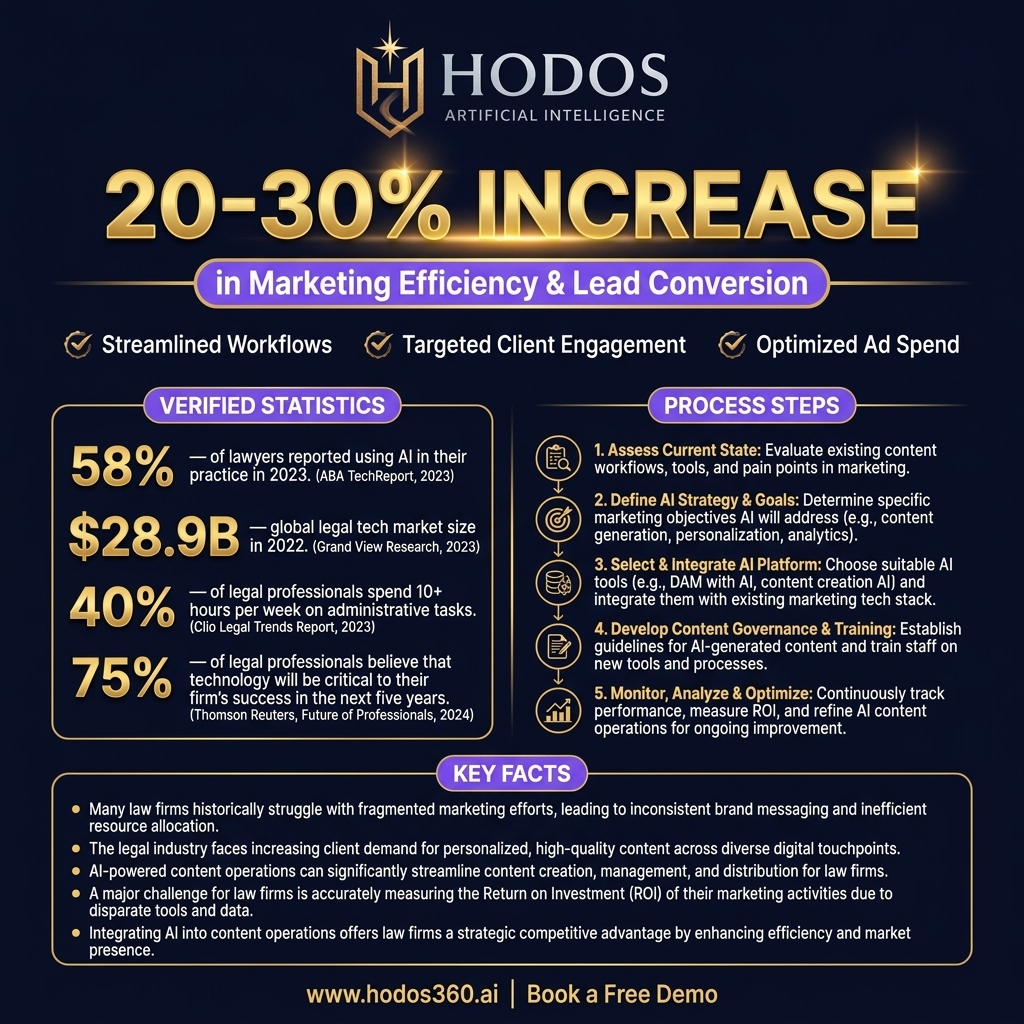
Historically, legal marketing has been a patchwork of disparate tools and manual processes—from drafting blog posts to scheduling social media, managing client testimonials, and tracking campaign performance. This fragmentation not only drains valuable time and resources but also leads to inconsistent brand messaging and an inability to accurately measure return on investment (ROI).
The challenge is compounded by the increasing demand for personalized, high-quality content that resonates with diverse client bases. In this environment, the ability to orchestrate AI Content Operations becomes not just an advantage, but a strategic imperative. It promises to revolutionize how legal services are promoted, how leads are qualified, and how a firm’s brand narrative is consistently delivered across all digital touchpoints.
This evolution necessitates a holistic view of content, treating it as a central asset that powers every facet of a firm’s outreach. Firms that embrace this integrated vision will unlock unparalleled efficiencies, elevate their market presence, and ultimately, secure a stronger competitive position. The unveiling of interconnected systems by industry leaders like Aprimo provides a blueprint for what is possible when AI is intelligently woven into the fabric of marketing strategy, offering a compelling opportunity for law firms to rethink their digital engagement models.
It’s time for legal professionals to move beyond basic automation and into a realm where AI proactively manages and optimizes their entire content lifecycle.
Ready to transform your law firm's marketing? Discover how HODOS 360’s AI Marketing Platform can streamline your content operations and boost your ROI. [Click here to learn more!]
The Imperative of Unified AI Content Operations in Legal Marketing
The traditional silos in legal marketing—where website management, social media, email campaigns, and client intake often operate as separate entities—are no longer sustainable. A 2024 report by the ABA TechReport indicated that while 70% of law firms use social media for marketing, only a fraction effectively integrate these efforts with their broader digital strategy.
This disconnect results in missed opportunities, duplicated efforts, and a murky understanding of what truly drives client acquisition. The concept of interconnected content operations, as highlighted by Aprimo, directly addresses this pain point, advocating for a single, intelligent ecosystem where all marketing activities are synchronized and optimized by AI.
For a managing partner like Robert Jenkins of LexBridge Chambers, whose firm struggled with inconsistent branding across its regional offices, the promise of a unified platform is not just about efficiency, but about maintaining a coherent professional identity in a fragmented digital world.
What does this mean for law firms?
It means moving towards a system where a single piece of expertly crafted content—say, an article on recent intellectual property litigation—can be automatically repurposed for a LinkedIn post, a client newsletter, an update on the firm's website, and even as a script for an AI-generated video, all while adhering to the firm's brand guidelines and legal compliance.
This level of automation is facilitated by agentic AI capabilities that not only generate content but also understand context, audience, and performance metrics. Learn more about AI Websites: Essential for Law Firm Growth & Control. The integration of asset management ensures that all branding elements, disclaimers, and legal disclosures are consistently applied, mitigating risks associated with misrepresentation or non-compliance, a critical concern under ABA Model Rule 7.1 (Communications Concerning a Lawyer's Services).
The competitive landscape in legal services is intensifying, with both traditional firms and innovative legal tech startups vying for market share. Firms that continue to rely on manual, disconnected operations will find themselves outmaneuvered by those leveraging AI Content Operations to scale their marketing efforts with precision and speed.
The shift is not merely about adopting new tools; it's about fundamentally rethinking the strategic approach to client engagement and firm growth. By embracing an interconnected framework, law firms can transform their marketing departments from cost centers into powerful engines for business development, capable of delivering targeted, impactful messages that attract and retain high-value clients.
From Fragmented Tools to Unified Workflows: The Strategic Advantage
The strategic advantage of unified workflows cannot be overstated. Instead of juggling multiple subscriptions and platforms, a law firm can manage its entire content lifecycle—from ideation and creation to distribution and analysis—within a single, intelligent environment. This dramatically reduces the administrative burden on marketing teams and allows attorneys to focus on high-value legal work rather than chasing down content approvals or coordinating disparate campaigns.
Learn more about Legal AI Deployment: The Ultimate Firmwide Strategy for Torys. The capabilities of such a platform expands beyond simple task management, embedding AI to suggest content topics based on trending legal news, optimize distribution channels for maximum reach, and even personalize content delivery based on client segments.
This ensures that every marketing dollar and every hour spent on content contributes directly to the firm's strategic objectives, making the investment in AI Content Operations a clear win for efficiency and effectiveness.
Leveraging Agentic AI for Smarter Legal Content Creation
The true power of AI in content operations lies in its agentic nature—the ability for AI to not just execute tasks but to reason, plan, and adapt autonomously to achieve specific goals. This isn't just about generating text; it's about AI systems understanding the nuances of legal language, compliance requirements, and target audience preferences to produce truly effective marketing materials.
For instance, OpenAI's advancements in large language models, or specialized legal AI platforms like Harvey AI partnering with firms such as Allen & Overy for legal research, demonstrate the sophisticated reasoning now available. Extending this to marketing, imagine an AI that can analyze a recent court ruling, draft a concise client alert, propose relevant social media snippets, and even generate a short video summary for the firm's website, all with minimal human oversight.
This significantly reduces the time from legal development to content publication, ensuring firms are always timely and relevant.
Firms are already seeing tangible benefits. A 2025 report by Thomson Reuters on the State of the Legal Market highlighted that early adopters of AI in marketing reported a 15-20% increase in lead generation efficiency.
This is not merely about speed but about quality and strategic alignment. Agentic AI can analyze vast datasets of past campaigns, client demographics, and industry trends to identify optimal content strategies. It can predict which topics will resonate most with a specific client segment, personalize email outreach, and even optimize ad spend in real-time.
Learn more about AI Legal Guidance: Your Essential Compass for Regulatory Complexity. This level of predictive analytics and automated execution elevates legal marketing from a reactive function to a proactive, data-driven engine. The release of such capabilities across an interconnected platform ensures that these insights are not siloed but inform every aspect of a firm's digital presence.
Consider the creation of AI video content. For many law firms, producing high-quality video has been a costly and time-consuming endeavor. With agentic AI, firms can now generate professional-grade videos for client testimonials, legal explainers, or firm introductions using text prompts and existing brand assets.
This democratizes video production, allowing firms of all sizes to leverage a powerful marketing medium that was once reserved for those with large budgets. Similarly, social media automation tools powered by AI can schedule posts, respond to inquiries, and even analyze sentiment, freeing up marketing teams to focus on strategic initiatives rather than repetitive tasks.
This comprehensive suite of capabilities transforms content creation into a scalable, highly efficient operation.
From Manual Drafts to Automated Campaigns: The Shift in Legal Content Workflows
The shift in legal content workflows is profound. What once required multiple rounds of drafting, legal review, graphic design, and manual scheduling can now be orchestrated by intelligent systems. This not only accelerates time-to-market for critical legal updates and firm news but also ensures a higher degree of accuracy and compliance.
Learn more about Claude AI for Legal: The Ultimate Guide to Contract Review. AI Content Operations platforms are becoming future-ready by incorporating advanced natural language processing (NLP) to ensure legal precision and tone, while also integrating with compliance checks to flag potential ethical issues under rules like those governing attorney advertising.
This holistic approach to content creation and management is a game-changer, allowing legal marketing teams to operate with an agility and sophistication previously unimaginable, especially for enterprise level firms managing complex marketing operations.
Digital Asset Management (DAM) and ROI Tracking: The Foundation of Modern Legal Marketing
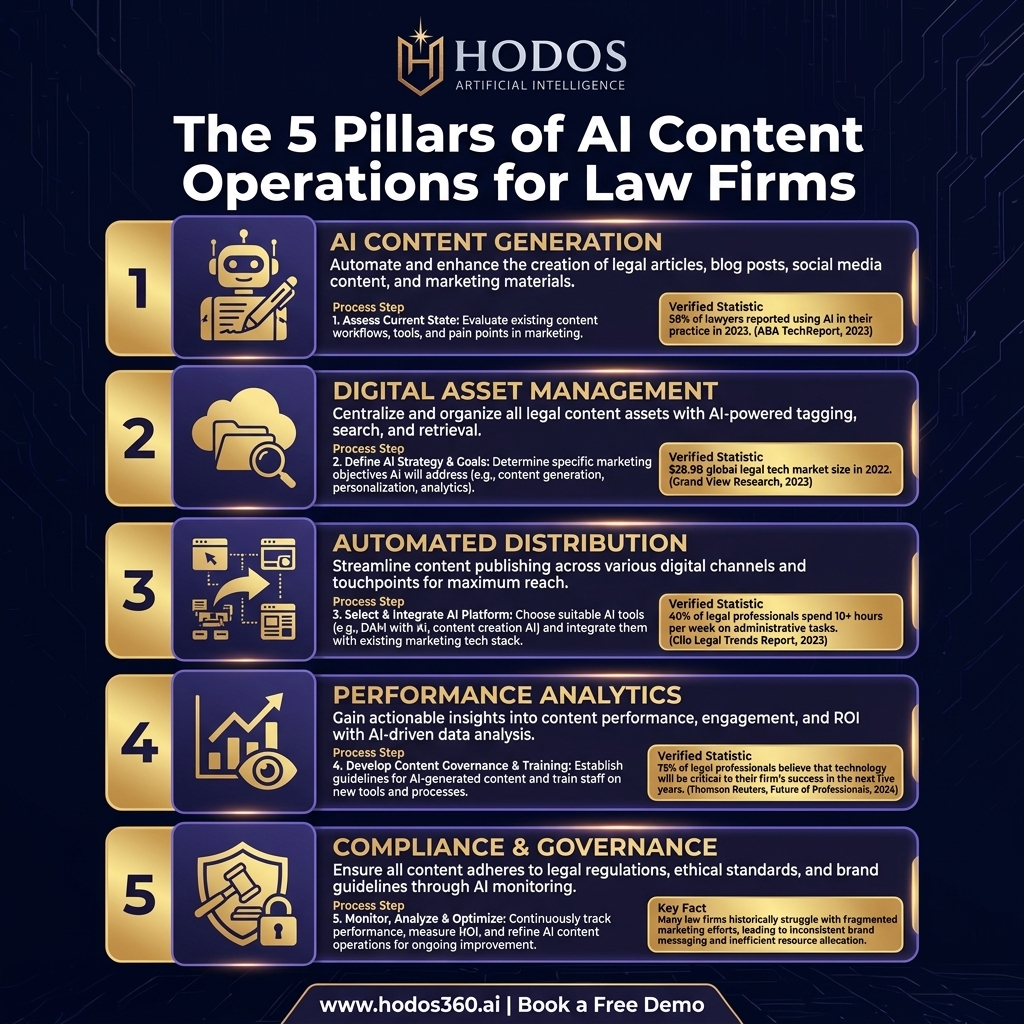
At the core of interconnected content operations lies robust Digital Asset Management (DAM). For law firms, this means centralizing and organizing a vast array of critical assets: firm logos, attorney headshots, case study documents, client testimonials, legal templates, brand guidelines, and approved marketing collateral. Without a centralized DAM, these assets are often scattered across various drives and departments, leading to inconsistencies, outdated versions, and wasted time searching for the right file.
Aprimo’s emphasis on DAM within its release highlights its foundational role. Imagine David Lee, Marketing Director at JurisPro Advocates, trying to launch a new practice area campaign. Without a unified DAM, he'd spend days collecting approved imagery, bios, and disclaimers. With it, all asset management is streamlined, ensuring every piece of content is on-brand and legally compliant.
This is crucial for maintaining a professional image and adhering to strict legal advertising standards.
Beyond asset management, the ability to accurately track ROI is paramount for any marketing operation, particularly in the legal sector where budgets are often scrutinized. AI Content Operations platforms integrate sophisticated analytics that go far beyond simple website traffic.
Learn more about AI Marketing: The Ultimate Platform Disrupting Agencies. They can track the entire client journey, from initial content interaction to lead conversion and ultimately, case acquisition. This means understanding which blog posts lead to consultations, which social media campaigns generate qualified leads, and which AI video creation efforts result in new client intake.
This granular level of detail allows firms to optimize their marketing spend, identifying high-performing content and reallocating resources away from underperforming strategies. As the legal market becomes more data-driven, the ability to demonstrate a clear ROI on marketing investments is no longer a luxury but a necessity for firm growth.
Furthermore, the integration of AI-powered legal workflows into the marketing platform ensures that once a lead is qualified through marketing efforts, the transition to client intake and case management is seamless. This prevents leads from falling through the cracks and ensures a consistent, professional experience for potential clients.
The interconnected nature of these capabilities means that insights gained from marketing performance can inform other areas of the firm, such as identifying emerging legal trends based on popular content topics or optimizing client communication strategies. This holistic approach to data leverages every interaction to enhance both client service and business development, solidifying the firm's enterprise-level operations.
Ensuring Compliance and Brand Consistency with Centralized Assets
In legal marketing, compliance is non-negotiable. Centralized asset management is a powerful tool for ensuring that all content adheres to ethical rules and regulatory requirements, such as those related to attorney advertising or data privacy (e.g., GDPR, CCPA). For instance, Federal Rules of Civil Procedure concerning e-discovery also underscore the importance of organized, traceable digital assets.
A unified DAM system ensures that disclaimers are automatically appended, attorney qualifications are accurately represented, and client testimonials are used with appropriate consent. Learn more about AI Marketing: The Essential Guide to Legal Personalization. This level of control and consistency protects the firm's reputation and minimizes the risk of costly legal and ethical violations.
It also ensures that the firm's brand voice and visual identity remain consistent across all marketing channels, building trust and recognition among prospective clients and within the broader legal community.
The Competitive Edge: Integrating AI Marketing with Law Firm Management
The true competitive differentiator for law firms in the coming years will be their ability to integrate AI Marketing Platform capabilities seamlessly with their core AI Law Firm Management System. This is the vision that platforms like HODOS 360 are bringing to fruition. It's not enough to have a great marketing tool; that tool must speak to and inform your case management, billing, client intake, and document automation systems.
When a lead generated by an AI marketing campaign is automatically entered into the firm's CRM, and their initial inquiry data populates a new client intake form, the efficiency gains are exponential. This integration ensures a smooth client journey from first contact to case resolution, enhancing client satisfaction and freeing up administrative staff for more complex tasks.
This holistic integration reflects a broader trend in the legal tech market. Companies like Clio, with its strategic acquisitions and expansion beyond core practice management, exemplify the drive towards comprehensive, interconnected solutions. They understand that law firms need more than just point solutions; they need an ecosystem that supports every aspect of their operations.
Firms that leverage such integrated capabilities gain a significant competitive edge by optimizing every touchpoint with clients and prospects. They can identify bottlenecks not just in marketing but across the entire client lifecycle, making data-driven decisions that improve overall firm performance and profitability. This proactive approach to management and marketing positions them as future-ready leaders in the legal industry.
The human element remains vital, but AI integration empowers legal professionals. Attorneys can focus on delivering exceptional legal services, while marketing teams can execute sophisticated campaigns with unprecedented precision. The drama in the market isn't just about firms adopting AI; it's about the widening gap between those who master interconnected AI Content Operations and those who remain tethered to outdated, fragmented systems.
Those who embrace this shift are not just adapting; they are actively shaping the future of legal service delivery, attracting top talent, and securing a loyal client base by demonstrating innovation and efficiency at every turn. This creates a compelling narrative of disruption versus tradition, where the agile, tech-forward firms inevitably win.
Future-Ready Legal Marketing: Adapting to Evolving Client Demands
Being future-ready in legal marketing means continuously adapting to evolving client demands and technological advancements. Clients today expect seamless digital experiences, personalized communication, and immediate access to information. A firm equipped with robust AI Content Operations can meet these expectations, offering 24/7 engagement through AI Voice Assistants for lead qualification and appointment booking, alongside highly targeted content distribution.
This not only enhances the client experience but also positions the firm as a modern, forward-thinking entity. The competitive tension is palpable: firms that invest in these capabilities now will be best ready to capture the next generation of clients, while those that delay risk being left behind in an increasingly digital-first legal landscape.
The foresight to unveil and implement these interconnected operations is what sets market leaders apart.

Key Takeaways and Next Steps for Law Firms
The unveiling of interconnected content operations by companies like Aprimo serves as a powerful reminder: the future of marketing, particularly in specialized sectors like law, hinges on intelligent integration. For law firms, this means moving beyond siloed tools and embracing a holistic ecosystem where AI Content Operations drive efficiency, compliance, and strategic growth.
The release of advanced agentic AI capabilities for content creation, robust digital asset management, and precise ROI tracking are no longer aspirational features but essential components of a future-ready marketing strategy. Firms that invest in these capabilities will not only streamline their workflows but also build stronger client relationships and solidify their market position.
The legal industry is at an inflection point, and the firms that seize this opportunity to innovate their marketing operations will emerge as leaders.
Embracing AI Content Operations is a strategic investment in your firm's longevity and competitive advantage. It’s about leveraging technology to free up your human talent for higher-value work, ensuring every marketing effort is optimized for maximum impact.
By adopting interconnected platforms that unify content creation, asset management, and performance analytics, law firms can navigate the complexities of modern marketing with confidence and precision. This shift is not merely about adopting a new tool; it's about transforming the very foundation of your firm's outreach and client engagement strategy.
The enterprise-level capabilities offered by platforms like HODOS 360, which provide an AI Marketing Platform alongside comprehensive firm management solutions, exemplify this integrated future.
To stay ahead, law firms must evaluate their current marketing operations and identify areas where AI can introduce significant efficiencies and strategic advantages.
Prioritize platforms that offer interconnected capabilities across content creation, social media automation, AI video creation, and ROI tracking. The goal is to create a seamless, intelligent workflow that not only elevates your firm's brand but also directly contributes to its bottom line. Don't let your firm get left behind.
Embrace the power of AI Content Operations today. [Request a free demo of HODOS 360’s AI Marketing Platform!]
Frequently Asked Questions
What are AI Content Operations for law firms?+
AI Content Operations involve integrating artificial intelligence into every stage of a law firm's content lifecycle, from ideation and creation to distribution, analysis, and management. This includes AI-powered content generation, social media automation, video creation, and intelligent digital asset management, all designed to streamline marketing workflows and enhance client engagement efficiently and compliantly.
How can AI improve a law firm's marketing ROI?+
AI improves marketing ROI by optimizing content strategies based on data analytics, personalizing client outreach, and automating repetitive tasks. This leads to more effective campaigns, better lead qualification, and reduced operational costs. By accurately tracking performance and allocating resources to high-impact content, AI ensures marketing spend yields measurable returns and maximizes profitability.
What is Digital Asset Management (DAM) and why is it crucial for legal marketing?+
Digital Asset Management (DAM) is a system for centralizing, organizing, and distributing a law firm's digital assets like logos, attorney bios, case studies, and brand guidelines. It's crucial for legal marketing to ensure brand consistency, maintain legal compliance (e.g., proper disclaimers), prevent use of outdated materials, and streamline content creation workflows across the entire firm, enhancing efficiency and reducing risk.
Can AI help law firms create video content?+
Yes, AI can significantly assist law firms in creating high-quality video content. AI video creation tools can generate professional-grade videos from text prompts, repurpose written content into engaging video summaries, or even produce animated explainers. This capability democratizes video production, making it accessible and cost-effective for firms to leverage this powerful marketing medium without extensive budgets or specialized teams.
How does an integrated AI Marketing Platform benefit law firm management?+
An integrated AI Marketing Platform benefits law firm management by connecting marketing efforts directly to core firm operations like client intake, case management, and billing. This seamless flow of information ensures leads are efficiently converted, client data is consistent, and marketing insights inform broader strategic decisions. It optimizes the entire client journey, enhancing operational efficiency and overall firm profitability by breaking down departmental silos.