


AI CRM Software: The Essential Guide for Law Firms
In the bustling halls of the LegalTech NYC 2026 conference, Sarah Chen, managing partner at LexCorp LLP, found herself grappling with a pervasive industry challenge. Despite LexCorp’s sterling reputation and a robust online presence, converting initial leads into loyal clients felt increasingly like a game of chance. Their traditional CRM, a relic of a bygone era, offered little more than basic contact management, lacking the predictive power and personalized engagement demanded by today’s discerning legal market. The conversations swirling around her—about artificial intelligence transforming client acquisition and retention—highlighted a stark contrast with LexCorp’s manual, often reactive, approach.
The modern legal landscape is no longer simply about legal expertise; it's about unparalleled client experience and proactive engagement. Clients, whether individuals seeking personal counsel or corporations navigating complex litigation, expect seamless digital interactions, personalized communication, and immediate responsiveness. Firms that fail to meet these evolving demands risk falling behind competitors who are rapidly adopting advanced technologies. This imperative extends beyond mere efficiency; it’s about maintaining relevance and securing future growth in a fiercely competitive environment where client loyalty is paramount.
This is precisely where AI CRM software emerges as a game-changer for law firms. Far more than a contact database, these intelligent platforms leverage deep learning and advanced analytics to transform how legal practices attract, engage, and retain clients. From identifying high-value leads to automating personalized outreach and predicting client needs, AI CRM offers an unparalleled competitive advantage. By embracing these sophisticated tools, law firms can move beyond reactive client management to a proactive, data-driven strategy, ensuring every client interaction is optimized for success and long-term relationships.
Discover how HODOS 360’s AI Marketing Platform can elevate your firm’s client engagement and streamline your marketing efforts.
The Shifting Landscape of Legal Client Engagement
The expectations of legal clients have undergone a profound transformation, moving far beyond the traditional attorney-client relationship. Today’s clients, conditioned by seamless digital experiences in other sectors, demand hyper-personalized interactions, instant access to information, and transparent communication from their legal providers. A recent ABA Legal Technology Survey Report (2025) highlighted this shift, revealing that over 70% of legal clients now expect digital communication channels and self-service options, underscoring a clear preference for convenience and efficiency. This evolving demand places immense pressure on law firms to adapt their client engagement strategies, moving away from outdated, one-size-fits-all approaches.
Many law firms, however, continue to operate with traditional marketing and client management methodologies. These often involve manual lead tracking, disparate communication systems, and reactive client outreach. Such practices not only create significant operational inefficiencies but also lead to missed opportunities for client acquisition and retention. The inherent "human conflict" within the legal industry, between those steadfastly adhering to established norms and those boldly embracing technological innovation, defines the current competitive landscape. Firms that resist this digital imperative often find themselves struggling to keep pace, losing potential clients to more agile, tech-savvy competitors who understand the value of a proactive, data-driven approach.
AI CRM software serves as the crucial bridge between these evolving client expectations and the operational realities of a modern law firm. Learn more about AI-Powered Web Development: The Essential Guide for Law Firms. Unlike basic contact management systems, AI CRM leverages advanced algorithms to provide predictive analytics, conduct sentiment analysis, and facilitate automated, personalized outreach. This intelligent capability directly addresses common pain points such as lead leakage—where promising prospects fall through the cracks—and inconsistent client follow-up. By integrating AI, firms can ensure that every potential client receives timely, relevant communication, significantly improving conversion rates and fostering stronger initial relationships, setting a foundation for enduring trust and loyalty.
The legal tech market itself is a testament to this profound shift. Major investments and strategic acquisitions underscore the industry's appetite for integrated, AI-powered solutions. For instance, Clio, a dominant player in legal practice management, acquired Lawyaw in 2021 to bolster its document automation capabilities, signaling a move towards more comprehensive AI integration. Similarly, the emergence of startups like Harvey AI, and its high-profile partnership with Allen & Overy, demonstrates the increasing demand for specialized AI applications within legal services. These developments confirm that the legal industry is no longer immune to the digital transformation observed across other sectors; neglecting the adoption of AI CRM software means ceding a significant competitive advantage in an increasingly digital-first world.
Beyond Basic CRM: The Power of AI in Legal Marketing
The true distinction of AI CRM software lies in its ability to inject genuine intelligence into client relationship management, moving far beyond mere automation. AI algorithms are designed to analyze vast datasets—from past client interactions and case outcomes to demographic information and communication preferences—to identify subtle patterns, predict future client needs, and accurately score leads. This predictive capability transforms raw data into actionable insights, enabling law firms to make more informed decisions about their marketing and client engagement strategies. For example, Salesforce's Einstein AI, when specifically tailored and configured for legal applications, can predict which prospective clients are most likely to convert based on firm-specific criteria and historical data, allowing resources to be focused on high-potential opportunities.
### AI-Powered Lead Generation and Nurturing At the very top of the client acquisition funnel, AI revolutionizes lead generation and nurturing. AI CRM platforms can identify ideal client profiles by analyzing both internal firm data and external market trends, then target these prospects with precision. This includes automating personalized email sequences, delivering highly relevant content recommendations, and even optimizing the timing of outreach. Furthermore, AI capabilities extend to sophisticated content creation; for instance, AI video creation tools can generate engaging promotional content, while social media automation ensures consistent brand messaging and engagement across all digital channels. This integrated approach ensures that every lead is systematically nurtured, increasing the likelihood of conversion and reducing the burden on marketing teams.
AI also excels at granular client segmentation and hyper-personalization, a critical component of effective legal marketing automation. Learn more about AI Voice Agent: Essential Guide for Modern Law Firms. Instead of broad-stroke campaigns, AI CRM allows firms to segment their client base with remarkable precision—by practice area interest, geographic location, communication preferences, and even specific case history. This enables the delivery of highly targeted information, ensuring clients receive content that is directly relevant to their needs and interests, rather than generic newsletters. Such personalization fosters a deeper sense of connection and trust, significantly enhancing the client experience and strengthening the overall client relationship management strategy.
The integration of natural language processing (NLP) within AI CRM systems further enhances client communication. AI Voice Assistants, like those offered by HODOS 360, can provide 24/7 phone answering, expertly qualify leads based on predefined criteria, and even book appointments directly into attorneys' calendars. This frees up valuable legal staff time, allowing them to focus on complex legal work rather than routine administrative tasks. By ensuring that no lead is missed and every initial interaction is professional and efficient, these AI tools contribute significantly to a seamless and optimized client journey, proving their indispensable role in modern legal practice.
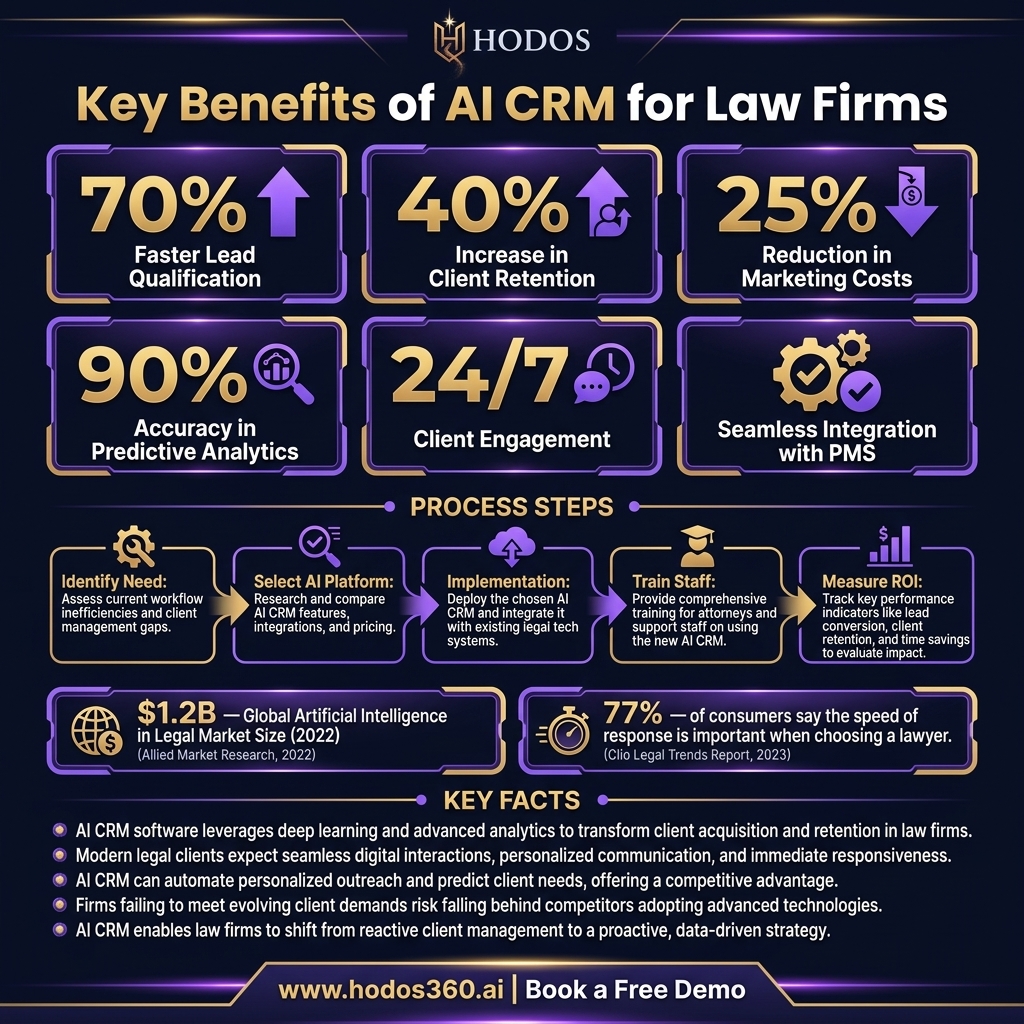
Explore the full suite of HODOS 360 solutions, from our AI Law Firm Management System to our AI Voice Assistants, designed to empower modern legal practice.
Implementing AI CRM: Strategies for Law Firms
Successfully adopting AI CRM software within a law firm requires more than just purchasing a new tool; it demands a strategic, phased approach tailored to the firm's unique needs, existing technological infrastructure, and long-term objectives. Firms must conduct a thorough internal assessment to identify specific pain points in client acquisition and management, then align these with the capabilities of potential AI CRM platforms. Gaining buy-in from all stakeholders—from managing partners to administrative staff—is paramount, as successful implementation hinges on collective commitment. As Marc Benioff, CEO of Salesforce, has often stressed, organizational alignment is a critical factor in the success of any digital transformation, ensuring that technology serves the broader strategic vision of the enterprise.
### Integrating AI CRM with Practice Management A standalone AI CRM system, no matter how powerful, will only realize a fraction of its potential without seamless integration into the firm's existing tech ecosystem. The true power of AI-powered legal workflows is unleashed when the CRM connects effortlessly with other critical systems such as case management, billing, client intake, and document automation platforms. This integration creates a unified client view, allowing attorneys and staff to access comprehensive client histories, communication logs, and case progress from a single dashboard. Such a holistic approach eliminates data silos, reduces manual data entry, and ensures that every interaction is informed by a complete understanding of the client relationship, leading to greater efficiency and accuracy across the firm.
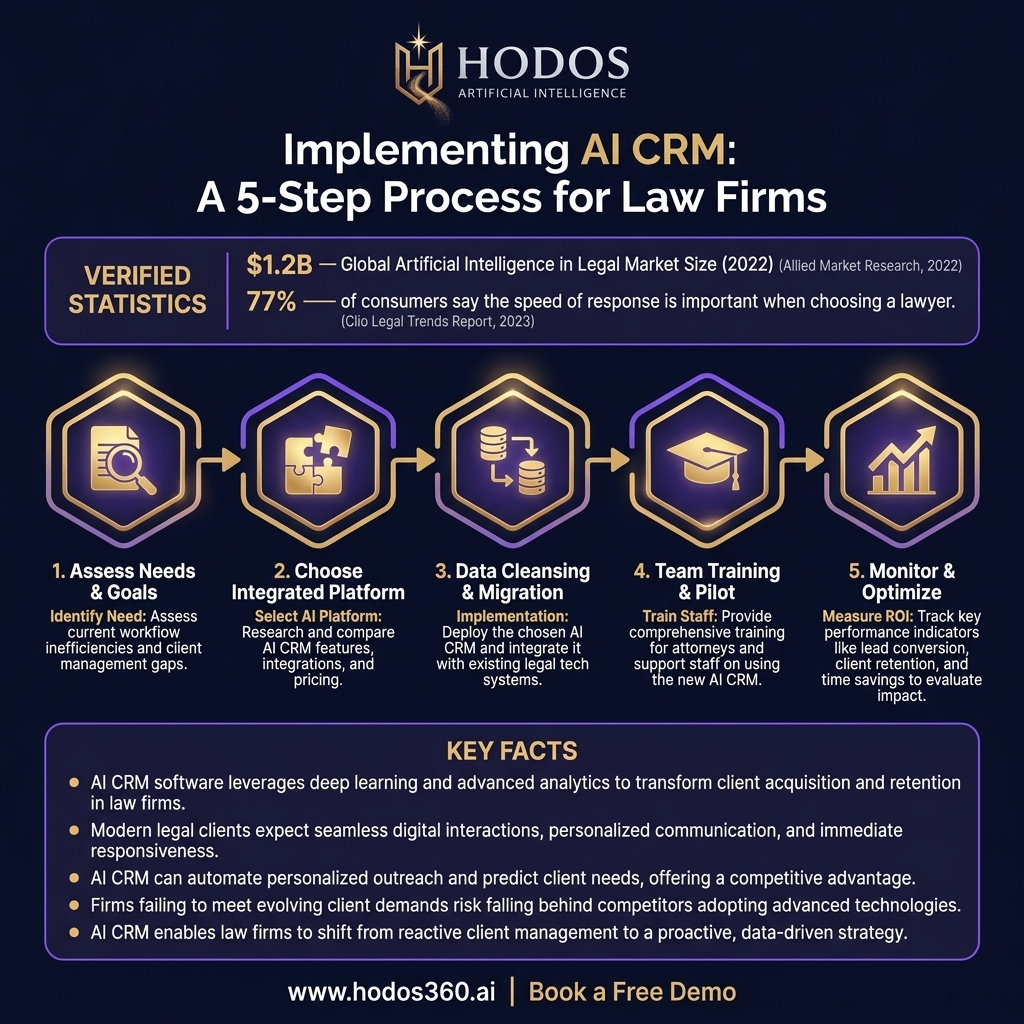
Data migration and quality are foundational to the success of any AI-driven system. AI models learn and make predictions based on the data they are fed; therefore, the accuracy and completeness of this data are paramount. Learn more about Voice AI: The Ultimate Leap with GPT-Live-1 for Law Firms. Law firms must dedicate significant resources to data cleansing, ensuring that legacy client information is accurate, consistent, and properly formatted before migration. Establishing robust data governance policies is equally crucial to maintain data integrity moving forward. This might involve leveraging modern frontend frameworks for intuitive data input interfaces or utilizing python web framework solutions for custom data processing and integration, ensuring that the underlying technical infrastructure supports clean data flows and optimal AI performance.
### Ethical Considerations and Data Privacy For law firms, the ethical implications of using AI, particularly concerning client data privacy and confidentiality, are paramount. Attorneys are bound by strict professional obligations, including ABA Model Rule 1.6 (Confidentiality of Information), which mandates the protection of client information, and ABA Model Rule 1.1 (Competence), which now implicitly includes technological competence. Firms must exercise extreme due diligence when selecting AI CRM vendors, thoroughly understanding how their AI models are trained, what data they access, and their security protocols. Compliance with stringent data protection regulations such as the GDPR and CCPA is non-negotiable, requiring careful consideration of data residency, consent mechanisms, and the firm’s responsibilities as a data controller. Transparency with clients about the use of AI in their service delivery is also a best practice, fostering trust and demonstrating ethical leadership.
Measuring Success: ROI and Analytics in AI-Powered Marketing
The adoption of AI CRM software provides law firms with an unprecedented level of visibility into their marketing performance, enabling them to move beyond anecdotal evidence to data-driven decision-making. These platforms offer sophisticated tools for tracking key metrics that directly impact the firm's bottom line. Firms can precisely measure lead conversion rates, accurately calculate the client acquisition cost, determine the client lifetime value, and, most importantly, quantify the return on investment (ROI) for specific marketing campaigns. This granular insight allows firm leaders to understand exactly where their marketing dollars are most effective, transforming nebulous marketing efforts into clear, measurable successes.
AI-driven analytics transcend traditional reporting by offering predictive insights that anticipate future trends and client behaviors. These advanced capabilities can identify which marketing channels are generating the highest quality leads, which campaigns resonate most effectively with target audiences, and even predict potential client churn before it occurs. For example, HubSpot's advanced analytics, when powered by AI, can provide granular insights into individual client journeys, tracking every touchpoint from initial inquiry to case completion. This allows firms to proactively intervene, optimize client experiences, and fine-tune strategies in real-time, preventing issues before they escalate and capitalizing on emerging opportunities.
The clear, actionable insights derived from data analytics for law firms have a profound impact on resource allocation. Learn more about Autonomous Marketing: The Ultimate Guide for Law Firms. With precise ROI tracking and predictive modeling, managing partners and marketing directors, like LexCorp's Sarah Chen, can make informed, strategic decisions about where to invest their marketing budgets. This data-driven approach optimizes spending, ensures that resources are directed towards the most impactful initiatives, and maximizes the overall effectiveness of marketing efforts. It shifts firms from a reactive, guesswork-based approach to a proactive, evidence-based strategy, ensuring every dollar spent contributes meaningfully to firm growth and profitability.
Ultimately, firms that effectively leverage AI CRM software for their marketing and client relationship management gain a significant and sustainable competitive advantage in a crowded legal market. These firms are better equipped to attract a steady stream of high-quality clients, retain existing clients for longer durations, and cultivate stronger, more profitable relationships built on personalized service and proactive engagement. By embracing these cutting-edge technologies, law firms position themselves not merely as legal service providers, but as forward-thinking leaders capable of delivering exceptional value and unparalleled client experiences in the digital age. This strategic adoption is no longer an option but a necessity for firms aiming for long-term success and market leadership.

Key Takeaways and Next Steps
AI CRM software is no longer a luxury but a strategic imperative for modern law firms. It drives unparalleled efficiency, significantly enhances client experiences, and provides a crucial competitive edge in an increasingly digital and demanding legal landscape. Embracing this technology allows firms to move from reactive client management to a proactive, intelligent approach that anticipates needs and optimizes every interaction. The future of legal client relationships is undeniably intelligent, personalized, and data-driven.
For law firms ready to transform their client engagement and marketing strategies, the next step involves careful assessment of current needs, exploration of integrated platforms, and a commitment to robust data governance. Learn more about AI Law Firm Management: The Ultimate Guide to Thriving. Platforms like HODOS 360 offer comprehensive solutions that seamlessly integrate AI Marketing Platform capabilities with other essential firm services, including an AI Law Firm Management System, AI Voice Assistants for lead qualification, and AI-powered website building. This holistic approach provides a unified ecosystem for legal practice transformation, ensuring your firm is equipped for sustained growth and success.
Ready to transform your client relationships? [Book a Free Demo with HODOS 360 today!]
- ✓Enhanced Lead Qualification: AI screens and scores potential clients efficiently, identifying high-value prospects for targeted outreach.
- ✓Personalized Client Journeys: Tailored communication and content delivery ensure every client receives relevant, timely information, fostering stronger relationships.
- ✓Automated Marketing Campaigns: AI automates email sequences, social media posts, and content distribution, saving time and ensuring consistent outreach.
- ✓Predictive Analytics: AI forecasts client needs, anticipates potential churn, and identifies cross-selling opportunities, enabling proactive client management.
- ✓Improved ROI Tracking: Provides clear visibility into marketing expenditure effectiveness, allowing firms to optimize budgets and maximize impact.
- ✓Seamless Integration: Connects with existing practice management, document automation, and client intake systems for a unified operational view.
- ✓24/7 Client Engagement: AI Voice Assistants handle initial inquiries, answer common questions, and book appointments around the clock, improving responsiveness.
Frequently Asked Questions
What is AI CRM software for law firms?+
AI CRM software for law firms is an advanced client relationship management system that integrates artificial intelligence to automate, personalize, and optimize client interactions. It goes beyond basic contact management by using AI for lead scoring, predictive analytics, marketing automation, and enhanced communication, specifically tailored to the unique needs and compliance requirements of the legal industry.
How does AI CRM differ from traditional CRM?+
Traditional CRM primarily stores client data and automates basic tasks. AI CRM, however, leverages machine learning and natural language processing to analyze data, predict client behavior, personalize communication at scale, and automate complex workflows. It provides proactive insights and intelligent recommendations, transforming client engagement from reactive to predictive, offering a significant competitive edge.
What are the main benefits of AI CRM for legal marketing?+
AI CRM significantly boosts legal marketing by enabling precise lead qualification, hyper-personalized client communication, and automated campaign management. It helps firms understand client needs through data analytics, optimize marketing spend by tracking ROI, and ensure consistent brand messaging across channels. This leads to higher conversion rates, improved client retention, and a more efficient marketing department.
Are there ethical concerns with using AI CRM in a law firm?+
Yes, ethical concerns are paramount. Law firms must ensure compliance with ABA Model Rule 1.6 (Confidentiality of Information) and Rule 1.1 (Competence), protecting client data privacy and maintaining technological proficiency. Key considerations include data security, transparency with clients about AI usage, and ensuring the AI does not introduce bias or compromise confidentiality. Due diligence in vendor selection is crucial.
How can a law firm get started with AI CRM?+
Getting started involves assessing your firm's specific needs and existing tech infrastructure. Research and select an AI CRM platform that integrates seamlessly with your current practice management systems. Prioritize data cleansing and migration, and train your team on the new software. Begin with a pilot program, measure its impact, and iteratively scale. Platforms like HODOS 360 offer integrated solutions to facilitate this transition.