

AI Voice Agent: Essential Guide for Modern Law Firms
The digital landscape of 2026 is continuously reshaping industries, and the legal sector is no exception. Just last week, appinventiv.com’s article, "Build an AI Voice Agent for Real Estate in 2026," spotlighted how conversational AI is revolutionizing client interactions, lead generation, and operational efficiency in property management. This isn't just a trend; it's a blueprint for disruption. Imagine a bustling law firm, 'Sterling & Associates,' based in downtown Chicago. A potential high-value client, Sarah Chen, calls after hours, seeking urgent advice on a complex M&A deal. Sterling & Associates, like many traditional firms, relies on an answering service that only takes messages. Meanwhile, a forward-thinking competitor, 'Apex Legal Tech,' has deployed an AI Voice Agent that not only answers Chen’s call instantly but also qualifies her case, schedules a preliminary consultation, and even routes her to the appropriate senior partner's calendar – all before Sterling & Associates’ office opens the next morning. This isn't a futuristic fantasy; it's the present reality that AI Voice Agents are crafting for law firms that embrace innovation.
For too long, the legal profession has grappled with the inherent tension between delivering personalized, high-touch client service and the relentless pressure to optimize operational costs and efficiency. The human element, while indispensable, often presents scalability challenges, particularly in handling the sheer volume of initial inquiries, routine questions, and administrative tasks that consume valuable attorney and paralegal time. This is where the power of an AI Voice Agent truly shines, extending the firm's reach beyond traditional business hours and geographical limitations. The ability to seamlessly manage client intake, qualify leads, and provide instant information is no longer a luxury but a strategic imperative. As firms compete for market share in an increasingly digital world, the capacity to respond immediately and intelligently to prospective clients can be the decisive factor in securing new business.
This article delves into how law firms can leverage the same underlying principles and advanced AI development to build and deploy their own sophisticated AI Voice Agents, moving beyond the successes seen in real estate and into the nuanced world of legal services. We will explore the transformative potential of these intelligent assistants, examining their features, deployment strategies, and the critical ethical considerations that must guide their implementation. By understanding the core mechanics and strategic advantages, law firm owners and legal professionals can position their practices at the forefront of innovation, ensuring they not only keep pace with industry changes but lead them. The goal is not to replace human interaction but to augment it, freeing up legal experts to focus on complex legal work, while AI handles the high-volume, repetitive interactions, thereby enhancing both client satisfaction and firm profitability.
The Dawn of Conversational AI in Legal: Beyond Real Estate
The journey of conversational AI from rudimentary chatbots to sophisticated AI Voice Agents has been meteoric, driven by advancements from tech giants and innovative startups alike. Companies like OpenAI, with its groundbreaking GPT models and advanced voice capabilities, have democratized access to powerful natural language processing (NLP). Google's Duplex, demonstrated years ago, hinted at a future where AI could make calls and book appointments with remarkable human-like fluency. Similarly, Amazon's Alexa and Microsoft's Cortana have accustomed consumers to interacting with voice interfaces in their daily lives. This widespread adoption in consumer tech has paved the way for enterprise applications, as seen in the real estate sector where AI voice agents are now routinely handling property inquiries, scheduling viewings, and providing instant information on listings, as highlighted by the appinventiv.com article. The success of these applications demonstrates a clear precedent: if AI can navigate the complexities of property transactions and client queries, it can certainly be tailored for the legal field.
However, the legal industry presents a unique set of challenges that differentiate it from real estate. Confidentiality, ethical obligations, and the nuanced, often emotionally charged nature of legal issues demand a higher degree of precision, security, and empathy from any automated system. Yet, the core benefits of scalability, 24/7 availability, and instant response remain incredibly appealing. Visionaries like Sam Altman, CEO of OpenAI, have consistently articulated a future where AI becomes a ubiquitous assistant, seamlessly integrating into various professional domains. Learn more about Ultimate AI in MarTech: Predictive Power for Law Firms. For law firms, this vision translates into an AI Voice Agent that can act as the firm's always-on, multilingual receptionist and initial intake specialist, capable of understanding legal terminology and routing inquiries with intelligent precision. This isn't about replacing the seasoned attorney; it's about augmenting their capacity, ensuring no potential client lead is ever missed and that routine inquiries are handled efficiently, allowing legal professionals to dedicate their expertise to strategic thinking and complex casework.
While the real estate sector focuses on property details and transaction logistics, legal voice agent development must contend with concepts like legal privilege, specific jurisdictional laws, and the sensitive nature of client disclosures. This requires a foundation built on robust, secure AI models trained on vast amounts of legal data, capable of understanding context and identifying when human intervention is absolutely critical. The legal tech ecosystem has seen significant investment, with companies like Harvey AI partnering with major firms such as Allen & Overy to build and refine AI tools for legal research and contract review. This demonstrates the industry's readiness to adopt advanced AI. The next logical step is extending this intelligence to the very first point of client contact, transforming the front office into an efficient, AI-powered gateway. This strategic shift allows firms to optimize their client acquisition funnel, improve response times, and ultimately enhance their competitive edge in a demanding market.
Transforming Law Firm Operations with AI Voice Assistants
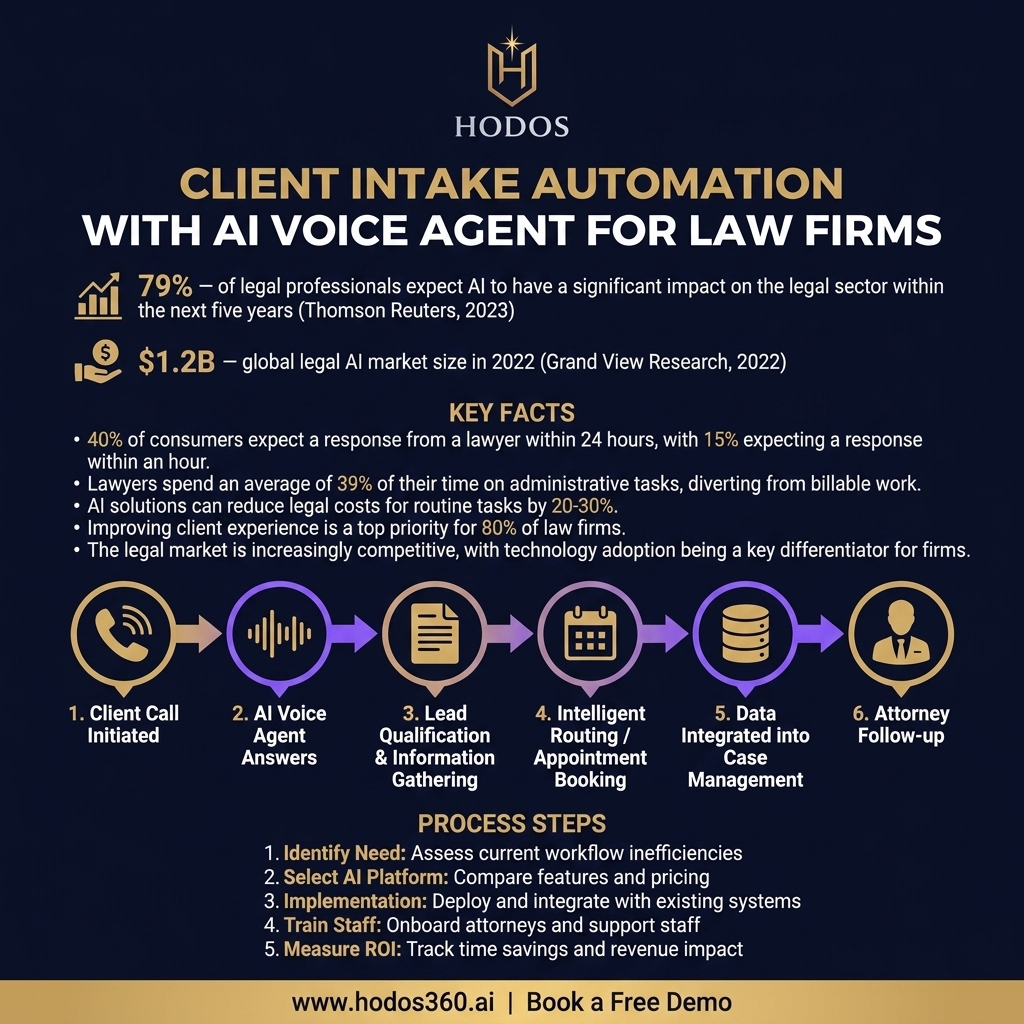
The adoption of AI Voice Agents within law firm operations represents a paradigm shift from traditional, often manual, processes. For decades, law firms have struggled with the inefficiencies inherent in client intake, lead qualification, and appointment scheduling. Missed calls, delayed responses, and overburdened administrative staff are common pain points that directly impact client satisfaction and revenue generation. The American Bar Association's annual TechReport consistently highlights the challenges firms face in adopting new technologies, yet also underscores the growing necessity. An AI Voice Agent can intercept incoming calls, identify the caller's intent, and perform initial screening questions, much like a human receptionist, but with unparalleled speed and availability. For instance, a personal injury firm can program its AI to ask specific questions about an incident, assess the potential claim's viability, and only then route qualified leads to an attorney, saving valuable time for both the firm and the client. This proactive approach ensures that every lead is captured and processed, significantly increasing conversion rates.
### Enhancing Client Intake and Lead Qualification One of the most immediate and impactful applications of an AI Voice Agent in a law firm is the complete overhaul of the client intake and lead qualification process. Consider a busy property law firm dealing with numerous inquiries about real estate transactions, zoning laws, or landlord-tenant disputes. An AI Voice Assistant can handle initial inquiries, gather essential details, and even provide preliminary information on common legal processes, freeing up paralegals and attorneys from repetitive tasks. The AI can be trained to recognize specific keywords and phrases related to various legal matters, ensuring that calls are accurately categorized and routed to the most appropriate department or individual. For example, if a caller mentions 'eviction notice,' the AI can immediately direct them to the landlord-tenant department, while a query about 'patent infringement' would be routed to intellectual property specialists. This intelligent routing minimizes delays and ensures that clients connect with the right expert from the outset, enhancing the overall client experience.
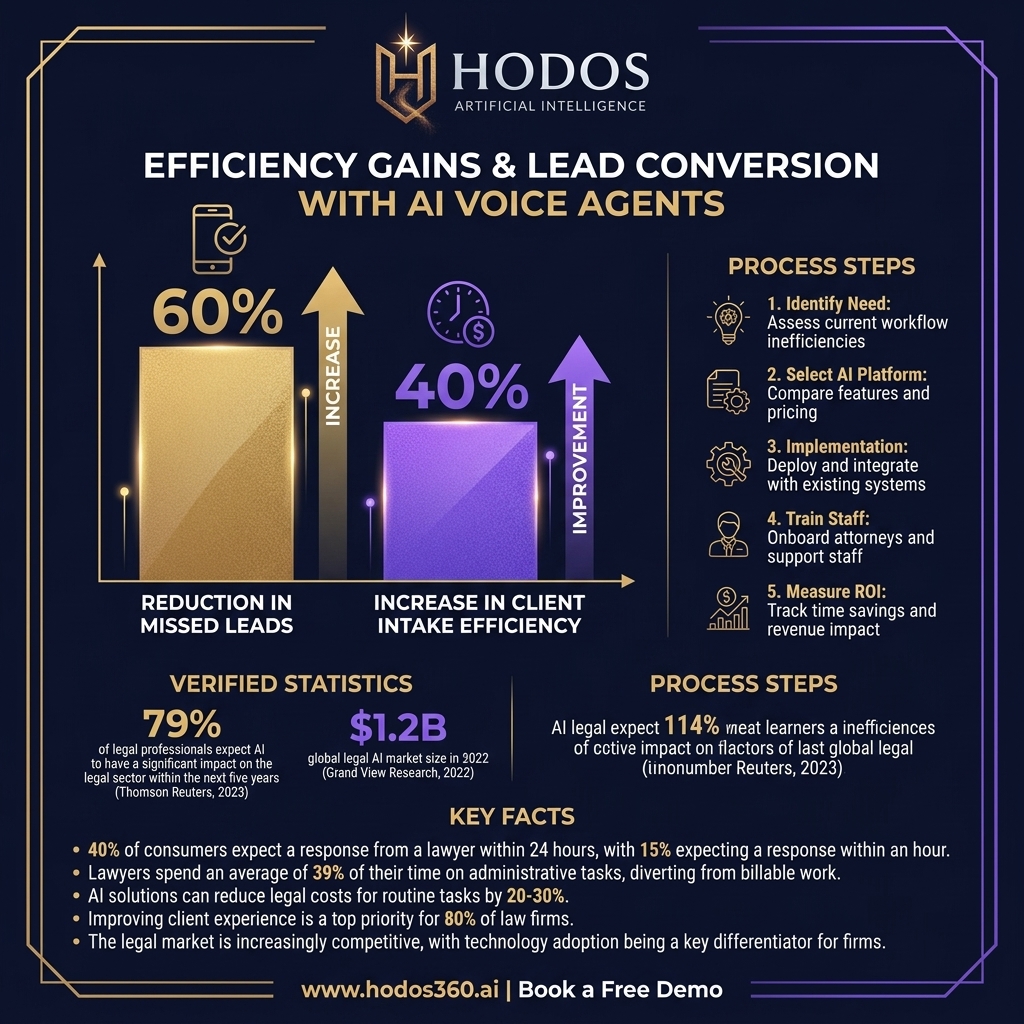
Beyond basic routing, an AI Voice Agent excels at lead qualification. Learn more about Building an Essential AI Meeting Assistant for Law Firms. It can ask a series of pre-defined questions to ascertain the nature of the legal issue, the urgency, and the client's financial capacity, using sophisticated natural language processing (NLP) to interpret responses. This allows firms to filter out non-viable leads and prioritize those with high potential, ensuring that attorneys spend their time on cases that align with the firm's strategic objectives. This automated pre-screening is invaluable in competitive legal markets, enabling firms to react faster than competitors. For example, a recent study by the Thomson Reuters Institute indicated that firms leveraging advanced client intake technologies saw an average increase of 15% in new client acquisition rates. The HODOS 360 AI Voice Assistants, for instance, offer 24/7 phone answering, lead qualification, and appointment booking, providing a comprehensive solution for firms looking to streamline their front office operations and never miss a critical lead.
Furthermore, the ability of these AI Voice Agents to provide multilingual support is a game-changer for diverse communities. In a globalized world, law firms often serve clients from various linguistic backgrounds. An AI Voice Assistant can engage with clients in their native language, breaking down communication barriers and fostering a more inclusive and accessible legal service. This not only expands the firm's potential client base but also demonstrates a commitment to client-centric services. The collected data from these interactions provides invaluable insights, allowing firms to identify common client needs, optimize their marketing strategies, and refine their service offerings. This data-driven approach, powered by AI, enables continuous improvement and ensures that the firm remains responsive to the evolving demands of its clientele, making the firm more efficient and responsive.
- ✓24/7 Client Availability: AI Voice Agents ensure your firm is always open, capturing leads and providing information outside of traditional business hours, significantly reducing missed opportunities.
- ✓Automated Lead Qualification and Routing: Intelligent systems screen callers, gather critical information, and route qualified leads directly to the appropriate legal agents or departments, optimizing attorney time.
- ✓Reduced Administrative Burden: Automating routine inquiries, appointment scheduling, and information dissemination frees up paralegals and administrative staff to focus on more complex, value-added tasks.
- ✓Multilingual Support for Diverse Clientele: AI Voice Assistants can communicate in multiple languages, expanding your firm's reach and ensuring accessible legal services for a broader client base.
- ✓Consistent Brand Voice and Client Experience: Every interaction is professional, consistent, and adheres to your firm's brand guidelines, ensuring a high-quality client experience from the very first contact.
- ✓Scalable Operations Without Hiring More Staff: AI provides an infinitely scalable solution for handling fluctuating call volumes, allowing your firm to grow without proportional increases in staffing costs.
- ✓Data-Driven Insights for Marketing and Service Improvement: Detailed analytics from AI interactions offer valuable insights into client needs, common queries, and lead sources, informing strategic decisions.
Key Features and Deployment Strategies for Legal AI Voice Agents
Successful deployment of an AI Voice Agent in a law firm hinges on identifying and implementing key features that cater specifically to the legal environment. First and foremost is robust Natural Language Processing (NLP) tailored for legal jargon. Generic AI models may struggle with the nuanced language of statutes, case law, and client testimonies. A specialized legal NLP engine can accurately understand complex queries, identify legal terms, and extract critical information from conversations. Furthermore, seamless integration with existing legal tech infrastructure – such as case management systems (e.g., Clio, MyCase), CRM platforms, and billing software – is non-negotiable. This integration ensures that client data captured by the AI is automatically updated across all relevant systems, eliminating manual data entry and reducing errors. For instance, after qualifying a lead and booking an appointment, the AI should be able to create a new client profile in the firm’s case management system and add the appointment to the attorney’s calendar without human intervention. This interconnectedness is crucial for maximizing efficiency and ensuring a smooth workflow. A firm considering building its own solution must prioritize these integrations from the outset.
### Tailoring Voice AI to Your Firm's Unique Needs The build and deploy process for a legal AI Voice Agent should be iterative and highly customized. It begins with defining clear objectives: Is the primary goal lead generation, appointment scheduling, answering FAQs, or a combination? Once objectives are set, firms must carefully design the conversational flow, creating scripts that are both informative and compliant with legal ethical standards. Training the AI involves feeding it vast amounts of legal-specific data – firm FAQs, practice area descriptions, and anonymized client interaction transcripts – to enhance its understanding and response accuracy. Learn more about AI Marketing Systems: The Essential Guide for Law Firms. Companies specializing in AI development services for the legal sector, like some innovative startups showcased at LegalTech NYC 2026, are emerging to provide this specialized expertise, helping firms navigate the complexities of data training and model refinement. Starting with a pilot program in a specific practice area or for a particular type of inquiry allows firms to test the AI's effectiveness, gather feedback, and make necessary adjustments before a broader rollout. This phased approach minimizes disruption and ensures the AI is optimally performing.
Crucially, a legal AI Voice Agent must always have a clear escalation path to a human agent. While AI can handle many routine tasks, complex legal advice, sensitive disclosures, or emotionally charged situations require the empathy and nuanced judgment of a human attorney. The AI should be programmed to identify these scenarios and seamlessly transfer the call to a live person, providing the human agent with a summary of the conversation thus far. This hybrid approach ensures that clients receive the best of both worlds: the efficiency and availability of AI, combined with the personalized expertise of a human. Furthermore, the security architecture of the AI Voice Agent platform is paramount. Data encryption, compliance with privacy regulations (e.g., CCPA, GDPR where applicable), and secure cloud infrastructure are non-negotiable requirements to protect sensitive client information. Firms must rigorously vet their AI providers to ensure they meet the highest standards of data security and privacy, recognizing that a breach in confidentiality can have severe repercussions for both the firm and its clients. By focusing on these core features and a strategic development process, law firms can successfully integrate AI Voice Agents into their operations, enhancing their service delivery and competitive advantage.
Navigating Ethical and Regulatory Landscapes in Voice AI
The deployment of AI Voice Agents in the legal sector is not merely a technological challenge; it is profoundly intertwined with complex ethical and regulatory considerations. The legal profession is bound by stringent rules of professional conduct, most notably client confidentiality. ABA Model Rule 1.6 mandates that attorneys protect client information, and the use of AI must strictly adhere to this principle. Firms must ensure that any AI system used to interact with clients is built on a secure, encrypted platform that prevents unauthorized access or data breaches. This includes meticulous vetting of third-party AI providers to confirm their security protocols, data handling practices, and compliance certifications. For instance, the AI Voice Agent should be designed to anonymize or redact sensitive information when training data, and conversations should be stored securely with access restricted to authorized personnel. The legal ramifications of a data breach involving an AI system could be severe, impacting client trust, leading to potential malpractice claims, and incurring significant regulatory fines. Therefore, understanding and mitigating these risks is paramount during the development and implementation phases.
### Data Privacy and Confidentiality in Voice AI Beyond confidentiality, data privacy laws, such as the FTC Act in the United States and the EU AI Act, which came into full enforcement recently, impose strict requirements on how personal data is collected, processed, and stored. Law firms must obtain explicit consent from clients before recording or analyzing their conversations with an AI Voice Agent, clearly disclosing how the data will be used and stored. Transparency is key: clients need to understand that they are interacting with an AI and have the option to speak with a human agent at any time. The EU AI Act, in particular, sets a global benchmark for AI governance, categorizing AI systems based on risk and imposing stringent requirements for high-risk applications, which could include certain legal AI systems. While the Act is primarily European, its influence extends globally, prompting developers and users worldwide to consider its principles. Learn more about Essential AI Marketing Tools: Supercharge Your Law Firm's Growth. Firms must also consider the potential for algorithmic bias. If an AI Voice Agent is trained on biased data, it could inadvertently lead to discriminatory outcomes in client qualification or case assessment. For example, if the training data disproportionately represents certain demographics or legal issues, the AI might exhibit bias against underrepresented groups or misinterpret their legal needs. Addressing bias requires diverse training datasets, rigorous testing, and continuous monitoring to ensure fair and equitable treatment for all clients.
Another critical ethical consideration is the unauthorized practice of law. An AI Voice Agent should never provide legal advice. Its role is to gather information, answer factual questions, qualify leads, and direct callers, but it must be explicitly programmed to avoid offering opinions or interpretations that constitute legal counsel. Firms must implement clear disclaimers and safeguards to prevent the AI from overstepping its boundaries. The development team responsible for building these services must include legal professionals to ensure ethical compliance. For example, a client asking, "Should I file for bankruptcy?" should trigger an AI response like, "I cannot provide legal advice, but I can connect you with an attorney specializing in bankruptcy law to discuss your options." This distinction is vital for maintaining professional integrity and avoiding legal liabilities. The ongoing evolution of AI technology necessitates that law firms regularly explore and re-evaluate their ethical guidelines and regulatory compliance strategies, potentially consulting with legal ethicists and technology law experts. This proactive approach ensures that the adoption of AI enhances, rather than compromises, the core values of the legal profession.
HODOS 360 and the Future of Legal Client Engagement
The integration of AI Voice Agents into law firm operations is not just a technological upgrade; it's a fundamental shift in how legal professionals engage with their clients and manage their practices. The future of legal services hinges on the strategic adoption of AI, transforming every touchpoint from initial inquiry to case resolution. Law firms that embrace this change will be better positioned to attract and retain clients, optimize resource allocation, and ultimately thrive in a competitive market. The days of missed opportunities due to unanswered calls or inefficient intake processes are rapidly fading, replaced by a dynamic, responsive, and intelligent client engagement model. This evolution demands robust, purpose-built solutions that understand the unique needs of the legal industry, moving beyond generic AI applications to specialized legal tech. The advancements in conversational AI, pioneered by companies like Google and OpenAI, are now mature enough to deliver tangible benefits, provided they are implemented with an acute understanding of legal ethics and operational nuances.
HODOS 360 stands at the forefront of this transformation, offering an AI-powered platform designed specifically to meet the rigorous demands of law firms. Our AI Voice Assistants are engineered to provide comprehensive support, including 24/7 phone answering, sophisticated lead qualification, seamless appointment booking, and crucial multilingual support. This means that whether a potential client calls at midnight or from across the globe, they are met with an intelligent, responsive system that can accurately assess their needs and ensure they are connected with the right legal expert. Learn more about AI Voice: Legal's 2026 Paradigm Shift & Innovation Catalyst. Our platform integrates these capabilities with other essential services like AI Law Firm Management and AI Marketing, creating a holistic ecosystem that empowers firms to optimize every facet of their operation. By leveraging HODOS 360, law firms can unlock new levels of efficiency, client satisfaction, and growth, ensuring they are not just keeping pace with the future of legal tech but actively shaping it.
The narrative of legal innovation is no longer about whether AI will impact the profession, but how strategically it will be integrated. The journey from the real estate sector’s early adoption of AI Voice Agents to their sophisticated deployment in law firms illustrates a clear path forward. Firms that invest in these advanced tools will gain a significant competitive advantage, characterized by enhanced client experiences, streamlined workflows, and a robust capacity for growth. By partnering with platforms like HODOS 360, law firms can confidently navigate this exciting new era, transforming challenges into opportunities and setting new benchmarks for legal services delivery. The future of client engagement is conversational, intelligent, and always on, and it's within reach for every forward-thinking law firm.

Key Takeaways and Next Steps
The rise of AI Voice Agents, inspired by their success in diverse sectors like real estate, offers an unprecedented opportunity for law firms to revolutionize client engagement and operational efficiency. From enhancing 24/7 client availability and automating lead qualification to providing multilingual support and streamlining administrative tasks, the applications are vast and impactful. However, successful deployment requires a nuanced understanding of legal ethics, data privacy, and the specific needs of a law practice. Firms must prioritize secure, legally compliant development and ensure that AI systems are designed to augment, not replace, the invaluable human element of legal counsel. The journey to integrating an AI Voice Agent is a strategic investment in the future, promising not just efficiency gains but also a superior client experience that sets leading firms apart.
For law firm owners and legal professionals looking to explore this transformative technology, the next step is to assess your firm's specific pain points in client intake and front-office management. Research AI providers that specialize in legal tech and prioritize solutions offering robust security, customizable features, and seamless integration with your existing systems. Learn more about AI Marketing: The Ultimate Platform Disrupting Agencies. Consider starting with a pilot program to test the AI Voice Agent in a controlled environment, gathering feedback and refining its capabilities. Embracing this technology is not merely about adopting a new tool; it's about strategically positioning your firm for sustained growth and unparalleled client satisfaction in the rapidly evolving legal landscape. The future of legal services is conversational, intelligent, and accessible, and your firm can be at its forefront.
Ready to transform your law firm's client engagement and operational efficiency with advanced AI? Discover how HODOS 360's AI Voice Assistants can provide 24/7 client support, intelligent lead qualification, and seamless appointment booking, all while adhering to the highest standards of legal ethics and data security. Take the first step towards a more efficient, client-centric future. Book a Free Demo with HODOS 360 Today!
Frequently Asked Questions
What is an AI Voice Agent for law firms?+
An AI Voice Agent for law firms is an intelligent conversational AI system designed to interact with clients via voice, handling tasks like 24/7 phone answering, initial lead qualification, appointment scheduling, and providing general firm information. It leverages natural language processing to understand legal queries and respond appropriately, enhancing efficiency and client experience without replacing human attorneys.
How can an AI Voice Agent improve client intake?+
An AI Voice Agent significantly improves client intake by providing instant, 24/7 responses to inquiries, ensuring no potential lead is missed. It can gather essential information from callers, pre-qualify leads based on predefined criteria, and automatically route them to the appropriate attorney or department. This streamlines the process, reduces administrative burden, and ensures timely follow-up, boosting conversion rates.
What are the key ethical considerations for deploying AI Voice Agents in legal practices?+
Key ethical considerations include client confidentiality (ABA Model Rule 1.6), data privacy, and avoiding the unauthorized practice of law. Firms must ensure the AI Voice Agent platform is secure, complies with data protection regulations, and never provides legal advice. Transparency with clients about AI interaction and clear human escalation paths are also crucial to maintain ethical standards.
Can AI Voice Agents handle multiple languages?+
Yes, advanced AI Voice Agents are often equipped with multilingual capabilities, allowing them to communicate with clients in various languages. This feature is particularly beneficial for law firms serving diverse communities, as it breaks down communication barriers, expands the firm's reach, and provides more accessible legal services to a broader clientele, enhancing inclusivity.
How does an AI Voice Agent integrate with existing law firm software?+
A well-designed AI Voice Agent should seamlessly integrate with a law firm's existing software, such as case management systems, CRM platforms, and calendaring tools. This integration ensures that client data collected by the AI is automatically updated across all relevant systems, streamlining workflows, reducing manual data entry errors, and maintaining a consistent, accurate record of client interactions and case progress.