

AI Emails: Essential Strategies to Build Consumer Trust
In the bustling digital landscape of October 2026, the promise of Artificial Intelligence continues to reshape industries, and the legal sector is no exception. However, as law firms increasingly turn to AI for efficiency, a critical question emerges: at what cost to client relationships? Consider the experience of Sarah Chen, a managing partner at a respected boutique litigation firm, Chen & Associates. Eager to streamline her firm's outreach, Sarah embraced a popular AI content generator for their monthly client newsletter and new lead nurturing sequences. Initially, the output was impressive—fast, grammatically perfect, and SEO-optimized. Yet, within months, her firm observed a subtle but unsettling trend: a slight dip in email open rates, fewer direct inquiries from new leads, and an unquantifiable sense of detachment in client feedback. Sarah, like many legal professionals, was grappling with the unforeseen consequences of unchecked AI adoption.
This tension between technological advancement and human connection is underscored by a recent report from 디지털투데이, which reveals a significant concern: AI-written marketing emails can undermine trust for 40 percent of consumers. For law firms, where the bedrock of every client relationship is trust and empathy, this statistic isn't just a marketing blip—it's a professional imperative. The legal profession, bound by ethical duties of competence and client care, cannot afford to alienate potential or existing clients through perceived inauthenticity. The challenge isn't whether to use AI, but how to integrate it responsibly, ensuring that the efficiency gains of generative AI in crafting compelling email marketing campaigns do not erode the very foundation of client loyalty and credibility.
As law firms navigate this evolving terrain, understanding the nuances of AI's impact on consumer trust becomes paramount. This isn't merely about avoiding generic messaging; it's about safeguarding a firm's reputation and ensuring that every digital interaction reinforces its commitment to its clients. The goal is to leverage AI's power for sophisticated content generation and targeted social media marketing without sacrificing the authentic, human touch that defines legal service. We will explore strategies to harness AI's potential while upholding the highest standards of trust and ethical communication, charting a course for law firms to thrive in the AI era.
Ready to transform your firm's marketing with intelligent AI that builds trust? Book a Free Demo with HODOS 360 today!
The Trust Deficit in AI-Generated Content: A Legal Imperative
The 40 percent figure cited in the 디지털투데이 report is a stark reminder of the delicate balance firms must strike. Why do consumers react negatively to AI-written marketing emails? Experts like Dr. Peter Cardon, a professor at the University of Southern California, have conducted extensive research into the psychological impact of AI-generated communications, noting that recipients often perceive them as less sincere and more manipulative, especially when the AI involvement is undisclosed or too obvious. This isn't merely about discerning a robotic tone; it's about a fundamental human need for authentic connection, particularly in high-stakes fields like law. When a potential client seeks legal counsel, they are looking for empathy, understanding, and a personal commitment—qualities that a poorly deployed AI might inadvertently undermine, leading to a significant trust reduction.
The implications for law firms are profound. Unlike retail or casual communication, legal services demand a deep level of personal trust. A generic, AI-generated email that lacks a genuine human touch can inadvertently signal a lack of personal investment from the firm. According to the 2023 Thomson Reuters Future of Legal Report, while 65% of law firms are exploring or adopting AI for various tasks, only a fraction have robust strategies for maintaining client trust in AI-driven communications. Learn more about Digital Marketing: Essential Strategies for Law Firms. This gap represents a significant risk. Firms that prioritize efficiency over authenticity in their AI marketing emails may find themselves struggling to convert leads or retain existing clients, as the perceived value of their service diminishes.
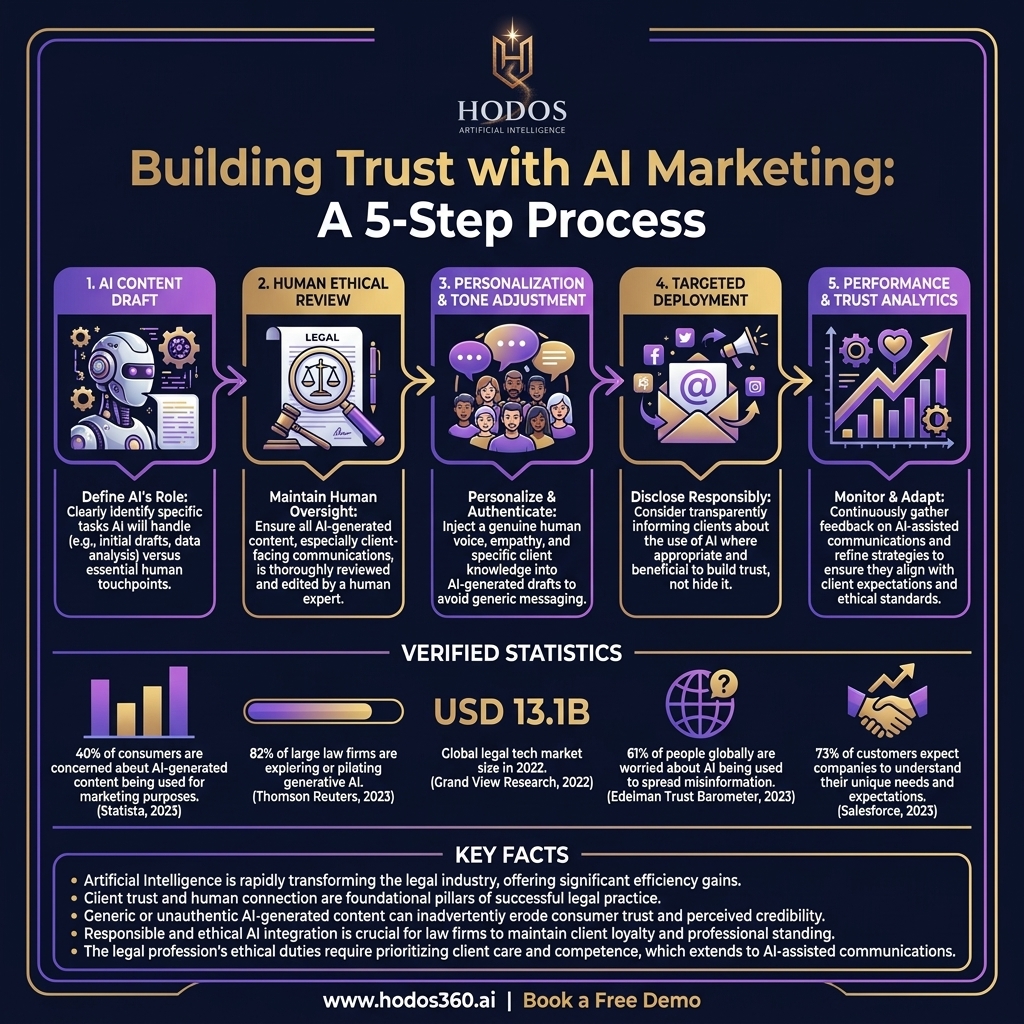
Furthermore, the ethical considerations for law firms extend beyond mere client perception. The American Bar Association's Model Rules of Professional Conduct, specifically Rule 7.1 (Communications Concerning a Lawyer's Services), mandates that lawyers not make false or misleading communications about their services. While AI itself isn't misleading, its uncritical application can inadvertently lead to claims that lack nuance or fail to represent the firm's true capabilities or approach. For instance, an AI-generated email that overpromises outcomes or uses overly aggressive language without human review could inadvertently violate ethical standards. This necessitates a 'human-in-the-loop' approach, where attorneys maintain oversight and ensure all AI-assisted emails align with professional obligations and the firm's commitment to honesty and integrity. This careful navigation is essential to prevent AI from becoming a liability rather than an asset in building a firm's reputation.
Navigating Ethical AI in Legal Marketing: Beyond Automation
The path forward for law firms in leveraging AI for marketing isn't about shunning the technology, but about embracing it with a strong ethical framework. This means moving beyond mere automation to intelligent augmentation. Leaders in the AI space, such as Anthropic CEO Dario Amodei, consistently emphasize the importance of developing AI that is aligned with human values and safety. For law firms, this translates to a proactive strategy for designing and implementing AI-driven marketing processes that prioritize transparency, accuracy, and client-centricity. Firms must establish clear internal policies on AI usage, delineating what content can be fully automated, what requires significant human review, and what should always be crafted by a human from scratch. This not only mitigates the risk of eroding consumer trust but also ensures compliance with evolving legal and ethical guidelines.
Crucially, the 'human-in-the-loop' model is not just a safeguard; it's an enhancement. Instead of viewing AI as a replacement for human marketers or attorneys, consider it a powerful assistant that takes care of the tedious, repetitive tasks, freeing up human talent for higher-level strategic thinking and relationship building. For example, AI can analyze vast datasets to identify emerging legal trends, client pain points, or optimal times for outreach, providing invaluable insights that human marketers can then use to craft highly targeted and empathetic messages. Learn more about AI Law Firm's Landmark UK Trial Win: An Essential Blueprint. This symbiotic relationship was a key theme at LegalTech NYC 2026, where discussions often revolved around how to train legal AI models on a firm's unique brand voice and ethical guidelines, ensuring that even AI-written drafts resonate authentically. The focus must shift from simply generating content to generating *trusted* content.
Developing a responsible AI strategy also involves continuous education for legal professionals. As noted by Mary Juetten, Esq., a prominent legal tech founder, understanding the capabilities and limitations of AI is crucial for its effective and ethical deployment. Firms should invest in training their marketing teams and even attorneys on how to effectively prompt generative AI tools, how to critically evaluate AI output, and how to infuse human nuance into AI-generated drafts. This includes understanding the biases that can be inherent in AI models and taking steps to mitigate them. By fostering a culture of informed AI use, law firms can transform AI from a potential trust liability into a powerful tool for building stronger, more credible client relationships, ensuring that every AI-assisted email reflects the firm's unwavering commitment to its clients.
Transparency and Authenticity in AI Content
The debate around disclosing AI use in marketing content is ongoing, but for law firms, a bias towards transparency often serves to build rather than undermine trust. While explicit disclaimers like "This email was AI-generated" might be counterproductive, firms can adopt subtler, more effective approaches. This could involve clearly stating that AI tools are used to enhance efficiency and personalization, allowing the legal team to focus on providing high-value counsel. For instance, a firm might include a brief note in their newsletter's footer: "Leveraging advanced technology to bring you timely insights." This acknowledges AI's role without making it the central focus. Learn more about Automate Client Lead Follow-Up: Proven Strategies for Law Firms. The key is to demonstrate that AI is a tool augmenting human expertise, not replacing it. Authenticity also stems from consistency: ensuring the tone and quality of AI-written marketing emails align perfectly with the firm's established brand voice and ethical standards. This requires careful training of AI models on the firm’s specific communication style and a rigorous human review process, ensuring that every message genuinely reflects the firm's values and expertise.
Ensure your marketing efforts resonate authentically with clients. Explore HODOS 360's AI Marketing Platform and elevate your firm's outreach!
Crafting Authentic AI Email Campaigns: Strategies for Law Firms
Moving beyond generic templates is crucial for law firms aiming to leverage AI for email marketing campaigns without sacrificing authenticity. The true power of AI lies not in mass production of bland messages, but in its ability to facilitate deep personalization at scale. Instead of simply inserting a client's name, advanced AI can analyze a client's past interactions, legal needs, and expressed preferences to suggest highly relevant content, case studies, or service offerings. For instance, if a client previously inquired about estate planning, an AI-assisted follow-up email could intelligently suggest relevant articles on recent changes in inheritance tax law, rather than a generic firm update. This level of nuanced personalization, when reviewed and approved by a human, transforms AI-written marketing emails from impersonal blasts into genuinely helpful and timely communications, thereby reinforcing trust and demonstrating the firm's attentiveness.
Crafting effective prompts for generative AI is an art form that legal marketers must master. Instead of asking AI to "write a marketing email," a more effective prompt might be: "Draft a personalized email to a prospective client who recently downloaded our whitepaper on commercial real estate disputes. Emphasize our firm's expertise in local zoning laws and recent successful outcomes for similar businesses. Maintain a professional, empathetic, and slightly formal tone, consistent with the firm's established brand voice. Learn more about AI Voice Assistants: Essential Balance for Law Firms. Include a call to action for a complimentary consultation." This detailed prompting ensures the AI produces content that is not only relevant but also aligns with the firm's specific brand identity and ethical guidelines. Firms should also use AI to A/B test different subject lines, call-to-action phrases, and content structures, allowing for continuous optimization based on real-world engagement metrics, which helps refine the authenticity and effectiveness of future campaigns.
Furthermore, integrating AI into a broader content marketing strategy means leveraging its capabilities across multiple channels. For example, the insights gained from AI-analyzed email engagement can inform the creation of new blog posts, social media updates, or even topics for webinars. If AI identifies a high level of interest in a specific type of litigation from email analytics, the firm can then use AI to help draft comprehensive blog posts on that subject, ensuring a consistent and valuable content flow across its digital presence. This holistic approach, where AI acts as an intelligence layer informing all aspects of content creation and distribution, ensures that the firm's messaging is not only efficient but also deeply resonant with its target audience, fostering long-term credibility and client relationships. This strategic use allows firms to maximize their marketing budgets and streamline workflows, which is a true benefit of generative AI.
Leveraging AI for Strategic Content Marketing
Beyond emails, AI can significantly enhance a law firm's overall content marketing strategies. Tools can analyze vast amounts of legal data, court rulings, and industry news to identify emerging trends and topics of interest to clients, enabling firms to proactively create valuable content. For instance, AI could flag a recent appellate court decision that impacts a specific industry, allowing the firm to quickly generate an expert analysis for their blog or a targeted LinkedIn post. This proactive content creation positions the firm as a thought leader, providing timely and relevant information that builds trust and authority. Learn more about AI Web Development: Essential Collaboration for Law Firms. Similarly, AI can assist in optimizing content for SEO, ensuring that the firm's insights reach a wider audience seeking legal information. By automating the research and initial drafting phases, attorneys and marketers can dedicate more time to refining content, adding their unique legal perspective, and ensuring factual accuracy and ethical compliance. This strategic integration of AI elevates the quality and reach of a firm's entire content ecosystem.
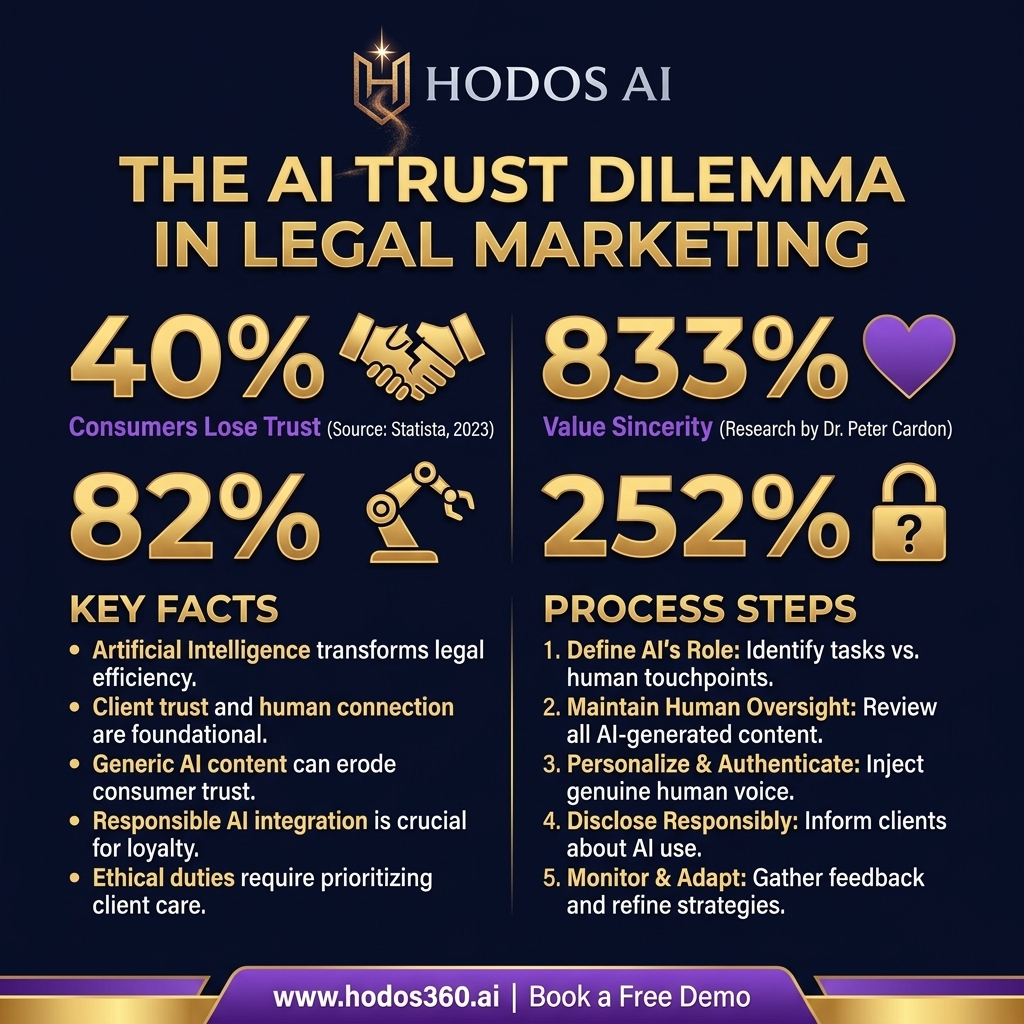
- ✓Implement a 'Human-in-the-Loop' Policy: Always have a qualified legal professional review and edit AI-generated content before publication, ensuring accuracy, tone, and ethical compliance.
- ✓Train AI on Your Firm's Voice: Feed AI models with existing high-quality, human-written content from your firm to develop a consistent and authentic brand voice for AI-written marketing emails.
- ✓Focus on Deep Personalization: Use AI to analyze client data for truly tailored content suggestions, rather than just basic name insertion, making emails more relevant and trustworthy.
- ✓Prioritize Transparency (Subtly): Consider soft disclosures about using technology to enhance client service, without explicitly stating "AI-generated" in every message, to maintain consumer trust.
- ✓Utilize AI for A/B Testing and Optimization: Leverage AI to test different subject lines, calls-to-action, and content variations to continuously improve engagement and effectiveness of email marketing campaigns.
- ✓Integrate AI Across Content Channels: Extend AI's role beyond emails to assist with blog posts, social media automation, and legal research summaries, ensuring a cohesive and intelligent content strategy.
- ✓Continuous Ethical Review: Regularly assess AI outputs against ABA Model Rules and internal ethical guidelines to prevent any misleading or inappropriate communications.
The HODOS 360 Advantage: Building Trust with Intelligent Automation
In a landscape where AI-written marketing emails can either build or erode consumer trust, law firms need a partner that understands the legal industry's unique demands. HODOS 360's AI Marketing Platform is specifically designed to empower law firms to leverage the full potential of AI for their outreach while meticulously safeguarding their reputation. Our platform's content generation capabilities are built with a 'human-in-the-loop' philosophy, providing sophisticated AI drafting tools that legal professionals can then refine, ensuring every message is authentic, legally sound, and perfectly aligned with the firm's brand voice. This empowers attorneys to quickly produce high-quality drafts for email marketing campaigns, social media updates, and blog posts, significantly reducing time spent on initial content creation without compromising on quality or ethical integrity.
Beyond content creation, HODOS 360 provides robust social media automation and analytics, allowing firms to track the performance of their AI marketing emails and other digital assets in real-time. This includes monitoring engagement rates, client sentiment, and overall ROI, providing actionable insights to continually refine strategies and ensure that marketing efforts are truly building trust and driving conversions. If a particular campaign is not resonating, our analytics can quickly identify the disconnect, allowing the legal team to adjust and optimize, preventing any long-term damage to credibility. Learn more about Proven Legal AI ROI: Essential Strategies for Law Firms. This data-driven approach ensures that firms are not blindly automating but intelligently adapting their marketing strategies based on tangible client feedback and market response.
HODOS 360 also recognizes that marketing isn't an isolated function. Our comprehensive suite of services, including the AI Law Firm Management System and AI Voice Assistants, works synergistically to create a seamless, client-centric experience. From initial client intake and lead qualification via AI Voice Assistants to automated case management and personalized follow-ups through the AI Law Firm Management System, every touchpoint is designed to reinforce the firm's professionalism and attentiveness. This integrated approach ensures that the client journey, from the first marketing email to the final case resolution, is consistent, efficient, and above all, trust-inspiring, allowing firms to confidently embrace the future of legal tech.
Integrating AI for Holistic Client Engagement
The integration of AI across a law firm's operations, beyond just marketing, creates a powerful ecosystem for client engagement. Imagine a scenario where an AI-written marketing email generates a lead, which is then qualified by an AI Voice Assistant that can book an appointment directly into the firm's AI Law Firm Management System. This system then automates client intake, document generation, and even provides AI-powered legal workflows for case management. This end-to-end automation, facilitated by platforms like HODOS 360, ensures that every interaction is efficient, personalized, and professional. It reduces friction for clients, provides faster responses, and frees up legal staff to focus on high-value legal work. By ensuring consistency and responsiveness across all client touchpoints, firms can significantly enhance consumer trust and build a reputation for modern, client-focused service, making the most of generative AI capabilities.

Key Takeaways and Future-Proofing Your Firm's Reputation
The digital era demands that law firms adapt, but not at the expense of their most valuable asset: trust. The data from 디지털투데이 is a clear warning: unchecked use of AI-written marketing emails can significantly undermine consumer trust. However, this doesn't signal a retreat from AI; rather, it calls for a more sophisticated, ethically grounded approach. Firms that will thrive in this new landscape are those that master the art of intelligent augmentation, where AI serves as a powerful co-pilot, enhancing efficiency and personalization while human oversight ensures authenticity and ethical compliance. This strategic integration is not just about adopting new tools but about fostering a culture of responsible innovation.
To future-proof your firm's reputation, prioritize transparency, even if subtle, in your AI-driven communications. Invest in training your team to effectively prompt, review, and refine AI outputs, ensuring every message reflects your firm's unique voice and unwavering commitment to client well-being. Embrace platforms that are built with the legal professional in mind, offering features that support ethical AI deployment and provide actionable insights into client engagement and trust. The firms that will lead are those that recognize AI not as a shortcut to replace human connection, but as a sophisticated tool to deepen it, allowing them to deliver legal services that are both cutting-edge and deeply human. The journey to mastering AI in legal marketing is continuous, but with a thoughtful strategy, law firms can leverage these powerful tools to build stronger, more enduring relationships based on genuine trust and unparalleled service.
Ready to build trust and elevate your firm's marketing with cutting-edge AI? Discover how HODOS 360 can transform your practice.
Frequently Asked Questions
How can law firms use AI in marketing without losing trust?+
Law firms can leverage AI by adopting a 'human-in-the-loop' approach, ensuring all AI-generated content is reviewed and refined by a legal professional. Focus on using AI for efficiency in drafting and personalization, but always infuse human empathy and ethical judgment. Training AI on your firm's specific brand voice and ethical guidelines is also crucial to maintain authenticity and credibility.
What role does transparency play in AI-generated content for legal marketing?+
Transparency, even subtle, helps build consumer trust. While overt disclaimers might not always be ideal, firms can acknowledge the use of advanced technology to enhance service efficiency. The key is to demonstrate that AI augments human expertise, allowing for better, faster service, rather than replacing genuine human interaction. This reinforces the firm's commitment to modern, client-focused practice.
Are there specific ABA rules that apply to AI in legal marketing?+
Yes, ABA Model Rules of Professional Conduct, particularly Rule 7.1 (Communications Concerning a Lawyer's Services), are highly relevant. This rule prohibits false or misleading communications. Firms must ensure that AI-written marketing emails and other content are accurate, not misleading, and uphold the highest standards of professional conduct, requiring careful human oversight of AI outputs.
How can AI help personalize emails authentically for legal clients?+
AI can analyze vast client data, including past interactions and expressed preferences, to suggest highly relevant and timely content. Instead of generic messages, AI can help tailor emails with specific legal insights, case studies, or service offerings that directly address a client's needs. This deep personalization, when reviewed by a human, makes AI-assisted emails feel genuinely helpful and attentive, enhancing trust.
What are the risks for law firms that don't adapt to AI in legal marketing?+
Firms that fail to strategically adapt to AI risk falling behind competitors in efficiency, reach, and client engagement. They may struggle with content generation, miss opportunities for targeted email marketing campaigns, and appear outdated. While unchecked AI use can undermine trust, a complete avoidance of AI can lead to missed opportunities for growth, reduced credibility, and an inability to meet evolving client expectations for modern legal services.