
AI Innovations: Ultimate Guide to Transforming Legal CRM
Just two years ago, Sarah Chen, managing partner at Sterling & Associates, faced a familiar dilemma: their mid-sized law firm was a powerhouse in litigation, but their client relationship management (CRM) system was a relic. Leads often fell through the cracks, client follow-ups were inconsistent, and personalized communication felt like a pipe dream.
"We were excellent lawyers, but our client experience felt transactional, not relational," Chen recalled at LegalTech NYC 2026. This narrative, common across the legal landscape, highlights a critical tension: the imperative for firms to maintain their professional gravitas while simultaneously embracing the disruptive potential of advanced technology.
The challenge wasn't just about adopting new tools; it was about fundamentally rethinking how client interactions could be managed and enhanced.
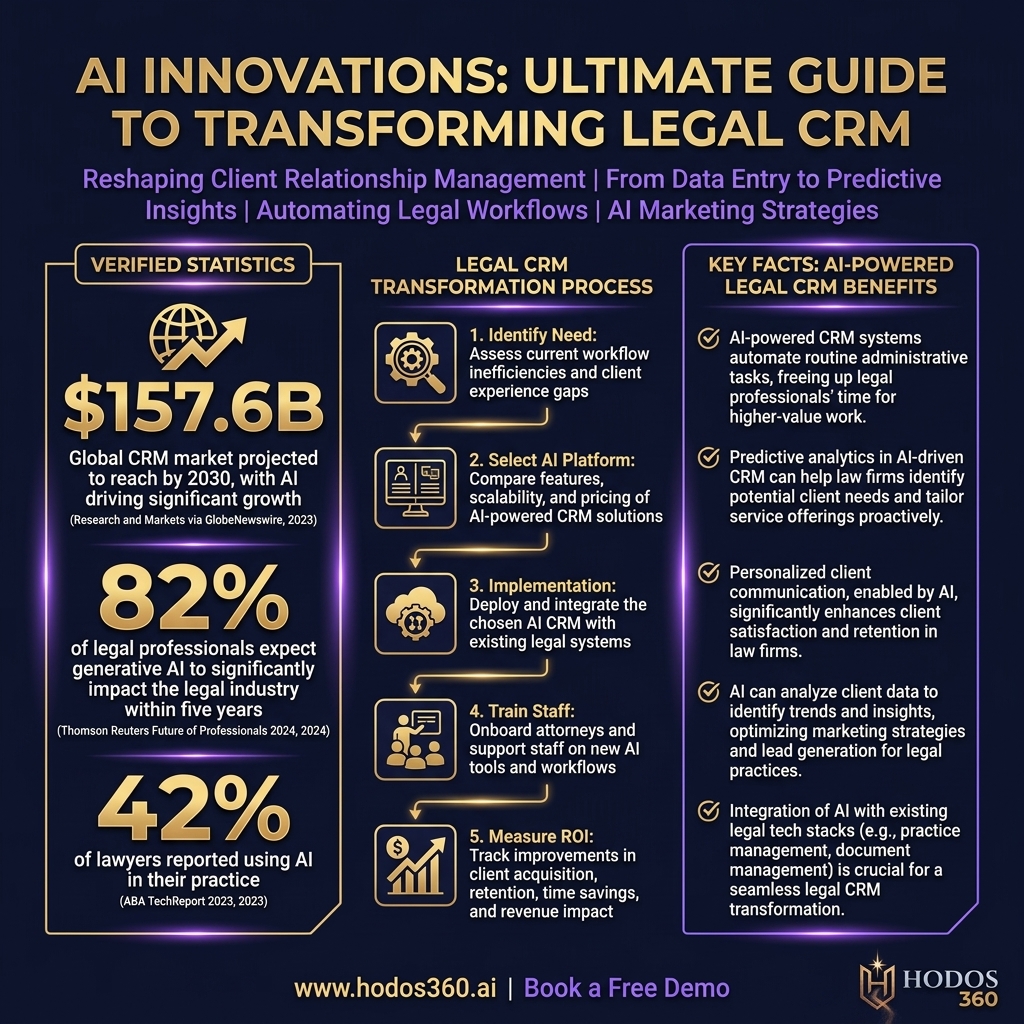
The global CRM market, projected to exceed $150 billion by 2030 with a significant portion driven by AI, is undergoing a profound transformation, as highlighted by recent GlobeNewswire reports on "AI Innovations: Transforming CRM Market with Advanced Customer Experience Technologies."
This shift is not merely incremental; it's a paradigm leap powered by artificial intelligence, offering unprecedented capabilities for personalization, automation, and predictive analytics. For law firms, this means moving beyond rudimentary contact databases to sophisticated platforms that anticipate client needs, streamline marketing efforts, and ultimately, foster deeper, more profitable relationships.
The question for legal professionals is no longer *if* AI will impact their CRM strategy, but *how* quickly and effectively they can integrate these AI innovations to secure a competitive edge and elevate their client service standards.
Firms like Sterling & Associates, under Chen's visionary leadership, began exploring bespoke AI-powered solutions.
Their journey underscores a broader trend: the legal industry, historically cautious, is now recognizing the strategic imperative of investing in cutting-edge CRM. This evolution demands a comprehensive understanding of how AI can be integrated across various touchpoints—from initial lead qualification to ongoing client engagement and retention.
The goal is to create a seamless, efficient, and highly personalized client journey that reflects the firm's commitment to excellence, while simultaneously freeing up valuable attorney time for high-value legal work. This guide will explore the multifaceted ways AI in CRM is reshaping the legal practice, offering actionable insights for firms ready to embrace the future of client management.
Discover how HODOS 360’s integrated AI platform can empower your firm to navigate this transformation and thrive. [Learn More About HODOS 360's AI Solutions]
AI Innovations: Reshaping Client Relationship Management in Legal
The traditional CRM model, often a static repository of client data, is rapidly being superseded by dynamic, AI-powered systems capable of learning, adapting, and predicting. This evolution is driven by advancements in machine learning (ML), natural language processing (NLP), and predictive analytics, which together allow CRM platforms to do far more than just store names and numbers.
For law firms, this means a shift from reactive client management to proactive engagement, where AI identifies potential client needs before they even articulate them. Salesforce CEO Marc Benioff has consistently championed AI's transformative potential, stating that "AI is the greatest technology revolution of our lifetime," a sentiment that resonates deeply within the legal tech sector.
This shift is not just about efficiency; it's about fundamentally changing the customer experience in a way that builds trust and loyalty, critical components for long-term legal client relationships.
The broader CRM market is a testament to this change, with a recent Gartner report indicating that AI capabilities are now a top differentiator for CRM software.
Learn more about Event Marketing: Essential Strategies for Live Events in the AI Era. Firms that embrace these AI innovations can leverage sophisticated algorithms to analyze vast datasets, uncovering patterns in client behavior, preferences, and engagement history. This deep analytical capability allows for highly targeted communication and service delivery, moving beyond generic outreach to truly personalized interactions.
Consider the competitive landscape: firms that fail to adopt these advanced systems risk falling behind those that can offer a superior, more responsive client journey. The future of customer relationship management in legal is undeniably intertwined with the intelligent application of AI, offering a pathway to not just maintain, but significantly enhance, client satisfaction and firm profitability.
The Evolution of Legal CRM: From Data Entry to Predictive Insights
At its core, the evolution of legal CRM signifies a move from mere data entry to the generation of actionable, predictive insights. Historically, legal professionals spent countless hours manually inputting client information, tracking communications, and managing case files—a process that was often inefficient and prone to human error.
Today, AI-powered CRM systems can automatically capture and categorize client data from diverse sources, including emails, calls, and website interactions. More importantly, they employ ML algorithms to analyze this aggregated data, identifying patterns that indicate client sentiment, potential new service needs, or even early warning signs of disengagement.
For example, an AI might flag a client who hasn't been contacted in several months, suggesting a proactive check-in, or identify a surge in inquiries related to a specific legal topic, signaling an opportunity for a targeted marketing campaign. This capability transforms CRM from a record-keeping tool into a strategic asset, enabling firms to anticipate and respond to client needs with unprecedented agility.
This shift is particularly impactful for business development. By leveraging AI in CRM, law firms can move beyond generic lead generation to a highly refined process of lead qualification and prioritization. Learn more about Voice AI: The Essential Shift for Modern Law Firms. AI can score leads based on their potential value, alignment with firm expertise, and likelihood of conversion, allowing marketing and legal teams to focus their efforts where they will yield the greatest return.
For instance, a system might identify a prospect whose industry is facing new regulatory challenges, presenting a perfect opportunity for the firm to offer specialized counsel. Furthermore, these predictive capabilities extend to client retention. AI can analyze historical data to identify clients at risk of churn, enabling firms to intervene with targeted support or value-added services.
The ethical implications of such data-driven strategies are paramount; firms must ensure compliance with regulations like ABA Model Rule 1.6 on Confidentiality of Information, safeguarding client data while still harnessing its power for strategic advantage. The ultimate benefit is a more efficient, effective, and ethically sound approach to client relationship management.
Operational Excellence: Automating Legal Workflows with AI-Powered CRM
Beyond client-facing interactions, AI innovations are fundamentally transforming the internal management of law firms by automating previously manual and time-consuming legal workflows. The integration of AI into CRM platforms means that routine administrative tasks, from initial client intake to document generation and billing, can be streamlined with remarkable efficiency.
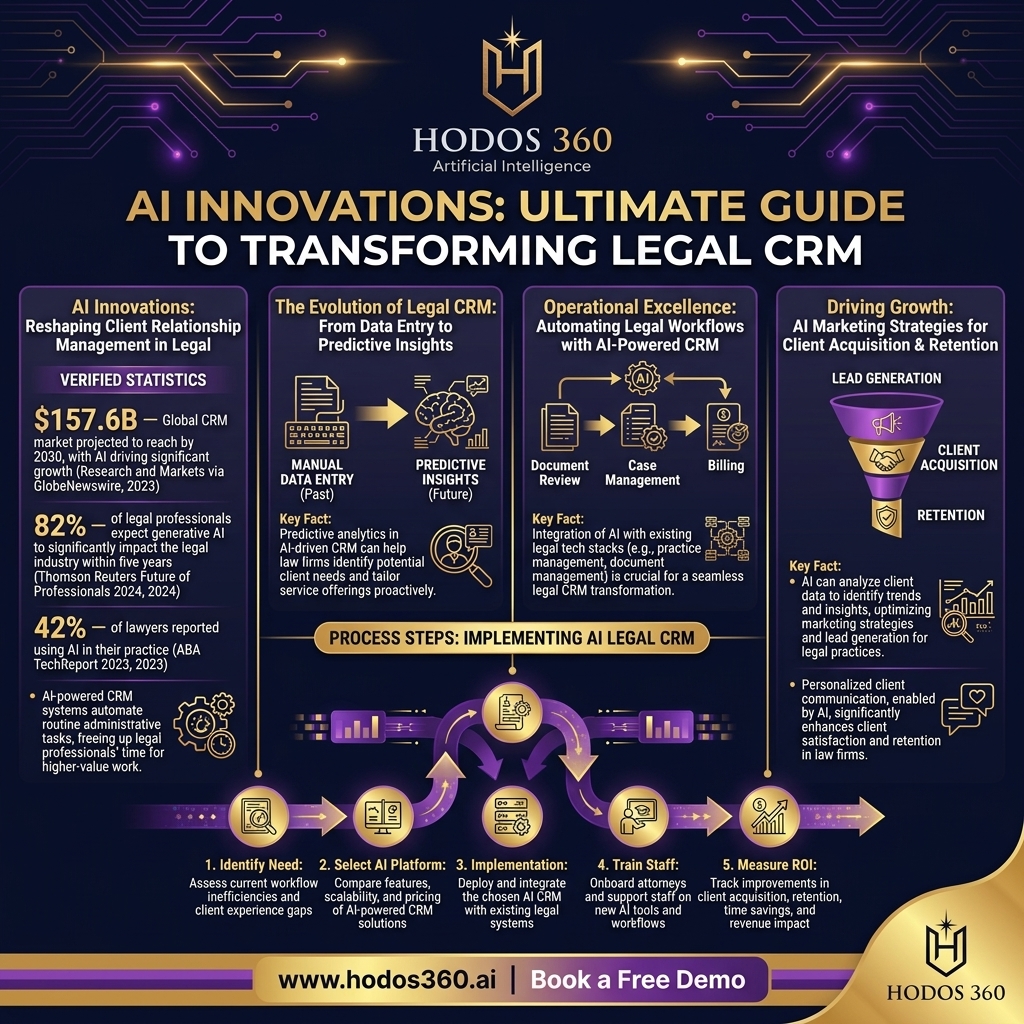
Consider the client intake process: what once involved multiple forms, manual data entry, and potential delays can now be largely automated. AI can guide prospective clients through intelligent questionnaires, automatically populate client profiles, and even initiate conflict checks, significantly reducing the administrative burden on staff.
This not only speeds up the onboarding process but also ensures greater accuracy and compliance, critical for maintaining professional standards as outlined in ABA Model Rule 1.1 on Competence.
This operational overhaul is central to platforms like HODOS 360's AI Law Firm Management System. By consolidating case management, billing, document automation, and calendar functions within an AI-powered framework, firms gain a holistic view of their operations.
Learn more about AI Podcasts: Essential Voice Assistant Strategies for Law Firms. For instance, after a new client is onboarded, AI can automatically trigger the creation of necessary legal documents, generate initial invoices, and schedule key appointments, all based on predefined workflows. This level of automation frees up attorneys and paralegals to focus on substantive legal work, enhancing overall firm productivity and client service quality.
The impact of such systems is not theoretical; firms adopting similar AI tools, such as Allen & Overy's widely publicized partnership with Harvey AI for contract review and due diligence, have reported significant reductions in processing times and improved accuracy, demonstrating the tangible benefits of AI across various legal functions.
The ability to automate these core business processes means law firms can operate with unprecedented agility and focus, allowing them to scale more effectively and respond to client needs with greater speed.
- ✓Automated Client Intake: AI-driven forms and data capture reduce manual entry errors and accelerate onboarding by up to 50%.
- ✓Intelligent Document Automation: Generate complex legal documents, such as contracts and pleadings, instantly using AI-powered templates and client data.
- ✓Predictive Case Management: AI analyzes historical case data to offer insights on potential outcomes, resource allocation, and timeline estimations.
- ✓Streamlined Billing & Financial Management: Automated time tracking, invoice generation, and expense categorization improve accuracy and reduce billing cycles.
- ✓Optimized Calendar & Deadline Management: AI proactively identifies critical deadlines and schedules appointments, minimizing the risk of missed dates.
- ✓AI-Powered Legal Workflows: Customize and automate sequences of tasks, from lead nurturing to case closing, ensuring consistency and efficiency.
- ✓Enhanced Compliance & Conflict Checking: AI rapidly cross-references new client data against existing records and regulatory requirements to prevent conflicts of interest.
Driving Growth: AI Marketing Strategies for Client Acquisition & Retention
In today's competitive legal market, effective marketing is no longer a luxury but a necessity, and AI innovations are revolutionizing how law firms attract and retain customers. The HODOS 360 AI Marketing Platform exemplifies this shift, providing firms with sophisticated tools for content generation, social media automation, and targeted outreach.
Imagine creating compelling legal video content in minutes, tailored to specific client segments, or automatically scheduling social media posts that resonate with your target audience based on AI-driven insights. This level of personalized, scalable marketing was previously unattainable for most firms, requiring significant time and budget.
Now, AI can analyze market trends, identify emerging legal needs, and even craft persuasive copy, allowing firms to engage potential clients with unprecedented precision. The ability to generate high-quality, relevant content consistently is a game-changer, helping firms establish thought leadership and build a strong online presence.
Furthermore, AI in CRM significantly enhances ROI tracking and analytics, providing law firms with clear, data-driven insights into their marketing efforts. Learn more about AI Agents Marketing: Your Essential Guide for Law Firms. Instead of guessing which campaigns are effective, AI analyzes engagement rates, conversion paths, and client acquisition costs, offering a transparent view of marketing performance.
The ABA's annual TechReport consistently highlights that law firms struggle with effective marketing and measuring its return; AI offers a powerful solution to this longstanding challenge. By understanding exactly what works, firms can optimize their marketing strategies, allocate resources more efficiently, and ultimately, secure a higher return on investment.
This data-driven approach allows firms to continuously refine their outreach, ensuring that every marketing dollar contributes directly to business development and client growth. [Transform Your Client Acquisition: Explore HODOS 360's AI Marketing Platform]
Precision Engagement: Hyper-Personalization and ROI Optimization
The true power of AI innovations in legal marketing lies in their capacity for hyper-personalization. Traditional marketing often relies on broad demographic segmentation, leading to generic messages that may not resonate with individual prospects. AI-powered systems, however, can analyze vast amounts of data—including past interactions, website browsing history, and expressed interests—to create highly individualized client profiles.
This allows law firms to deliver bespoke content, tailored service recommendations, and personalized communications that speak directly to a client's specific legal needs and concerns. For instance, if a prospect has been researching intellectual property law on a firm's website, AI can ensure they receive targeted content related to patent applications or trademark protection, rather than general legal news.
This level of precision fosters a stronger sense of connection and relevance, significantly increasing the likelihood of conversion and long-term client loyalty. Such personalized interactions are key to building lasting professional relationships in the legal field, as clients increasingly expect bespoke service.
Coupled with hyper-personalization is the critical function of ROI optimization.
Learn more about Essential Website Accessibility Tools for Law Firms. In the past, measuring the exact benefits of marketing spend was often a nebulous exercise. With AI, every touchpoint, from an initial ad click to a successful client conversion, can be meticulously tracked and analyzed.
AI-powered CRM platforms provide sophisticated dashboards that illustrate which marketing channels are performing best, which content generates the most engagement, and the precise cost-per-acquisition for different client segments. This granular level of detail empowers law firm management to make informed, data-backed decisions about their marketing strategies, shifting resources from underperforming campaigns to those yielding the highest returns.
This analytical rigor ensures that marketing efforts are not just creative, but also demonstrably effective, aligning directly with the firm's business objectives and driving sustainable growth. This strategic use of data helps firms navigate the complex digital market with confidence, ensuring maximum impact from their advanced marketing investments.
Elevating Client Experience: AI Voice & Web Development as Your Digital Front Door
The modern client's journey with a law firm often begins long before they speak to an attorney, frequently starting with a phone call or a visit to the firm's website. Here, too, AI innovations are transforming the customer experience, creating a seamless and highly responsive digital front door.
HODOS 360's AI Voice Assistants, for example, offer 24/7 phone answering, ensuring no potential lead is ever missed due to after-hours calls or busy lines. These intelligent assistants can qualify leads, answer common questions, book appointments directly into attorney calendars, and even provide multilingual support, catering to a diverse client base.
This level of constant availability and intelligent interaction significantly enhances client satisfaction, addressing a common pain point in the legal industry: accessibility. Firms that leverage such advanced voice AI are not just answering calls; they are providing an immediate, professional, and efficient first point of contact that sets them apart.
Complementing AI Voice Assistants, HODOS 360's Web & Mobile Development services integrate AI-powered website building, responsive design, and SEO optimization. Learn more about Essential Guide: AI Citation Hallucinations & Legal Integrity. A law firm's website is its digital storefront, and AI ensures it's not just visually appealing but also a high-converting lead generation machine.
AI can analyze user behavior to optimize website layouts, personalize content, and ensure the site ranks highly in search results for relevant legal queries. This strategic integration of AI across both voice and web channels creates a cohesive and superior customer experience. Consider a potential client searching for a personal injury lawyer: an AI-powered website guides them seamlessly to relevant information, while an AI Voice Assistant handles their immediate inquiry, qualifies their need, and schedules a consultation—all without human intervention until a qualified lead is ready for an attorney.
This comprehensive digital strategy is crucial for firms aiming to maximize their online presence and capture a larger share of the legal market, ensuring a consistent and positive relationship from the very first touchpoint.
Seamless Interaction: Intelligent Call Answering and High-Converting Websites
The synergy between AI Voice Assistants and AI-powered web development creates a truly seamless and efficient client journey. For instance, Google's Duplex AI, while not specific to legal, showcases the potential for highly natural and effective AI-driven conversations, setting a new standard for automated interactions.
In the legal context, an AI Voice Assistant can act as an extension of the firm, intelligently routing calls to the appropriate department or attorney, handling routine inquiries about office hours or service areas, and even collecting initial case details. This reduces the workload on administrative staff, allowing them to focus on more complex tasks, while ensuring that clients always receive a prompt and professional response, aligning with ABA Model Rule 1.4 on Communication.
This consistent, 24/7 availability significantly improves client satisfaction and ensures that potential leads are captured and nurtured immediately, regardless of when they reach out. This is a crucial benefit for law firms operating in a competitive market where responsiveness can be a key differentiator.
Simultaneously, AI-powered website building leverages sophisticated algorithms to create highly optimized and conversion-focused legal websites.
These websites are not just aesthetically pleasing; they are designed to guide visitors through a clear user journey, from initial interest to booking a consultation. AI can dynamically adjust content based on visitor behavior, personalize calls to action, and continually optimize for search engine rankings, ensuring maximum visibility.
The use of high-converting templates, informed by extensive data analytics, means that every element of the website is geared towards turning visitors into qualified leads. This intelligent design, coupled with responsive features for mobile users, ensures that the firm's digital presence is both accessible and effective across all devices.
The integration of these AI innovations into a firm's digital strategy is no longer a luxury but a strategic imperative, driving both customer satisfaction and measurable business growth.

Strategic Imperative: Navigating the Future of Legal Practice with AI
The transforming legal landscape, heavily influenced by rapid AI innovations, presents both a challenge and an unparalleled opportunity for law firms. As we've explored, the intelligent integration of AI in CRM offers profound benefits across client relationship management, operational efficiency, and marketing strategies. Firms that embrace these advanced systems are not just adopting new software; they are investing in a future where client interactions are more personalized, workflows are more automated, and business growth is propelled by data-driven insights.
The competitive pressure to adopt these trends is mounting, with early adopters already reporting significant gains in lead conversion, client satisfaction, and overall profitability. The choice for law firm management is clear: evolve with the technology or risk being outmaneuvered by more agile, tech-forward competitors.
For firms like Sterling & Associates, the decision to invest in AI-powered CRM was a strategic pivot that yielded tangible results. Sarah Chen noted, "Our customer experience scores have jumped by 30%, and our lead conversion rate has nearly doubled since we implemented AI across our marketing and management platforms."
This success story underscores the critical takeaway: AI is not just a tool; it's a strategic imperative that reshapes every aspect of a law firm's operation and client engagement. It demands a holistic approach, integrating AI innovations not as isolated solutions but as a cohesive ecosystem that supports the firm's overarching goals.
Platforms like HODOS 360, with their comprehensive suite of AI Law Firm Management, AI Marketing, AI Voice Assistants, and Web & Mobile Development services, offer a powerful, integrated solution for firms ready to make this leap. The future of legal practice is here, and it is intelligently powered by AI.
[Request a Free Demo of HODOS 360's AI Platform Today]
Frequently Asked Questions
What is AI in CRM, and how does it specifically benefit law firms?+
AI in CRM refers to the integration of artificial intelligence capabilities into customer relationship management systems. For law firms, it means automating client intake, personalizing communications, predicting client needs, and streamlining marketing efforts. This leads to improved client satisfaction, increased lead conversion, and greater operational efficiency, allowing attorneys to focus on high-value legal work rather than administrative tasks.
How do AI Voice Assistants enhance client experience for law firms?+
AI Voice Assistants provide 24/7 client support, ensuring that all calls are answered promptly, even outside business hours. They can qualify leads, book appointments, answer frequently asked questions, and offer multilingual support. This improves responsiveness, captures more potential clients, and provides a professional first impression, elevating the overall client experience and firm accessibility.
Can AI-powered marketing really boost a law firm's ROI?+
Absolutely. AI-powered marketing platforms utilize data analytics to identify target audiences, create personalized content (like AI videos or social media posts), and optimize campaign performance. By understanding which strategies yield the best results, firms can allocate resources more effectively, reduce wasted spend, and achieve a higher return on investment for their marketing efforts compared to traditional methods.
What ethical considerations should law firms keep in mind when adopting AI in CRM?+
Law firms must prioritize client data privacy and confidentiality, adhering to rules like ABA Model Rule 1.6. Transparency with clients about AI's role, ensuring data security, and maintaining human oversight in decision-making are crucial. Firms must also ensure that AI tools are used competently and ethically, aligning with professional responsibilities and avoiding bias in client interactions or marketing.
How does HODOS 360's platform integrate these AI innovations for law firms?+
HODOS 360 offers a comprehensive, integrated suite of AI-powered services. This includes an AI Law Firm Management System for internal workflows, an AI Marketing Platform for client acquisition, AI Voice Assistants for enhanced client interaction, and Web & Mobile Development for a strong digital presence. This holistic approach ensures seamless integration and maximum synergy across all aspects of a law firm's operations and client engagement.