

Essential Website Accessibility Tools for Law Firms
The digital front door of a law firm is no longer merely a convenience; it is often the first, and sometimes only, point of contact for potential clients. Yet, for millions of Americans with disabilities, this door remains frustratingly, or even entirely, shut. Consider the recent high-profile settlement involving the Department of Justice and a major restaurant chain in May 2026, where the core issue revolved around an inaccessible online ordering system.
This wasn't just a technical oversight; it was a violation of civil rights under the Americans with Disabilities Act (ADA), echoing the landmark *Robles v. Domino's Pizza LLC* Supreme Court decision that solidified website accessibility as a legal imperative. For law firms, this landscape presents a critical juncture: embracing digital inclusion or risking legal exposure and alienating a significant segment of the population.
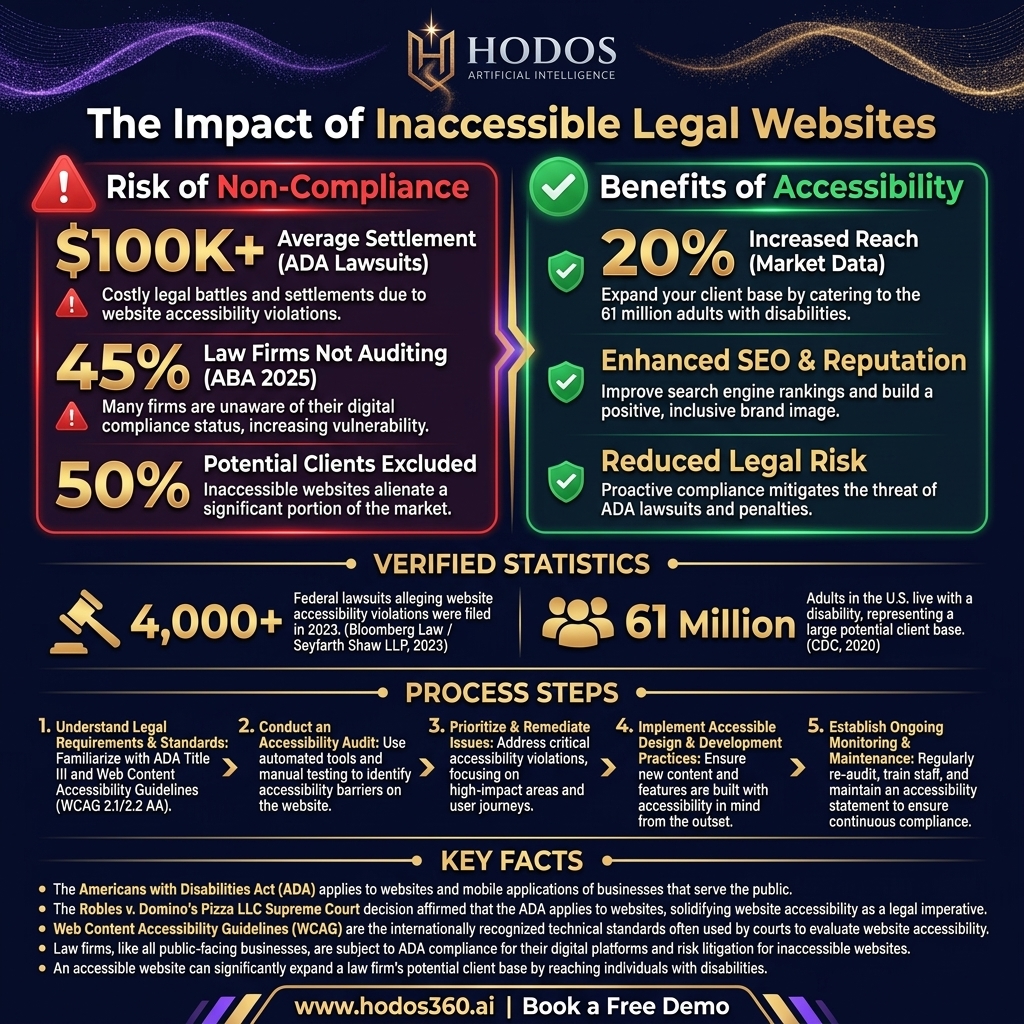
The stakes are particularly high for legal practices, which are not only subject to these laws themselves but also advise clients on similar compliance issues. The irony of a law firm being sued for an inaccessible website is not lost on the industry. According to the 2025 ABA Legal Technology Survey Report, only 45% of small and mid-sized law firms actively audit their websites for accessibility, a figure that remains alarmingly low given the escalating litigation.
This gap underscores a pervasive challenge: while many firms understand the *concept* of accessibility, the practical application, especially identifying and remediating issues, often falls by the wayside. This article will delve into essential website accessibility checker tools, offering a strategic roadmap for law firms to ensure their digital platforms are not just compliant, but truly inclusive.
Ready to ensure your firm's website meets critical accessibility standards? Discover how HODOS 360's Web & Mobile Development solutions can build your firm a fully compliant, high-performing digital presence.
The Legal Imperative: ADA, WCAG, and the Cost of Non-Compliance
The legal landscape surrounding website accessibility for businesses, including law firms, has matured significantly, shifting from ambiguous guidance to concrete enforcement. The Americans with Disabilities Act (ADA), specifically Title III, mandates that public accommodations provide equal access to individuals with disabilities. While the ADA was enacted prior to the internet's widespread adoption, courts and regulatory bodies, notably the Department of Justice (DOJ), have consistently interpreted it to apply to websites and mobile applications.
This was powerfully reaffirmed in cases like *Gil v. Winn-Dixie Stores, Inc.*, where a federal court found a grocery chain's inaccessible website violated the ADA, highlighting the real-world impact on individuals unable to access essential services. The financial repercussions are not trivial; settlements and legal fees can easily run into six or even seven figures, a stark reality for firms like one well-known regional practice in the Midwest that faced a class-action suit in late 2025 over its client intake portal's lack of keyboard navigation support.
Central to achieving ADA compliance in the digital realm are the Web Content Accessibility Guidelines (WCAG), developed by the World Wide Web Consortium (W3C). Learn more about AI Website Development: Essential Strategies for Law Firms. While not explicitly codified into U.S. law for private entities, WCAG 2.1 Level AA has become the de facto technical standard cited by courts and the DOJ in accessibility enforcement actions.
These guidelines provide a comprehensive framework covering principles like perceivability (information and user interface components must be presentable to users in ways they can perceive), operability (user interface components and navigation must be operable), understandability (information and the operation of user interface must be understandable), and robustness (content must be robust enough that it can be interpreted reliably by a wide variety of user agents, including assistive technologies).
Neglecting these standards can transform a firm's digital asset into a significant liability. The American Bar Association's Standing Committee on Professionalism has even begun to publish advisories emphasizing the ethical obligation of attorneys to ensure their digital communications are accessible, recognizing that denying access to legal services via an inaccessible website could be seen as a breach of professional conduct.
Navigating the Landscape: Understanding Website Accessibility Tools
For law firms committed to digital inclusion, understanding the array of website accessibility checker tools available is the first practical step. These tools can generally be categorized into automated checkers, browser extensions, and manual testing methodologies, each offering distinct advantages and limitations. Automated tools, such as WAVE (Web Accessibility Evaluation Tool) by WebAIM or Siteimprove Accessibility Checker, are excellent for quickly scanning entire websites or specific pages for common, easily detectable issues.
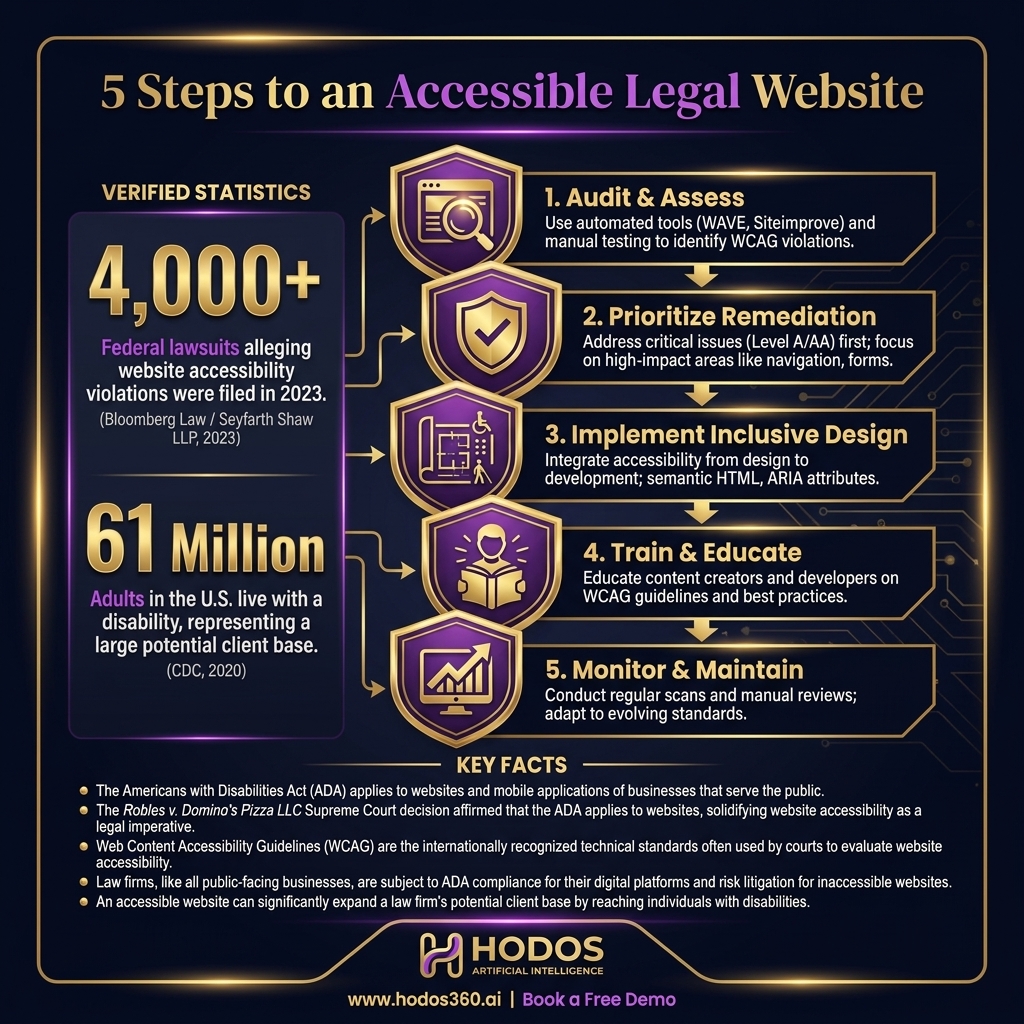
They can identify problems like insufficient color contrast, missing alternative text for images, empty links, or improperly structured headings. For instance, a recent audit using Siteimprove by TechLaw Partners in Silicon Valley revealed over 2,000 WCAG 2.1 Level AA violations across their 500-page knowledge base, primarily due to inconsistent heading structures and non-descriptive link texts, issues easily flagged by automated scans.
However, relying solely on automated website accessibility tools is a critical mistake. Experts like Jennison Asuncion, Head of Accessibility Engineering at LinkedIn and co-founder of Global Accessibility Awareness Day, frequently emphasize that automated tools can only detect about 30-40% of WCAG issues. Learn more about AI Agents Unveiled: Essential Frontend Vision for Law Firms.
They cannot interpret context, assess the clarity of language, or evaluate the usability of complex interactive elements for someone using a screen reader. This is where manual testing becomes indispensable. Manual testing involves human testers, often individuals with disabilities, using assistive technologies like screen readers (e.g., JAWS, NVDA), keyboard-only navigation, and voice control software to interact with the website.
This qualitative approach uncovers nuanced usability barriers that automated checkers simply miss, such as a contact form that is technically coded correctly but is confusing to navigate without a mouse, or a video with accurately transcribed captions but lacking critical visual context descriptions.
Automated vs. Manual Accessibility Testing: A Balanced Approach
The most effective strategy for law firms combines the efficiency of automated website accessibility checker tools with the depth of manual testing. Automated checkers serve as a crucial first line of defense, providing a broad overview and identifying low-hanging fruit for remediation. They are particularly useful during the development phase for continuous integration and immediate feedback.
For example, a development team at LexTech Solutions, a legal software startup, integrates Axe Core into their CI/CD pipeline, ensuring that new code deployments are automatically scanned for critical accessibility errors before reaching production. This proactive approach saves significant time and resources compared to finding issues post-launch.
Conversely, manual testing, while more time-intensive, is essential for validating the true user experience. Learn more about AI Voice Agent: Essential Legal Firm Automation for 2026. It involves a deeper dive into complex functionalities, user flows, and content comprehensibility, ensuring that the website is not just technically compliant but genuinely usable for all.
This includes reviewing keyboard navigation paths for logical flow, testing forms with various assistive technologies, and evaluating the clarity of error messages. Law firms should consider engaging accessibility consultants or internal teams trained in manual testing to conduct regular, comprehensive audits. The blend of automated scans for efficiency and manual reviews for thoroughness creates a robust framework, ensuring that the firm's digital presence is both legally sound and truly accessible to every potential client.
Don't let accessibility become an afterthought. Partner with HODOS 360 to build a legal website that is not only compliant and high-performing but also genuinely inclusive, reaching every potential client.
Implementing Best Practices: A Proactive Approach to Digital Inclusion
Achieving and maintaining website accessibility extends far beyond running periodic scans with website accessibility checker tools; it demands a proactive, integrated approach embedded throughout the entire web development lifecycle. This starts at the design phase, where accessibility considerations should inform everything from color palettes to layout structures.
Kat Holmes, a renowned advocate for inclusive design and author of *Mismatch*, argues that "exclusion happens when we solve problems for ourselves and those we identify with." For law firms, this means moving beyond the assumption that all users interact with their website in the same way.
Designers should prioritize high color contrast ratios (easily checked by tools but designed intentionally), clear visual hierarchies, and multiple ways to access information, such as distinct links and search functions. Early integration of accessibility ensures it's a foundational element, not an expensive afterthought requiring extensive retrofitting.
Furthermore, the implementation phase requires developers to adhere strictly to semantic HTML, ARIA (Accessible Rich Internet Applications) attributes, and robust JavaScript practices. Semantic HTML ensures that screen readers and other assistive technologies can correctly interpret the structure and meaning of content. ARIA roles and properties provide additional context for dynamic content and complex widgets that native HTML might not fully support.
Learn more about Voice AI Landscape: Essential Strategies for Law Firms. For instance, a legal firm's interactive case study section, built with dynamic filters and accordions, would require careful ARIA implementation to announce state changes and focus management to assistive technology users. Content creators, too, play a vital role, ensuring all images have descriptive alt text, videos include accurate captions and transcripts, and language is clear, concise, and jargon-free where possible.
This holistic approach, from the initial wireframe to the final deployment and beyond, is crucial. As Tim Berners-Lee, the inventor of the World Wide Web, famously stated, "The power of the Web is in its universality. Access by everyone regardless of disability is an essential aspect."
The Future of Accessible Legal Websites: AI and Emerging Solutions
The landscape of web accessibility is continually evolving, with artificial intelligence (AI) poised to revolutionize how law firms approach digital inclusion. At LegalTech NYC 2026, a significant portion of the discourse focused on AI's potential to move beyond reactive accessibility fixes to proactive, embedded solutions.
Companies like AccessiBe and UserWay are already leveraging AI-powered widgets to provide automated remediation layers, dynamically adjusting website code to improve compliance. While these solutions are not without their critics – often cited for not fully replacing human oversight – they represent a significant leap in making basic accessibility achievable for firms with limited resources.
Imagine an AI that can automatically generate contextually relevant alt text for newly uploaded images, or one that can identify and suggest clearer language for complex legal jargon, making content more understandable for a broader audience.
Beyond automated widgets, AI is being developed to assist developers directly.
Tools are emerging that can analyze code in real-time, suggesting accessibility improvements before deployment, effectively embedding WCAG compliance into the development pipeline. Learn more about Legal AI Trust: An Essential Guide for Law Firms. For example, a startup showcased at a recent SXSW event demonstrated an AI-driven platform that learns from WCAG violations and automatically refactors problematic CSS and JavaScript, drastically reducing manual remediation efforts.
Furthermore, the future holds promise for personalized accessibility experiences, where AI could dynamically adapt a website's interface based on a user's known preferences or assistive technology, offering a truly tailored and barrier-free interaction. This proactive integration of AI ensures that accessibility is not merely a checklist item but an inherent quality of the digital experience, fostering trust and expanding a law firm's reach to every potential client.
HODOS 360's Web & Mobile Development services are at the forefront of this evolution, integrating AI-powered features that enhance both SEO and accessibility, ensuring your firm's online presence is future-proof.
HODOS 360's Role in Building Compliant Legal Websites
In this rapidly evolving digital landscape, HODOS 360 stands as a crucial partner for law firms seeking to build and maintain fully accessible and high-performing websites. Our Web & Mobile Development service goes beyond aesthetic design and basic functionality, focusing on creating AI-powered websites that inherently comply with WCAG 2.1/2.2 Level AA standards and anticipate future accessibility needs.
We integrate robust accessibility audit tools and best practices directly into our development process, from initial design concepts to final deployment. This means features like semantic HTML, proper ARIA attribute implementation, keyboard navigation support, and optimal color contrast are not add-ons but fundamental components of every site we build.
Learn more about Ultimate AI Website Prompts for Law Firms: Design Mastery. For example, our AI-powered website builder includes templates rigorously tested for accessibility, ensuring that even firms leveraging automated content generation or workflow integrations maintain full compliance. By partnering with HODOS 360, law firms can confidently launch digital platforms that are not only visually appealing and SEO-optimized but also genuinely inclusive, reaching a wider client base and mitigating legal risks.

Key Takeaways and Next Steps for Law Firms
Ensuring your law firm's website is accessible is no longer optional; it's a cornerstone of ethical practice, legal compliance, and business growth in the 21st century. The journey towards digital inclusion requires a multi-faceted approach, leveraging the power of website accessibility checker tools while understanding their limitations and supplementing them with rigorous manual testing.
The legal implications of non-compliance, underscored by the ADA and WCAG guidelines, are substantial, with the Department of Justice actively pursuing enforcement and courts consistently ruling in favor of accessibility advocates. Firms that delay addressing these issues risk not only significant financial penalties but also reputational damage and the alienation of potential clients who rely on accessible digital channels.
The path forward involves a commitment to embedding accessibility throughout your firm's digital strategy. Start by conducting a comprehensive audit using a combination of automated website accessibility tools like WAVE or Siteimprove, followed by in-depth manual testing to uncover nuanced usability barriers. Prioritize remediation based on impact and frequency, focusing on WCAG 2.1/2.2 Level AA guidelines.
Crucially, foster a culture of inclusive design and development within your team, ensuring that all new content and features are built with accessibility in mind. This proactive stance not only mitigates legal risks but also expands your firm's reach, demonstrating a commitment to serving all members of the community.
In a competitive legal market, a truly accessible website is a powerful differentiator, signaling professionalism and empathy to a diverse clientele.
Ready to transform your law firm's online presence into an accessible, high-performing asset? Book a free demo with HODOS 360 today and see how our AI-powered Web & Mobile Development solutions can empower your firm.
Frequently Asked Questions
Q1: What is website accessibility and why is it crucial for law firms?+
Website accessibility ensures that people with disabilities can perceive, understand, navigate, and interact with your firm's website. For law firms, it's crucial not only for ethical reasons and expanding client reach but also for legal compliance. The Americans with Disabilities Act (ADA) extends to websites, meaning an inaccessible site can lead to costly lawsuits, reputational damage, and a failure to serve all potential clients.
Q2: What are the primary legal standards for website accessibility in the U.S.?+
The primary legal standard is the Americans with Disabilities Act (ADA), particularly Title III, which applies to public accommodations. While the ADA doesn't specify technical standards for websites, courts and the Department of Justice frequently reference the Web Content Accessibility Guidelines (WCAG) 2.1 Level AA as the de facto benchmark for compliance. Adhering to WCAG helps ensure ADA conformity.
Q3: Can automated website accessibility checker tools fully ensure compliance?+
No, automated website accessibility checker tools cannot fully ensure compliance. While invaluable for identifying about 30-40% of common WCAG issues like color contrast or missing alt text, they cannot assess contextual usability, logical flow for keyboard navigation, or the clarity of complex content for screen reader users. A comprehensive strategy requires both automated scans and thorough manual testing by human experts.
Q4: What are some essential features to look for in a website accessibility tool?+
When evaluating website accessibility tools, look for features like comprehensive WCAG 2.1/2.2 Level AA reporting, clear issue descriptions with suggested remediation, integration with development workflows, and the ability to scan multiple pages or entire sites. Browser extensions can be useful for quick, single-page checks, while enterprise solutions offer deeper analytics and monitoring capabilities to identify and resolve issues.
Q5: How often should law firms audit their websites for accessibility?+
Law firms should audit their websites for accessibility regularly. Automated scans can be integrated into continuous development cycles (e.g., weekly or monthly), especially after content updates or feature deployments. Comprehensive manual audits, however, should be conducted at least annually, or whenever significant design changes or platform migrations occur. Ongoing monitoring is key to maintaining compliance and providing an inclusive experience.