

AI Marketing Software vs. Agency: Ultimate Guide for Law Firms
Just two years ago, when Sarah Chen, managing partner at a boutique intellectual property firm in Silicon Valley, LexTerra IP, found her firm's growth plateauing, she faced a familiar dilemma. Her traditional marketing agency, a stalwart partner for over a decade, was delivering consistent but uninspired results. The monthly retainer felt increasingly heavy, especially when compared to the buzz surrounding new AI marketing software promising unprecedented efficiency and ROI. Chen’s struggle wasn't unique; it mirrored a broader tension across the legal industry as firms grapple with the marketing agency vs. AI marketing software debate. The question isn't whether AI will transform legal marketing, but rather how law firms can best integrate these powerful tools to thrive without losing the strategic edge that human expertise provides.
The narrative of disruption is often dramatic, pitting old against new. In legal marketing, this plays out as a contest between the established relationships and bespoke strategies offered by full-service agencies, and the data-driven precision, speed, and cost-effectiveness of AI tools. From crafting compelling social media campaigns to optimizing for search engines, the capabilities of AI marketing platforms have expanded exponentially. Companies like OpenAI and Google continue to push the boundaries of large language models, making content generation and predictive analytics more sophisticated and accessible than ever before. This technological surge forces law firms to re-evaluate their entire marketing expenditure, asking where their valuable resources – both financial and human – are best allocated. Traditional marketing agencies, once indispensable, now find themselves needing to adapt or risk being sidelined by the automated prowess of AI.
This isn't merely a theoretical discussion; it has profound implications for a law firm's bottom line and competitive standing. A 2024 report by Thomson Reuters revealed that over 60% of law firms surveyed planned to increase their investment in legal technology, with a significant portion earmarked for client acquisition and marketing tools. The competitive landscape demands not just presence, but strategic, high-impact engagement. Whether it's a small business attorney seeking to expand their local client base or a large corporate firm targeting global enterprises, understanding the strengths and weaknesses of both AI marketing software and traditional agencies is paramount. This guide will delve into the core arguments for each, explore hybrid models, and ultimately help legal professionals make an informed decision that aligns with their firm's unique goals and budget. Discover how to navigate this pivotal choice for sustained legal practice growth.
The Evolving Landscape: AI's Inroads into Legal Marketing
The legal marketing landscape, once dominated by referrals and traditional advertising, has undergone a seismic shift driven by digital transformation and, more recently, artificial intelligence. Firms are no longer just competing on legal acumen; they're vying for attention in crowded digital spaces. This competitive pressure has fueled the adoption of advanced tools. According to the American Bar Association's 2025 Legal Technology Survey Report, nearly 45% of firms now utilize some form of AI in their operations, a figure that has almost doubled in three years. This surge isn't just in back-office tasks like document review; it’s increasingly visible in client-facing functions, particularly marketing. The expectation from clients, too, has evolved, demanding personalized, timely, and accessible information, which traditional agencies often struggle to deliver at scale without significant cost increases. The rise of AI marketing software directly addresses these scalability and personalization challenges, offering solutions that were once the exclusive domain of large, well-funded marketing departments or expensive agencies.
This shift has created a palpable tension between the old guard and the new innovators. Agencies, for decades, have provided invaluable strategic guidance, brand building, and relationship management. They understood the nuances of legal ethics and client trust, areas where AI, despite its advancements, still requires human oversight. However, the sheer volume of digital content required today – from blog posts and social media updates to video testimonials and email newsletters – often overwhelms traditional agency models, leading to higher costs and slower turnaround times. Learn more about Legal AI: The Ultimate Guide to Automating Conveyancing. AI marketing tools, conversely, excel at these high-volume, repetitive tasks. For example, platforms powered by large language models can generate dozens of social media posts, draft blog outlines, or even personalize email campaigns for different client segments in minutes, a task that would take an agency team hours or days. This efficiency directly impacts the monthly charge that law firms face, making AI an attractive alternative for managing marketing costs.
Moreover, the analytical capabilities of AI marketing software far surpass manual human analysis. These tools can track campaign performance in real-time, identify trends, predict optimal posting times, and even pinpoint which content resonates most with specific client demographics. This level of data-driven insight allows for rapid iteration and optimization, something crucial in the fast-paced digital environment. Consider the case of "LegalTech NYC 2026," where several startups showcased AI platforms capable of not only content generation but also advanced sentiment analysis of client reviews and competitor monitoring. These demonstrations highlighted how AI can provide a competitive edge, allowing firms to react swiftly to market changes and client feedback. The debate is no longer about *if* AI will play a role, but *how* law firms can strategically integrate these powerful tools into their marketing strategy to outrank competitors and secure new business.
The Cost-Benefit Analysis: AI vs. Agency Retainers
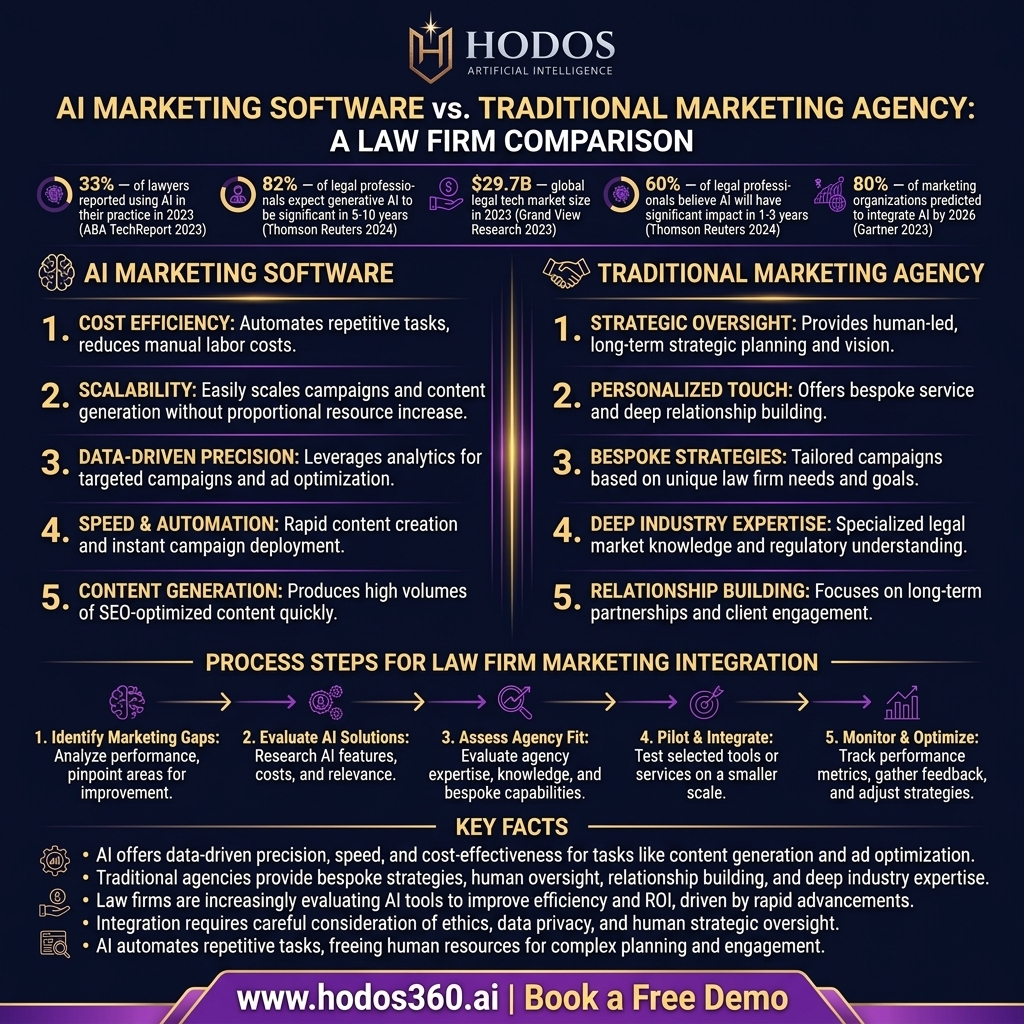
One of the most immediate points of comparison between AI marketing software and agencies is cost. Traditional marketing agencies typically operate on monthly retainers, which can range from a few thousand dollars for basic services to tens of thousands for comprehensive, full-service engagements. These costs cover not only the execution of campaigns but also strategic planning, account management, and creative development. For many small business law firms, these monthly charges can be a significant drain on resources. Learn more about AI Voice Assistant: Essential for Modern Law Firms. AI marketing software, on the other hand, often comes with a subscription model that is considerably lower, typically ranging from a few hundred to a couple of thousand dollars per month, depending on the features and scale. This stark difference in pricing models is a primary driver for firms considering the switch, especially those looking to optimize their marketing budget without sacrificing output. While an agency might charge premium fees for content creation, an AI tool can generate similar content at a fraction of the cost, making it a compelling option for firms focused on maximizing their ROI.
The Rise of AI Marketing Software: Efficiency and Scalability
The appeal of AI marketing software for law firms is multifaceted, primarily centered on its unparalleled efficiency and scalability. Platforms like HODOS 360's AI Marketing Platform offer a suite of tools designed to automate and optimize virtually every aspect of a firm’s digital presence. Consider content generation: AI can draft blog posts, social media updates, and even email newsletters tailored to specific legal niches and client segments in minutes. This dramatically reduces the time and resources traditionally allocated to content creation, allowing legal professionals to focus on their core practice. Firms that adopt these tools can maintain a consistent and high-volume content schedule, a crucial factor for SEO optimization and staying top-of-mind with potential clients. For instance, a firm specializing in personal injury might use AI to generate daily posts about recent legal developments or frequently asked questions, ensuring a constant stream of relevant information without hiring additional staff or paying an agency a hefty monthly fee for similar output.
Beyond content, AI marketing software excels in social media automation and analytics. These tools can schedule posts across multiple platforms, identify optimal times for engagement based on audience data, and even suggest relevant hashtags to maximize reach. The analytics capabilities are particularly transformative; AI can process vast amounts of data from various marketing channels, providing actionable insights into campaign performance, client behavior, and conversion rates. This allows law firms to quickly identify what’s working and what isn’t, enabling agile adjustments to their strategies. For example, if an AI platform detects that LinkedIn posts about corporate law are generating significantly more leads than those about mergers and acquisitions, the firm can immediately adjust its content strategy to capitalize on this insight. This level of data-driven decision-making is often beyond the scope of traditional agencies, which may rely on more generalized reporting and slower analysis cycles, making AI tools more effective for real-time optimization.
Another significant advantage is the ability to personalize marketing efforts at scale. Learn more about AI Marketing: The Ultimate Guide for Law Firms. AI algorithms can analyze client data to understand individual preferences, past interactions, and likely legal needs. This allows firms to deliver highly targeted messages, whether through email, website content, or even AI Voice Assistants for lead qualification. Imagine a prospective client visiting a firm's website; an AI-powered system could dynamically adjust the displayed content based on their browsing history and demographic information, presenting them with the most relevant legal services. This level of customization fosters deeper engagement and significantly improves conversion rates. Jensen Huang, CEO of NVIDIA, often speaks about the future of AI not just as automation but as augmentation, enhancing human capabilities. In legal marketing, this means empowering law firms to achieve a level of client engagement and operational efficiency that was previously unattainable, allowing them to attract and retain more clients without the extensive overhead associated with traditional marketing agencies.
Furthermore, AI marketing software empowers law firms to manage their brand consistency across all digital touchpoints. From ensuring consistent messaging in content generation to maintaining a cohesive visual identity on social media, AI tools can enforce brand guidelines automatically. This is particularly valuable for firms with multiple attorneys or practice areas, ensuring that the firm's voice and values are uniformly represented. The ability to track ROI for every marketing dollar spent is also greatly enhanced, as AI platforms provide granular data on lead sources, conversion paths, and client lifetime value. This transparency helps firms justify their marketing investment and make informed decisions about future spending, often revealing that the return on investment from AI marketing software can significantly outperform traditional agency models, especially when considering the lower monthly costs and higher efficiency gains.
Customization vs. Scalability: Finding the Balance
The trade-off between customization and scalability often defines the AI marketing software vs. agency debate. Agencies excel at crafting highly bespoke strategies, deeply understanding a firm's unique culture, niche, and long-term vision. This level of tailored, human-led strategy can be crucial for complex brand building or crisis management. Learn more about AI Specialist Unveiled: Essential Guide for Law Firms. However, this customization often comes at the expense of scalability and speed. AI marketing software, while offering immense scalability and efficiency in content generation and automation, may require more upfront effort from the firm to define parameters and ensure outputs align with brand voice and legal ethics, such as those outlined in ABA Model Rule 7.1 regarding communications concerning a lawyer’s services. The balance lies in determining which elements of marketing require deep, human-led customization and which can benefit from AI's scalable automation.
The Enduring Value of Legal Marketing Agencies: Human Touch and Strategy
Despite the undeniable advancements of AI marketing software, traditional legal marketing agencies retain significant, enduring value, particularly in areas requiring nuanced human judgment, deep industry insight, and strategic relationship building. Agencies offer a level of bespoke strategy that AI, for all its sophistication, cannot fully replicate. They bring years of experience navigating the complex ethical guidelines of legal advertising, understanding the subtle cultural differences in client communication, and crafting brand narratives that resonate on an emotional level. For instance, when a law firm faces a public relations crisis or needs to rebrand after a merger, the strategic counsel of an experienced agency partner like those at LexisNexis’s marketing arm can be invaluable, providing guidance that goes beyond data points to encompass reputation management and stakeholder engagement. This human element is critical for building trust, a cornerstone of the legal profession, and for ensuring that marketing efforts comply with stringent regulations like the FTC Guides Concerning the Use of Endorsements and Testimonials in Advertising, which AI might not inherently grasp.
Furthermore, agencies provide a dedicated team of experts in various marketing disciplines—SEO specialists, content writers, graphic designers, public relations strategists—all working cohesively under a unified strategic vision. This holistic approach ensures that all marketing efforts are integrated and aligned with the firm's broader business objectives. While AI tools can perform individual tasks, an agency brings the human intelligence to connect these dots, to anticipate market shifts, and to develop long-term growth trajectories. For a law firm looking to penetrate a new, highly specialized market, an agency can conduct in-depth market research, competitor analysis, and client segmentation with a qualitative understanding that AI’s quantitative analysis might miss. They can identify unique value propositions and craft compelling messaging that speaks directly to the pain points of specific client demographics, something that requires a deep understanding of human psychology and legal practice nuances.
The relationship aspect is another critical differentiator. An agency acts as an extension of the law firm, often developing a deep understanding of its partners, culture, and client base over time. Learn more about AI Document Management: Essential for Modern Law Firms. This close partnership allows for real-time feedback, collaborative problem-solving, and a proactive approach to marketing challenges. For example, if a partner at a firm like Allen & Overy, known for its innovative approach, decides to launch a new practice area, an agency can quickly mobilize its resources to develop a comprehensive launch strategy, leveraging existing relationships with media and industry influencers. This level of personalized service and strategic partnership is difficult to replicate with a purely software-driven approach, which, while efficient, can sometimes feel impersonal. The human element of an agency provides not just execution, but genuine partnership and strategic foresight, crucial for navigating the unpredictable currents of the legal market.
Finally, agencies offer accountability and peace of mind. While AI marketing software requires a firm to manage and interpret its outputs, an agency takes on the responsibility for campaign performance, reporting, and adjustments. This frees up valuable time for attorneys and firm administrators, allowing them to focus on legal work rather than becoming marketing experts. For firms that lack in-house marketing expertise or the bandwidth to manage complex software, an agency provides a ready-made solution, offering a comprehensive suite of services from strategy to execution. The monthly charge, while higher, often includes this invaluable layer of expertise, oversight, and strategic guidance that many firms find essential for their long-term growth and brand reputation, ensuring that their marketing efforts are not only effective but also ethically sound and strategically aligned with their business goals.
The Human Element in AI-Driven Strategies
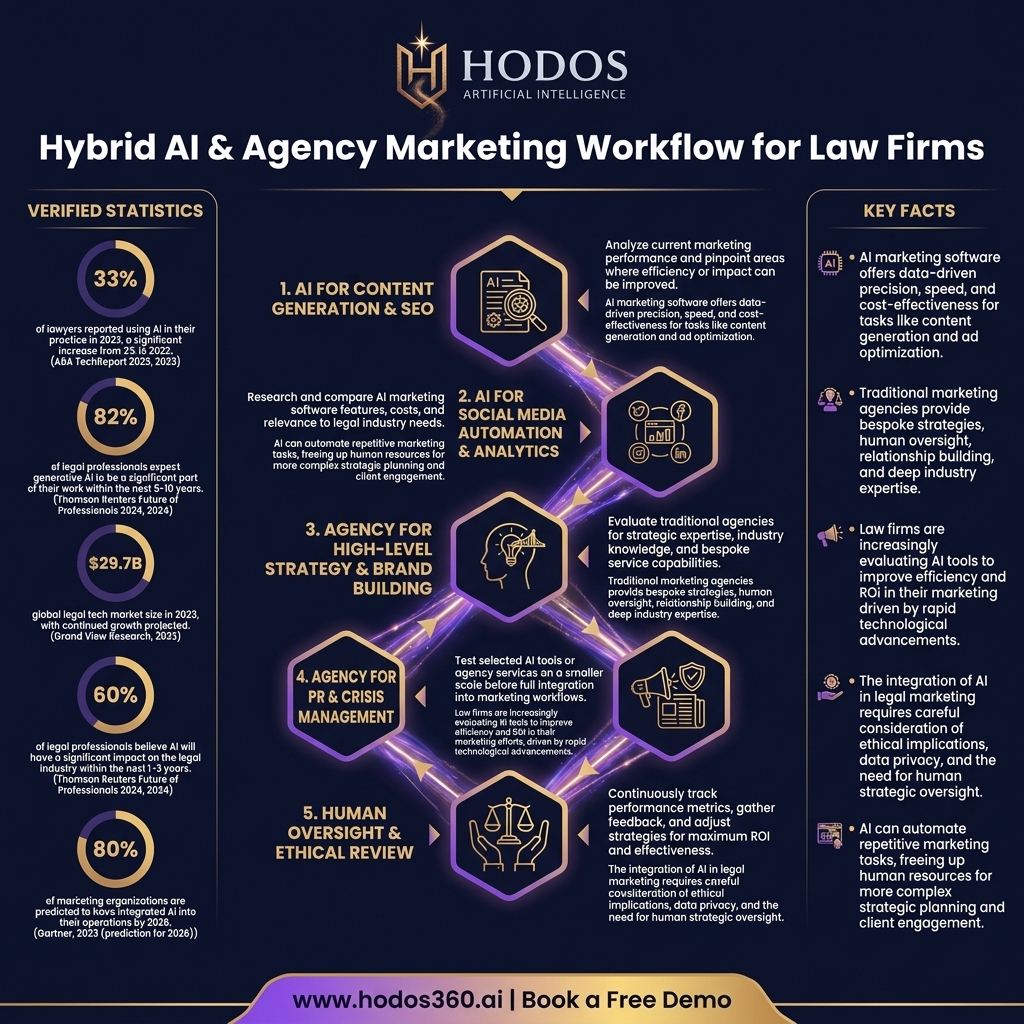
Even with the most advanced AI marketing software, the human element remains indispensable. AI excels at data processing, automation, and pattern recognition, but it lacks the intuition, empathy, and creative strategic thinking that define effective human marketing. For law firms, this means human oversight is crucial for ensuring brand voice consistency, ethical compliance, and nuanced messaging that resonates with clients on a personal level. Learn more about Fine-Tuning LLMs: Ultimate Guide for Legal Innovation. The strategic direction, the interpretation of complex data, and the emotional intelligence required for client relationship building still fall squarely within the human domain. AI is a powerful tool, but it is not a replacement for the strategic mind of a seasoned legal marketing professional or the ethical judgment of a lawyer.
Hybrid Models: Maximizing Synergy for Law Firms
The most effective approach for many law firms in the current climate isn't an either/or proposition but rather a synergistic integration of both AI marketing software and strategic agency partnerships. This 'hybrid model' allows firms to leverage the strengths of each, creating a robust, cost-effective, and highly impactful marketing ecosystem. Firms can utilize AI marketing software for high-volume, repetitive tasks that demand efficiency and scalability, such as content generation for blog posts, social media scheduling, SEO optimization, and initial lead qualification through tools like HODOS 360's AI Voice Assistants. This significantly reduces the monthly costs associated with an agency’s production work, freeing up budget for more strategic initiatives. For example, a firm might use AI to generate 80% of its routine social media content and manage its ad campaigns, while an agency focuses on crafting high-level thought leadership pieces, managing public relations, and developing complex brand campaigns that require human creativity and strategic foresight.
This division of labor allows agencies to focus on their core competencies: strategy, high-level creative direction, crisis management, and cultivating media relationships. Instead of spending valuable time on execution, they can dedicate their expertise to understanding the firm's unique value proposition, identifying emerging market opportunities, and ensuring that all AI-generated content aligns with the firm's brand voice and ethical obligations. This approach transforms the traditional agency-client relationship into a more collaborative partnership, where the agency acts as a strategic advisor and creative lead, while the AI software serves as an incredibly efficient execution engine. For law firms looking to streamline operations with AI-powered legal workflows and enhance client communication through AI Voice Assistants for lead qualification, this hybrid model offers the best of both worlds, optimizing both costs and outcomes. It's about smart hiring – hiring AI for tasks it excels at, and hiring human experts for tasks that demand their unique capabilities.
Ultimately, the choice hinges on a firm's specific needs, budget, and internal resources. Small business practices with limited budgets might lean more heavily on comprehensive AI marketing tools to handle the bulk of their marketing, perhaps engaging an agency on a project basis for specific strategic consultations. Larger firms, with more complex branding needs and higher monthly marketing budgets, might benefit from a more balanced hybrid approach, using AI for efficiency while retaining an agency for high-level strategy and brand guardianship. The key is to conduct a thorough audit of current marketing efforts, identify areas where AI can drive efficiency, and pinpoint where human expertise is indispensable. This strategic allocation of resources ensures that every marketing dollar is spent wisely, contributing directly to the firm's growth and competitive advantage in a legal market that demands both technological prowess and human ingenuity.
One emerging trend in this hybrid model is the use of AI-powered analytics by agencies themselves. Instead of viewing AI as a competitor, forward-thinking agencies are integrating AI tools into their own workflows to enhance their service offerings. They use AI for faster data analysis, trend identification, and predictive modeling, allowing them to provide even more insightful and data-driven strategies to their law firm clients. This demonstrates a shift towards augmentation, where AI enhances human capabilities rather than replacing them entirely. By leveraging sophisticated platforms like HODOS 360's AI Marketing Platform, agencies can deliver superior results, proving that the future of legal marketing is not about choosing one over the other, but about intelligently combining both for optimal impact.
- ✓Content Creation: AI excels at generating high-volume, routine content like blog posts, social media updates, and email drafts, significantly reducing production time and costs.
- ✓SEO Optimization: AI tools can analyze keywords, track search rankings, and suggest optimizations for website content and structure to improve organic visibility.
- ✓Social Media Automation: AI platforms automate post scheduling, analyze engagement metrics, and identify optimal posting times across various social channels.
- ✓Lead Qualification: AI Voice Assistants can handle initial client inquiries, qualify leads, and book appointments 24/7, improving response times and efficiency.
- ✓Data Analytics & ROI Tracking: AI provides granular, real-time data on campaign performance, allowing firms to accurately track ROI and make data-driven decisions.
- ✓Website Development & Optimization: AI-powered website builders create responsive, SEO-optimized sites with high-converting templates, ensuring a strong digital foundation.
- ✓Personalized Marketing: AI algorithms can segment audiences and deliver highly personalized content and offers, enhancing client engagement and conversion rates.

Key Takeaways and Next Steps
The debate between AI marketing software and traditional agencies for law firms is not about finding a single victor, but about identifying the optimal synergy. As the legal industry continues its rapid digital transformation, firms must adopt a nuanced strategy that leverages the efficiency and scalability of AI tools while retaining the strategic depth and human touch of experienced marketing professionals. AI marketing software shines in automation, data analysis, and high-volume content production, offering a cost-effective way to maintain a robust digital presence. Agencies, conversely, provide invaluable strategic guidance, creative vision, ethical compliance oversight, and the nuanced human understanding critical for complex brand building and relationship management. The most successful law firms will be those that embrace a hybrid model, using AI as a powerful engine for execution and data insights, while relying on human experts for high-level strategy, ethical oversight, and personalized client engagement.
For law firms looking to navigate this evolving landscape, the first step is a thorough assessment of their current marketing needs, budget, and in-house capabilities. Identify which tasks can be effectively automated by AI to reduce costs and increase output, and which require the strategic insight of an agency. Platforms like HODOS 360 offer a comprehensive suite of services, including an AI Marketing Platform that integrates AI video creation, social media automation, and ROI tracking, alongside AI-powered website building and AI Law Firm Management System solutions. By intelligently combining these advanced tools with strategic human oversight, law firms can unlock unprecedented growth, enhance client acquisition, and solidify their competitive position in the digital age. This isn't just about cutting costs; it's about building a future-proof marketing strategy that truly resonates with clients and drives sustainable success.
Frequently Asked Questions
What is the primary difference in cost between AI marketing software and a traditional agency?+
AI marketing software typically operates on a lower, fixed monthly subscription, ranging from a few hundred to a couple of thousand dollars. Traditional agencies, however, often charge higher monthly retainers, from several thousand to tens of thousands, covering strategic planning, account management, and execution, making AI a more budget-friendly option for many firms.
Can AI marketing software completely replace a traditional marketing agency for a law firm?+
While AI marketing software offers extensive automation and efficiency for tasks like content generation and analytics, it cannot fully replace the strategic human insight, ethical judgment, and nuanced relationship building provided by a traditional agency. A hybrid model often yields the best results, combining AI's efficiency with human expertise.
What specific marketing tasks are AI tools best suited for in a law firm?+
AI tools excel at high-volume, repetitive tasks such as content generation (blog posts, social media updates), SEO optimization, social media scheduling, lead qualification via AI Voice Assistants, and detailed ROI tracking. They provide data-driven insights and ensure consistent digital presence efficiently.
How does AI marketing software ensure compliance with legal ethics in advertising?+
AI marketing software can be programmed with ethical guidelines, but human oversight remains crucial. Attorneys or marketing professionals must review AI-generated content to ensure compliance with rules like ABA Model Rule 7.1 concerning lawyer advertising and other relevant regulations, as AI lacks inherent ethical judgment.
What are the benefits of a hybrid AI marketing and agency model for law firms?+
A hybrid model combines AI's efficiency and scalability for routine tasks with an agency's strategic depth, creative direction, and ethical oversight. This approach optimizes costs, enhances output, provides sophisticated data insights, and ensures that marketing efforts are both effective and aligned with the firm's long-term goals and brand integrity.