


AI Document Management: Essential for Modern Law Firms
The legal world is witnessing a profound transformation, with artificial intelligence at its core, reshaping how firms handle their most critical asset: information. Just recently, Above the Law highlighted NetDocuments' groundbreaking initiative to build a "new concept of organization for an AI-powered world," underscoring a pivotal shift from mere storage to intelligent, proactive document management.
This development isn't just an incremental upgrade; it represents a fundamental rethinking of legal workflows, driven by the imperative for greater efficiency, accuracy, and strategic insight in an increasingly complex regulatory and competitive landscape. Firms that embrace this paradigm shift are not merely adopting new tools; they are fundamentally redefining their operational blueprints and competitive postures.
This evolution extends far beyond simple keyword searches or basic file organization. Modern AI document management systems leverage sophisticated machine learning algorithms and natural language processing (NLP) to understand, categorize, and extract critical information from vast repositories of legal documents. Consider the challenge faced by Sarah Chen, Managing Partner at Chen & Associates, a mid-sized litigation firm in New York.
For years, her firm grappled with the labor-intensive process of due diligence in large M&A cases, often requiring dozens of associates to manually review thousands of contracts. The introduction of AI-powered platforms, capable of identifying specific clauses, anomalies, and potential risks in a fraction of the time, has not only cut costs but also significantly reduced human error, allowing her team to focus on higher-value strategic analysis rather than rote review.
This shift is not just about speed; it's about elevating the intellectual capital of legal professionals and empowering them with unprecedented analytical capabilities.
The implications for law firms are immense. According to a 2023 report by Thomson Reuters, legal professionals spend an average of 4.5 hours per day on administrative tasks, much of which involves document handling.
AI promises to reclaim a significant portion of this time, redirecting it towards client-facing work and strategic problem-solving. As industry leaders like Dan Broderick, CEO of NetDocuments, articulate, the goal is to move beyond passive data storage to an "intelligent content platform" that anticipates needs, automates routine processes, and provides actionable insights.
This comprehensive approach to AI document management is no longer a luxury but an essential component for any firm aiming to maintain relevance, attract top talent, and deliver superior client outcomes in the rapidly accelerating digital age.
Ready to transform your practice? Discover the power of AI-driven legal solutions.Book a Free Demo with HODOS 360
The AI Revolution in Legal Document Management: Beyond Basic Storage
The narrative around legal technology has long focused on incremental improvements – better search functions, cloud storage, or e-discovery tools. However, the current wave of AI document management represents a quantum leap, fundamentally redefining the entire lifecycle of legal information. It moves beyond the passive storage and retrieval of documents to an active, intelligent system that understands, organizes, and even anticipates the needs of legal professionals.
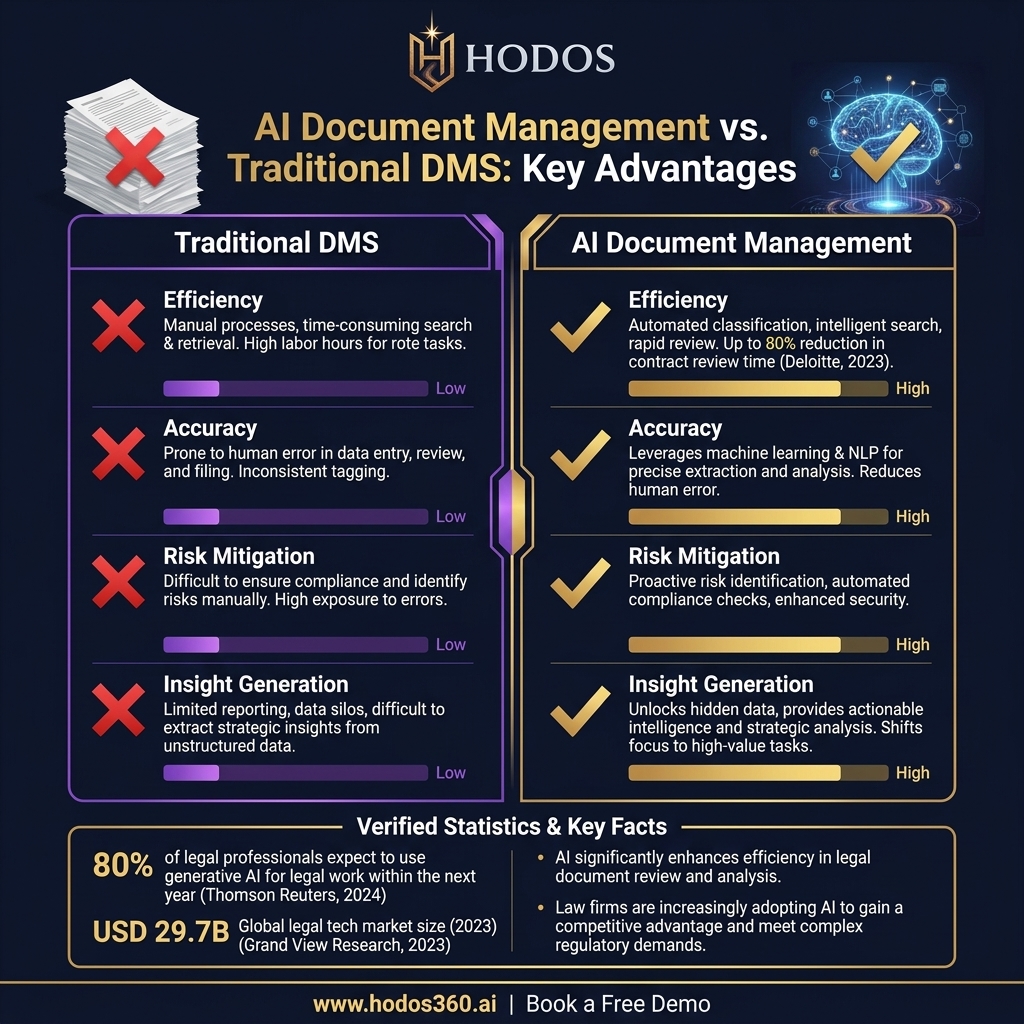
This shift is particularly evident in the evolution of Document Management Systems (DMS), which traditionally acted as digital filing cabinets. Today, these systems, supercharged by AI, function more like highly specialized legal assistants, capable of complex analytical tasks.
Consider the recent announcement by NetDocuments, a veteran in the legal tech space, as reported by Above the Law.
Learn more about Claude AI for Legal: The Ultimate Guide to Contract Review. Their "new concept of organization for an AI-powered world" emphasizes an integrated approach where AI isn't an add-on but an intrinsic part of how documents are managed from creation to archival. This involves AI-driven profiling, which automatically categorizes documents based on content, context, and metadata, ensuring that every piece of information is not only stored but also intelligently connected to relevant cases, clients, and legal precedents.
For instance, a firm like Allen & Overy, known for its early adoption of AI tools like Harvey AI, understands that integrating AI at the foundational level of document management is crucial for streamlining complex international transactions and litigation. This proactive, intelligent organization stands in stark contrast to the reactive, manual processes that have long plagued legal operations, where valuable insights often remained buried within vast, unstructured data sets.
The Evolving Role of AI in Legal Workflows
The integration of AI into legal workflows is transforming every stage of a case, from client intake to trial preparation. AI-powered systems are now automating document assembly, drafting routine contracts, and even conducting preliminary legal research with remarkable speed and accuracy. This extends to tasks like identifying key clauses in contracts, summarizing lengthy depositions, and flagging discrepancies across multiple documents – tasks that traditionally consumed significant associate hours.
For example, a litigator preparing for a complex trial can use an AI document management system to instantly cross-reference arguments, identify conflicting statements in witness testimonies, and locate relevant case law, dramatically reducing the time spent on manual review and increasing the strategic depth of their preparation.
Learn more about AI Agents Unveiled: Essential Frontend Vision for Law Firms. This shift allows legal teams to move from being data processors to strategic advisors, focusing their expertise on nuanced legal analysis and client engagement. This profound change underscores the necessity of robust legal AI adoption strategies for modern practices.
Intelligent Document Profiling and Data Extraction: A New Era of Efficiency
The true power of modern AI document management systems lies in their ability to perform intelligent document profiling and sophisticated data extraction. Unlike older systems that relied on manual tagging or basic keyword recognition, AI-powered platforms leverage advanced Natural Language Processing (NLP) and machine learning algorithms to deeply understand the content and context of legal documents.
This capability allows systems to automatically identify document types, extract critical entities such as parties, dates, jurisdictions, and specific clauses, and then profile them for optimal organization and retrieval. For example, in a large-scale M&A due diligence, an AI system can instantly identify all change-of-control clauses across hundreds of acquisition agreements, a task that would take human lawyers weeks, if not months, to complete with a high risk of oversight.
This level of automation not only accelerates processes but also significantly enhances the accuracy and completeness of legal analysis.
The impact of this technology is profoundly changing how firms approach large-scale document review and contract analysis. Companies like Luminance have demonstrated the capacity of their AI to analyze millions of documents and highlight anomalies or critical information within hours, a feat unimaginable a decade ago.
Learn more about AI Customer Support: Essential for Law Firm Growth. This intelligent profiling extends beyond mere identification; it creates a rich, interconnected web of information within a firm’s document repository, allowing for dynamic searches and predictive insights. Imagine a scenario where a partner needs to understand the firm’s exposure across all client contracts related to a specific regulatory change.
An AI document management system can, within moments, pull all relevant contracts, identify affected clauses, and even flag potential risks, providing a comprehensive overview that would otherwise require extensive manual labor and cross-referencing. This capability is not just about efficiency; it's about enabling a proactive, data-driven approach to legal practice, offering significant document automation benefits.
Enhancing Compliance and Risk Management with AI-Powered Systems
In an era of escalating regulatory scrutiny and increasingly complex data privacy laws, effective compliance and risk management are paramount for law firms. AI document management systems are emerging as indispensable tools in this domain, providing capabilities that far surpass traditional methods. These platforms can be trained to identify and flag sensitive information, such as personally identifiable information (PII) or protected health information (PHI), ensuring adherence to regulations like the GDPR or CCPA.
For instance, during a data breach investigation, an AI system can rapidly scan vast document archives to pinpoint exactly where sensitive client data resides and how it has been accessed, significantly expediting the firm's response and mitigation efforts, which is crucial for minimizing legal and reputational damage.
This proactive identification capability helps firms avoid costly penalties and maintain client trust.
Beyond reactive measures, AI also empowers proactive risk mitigation. By analyzing historical data and legal precedents, these systems can identify patterns and potential compliance gaps in new contracts or legal advice before they become liabilities.
Learn more about AI Legal Research: The Ultimate Guide for Law Firms. For example, in a transactional practice, an AI-powered system can review draft agreements against a firm's compliance guidelines and relevant statutes, highlighting clauses that might expose the client or firm to undue risk.
This early detection mechanism is a game-changer, moving firms from a reactive "fix-it-when-it-breaks" mentality to a preventative "design-for-compliance" strategy. As Justice Breyer once noted in *Kansas v. Marsh*, the legal system strives for certainty and reliability, and AI offers a new pathway to achieve this in document-centric compliance tasks.
The integration of such sophisticated tools means that firms can establish robust internal controls, maintain impeccable audit trails, and demonstrate due diligence with an unprecedented level of detail and consistency, significantly bolstering their overall risk posture.
Navigating Ethical AI Adoption in Law Firms
While the benefits of AI in compliance are clear, ethical considerations in its adoption are paramount. The American Bar Association (ABA) Model Rules of Professional Conduct, particularly Rule 1.1 (Competence) and Rule 1.6 (Confidentiality of Information), mandate that lawyers understand the risks and benefits of technology.
This requires firms to carefully vet AI tools, ensure data security protocols are robust, and understand the potential for algorithmic bias. For example, if an AI system is trained on a biased dataset, it could inadvertently perpetuate or amplify existing biases in legal analysis, leading to unfair outcomes.
Learn more about Essential AI Vibe Coding: Elevate Law Firm Web Development. Firms must implement rigorous oversight, regular audits, and ensure transparency in how AI tools process and interpret legal information. This commitment to ethical AI ensures that technology serves justice, rather than undermining its foundational principles, requiring a thoughtful, informed approach to integration.
Unlock the full potential of your legal practice with HODOS 360's integrated AI solutions.Explore Our AI Law Firm Management System
The Strategic Advantage: How AI Transforms Law Firm Operations
The adoption of AI document management is not merely an operational improvement; it is a strategic imperative that fundamentally transforms law firm operations, offering a significant competitive advantage. Firms leveraging these intelligent systems are experiencing enhanced productivity, improved client satisfaction, and a stronger financial bottom line.
A 2024 McKinsey report on AI in professional services highlighted that early adopters could see a 15-20% increase in revenue within five years due to efficiency gains and the ability to take on more complex, higher-value work. This is achieved by automating time-consuming, repetitive tasks, freeing up highly skilled legal professionals to focus on strategic analysis, client relationship building, and business development.
For instance, by automating document review for discovery, a firm can reduce the associate hours billed for that task, offering more competitive pricing to clients while maintaining or even increasing profit margins due to reduced overhead.
This strategic transformation extends to client service. In an increasingly competitive market, clients expect faster turnaround times, greater transparency, and cost-effective solutions.
Learn more about Voice AI: Essential Transformation for Modern Legal Workflows. AI-powered platforms deliver on these expectations by accelerating legal processes, providing real-time insights into case progress, and enabling more accurate cost estimations. Consider a firm that utilizes an integrated platform like HODOS 360, which combines AI Law Firm Management with advanced document automation.
This allows them to not only manage cases and billing efficiently but also to leverage AI for rapid document generation and review, translating directly into quicker, more responsive service for clients. The ability to quickly synthesize complex information and present clear, data-backed advice positions these firms as forward-thinking and highly capable, attracting new business and fostering long-term client loyalty.
This shift is critical for firms looking to differentiate themselves in a crowded legal marketplace and build a reputation for innovation and efficiency.
Future-Proofing Your Practice with Integrated AI Solutions
The future of legal practice is undeniably integrated and AI-driven. Firms that invest in comprehensive AI solutions are not just solving today's problems; they are future-proofing their operations against evolving market demands and technological advancements. This involves looking beyond standalone tools to platforms that offer seamless integration across various functions – from client intake and case management to marketing and analytics.
For example, the Federal Rules of Civil Procedure, particularly Rule 26 regarding discovery, continually adapt to technological advancements, making AI-driven e-discovery and document review capabilities not just beneficial, but increasingly necessary for compliance. Firms that proactively build an AI-centric infrastructure, much like how tech giants like Google or Amazon constantly iterate on their core platforms, will be better positioned to adapt to future legal tech innovations, ensuring sustained growth and resilience in a dynamic industry.
- ✓Enhanced Efficiency: Automate routine document tasks, freeing legal professionals for higher-value work.
- ✓Improved Accuracy: AI reduces human error in data extraction and document review, leading to more reliable outcomes.
- ✓Better Compliance: Proactively identify and manage sensitive information, ensuring adherence to evolving regulations like GDPR.
- ✓Strategic Insights: Gain deeper understanding from document repositories, enabling data-driven decision-making.
- ✓Competitive Advantage: Offer faster, more cost-effective services, attracting and retaining clients.
- ✓Future-Proofing: Build a resilient practice capable of adapting to future technological shifts and market demands.

Key Takeaways and Next Steps for Law Firm Leaders
The insights from NetDocuments' latest initiatives and the broader legal tech landscape confirm one undeniable truth: AI document management is no longer a futuristic concept but a present-day imperative for law firms. The transition from traditional document storage to intelligent, AI-powered content platforms offers a myriad of benefits, from unparalleled efficiency and accuracy in document profiling to robust enhancements in compliance and risk management.
Firms that embrace this technological evolution are not just modernizing; they are strategically positioning themselves for sustained growth, competitive advantage, and superior client service in an increasingly data-driven legal world. The ability to extract meaningful insights from vast repositories of legal information, automate routine tasks, and ensure regulatory adherence at scale is transforming the very fabric of legal practice.
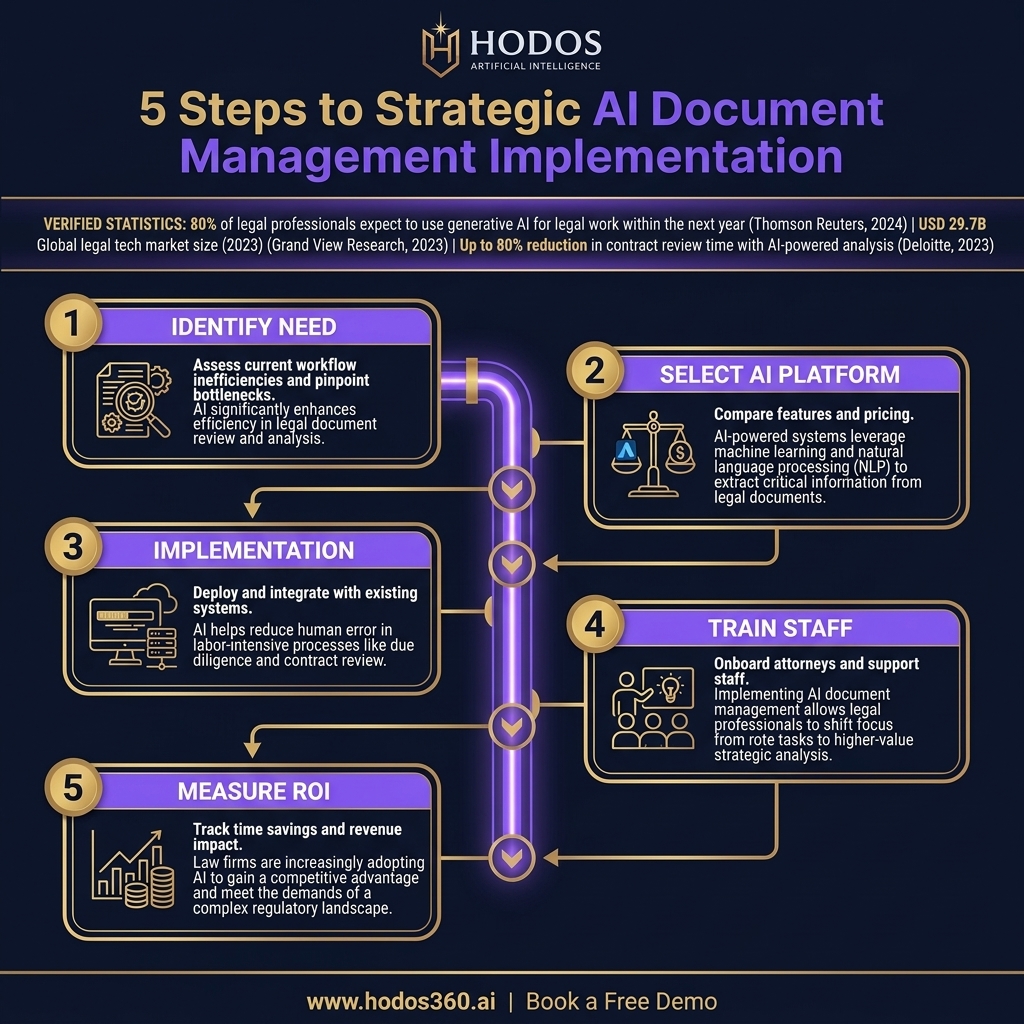
For law firm leaders considering their next steps, the path forward involves a clear-eyed assessment of current operational inefficiencies and a commitment to strategic AI adoption. Begin by identifying areas where manual document handling consumes significant time and resources – whether it's contract review, litigation discovery, or client intake.
Research and pilot AI-powered solutions that offer intelligent document profiling, automated data extraction, and seamless integration with existing legal workflows. Prioritize platforms that provide a holistic approach, much like HODOS 360's comprehensive suite of services, which integrates AI-powered law firm management, marketing, and voice assistants, ensuring that your technological investments work synergistically across your entire practice.
Engage your team in the transition, providing training and fostering a culture of innovation. The legal profession is at an inflection point, and those who strategically leverage AI will be the ones to define its future, delivering more value to clients and securing a leading position in the evolving legal landscape.
Ready to lead your firm into the AI-powered future?Request a Free Consultation Today
Frequently Asked Questions
What is AI document management in the legal context?+
AI document management in law refers to using artificial intelligence technologies like machine learning and natural language processing to automate and enhance the way legal documents are organized, processed, and analyzed. This goes beyond simple storage, enabling intelligent profiling, data extraction, automated review, and risk identification from contracts, case files, and other legal texts, significantly boosting efficiency and accuracy for law firms.
How does AI document profiling benefit law firms?+
AI document profiling automatically categorizes, tags, and extracts key information from legal documents based on their content and context. This benefits firms by drastically reducing manual review time, improving searchability, ensuring consistent organization, and enabling faster identification of critical clauses or data points, thereby accelerating due diligence, discovery, and contract management processes with greater precision.
What are the key ethical considerations when adopting AI in legal document management?+
Ethical considerations include ensuring data privacy and confidentiality, mitigating algorithmic bias in AI analysis, maintaining professional competence in using new technologies, and upholding the duty of supervision over AI-generated outputs. Firms must implement robust security measures, conduct regular audits for bias, and ensure lawyers understand the limitations and capabilities of AI tools to comply with ethical obligations.
Can AI document management help with legal compliance?+
Yes, AI document management systems are highly effective for legal compliance. They can automatically identify and flag sensitive information (e.g., PII, PHI) to meet data privacy regulations, analyze contracts for adherence to specific statutes, and track regulatory changes. This proactive approach helps firms mitigate risks, avoid penalties, maintain audit trails, and ensure consistent adherence to legal and industry standards.
What should law firms look for in an AI document management solution?+
Law firms should seek solutions offering robust data security, intuitive user interfaces, strong integration capabilities with existing systems, and proven AI functionalities like NLP for accurate data extraction and intelligent profiling. Scalability, vendor reputation, comprehensive support, and a commitment to ethical AI development are also crucial factors to ensure the chosen platform genuinely enhances efficiency and strategic advantage.