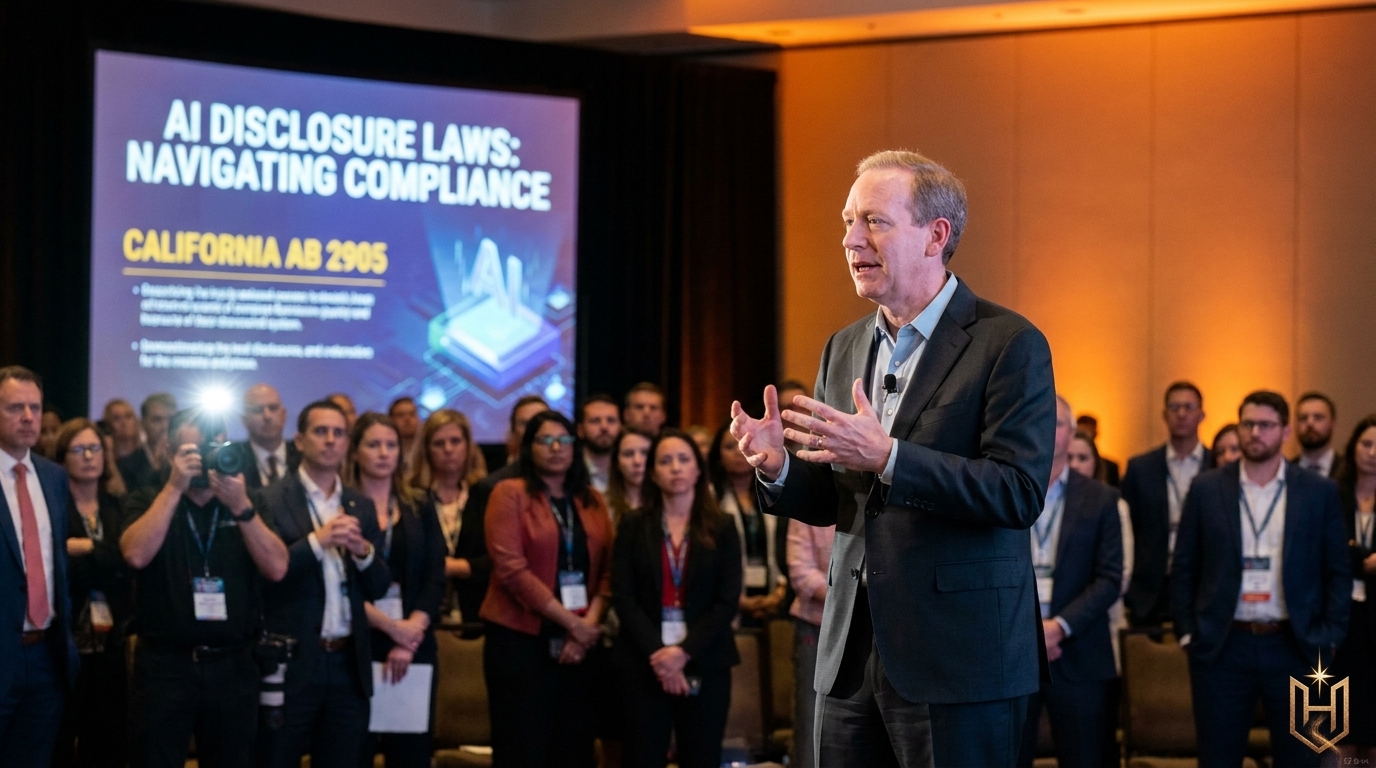
AI Receptionist Disclosure: Essential Legal Compliance for Firms
The legal landscape is undergoing a profound transformation, driven by the rapid advancements in artificial intelligence. A recent headline from Tech Times, announcing that AI Receptionist startup Pie secured a significant $19.5 million in funding, underscored the burgeoning market for automated client interaction in professional services.
This substantial investment signals a widespread industry belief in the efficiency and scalability that AI-powered voice assistants can bring, from handling routine inquiries to advanced lead qualification and appointment booking. However, this promising surge in adoption is not without its complexities, particularly concerning the evolving regulatory environment.
As AI voice assistants become increasingly sophisticated and indistinguishable from human operators, a critical question arises: how transparent must law firms be about their use of these technologies? The same Tech Times article highlighted a crucial caveat: "State Laws May Require Bot Disclosure." This isn't just a theoretical concern; it's a rapidly materializing legal obligation that demands immediate attention from law firm owners and managing partners.
The tension between leveraging cutting-edge AI for competitive advantage and adhering to stringent disclosure requirements forms the core challenge for legal professionals in 2026.
For law firms, the imperative is clear: embrace innovation responsibly. The stakes are high, encompassing not only potential regulatory penalties but also the invaluable trust clients place in their legal counsel.
This post delves into the intricacies of AI receptionist disclosure laws, examining the precedents set by pioneering states, exploring the ethical dimensions for attorneys, and providing a strategic roadmap for implementing AI voice assistants compliantly. We will dissect how firms can harness the power of tools like HODOS 360's AI Voice Assistants to streamline operations while meticulously navigating the legal and ethical frameworks surrounding artificial intelligence.
The Rising Tide of AI Receptionists in Legal Practice
The legal sector, traditionally cautious in its adoption of new technologies, has begun to embrace AI with unprecedented enthusiasm. The valuation of *startup* Pie at $19.5 *million* is merely one indicator of a broader trend. According to the 2025 ABA Legal Technology Survey Report, nearly 40% of law firms reported exploring or implementing AI tools, a significant jump from just 15% three years prior.
AI-powered *receptionists* are at the forefront of this shift, offering 24/7 availability, multilingual support, and consistent service quality that human receptionists, no matter how dedicated, simply cannot match. Firms are leveraging these systems for initial client intake, answering frequently asked questions, routing calls, and even performing preliminary lead qualification, ensuring that potential clients receive immediate attention.
This technological integration is driven by a clear economic incentive. Learn more about AI App Builders: Ultimate Guide for Law Firm Innovation. A 2024 Gartner report projected that by 2027, generative AI would automate 30% of legal tasks, significantly reducing operational costs and freeing up human staff for more complex, high-value work.
Firms like 'LexConnect Legal', a mid-sized personal injury firm in Atlanta, reported a 30% reduction in missed calls and a 15% increase in qualified leads within six months of deploying an *AI receptionist*. As Sarah Chen, managing partner at LexConnect, stated at LegalTech NYC 2026, "Our *AI receptionist* isn't replacing our team; it's augmenting them, allowing our paralegals and attorneys to focus on what they do best: practicing law, not answering repetitive phone calls."
This shift represents a strategic investment, with firms allocating significant *budget* to remain competitive.
Navigating the Patchwork of AI Disclosure State Laws
The rapid proliferation of *AI receptionists* has prompted a legislative response, particularly at the *state* level. The core issue revolves around transparency: when is a consumer *required* to know they are interacting with an artificial intelligence rather than a human? California has been a pioneer in this area with its landmark Assembly Bill 2905, enacted in 2020, which mandates disclosure for certain automated bots.
This law stipulates that any bot interacting with a person in California must clearly state that it is a bot, especially when attempting to influence a vote or purchase. While not directly aimed at legal services, its principles are highly relevant to how law firms engage with clients.
Following California's lead, several other *states* are now either considering or have implemented similar bot disclosure requirements. For instance, Texas and New York have initiated legislative discussions around requiring disclosure for AI-driven customer service interactions, particularly in sectors where sensitive information is exchanged or where a professional relationship is established.
Learn more about AI Law Firms: Essential for Construction Contract Mastery. This creates a complex, fragmented regulatory landscape for law firms, especially those with a *general* or multi-state practice. A firm in Delaware may face different disclosure obligations than one in Arizona, making a standardized approach to *AI receptionist* implementation challenging but absolutely necessary to avoid legal pitfalls.
The lack of a uniform federal standard places the onus firmly on firms to monitor and comply with local statutes.
California's Pioneering AB 2905 and its Influence
California's AB 2905 serves as a critical precedent, illustrating the legislative direction many *states* are taking. The law explicitly targets "bots" designed to simulate human interaction online to mislead or persuade. While the initial focus was on political campaigns and e-commerce, the underlying principle of preventing deceptive practices extends naturally to professional services like law.
For an *AI receptionist* engaging with potential clients, the risk of perceived deception, even if unintended, is high. Imagine a prospective client, already in a vulnerable position, believing they are speaking to a human legal assistant when in fact it is an AI. Learn more about AI Web Development: The Ultimate Guide for Law Firms.
Such a scenario could undermine trust and lead to ethical complaints, regardless of the AI's efficacy in *lead qualification*.
The implications of AB 2905 extend beyond merely stating "I am a bot." It speaks to the broader concept of informed consent in digital interactions. Lawyers, under their ethical duties, are *required* to ensure clear communication with clients.
As more *states* like Colorado and Virginia begin to draft similar legislation, potentially broadening the scope to include any AI-powered interaction that could be mistaken for human, law firms must proactively embed disclosure mechanisms into their AI voice assistant protocols. The funding of *startups* like Pie highlights the market demand, but the legislative response emphasizes the need for careful implementation.
Ethical Obligations and Professional Responsibility in Voice AI
Beyond statutory compliance, attorneys face profound ethical obligations when deploying *AI receptionists*. The American Bar Association's Model Rules of Professional Conduct, particularly Rule 1.1 (Competence) and Rule 1.4 (Communication), provide a foundational framework. Competence in the age of AI now includes understanding the technology's capabilities and limitations, especially concerning client interactions.
Communication, on the other hand, demands transparency. If a client reasonably believes they are communicating with a human and that expectation is violated, it can erode the trust that is paramount to the attorney-client relationship. Justice Elena Kagan, in a recent address on legal tech, emphasized that "while AI can enhance efficiency, it must never compromise the bedrock principles of our profession: trust, transparency, and the human element of justice."
Law firms must consider how an *AI receptionist* impacts the perception of their *private* practice. Learn more about Essential AI Website Optimization for Law Firms: Beyond WordPress Basics. While the AI may efficiently handle *client intake* and basic inquiries, the absence of explicit disclosure can lead to accusations of misrepresentation or even a breach of fiduciary duty.
The ABA Standing Committee on Ethics and Professional Responsibility has issued guidance, albeit not specific to AI voice assistants, emphasizing that lawyers remain ultimately responsible for the actions of non-lawyer personnel, including AI systems. This means that if an *AI receptionist* fails to disclose its nature, misleads a client, or mishandles sensitive information, the attorney-in-charge bears the professional responsibility.
This oversight is *required* and non-negotiable, irrespective of the AI's sophistication.
The Role of Transparency in Client Trust
Transparency is not merely a legal or ethical requirement; it is a strategic imperative for building and maintaining client trust. In an era where clients are increasingly discerning about how their data is handled and by whom they are served, explicit disclosure about *AI receptionists* can actually be a differentiator.
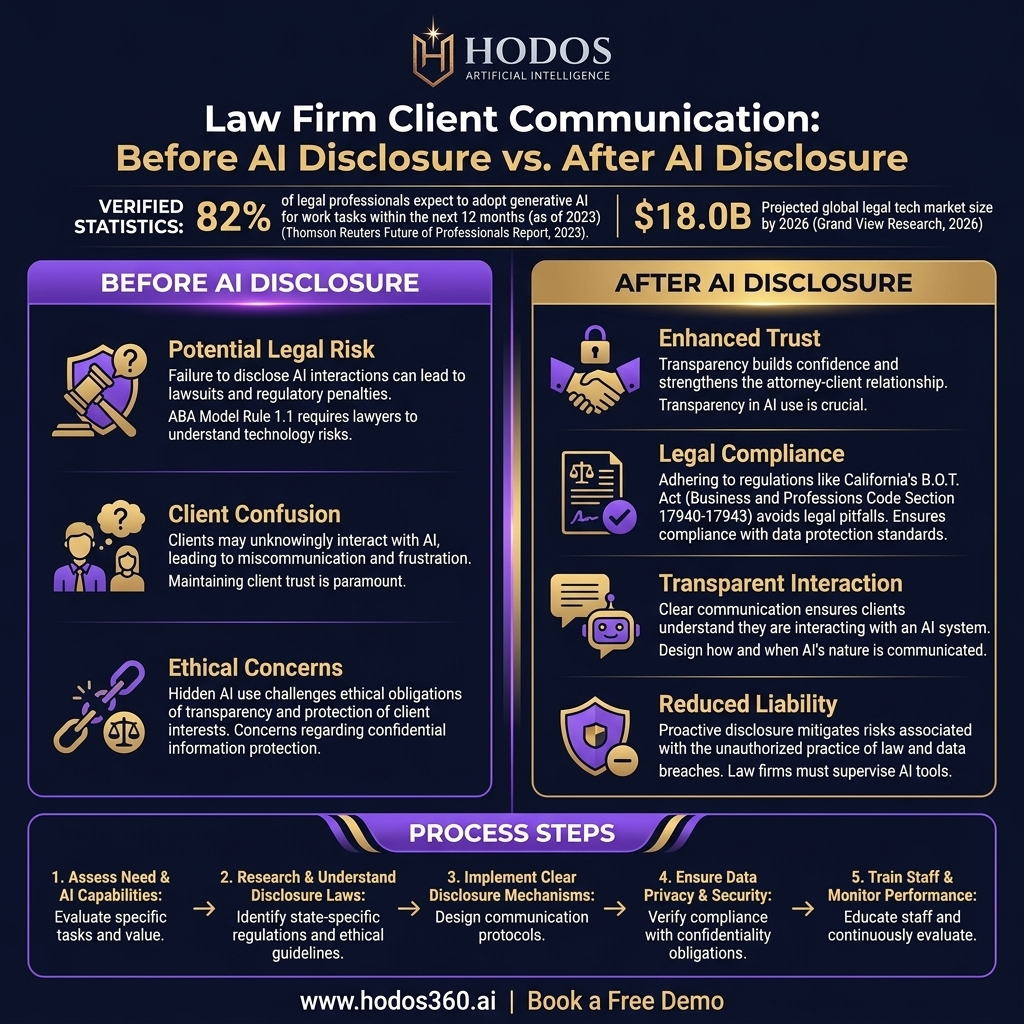
Instead of viewing disclosure as a burden, progressive law firms are framing it as a commitment to honesty and technological advancement. For example, 'Smith & Jones Legal', a commercial law firm, prominently displays on their website and through their *AI voice assistants* a message: "You are currently speaking with an AI-powered assistant, designed to provide efficient service and connect you with the right legal expert.
Your data privacy is our priority." This proactive approach fosters confidence.
Furthermore, the quality of interaction provided by an *AI receptionist* can significantly impact a client's initial perception of the firm. Learn more about AI Meeting Privacy: Essential Governance Lessons for Law Firms. A well-designed system, like those offered by HODOS 360's AI Voice Assistants, can offer a seamless, professional experience.
However, even the most advanced AI cannot fully replicate human empathy and nuance. Therefore, the disclosure serves as a crucial bridge, managing client expectations and ensuring that the transition to human interaction, when needed, is smooth and seamless. This balance of efficiency and human touch is vital for the modern legal practice, especially for firms handling sensitive *private* matters.
Implementing Compliant AI Voice Assistants: A Strategic Imperative
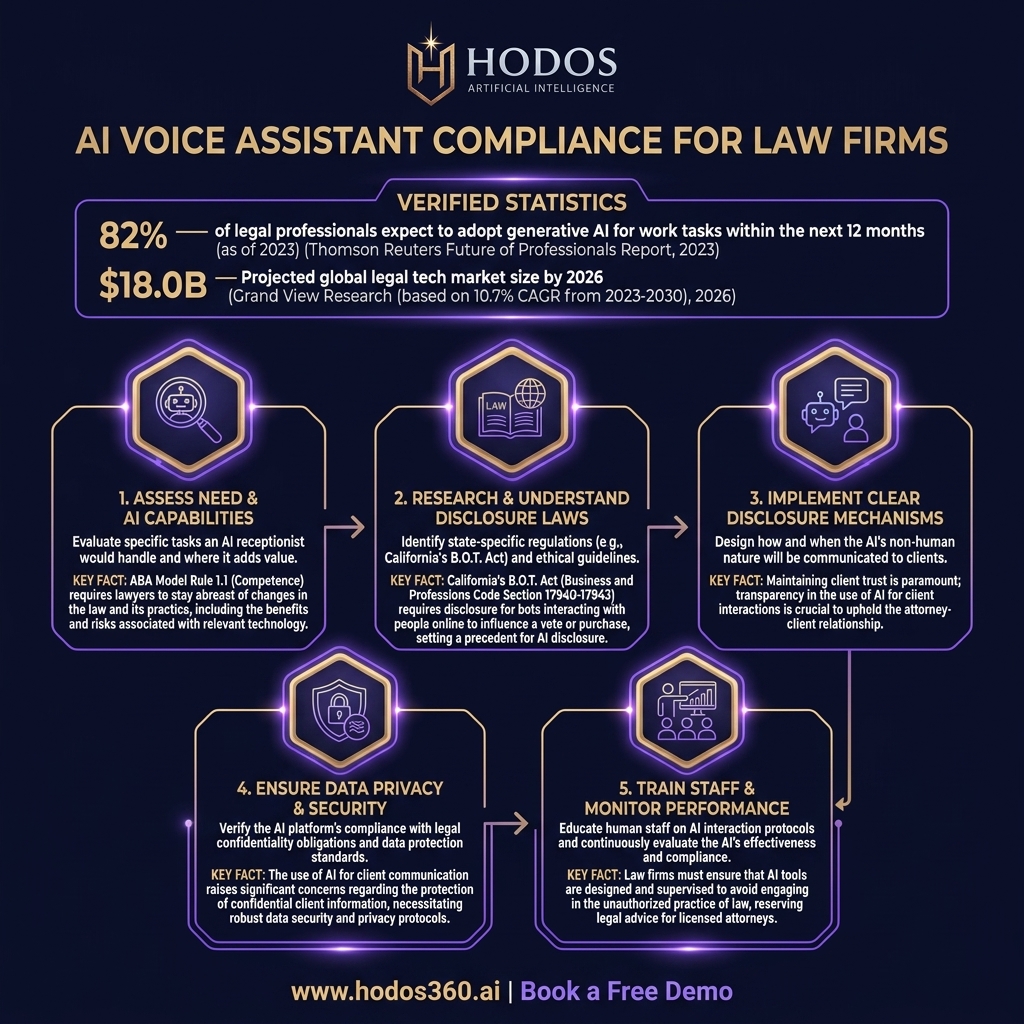
For law firms looking to integrate *AI receptionists* compliantly, a strategic, multi-faceted approach is *required*. The first step involves a comprehensive audit of existing and proposed client communication channels. Firms must identify every point of contact where an AI might interact with a client or prospective client and assess the jurisdictional laws that apply.
This includes not only direct phone calls but also chat functions, email responses, and even initial website interactions. Partnering with a legal tech provider that understands these nuances, like HODOS 360, can be invaluable in this assessment phase, helping firms navigate the intricacies of *state* regulations and ensuring robust *legal compliance*.
Developing clear, unambiguous disclosure protocols is paramount. This might involve a verbal disclosure at the beginning of an *AI receptionist* interaction (e.g., "Hello, you've reached [Firm Name]. Learn more about Essential AI Web Development for Law Firms: Harvard's Impact. Please note you are speaking with an AI-powered assistant."), a visual indicator on chat interfaces, or a prominent notice on the firm's website.
These disclosures should be easily understandable and not buried in fine print. Furthermore, firms must develop internal policies for staff on how to handle client inquiries about AI usage, ensuring a consistent and transparent message across the entire practice. Training staff on these protocols is crucial, as is regular review and updating of policies to keep pace with evolving technology and legislation.
- ✓Conduct a Jurisdictional Audit: Identify all relevant state and federal laws regarding AI disclosure for all operating locations.
- ✓Develop Explicit Disclosure Scripts: Create clear, concise verbal and written disclosures for every AI interaction point.
- ✓Implement Visual AI Indicators: For chat or web-based AI, ensure clear visual cues indicate AI interaction.
- ✓Train All Staff: Educate attorneys and support staff on AI disclosure policies and how to address client queries.
- ✓Update Engagement Agreements: Consider adding clauses about the firm's use of AI in client communications.
- ✓Regularly Review & Update Policies: Stay abreast of new legislation and technological advancements in AI voice assistants.
- ✓Partner with Compliant Vendors: Select legal tech providers (like HODOS 360) that prioritize ethical AI development and legal compliance features.

Key Takeaways and Next Steps
The era of the *AI receptionist* in law firms is not just arriving; it is already here, reshaping the very fabric of client engagement and operational efficiency. The substantial investment in *startups* like Pie underscores a clear market validation for these tools. However, this transformative power comes hand-in-hand with a critical responsibility: ensuring rigorous *legal compliance* and upholding the highest ethical standards.
Law firms must recognize that transparency is not a barrier to innovation but a cornerstone of trust. Proactive engagement with evolving *state laws* on bot disclosure, coupled with a deep commitment to ethical communication, will define the leaders in the next generation of legal practice.
Embracing advanced solutions like HODOS 360's AI Voice Assistants offers a powerful pathway to efficiency, but only when integrated with a clear strategy for compliance. The firms that navigate this complex terrain thoughtfully, prioritizing both technological advantage and unwavering professional responsibility, will be best positioned for sustained success in the evolving legal landscape.
Frequently Asked Questions
What is an AI receptionist and how does it benefit law firms?+
An AI receptionist is an automated system designed to handle phone calls, manage client intake, answer common questions, and schedule appointments. For law firms, it offers 24/7 availability, reduces missed calls, improves lead qualification, and frees up human staff to focus on complex legal work, significantly boosting efficiency and client satisfaction.
Which states currently require disclosure for AI interactions?+
California's AB 2905 is a prominent example requiring disclosure for certain bots. While a comprehensive federal law doesn't exist, several other states like Texas and New York are actively discussing or drafting similar legislation. Law firms must monitor the specific requirements in all jurisdictions where they operate to ensure compliance.
What ethical considerations should lawyers keep in mind when using AI voice assistants?+
Lawyers must adhere to ABA Model Rules, particularly those concerning competence (Rule 1.1) and communication (Rule 1.4). Transparency is key; clients should be aware they are interacting with an AI. Misleading clients, even unintentionally, can erode trust and lead to professional responsibility issues. Firms must ensure proper supervision of AI functions.
How can law firms ensure their AI voice assistants are compliant with disclosure laws?+
Firms should conduct a jurisdictional audit, develop clear verbal and visual disclosure protocols, and train all staff on these policies. It's crucial to partner with legal tech providers that build compliance features into their platforms and to regularly review and update internal policies to align with new legislation and best practices.
Can AI receptionists help with lead qualification for law firms?+
Yes, AI receptionists are highly effective in lead qualification. They can be programmed to ask specific questions to assess a caller's needs, determine if they meet the firm's client criteria, and gather essential information before routing them to the appropriate attorney or department. This streamlines the intake process and ensures efficient use of attorney time.