

AI Meeting Privacy: Essential Governance Lessons for Law Firms
The digital courtroom is no longer confined to virtual hearings; it extends to every interaction recorded, transcribed, and analyzed by artificial intelligence. This reality was sharply brought into focus by the *Cruz v. Fireflies.AI* lawsuit, a case that has sent a clear, resounding warning across the legal tech landscape.
Fireflies.AI, a popular AI meeting assistant, found itself at the center of a class-action complaint alleging violations of Illinois' stringent Biometric Information Privacy Act (BIPA). The core of the legal challenge? The alleged collection and storage of voiceprints—a form of biometric data—from meeting participants without obtaining proper informed consent.
For law firms, where the sanctity of client confidentiality and the integrity of sensitive data are paramount, this case isn't just a headline; it's a pivotal moment demanding immediate attention to AI meeting privacy and robust governance frameworks.
In an era where efficiency often dictates technological adoption, AI meeting assistants like Fireflies.AI and Otter.ai have become indispensable tools for many professionals, promising streamlined note-taking, automated transcriptions, and enhanced productivity.
Yet, the convenience these tools offer comes with a profound responsibility, particularly for legal practitioners bound by strict ethical obligations and data privacy regulations. The *Cruz* lawsuit starkly illustrates the tension between the drive for innovation and the imperative for rigorous biometric privacy protection. It serves as a potent reminder that while AI can revolutionize legal operations, its implementation must be meticulously aligned with legal and ethical standards, especially when dealing with personally identifiable information and biometric data.
The legal industry, historically cautious but increasingly embracing AI, now faces a critical juncture: how to harness the power of these tools without inadvertently exposing clients and firms to significant legal risks.
This comprehensive guide will delve into the critical governance lessons emerging from the Fireflies.AI lawsuit, offering actionable insights for law firm owners, attorneys, and legal professionals.
We will explore the intricacies of biometric data laws, the ethical implications of AI meeting assistants, and the best practices for establishing a resilient AI governance strategy. Our aim is to equip your firm with the knowledge and tools necessary to navigate this complex terrain, ensuring compliance while leveraging AI to its full potential.
Discover how your firm can safeguard client data and ensure compliance in the age of AI.
The Fireflies.AI Lawsuit: A Pivotal Moment for Legal Tech
The *Cruz v. Fireflies.AI, Inc.* lawsuit, filed in Cook County, Illinois, isn't just another class-action; it's a bellwether for the burgeoning field of AI meeting assistants and the critical issue of biometric privacy. The complaint alleges that Fireflies.AI's platform, designed to transcribe meetings and identify speakers, collected and stored unique voiceprints—a form of biometric identifier—from participants without first obtaining their informed, written consent.
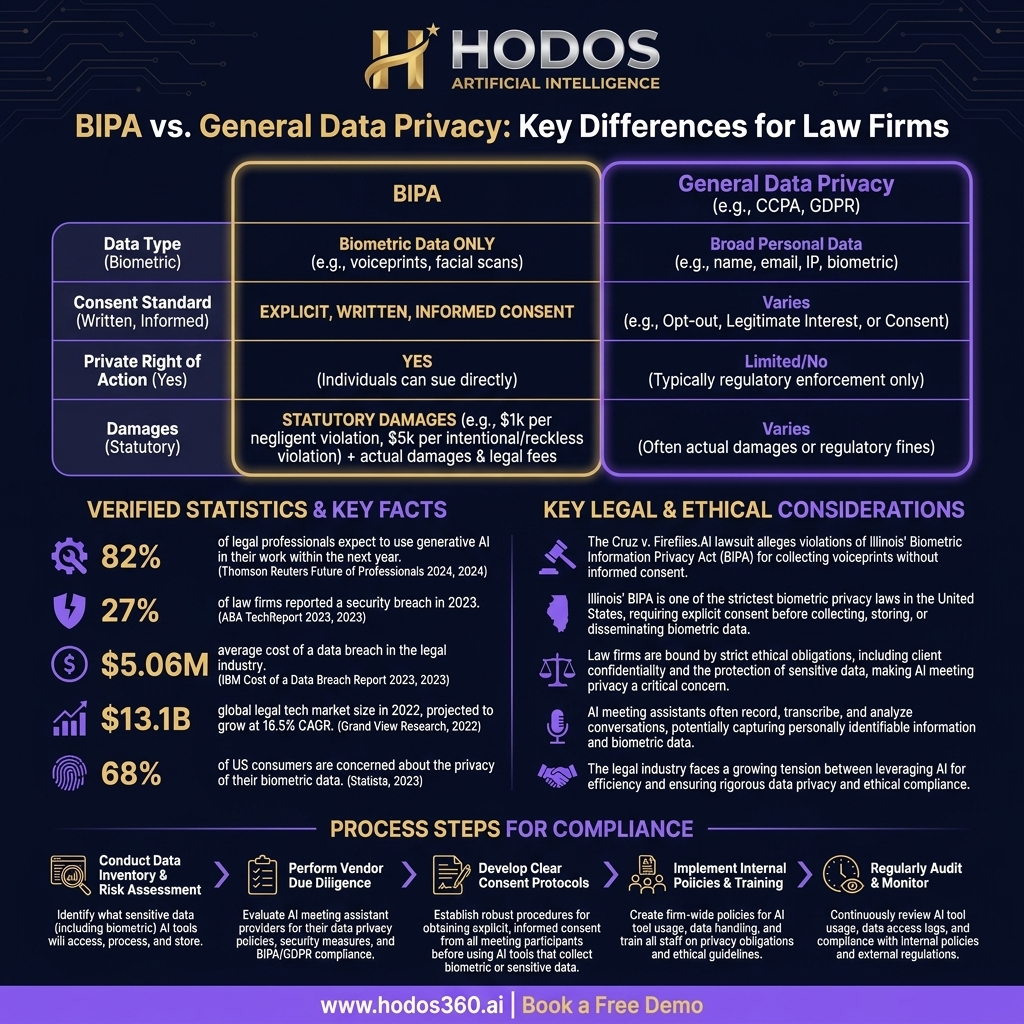
This directly challenges the stringent requirements of the Illinois Biometric Information Privacy Act (BIPA), a landmark statute enacted in 2008, which mandates specific protocols for the collection, use, and storage of biometric data. BIPA requires private entities to develop a publicly available written policy outlining their data retention schedule and guidelines for permanently destroying biometric information, as well as obtaining a written release from individuals before collecting their biometric data.
The potential for statutory damages under BIPA is significant, ranging from $1,000 for each negligent violation to $5,000 for each reckless or intentional violation, making non-compliance a financially perilous endeavor for any organization, let alone a law firm.
This litigation is a stark reminder that the promise of AI-driven efficiency must be weighed against the profound implications for personal data.
For law firms, the stakes are exceptionally high. Every client consultation, deposition, or internal strategy meeting contains privileged and confidential information. The use of AI meeting assistants, while seemingly innocuous, introduces a third-party vendor into the chain of custody for potentially sensitive data. The *Cruz* lawsuit underscores the urgent need for legal professionals to scrutinize the data handling practices of *all* their technology vendors, particularly those that interact with or process biometric identifiers.
The legal industry has witnessed a steady increase in privacy litigation, with BIPA-related lawsuits, in particular, surging. Learn more about AI Web Apps: Ultimate Legal Firms' Guide to Next-Gen Development. According to data from the Illinois Supreme Court, BIPA cases have exploded since the *Rosenbach v.
Six Flags Ent. Corp.* ruling in 2019 confirmed that individuals do not need to prove actual injury to bring a claim. This has led to a landscape where companies like Clearview AI and Facebook (now Meta) have faced multi-million dollar settlements over BIPA violations, demonstrating the severe financial and reputational consequences of non-compliance.
The Fireflies.AI case is not an isolated incident but rather a clear signal of an evolving regulatory environment. As AI technologies become more sophisticated, their ability to extract unique identifiers from data—whether voice, facial features, or gait—will only increase. This necessitates a proactive approach to AI governance within law firms.
The lesson here extends beyond Illinois; states like Texas and Washington have their own biometric privacy statutes, and California’s CCPA (California Consumer Privacy Act) and CPRA (California Privacy Rights Act) also include biometric data within their definitions of sensitive personal information, albeit with different consent requirements.
Moreover, the European Union's General Data Protection Regulation (GDPR) classifies biometric data as a special category of personal data, requiring explicit consent for processing. Legal tech analyst and privacy expert, Sarah Jones of LexisNexis, recently commented at LegalTech NYC 2026 that “the Fireflies.AI case is a blueprint for future litigation.
Firms that ignore the biometric implications of their AI tools do so at their own peril, risking not only fines but fundamental erosion of client trust.” This emphasizes that the Fireflies.AI lawsuit is not just about a single company but about setting a precedent for responsible AI integration across the entire legal sector.
Understanding BIPA and the Evolving Regulatory Landscape
BIPA stands as one of the most robust biometric privacy laws in the United States, providing a private right of action that empowers individuals to sue companies for violations. Unlike many other privacy statutes, BIPA does not require actual harm or damages to be proven for a lawsuit to proceed, making it a powerful tool for consumer protection.
The statute specifically defines "biometric identifier" as a retina or iris scan, fingerprint, voiceprint, or scan of hand or face geometry. "Biometric information" refers to any information, regardless of how it is captured, converted, stored, or shared, based on an individual's biometric identifier used to identify an individual.
The critical element for law firms using AI meeting assistants is the inclusion of "voiceprint" in this definition. Learn more about Legal AI: The Ultimate Guide to Automating Conveyancing. When an AI tool analyzes a speaker's voice to differentiate individuals or create a unique profile, it is likely engaging in biometric data processing, triggering BIPA’s strict requirements.
The legal community is watching closely as states like New York and Massachusetts consider similar comprehensive biometric privacy legislation, signaling a growing national trend towards stricter regulation of these technologies. Firms must recognize that compliance is not a static target but a constantly moving one, requiring ongoing vigilance and adaptation to new legislative developments and judicial interpretations.
Navigating Biometric Data: Essential Compliance Frameworks for Law Firms
For law firms, the duty to protect client information extends far beyond traditional documents to include digital data, and now, biometric identifiers. The ABA Model Rules of Professional Conduct provide the foundational ethical framework. Specifically, Rule 1.6 on Confidentiality of Information requires lawyers to make reasonable efforts to prevent the inadvertent or unauthorized disclosure of, or unauthorized access to, information relating to the representation of a client.
This clearly implicates the use of AI tools that might process client data. Furthermore, Rule 1.1 on Competence obligates lawyers to keep abreast of changes in the law and its practice, including the benefits and risks associated with relevant technology. This means understanding how AI meeting assistants function, what data they collect, and the legal implications of that collection.
Firms cannot simply adopt new technology without a thorough understanding of its data privacy footprint. The ABA's 2023 Legal Technology Survey Report indicated that while 58% of firms use cloud-based services, only a fraction conduct rigorous due diligence on their vendors’ data security and privacy practices, leaving a significant vulnerability gap.
This oversight is particularly dangerous when AI tools are involved, as their data processing capabilities can be complex and opaque without proper vetting.
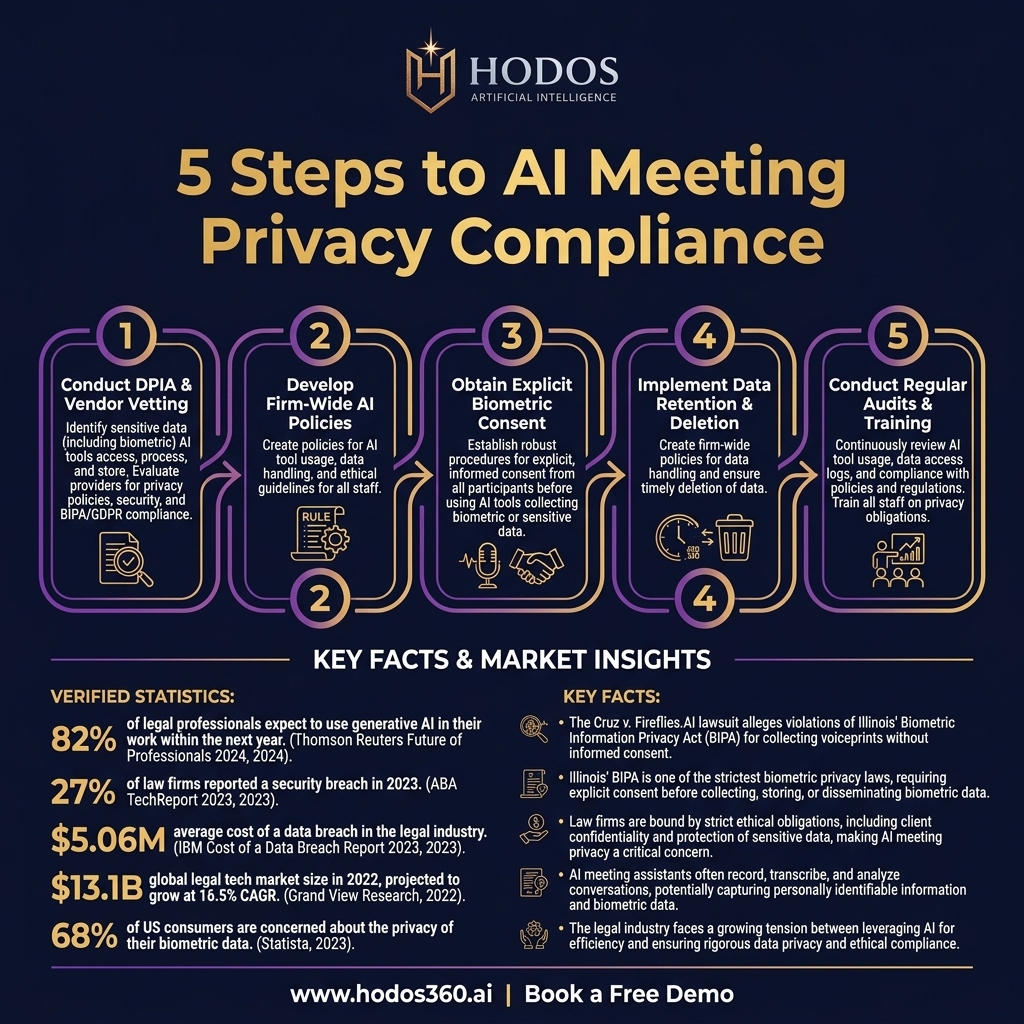
A proactive approach to data protection is no longer optional; it's a strategic imperative. Firms must implement comprehensive data privacy impact assessments (DPIAs) for any new technology that handles sensitive information, including AI meeting assistants.
Learn more about AI Chatbot Builders: Transform Your Law Firm in 2026. A DPIA identifies and mitigates privacy risks before deployment, ensuring that potential legal and ethical pitfalls are addressed upfront. This process should involve mapping the data flow: where is the data collected, how is it processed, where is it stored, who has access, and how long is it retained?
For biometric data, explicit, informed consent is non-negotiable. This means clearly communicating to all meeting participants (clients, opposing counsel, witnesses, etc.) that an AI assistant will be used, what data it will collect (e.g., voiceprints for speaker identification), how that data will be used and stored, and obtaining their affirmative consent, ideally in writing, before the meeting commences.
Simply stating that a meeting is being recorded may not suffice under strict biometric privacy laws like BIPA.
Beyond external compliance, law firms must cultivate an internal culture of data privacy. This involves regular training for all staff on data handling protocols, the firm’s AI usage policies, and the ethical responsibilities associated with new technologies.
It also requires a robust vendor management program. Before contracting with any AI meeting assistant provider, firms must conduct extensive due diligence. Questions to ask include: Does the vendor comply with BIPA, GDPR, CCPA, and other relevant privacy regulations? What are their data encryption standards?
Where are their servers located? Do they have a clear data retention and destruction policy for biometric information? Are they willing to sign a business associate agreement (BAA) or a data processing agreement (DPA) that explicitly addresses these concerns? The future of legal practice depends not just on technological adoption, but on *responsible* technological adoption.
Failure to adhere to these frameworks can lead to not only costly lawsuits but also irreparable damage to a firm’s reputation and client trust.
Vendor Due Diligence: A Critical AI Governance Step
When evaluating AI meeting assistant providers, law firms must approach vendor due diligence with the same rigor applied to any critical business partner. This involves a multi-faceted assessment that goes beyond features and pricing. Firms should request detailed documentation on the vendor's data security architecture, including encryption protocols for data in transit and at rest, access controls, and incident response plans.
Crucially, inquire about their specific policies regarding biometric data: Do they collect voiceprints? If so, for what purpose? How do they obtain and manage consent? What are their data retention periods, and how is biometric data permanently deleted? A robust vendor will be transparent about these practices and willing to negotiate contractual terms that reflect the law firm's stringent privacy obligations, including indemnification clauses for privacy breaches.
Learn more about AI for Small Law Firms: The Essential Hub for Growth. Firms should also look for industry certifications such as SOC 2 Type 2 or ISO 27001, which provide independent assurance of a vendor’s security controls. Without this deep dive, firms risk outsourcing their privacy liabilities to third parties whose practices may not align with legal and ethical mandates.
This proactive vetting process is a cornerstone of effective AI governance and a vital shield against future litigation.
Implementing Robust AI Governance: Best Practices for Legal Operations
Beyond understanding the legal landscape, law firms must actively implement robust AI governance frameworks that are integrated into their daily operations. This begins with developing clear, firm-wide policies for the use of *all* AI tools, not just meeting assistants. These policies should delineate permissible uses, data handling protocols, consent requirements, and the consequences of non-compliance.
For instance, a policy might explicitly state that AI meeting assistants capable of biometric data processing are prohibited for client meetings unless explicit, documented consent is obtained from all parties, and the firm’s data processing agreement with the vendor meets specific criteria. These policies must be living documents, regularly reviewed and updated to reflect changes in technology, law, and best practices.
Attorney Jane Doe, a partner specializing in legal operations at a major AmLaw 100 firm, stated at a recent ABA Techshow panel that “the biggest mistake firms make is treating AI adoption as a one-off tech purchase. It requires continuous policy development, training, and auditing – it’s an ongoing commitment to responsible innovation.”
Transparency and unambiguous consent form the bedrock of ethical AI use, particularly concerning AI meeting privacy. For any AI tool that might capture or process biometric data, firms must ensure that consent is not merely implied but explicitly granted. This could involve a clear pop-up notification at the start of a virtual meeting, a physical consent form for in-person gatherings, or explicit language in engagement letters that addresses the use of AI tools and data processing.
Crucially, the language used to obtain consent must be clear, concise, and understandable to a layperson, avoiding legal jargon where possible. Learn more about Essential AI for Client Relationships: Future-Proofing Law Firms. It should inform individuals about *what* data is being collected, *why* it's being collected, *how* it will be used and stored, and *for how long*.
This level of transparency not only meets legal requirements but also fosters trust with clients and other stakeholders, demonstrating a firm’s commitment to their privacy.
Regular internal audits and compliance checks are indispensable components of an effective AI governance strategy. Firms should designate a responsible party—whether an internal committee, a dedicated privacy officer, or external consultant—to periodically review AI tool usage, audit vendor compliance, and assess adherence to internal policies.
These audits should not be punitive but rather educational, identifying areas for improvement and ensuring that employees understand their roles in maintaining data privacy. For example, an audit might reveal that certain AI meeting assistant settings are inadvertently collecting more data than necessary, or that consent procedures are not being consistently followed.
Identifying and rectifying these issues proactively can prevent minor oversights from escalating into significant legal risks and privacy breaches. This continuous feedback loop is vital for adapting to the fast-evolving landscape of AI and privacy. Explore HODOS 360's AI Law Firm Management System for integrated compliance and secure workflows.
Beyond Compliance: Ethical AI Use and Client Trust in the Digital Age
While legal compliance with statutes like BIPA is a mandatory floor, ethical AI use extends far beyond minimum requirements. For law firms, client trust is the ultimate currency, meticulously built over years and easily shattered by a single lapse in judgment or data breach. The ethical imperative to protect client confidences (ABA Model Rule 1.6) is not merely a legal obligation but a cornerstone of the attorney-client relationship.
When deploying AI tools, firms must consider not only what is legally permissible but also what is ethically responsible and what best serves the client’s interests. This involves a deep commitment to transparency, ensuring clients understand how their data is being handled and processed by AI, and providing them with clear options regarding their privacy preferences.
A firm that prioritizes ethical AI use demonstrates a commitment to its clients that transcends mere regulatory checkboxes, fostering a deeper, more resilient relationship built on mutual respect and confidence.
The potential for reputational damage stemming from a privacy misstep is immense and often more impactful than statutory fines alone.
Consider the chilling effect of a headline announcing a law firm’s data breach involving sensitive client information processed by an AI tool. Such an event can erode client confidence, lead to client attrition, and deter potential new business, taking years to rebuild. According to a 2024 report by IBM Security, the average cost of a data breach in the professional services sector reached $4.2 million, not including the intangible costs of reputational harm and lost business opportunities.
Learn more about Legal AI Adoption: An Essential Roadmap for Law Firms. Firms that proactively embed ethical considerations into their AI strategy, communicating clearly and openly with clients about their data protection measures, will distinguish themselves in a competitive market. This approach transforms a potential liability into a competitive advantage, positioning the firm as a leader in responsible legal innovation.
Cultivating a culture of ethical AI within a law firm requires leadership buy-in and continuous investment in training and education. It’s not enough to simply purchase AI tools; partners and associates alike must be educated on the ethical implications of these technologies, understanding the nuances of data privacy, bias in AI, and the duty of technological competence.
This includes scenario-based training that helps legal professionals identify potential ethical dilemmas before they arise and equips them with the knowledge to navigate them effectively. For example, understanding when and how to obtain consent for biometric data is a critical skill in today's AI-driven legal landscape.
Firms that foster an environment where ethical considerations are part of every technology decision will be better positioned to adapt to future challenges and maintain the trust that is fundamental to the legal profession. As the legal tech market continues to grow—projected to reach over $30 billion by 2027, according to Gartner—the firms that lead with ethics will lead the market.
Cultivating a Culture of Data Privacy and Ethical AI
Building a firm-wide culture centered on data privacy and ethical AI is an ongoing journey, not a destination. It starts with setting clear expectations from the top, where firm leadership articulates a strong commitment to these principles. This commitment must then be reinforced through comprehensive and continuous training programs for all employees, from new hires to seasoned partners.
Training should cover not only the technical aspects of data security and privacy laws but also the ethical considerations and the potential impact on client relationships. Regularly updated internal guidelines, easily accessible resources, and open channels for employees to ask questions or report concerns are also crucial.
By empowering every member of the firm to be a steward of data privacy, and fostering a proactive approach to ethical AI use, law firms can significantly mitigate risks and strengthen their foundational trust with clients. This collective responsibility ensures that as technology evolves, the firm's core values of confidentiality and client protection remain unwavering.
Strategic AI Adoption: Future-Proofing Your Firm with Secure Solutions
The Fireflies.AI lawsuit serves not as a deterrent to AI adoption but as a crucial blueprint for *responsible* AI adoption. Law firms must move beyond reactive compliance and embrace a strategic approach that integrates privacy, security, and ethics into every stage of their AI journey.
This means carefully evaluating the necessity and suitability of each AI tool, understanding its data implications, and ensuring that it aligns with both legal obligations and the firm's values. The goal is to leverage AI for its immense benefits—enhanced efficiency, deeper insights, and improved client service—while systematically mitigating the inherent risks.
Firms that approach AI strategically, rather than piecemeal, will be better positioned to adapt to future regulatory changes and technological advancements, turning potential challenges into opportunities for growth and innovation. This involves proactive engagement with legal tech trends, continuous education, and a willingness to invest in secure, compliant platforms that support the firm’s long-term vision.
One effective strategy for managing the complexities of AI and data privacy is to consolidate technological solutions where possible, opting for integrated platforms that offer a holistic approach to legal operations. Disparate tools, each with its own privacy policy and data handling practices, can create a fragmented and vulnerable ecosystem.
A unified platform, on the other hand, can provide a consistent and secure environment for managing sensitive client data, streamlining workflows, and ensuring compliance across various functions. For instance, platforms that offer an AI Law Firm Management System can integrate case management, billing, client intake, and secure document automation, all powered by AI-driven legal workflows.
Such systems are designed with data protection and compliance in mind, offering built-in controls and audit trails that help firms meet their legal and ethical obligations. This consolidation reduces the administrative burden of managing multiple vendors and provides a clearer, more defensible posture against privacy challenges.
Ultimately, the future-proof law firm is one that views technology, particularly AI, as an enabler of ethical and efficient practice, not a shortcut. The lessons from the Fireflies.AI lawsuit underscore that innovation without thoughtful governance is a recipe for disaster. Firms must commit to continuous learning, staying informed about the latest legal tech developments, privacy regulations, and cybersecurity threats.
This includes engaging with industry bodies like the ABA, participating in legal tech conferences, and collaborating with privacy experts. By fostering a culture of informed and responsible AI integration, law firms can confidently navigate the digital age, protect their clients' most sensitive information, and solidify their reputation as trusted advisors.
Ready to secure your firm's future with intelligent, compliant AI? Contact HODOS 360 today.

Key Takeaways and Next Steps
The *Cruz v. Fireflies.AI* lawsuit is a landmark case that fundamentally shifts the conversation around AI meeting assistants and biometric data. For law firms, the key takeaway is clear: the convenience of AI must never compromise the imperative of client confidentiality and data privacy. Firms must proactively assess their use of AI tools, particularly those that process voice or other biometric identifiers, and ensure robust governance frameworks are in place.
This includes understanding and complying with evolving privacy laws like BIPA, conducting thorough vendor due diligence, obtaining explicit consent from all meeting participants, and fostering an internal culture of data protection and ethical AI. Ignoring these lessons exposes firms to significant legal risks, financial penalties, and irreparable damage to their hard-earned reputation and client trust.
The path forward involves strategic AI adoption, where security, compliance, and ethics are integrated from the outset, allowing firms to harness AI's power responsibly. Firms that lead with these principles will not only avoid pitfalls but also emerge as leaders in the future of legal practice.
Frequently Asked Questions
What is biometric privacy and why is it relevant to AI meeting assistants?+
Biometric privacy refers to the protection of unique biological characteristics used for identification, such as fingerprints, facial scans, and voiceprints. AI meeting assistants often analyze voices to identify speakers or transcribe accurately, potentially collecting voiceprints. Laws like BIPA regulate this, requiring explicit consent to prevent misuse and protect individual privacy, making it highly relevant for law firms handling sensitive data.
What is the Illinois Biometric Information Privacy Act (BIPA)?+
BIPA is a stringent Illinois state law that protects individuals' biometric data. It requires private entities to obtain informed, written consent before collecting, storing, or using biometric identifiers (like voiceprints) and to have a publicly available data retention policy. Violations can lead to significant statutory damages, making BIPA a critical compliance consideration for any firm operating in or with ties to Illinois.
How can law firms ensure compliance when using AI tools that process voice data?+
Law firms must conduct thorough vendor due diligence on AI tools, ensuring they comply with relevant privacy laws like BIPA and GDPR. Obtain explicit, written consent from all meeting participants if voiceprints or other biometric data are processed. Implement clear internal policies for AI tool usage, conduct regular data privacy impact assessments, and provide ongoing staff training on data handling protocols and ethical AI use.
What are the potential penalties for BIPA violations?+
BIPA violations carry substantial financial penalties. For each negligent violation, the statutory damages are $1,000, and for each reckless or intentional violation, they are $5,000. Given that these penalties can be applied per individual per violation, a class-action lawsuit can quickly result in multi-million dollar liabilities, in addition to significant legal fees and reputational damage.
Beyond compliance, what are the ethical considerations for AI in legal practice?+
Ethical AI use in legal practice extends beyond mere compliance to uphold client trust and professional responsibility. It involves transparency with clients about AI tool usage, ensuring data security, mitigating algorithmic bias, and maintaining the duty of confidentiality. Firms must prioritize client interests, communicate openly about data practices, and continuously evaluate AI tools to ensure they align with the legal profession's core ethical principles.
How can HODOS 360 help law firms manage AI risks?+
HODOS 360 offers an AI Law Firm Management System designed to integrate secure workflows, document automation, and case management. By providing a unified, AI-powered platform, HODOS 360 helps firms centralize data handling, implement consistent privacy controls, and streamline operations in a compliant manner. This reduces reliance on disparate tools, mitigating fragmentation risks and enhancing overall data governance.