
AI Receptionist Market: Essential Strategies for Legal Growth
The scene at Sterling & Hayes, a mid-sized corporate law firm in Chicago, was once a familiar ballet of ringing phones, hurried voicemails, and missed client calls. Senior Partner Eleanor Vance, a veteran of complex M&A, recounts a particularly frustrating Monday morning in late 2025. "We lost a significant prospective client, a tech startup, because our lines were jammed during their initial inquiry," Vance revealed in a recent interview. "They called three times, went straight to voicemail, and by the time we returned the call, they'd already engaged another firm. It was a stark wake-up call that our traditional intake process was not just inefficient, but actively costing us business." This anecdote, far from isolated, highlights a critical tension within the legal industry: the struggle to maintain high-touch client service in an increasingly fast-paced, digitally native world, often bottlenecked by outdated administrative infrastructure. The promise of artificial intelligence, particularly in the realm of client-facing interactions, is now emerging as the most potent solution.
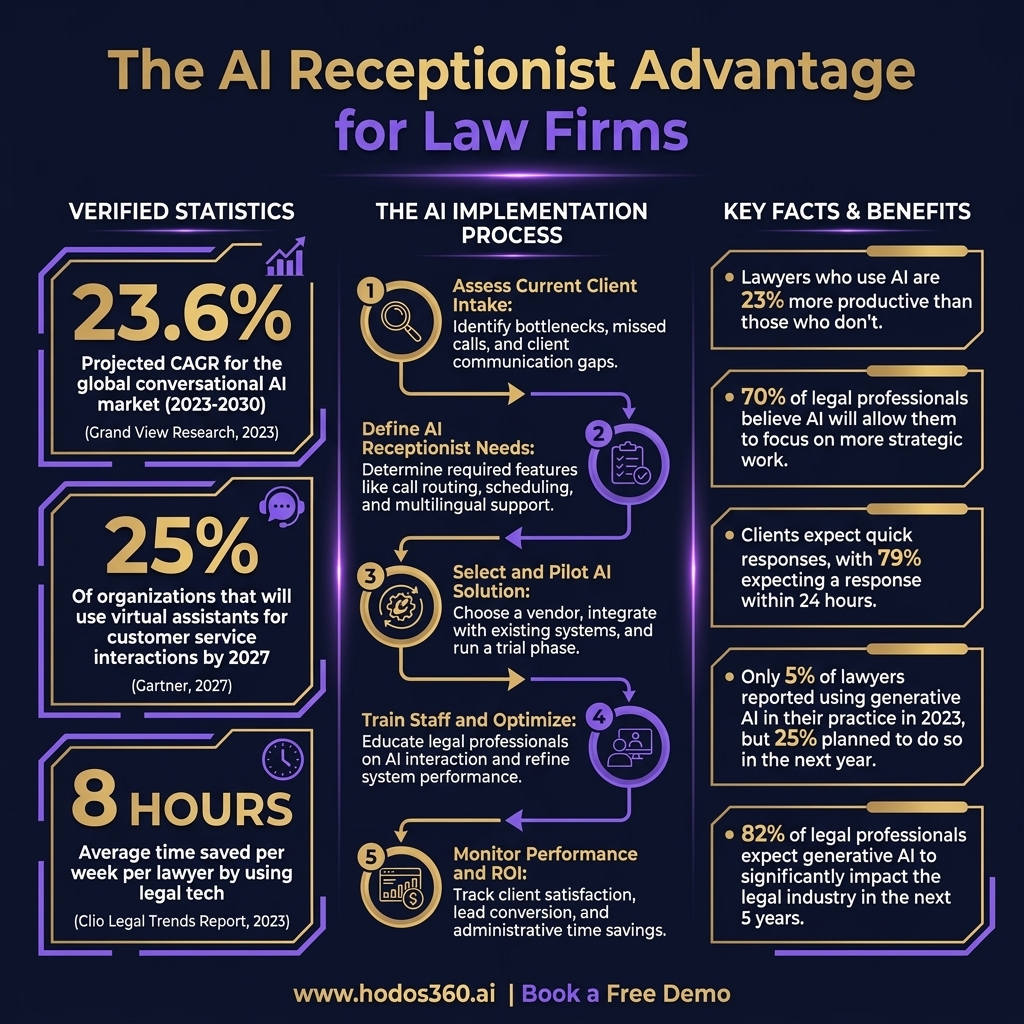
The burgeoning AI receptionist market is not just a technological curiosity; it's rapidly becoming an indispensable asset for law firms navigating this competitive landscape. According to a recent report from Market.us, this market is projected to grow at a Compound Annual Growth Rate (CAGR) of 27.8%, indicating a profound and swift transformation across industries, with legal firms poised to be major beneficiaries. This isn't merely about automating phone calls; it's about redefining the initial client experience, ensuring no lead is missed, and freeing up highly compensated legal professionals from repetitive administrative burdens. The shift is so significant that industry analysts like Gartner are predicting that by 2027, over 25% of all customer service interactions will be handled by virtual assistants, a figure that includes the specialized needs of legal practices. Firms like Sterling & Hayes, under Eleanor Vance's leadership, are now on the vanguard of this adoption, realizing that embracing these advanced AI voice assistants isn't just about efficiency; it's about competitive survival and strategic growth.
This comprehensive analysis delves into the dynamics of the rapidly expanding AI receptionist market, exploring its specific implications and opportunities for law firms. We will examine the core technologies driving this growth, dissect the tangible benefits ranging from enhanced client intake to improved operational efficiency, and address the critical considerations for successful implementation. From understanding the nuanced ethical obligations under the ABA Model Rules to navigating the integration challenges, this piece offers a strategic roadmap for legal professionals looking to leverage voice AI to not only meet but exceed the demands of the modern legal client. The goal is to move beyond the hype and provide actionable insights, drawing on real-world examples and expert perspectives, to empower law firms to transform their client engagement and administrative workflows.
Ready to streamline your client intake and enhance efficiency? Discover how HODOS 360's AI Voice Assistants can transform your law firm.
The Exploding AI Receptionist Market: A Landscape Redefined for Legal
The current trajectory of the AI receptionist market signals a profound paradigm shift, driven by advancements in natural language processing (NLP), speech-to-text, and generative AI. This isn't just about automated phone trees; it's about sophisticated AI voice assistants capable of understanding context, managing complex dialogues, and performing a myriad of administrative tasks with human-like proficiency. Venture capital poured over $50 billion into AI startups in the first half of 2026 alone, with a significant portion targeting conversational AI solutions, indicating robust investor confidence in this sector. Companies like OpenAI and Anthropic are continually pushing the boundaries of foundational models, which in turn power the specialized applications tailored for industries like legal. For instance, OpenAI's latest iterations of GPT models offer unprecedented capabilities in understanding nuanced legal queries and responding appropriately, a critical factor for legal AI receptionists.
The projected growth of the global AI receptionist market to reach several billion dollars by 2030, with a CAGR of 27.8% as highlighted by Market.us, underscores its inevitable integration into the operational fabric of small and large businesses alike, including law firms. This growth is fueled by several factors: the increasing cost of human labor, the demand for 24/7 client service, and the need for scalable solutions in a fluctuating economic environment. Firms like Clio and MyCase, while primarily practice management solutions, are increasingly integrating or partnering with AI voice assistant providers, recognizing the critical role of seamless client communication. Jack Newton, CEO of Clio, has often emphasized the importance of client-centricity in legal tech, and AI receptionists are a direct extension of that philosophy. Learn more about AI Marketing: The Ultimate Guide for Law Firm Growth. The competitive landscape for legal services is becoming fiercer, and firms that delay adopting these technologies risk falling behind those that embrace innovation.
Consider the practical implications for a bustling legal practice. Traditional receptionists are bound by office hours, prone to human error, and represent a significant overhead. An AI voice assistant, however, operates 24/7, handles overflow calls without a drop in quality, and can manage routine tasks like appointment booking, lead qualification, and basic information dissemination with unwavering consistency. This allows human staff, including paralegals and junior attorneys, to focus on higher-value, billable work. According to a 2025 report by Thomson Reuters, law firms leveraging AI for administrative tasks reported an average of 15-20% increase in operational efficiency and a noticeable improvement in client satisfaction scores. This data paints a clear picture: the AI receptionist market is not just a trend; it's a strategic imperative for law firms aiming for sustainable growth and a competitive edge in the digital age.
Revolutionizing Legal Client Intake and Operational Efficiency with Voice AI
For law firms, the primary allure of the AI receptionist market lies in its transformative potential for client intake and overall operational efficiency. The initial point of contact is often the most critical in converting a prospective client into an engaged one. A human receptionist can only handle one call at a time, leading to missed opportunities during peak hours or after-hours. This is where AI voice assistants excel, providing instant, multilingual support, ensuring that every inquiry is captured, qualified, and routed correctly, regardless of when it occurs. For example, a small immigration law firm based in Miami, led by attorney Maria Rodriguez, struggled with after-hours calls from potential clients in different time zones. Implementing an AI voice assistant dramatically improved their lead capture rate by 40% within six months, directly attributing to a 25% increase in new client retainers, according to Rodriguez in a recent legal tech webinar. This showcases how AI can literally expand a firm's reach and capacity without adding headcount.
Beyond initial capture, AI voice assistants can significantly streamline the lead qualification process. Instead of a human spending valuable time asking screening questions, the AI can gather essential information – case type, urgency, contact details, potential conflicts – and even conduct preliminary conflict checks against a firm's database. Learn more about Legal Technology: Essential Steps to Reset Your AI Strategy. This intelligent pre-screening means that by the time a human attorney or paralegal engages, they are already equipped with a robust understanding of the caller's needs, enabling a more productive and efficient first consultation. This automation aligns perfectly with the principles of efficient practice management, freeing up resources that can be redirected to complex legal analysis or client advocacy. The American Bar Association's (ABA) 2024 Legal Technology Survey Report noted a growing trend in firms adopting AI for intake, with 30% of surveyed firms reporting use, up from just 12% two years prior, highlighting the accelerating adoption curve.
Moreover, the capabilities extend to appointment booking, sending automated reminders, and even providing answers to frequently asked questions about firm services, fees, or legal processes. This reduces the administrative load on human staff, allowing them to focus on substantive legal work. Imagine a scenario where an AI voice assistant handles all initial inquiries for a personal injury firm: it qualifies leads, schedules consultations directly into the firm’s calendar, and sends out initial client questionnaires, all while the attorneys are in court. This level of automation is not about replacing humans but augmenting their capabilities, allowing them to operate at the top of their license.
Enhancing Client Experience and Accessibility
The modern client expects immediate responses and seamless interactions, a standard often set by consumer tech giants. An AI receptionist helps law firms meet this expectation by offering 24/7 availability and multilingual support. For diverse communities, this multilingual capability is particularly impactful, breaking down communication barriers and making legal services more accessible. A study published by Georgetown Law's Institute for Technology Law and Policy in 2025 highlighted that firms offering multilingual AI support reported significantly higher client retention rates among non-English speaking demographics. Learn more about Voice AI Unleashed: Transforming Law Firms in 2026 with HODOS 360. This isn't just about convenience; it's about expanding access to justice and demonstrating a commitment to serving a broader client base, thereby strengthening a firm's reputation and market share. The ability to communicate effectively in a client's native language fosters trust and reduces the anxiety often associated with seeking legal help, making the entire process more client-friendly and inclusive.
Transform your firm's client experience and boost efficiency. Explore HODOS 360's AI Voice Assistants and schedule a personalized demo today!
Navigating Ethical Considerations and Implementation Challenges
While the benefits of the AI receptionist market are undeniable, law firms must approach implementation with a clear understanding of the ethical and practical challenges. The most significant concern revolves around client confidentiality, a cornerstone of legal practice. ABA Model Rule 1.6 mandates that lawyers protect client information, and this extends to how third-party vendors, including AI systems, handle data. Firms must ensure that any AI voice assistant solution is compliant with robust data security protocols, encryption standards, and adheres to privacy regulations like GDPR or CCPA. For example, Harvey AI, a legal AI research assistant, has emphasized its enterprise-grade security and data privacy measures in its partnerships with firms like Allen & Overy, setting a standard for responsible AI deployment in legal. Firms must conduct thorough due diligence on their chosen AI provider’s data handling practices, ensuring that client communications remain privileged and secure.
Another crucial ethical consideration is the duty of supervision under ABA Model Rule 5.3, which requires lawyers to ensure that nonlawyer assistants (including AI) act in a manner compatible with the professional obligations of the lawyer. This means firms cannot simply "set and forget" an AI receptionist. The AI's responses must be carefully scripted, regularly reviewed, and continuously updated to ensure accuracy and compliance with legal ethics. For instance, an AI should never offer legal advice, only gather information or provide general factual responses. Learn more about AI Voice Platform: Essential for Modern Legal Operations. Clear disclaimers about the AI's role and limitations are essential to manage client expectations and prevent the unauthorized practice of law. Law firms must also consider the potential for bias in AI algorithms, ensuring that the system does not inadvertently discriminate against certain demographics in its interactions or lead qualification processes, which could lead to significant ethical and reputational repercussions.
Beyond ethics, practical implementation challenges include integration with existing CRM and practice management systems, training the AI to understand legal jargon and specific firm protocols, and managing the transition for both staff and clients. Firms often underestimate the time and effort required to customize an AI voice assistant to their specific needs. It’s not just about plugging in a system; it requires careful configuration, extensive testing, and ongoing refinement. The initial rollout can also face resistance from staff who fear job displacement or are uncomfortable with new technology. Effective change management, including transparent communication and comprehensive training, is vital to ensure smooth adoption and maximize the return on investment. Firms that embrace a phased implementation approach, starting with less sensitive tasks and gradually expanding capabilities, often find greater success in navigating these complexities and securing buy-in from all stakeholders.
Data Security and Client Confidentiality in the AI Era
The legal profession's bedrock is trust, inextricably linked to the strict confidentiality of client communications. When deploying an AI receptionist, firms must prioritize vendors that offer end-to-end encryption, secure data storage, and strict access controls. A breach of client data, even if accidental, can lead to severe reputational damage, financial penalties, and professional sanctions under various state bar rules. Learn more about AI Marketing Strategy: Essential Lessons from 25 Years of Evolution. Firms should meticulously review vendor contracts, focusing on data ownership, retention policies, and breach notification clauses. This proactive approach ensures that the technological advantage gained by AI does not come at the cost of compromising the sacred attorney-client privilege, as outlined in numerous legal precedents and the foundational principles of the profession.
Strategic Implementation: Best Practices for Law Firms Adopting Voice AI
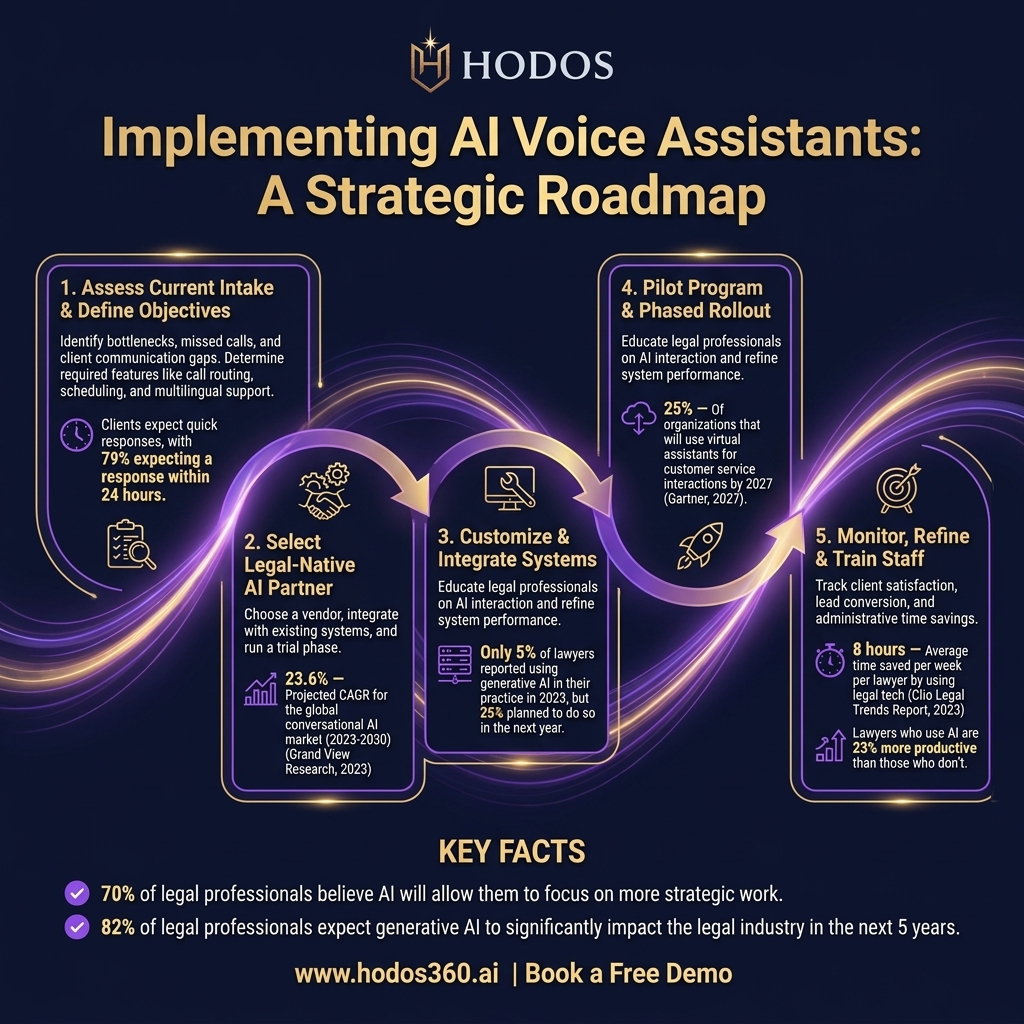
Successful adoption of AI voice assistants requires a strategic, phased approach rather than a haphazard rollout. The first step for any law firm is a thorough assessment of its current client intake process, identifying bottlenecks, pain points, and areas where an AI can provide the most immediate value. This diagnostic phase should involve input from receptionists, paralegals, and attorneys. Once key areas are identified, firms should define clear objectives and metrics for success, whether it's reducing missed calls, improving lead qualification rates, or freeing up staff time. For example, a family law firm might prioritize empathetic yet efficient handling of sensitive initial inquiries, while a corporate firm might focus on rapid routing of complex commercial queries.
Next, selecting the right AI partner is paramount. Firms should look for providers with a deep understanding of the legal industry, a proven track record, and robust security features. Critically, the AI should be highly customizable, allowing firms to tailor scripts, integrate with existing calendaring and CRM systems, and adapt to specific legal terminology and firm culture. During LegalTech NYC 2026, several vendors showcased "legal-native" AI solutions, emphasizing their ability to understand and process legal nuances, a significant leap from generic conversational AI. Pilot programs with a subset of calls or specific departments can provide valuable insights and allow for iterative adjustments before a full-scale deployment. Learn more about AI Assistants: Essential for Law Firm Web Engagement & Growth. This gradual approach minimizes disruption and builds confidence among staff and clients.
Finally, ongoing monitoring, training, and refinement are essential. The AI is not a static tool; it learns and improves with data. Firms must establish a feedback loop, regularly reviewing call logs, AI performance metrics, and client satisfaction data. This allows for continuous optimization of scripts, responses, and routing logic. Furthermore, internal training for staff on how to effectively collaborate with the AI — understanding its capabilities and limitations, and knowing when to escalate calls — is crucial. This ensures that the AI functions as a seamless extension of the human team, rather than a standalone, disconnected system. By following these best practices, law firms can harness the full potential of the AI receptionist market to drive efficiency, enhance client satisfaction, and achieve sustained growth.
Integrating AI with Existing Legal Tech Infrastructure
The true power of an AI receptionist is unlocked through seamless integration with a firm's existing technology stack. This includes practice management software (like Clio or MyCase), CRM systems, and calendaring tools. Integration ensures that qualified leads are automatically entered, appointments are booked in real-time, and client information is accessible across platforms, eliminating data silos and manual data entry errors. Firms should prioritize AI solutions that offer open APIs and robust integration capabilities, ensuring a cohesive and efficient digital ecosystem. This interconnectedness is not just about convenience; it's about creating a single source of truth for client data and streamlining workflows from initial contact to case resolution.

Key Takeaways and Next Steps for Forward-Thinking Law Firms
The rapid expansion of the AI receptionist market, driven by technological advancements and the increasing demands of the modern legal client, presents both an opportunity and an imperative for law firms. As demonstrated by the experiences of firms like Sterling & Hayes and the projections of market analysts, the legal industry stands at a critical juncture where embracing intelligent automation is no longer a luxury but a strategic necessity. Firms that proactively adopt AI voice assistants are not merely gaining an efficiency advantage; they are fundamentally enhancing their client engagement models, expanding their operational capacity, and positioning themselves as leaders in a competitive landscape. The narrative is clear: innovation in client-facing technology is a direct pathway to growth and relevance.
For law firm leaders, the immediate next step is to initiate an internal dialogue about how AI voice assistants can address their specific operational challenges and client service goals. This involves understanding the nuances of the technology, evaluating potential providers, and meticulously planning for ethical compliance and seamless integration. The journey requires a commitment to continuous learning and adaptation, ensuring that the AI system evolves with the firm's needs and the ever-changing legal and technological landscape. By leveraging the power of AI to manage initial client interactions, qualify leads, and streamline administrative tasks, firms can empower their human talent to focus on the complex, strategic work that only legal professionals can deliver, ultimately fostering a more productive, client-centric, and profitable practice. The future of legal service delivery is here, and it speaks with an intelligent, always-on voice.
Ready to future-proof your firm? Explore HODOS 360's full suite of AI-powered solutions to revolutionize your practice, from management to marketing and client engagement.
Frequently Asked Questions
What exactly is an AI receptionist for a law firm?+
An AI receptionist is an intelligent virtual assistant powered by artificial intelligence and natural language processing. It handles incoming calls, qualifies leads, books appointments, answers frequently asked questions, and routes calls, providing 24/7 client support. For law firms, it's tailored to understand legal terminology and client needs, ensuring professionalism and efficiency in the initial client interaction and reducing missed opportunities.
How does an AI receptionist ensure client confidentiality?+
Reputable AI receptionist providers implement robust data security measures, including end-to-end encryption, secure cloud storage, and compliance with data privacy regulations like GDPR and CCPA. Law firms must conduct due diligence on their chosen vendor's security protocols and ensure contracts specify data handling, ownership, and privacy safeguards to protect sensitive client information, adhering to ABA Model Rule 1.6.
Can an AI receptionist provide legal advice?+
No, an AI receptionist is designed to provide administrative support, gather information, and route calls, but it cannot and should not provide legal advice. It is crucial for law firms to program their AI with clear limitations and disclaimers to prevent the unauthorized practice of law and ensure ethical compliance under rules like ABA Model Rule 5.5, which prohibits non-lawyers from practicing law.
What are the key benefits of adopting an AI receptionist for my law firm?+
Key benefits include 24/7 client availability, improved lead capture and qualification, reduced administrative overhead, increased operational efficiency, enhanced client experience through immediate and multilingual support, and allowing human staff to focus on higher-value legal work. It helps firms scale capacity without proportional increases in staffing costs, boosting overall profitability and client satisfaction.
How difficult is it to integrate an AI receptionist with existing law firm software?+
The difficulty varies by provider and your existing tech stack. Many modern AI receptionist solutions offer robust integration capabilities via APIs, allowing seamless connection with popular practice management systems (e.g., Clio, MyCase), CRM tools, and calendaring software. Choosing a provider with a focus on legal tech integration simplifies the process significantly, ensuring a cohesive and efficient digital ecosystem for your firm.