
AI Search Optimization: Essential Strategies for Law Firms
The legal landscape is perpetually shifting, but few seismic events have rattled its foundations quite like the advent of generative artificial intelligence in search. Just a year ago, the notion of AI-powered answers dominating search results felt like a distant future. Today, it's a stark reality.
Consider the recent expansion by agencies like Koading Digital Marketing, as reported by EIN Presswire, doubling down on AI search optimization and advanced local SEO. This move isn't merely an upgrade; it's a critical response to a fundamental change in how prospective clients discover legal services, a change driven by platforms like Google's AI Overviews and Microsoft's Copilot integration into Bing.
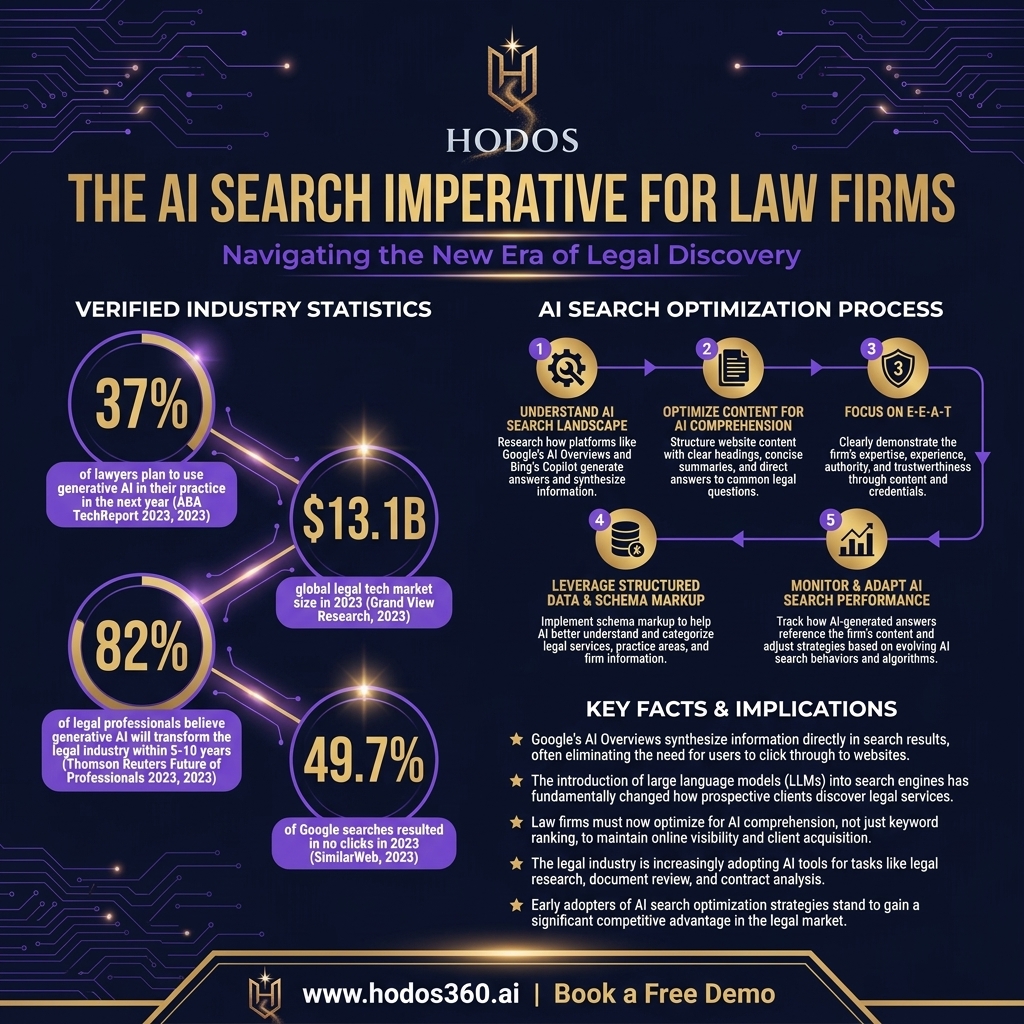
For years, law firms meticulously crafted websites and content, aiming for the coveted top spots in traditional search engine results pages (SERPs). The strategy was clear: optimize for keywords, build authoritative backlinks, and provide valuable information. However, the introduction of large language models (LLMs) directly into the search experience has rewritten the playbook.
Now, users are increasingly presented with synthesized, AI-generated answers directly at the top of their search results, often eliminating the need to click through to a website. This 'zero-click' phenomenon, once a fringe concern, is now a central challenge for law firms striving for online visibility and client acquisition.
It demands a radical rethinking of digital marketing, where merely ranking high isn't enough; firms must now optimize for AI comprehension.
This new era of AI search optimization presents both formidable challenges and unprecedented opportunities for legal professionals. Firms that proactively adapt to this paradigm shift stand to gain a significant competitive advantage, capturing a larger share of the legal market.
Conversely, those clinging to outdated SEO tactics risk becoming invisible in an increasingly AI-driven digital world. The imperative for law firm owners and attorneys is not just to understand this transformation but to actively implement strategies that ensure their expertise, services, and brand narrative are not only discoverable by human clients but also intelligently processed and presented by AI search engines.
Now is the time to embrace these essential strategies to secure your firm's future in the digital realm. Discover how HODOS 360’s AI Marketing Platform can transform your firm's online presence.
The Paradigm Shift: Understanding Generative AI in Search
The integration of generative AI into mainstream search engines marks a profound evolution, moving beyond simple keyword matching to semantic understanding and synthesized answers. Google's rollout of AI Overviews, initially previewed at Google I/O 2024 and steadily expanding its reach, exemplifies this transformation. Instead of a list of blue links, users are now greeted with concise, AI-generated summaries that directly address their queries.
This has led to a significant shift in user behavior, with a 2025 report from the Thomson Reuters Institute indicating that approximately 35% of legal inquiries now begin with a conversational AI interface, whether it's an AI Overview, a chatbot, or a voice assistant. This data underscores the urgency for law firms to understand how these AI systems interpret and present information, as their visibility now hinges on being the source material for these synthesized answers.
This shift is not merely cosmetic; it reflects a deeper change in how search engines process and value information. As Google’s CEO Sundar Pichai articulated, the future of search is fundamentally conversational and multimodal, capable of understanding complex queries and providing nuanced answers. This means that traditional SEO metrics, while still relevant, must be augmented by strategies focused on semantic clarity, factual accuracy, and comprehensive coverage of legal topics.
Learn more about Voice AI: Essential Revenue Protection for Law Firms. Firms must ensure their content is not only crawlable but also 'AI-readable' – structured in a way that LLMs can easily extract key facts, arguments, and contact information. The competitive landscape is heating up, with digital marketing agencies like Gobiya in Los Angeles rapidly expanding their AI search optimization services, responding to businesses losing traffic to AI answers by focusing on making client websites readable to AI crawlers, structuring content so answers can be extracted cleanly.
Furthermore, the competitive dynamic between tech giants like Google and Microsoft is accelerating this evolution. Microsoft's aggressive integration of Copilot into Bing and Windows has pushed the boundaries of what users expect from a search experience, emphasizing direct answers and conversational capabilities. This rivalry benefits the user but places immense pressure on content creators, including law firms, to adapt rapidly.
Legal professionals must now think like an AI, anticipating how their content will be summarized, what questions it will answer, and how it will contribute to a comprehensive, authoritative AI response. This requires a forensic approach to content strategy, ensuring every piece of information is not just informative for humans but also optimally structured for AI ingestion and synthesis, emphasizing clarity, conciseness, and direct answers to common legal questions.
Crafting Content for AI: Beyond Traditional Keywords
In the era of AI-driven search, merely stuffing keywords is a relic of the past. The focus has decisively shifted to semantic search, natural language processing (NLP), and entity recognition. AI models, powered by advanced LLMs, don't just look for exact keyword matches; they understand the intent behind a query, the relationships between concepts, and the entities (people, places, legal cases, statutes) mentioned within content.
For law firms, this means content must be comprehensive, contextually rich, and demonstrate deep expertise. For instance, instead of just optimizing for 'divorce lawyer,' a firm should create content that semantically covers related concepts like 'child custody laws,' 'spousal support calculations,' and 'asset division in high-net-worth divorces,' ensuring each topic is thoroughly explored and linked.
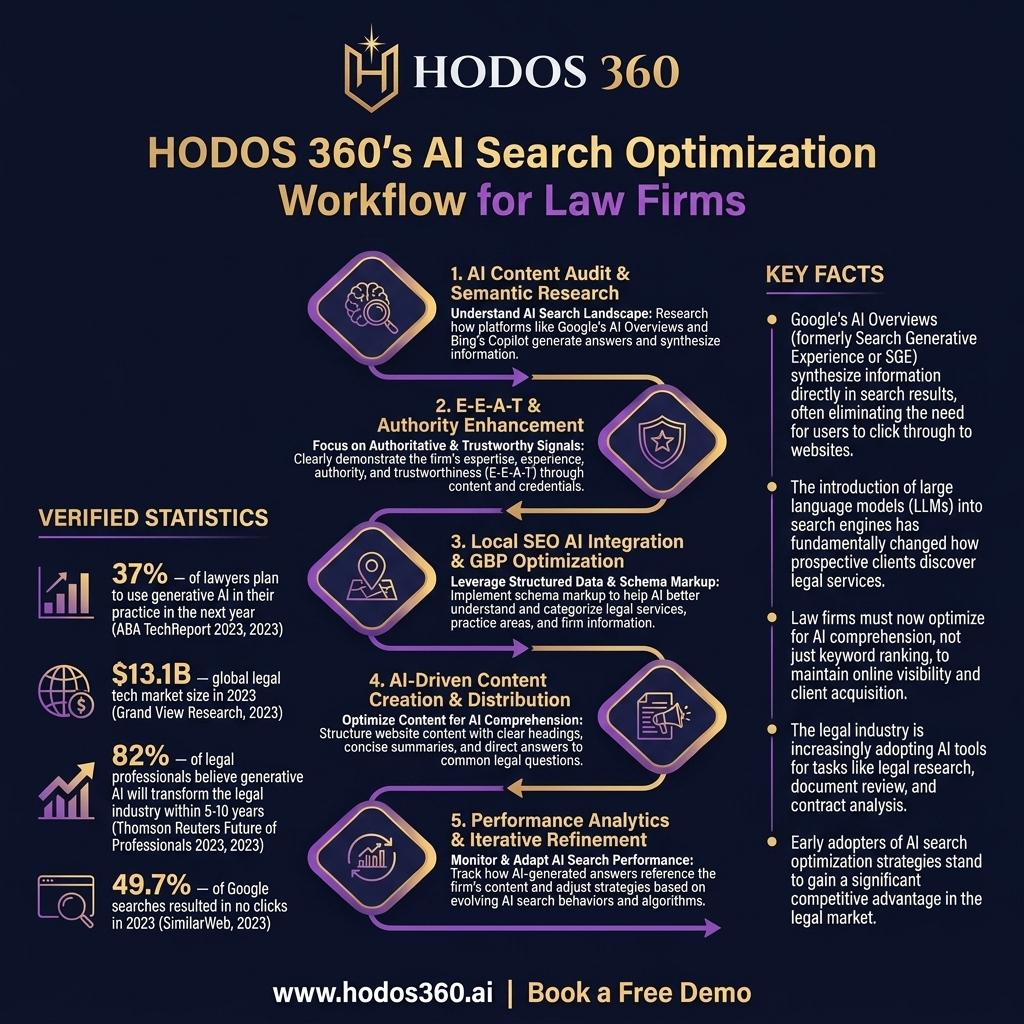
Structuring content for AI crawlers is paramount. This involves using clear headings (H1, H2, H3), bullet points, numbered lists, and well-defined Q&A sections that directly answer common legal questions. The goal is to make it easy for AI to extract definitive answers and present them in a concise format.
Legal content, by its nature, is often complex and nuanced. However, for AI search, it must also be digestible and unambiguous. Firms should consider adopting a 'pyramid' structure, starting with the most critical information and then elaborating with details and supporting arguments. This approach not only aids AI comprehension but also improves readability for human clients seeking quick answers to pressing legal concerns, such as 'what is the statute of limitations for personal injury in California?'
The importance of Expertise, Authoritativeness, and Trustworthiness (E-E-A-T) has never been more critical. Learn more about Essential AI for Client Relationships: Future-Proofing Law Firms. Google has consistently emphasized E-E-A-T in its Quality Rater Guidelines, and AI systems are designed to prioritize content from credible sources.
For law firms, this means actively showcasing the credentials, experience, and accolades of their attorneys. Publishing articles in reputable legal journals, securing quotes in industry news, and maintaining active, professional profiles on platforms like LinkedIn and the ABA Lawyer Directory all contribute to a firm's E-E-A-T score.
As AI synthesizes information, it will naturally gravitate towards sources that demonstrate clear expertise and are widely recognized as authoritative within the legal field. Ignoring E-E-A-T in this environment is akin to practicing law without a license – it undermines credibility and visibility.
Moreover, the role of LLMs in understanding complex legal queries is transformative.
These models can parse the subtleties of legal jargon, differentiate between similar legal concepts, and even infer the emotional context behind a client's search. This allows for more precise targeting and content creation. Firms can leverage this by creating content that addresses specific legal scenarios, potential client anxieties, and frequently asked questions with detailed, yet accessible, answers.
For example, a firm specializing in intellectual property law could create content that not only defines 'patent infringement' but also outlines common defenses, potential damages, and the process for filing a lawsuit, all structured to be easily digestible by both human and AI audiences. This deep, nuanced content strategy is key to optimizing for current and future AI search engines.
Optimizing for AI Overviews and Featured Snippets
The emergence of AI Overviews and traditional Featured Snippets means that a significant portion of search traffic can be captured without a user ever visiting your website. To capitalize on this, law firms must strategically format their content to be directly answerable. This involves creating dedicated Q&A sections, using clear definitions, and summarizing complex legal topics into digestible bullet points or numbered lists.
For instance, an article on 'Understanding Contract Law' might include a section titled 'Key Elements of a Valid Contract' presented as a bulleted list, making it an ideal candidate for an AI Overview. The goal is to provide the most direct, authoritative answer possible within your content, anticipating the exact phrasing of common legal questions.
Learn more about AI-Native Law Firms: The Ultimate Guide to Thriving in a New Era. This proactive approach ensures your firm's expertise is the voice behind the AI's answer, even if the user doesn't click through immediately.
The "zero-click" search phenomenon, where users find their answers directly on the SERP, can be mitigated by ensuring your AI-optimized content still encourages engagement.
While the AI provides a summary, your website should offer the deeper dive, the specific case studies, and the unique insights that differentiate your firm. A powerful call to action (CTA) within your content, even if it's part of an AI Overview, can prompt further engagement.
For example, after an AI provides a summary of 'What to Do After a Car Accident,' your firm's content could then offer a CTA like 'For personalized advice on your car accident claim, contact our experienced attorneys today.' This bridges the gap between the AI's synthesized answer and a potential client's need for direct legal counsel, converting passive information consumption into active lead generation.
Local SEO in the Age of AI: Hyper-Targeting Legal Clients
Local SEO has always been critical for law firms, given the inherently geographical nature of legal practice. In the age of AI, its importance has only intensified, with generative AI enhancing the precision and relevance of local search results. When a prospective client searches for 'personal injury lawyer near me' or 'estate planning attorney [city name],' AI-powered algorithms leverage not only traditional SEO signals but also a deeper understanding of user intent, geographical context, and real-time data to present the most relevant local options.
A recent study by the ABA Journal highlighted that 78% of legal clients seek local firms, making hyper-targeted local AI search optimization an undeniable imperative. Firms that fail to optimize their local presence risk being completely overlooked by AI-driven local search, even if their overall domain authority is strong.
The cornerstone of effective local AI search optimization remains a meticulously optimized Google Business Profile (GBP). This involves ensuring all information is accurate and up-to-date, including hours of operation, address, phone number, and service areas. Beyond the basics, firms must actively manage and solicit client reviews, as AI places significant weight on social proof and reputation.
Positive reviews, especially those that include relevant keywords about services and locations, feed directly into AI's understanding of a firm's local authority and quality. Furthermore, local citations across directories like Yelp, Avvo, and Justia, alongside consistent Name, Address, Phone (NAP) information, reinforce a firm's local presence for AI crawlers.
Learn more about AI Voice Assistants: The Ultimate Guide for Law Firms. Firms like 'Justice & Associates' in downtown Chicago, for example, saw a 40% increase in local inquiries after overhauling their GBP with AI-driven keyword analysis and proactive review management.
AI's ability to understand local intent and context goes beyond simple geofencing.
It can infer nuances from conversational queries, such as 'I need a lawyer who handles real estate disputes near the courthouse.' This requires law firms to create content that speaks to specific local landmarks, community issues, and regional legal particularities. For instance, a firm in Florida might publish articles addressing 'Florida hurricane insurance claims' or 'property disputes in Miami-Dade County.'
This level of granular, locally-focused content signals to AI that the firm possesses specific expertise relevant to that geographic area and its unique legal challenges. It is about demonstrating not just legal prowess, but local legal relevance, making your firm the authoritative local answer for specific legal needs.
Ready to elevate your firm's local reach? Explore how HODOS 360 can amplify your local AI search optimization efforts.
Moreover, the integration of local data with broader legal trends allows AI to make more sophisticated recommendations. For example, if there's a local increase in certain types of litigation, AI might prioritize firms specializing in those areas within local search results.
Law firms should monitor local news, economic shifts, and community legal needs to proactively create content that aligns with these emerging trends. This foresight, combined with robust local SEO practices, positions a firm as a highly relevant and responsive legal resource within its community, a critical factor for AI-driven local search engines.
Voice Search and Conversational AI for Legal Services
The proliferation of smart speakers and mobile voice assistants has ushered in a new dimension of local search: voice search. People are increasingly using natural, conversational language to ask devices like Amazon Alexa, Google Assistant, and Apple Siri for local services, including legal counsel. Queries like 'Hey Google, find a personal injury attorney open now' or 'Siri, recommend a divorce lawyer near me' are becoming commonplace.
Optimizing for voice search requires a shift from short, transactional keywords to long-tail, conversational phrases that mimic how people naturally speak. This means creating content that directly answers spoken questions, often in a Q&A format, and ensuring your GBP is meticulously updated, as voice assistants frequently pull information directly from these profiles to provide quick answers.
Conversational AI extends beyond voice search to chatbots and virtual assistants on websites, which are increasingly powered by LLMs. Learn more about Marketing AI: Essential Tools to 10x Law Firm Growth. These tools can qualify leads, answer preliminary questions, and even book appointments, significantly improving the client intake process.
For law firms, integrating such AI voice assistants can provide 24/7 support, capture leads outside of business hours, and offer multilingual support, addressing a broader client base. The key is to train these AI assistants with comprehensive, accurate legal information about your firm's services, ensuring they provide consistent and helpful responses.
This not only enhances client experience but also frees up valuable human resources for more complex legal work, demonstrating a modern, client-centric approach to legal service delivery.
Leveraging AI Marketing Platforms for Legal Visibility
In this rapidly evolving digital landscape, law firms need more than just a website; they need an integrated AI marketing strategy. Platforms like HODOS 360's AI Marketing Platform are specifically designed to empower law firms to navigate the complexities of AI search optimization and broader digital visibility.
This comprehensive suite offers tools that directly address the challenges posed by generative AI in search. For instance, its AI video creation capabilities allow firms to produce engaging, short-form content that can be leveraged across social media and even serve as source material for AI-generated video summaries in search results.
The platform's social media automation ensures consistent brand messaging and engagement, crucial for building E-E-A-T signals that AI algorithms value.
Content generation, a core component of HODOS 360's platform, is particularly vital for AI search optimization. It assists firms in producing high-quality, semantically rich articles, blog posts, and Q&A content tailored for AI comprehension.
This goes beyond simple article spinning; it focuses on creating authoritative, entity-rich content that satisfies both human search intent and AI's need for structured data. The platform can help identify gaps in content coverage, suggest topics that align with emerging AI search trends, and even optimize existing content for better AI readability.
Learn more about Essential AI Voice Assistant Strategies for Modern Law Firms. This level of AI-assisted content strategy ensures that a firm's digital footprint is not just large, but intelligently optimized for the new search paradigm.
Furthermore, the platform's analytics and ROI tracking capabilities are indispensable for measuring the effectiveness of AI search optimization efforts.
As Google and other search engines continue to refine their AI models, law firms need real-time data to understand what's working and what's not. HODOS 360 provides granular insights into traffic sources, AI Overview appearances, client conversion rates, and the overall return on investment for marketing spend.
This data-driven approach allows firms to iteratively refine their strategies, ensuring resources are allocated effectively and that their AI search optimization efforts are yielding tangible results in terms of lead generation and client acquisition. This is crucial as the legal tech market continues to consolidate, with companies like Clio making strategic acquisitions to enhance their integrated platforms, underscoring the value of comprehensive solutions.
The strategic adoption of an AI Marketing Platform allows law firms to not only keep pace with digital transformation but to lead it. By automating routine marketing tasks and providing AI-driven insights, attorneys and marketing teams can focus on high-value activities, secure in the knowledge that their online visibility is being actively managed and optimized for the future of search.
This proactive investment in AI-powered tools is no longer a luxury but a necessity for any firm aiming to thrive in the competitive legal market, ensuring their expertise is visible and accessible to the next generation of legal clients searching through AI-powered interfaces.
The Data-Driven Advantage: Analytics and ROI Tracking
In the complex world of AI search, guesswork is a luxury law firms cannot afford. Robust analytics and ROI tracking are the compass guiding effective AI search optimization strategies. Firms must move beyond vanity metrics like simple website traffic and delve into deeper insights: which AI Overviews are displaying their content, what types of queries are generating leads through AI answers, and what is the conversion rate from AI-driven visibility?
Tools that provide granular data on these new metrics are invaluable. For example, tracking which specific questions answered by AI Overviews lead to phone calls or form submissions can inform future content creation, allowing firms to double down on topics that demonstrably convert.
Measuring the true return on investment (ROI) for AI search optimization requires a comprehensive view.
This includes not only the direct costs of marketing efforts but also the value of leads generated and clients acquired through AI-driven channels. Platforms that integrate marketing data with client intake and case management systems provide the clearest picture of ROI. This allows firms to see the full client journey, from an initial AI-powered search interaction to successful case resolution, demonstrating the tangible impact of their AI marketing investments.
As stated by the ABA Model Rules of Professional Conduct, Rule 7.1, all communications concerning a lawyer's services must not be false or misleading, making accurate ROI tracking essential for ethical and effective marketing.

Key Takeaways and Next Steps
The shift to AI-driven search is not a fleeting trend but a fundamental redefinition of online visibility. Law firms must recognize that the battle for client attention is now fought on two fronts: human readability and AI comprehensibility. The strategies for AI search optimization demand a proactive, adaptive approach, focusing on semantic content, robust E-E-A-T signals, and hyper-local relevance.
Firms that embrace these changes will not only maintain their current market position but significantly expand their reach, attracting a new generation of clients who rely on AI for their initial legal inquiries. The competitive tension, as seen with agencies like Koading expanding their AI services, underscores the immediacy of this transformation.
Ignoring this evolution is no longer an option; it's a strategic misstep that could prove costly in the long run.
For law firms looking to thrive in this new era, the next steps are clear: conduct a comprehensive audit of your existing content for AI readability, invest in tools that facilitate AI-driven content creation and optimization, and rigorously track your performance with advanced analytics.
Prioritize local SEO with an AI-first mindset, ensuring your firm is the definitive answer for 'lawyer near me' queries. By integrating an AI Marketing Platform, firms can streamline these complex processes, freeing up valuable time and resources while ensuring their digital presence is future-proofed. The future of legal marketing is intelligent, data-driven, and AI-powered.
Embrace it, and secure your firm's enduring success.
Frequently Asked Questions
What is AI search optimization for law firms?+
AI search optimization for law firms involves tailoring digital content and strategies to be effectively understood and presented by artificial intelligence-powered search engines, such as Google's AI Overviews. This goes beyond traditional SEO by focusing on semantic understanding, E-E-A-T (Expertise, Authoritativeness, Trustworthiness), and structured data that AI models can easily process to provide direct answers to legal queries, ensuring the firm's visibility in AI-generated search results and attracting qualified leads.
How does generative AI impact traditional legal SEO?+
Generative AI significantly impacts traditional legal SEO by introducing AI Overviews and synthesized answers directly into search results. This reduces the need for users to click through to websites, creating a 'zero-click' phenomenon. While traditional SEO factors like keywords and backlinks remain relevant, firms must now also optimize for AI comprehension, ensuring their content directly answers questions and demonstrates strong E-E-A-T to be chosen as the source for AI-generated summaries, shifting the focus from clicks to direct answers.
Why is local SEO more critical for law firms with AI search?+
Local SEO is more critical for law firms with AI search because AI algorithms are highly adept at understanding geographical intent and providing hyper-relevant local results. When clients search for 'lawyer near me,' AI leverages advanced context to surface the most authoritative and relevant local firms. Optimizing Google Business Profile, managing reviews, and creating location-specific content are crucial for AI to identify a firm as the definitive local answer, ensuring visibility in an increasingly location-aware AI search landscape.
What role do E-E-A-T signals play in AI search optimization?+
E-E-A-T (Expertise, Authoritativeness, Trustworthiness) signals play a paramount role in AI search optimization. AI models are trained to prioritize high-quality, credible sources. For law firms, this means actively showcasing attorney credentials, publications, industry recognition, and positive client testimonials. Content that clearly demonstrates deep legal expertise and is backed by a strong reputation is more likely to be selected by AI as the source for its generated answers, directly influencing a firm's online visibility and perceived authority in the legal field.
How can an AI Marketing Platform help my law firm with AI search?+
An AI Marketing Platform, like HODOS 360, can significantly help law firms with AI search by providing integrated tools for content generation, social media automation, and advanced analytics. It assists in creating semantically rich, AI-readable content, optimizing for AI Overviews, and enhancing local SEO. The platform's ROI tracking capabilities allow firms to measure the effectiveness of their AI search strategies, ensuring resources are efficiently allocated and that their online presence is continuously optimized for the evolving AI-driven search landscape, ultimately driving client acquisition.