
AI Search Visibility: The Ultimate Guide for Law Firms
Just last month, Sarah Chen, managing partner at Chen & Associates in San Francisco, found herself in a familiar predicament. Her firm, a respected boutique specializing in intellectual property, saw a steady decline in new client inquiries despite maintaining top Google rankings for traditional keywords.
Meanwhile, a newer competitor, “Innovate Legal,” seemed to be consistently capturing the attention of tech startups, often appearing in AI-generated search summaries and personalized recommendations. This wasn't a failure of traditional SEO; it was a fundamental shift in how potential clients were discovering legal services, driven by the rise of AI search visibility.
The recent launch of EthosM2’s FOCAS AMS platform for SMB AI Search Visibility & Marketing, as highlighted by markets.businessinsider.com, underscores a critical evolution in the digital landscape. This platform is designed to help small and medium-sized businesses maintain a strong online presence as consumers increasingly rely on AI-powered search tools.
For law firms, this isn't merely a technological curiosity; it's a direct challenge to outdated marketing paradigms. The legal sector, often cautious in adopting new technologies, must now confront the reality that clients are no longer just typing keywords into a search bar; they are asking complex questions to AI assistants, expecting synthesized answers, and trusting algorithmically curated recommendations.
According to a 2024 report by McKinsey & Company, nearly 45% of consumers now utilize AI tools for local business discovery, a figure projected to rise dramatically over the next two years.
This trend creates a significant competitive gap. Law firms that proactively embrace AI search visibility strategies will not only retain their existing client base but also unlock new avenues for growth and client acquisition.
Those that cling to legacy approaches risk becoming digital relics, overlooked by the intelligent agents guiding today’s consumers. Understanding and mastering AI search visibility is no longer optional; it's an essential component of modern legal marketing. The firms that recognize this early, such as Innovate Legal, are already seeing the benefits, capturing market share from those slower to adapt.
It's a race for relevance, and the finish line is defined by how well your firm can communicate its value to an AI-driven world.
Ready to transform your law firm's digital presence and attract more clients? Discover how cutting-edge AI marketing strategies can redefine your client acquisition efforts.
The Paradigm Shift: From Traditional SEO to Agentic AI Search
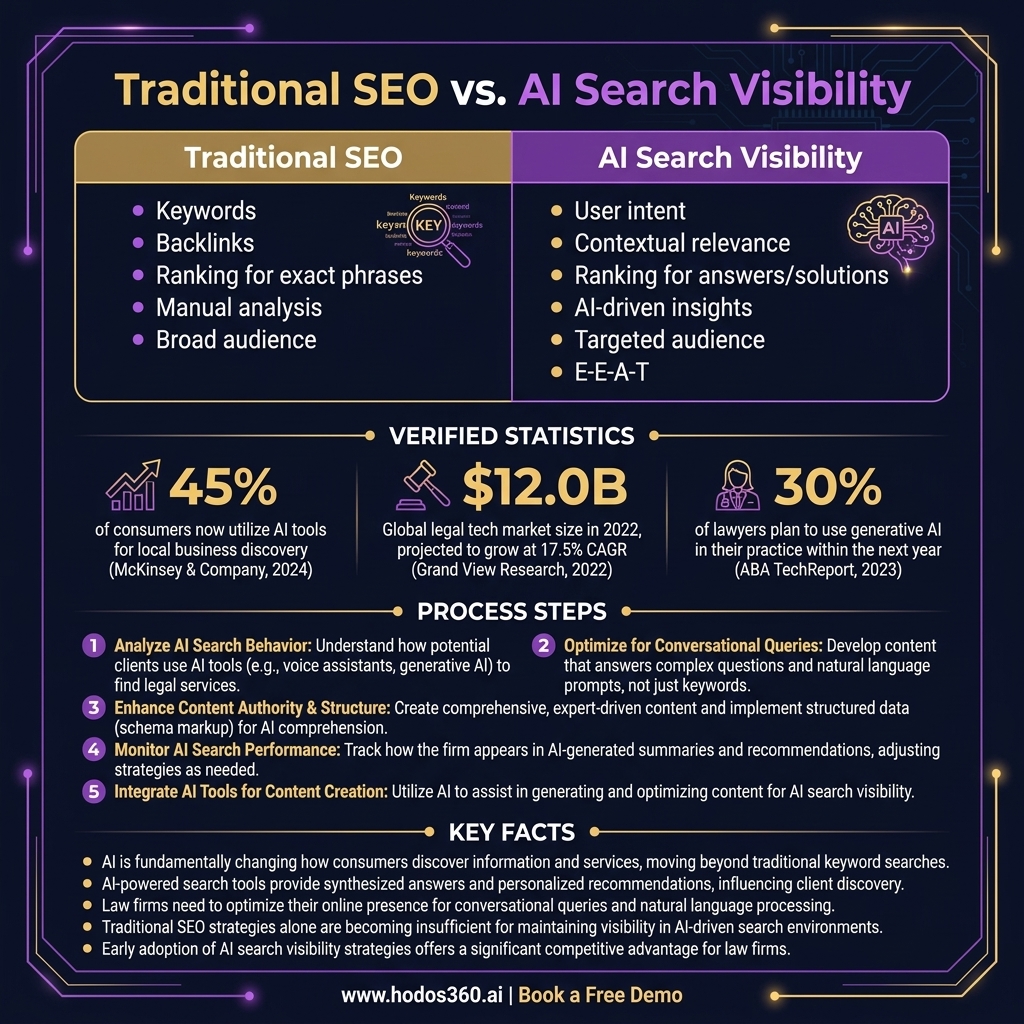
The internet's evolution has always been about information retrieval, but the latest chapter, spearheaded by generative AI, has fundamentally changed the game. Traditional Search Engine Optimization (SEO) focused on matching keywords and building backlinks to rank pages. Today, AI-powered search, epitomized by Google's Search Generative Experience (SGE) and similar innovations from players like Microsoft's Copilot, moves beyond simple keyword matching.
It understands user intent, synthesizes information from multiple sources, and provides direct, conversational answers. This shift is often described as 'agentic search,' where AI acts as an intelligent agent, interpreting complex queries, performing multi-step reasoning, and even anticipating follow-up questions to deliver comprehensive solutions. Companies like Coveo are at the forefront of this, developing 'AI Relevance™ Platforms' that leverage machine learning to personalize search experiences for enterprises, a technology that is rapidly trickling down to consumer-facing search engines.
This means that a law firm's online presence must now be optimized not just for algorithms, but for the sophisticated comprehension capabilities of AI models.
The implications for legal marketing are profound. Learn more about Legora's Strategic Leap: Essential AI Law Firm Management. Instead of merely ensuring your 'personal injury lawyer' page ranks high, firms must now ensure their content provides authoritative, contextually rich answers to queries like 'What are my rights after a car accident in Texas?'
or 'How do I protect my intellectual property as a startup founder?' This requires a departure from thin, keyword-stuffed content towards deep, expert-driven narratives. As Jensen Huang, CEO of NVIDIA, frequently emphasizes, the future of computing is about 'accelerated computing' and 'AI factories' that process vast amounts of data to generate insights.
For law firms, this translates into an urgent need to become a recognized authority in their niche, producing content that AI systems can reliably use to answer complex legal questions. The competition for AI search visibility is intensifying, with startups like Emberos AI and platforms like EthosM2's FOCAS AMS emerging to help SMBs navigate this new frontier.
Firms that fail to adapt their content strategies risk being overlooked by these intelligent agents, effectively becoming invisible in the modern digital ecosystem.
Decoding AI-Powered Search Engines and Legal Information
AI-powered search engines employ advanced Natural Language Processing (NLP) and Large Language Models (LLMs) to understand the nuances of legal queries. They don't just look for keywords; they analyze the semantic meaning, context, and implied intent behind a user's question. This allows them to identify and prioritize highly authoritative sources that offer comprehensive and accurate information.
For instance, if a user asks about 'data privacy regulations for healthcare providers,' an AI system will scour legal databases, government websites, and reputable legal publications to synthesize an answer, often citing specific statutes or case law. Learn more about Law Firm Return on Investment: Maximize AI in 2026.
This capability demands that law firms not only publish content but ensure it meets stringent standards of accuracy, verifiability, and legal authority. The ethical implications are also critical; the ABA Model Rules of Professional Conduct, particularly Rule 7.1 (Communications Concerning a Lawyer's Services), mandate that legal marketing communications be truthful and not misleading.
Law firms must ensure that any content designed for AI consumption adheres to these ethical guidelines, maintaining professional integrity even as technology evolves.
Crafting Content for AI Search: Beyond Keywords and Volume
In the era of AI search, the mantra shifts from 'quantity over quality' to 'authority and comprehensiveness above all.' AI models are trained on vast datasets and are adept at discerning genuine expertise from superficial content. For law firms, this means creating substantive, detailed legal guides, expert analyses, and thought leadership pieces that genuinely educate and inform.
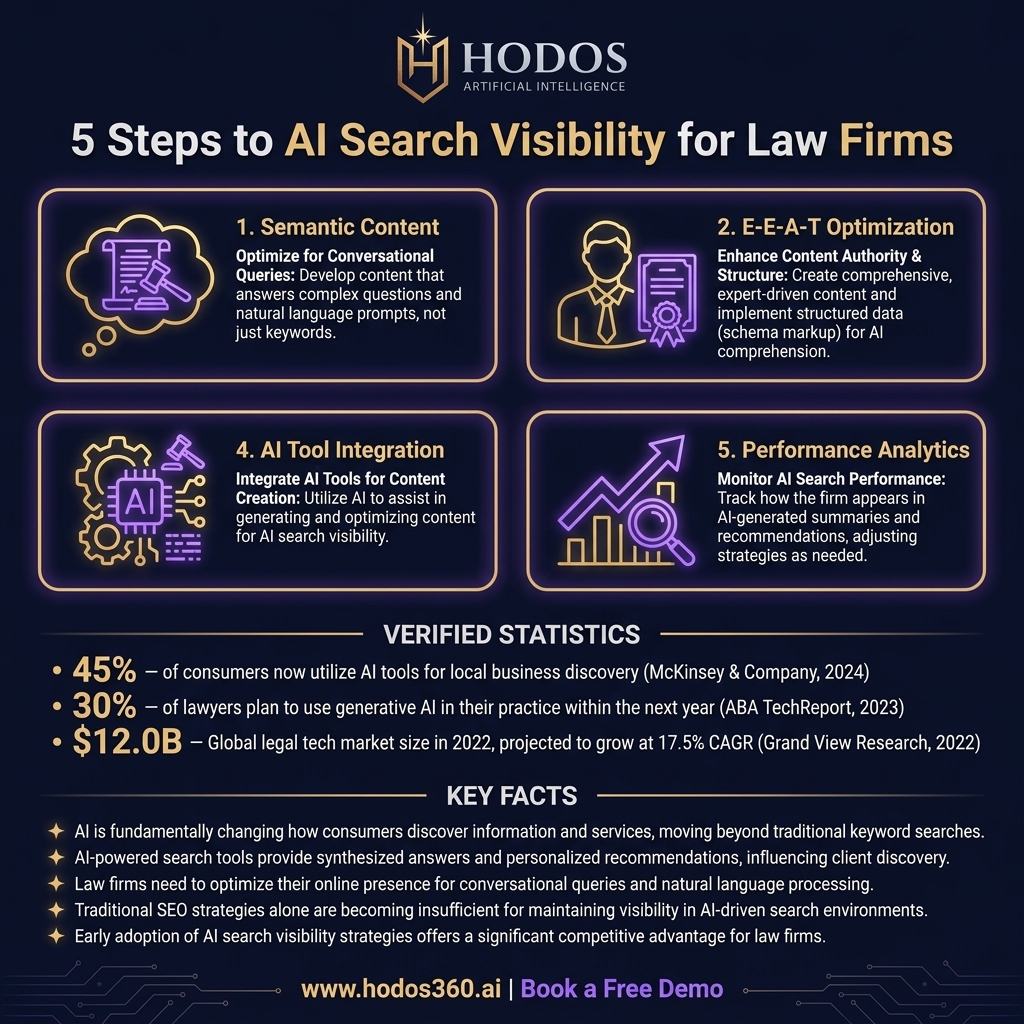
Think of content that answers the 'why' and 'how,' not just the 'what.' This approach aligns perfectly with Google's E-E-A-T (Experience, Expertise, Authoritativeness, Trustworthiness) guidelines, which have become even more critical in the age of AI. A firm's content must demonstrate a deep understanding of legal principles, practical experience in specific areas, and be published on a reputable domain.
For example, instead of a short blog post on 'divorce law,' a firm should consider a comprehensive guide covering 'Understanding Equitable Distribution in High-Net-Worth Divorces in New York State,' replete with references to relevant state statutes and judicial precedents.
Furthermore, optimizing for AI search involves embracing structured data and semantic SEO.
This means using schema markup to explicitly tell search engines what your content is about—identifying legal services, practice areas, lawyers' credentials, and client testimonials in a machine-readable format. Learn more about AI Document Management: Essential for Modern Law Firms. This helps AI systems understand the context and relevance of your information, making it more likely to be featured in AI-generated summaries or direct answers.
For instance, a law firm could use schema markup to highlight its specific expertise in 'corporate mergers and acquisitions' or 'environmental litigation,' providing AI with clear signals about its specialization. The goal is not to trick the algorithm, but to provide the clearest possible signals of expertise and relevance.
This sophisticated approach to content generation ensures that when an AI agent is tasked with finding a reputable lawyer for a complex legal matter, your firm's well-structured, authoritative content stands out as a reliable source, enhancing your overall AI search visibility and positioning your brand as a leader in the legal tech adoption curve.
The Imperative of Local AI Search Visibility for Law Firms
While national and global reach are important for some practice areas, the vast majority of law firms rely heavily on local clients. AI search engines are particularly adept at understanding and prioritizing local intent. When a user asks an AI assistant, 'Find a probate lawyer near me,' the AI leverages geographic data, user location, and local business profiles to deliver highly relevant recommendations.
This makes optimizing for local AI search visibility an absolute imperative. A robust Google Business Profile (GBP) is no longer just a nice-to-have; it's a foundational element. Ensuring your GBP is fully optimized with accurate contact information, up-to-date service descriptions, high-quality images, and a consistent flow of positive client reviews is critical.
According to a 2023 report by BrightLocal, over 87% of consumers use online reviews to evaluate local businesses, a factor that AI heavily weighs when recommending services. Firms must also actively seek and manage client testimonials, as AI algorithms analyze sentiment and keywords within reviews to gauge a firm's reputation and service quality.
The competition for local clients is fierce, especially for small and medium-sized businesses (SMBs) in the legal sector. Learn more about Essential AI Legal Adoption: Akin's Firmwide Success Blueprint. Platforms like EthosM2’s FOCAS AMS specifically target this challenge, providing tools for SMBs to enhance their local search visibility through AI-powered content amplification and CRM functionality.
For law firms, this means going beyond simply listing your address. It involves actively engaging with local communities online, creating location-specific content (e.g., 'Understanding Zoning Laws in Austin, Texas'), and fostering a strong local reputation that AI can detect and endorse. Firms that invest in these strategies will find themselves recommended by AI assistants, directing high-intent local leads directly to their virtual doorstep.
Failing to prioritize local AI search optimization is akin to having a beautiful office in a bustling city but no street-level signage—clients will simply walk past without ever knowing you're there. The stakes are high, and the firms that master local AI search will secure a decisive competitive edge in their respective markets, turning the tide in the ongoing struggle for client acquisition.
Leveraging Client Testimonials and Case Studies
Client testimonials and detailed case studies are invaluable assets in the AI search era. AI algorithms are sophisticated enough to analyze not just the star rating, but the content and sentiment of reviews. Authentic, detailed testimonials that highlight specific positive outcomes, professionalism, and client satisfaction provide powerful signals of trust and expertise.
Similarly, well-documented case studies, while adhering to client confidentiality (see ABA Model Rule 1.6 (Confidentiality of Information)), can showcase a firm's ability to handle complex legal challenges and achieve favorable results. Learn more about AI Search Era Web Design: An Essential Guide for Law Firms.
These narratives serve as compelling social proof, which AI systems interpret as indicators of a firm's real-world impact and reliability. Law firms should actively encourage satisfied clients to leave detailed reviews on platforms like Google Business Profile, Avvo, and LinkedIn, and strategically integrate anonymized or permission-granted case studies into their website content.
This not only builds human trust but also provides the rich, verifiable data points that AI craves when assessing a firm's authority and effectiveness.
Integrating AI Tools for Enhanced Legal Marketing & Client Engagement
The transition to AI-first marketing doesn't mean abandoning human expertise; it means augmenting it with powerful tools. Law firms have access to a growing suite of AI-powered solutions designed to streamline marketing efforts, enhance client acquisition, and improve overall efficiency. These tools can automate repetitive tasks, generate content ideas, analyze market trends, and even create engaging multimedia.
For instance, AI-powered platforms can analyze vast amounts of legal news and court filings to identify emerging practice areas or shifts in judicial sentiment, allowing firms to proactively create relevant content. They can also optimize social media posting schedules for maximum engagement, generate compelling ad copy, and even produce short, informative AI videos explaining complex legal concepts, a rapidly growing trend in digital marketing.
This is where an integrated solution like HODOS 360's AI Marketing Platform becomes a game-changer for law firms. Learn more about AI Marketing Agents: Essential for Law Firm Growth. Our platform offers a comprehensive suite of services, including AI video creation, social media automation, advanced content generation, and robust analytics with ROI tracking.
Imagine an AI assistant drafting a blog post on a new regulatory change, then automatically scheduling social media updates across all channels, and finally providing real-time data on lead generation and conversion rates. This level of integration ensures that a firm's marketing efforts are not only visible to AI search engines but also highly efficient and effective in converting prospects into clients.
Furthermore, the synergy with HODOS 360's AI Voice Assistants, offering 24/7 phone answering, lead qualification, and appointment booking, creates a seamless client intake funnel that maximizes the value of enhanced AI search visibility.
The Role of AI Voice Assistants in Lead Qualification
As AI search evolves, voice search and AI assistants are playing an increasingly prominent role in client discovery. When a potential client asks their smart speaker or phone for legal advice, they expect an immediate, helpful response. HODOS 360's AI Voice Assistants are designed to capitalize on this trend.
These assistants can provide 24/7 phone answering, ensuring no lead is missed outside of business hours. More critically, they can perform initial lead qualification, gathering essential information, answering common questions, and even booking appointments directly into your firm's calendar. With multilingual support and intelligent call routing, these AI assistants ensure that every inbound inquiry, whether from an AI-generated search result or a direct call, is handled professionally and efficiently.
This not only enhances client experience but also frees up valuable human resources, allowing attorneys and paralegals to focus on high-value legal work rather than administrative tasks. The integration of AI voice assistants closes the loop between a client's initial AI-powered search and their seamless entry into your firm's client intake process.

Key Takeaways for Law Firms to Win in the AI Search Era
The shift towards AI-powered search is not a fleeting trend but a fundamental re-architecture of how information is discovered and consumed. For law firms, achieving superior AI search visibility is now paramount for sustainable growth and competitive advantage. The firms that will thrive are those that embrace semantic SEO, prioritize the creation of deep, authoritative content that satisfies E-E-A-T principles, and meticulously optimize their local online presence.
As Sam Altman, CEO of OpenAI, frequently reminds us, AI is a powerful tool that amplifies human capability, not replaces it. This means leveraging AI to empower your marketing, not just for the sake of technology, but to better serve and connect with your future clients.
Adopting an integrated approach, utilizing AI tools for content generation, social media management, and client engagement, will be crucial. Platforms like HODOS 360's AI Marketing Platform offer the comprehensive suite of services necessary to navigate this complex landscape, from AI video creation to ROI tracking.
The legal industry is at an inflection point, and the firms that proactively adapt their marketing strategies to the demands of AI search will not only remain relevant but will also redefine what it means to be a leading legal practice in the 21st century.
The future of client acquisition is here, and it's powered by AI. Don't be left behind; embrace the change and position your firm for unprecedented success.
Frequently Asked Questions
What is AI search visibility and how does it differ from traditional SEO?+
AI search visibility refers to a law firm's ability to appear prominently in AI-powered search results and recommendations. Unlike traditional SEO, which focuses on keyword matching, AI search prioritizes understanding user intent, context, and semantic meaning. It requires content that is authoritative, comprehensive, and demonstrates genuine expertise (E-E-A-T), as AI agents synthesize information to provide direct answers and personalized recommendations, rather than just listing links.
What specific content strategies work best for AI search for law firms?+
For AI search, law firms should prioritize creating deep, authoritative, and contextually rich content. This includes comprehensive legal guides, detailed case studies (with client permission), expert analyses, and thought leadership pieces that address complex legal questions. Utilizing schema markup to structure data and clearly signal your firm's expertise to AI models is also crucial. Focus on answering the 'why' and 'how,' not just the 'what,' to demonstrate true understanding.
How can AI tools help small and medium-sized law firms compete?+
AI tools level the playing field for SMB law firms by automating marketing tasks, generating content ideas, and providing advanced analytics without the need for large marketing teams. Platforms like EthosM2's FOCAS AMS or HODOS 360's AI Marketing Platform offer features like AI video creation, social media automation, and ROI tracking, enabling smaller firms to achieve significant AI search visibility and compete effectively with larger counterparts for client acquisition.
What is 'agentic search' and why is it important for legal marketing?+
'Agentic search' describes AI systems that act as intelligent agents, understanding complex user queries, performing multi-step reasoning, and synthesizing information from various sources to provide direct, comprehensive answers. For legal marketing, this means content must be designed to be consumed and understood by AI agents, not just human readers. Your firm's digital presence needs to reliably answer nuanced legal questions to be featured in these AI-generated responses, enhancing your AI search visibility.
How do I measure the ROI of my AI marketing efforts for AI search visibility?+
Measuring ROI for AI marketing involves tracking key performance indicators (KPIs) such as website traffic from AI-generated search, lead generation through AI-powered client intake (e.g., AI voice assistants), conversion rates from AI-driven campaigns, and client acquisition costs. Integrated AI marketing platforms, like HODOS 360's, provide robust analytics dashboards that offer real-time insights into these metrics, allowing firms to optimize their strategies and demonstrate tangible returns on their AI investments.