
Essential AI Voice Agent Transfer: Mastering Warm Handoffs
In the high-stakes world of legal practice, client experience isn't just a buzzword; it's the bedrock of reputation and retention. Imagine a prospective client, facing a complex legal challenge, calling your firm. They speak with an AI voice agent, clearly explaining their situation, only to be transferred to a human attorney who asks them to repeat everything from scratch.
This 'cold handoff' is a jarring experience, eroding trust and signaling inefficiency. Such scenarios, unfortunately, are not uncommon in an era where AI adoption often outpaces thoughtful integration. The challenge lies not in deploying AI, but in perfecting the transition from artificial intelligence to human expertise, particularly when it comes to AI voice agent transfer.
The industry has seen rapid advancements in conversational AI, championed by figures like Dario Amodei, co-founder of Anthropic, whose work on large language models like Claude has pushed the boundaries of natural language understanding. Yet, the true test of this technology in a professional services context, especially for law firms, is its ability to facilitate a 'warm handoff'—a seamless transfer where all prior context is not just preserved but actively leveraged.
This isn't merely a technical feat; it’s a strategic imperative that directly impacts client satisfaction, operational efficiency, and ultimately, a firm's bottom line. Law firms that master this critical juncture stand to gain a significant competitive edge, turning potential friction points into moments of enhanced client trust and service excellence.
The Imperative of Seamless AI Voice Agent Transfer in Legal Practice
The legal landscape is undergoing a profound transformation, driven by client expectations for instant, intelligent, and empathetic service. A 2024 report by the American Bar Association (ABA) indicated that over 60% of legal consumers now expect 24/7 access to information and support from their law firms, a demand traditional models struggle to meet.
This is where AI voice agents have emerged as a powerful solution, handling initial inquiries, qualifying leads, and scheduling appointments. However, the true value of these agents is unlocked only when they can execute a 'warm handoff'—a process where the AI passes comprehensive client context to a human agent before the actual connection, often including a whisper summary for the human.
Without this, the efficiency gained by the AI is negated by the frustration of repetition, a significant point of contention for clients already under stress.
Consider the operational friction. A 'cold transfer' forces the client to re-explain their legal issue, personal details, and previous interactions to a new human agent.
This not only wastes valuable time for both the client and the attorney but also creates an impression of disorganization and lack of attention to detail—qualities antithetical to professional legal service. Firms like Allen & Overy, known for their early adoption of legal AI, have openly discussed the challenges of integrating disparate AI tools into a cohesive client journey.
Their experience highlights the necessity of an architecture that supports robust data exchange and context preservation during any transfer from an automated system to a human. This intricate dance of data ensures that every client interaction builds upon the last, fostering a sense of continuity and personalized care, which is paramount in legal matters.
Moreover, the ethical dimensions of client communication, as outlined in ABA Model Rule 1.4 (Communication), mandate that lawyers keep clients reasonably informed and explain matters to the extent necessary. Learn more about Essential AI Website Security: Protecting Law Firms from Cyber Threats. A botched AI voice agent transfer that loses context can easily violate the spirit, if not the letter, of this rule, leading to client dissatisfaction and potential ethical dilemmas.
The emphasis shifts from merely automating tasks to intelligently augmenting human capabilities. When a client calls regarding a complex civil litigation matter, and the AI agent has already gathered preliminary details about the opposing party, the court, and the client's desired outcome, the human attorney can dive straight into strategic advice, rather than spending the first ten minutes on data collection.
This efficiency is a game-changer, allowing legal professionals to focus on high-value work and deepening client relationships.
Indeed, the market is rife with solutions promising efficiency, but few deliver on the promise of true seamless handoffs. Companies like Twilio and Genesys have been at the forefront of developing communication APIs that enable sophisticated call routing and data integration.
However, the legal sector's unique demands—data privacy, attorney-client privilege, and the sensitive nature of legal issues—require a specialized approach. The goal is to ensure that the AI voice agent acts as an intelligent pre-qualifier and information gatherer, not a barrier. By leveraging advanced natural language processing and understanding (NLP/NLU) capabilities, such as those refined by Google's DeepMind or OpenAI's GPT models, these agents can parse complex legal narratives, identify key entities, and even infer emotional states, all of which are invaluable context to hand over to a human attorney.
This transition is not just about technology; it's about elevating the entire client service paradigm in law firms.
Beyond Basic Call Routing: The Contextual Handover
The evolution of AI voice agents has moved far beyond simple interactive voice response (IVR) systems. Modern agents, powered by sophisticated machine learning algorithms, are capable of engaging in dynamic conversations, understanding nuances, and even recognizing intent. When a client calls a law firm, these advanced agents don't just ask a series of pre-programmed questions; they actively listen, process information, and build a profile of the caller's needs.
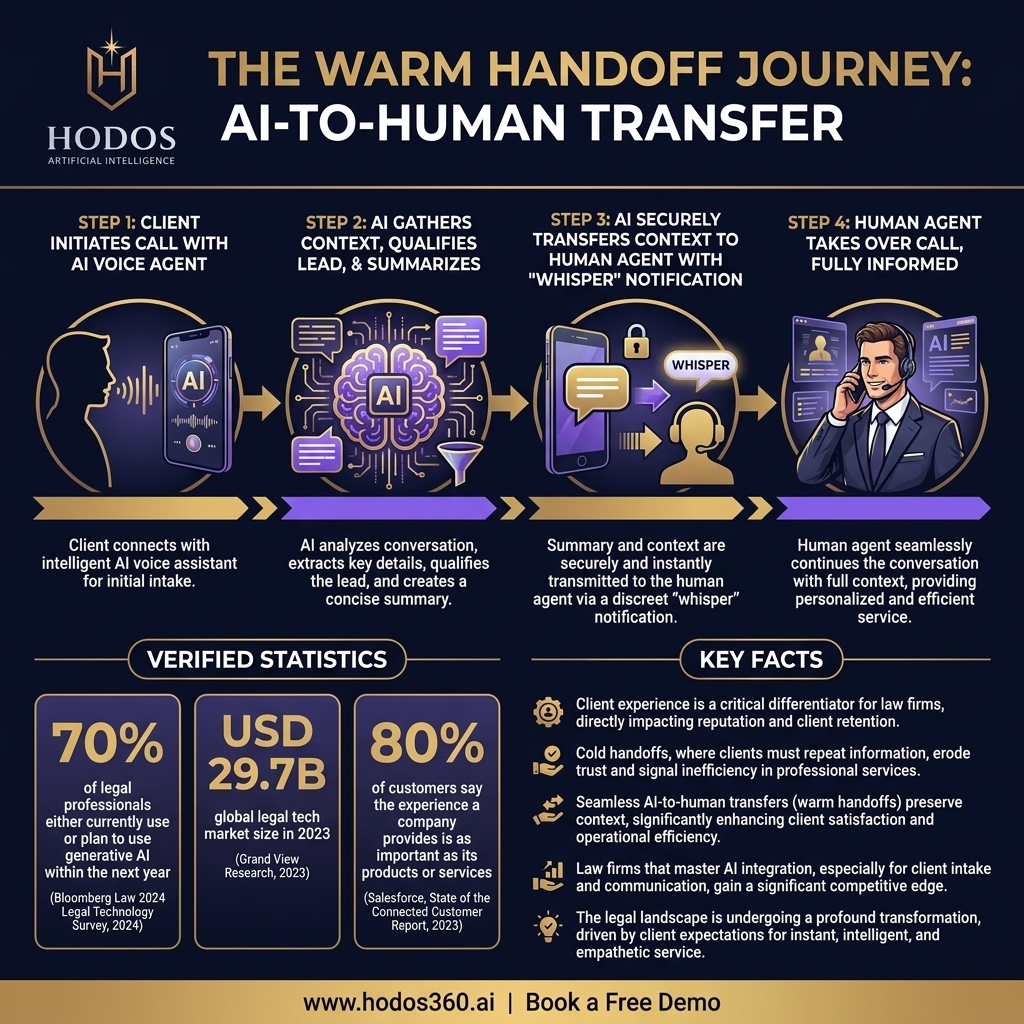
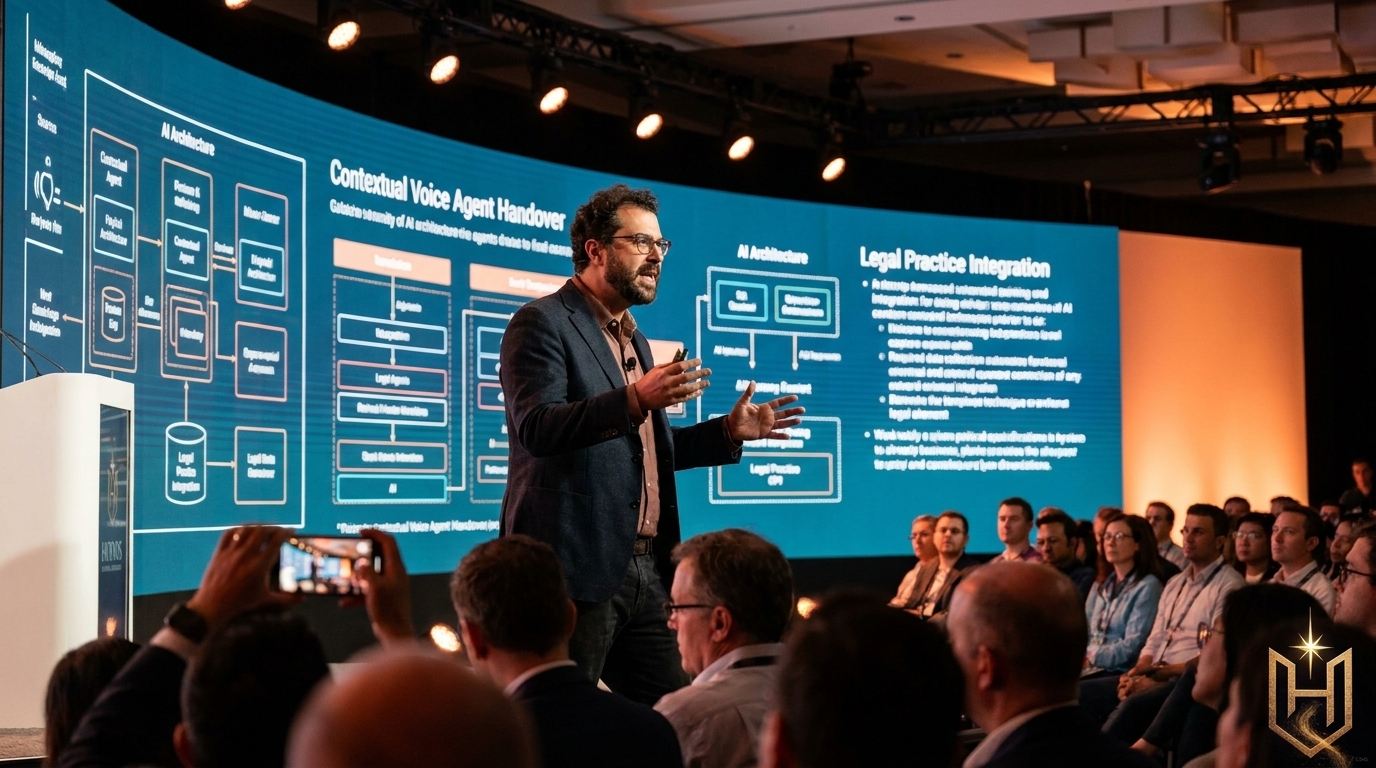
This profile often includes the type of legal issue, urgency, geographical location of the dispute, and any prior interactions the client may have had with the firm. The crucial step is ensuring this rich tapestry of context is transferred intact to the human attorney. This isn't just about passing a transcript; it’s about delivering an intelligent summary, often presented in a digestible format on the attorney's screen even before they pick up the call.
This intelligent handover is what truly defines a 'warm handoff.' It means that by the time the human lawyer is conferenced into the call, they are already equipped with a foundational understanding of the client's situation, allowing them to skip introductory pleasantries and immediately address the core legal problem.
Learn more about AI Marketing: The Essential Legal Firm Growth Blueprint. For example, if a client is calling about a potential personal injury claim, the AI agent might have already identified the date of incident, parties involved, and initial injuries. The attorney can then start the conversation by saying, "I understand you were involved in an accident on May 1st and are seeking advice regarding your injuries.
Let's discuss the next steps." This level of preparation demonstrates professionalism and respect for the client's time, significantly enhancing the initial interaction. It’s a stark contrast to the traditional model where clients often feel like they are starting from scratch with every new point of contact within a firm.
The ability to maintain this continuity of context across different interaction points is a hallmark of truly advanced legal tech solutions.
Engineering the Perfect Warm Handoff: Technical Architectures and Best Practices
Building a truly seamless AI voice agent transfer requires a robust technical architecture that prioritizes data integrity and real-time communication. At its core, this involves integrating the AI conversational platform with the firm's existing Client Relationship Management (CRM) system, practice management software, and communication infrastructure.
For instance, a firm might utilize an AI voice platform that, upon detecting a need for human intervention, triggers an API call to the CRM to log the conversation. Concurrently, it might push a summary of the interaction and relevant client data to a queue managed by the firm's internal communication system, alerting the next available attorney.
This multi-faceted integration ensures that all relevant data points—from initial query to specific client needs—are accessible to the human agent instantly. Companies like Salesforce and Clio, with their extensive API ecosystems, are often central to enabling such sophisticated integrations, allowing legal practices to build custom workflows that support these critical handoffs.
One of the most effective strategies for perfecting the technical aspect of transfers is the implementation of a 'whisper' agent. This technology allows the AI to provide a real-time summary or key points of the conversation to the human agent *before* they are fully conferenced with the client.
Imagine an attorney receiving an audible brief in their ear: "Client John Doe, calling about a breach of contract, has already provided details on the disputed clause and preferred resolution." This immediate context allows the attorney to step into the call fully prepared, eliminating the awkward silence or redundant questioning that often plagues cold handoffs.
This 'whisper' functionality, often powered by advanced text-to-speech and summarization AI, is a game-changer for maintaining a professional and efficient client experience. It’s a testament to how intelligent design can bridge the gap between AI automation and human empathy, ensuring that the client feels heard and valued from the very first interaction.
Beyond the 'whisper,' the technical architecture must also account for the secure and compliant handling of sensitive legal data. Learn more about AI Content Operations: Essential for Law Firm Marketing Success. This means implementing end-to-end encryption for all calls and data transfers, adhering to strict data privacy regulations like GDPR or CCPA, and ensuring that the AI platform itself is built with security by design.
Firms must conduct thorough due diligence on their AI vendors, scrutinizing their data handling policies and security certifications. For example, a legal tech startup, LegalMind AI, recently secured a significant funding round precisely because of its focus on secure, compliant AI solutions for law firms, addressing a critical market need for trust and reliability.
This emphasis on security is not just about avoiding breaches; it’s about upholding attorney-client privilege and maintaining the highest standards of professional conduct, as underscored by ABA Model Rule 1.6 (Confidentiality of Information), which dictates the protection of client information.
Furthermore, the system should allow for seamless logging and auditing of all transfers and interactions.
This ensures accountability and provides valuable data for continuous improvement. By analyzing metrics such as the duration of AI interaction before transfer, client satisfaction post-handoff, and the frequency of human intervention, firms can refine their AI's capabilities and optimize their handoff protocols. This iterative process, championed by lean methodologies, allows firms to incrementally enhance their client service, ensuring that the AI voice agent transfer mechanism is not a static feature but an evolving, intelligent component of their client engagement strategy.
The integration of such feedback loops is crucial for perfecting these sophisticated systems over time, mirroring the adaptive strategies seen in leading tech companies like Amazon and Google in their customer service operations.
Measuring Success: Metrics for Perfecting AI-to-Human Transfers
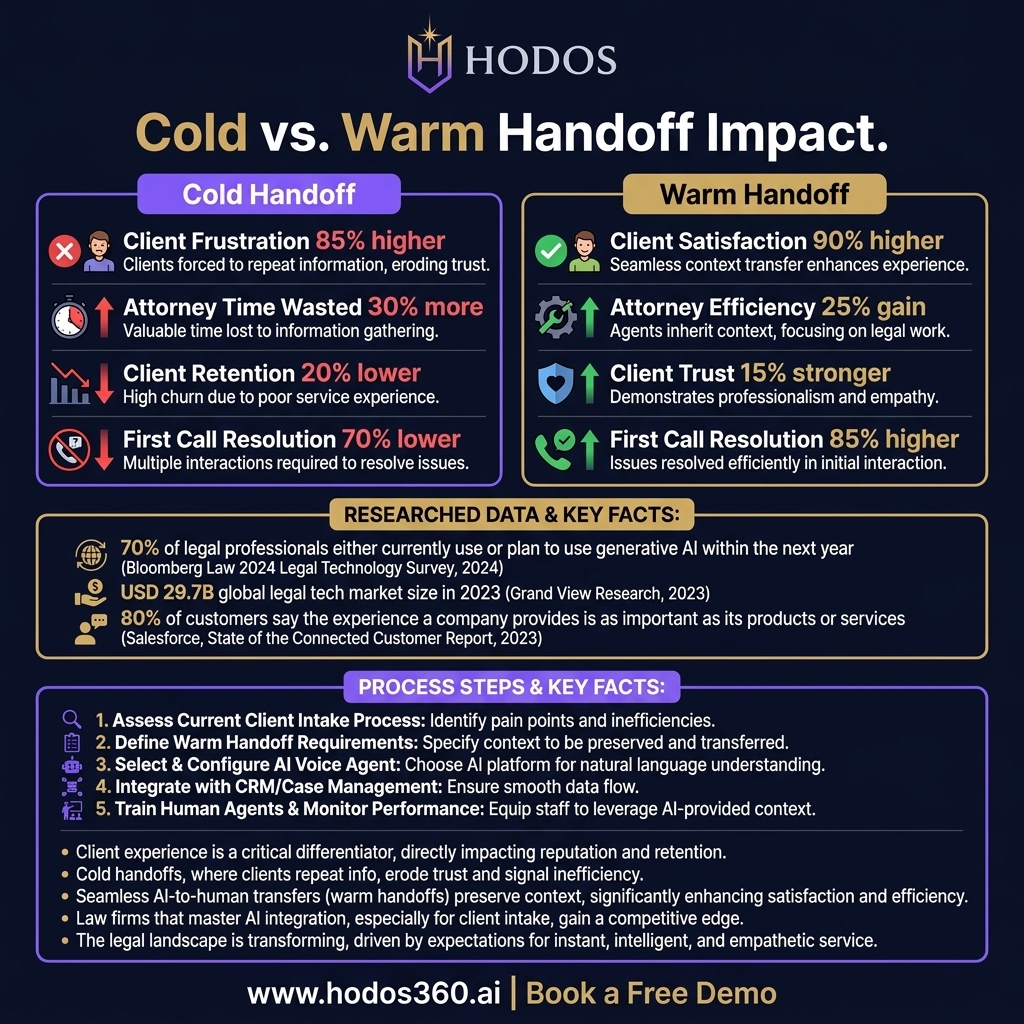
To truly perfect the AI voice agent transfer, law firms must establish clear metrics for success. Key Performance Indicators (KPIs) extend beyond simple call volume and encompass the quality and efficiency of the client journey. First-Call Resolution (FCR) is paramount; if a client's issue is resolved or significantly advanced during the initial call, regardless of whether it involved AI or human, it signifies success.
Equally important are Client Satisfaction (CSAT) scores, gathered through post-interaction surveys, specifically focusing on the perceived seamlessness of the handoff. A low CSAT score following an AI-to-human transfer indicates a breakdown in context or communication. According to a 2023 Gartner report on customer service, businesses that prioritize FCR and CSAT see up to a 15% increase in customer retention.
For law firms, this translates directly to client loyalty and repeat business, crucial for sustainable growth. Learn more about Essential AI Web Development: Harvard's Free Courses for Law Firms. Monitoring these metrics over time allows firms to identify bottlenecks and refine their transfer protocols, ensuring continuous improvement in client service delivery.
Another critical metric is Average Handling Time (AHT) for human agents post-AI transfer. If the AI is effectively gathering context, the human agent's AHT should ideally decrease, as they spend less time on preliminary data collection and more on substantive legal advice. Conversely, an increasing AHT could signal that the AI is not adequately preparing the human agent or that the context passed is incomplete.
Furthermore, firms should track the number of 'cold transfers' versus 'warm transfers' to ensure compliance with established protocols. Regular audits of recorded calls and transfer notes can provide qualitative insights into the effectiveness of the handoff process. By establishing a robust framework for measuring these KPIs, law firms can move beyond anecdotal evidence and make data-driven decisions to optimize their AI voice agent transfer mechanisms, transforming a potential weakness into a significant strength in their client engagement strategy.
The Human Element: Training Attorneys for AI-Augmented Client Interactions
While technology provides the infrastructure for seamless handoffs, the ultimate success of AI voice agent transfer hinges on the human element—specifically, how attorneys are prepared to receive and leverage the AI-provided context. It’s not enough for an attorney to simply receive a transcript; they need to be trained on how to quickly digest the AI's summary, identify key information, and integrate it into their client interaction fluidly.
This requires a shift in mindset, moving from a reactive information-gathering role to a proactive, problem-solving one from the outset of the call. Firms must invest in comprehensive training programs that equip their legal teams with the skills to interpret AI-generated insights, understand the limitations of the technology, and build rapport based on the pre-existing context.
At LegalTech NYC 2026, several sessions highlighted the growing importance of 'AI literacy' among legal professionals, emphasizing that technology is only as effective as the humans wielding it.
This training should cover not only the technical aspects of using the AI transfer interface but also the soft skills necessary to make the client feel valued and understood.
Attorneys should be coached on how to acknowledge the AI's prior interaction without making the client feel like a mere data point. Phrases like, "Thank you for speaking with our AI assistant, I've reviewed the details you provided regarding your inheritance dispute, and I'm ready to discuss the next steps," can significantly enhance the client's perception of a smooth, integrated service.
This subtle yet powerful communication strategy ensures that the client feels heard and that their time with the AI was productive. It’s about creating a unified client experience where the AI and human attorney function as a cohesive team, rather than two separate, disconnected entities, thereby perfecting the overall journey.
Furthermore, continuous feedback loops between the legal team and the AI development team are crucial. Attorneys on the front lines can provide invaluable insights into common scenarios where the AI’s context transfer might be lacking or where specific nuances are missed. Learn more about AI Podcasts: Essential Voice Assistant Strategies for Law Firms.
This iterative refinement process, often seen in agile software development, allows the AI system to learn and improve over time, making subsequent handoffs even more effective. For example, if attorneys consistently find that the AI misses specific details related to real estate contracts, this feedback can be used to retrain the AI model, enhancing its ability to capture and transfer that specific type of context.
This collaborative approach ensures that the technology evolves in lockstep with the practical needs of legal practice, preventing the common pitfall of AI solutions becoming static or outdated, and truly perfecting the AI voice agent transfer.
Ethical considerations also play a significant role in training.
Attorneys must understand the ethical boundaries of AI interaction, particularly concerning client confidentiality and the avoidance of bias. The EU AI Act, though primarily focused on high-risk AI systems, sets a precedent for transparency and human oversight that legal professionals must internalize. Training should emphasize that while AI can gather facts, the ultimate responsibility for legal advice and client care rests with the human attorney.
This reinforces the idea that AI is a powerful tool to augment, not replace, human judgment and empathy. Firms like White & Case have been proactive in developing internal guidelines for AI use, underscoring the legal profession's commitment to responsible innovation. This comprehensive approach to training ensures that the integration of AI voice agents enhances, rather than compromises, the ethical and professional standards of legal service.
Future Horizons: Predictive AI and the Evolution of Seamless Client Journeys
The future of AI voice agent transfer is poised to move beyond reactive handoffs to predictive, proactive client engagement. Imagine an AI system that not only understands a client's current query but also anticipates their future legal needs based on historical data, industry trends, and even external events.
This level of predictive analytics, drawing on vast datasets and advanced machine learning, could allow law firms to offer hyper-personalized service, proactively reaching out to clients with relevant information or services before they even realize they need them. For example, if a client has recently inquired about intellectual property protection, the AI might flag them for future updates on relevant patent law changes or offer a consultation on related trademark issues.
This foresight transforms the client relationship from transactional to deeply consultative, solidifying the firm's position as a trusted advisor.
Advancements in multimodal AI, which can process and understand information from various inputs like voice, text, and even video, will further enhance the richness of context available during a transfer.
An AI voice agent might not only listen to a client's words but also analyze their tone, pace, and emotional cues, providing the human attorney with a more holistic understanding of the client's state. This nuanced context allows for a more empathetic and tailored human response, elevating the quality of legal counsel.
Companies like OpenAI are continually pushing the boundaries of these models, and their deployment in specialized legal tech platforms is inevitable. The integration of such sophisticated AI will mean that a seamless handoff is not just about passing data, but about transferring a complete, emotionally intelligent understanding of the client's situation.
Furthermore, the evolution of generative AI will enable AI voice agents to create more dynamic and personalized pre-handoff summaries and even draft preliminary legal documents or information packets based on the initial client interaction. This could significantly reduce the attorney's workload post-transfer, allowing them to focus almost exclusively on strategic advice and complex problem-solving.
Learn more about AI Legal Platform: The Ultimate Guide to Unified Firm Operations. Consider a scenario where an AI agent, after a warm handoff, automatically generates a draft client intake form pre-filled with the discussed details, or a summary of relevant case law for the attorney's review.
This level of automation, grounded in a deep understanding of legal principles, promises to redefine efficiency in legal practice. The venture capital community is already heavily investing in startups exploring these frontiers, with firms like Andreessen Horowitz backing promising legal AI ventures, recognizing the immense potential for disruption and value creation in the legal sector.
This continuous innovation ensures that the concept of AI voice agent transfer will only become more sophisticated and integrated into the fabric of legal service delivery.
Navigating the ethical implications of these advanced AI capabilities will be paramount. As AI becomes more predictive and proactive, questions around data privacy, algorithmic bias, and the boundaries of automated legal advice will intensify.
The legal profession, through bodies like the ABA and state bar associations, must continue to develop robust ethical guidelines for AI deployment. This includes ensuring transparency about when a client is interacting with AI, maintaining human oversight over critical decisions, and implementing strong safeguards against data misuse.
The focus will remain on ensuring that AI serves to enhance justice and access to legal services, rather than creating new inequalities or ethical quandaries. The ongoing dialogue around responsible AI development, as seen at global forums and regulatory discussions, underscores the profession's commitment to leveraging technology ethically while perfecting the client journey.

Key Takeaways and Next Steps for Law Firms
The era of the 'cold handoff' is rapidly becoming obsolete in the legal industry. For law firms seeking to thrive in a competitive and technology-driven landscape, perfecting the AI voice agent transfer is no longer an option but a strategic imperative. By ensuring seamless transfers that preserve crucial client context, firms can elevate their client experience, boost operational efficiency, and cement their reputation as forward-thinking, client-centric practices.
The investment in robust technical architectures, comprehensive attorney training, and continuous measurement of success metrics will yield significant returns in client satisfaction and firm profitability. This isn't just about adopting new tools; it's about fundamentally rethinking how legal services are delivered, placing empathy and efficiency at the forefront of every interaction.
Embracing solutions that prioritize the warm handoff means leveraging AI not as a replacement for human talent, but as a powerful augmentation. It frees up valuable attorney time from repetitive tasks, allowing them to focus on the complex legal analysis and empathetic counsel that only a human can provide.
For law firms ready to lead this transformation, HODOS 360 offers AI Voice Assistants specifically designed for the legal sector. Our platform ensures that every AI voice agent transfer is a warm, contextual handover, integrating seamlessly with your existing systems to provide attorneys with all the necessary information before they engage.
This commitment to context preservation transforms potential friction points into opportunities for exceptional service. By implementing such advanced systems, law firms can ensure that every client interaction is a testament to their dedication to excellence, setting new benchmarks for service quality in the legal industry.
Frequently Asked Questions
What is a 'warm handoff' in the context of AI voice agents?+
A warm handoff is a sophisticated AI voice agent transfer where the AI passes all relevant client context—such as their query, personal details, and conversation history—to a human agent *before* connecting the call. This allows the human to immediately understand the situation and continue the conversation seamlessly, without requiring the client to repeat information, significantly enhancing client experience and efficiency.
Why is context preservation so critical during an AI-to-human transfer for law firms?+
For law firms, context preservation is critical because legal matters are often sensitive and complex. Losing context during a transfer can lead to client frustration, wasted time, potential miscommunication, and even ethical concerns regarding adequate client communication (ABA Model Rule 1.4). A seamless handoff ensures professionalism, builds trust, and allows attorneys to focus on substantive legal issues immediately.
What are the technical requirements for implementing effective warm handoffs?+
Effective warm handoffs require robust integration between the AI voice agent platform, the firm’s CRM, and practice management software. Key technical requirements include API integrations for data exchange, real-time data synchronization, secure data transfers (encryption), and often a 'whisper' agent feature that provides a summary to the human agent before they join the call. Scalability and reliability are also paramount.
How can law firms train their attorneys to leverage AI-provided context effectively?+
Law firms should implement comprehensive training programs focusing on 'AI literacy.' Attorneys need to learn how to quickly digest AI-generated summaries, identify key information, and integrate it into client conversations fluidly. Training should also cover soft skills for acknowledging prior AI interaction and ethical considerations, ensuring attorneys feel confident in using AI as an augmentation tool for perfecting client service.
What metrics should law firms use to measure the success of their AI voice agent transfers?+
Key metrics include First-Call Resolution (FCR), Client Satisfaction (CSAT) scores specifically related to the transfer experience, and Average Handling Time (AHT) for human agents post-AI transfer. Tracking the ratio of 'warm' vs. 'cold' transfers, along with qualitative feedback from attorneys and clients, provides a comprehensive view of the effectiveness and areas for improvement in perfecting seamless handoffs.