

AI Voice Assistants Legal Firms Client Engagement
In September 2026, the global legal tech community watched with keen interest as ClawCon Nairobi, Africa's premier personal AI conference, drew over 400 attendees – a clear signal that artificial intelligence is taking root deeply across continents, not just in established tech hubs. This burgeoning interest in personal AI, from developers to entrepreneurs, highlights a universal truth: AI is becoming an indispensable part of our professional and personal lives. For law firms, this shift is particularly resonant. The days of solely relying on human receptionists for every call, every lead qualification, and every appointment booking are rapidly giving way to a more efficient, AI-powered paradigm. As law firm owners and attorneys navigate an increasingly competitive and tech-driven market, the adoption of sophisticated AI Voice Assistants is emerging as not just an advantage, but an essential component of modern practice.
Historically, the legal sector has been cautious in its embrace of new technologies, often prioritizing tradition and human-centric processes. However, the sheer volume of calls, the demands for 24/7 client access, and the critical need for efficient lead conversion have made the case for AI undeniable. Firms that once viewed AI as a futuristic concept are now actively seeking solutions to streamline operations and enhance client engagement. The advancements in generative AI have made voice assistants incredibly sophisticated, capable of nuanced conversations, multilingual support, and seamless integration into existing workflows. This isn't merely about answering phones; it's about creating an always-on, intelligent front desk that can handle routine inquiries, qualify leads with precision, and free up valuable human resources for complex legal work. The narrative arc of AI in law is moving from skepticism to strategic necessity, driven by tangible benefits and a clear competitive imperative.
The implications of this global adoption are profound. Firms that hesitated in the past now face the reality that their competitors are leveraging AI to capture market share and deliver superior service. The insights from events like ClawCon Nairobi, where the focus on personal AI empowers individuals and small businesses, directly translate to the legal sector's need for scalable, intelligent tools. HODOS 360, with its comprehensive suite of AI-powered services, including advanced AI Voice Assistants, stands at the forefront of this transformation. By understanding the evolving landscape of artificial intelligence and its practical applications, law firms can strategically implement solutions that not only improve their bottom line but also redefine their client relationships and operational excellence.
The Global Surge of Personal AI and Voice Assistants in Legal Tech
The burgeoning interest in AI, as showcased by ClawCon Nairobi, isn't an isolated phenomenon; it's part of a broader global movement. In Africa, the rapid adoption of mobile technology has created fertile ground for AI innovation, with local developers and startups creating solutions tailored to unique market needs. This mirrors a trend seen worldwide: AI is no longer confined to Silicon Valley labs but is a truly global force. Major players like Microsoft and Google AI are heavily investing in localized AI solutions, recognizing the immense potential in diverse markets. For law firms, this means a wider array of robust, culturally aware, and adaptable AI tools are becoming available, moving beyond generic applications to specialized legal contexts. The momentum behind artificial intelligence is undeniable, with projections from Gartner indicating that by 2027, over 80% of enterprises will have deployed generative AI APIs or applications in production environments, a significant leap from less than 5% in 2023. This rapid proliferation underscores the immediate need for legal practices to integrate these advanced capabilities.
The competitive landscape for law firms is constantly evolving, with client expectations for immediate and intelligent service at an all-time high. The rise of personal AI extends beyond mere chatbots; it encompasses sophisticated systems that understand context, anticipate needs, and provide proactive support. This is where AI Voice Assistants shine. They are not just answering machines but intelligent agents capable of complex interactions, such as initial client consultations, conflict checks, and even basic legal information dissemination. Companies like OpenAI and Anthropic are continually pushing the boundaries of generative AI, making these interactions more natural and effective. For instance, the ability of Gemini AI to process multimodal inputs means future voice assistants could interpret not just speech but also tone and urgency, providing a truly empathetic and efficient first point of contact for clients. This level of sophistication helps firms differentiate themselves, especially in competitive markets where client acquisition costs are growing.
Consider the strategic implications for client acquisition and retention. Learn more about AI Website Building: The Ultimate Guide for Law Firms. In a world where consumers expect instant gratification, a law firm that can offer 24/7 intelligent support through an AI Voice Assistant has a distinct advantage. This capability allows firms to capture leads outside of traditional business hours, qualify them effectively, and schedule appointments without human intervention. This also extends to rebranding efforts, as a firm adopting such cutting-edge technology signals innovation and client-centricity. The data supports this: a Thomson Reuters Institute report found that leading law firms are significantly more likely to invest in AI, recognizing its potential to enhance client experience and operational efficiency. The success stories of smallholder businesses and startups in Africa leveraging AI for various tasks, from agricultural insights to customer service, serve as powerful testaments to the accessibility and impact of these technologies across sectors. This global trend of adoption is a clear indicator for law firms: embracing AI is no longer optional.
The narrative of AI in the legal sector is also shaped by the significant investments and partnerships forming globally. For example, Harvey AI's collaboration with Allen & Overy demonstrated the potential for generative AI in legal research and drafting, setting a precedent for what's possible. While that focused on internal workflows, the external-facing applications, such as AI Voice Assistants, are equally transformative. These assistants, powered by the same underlying large language models (LLMs), can manage the initial client journey, from the moment a potential client first calls to the point of a scheduled consultation. This not only streamlines operations but also ensures that no potential lead is missed, a critical factor for firm growth. The ability to handle high volumes of inquiries efficiently and accurately is particularly valuable for practices dealing with personal injury, family law, or immigration, where timely responses can make all the difference.
Essential Benefits of AI Voice Assistants for Law Firms
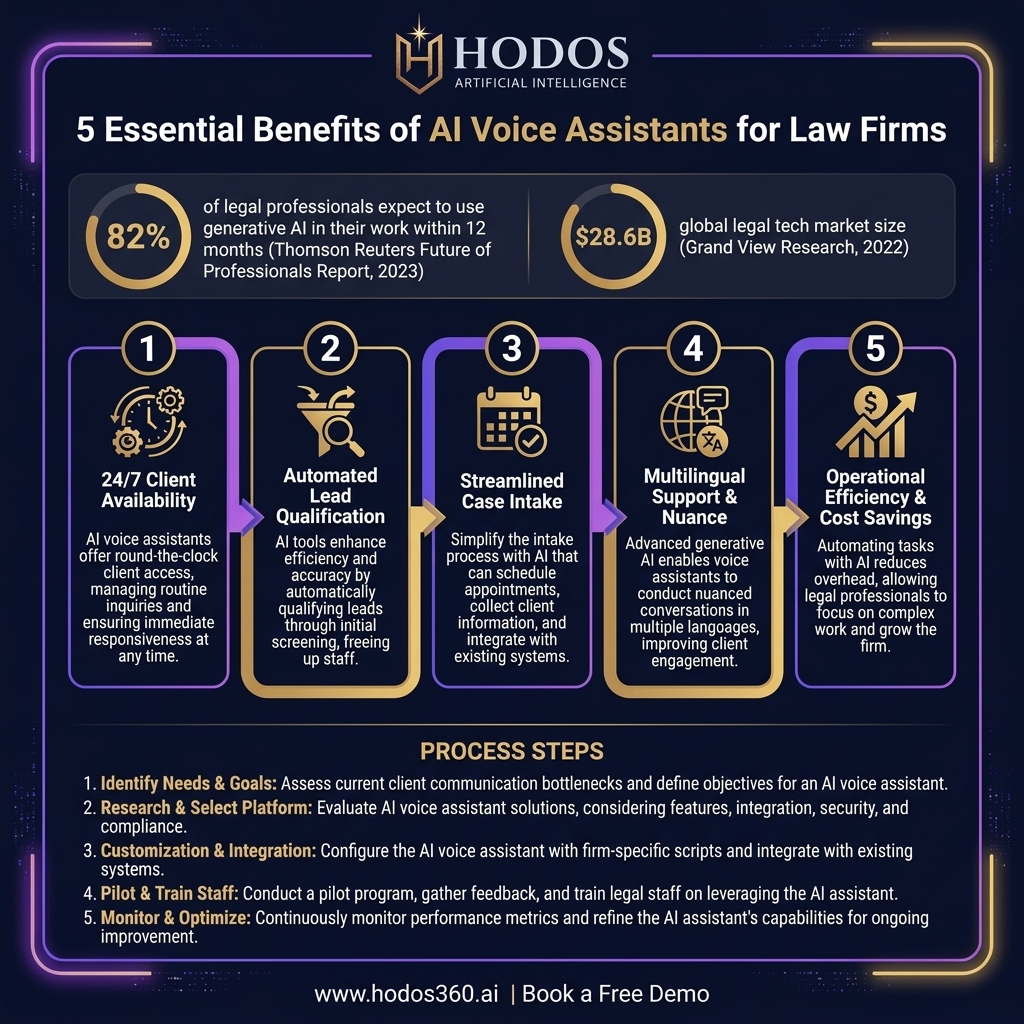
The strategic implementation of AI Voice Assistants offers a multifaceted array of benefits that directly impact a law firm's bottom line and client satisfaction. First and foremost, these assistants provide 24/7 phone answering, ensuring that no potential client call goes unanswered, regardless of the time zone or hour. This round-the-clock availability is a significant competitive edge, especially for firms operating in a globalized legal market or those serving clients with urgent needs. Imagine a scenario where a potential client faces a legal emergency at 2 AM; an AI voice assistant can capture their details, provide initial information, and schedule a follow-up, preventing the loss of a valuable lead. This continuous engagement significantly enhances the firm's responsiveness and accessibility, crucial factors in today's client-driven market. It also frees up human staff from mundane tasks, allowing them to focus on complex legal work that requires their specialized expertise.
Beyond basic answering services, AI Voice Assistants excel in lead qualification and appointment booking. Leveraging sophisticated algorithms and generative AI, these assistants can engage callers in intelligent conversations, asking pertinent questions to determine the nature of their legal issue, their urgency, and their financial capacity. This pre-qualification process ensures that attorneys only spend time on genuinely promising leads, optimizing their schedules and increasing conversion rates. Moreover, the assistants can seamlessly integrate with firm calendars, booking appointments directly and sending automated reminders, thereby reducing no-shows and maximizing attorney utilization. This level of automated efficiency is a game-changer, eliminating the administrative burden associated with managing initial client inquiries. The precision in enabling firms to target and convert high-quality leads is a testament to the advanced capabilities of these systems.
One of the most powerful features of modern AI Voice Assistants is their multilingual support. In diverse societies and an interconnected world, law firms often encounter clients who speak different languages. Learn more about AI Adoption: Essential Strategies for Law Firms to Lead. An AI assistant capable of communicating in multiple languages breaks down significant communication barriers, making legal services accessible to a broader demographic. This not only expands a firm's potential client base but also demonstrates a commitment to inclusivity and client service excellence. Furthermore, these assistants can perform intelligent call routing, directing specific inquiries to the most appropriate department or individual within the firm, ensuring that clients receive the right assistance promptly. This optimizes internal workflows and improves overall operational efficiency, preventing misdirected calls and client frustration. The ability to handle diverse linguistic needs is particularly vital in markets with growing immigrant populations or international clientele.
Finally, the integration of AI Voice Assistants can significantly impact a firm's AI marketing platform strategy. By capturing detailed information from initial calls, the assistants provide valuable data for analytics and ROI tracking. This data can inform marketing campaigns, helping firms understand which channels are generating the most qualified leads and where to allocate resources more effectively. For example, insights into common client questions or pain points can guide content generation and social media automation efforts. This synergy between client intake and marketing intelligence creates a powerful feedback loop, driving continuous improvement and strategic growth. The efficiency gains extend beyond mere cost savings; they contribute to a more agile, data-driven, and client-focused legal practice that is well-prepared for the future, leveraging AI news today to stay ahead of the curve.
Enhancing Client Intake and Lead Qualification
The initial point of contact is often the most critical in client acquisition. Traditionally, this process can be time-consuming and prone to human error, especially during peak hours or after-hours. AI Voice Assistants revolutionize this by providing a consistent, high-quality experience from the first interaction. They can gather essential information such as the caller's name, contact details, the nature of their legal issue, and even preliminary facts, all while maintaining a professional and empathetic tone. This structured data collection ensures that no critical piece of information is overlooked, and attorneys receive comprehensive summaries before their first meeting. Learn more about Voice AI Landscape: Essential Strategies for Law Firms. For instance, a firm specializing in personal injury law can program its AI assistant to ask specific questions about the incident, injuries sustained, and insurance details, immediately qualifying the lead based on predefined criteria. This level of precision significantly improves the efficiency of the intake process, allowing firms to handle a larger volume of inquiries without compromising service quality. The ability to capture and process this data instantly is invaluable, especially when running multiple marketing campaigns simultaneously, ensuring every lead is managed effectively.
Multilingual Support: Breaking Down Communication Barriers
In an increasingly diverse world, the ability to communicate effectively across languages is not just an advantage but a necessity for law firms. AI Voice Assistants equipped with advanced natural language processing (NLP) and generative AI capabilities can seamlessly interact with callers in their preferred language, eliminating the need for human interpreters in initial stages. This is particularly crucial in regions with significant immigrant populations or for firms with international clientele. For example, a legal practice in Miami or Los Angeles can serve its Spanish-speaking community with the same ease as its English-speaking clients, fostering trust and accessibility. Learn more about AI Marketing Platforms: Essential Tools for Law Firms. This capability not only broadens the firm's reach but also reduces potential misunderstandings and ensures that critical information is conveyed accurately from the outset. By removing language as a barrier, firms can demonstrate a commitment to serving all members of their community, enhancing their reputation and market presence. This directly addresses the need for inclusivity in legal services, ensuring that all potential clients feel heard and understood, regardless of their native tongue.
Navigating Ethical and Practical Considerations of Voice AI
While the benefits of AI Voice Assistants are substantial, their implementation in the legal sector necessitates careful consideration of ethical and practical challenges. Paramount among these is data privacy and security. Law firms handle highly sensitive and confidential client information, and any AI system must comply with stringent data protection regulations such as GDPR, CCPA, and state-specific privacy laws. Firms must ensure that their AI solutions employ robust encryption, secure data storage, and strict access controls. The ABA Model Rules of Professional Conduct, particularly Model Rule 1.6 on Confidentiality of Information, impose a strict duty on lawyers to protect client data. Firms must perform due diligence on their AI vendors, ensuring they meet these legal and ethical obligations. The potential for data breaches or unauthorized access poses a significant risk, and firms must mitigate these proactively through comprehensive security protocols and regular audits. This tension between leveraging cutting-edge technology and upholding fundamental ethical duties is a defining challenge for modern legal practice.
Another critical consideration is the ethical use of AI and the potential for bias. AI systems are trained on vast datasets, and if these datasets contain inherent biases, the AI's responses could inadvertently perpetuate discrimination or provide inaccurate information. For example, an AI voice assistant might misinterpret certain accents or dialects, leading to a suboptimal client experience. Law firms must actively work with their AI providers to ensure that systems are trained on diverse and inclusive datasets, and that fairness algorithms are employed to mitigate bias. Furthermore, transparency with clients about the use of AI is crucial. Clients should be aware that they are interacting with an AI system, and there should always be an option to speak with a human. This ensures compliance with principles of informed consent and maintains the human element that remains vital in legal services. The ongoing debate around the EU AI Act enforcement highlights the increasing global focus on responsible AI development and deployment, which legal firms must heed.
The role of human oversight cannot be overstated. Learn more about Voice AI: The Ultimate Leap with GPT-Live-1 for Law Firms. While AI Voice Assistants can handle routine tasks, complex legal issues, nuanced client emotions, and ethical dilemmas still require human judgment. AI should augment, not replace, the expertise of attorneys and legal staff. Firms must establish clear protocols for when a call needs to be escalated from an AI assistant to a human. Regular monitoring of AI interactions, training data, and performance metrics is essential to ensure the system is functioning as intended and providing accurate, ethical support. This hybrid approach, combining the efficiency of AI with the critical thinking and empathy of human professionals, represents the optimal path forward. The challenge lies in finding the right balance, ensuring that technology enhances human capabilities rather than diminishing them.
Finally, firms must consider the integration challenges with existing legal tech infrastructure. A standalone AI voice assistant, no matter how advanced, will have limited impact if it cannot seamlessly communicate with case management systems, billing software, or CRM platforms. The goal is to create a cohesive ecosystem where client data flows effortlessly, reducing manual data entry and potential errors. Firms like Allen & Overy, through their collaboration with platforms like Harvey AI, demonstrate the power of integrated AI solutions. The choice of an AI vendor that offers comprehensive integration capabilities is therefore paramount. The investment in an AI voice assistant should be viewed as part of a broader digital transformation strategy, not an isolated purchase. This holistic approach ensures maximum ROI and a truly optimized legal practice. The developers behind these systems are constantly working to improve interoperability, but firms must still prioritize solutions built for integration within a wider AI law firm management system.
Integrating AI Voice Assistants into Your Firm's Ecosystem
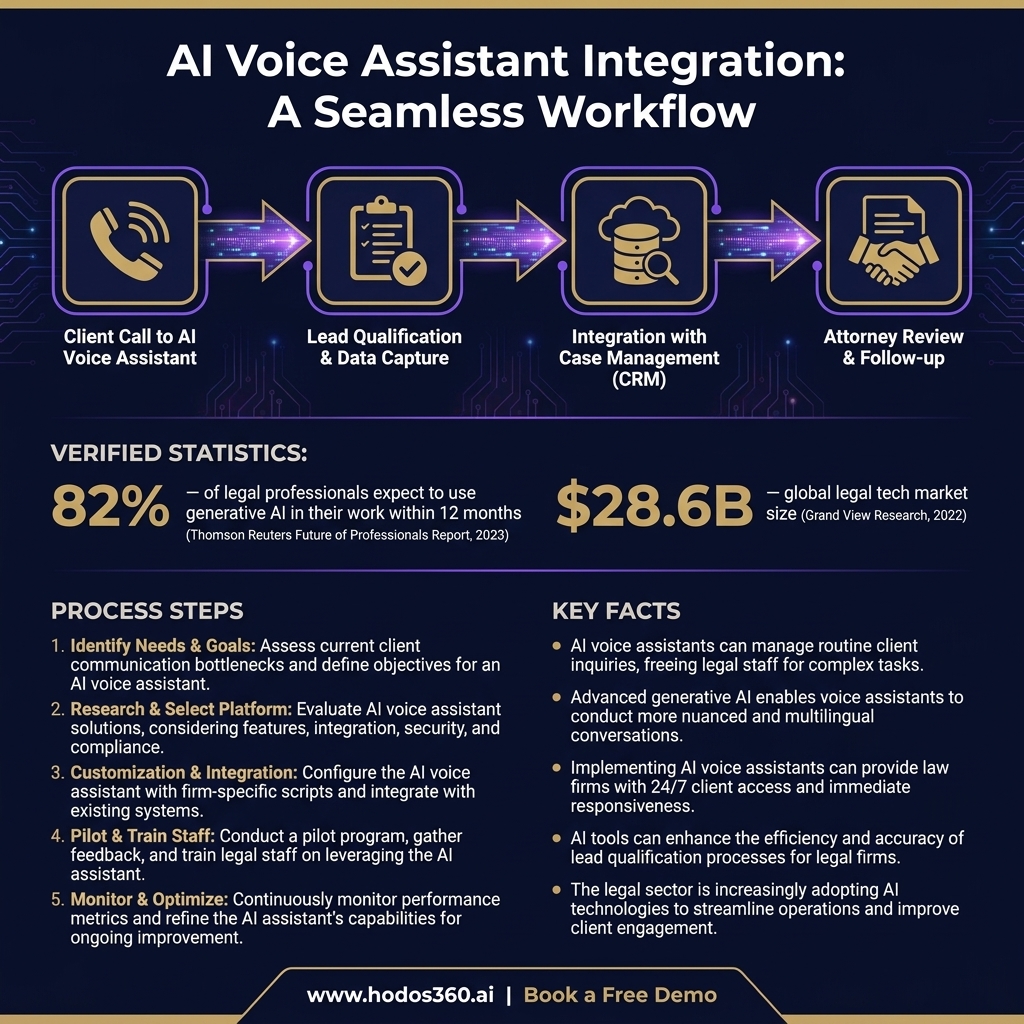
The true power of AI Voice Assistants for law firms is unlocked through seamless integration into the firm's existing technological ecosystem. This isn't just about plugging in a new tool; it's about orchestrating a symphony of digital services that work in harmony. A well-integrated AI assistant can feed client intake data directly into your AI Law Firm Management System, populating client profiles, creating new matters, and scheduling follow-up tasks automatically. This eliminates redundant data entry, reduces the risk of human error, and ensures that all client information is centralized and accessible to the relevant team members. Imagine a potential client calling at midnight, and by morning, their details, the summary of their inquiry, and a scheduled consultation are all neatly organized within your case management software, ready for an attorney to review. This level of automation significantly boosts operational efficiency and allows legal professionals to dedicate more time to substantive legal work rather than administrative overhead.
Furthermore, integrating AI Voice Assistants with an AI Marketing Platform creates a powerful feedback loop that drives smarter business development. The data captured by the voice assistant – such as common client pain points, preferred services, or geographic interest – can directly inform your marketing strategies. This allows for the creation of highly targeted content, optimized social media campaigns, and more effective advertising spend. For instance, if the AI assistant identifies a surge in inquiries related to a specific legal niche, the marketing platform can automatically generate blog posts, social media updates, or even targeted ads to capitalize on this trend. This data-driven approach ensures that marketing efforts are not only efficient but also highly responsive to actual client demand, maximizing ROI and enhancing the firm's visibility. The synergy between client interaction and marketing intelligence is crucial for sustained growth in today's competitive legal market, where every dollar spent on client acquisition needs to be carefully tracked and optimized.
Choosing the right partner for integration is paramount. Learn more about AI for Lawyers: Unlocking Proven Time Savings, Not Busywork. Platforms like HODOS 360 are designed with this holistic approach in mind, offering not just AI Voice Assistants but also a comprehensive AI Law Firm Management System and an AI Marketing Platform that are built to work together. This integrated suite ensures compatibility, simplifies implementation, and provides a unified dashboard for managing all aspects of your firm's operations and client engagement. Such an approach minimizes the headaches associated with disparate systems and maximizes the benefits of AI by creating a truly intelligent and interconnected legal practice. The goal is to move beyond fragmented solutions to a cohesive, AI-powered ecosystem that supports every facet of your firm, from initial client contact to case resolution and beyond. The future of legal practice is integrated, and AI is the connective tissue that binds it all together.
Beyond the operational and marketing benefits, deep integration allows for continuous improvement and personalization. As the AI Voice Assistant processes more interactions, it gathers valuable data that can be used to refine its scripts, improve its understanding of legal terminology, and even adapt its tone to better suit client needs. This iterative process, guided by real-world interactions, ensures that the AI system becomes increasingly effective and client-centric over time. Moreover, integration with a firm's Web & Mobile Development strategy means that the AI-powered website can also leverage insights from voice interactions, offering a truly responsive and personalized experience across all digital touchpoints. This level of sophisticated client engagement is what sets leading firms apart, creating a seamless and satisfying journey for every individual seeking legal assistance. The ongoing advancements in artificial intelligence make this a constantly growing area, requiring firms to stay informed and adaptive.
- ✓24/7 Client Availability: AI Voice Assistants ensure no call is missed, capturing leads and providing information outside of business hours, significantly boosting client accessibility.
- ✓Automated Lead Qualification: Intelligent conversations pre-qualify potential clients, ensuring attorneys spend time on high-value prospects and improving conversion rates.
- ✓Seamless Appointment Booking: Integration with calendars allows for automatic scheduling and reminders, reducing administrative burden and minimizing no-shows.
- ✓Multilingual Communication: Breaking down language barriers, AI assistants can serve diverse client bases, expanding market reach and fostering inclusivity.
- ✓Efficient Call Routing: Directing inquiries to the correct department or individual optimizes internal workflows and improves client satisfaction.
- ✓Data-Driven Marketing Insights: Information gathered informs marketing strategies, enabling targeted content creation and maximizing ROI on advertising spend.
- ✓Enhanced Operational Efficiency: Automating routine tasks frees up legal professionals to focus on complex legal work, increasing productivity and reducing overhead.

Key Takeaways and The Future of Legal Client Engagement
The global momentum behind personal AI, exemplified by events like ClawCon Nairobi, unequivocally signals a new era for professional services, and the legal sector is at its vanguard. For law firms, the message is clear: AI Voice Assistants are not merely a technological upgrade but an essential strategic imperative for sustained growth and competitive advantage. The ability to offer 24/7 intelligent client engagement, coupled with automated lead qualification and multilingual support, transforms the very foundation of client acquisition and service delivery. Firms that embrace this technology will distinguish themselves by their responsiveness, efficiency, and ability to meet the evolving demands of modern clients. This isn't just about keeping up; it's about leading the charge in a rapidly digitizing legal landscape. The future of legal client engagement is intelligent, always-on, and deeply integrated with advanced artificial intelligence.
The narrative of legal tech is no longer about hypothetical scenarios but about practical, impactful applications that are redefining daily operations. From the efficient handling of initial inquiries to the strategic insights for marketing campaigns, AI voice assistants offer a comprehensive solution to many of the long-standing challenges faced by law firms. The ongoing advancements in generative AI, fueled by companies like OpenAI and the continuous innovation from Google AI and Microsoft, promise even more sophisticated capabilities, making these tools indispensable. Firms that proactively invest in these technologies are not just adopting a new tool; they are building a resilient, future-proof practice designed for optimal performance and client satisfaction. As legal professionals, the ethical stewardship of these tools, as guided by principles like those in the ABA Model Rules of Professional Conduct, remains paramount.
To thrive in this new era, law firms must move beyond incremental changes and embrace a holistic digital transformation. This involves not only implementing AI Voice Assistants but also integrating them seamlessly with a robust AI Law Firm Management System and an effective AI Marketing Platform. This comprehensive approach ensures that every aspect of the firm, from client intake to case management and business development, is optimized by intelligent automation. HODOS 360 offers precisely this integrated suite of services, empowering law firms to harness the full potential of AI for unprecedented efficiency and client engagement. The time to act is now; the firms that strategically adopt these technologies will be the ones that redefine legal excellence for years to come. The adoption of these technologies is not just a trend; it's a foundational shift in how legal services are delivered globally.
Frequently Asked Questions
What specifically are AI Voice Assistants?+
AI Voice Assistants are intelligent software programs that use natural language processing (NLP) and generative AI to interact with callers, understand their queries, and provide relevant information or perform tasks. For law firms, they act as a virtual receptionist, handling client intake, qualifying leads, booking appointments, and routing calls effectively, ensuring 24/7 availability and efficient first contact.
How do AI Voice Assistants improve client intake for law firms?+
AI Voice Assistants streamline client intake by gathering essential information from callers, pre-qualifying leads based on specific criteria, and automatically populating client profiles within the firm's management system. This process ensures consistent data collection, reduces manual effort, and allows attorneys to focus on high-value prospects, significantly enhancing conversion rates and operational efficiency.
Are AI Voice Assistants secure for handling confidential client information?+
Yes, reputable AI Voice Assistants are designed with robust security measures, including encryption, secure data storage, and compliance with data protection regulations (e.g., GDPR, HIPAA). Law firms must vet their AI vendors thoroughly to ensure adherence to ethical obligations like ABA Model Rule 1.6 on client confidentiality, prioritizing solutions that offer verifiable security protocols and transparency.
Can AI Voice Assistants provide multilingual support?+
Absolutely. Modern AI Voice Assistants leverage advanced NLP and generative AI to support multiple languages, enabling law firms to communicate effectively with a diverse client base. This capability breaks down communication barriers, expands the firm's reach into new demographics, and demonstrates a commitment to inclusivity, crucial for firms serving multicultural communities.
How do AI Voice Assistants integrate with existing law firm software?+
Leading AI Voice Assistants are built for seamless integration with existing law firm management systems (LMS), CRM platforms, and calendars. This integration allows for automated data flow, from client intake to case creation and appointment scheduling. Choosing a comprehensive platform like HODOS 360 ensures cohesive functionality, minimizing IT complexities and maximizing the benefits of automation across the firm's ecosystem.