
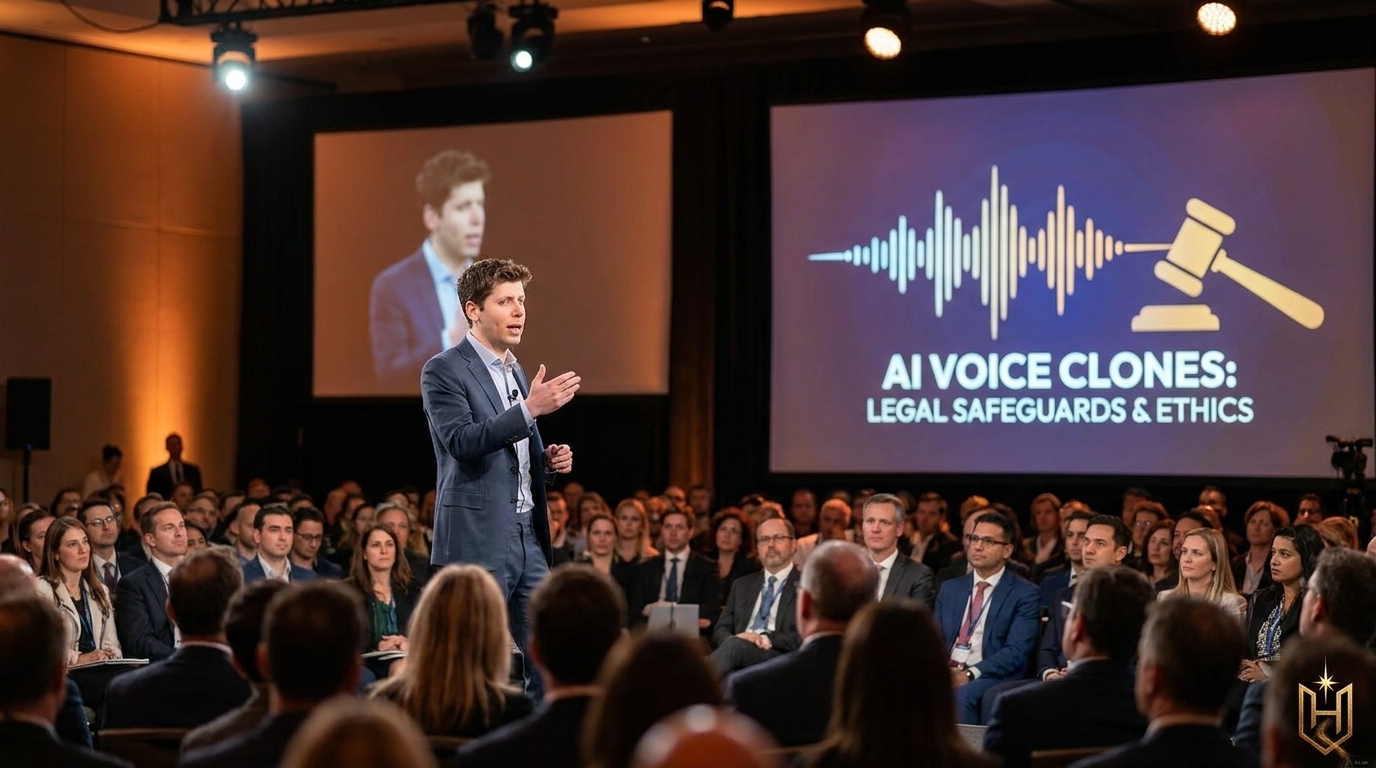
AI Voice Clones: Essential Legal Safeguards for Law Firms
The recent headlines from the Los Angeles Times, detailing actors sparring over AI voice clones, resonate far beyond Hollywood sound stages. This dramatic tension, amplified during the 2023 SAG-AFTRA strikes where the use of performers' digital likenesses and voices became a central negotiating point, underscores a profound shift in how we perceive and protect identity in the digital age. For law firms, this isn't just a distant industry squabble; it's a direct precursor to the complex legal and ethical challenges that are rapidly emerging within their own operations, especially as AI voice technology becomes more sophisticated and integrated into daily legal practice.
The ability of generative AI to create highly realistic synthetic voices, capable of mimicking specific individuals with uncanny accuracy, is no longer the stuff of science fiction. Companies like ElevenLabs, DeepMotion, and Resemble AI have pushed the boundaries of AI voice clones, making them accessible for a myriad of applications, from personalized marketing to virtual assistants. Learn more about General AI Alone: Essential Reasons It Isn't Enough for Legal Work. While the entertainment industry grapples with the unauthorized use of celebrity voices, often without consent or adequate compensation, law firms must confront parallel concerns: how do we protect client confidentiality, ensure data security, and uphold professional ethics when leveraging these powerful tools? The stakes are immensely high, touching upon intellectual property, privacy, and the very foundation of client trust.
This article delves into the critical legal and ethical considerations surrounding AI voice clones for law firms. We will explore the evolving landscape of intellectual property rights, the imperative of data privacy, and the ethical duties attorneys must uphold. Learn more about AI Legal Pages: The Ultimate Guide for Law Firms. By examining real-world conflicts and emerging legal frameworks, we aim to provide a comprehensive guide for law firms seeking to responsibly integrate advanced AI voice technology into their practices, ensuring compliance and safeguarding their clients' interests in this rapidly changing digital environment.
Ready to explore how advanced AI voice solutions can enhance your firm's operations while ensuring compliance? [Discover HODOS 360's AI Voice Assistants today!]
The Rise of AI Voice Clones and Emerging Legal Challenges
The proliferation of AI voice clones marks a pivotal moment in technological advancement, offering unprecedented capabilities for automation and personalized interaction. From sophisticated virtual receptionists handling client intake to multilingual support for diverse clientele, the potential for efficiency and expanded access to justice is undeniable. However, this innovation arrives with a complex legal undertow. Learn more about AI Marketing Agents: Essential for Law Firm Growth. The core tension, as highlighted by the actors' disputes, lies in the ownership and control of one's voice, which is increasingly recognized as a unique biometric identifier and a valuable asset. The legal framework, often slow to adapt, is now scrambling to address issues of unauthorized replication, digital identity theft, and the creation of deepfake audio that can mislead or defraud.
The entertainment industry's struggles offer a stark preview. During the 2023 SAG-AFTRA strike, led by President Fran Drescher, a central point of contention was the studios' desire for broad rights to scan and replicate actors' voices and likenesses, a move actors rightly feared could lead to perpetual digital employment without fair compensation or explicit consent. This battle illuminates the broader conflict between technological capability and individual rights. Learn more about Essential AI Legal Solutions: Freshfields' Gemini Integration. For law firms, this translates directly into the need for rigorous protocols when utilizing AI voice technology for client interactions, internal communications, or even generating legal content. Without clear consent and robust security, firms risk violating privacy laws, intellectual property rights, and their fundamental duties to clients.
The legal implications extend beyond mere consent. Consider the potential for AI voice clones to be used in phishing scams targeting law firm clients, impersonating an attorney or a client to extract sensitive information. A 2023 report by McAfee revealed that 77% of AI scam victims reported financial losses, with voice cloning being a significant vector. This necessitates not only internal safeguards but also educating clients about the risks. Learn more about Agentic Marketing: The Ultimate Guide for Law Firms. Law firms must also grapple with the provenance of the data used to train these AI models. If a third-party AI voice technology provider uses publicly available or improperly licensed voice data, the law firm could inadvertently become complicit in intellectual property infringement, leading to significant reputational and legal repercussions. The complexity demands a proactive, rather than reactive, approach to AI governance within the legal sector.
Furthermore, the rapid evolution of generative AI means that what constitutes 'fair use' or 'transformation' in the context of synthetic media is continuously being debated in courts and legislative bodies. The U.S. Copyright Office has issued guidance emphasizing that AI-generated works may only be copyrightable if there is sufficient human authorship. This ambiguity creates a minefield for firms developing or deploying custom AI voice technology solutions. Learn more about AI Marketing Strategy: Essential Lessons from 25 Years of Evolution. Firms must establish clear ethical guidelines and legal frameworks to ensure that their use of AI voice is not only compliant with existing laws but also anticipates future regulatory shifts, protecting both the firm and its clients from unforeseen liabilities. This requires a deep understanding of evolving legal precedents and a commitment to transparent and ethical AI deployment.
Right of Publicity & Copyright: Protecting Digital Identity
The legal protections surrounding a person's voice primarily fall under two distinct but often overlapping areas: the Right of Publicity and Copyright Law. The Right of Publicity, largely governed by state law (e.g., California Civil Code Section 3344), grants individuals the exclusive right to control the commercial use of their name, likeness, and in many jurisdictions, their voice. This means that if a law firm were to use an AI voice clone of a public figure or even a non-public individual for promotional purposes without explicit consent, they could face significant liability. The case of *Midler v. Ford Motor Co.* (1988), where Ford used a sound-alike singer mimicking Bette Midler's distinctive voice, set an early precedent for protecting vocal identity under this doctrine, even before sophisticated AI voice clones existed. Today, the challenge is amplified, as AI can replicate not just a 'sound-alike' but a near-perfect replica, making consent and licensing paramount.
Copyright law, while traditionally protecting original works of authorship, presents a more nuanced challenge for AI voice clones. While a recorded performance of a voice can be copyrighted as an audio recording, the voice itself, as a natural attribute, is generally not copyrightable. However, if an AI voice technology system is trained on copyrighted vocal performances, or if it generates new content that is substantially similar to a copyrighted work, then copyright infringement claims could arise. The key lies in the 'human authorship' requirement for copyright protection. The U.S. Copyright Office has consistently held that works created solely by AI, without human creative input, are not eligible for copyright. This creates a fascinating dilemma: who owns the copyright to content generated by an AI voice clone? Is it the owner of the source voice, the AI developer, or the human who prompted the AI? Law firms must navigate these ambiguities, particularly when leveraging AI for content creation, ensuring all source materials are properly licensed and that their generated outputs do not infringe existing copyrights. This landscape is ripe for litigation, making proactive legal counsel on these matters essential for firms engaging with synthetic media.
Navigating Intellectual Property in the Age of Synthetic Media
Beyond the specific challenges of voice, the broader domain of synthetic media introduces a seismic shift in intellectual property law. Generative AI models, whether creating text, images, or audio, are often trained on vast datasets that include copyrighted material. This raises fundamental questions about whether the output of these models constitutes a derivative work, a transformative use, or an entirely new creation. Major lawsuits, such as those filed by artists against Stability AI and Getty Images, are currently testing the boundaries of fair use and infringement in the context of AI training data. For law firms, this means that any AI voice technology or other generative AI tools they employ must be thoroughly vetted for their data provenance and licensing agreements. Blindly adopting AI solutions without understanding their underlying data practices could expose firms to significant IP litigation risks, potentially undermining their own efforts to protect clients' intellectual property.
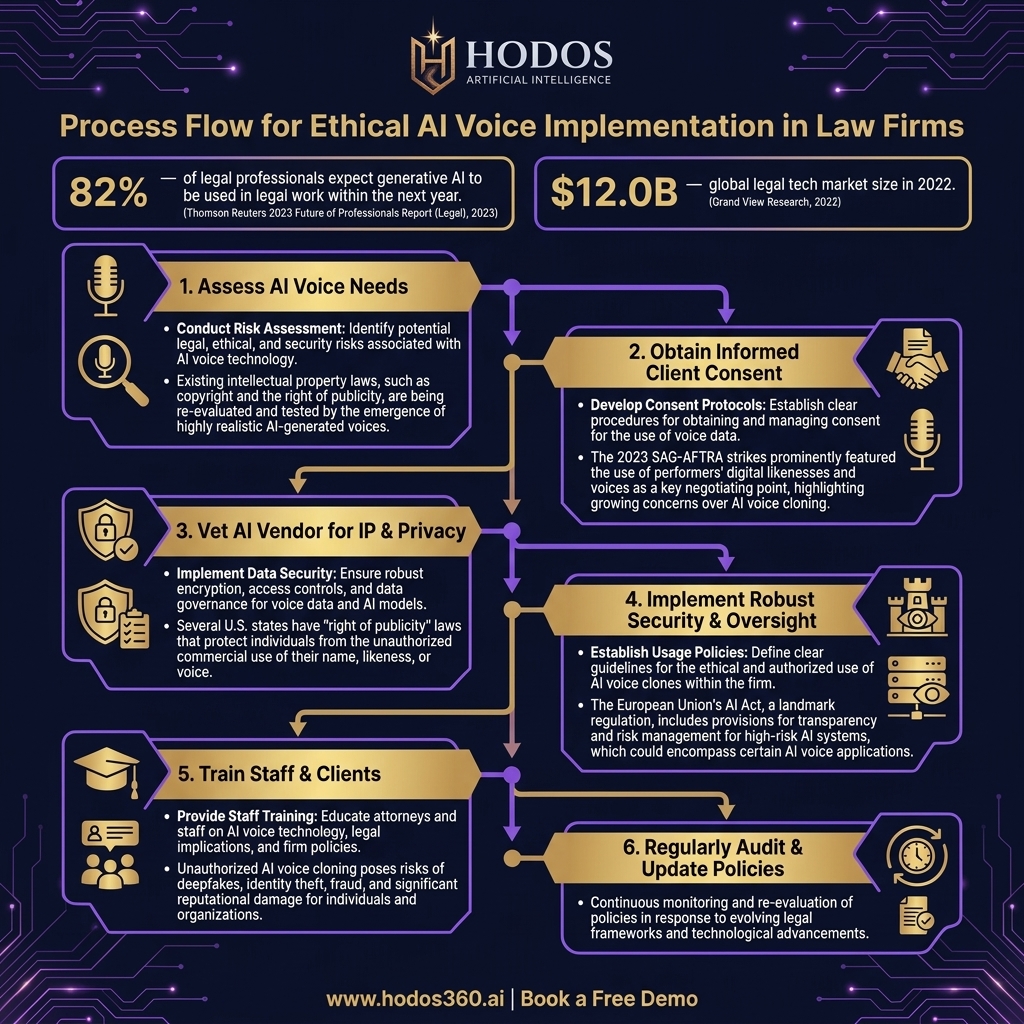
The concept of 'digital identity' is rapidly expanding, encompassing not just a person's name and image, but also their unique vocal characteristics. This expansion requires law firms to think critically about how they manage and protect client data, especially biometric data like voiceprints. The unauthorized creation or use of AI voice clones could lead to profound identity theft, not only for individuals but potentially for corporate entities if key executives' voices are replicated. This risk is particularly acute for law firms, which handle highly sensitive and confidential information. Ensuring that any AI voice technology solution is compliant with strict data privacy regulations, such as GDPR, CCPA, and emerging biometric data laws, is non-negotiable. Firms must implement robust data governance frameworks, including explicit consent mechanisms for voice data collection and clear policies for its use and deletion, to avoid devastating breaches and regulatory penalties.
Furthermore, the very nature of AI-generated content challenges traditional notions of authorship and ownership. If an attorney uses an AI voice clone to generate a podcast introducing new legal services, who holds the copyright to that audio content? Is it the attorney, the firm, or the AI's developer? The answer remains largely unresolved, creating a legal vacuum that demands careful consideration. Firms should establish clear internal policies regarding the use of AI for content creation, defining authorship, ownership, and the necessary disclaimers for AI-generated material. This proactive approach helps mitigate future disputes and ensures that the firm's IP strategy is aligned with the realities of generative AI. Partnering with providers like HODOS 360, which prioritize ethical AI development and data security, becomes crucial for navigating this complex landscape successfully.
The legal landscape for AI voice is evolving rapidly. Ensure your firm stays ahead with compliant and efficient solutions. [Learn more about HODOS 360's AI-powered legal innovations.]
Ethical Imperatives and Client Trust in the AI Era
For law firms, the adoption of AI voice technology is not merely a legal or technical decision; it is fundamentally an ethical one, touching upon the core tenets of the legal profession. The ABA Model Rules of Professional Conduct provide a foundational framework, particularly Rule 1.1 (Competence), Rule 1.6 (Confidentiality of Information), and Rule 5.3 (Responsibilities Regarding Nonlawyer Assistance). Competence now demands an understanding of the risks and benefits of relevant technology. Confidentiality is paramount, meaning firms must ensure that client voice data, if used by AI voice clones or AI voice assistants, is handled with the highest level of security and privacy. The use of nonlawyer assistance (which can include AI tools) requires lawyers to supervise and ensure ethical compliance. Failure to address these ethical considerations can erode client trust, damage reputation, and lead to disciplinary action.
Transparency with clients is a cornerstone of maintaining trust, especially when implementing novel technologies like AI voice clones. If a firm uses an AI voice assistant for initial client intake or routine communications, clients have a right to know they are interacting with an AI, not a human attorney or staff member. Misrepresenting an AI as a human could constitute a breach of the duty of candor and could lead to allegations of deceptive practices. Firms should establish clear communication protocols, including explicit disclosures, to inform clients about the role of AI in their interactions. This transparency not only builds trust but also aligns with the ethical obligations to avoid misleading clients about the nature of legal services provided. The ethical imperative is to use AI to enhance, not diminish, the human element of legal service.
The potential for AI voice clones to be misused for fraudulent purposes represents another significant ethical challenge. Imagine a sophisticated deepfake audio clip of a senior partner instructing a paralegal to transfer funds, or a client providing instructions via an AI voice clone that are later disavowed. The implications for financial fraud, misdirection, and even sabotage are terrifyingly real. Law firms, as custodians of sensitive financial and legal information, must implement robust verification processes that go beyond mere voice recognition. This includes multi-factor authentication, human oversight for critical transactions, and continuous training for staff on identifying and preventing AI-driven scams. The ethical duty to protect client assets and information extends to safeguarding against the advanced deceptive capabilities of synthetic media.
Ultimately, the ethical integration of AI voice technology requires a commitment to human oversight and accountability. While AI can automate tasks and enhance efficiency, the ultimate responsibility for legal advice, client confidentiality, and ethical conduct remains with the human attorneys. Firms must develop clear internal guidelines for when and how AI voice clones are used, ensuring that human review is always the final step for any critical communication or decision. This approach not only fulfills ethical obligations but also leverages AI as a powerful assistant, rather than an autonomous decision-maker, preserving the crucial human judgment and empathy that define the legal profession.
Mitigating Misinformation & Fraud with AI Voice Technology
The sophisticated nature of AI voice clones makes them a potent tool for generating misinformation and perpetrating fraud, a risk that law firms cannot afford to overlook. The ability to perfectly mimic a voice can be exploited to create convincing deepfake audio, which could be used to impersonate clients, opposing counsel, or even judges. A 2024 report by Gartner predicted that by 2026, 30% of enterprise digital content will be synthetically generated, making the detection of AI-generated fraud increasingly challenging. This poses a direct threat to the integrity of legal communications and transactions. Imagine a fabricated voicemail from a client, instructing a change in settlement terms, or a deepfake audio recording of a lawyer discussing confidential case details. The consequences could be catastrophic, leading to financial losses, compromised cases, and severe damage to a firm's reputation. Law firms must therefore prioritize robust security measures and advanced detection capabilities to counteract these emerging threats.
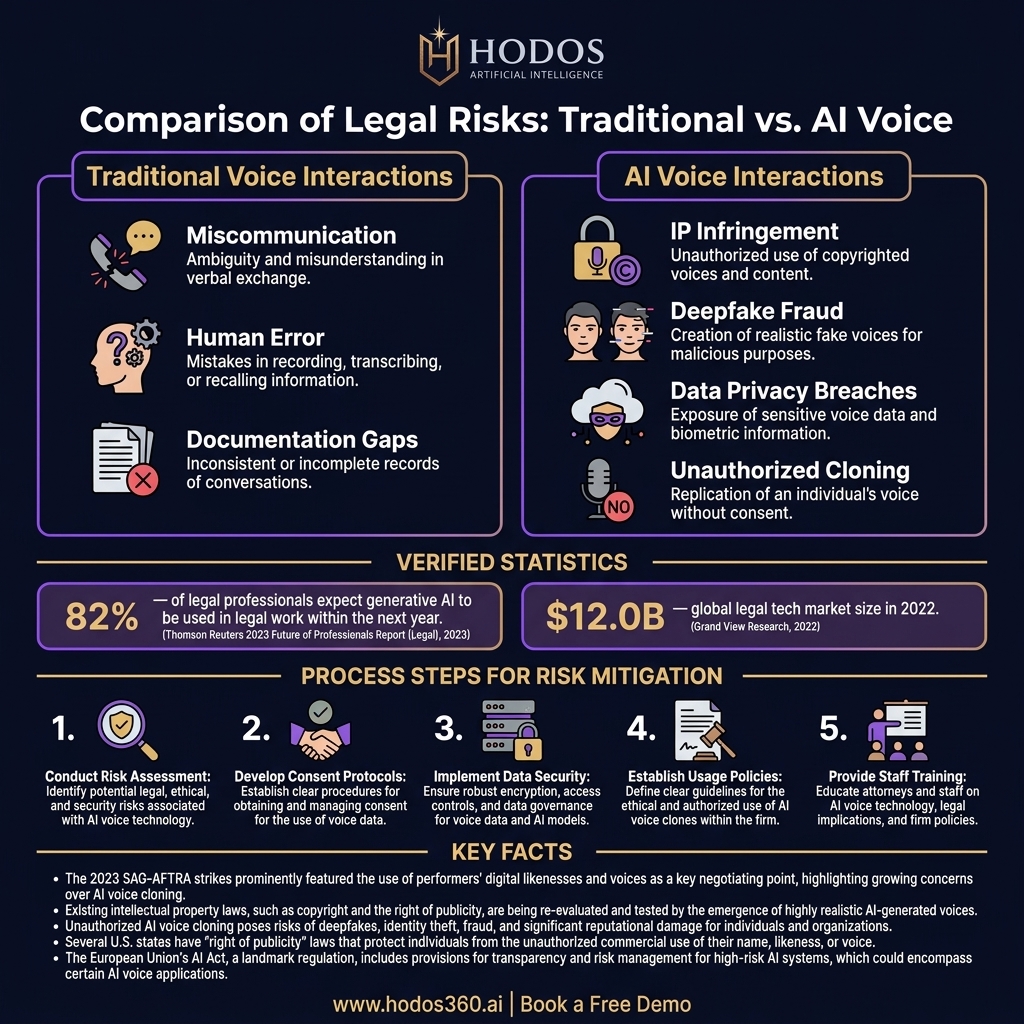
To mitigate these risks, law firms must implement a multi-layered defense strategy. Firstly, technological solutions, such as AI-powered deepfake detection software and advanced biometric verification, should be explored and integrated where appropriate, particularly for critical communications. Secondly, strict internal protocols for verifying instructions, especially those related to financial transactions or sensitive client data, must be enforced. This means moving beyond voice as a sole identifier and requiring secondary verification methods, such as secure video calls, encrypted written confirmations, or multi-factor authentication. Thirdly, continuous education for all staff and clients is essential. Training materials should highlight the dangers of AI voice clones and deepfakes, providing clear examples of how to identify suspicious communications. By fostering a culture of vigilance and skepticism, firms can empower their teams to act as the first line of defense against AI-driven fraud. This proactive stance is not just about compliance; it's about safeguarding the trust and assets entrusted to the legal profession.
Implementing Robust AI Voice Policies for Law Firms
Given the intricate legal and ethical landscape, law firms must proactively develop and implement robust internal policies governing the use of AI voice technology. This starts with a comprehensive assessment of all existing and planned AI tools that involve voice, including AI voice assistants for client communication, transcription services, or content generation. A key component of this policy should be a clear framework for obtaining informed consent from clients regarding the collection, storage, and use of their voice data. This consent must be explicit, detailed, and easily revocable, adhering to principles similar to those found in data privacy regulations like the GDPR. Firms should also define the permissible scope of AI voice usage, ensuring it aligns with professional obligations and client expectations, and outline strict data retention and deletion policies.
Beyond client consent, firms need to establish stringent vendor management protocols. When partnering with third-party AI voice technology providers, a thorough due diligence process is critical. This includes scrutinizing their data security practices, their compliance with relevant privacy laws, their intellectual property policies, and their commitment to ethical AI development. Firms should demand clear contractual assurances regarding data ownership, usage limitations, and liability in case of breaches or misuse. For instance, inquiring about the training data sources of their AI voice clones is essential to prevent inadvertent copyright infringement. A proactive approach to vendor selection can significantly mitigate risks and ensure that the firm's AI strategy is built on a foundation of trust and compliance. This due diligence is akin to the rigorous vetting applied to any other critical legal tech vendor, recognizing the unique sensitivities of voice data.
Furthermore, a robust policy must incorporate continuous training and oversight. All legal professionals and staff who interact with or deploy AI voice technology must receive regular training on the firm's policies, ethical guidelines, and the evolving legal landscape. This training should cover topics such as identifying deepfakes, understanding data privacy obligations, and the importance of transparency with clients. Regular internal audits of AI system usage and performance are also crucial to ensure ongoing compliance and to identify any emerging risks. Human oversight, particularly for sensitive tasks performed by AI voice assistants, remains non-negotiable. The policy should delineate clear lines of responsibility and accountability, ensuring that human judgment ultimately guides the deployment and application of these powerful tools. This ensures that the firm's adoption of AI is both innovative and responsible.
Finally, law firms should consider developing a dedicated 'Responsible AI' committee or task force. This interdisciplinary group, comprising attorneys, IT specialists, and ethics advisors, would be responsible for continually monitoring advancements in AI voice technology, assessing new risks, and updating the firm's policies accordingly. This proactive governance structure ensures that the firm remains agile and adaptable in a rapidly changing technological environment. For instance, as new legislation regarding synthetic media or biometric data emerges, this committee would be tasked with integrating those requirements into the firm's operational framework. This commitment to continuous improvement and ethical leadership positions the firm not just as a technology adopter, but as a thought leader in the responsible application of AI in the legal profession, safeguarding both its own future and the interests of its clients.
Leveraging HODOS 360 for Compliant AI Voice Solutions
In this complex environment, choosing the right technology partner is paramount. HODOS 360 offers AI Voice Assistants designed specifically for law firms, engineered with compliance and ethical considerations at their core. Our platform provides features like 24/7 phone answering, lead qualification, and appointment booking, all while prioritizing data security and transparent client communication. We understand the unique demands of the legal sector and build our solutions to align with professional conduct rules and privacy regulations. Our multilingual support ensures accessibility without compromising on ethical data handling, giving firms peace of mind as they embrace the power of AI to enhance their client service and operational efficiency. By leveraging a platform built with legal ethics in mind, firms can confidently adopt advanced voice AI without the inherent risks of less specialized solutions.

Key Takeaways and Next Steps for Responsible AI Voice Adoption
The debate over AI voice clones in Hollywood serves as a critical bellwether for the legal industry. The capabilities of AI voice technology offer unprecedented opportunities for law firms to enhance efficiency, improve client experience, and streamline operations, from automated client intake to providing 24/7 support. However, these advancements come tethered to significant legal and ethical responsibilities. Firms must proactively navigate the evolving landscape of intellectual property, data privacy, and professional conduct to leverage AI voice effectively and responsibly. The imperative is clear: embrace innovation with vigilance, ensuring that technological progress is always aligned with the foundational principles of justice, confidentiality, and client trust.
To successfully integrate AI voice technology into your practice, prioritize informed consent, implement robust data governance, conduct thorough vendor due diligence, and foster a culture of continuous ethical oversight. By taking these proactive steps, law firms can harness the transformative power of AI to drive growth and efficiency while safeguarding their clients' interests and upholding the integrity of the profession. The future of legal practice is undeniably AI-powered, but its success hinges on responsible and ethical deployment. Embrace the future of legal practice with confidence. [Schedule a free demo of HODOS 360's comprehensive AI platform and secure your firm's digital future.]
Frequently Asked Questions
What are the primary legal risks of using AI voice clones in a law firm?+
The main legal risks include intellectual property infringement (right of publicity, copyright), data privacy violations (unauthorized collection/use of biometric voice data under GDPR/CCPA), and potential liability for misinformation or fraud if deepfake audio is involved. Firms must ensure explicit consent and robust security protocols to mitigate these risks and maintain client trust.
How does the Right of Publicity apply to AI voice clones for legal professionals?+
The Right of Publicity protects an individual's commercial use of their voice. If a law firm uses an AI voice clone of an attorney, client, or public figure for marketing or other commercial purposes without explicit consent, it could lead to legal action. State laws, like California's Civil Code Section 3344, are crucial here, emphasizing the need for clear licensing and permission.
What ethical duties do lawyers have when using AI voice technology?+
Lawyers have ethical duties of competence (understanding AI's risks/benefits), confidentiality (protecting client voice data), and candor (transparency with clients about AI use). ABA Model Rules 1.1, 1.6, and 5.3 are particularly relevant. Firms must ensure human oversight and accountability for all AI-generated communications and decisions.
Can AI-generated voices be copyrighted?+
Generally, works created solely by AI, including AI-generated voices, are not eligible for copyright protection in the U.S. due to the 'human authorship' requirement. If a human significantly modifies or guides the AI's output, elements of that human contribution might be copyrightable. Firms must clarify ownership and licensing for all AI-generated content.
What are best practices for law firms to implement AI voice policies?+
Best practices include obtaining explicit client consent for voice data use, conducting thorough due diligence on AI voice technology vendors, implementing strict data security and privacy protocols, providing continuous staff training on AI ethics and deepfake detection, and establishing clear internal guidelines for AI voice deployment with human oversight.