

AI Website Builders: The Ultimate Guide for Law Firms
The digital storefront of a law firm is no longer a luxury; it's a critical component of client acquisition and brand reputation. For years, many solo practitioners and small to mid-sized firms like Sarah Chen's boutique family law practice in Austin, Texas, found themselves in a bind. Chen recounts spending upwards of $10,000 on a custom website five years ago, only to discover it was a static, slow, and non-responsive relic in an increasingly mobile-first world. Her frustration echoed that of countless legal professionals who either lacked the technical expertise to manage their online presence effectively or simply couldn't justify the exorbitant costs and lengthy development cycles of traditional web design. The competitive pressure from larger firms, armed with extensive marketing budgets and dedicated digital teams, only intensified this dilemma, making it harder for agile, client-focused practices to stand out.
This tension between traditional legal service delivery and the imperative for digital transformation has reached a crescendo. The legal industry, historically cautious in its adoption of new technologies, now faces an undeniable shift driven by client expectations and technological advancements. As legal tech expert Jack Newton, CEO of Clio, frequently emphasizes at events like the Clio Cloud Conference, "The future of law is client-centered, and that means being accessible and discoverable where clients are searching – online." Firms that cling to outdated digital strategies risk not just stagnation, but obsolescence. The digital divide isn't just about having a website; it's about having an *effective*, *optimized*, and *secure* website that genuinely serves as a hub for client engagement and business growth.
Enter the game-changer: AI website builders. These innovative platforms are democratizing sophisticated web design, offering law firms a powerful, cost-effective, and efficient pathway to a world-class online presence. As highlighted by Forbes' recent article, "Best AI Website Builders Of 2026: 18 Platforms Tested," the landscape of web development has been fundamentally reshaped by artificial intelligence. No longer confined to the realms of complex coding or expensive agencies, AI now empowers legal professionals to construct dynamic, responsive, and SEO-optimized websites with unprecedented ease. This evolution is not merely about automating tasks; it's about intelligent design, personalized user experiences, and strategic digital positioning that can level the playing field for law firms of all sizes. Ready to elevate your firm's digital presence? Discover HODOS 360's Web & Mobile Development solutions today!
The Transformative Power of AI Website Builders in Legal Practice
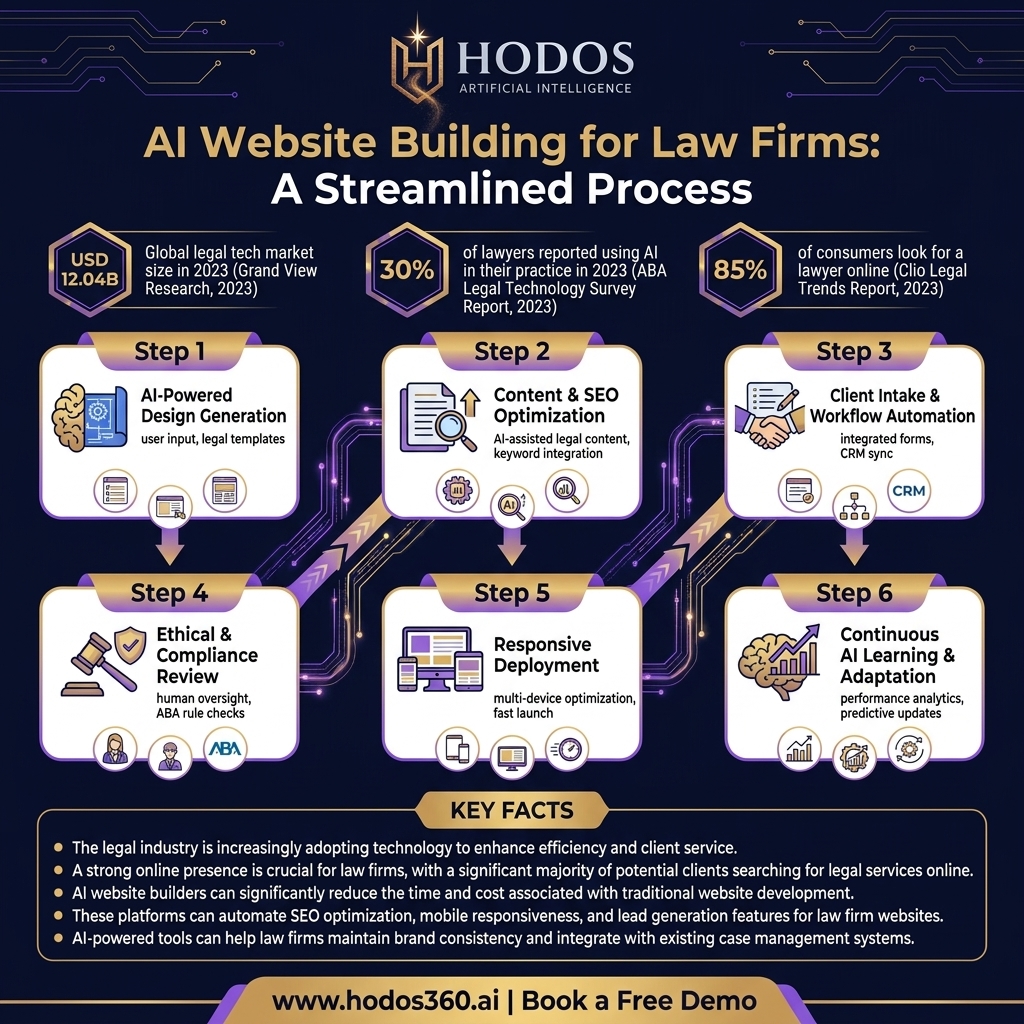
The advent of AI website builders has sparked a quiet revolution in how law firms approach their digital footprint. These platforms leverage artificial intelligence to automate significant portions of the website creation process, from initial design layouts and content generation to SEO optimization and ongoing maintenance. Instead of spending weeks or months with web developers, a law firm can now input its core information – practice areas, firm ethos, target audience – and watch as an AI algorithm constructs a bespoke, professional-grade website in a fraction of the time. This efficiency is a direct answer to the persistent challenges identified in the American Bar Association's annual TechReport, which consistently shows that a significant percentage of small firms still struggle with outdated websites or a complete lack of online presence, citing cost and time as primary barriers.
Consider the journey of 'Lex Innova Law,' an intellectual property firm led by founding partner Dr. Elena Rodriguez. Learn more about AI Marketing Law Firm Growth Strategies. Faced with the need for a scalable online presence without draining capital, she turned to an AI website builder. "The AI understood our brand guidelines and content requirements almost immediately," Rodriguez noted at a recent legal tech summit. "It suggested layouts optimized for showcasing complex case studies and client testimonials." This ability of AI to interpret specific business needs and translate them into functional, aesthetically pleasing web designs is a stark contrast to the traditional model, where a firm's vision often gets lost in translation between legal and technical teams.
Customization, Brand Identity, and Scalability
Modern AI website builders offer robust customization options, ensuring that each law firm's unique brand identity is not only preserved but enhanced. After the initial AI-driven draft, attorneys and marketing teams can easily fine-tune every element – from color palettes and font choices to specific page layouts and interactive features. The AI acts as a smart assistant, offering suggestions for improvement based on user behavior data and design best practices, but the final creative control remains firmly in the hands of the firm. Furthermore, the scalability inherent in AI-powered web development is invaluable for growing law practices. Learn more about AI Agents Search: The Essential API for Real-Time Legal Web Data. As a firm expands its services, adds new attorneys, or opens new offices, its website needs to adapt quickly and seamlessly. This capacity for rapid evolution means that a law firm's digital presence can keep pace with its business growth, allowing quick deployment for new services like 'medvi' (medical legal claims) or 'elixamd' (digital health legal advice).
Beyond Aesthetics: AI's Role in Law Firm SEO and Client Conversion
A beautiful website is only effective if it can be found by potential clients, and this is where AI website builders truly shine in the realm of Search Engine Optimization (SEO) and client conversion. Unlike static, traditionally built sites that often require manual, labor-intensive SEO efforts, AI-powered platforms integrate advanced SEO functionalities from the ground up. They automatically generate optimized meta descriptions, intelligent title tags, and structured data markup, ensuring that legal content is easily discoverable by search engines like Google. Data from a 2023 Thomson Reuters report indicated that over 60% of new legal client inquiries originate from online search, underscoring the critical importance of a robust SEO strategy.
Consider the case of 'JusticeLink Chambers,' a regional firm. Managing Partner David Kim, a proponent of data-driven legal marketing, spearheaded their adoption of an AI-powered website. Learn more about Gemini AI for Law Firms: The Ultimate Guide to Google's Legal Expansion. "Within six months of launching with an AI builder, our organic traffic for 'Seattle personal injury lawyer' increased by over 150%," Kim stated. "The AI suggested long-tail keywords we hadn't even considered and automatically optimized our blog posts for local search." This transformation highlights the AI's ability to act as a perpetual SEO consultant, constantly monitoring algorithm changes and recommending real-time adjustments to maximize visibility. Adherence to ethical marketing guidelines, such as ABA Model Rule 7.1 (Communications Concerning a Lawyer’s Services), is paramount, and AI tools can be configured to flag potentially misleading claims.
AI-Driven Content & Lead Generation
The role of AI in content creation and lead generation extends far beyond simple SEO. Many AI website builders now incorporate sophisticated AI writing assistants that can help draft blog posts, summarize complex legal concepts, and even generate social media updates. This dramatically reduces the time and resources attorneys typically spend on content marketing, allowing them to focus on their legal work. Beyond content, AI also plays a pivotal role in optimizing the lead generation funnel directly on the website. Learn more about AI Web Design: Essential Strategies for Law Firms in the AI Search Era. Features like AI-powered chatbots can provide 24/7 assistance to website visitors, answer common legal questions, pre-qualify leads, and even schedule initial consultations. The integration of such tools with services like HODOS 360's AI Marketing Platform and AI Voice Assistants creates a synergistic ecosystem where a firm's website becomes a highly efficient, automated client acquisition machine.
Navigating the Landscape: Choosing the Right AI Website Builder for Your Firm
With the proliferation of AI website builders, as noted by Forbes' extensive testing of 18 platforms, selecting the ideal solution for a law firm requires careful consideration. The market offers a diverse range of options, from general-purpose builders like Wix AI and GoDaddy's AI tool to more specialized platforms. For law firms, the choice hinges on several critical factors that go beyond basic functionality. Firstly, evaluate the level of legal-specific customization available. Does the builder offer templates designed for law firms? Can it easily integrate client portals, secure document upload features, and detailed attorney profiles? The ability to represent complex practice areas clearly and ethically is paramount. Look for platforms that understand the unique content and structural needs of a legal practice.
Secondly, scrutinize the pricing structures and included features. Learn more about Legal AI Models: The Essential Shift to In-House Development. While some builders offer enticing free tiers, these often come with limitations on storage and advanced functionalities essential for a professional law firm. Compare the value proposition: what are the monthly or annual costs, and what do they encompass? Does it include domain registration, secure hosting, SSL certificates, and email services? Some platforms, like Hostinger's AI builder, are praised for their competitive pricing alongside robust features, while others might offer premium support or advanced analytics at a higher cost. It's crucial to consider the total cost of ownership, including potential add-ons. The "best AI website builder" is ultimately the one that aligns most closely with your firm's specific needs and budget, offering a strong return on investment.
Data Security and Compliance in an AI-Powered Web Environment
The ethical obligations of attorneys regarding client confidentiality and data security are enshrined in professional conduct rules, such as ABA Model Rule 1.6 (Confidentiality of Information). When leveraging AI website builders, law firms must ensure that their chosen platform adheres to the highest standards of data protection. This involves understanding where data is hosted, how it is encrypted, and what measures are in place to prevent breaches. Many reputable AI website builders offer robust security features, including SSL certificates and compliance certifications (e.g., ISO 27001). Learn more about AI Lead Flow: Essential Strategies for Law Firm Growth. However, firms must conduct their due diligence, reviewing terms of service and privacy policies to ensure alignment with their professional responsibilities and any applicable jurisdictional data privacy laws. The ABA Standing Committee on Ethics and Professional Responsibility frequently issues guidance on technology use, and firms should consult these resources to stay abreast of evolving ethical obligations in the digital realm. Consult the ABA's Standing Committee on Ethics and Professional Responsibility for guidance on technology use.
Future-Proofing Your Practice with AI-Powered Web Development
The trajectory of AI website builders points towards an even more integrated and intelligent future for legal web development. We are already seeing the early stages of personalized web experiences, where an AI can dynamically alter content or layout based on a visitor's previous interactions, geographic location, or expressed interests. Imagine a potential client searching for "estate planning attorney" in their city, landing on a firm's website, and having the homepage immediately highlight relevant local services, attorney bios, and client testimonials specific to estate planning. This level of personalization, driven by advanced AI analytics and machine learning, promises to dramatically increase engagement and conversion rates.
Looking ahead, predictions from industry leaders at events like LegalTech NYC 2026 suggest deeper integration of AI across all aspects of digital presence. Voice search optimization, for example, will become increasingly critical as more clients use virtual assistants to find legal services. AI website builders are evolving to inherently understand and optimize for natural language queries, ensuring firms remain discoverable in this new paradigm. Furthermore, the integration of generative AI models, akin to those developed by OpenAI and Anthropic, directly into website interfaces will enable real-time, sophisticated content generation and interactive Q&A sessions for visitors, moving beyond simple chatbots to truly intelligent virtual receptionists. Jensen Huang, CEO of NVIDIA, often speaks about AI becoming the "co-pilot" for every industry, and web development is no exception.

Key Takeaways and Next Steps
The digital age demands a robust and dynamic online presence for every law firm. The emergence of AI website builders has irrevocably altered the landscape of legal web development, offering an unprecedented blend of efficiency, customization, and strategic advantage. From automating intricate design processes to optimizing for critical SEO factors and facilitating seamless client conversion, these platforms empower law firms to build and maintain sophisticated websites without the traditional barriers of cost and complexity. The ability to quickly adapt to market trends, maintain ethical compliance, and scale operations makes AI-powered web solutions an indispensable asset for any forward-thinking practice.
For law firm owners and legal professionals looking to future-proof their practice, the message is clear: embracing AI in your web strategy is no longer optional. It's about leveraging intelligent tools to enhance visibility, attract qualified leads, and ultimately, serve your clients better. HODOS 360's Web & Mobile Development service is engineered precisely for this purpose, providing AI-powered website building tailored to the unique demands of the legal sector. We combine cutting-edge AI with deep industry understanding to deliver websites that are not just visually appealing, but also high-performing, secure, and compliant. Don't let your firm fall behind in the digital age. Book a free demo with HODOS 360 to see our AI-powered web solutions in action.
- ✓Accelerated Development: Launch professional, responsive websites in days, not months.
- ✓Cost Efficiency: Significantly reduce web design and maintenance expenditures.
- ✓Enhanced SEO: Built-in AI optimization ensures higher visibility in search results.
- ✓Seamless Customization: Maintain your firm's unique brand identity with flexible design tools.
- ✓Improved Client Engagement: Features like AI chatbots and personalized content boost user experience.
- ✓Scalability for Growth: Easily adapt your website as your firm expands and services evolve.
- ✓Data-Driven Insights: Gain valuable analytics to refine your digital strategy continually.
Frequently Asked Questions
What is an AI website builder, and how does it benefit law firms?+
An AI website builder uses artificial intelligence to automate and streamline the process of creating and managing websites. For law firms, this means generating professional, responsive sites quickly and cost-effectively, without extensive coding knowledge. Benefits include faster launch times, reduced development costs, improved SEO, and enhanced client engagement through features like AI-driven content suggestions and chatbots, ultimately boosting online presence and lead generation.
How do AI website builders differ from traditional web development for legal practices?+
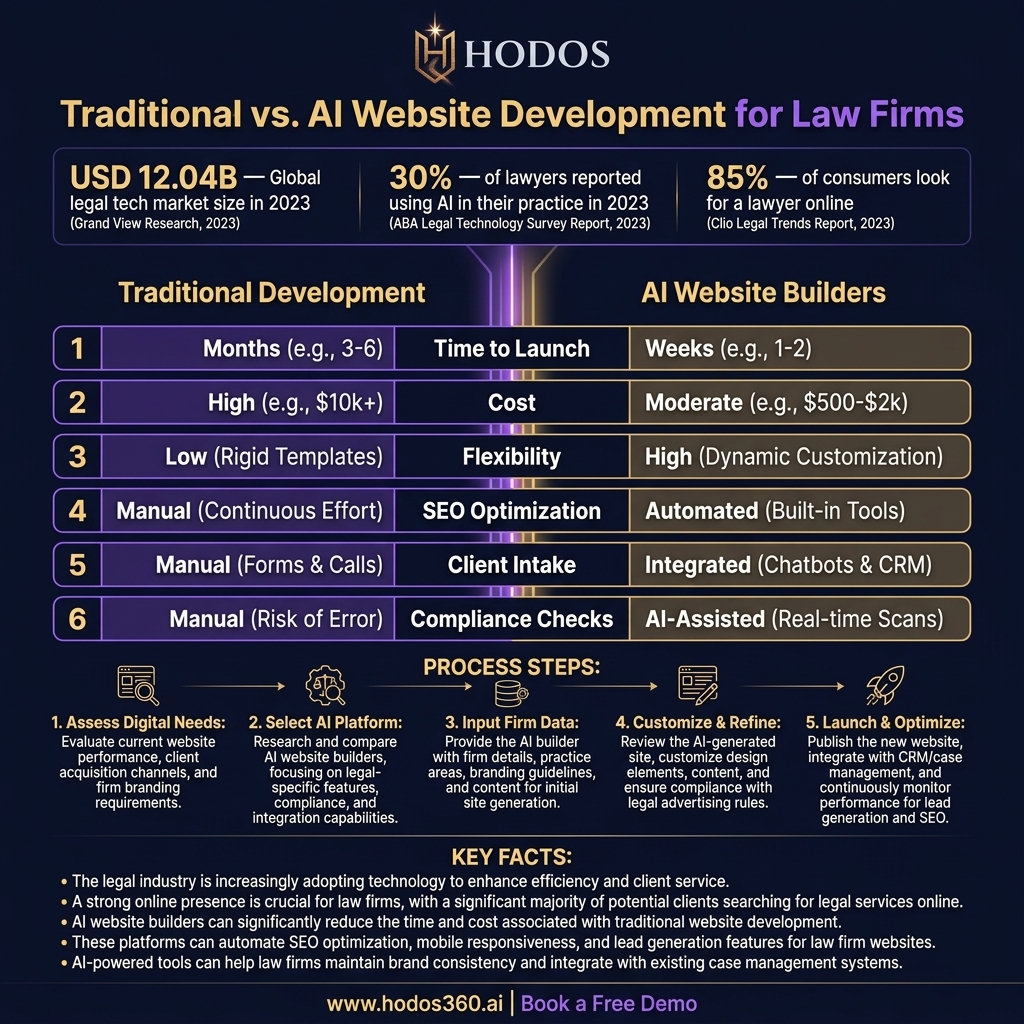
Traditional web development typically involves manual coding, design, and content creation, often requiring significant time and financial investment. AI website builders leverage algorithms to automate these tasks, generating initial designs, optimizing content for search engines, and providing smart customization options. This results in faster deployment, greater cost efficiency, and continuous optimization, allowing legal practices to maintain a cutting-edge online presence with fewer resources compared to bespoke development.
Are AI-generated websites customizable enough to reflect a law firm's unique brand and identity?+
Absolutely. While AI website builders can generate initial designs, they offer extensive customization tools that allow law firms to tailor every aspect of their site. Firms can easily adjust color schemes, fonts, layouts, and integrate specific branding elements, ensuring the website authentically represents their unique identity and professionalism. The AI acts as an intelligent assistant, providing suggestions while maintaining user control over the final design, blending efficiency with bespoke branding.
Can AI website builders effectively help with SEO for my law firm?+
Yes, AI website builders are highly effective for law firm SEO. They incorporate advanced AI algorithms that automatically optimize meta tags, descriptions, and content for search engines. These platforms analyze legal keywords, competitor strategies, and search trends to suggest improvements, ensuring your firm ranks higher in search results. This built-in SEO capability significantly enhances your firm's online visibility, making it easier for potential clients to find your services through organic search.
What are the security considerations for using an AI website builder for legal content and client data?+
Security is paramount for law firms. Reputable AI website builders offer robust security features like SSL encryption, DDoS protection, and compliance with data privacy regulations (e.g., GDPR, CCPA). Firms must verify the platform's security protocols, data hosting policies, and compliance certifications. Additionally, maintaining human oversight for all AI-generated content is crucial to ensure accuracy and ethical compliance with rules like ABA Model Rule 1.6, safeguarding client confidentiality and avoiding misleading information.