


Legal AI Models: The Essential Shift to In-House Development
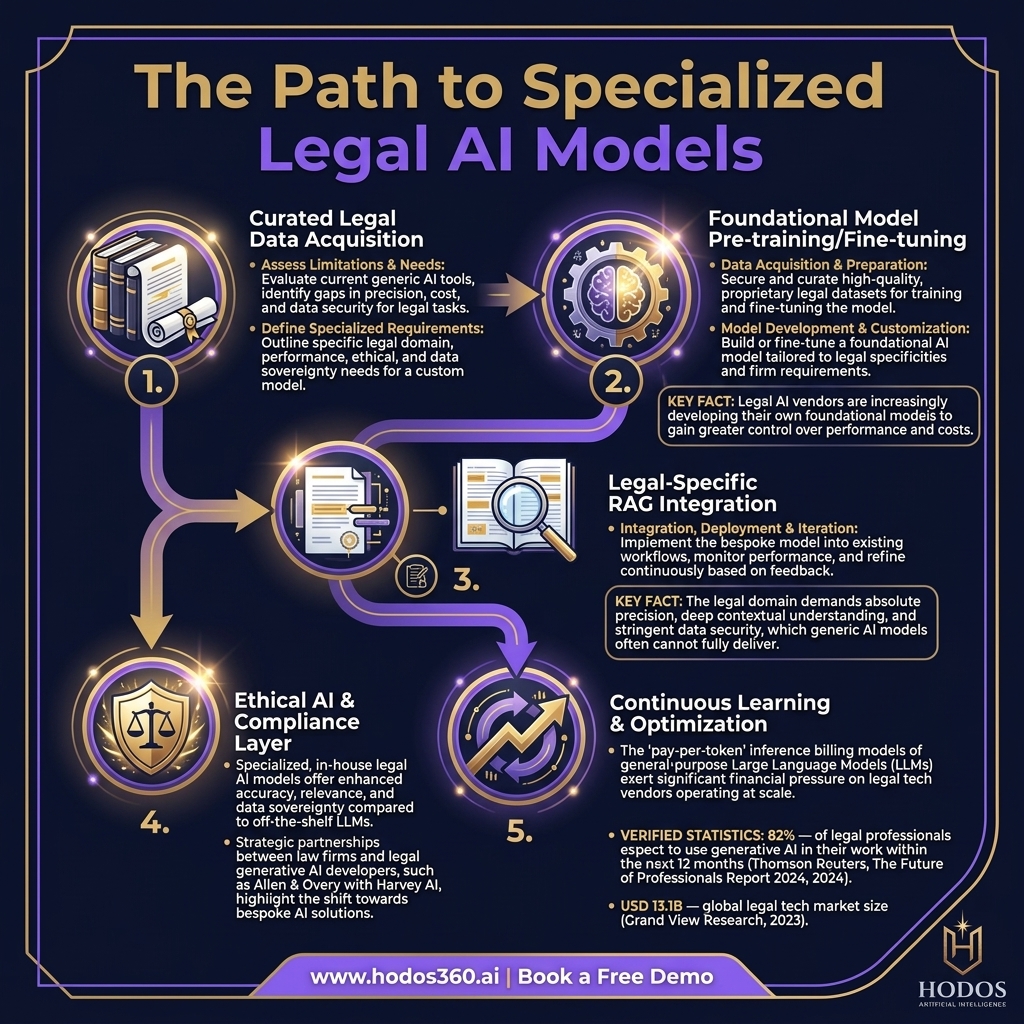
A palpable tension is building within the legal technology sector, a strategic pivot that was starkly highlighted in a recent MarketScale report: legal AI vendors are increasingly developing their own foundational models. This isn't merely an incremental update; it's a fundamental reorientation driven by the twin imperatives of cost control and the quest for hyper-specialized performance. For years, legal tech innovators, much like other industries, relied heavily on general-purpose Large Language Models (LLMs) from giants like OpenAI and Anthropic. While these powerful models offered unprecedented capabilities, their 'pay-per-token' inference billing models began to exert significant financial pressure on vendors operating at scale. As firms like Harvey AI, a key player in legal generative AI, forge deeper partnerships with global powerhouses such as Allen & Overy, the dialogue has shifted from simply integrating AI to strategically owning the core intelligence that powers legal workflows. This move represents a calculated response to the inherent limitations of generic AI in a field demanding absolute precision and confidentiality.
The implications for law firms are profound. What began as an exploration into general AI capabilities is now maturing into a sophisticated ecosystem of bespoke legal AI models. The initial excitement around tools powered by off-the-shelf LLMs is giving way to a more discerning demand for solutions that are purpose-built for legal nuances, ethical considerations, and stringent data security requirements. This trend isn't just about saving money; it’s about achieving a level of accuracy, relevance, and data sovereignty that generic models simply cannot deliver. As lawyers like Sarah Glassmeyer, a prominent legal tech futurist, have often emphasized, the legal domain requires more than just smart text generation; it demands a deep contextual understanding that only specialized training can provide. Law firms stand at a crucial juncture, needing to understand this shift to make informed decisions about their technology investments and secure their competitive edge in an increasingly AI-driven legal landscape.
The Strategic Imperative: Why Legal AI Vendors Build Their Own Models
The decision by legal AI models vendors to embark on the arduous and expensive journey of building their own foundational models is a strategic response to several market forces. Firstly, it's about achieving true domain specificity. While general LLMs like GPT-4 or Claude 3 are incredibly versatile, they lack the deep, nuanced understanding of legal terminology, precedents, and procedural rules that are critical for high-stakes legal work. This often leads to 'hallucinations' or outputs that, while grammatically correct, are factually or contextually incorrect in a legal setting. For instance, a generic model might struggle to differentiate between persuasive and binding authority, a distinction fundamental to legal reasoning. By training or fine-tuning models extensively on curated legal datasets—court opinions, statutes, regulations, and firm-specific documents—vendors can create custom models that demonstrate superior accuracy and relevance, drastically reducing the need for extensive human post-editing and mitigating professional liability risks. This strategic move differentiates specialized legal AI tools from general-purpose AI, offering a compelling value proposition to law firms seeking reliable and precise solutions.
Secondly, this shift is a direct answer to the escalating competition among legal tech vendors. Learn more about AI Website Builder: The Ultimate Guide for Law Firms. In a market where many initial offerings were built on the same underlying OpenAI or Anthropic APIs, differentiation became challenging. Companies like Casetext (now part of Thomson Reuters) recognized this early, investing in their own legal-specific models and R&D even before the widespread generative AI boom. Their acquisition by Thomson Reuters for an estimated $500 million underscores the immense value placed on proprietary, specialized AI. As Brad Smith, Vice Chair and President of Microsoft, has often emphasized regarding the broader AI landscape, the future belongs to those who can not only integrate but also innovate at the foundational layer. For legal tech, this means moving beyond being mere API wrappers to becoming architects of truly intelligent AI development that understands the intricate fabric of the law. This strategic investment positions these vendors, and by extension their law firm clients, at the forefront of the legal industry's technological evolution, ensuring they can offer genuinely cutting-edge capabilities.
The Competitive Edge: Differentiation in a Crowded Market
In a legal tech market predicted by Gartner to reach over $30 billion by 2027, the ability to differentiate is paramount. Building proprietary legal AI models provides a unique competitive moat, allowing vendors to offer features and performance characteristics that cannot be easily replicated by competitors relying on generic APIs. This isn't just about marginal improvements; it's about creating a fundamentally superior product that resonates with the specific demands of legal professionals. For example, a vendor with its own model can more precisely control the model's behavior, fine-tuning it to prioritize specific legal contexts, like contract analysis or litigation prediction, over general knowledge. Learn more about AI Assistants: Essential for Law Firm Web Engagement & Growth. This level of control translates into a more reliable and trustworthy tool for attorneys, leading to higher adoption rates and client satisfaction. This strategic differentiation is essential for long-term success in a rapidly maturing industry.
The Economics of Inference: Cost Savings and Data Sovereignty
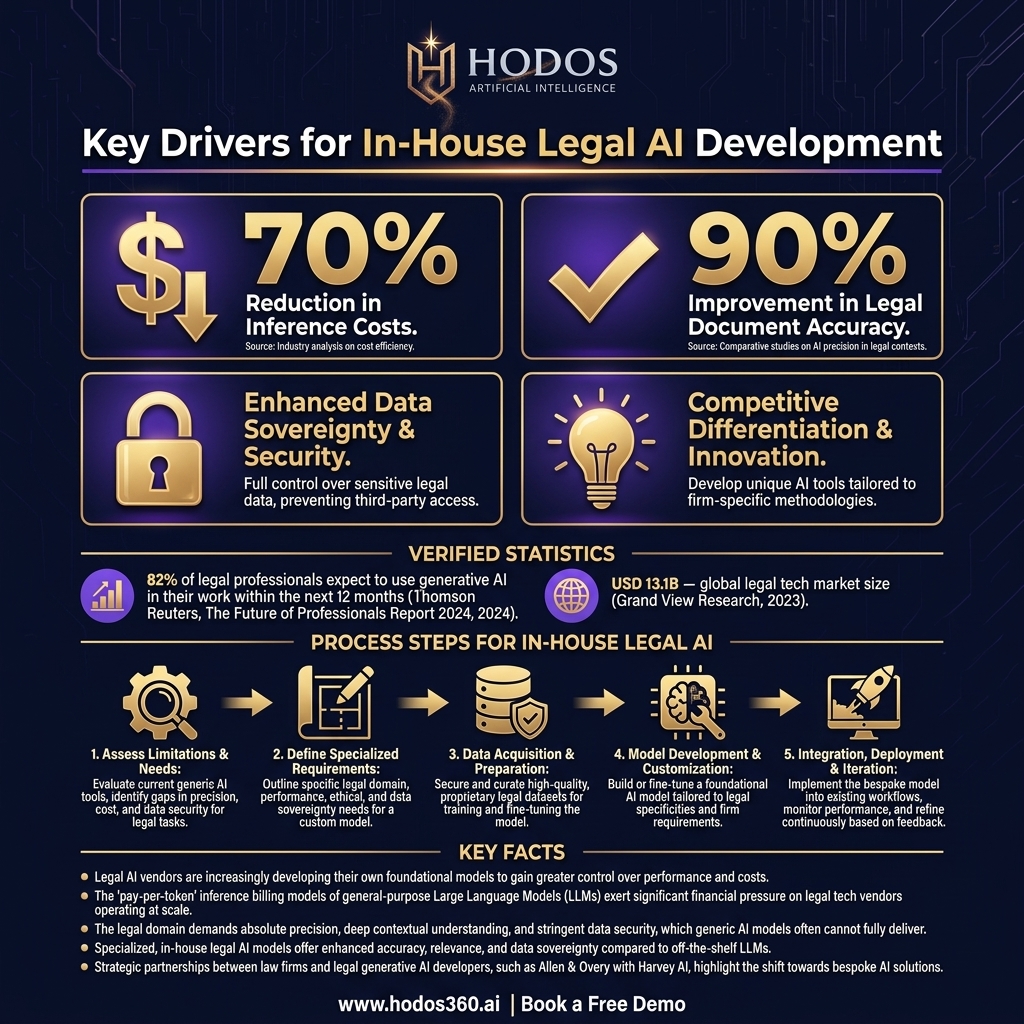
One of the most compelling drivers behind the shift to in-house AI models for law firms is the sheer economics of inference. As legal AI tools scale, the costs associated with calling external LLM APIs can become astronomical. Each query, each token generated, contributes to an 'inference bill' that can quickly erode profit margins for vendors and, indirectly, increase costs for end-user law firms. A 2025 report by McKinsey & Company on enterprise AI adoption highlighted that for companies with high-volume AI usage, the cost of external API calls often becomes the single largest operational expense. By developing and hosting their own models, vendors can significantly reduce these per-token costs, achieving economies of scale and passing those savings onto their clients, or reinvesting them into further R&D. This cost efficiency is not just about short-term gains but about building a sustainable business model for the long haul in a capital-intensive industry.
Beyond cost, the issue of data sovereignty is a critical concern, particularly within the legal sector. Learn more about Legal AI Adoption: An Essential Roadmap for Law Firms. When law firms use legal AI models that rely on external, general-purpose LLMs, there's an inherent dependence on third-party infrastructure for processing sensitive client data. While providers like OpenAI and Anthropic offer robust data privacy agreements, the concept of client confidentiality, enshrined in rules like ABA Model Rule 1.6, demands the highest level of control and transparency. By building and managing their own custom models, legal tech vendors can implement bespoke security protocols, ensure data processing occurs within controlled environments, and provide greater transparency regarding data handling. This reduces platform dependence and offers law firms peace of mind, knowing that their highly confidential information is being processed within an architecture specifically designed for legal data privacy and security. This control over the data pipeline is not just a technical advantage but a crucial ethical and professional responsibility.
Data Privacy and Security: A Paramount Concern
For law firms, the security and privacy of client data are non-negotiable. The move towards in-house AI development by legal tech vendors directly addresses this paramount concern. When a vendor controls the entire model stack, from training data to inference, they can implement end-to-end encryption, strict access controls, and robust auditing mechanisms that are tailored to legal industry standards. Learn more about Essential AI Legal Solutions: Freshfields' Gemini Integration. This minimizes the risk of data breaches and ensures compliance with global data protection regulations like GDPR or CCPA, which are increasingly relevant for law firms operating internationally. The ability to ensure that client information never leaves a secure, legally compliant environment is a significant advantage, fostering trust and enabling law firms to confidently adopt advanced legal AI tools without compromising their ethical obligations to clients.
Custom Models vs. Off-the-Shelf LLMs: Performance and Specialization
The performance gap between generic, off-the-shelf LLMs and custom models fine-tuned for legal applications is substantial. While a general LLM might excel at creative writing or broad information retrieval, it often falters when confronted with the intricate logic, specific terminology, and context-dependent interpretations inherent in legal documents. For example, a general model might misinterpret the intent behind a contractual clause or fail to identify critical jurisdictional nuances in a case brief. Legal AI models developed in-house, by contrast, are trained on vast corpora of legal texts, enabling them to understand legal concepts with far greater accuracy and reduce the incidence of 'hallucinations'—a persistent concern for legal professionals. This specialization allows for more reliable document review, contract drafting, and legal research, providing attorneys with outputs they can trust and integrate directly into their work, rather than spending time fact-checking every AI-generated response. The precision offered by these specialized models is not just a luxury; it's a necessity for maintaining professional standards and client confidence.
Furthermore, the evolution of AI development allows for sophisticated techniques like Retrieval-Augmented Generation (RAG), which integrates proprietary knowledge bases with LLMs. Learn more about AI Chatbot Development: The Essential Guide for Law Firms. When combined with a custom-built or heavily fine-tuned model, RAG systems can dramatically enhance the relevance and factual accuracy of AI outputs by grounding them in specific, verified legal documents. This is particularly crucial for tasks like summarizing complex litigation documents or analyzing discovery materials, where context and source attribution are paramount. Companies like LegalZoom and Rocket Lawyer, while not building foundational models, are increasingly leveraging fine-tuned models for their customer-facing legal assistance. This push towards specialization also aligns with ethical AI development principles, as discussed at events like LegalTech NYC 2026, where the emphasis was on building AI that is not only powerful but also transparent, fair, and accountable. By controlling the training data and model architecture, vendors can embed ethical safeguards, ensuring their legal AI models are less prone to bias and more aligned with the principles of justice, a critical aspect of responsible technology adoption in the legal field.
Ethical AI Development and Regulatory Compliance
The development of proprietary legal AI models offers vendors greater control over embedding ethical principles directly into the AI's architecture and training data. This is particularly vital in light of emerging regulations like the EU AI Act, which mandates stringent requirements for high-risk AI systems, including those used in legal contexts. By building their own models, vendors can ensure greater transparency in how AI decisions are made, actively mitigate algorithmic bias, and design systems that prioritize fairness and human oversight. Learn more about Legal AI Gap Widens: Strategic Imperative for Law Firms 2026. This proactive approach to ethical AI development not only fosters trust among legal professionals but also positions firms to be compliant with an increasingly complex regulatory landscape, safeguarding against potential legal liabilities and upholding the integrity of the justice system. The Comment [8] to ABA Model Rule 1.1 emphasizes that lawyers must keep abreast of changes in law and practice, including the benefits and risks of technology, making ethical AI development a core competency for vendors and firms alike.
Navigating the Legal AI Landscape: Implications for Law Firms
For law firms, this shift among legal tech vendors from generic to specialized AI models for law firms presents both opportunities and challenges. The primary benefit is access to more powerful, accurate, and reliable legal AI tools that are truly fit-for-purpose. Firms can expect to see improvements in everything from document review speed and accuracy to the generation of highly specific legal arguments and client communications. This translates into enhanced efficiency, reduced operational costs, and ultimately, better client outcomes. However, it also means that law firms must become more discerning buyers. The 'build versus buy' dilemma now extends beyond simply choosing a software package; it involves understanding the underlying AI architecture and the vendor's commitment to domain-specific AI development. Firms need to ask critical questions about data security, model transparency, and the vendor's long-term strategy for AI innovation. The days of simply adopting the most popular general AI are over; strategic partnerships with vendors committed to specialized legal AI are now essential for maintaining a competitive edge and delivering superior legal services in an increasingly data-driven world.
As the market matures, the differentiation between law firm platforms will increasingly hinge on the intelligence and specialization of their embedded legal AI models. Firms that embrace platforms leveraging these advanced, proprietary models will gain significant advantages in productivity, client service, and risk management. This strategic adoption allows firms to automate routine tasks, focus attorney time on complex legal analysis, and provide innovative services to clients. For example, a firm using a highly specialized AI for contract analysis can review hundreds of agreements in a fraction of the time, identify key clauses, and flag potential risks with greater consistency than manual review. This not only boosts internal efficiency but also positions the firm as a leader in legal innovation, attracting new talent and sophisticated clients. The future of legal practice is one where technology choices are not just about convenience but about strategic investment in capabilities that redefine legal service delivery.
- ✓Evaluate Vendor's AI Strategy: Look beyond marketing claims; inquire about their foundational AI development, whether they're using proprietary or fine-tuned models, and their commitment to legal-specific training.
- ✓Prioritize Data Security & Compliance: Ensure the vendor's AI infrastructure aligns with ABA ethical guidelines and relevant data privacy regulations like GDPR, particularly regarding client confidentiality.
- ✓Assess Model Performance & Accuracy: Request demos and case studies demonstrating the AI's accuracy and reliability in legal tasks, specifically in reducing hallucinations and providing contextual relevance.
- ✓Consider Integration Capabilities: Choose legal AI tools that integrate seamlessly with your existing law firm platforms for case management, document automation, and billing to create cohesive workflows.
- ✓Understand Cost Structures: Beyond initial fees, clarify inference costs and how the vendor's model strategy impacts long-term operational expenses for your firm.
- ✓Focus on Specialization: Opt for solutions that leverage custom models designed explicitly for legal tasks, offering deeper insights and more trustworthy outputs than generic LLMs.

Future-Proofing Your Practice: Embracing Bespoke Legal AI Solutions
The shift towards in-house AI models for law firms by legal tech vendors marks a significant inflection point, signaling the maturation of AI from a nascent technology to a foundational component of modern legal practice. Law firms that recognize and adapt to this trend will be best positioned for sustained success. The future lies not in generic AI applications, but in specialized, secure, and highly accurate legal AI tools that are purpose-built to navigate the complexities of the law. This means partnering with vendors who are investing heavily in their own AI development, ensuring that their platforms are powered by intelligence that truly understands the legal domain, rather than simply processing language. Such strategic alliances will enable firms to unlock unprecedented levels of efficiency, deliver superior client service, and confidently manage the ethical and security implications of AI adoption.
As the legal industry continues its rapid digital transformation, the strategic choice of law firm platforms will define competitive advantage. Platforms that offer integrated solutions, leveraging specialized legal AI models for everything from case management and document automation to marketing and client communication, will empower firms to operate at peak efficiency. HODOS 360, for instance, is at the forefront of this evolution, providing comprehensive AI-powered services designed to meet the specific demands of legal professionals. By embracing bespoke legal AI solutions, law firms are not just adopting new technology; they are future-proofing their practice, ensuring they remain agile, innovative, and highly competitive in an increasingly AI-driven legal landscape. The era of truly intelligent legal tech has arrived, and those who embrace its specialized future will lead the way.
Frequently Asked Questions
Why are legal AI vendors building their own models?+
Legal AI vendors are building their own models primarily to reduce high inference costs associated with general-purpose LLMs, gain greater control over data security and privacy for sensitive legal information, and achieve superior domain-specific performance. This allows them to offer more accurate, reliable, and ethically compliant legal AI tools tailored to the unique demands of the legal industry, differentiating their offerings in a competitive market.
What are the benefits of custom legal AI models for law firms?+
Custom legal AI models offer law firms enhanced accuracy in legal tasks, reduced risk of 'hallucinations,' and improved contextual understanding of legal nuances. They also provide stronger data privacy and security guarantees, ensuring client confidentiality. This leads to greater operational efficiency, better client outcomes, and a competitive advantage through specialized tools that truly understand legal workflows and requirements.
How do custom models differ from general LLMs like GPT-4?+
Custom legal AI models are specifically trained or heavily fine-tuned on vast legal datasets, giving them a deep understanding of legal terminology, precedents, and procedures. In contrast, general LLMs like GPT-4 are trained on broad internet data, making them versatile but less precise and more prone to errors or misinterpretations in highly specialized legal contexts. Custom models prioritize legal accuracy and relevance.
What is 'inference cost' in the context of AI?+
'Inference cost' refers to the computational expense incurred each time an AI model processes a query or generates an output. For vendors relying on external LLM APIs, these costs are typically billed per token or per query. As usage scales, these 'inference bills' can become substantial, making the development of in-house models a cost-saving strategy for high-volume legal AI providers.
What should law firms consider when choosing legal AI platforms now?+
Law firms should prioritize platforms that leverage specialized, custom-built or heavily fine-tuned legal AI models. Key considerations include the vendor's data security protocols, their commitment to ethical AI development, the model's proven accuracy in legal tasks, and its seamless integration with existing law firm management systems. Understanding the vendor's underlying AI strategy and long-term vision is crucial for a future-proof investment.