


AI Website Builders vs. Traditional: Proven Edge for Law Firms
The digital landscape for law firms in 2026 is a battleground for attention, and at its forefront stands the firm's website—its virtual front door. For years, the traditional web design process has been a rite of passage: months of consultations, meticulous coding, and often, ballooning budgets. Consider the frustration recounted by Sarah Chen, Managing Partner at Chen & Associates, a mid-sized litigation firm in Dallas. Her firm embarked on a comprehensive website redesign in early 2025, a project that promised a modern, client-centric platform. Eight months later, the site was still riddled with bugs, its SEO capabilities were lackluster, and the initial budget had nearly doubled. This narrative of extended timelines, unexpected costs, and unmet expectations is far too common, reflecting the inherent complexities and manual dependencies of traditional web development.
In stark contrast, a new paradigm has emerged, promising to dismantle these barriers: AI website builders. These platforms leverage artificial intelligence to automate much of the design, development, and optimization process, offering a speed and efficiency previously unimaginable. The tension between these two approaches—the bespoke, labor-intensive craft of human designers versus the data-driven, rapid deployment of AI-generated websites—is one of the most compelling narratives in legal tech today. Law firms, traditionally cautious adopters of new technology, are now faced with a critical strategic decision: to cling to the familiar, or embrace the transformative potential of AI.
This isn't merely a debate about tools; it's about competitive advantage, client acquisition, and the very future of a firm's digital footprint. As the legal industry continues its rapid embrace of AI across various functions, from case management to legal research, the website, as the ultimate client-facing asset, cannot remain untouched by this revolution. Understanding how AI website builders compare with traditional web development is no longer optional; it is essential for any law firm aiming to thrive in an increasingly digital-first world. The question is not if AI will shape your online presence, but how profoundly you will leverage it to gain a proven edge.
The Evolution of Legal Web Presence: AI vs. Traditional Approaches
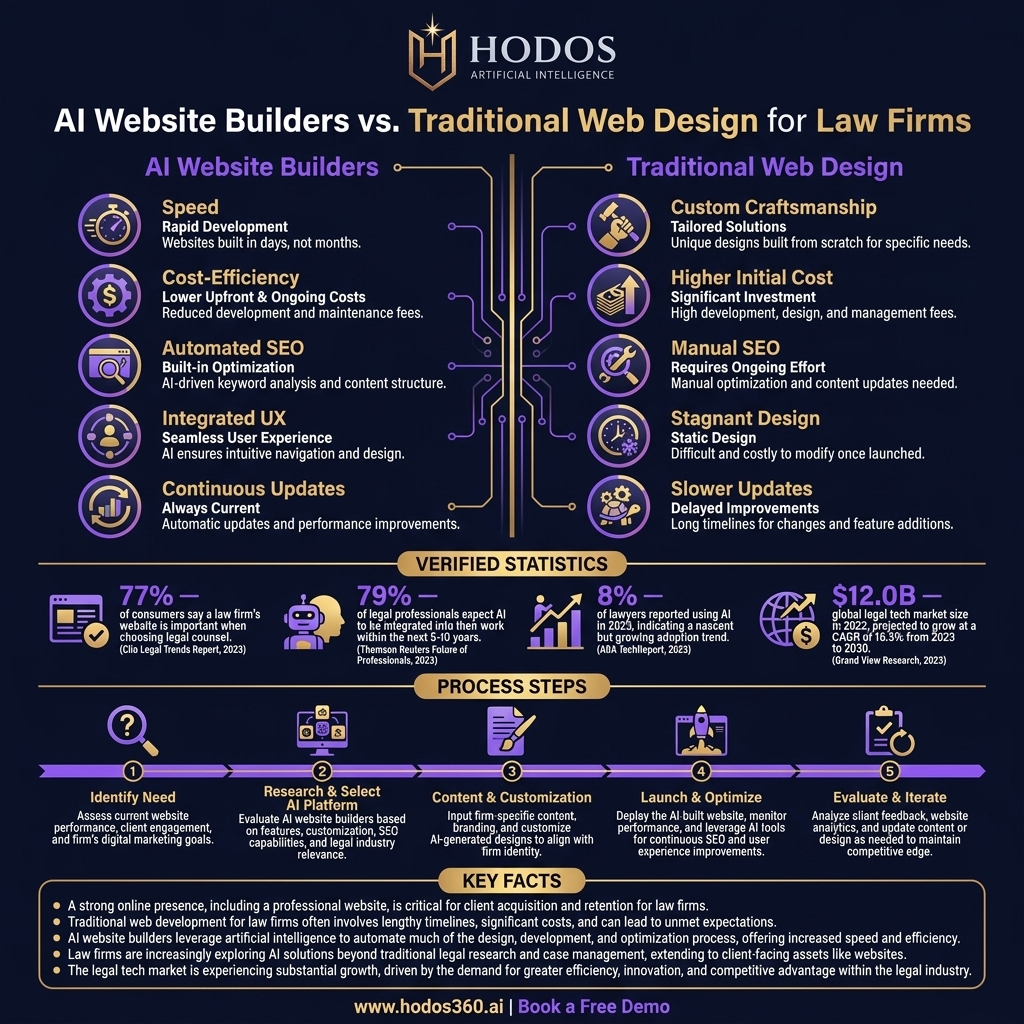
For decades, a law firm's website evolved from a static online brochure to a sophisticated digital hub. Initially, firms sought simple online visibility, often relying on basic templates or local developers for a modest web presence. As the internet matured, so did client expectations. Firms began investing heavily in custom-designed websites, believing that only a bespoke, human-crafted site could convey the gravitas and unique brand identity of their practice. This era saw a significant rise in web development agencies specializing in the legal sector, offering high-touch services that involved extensive consultations, wireframing, custom coding, and ongoing maintenance. While these traditional methods often produced polished results, they came with considerable time commitments and financial outlays, frequently exceeding six figures for complex projects and stretching over many months, if not a year, to complete.
However, the landscape began to shift dramatically with the advent of advanced AI. What started with simple drag-and-drop website builders has rapidly progressed to sophisticated AI-generated websites that can interpret user intent, design preferences, and content requirements with remarkable accuracy. This technological leap has introduced a fundamental philosophical divide. Traditional web development champions the artisanal approach, where every pixel and line of code is manually placed by a human designer and developer. Learn more about AI Web App Builders: An Essential Guide for Law Firms. The argument here is that only a human can truly understand the nuances of a law firm's unique value proposition, its ethical obligations, and the subtle cues necessary to build client trust. Yet, this human-centric approach is also its Achilles' heel, susceptible to human error, lengthy revision cycles, and significant cost escalation.
The AI paradigm, on the other hand, embraces data-driven efficiency and automation. Platforms powered by generative AI algorithms can analyze vast datasets of successful law firm websites, current design trends, SEO best practices, and user experience patterns to rapidly construct a fully functional site. This shift isn't about replacing human creativity entirely but augmenting it, allowing for rapid prototyping and iteration. Early adopters like boutique firm "Lex Counsel" reported reducing their website launch time from six months to six weeks using AI, freeing up resources for more direct client engagement. According to the ABA Legal Technology Survey Report 2025, over 60% of law firms now recognize their website as the primary client acquisition channel, underscoring the urgency for efficient, high-performing digital platforms. This data highlights the growing tension between the perceived control of traditional methods and the undeniable agility of AI.
Speed, Cost, and Customization: A Deep Dive into AI Website Builders
The most immediately striking advantages of AI website builders lie in their unparalleled speed and cost-effectiveness. In the traditional model, launching a new law firm website typically involves a laborious multi-stage process: discovery meetings, design mock-ups, development sprints, content integration, and rigorous testing. Each stage requires significant manual input, leading to timelines that can span from three months to over a year. For a law firm like "Sterling & Partners," a full redesign meant diverting partner attention for countless approval meetings, effectively costing them billable hours. AI website builders fundamentally disrupt this. Leveraging sophisticated algorithms, these platforms can generate an initial website draft—complete with design layouts, placeholder content, and basic SEO structure—in a matter of minutes or hours, rather than weeks. This rapid deployment capability is a game-changer for firms needing to establish or refresh their online presence quickly, perhaps in response to a new practice area, a merger, or emerging market trends.
The financial implications are equally transformative. Traditional web development, especially for custom solutions, often entails substantial upfront costs for design, development, and project management, followed by ongoing maintenance fees. These costs can easily run into tens of thousands, or even hundreds of thousands, of dollars depending on complexity and agency reputation. Learn more about Siri AI Revolution: Essential Legal Voice Assistant Strategies. AI website builders dramatically reduce these expenditures by automating labor-intensive tasks. While there are subscription costs associated with AI platforms, they are typically a fraction of what a traditional agency would charge, making high-quality web presence accessible even for solo practitioners and small firms. This cost efficiency allows firms to allocate more resources to core legal services or other critical marketing initiatives, democratizing access to professional, high-converting websites that would otherwise be out of reach.
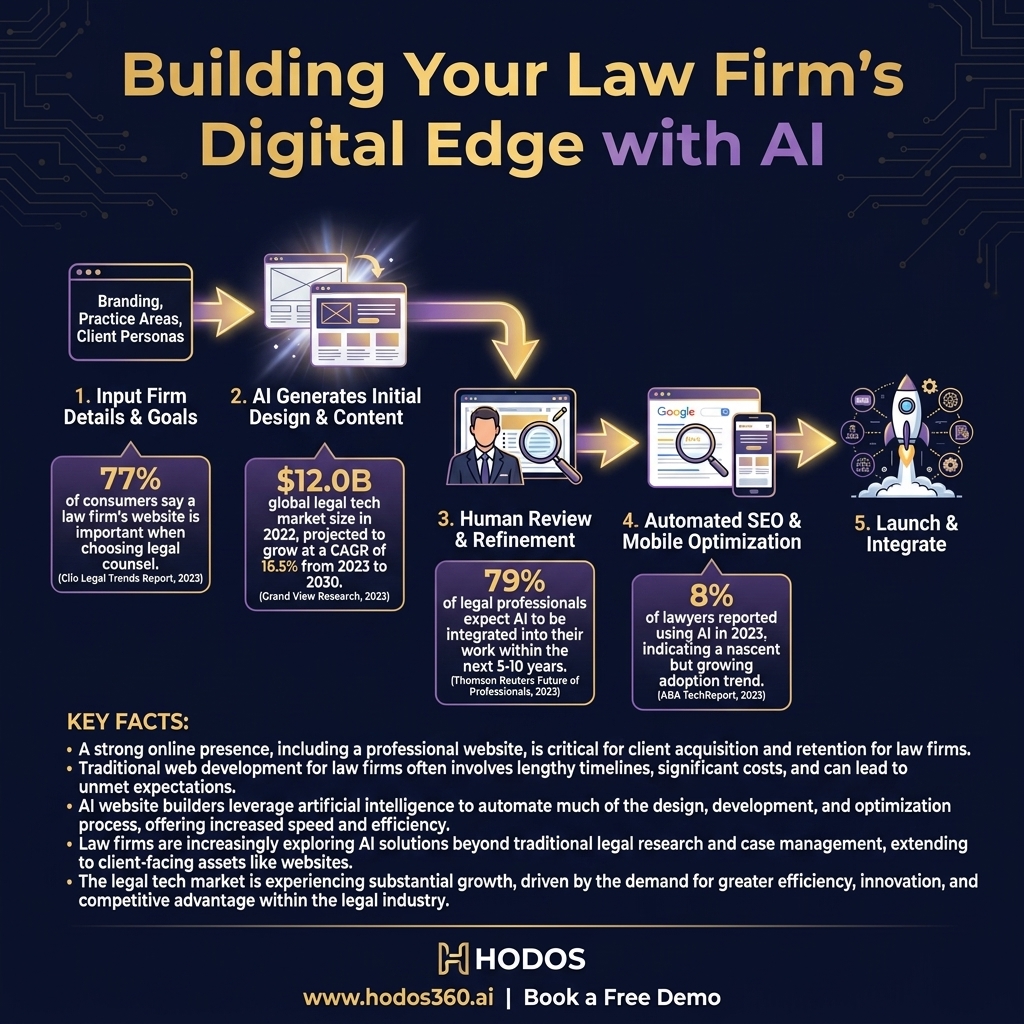
Addressing the common misconception that AI-generated websites lack customization, modern AI website builders, such as those powering HODOS 360’s Web & Mobile Development service, offer remarkable flexibility. Far from generic templates, these platforms utilize advanced machine learning to understand a firm's specific brand guidelines, target audience demographics, and desired aesthetic. Users can input specific color palettes, font choices, imagery preferences, and even provide existing branding assets. The AI then synthesizes this information to create a unique design that aligns with the firm's identity, while also adhering to best practices for user experience and conversion. Furthermore, these builders often allow for easy content updates, layout adjustments, and integration of third-party tools (like client intake forms or scheduling widgets) without needing a developer, empowering firms to maintain dynamic and responsive digital assets. This level of granular control, combined with AI's efficiency, ensures that uniqueness and brand integrity are not sacrificed for speed or cost savings, providing a truly bespoke feel without the bespoke price tag.
Beyond Templates: AI's Role in Unique Legal Branding
The sophistication of contemporary AI website builders extends far beyond simple template selection; they are designed to embody and amplify a law firm's unique brand identity. Unlike the early days of website builders where every site felt indistinguishable, today's AI-powered platforms can ingest a firm's mission statement, practice areas, target client profiles, and even stylistic preferences to generate a distinct visual and functional experience. For example, a personal injury firm might require a compassionate yet authoritative tone, reflected in specific color schemes, imagery, and clear calls to action, while a corporate law firm would demand a sophisticated, minimalist, and highly professional aesthetic. Learn more about Legal AI: Microsoft's Essential Tool Reshapes Law Practice. AI can discern these nuances and translate them into design elements that resonate with the intended audience, ensuring the website isn't just functional, but also a powerful extension of the firm's brand. This capability is crucial, as a firm's online presence must ethically and effectively communicate its services (as per ABA Model Rule 7.1: Communications Concerning a Lawyer's Services), which includes a unique and professional brand identity.
Strategic Design and SEO for Law Firms: Beyond Automation
A beautiful website is only effective if it can be found and if it converts visitors into clients. This is where the strategic advantages of AI website builders, particularly in SEO optimization and user experience (UX), truly shine for law firms. Traditional web development often treats SEO as an afterthought or an additional, costly service. Developers might build a site, and then an SEO specialist is brought in to optimize it, a process that can lead to retrofitting issues. AI website builders, by contrast, integrate SEO best practices from the ground up. They automatically handle technical SEO elements like site speed optimization, mobile-first indexing, and schema markup—factors that Google prioritizes in its ranking algorithms. Furthermore, advanced AI can analyze a firm’s practice areas and target demographics to suggest relevant keywords, optimize content structure, and even generate meta descriptions that improve search engine visibility and click-through rates. This proactive, embedded approach to SEO ensures that a law firm's digital presence is not just aesthetically pleasing but also a powerful lead generation engine.
Beyond search engine visibility, AI plays a pivotal role in crafting superior user experiences and driving conversions. A law firm's website must be intuitive, easy to navigate, and provide clear pathways for potential clients to find information and take action. AI website builders leverage data on user behavior, eye-tracking studies, and conversion funnels to design layouts that guide visitors effectively. They can automatically ensure responsive design, meaning the website adapts seamlessly to any device—desktop, tablet, or mobile—a non-negotiable in an era where over 70% of legal searches originate on mobile devices (Thomson Reuters Institute, 2024). Moreover, AI can dynamically optimize calls to action (CTAs), such as "Schedule a Free Consultation" or "Contact Our Attorneys," by analyzing which placements and phrasing yield the highest engagement. This continuous optimization, driven by real-time data, transforms a static website into a dynamic, high-converting asset, directly impacting a firm's client acquisition rates and ROI. Learn more about Legal AI Assistant: The Ultimate Guide for Modern Law Firms. The ability of AI to constantly refine and improve the user journey is a significant differentiator from the static, set-it-and-forget-it nature of many traditional websites, ensuring your firm's digital front door is always working its hardest for you.
Law firms often grapple with the challenge of converting website visitors into tangible leads. This is where AI's predictive analytics and integration capabilities provide a distinct strategic edge over manual processes. Traditional websites typically rely on static contact forms or phone numbers. While effective, these methods lack the dynamic, personalized approach that modern clients expect. AI website builders can integrate seamlessly with advanced client intake systems, allowing for automated lead qualification and immediate follow-up. Imagine a potential client landing on your site, interacting with an AI-powered chatbot that pre-screens their case, and then automatically scheduling an appointment with the relevant attorney, all within minutes. This level of integration streamlines the entire client journey, reducing friction and significantly increasing conversion rates. Furthermore, AI can provide granular analytics on visitor behavior, identifying pain points in the user journey and suggesting data-backed improvements. This continuous feedback loop, often absent in traditional web development post-launch, ensures that the website isn't just built, but perpetually optimized for performance. This intelligent functionality transforms a website from a mere information repository into a proactive business development tool, aligning perfectly with the strategic objectives of growth-oriented law firms. To truly leverage these capabilities, firms must look beyond basic builders and embrace platforms that offer complete and integrated web development solutions.
- ✓Automated Technical SEO: AI platforms automatically handle crucial technical elements like site speed, mobile responsiveness, and schema markup, ensuring foundational SEO strength without manual intervention.
- ✓Keyword Research & Content Optimization: AI analyzes practice areas and target audiences to suggest highly relevant legal keywords, guiding content creation for maximum search visibility.
- ✓Dynamic Content & Personalization: AI can adapt website content and CTAs based on visitor behavior, delivering personalized experiences that increase engagement and conversion rates.
- ✓Predictive Analytics for User Experience: AI tools monitor user interactions to identify navigation issues or conversion bottlenecks, offering data-backed recommendations for continuous UX improvement.
- ✓Seamless Integration with Legal Tech: AI-built websites can integrate directly with CRM, client intake, and case management systems, streamlining lead capture and client onboarding workflows.
- ✓Continuous Monitoring & Updates: Unlike static traditional sites, AI-powered platforms can automatically update for security, performance, and compliance with evolving web standards and search algorithms.
Ethical Considerations and Client Trust in AI-Generated Sites
While the efficiency of AI website builders is undeniable, law firms must navigate ethical considerations, particularly concerning client trust and transparency. The legal profession is founded on trust, and a firm's website is a critical conduit for building and maintaining that trust. It is imperative that an AI-generated site, while automated, still adheres to the highest standards of legal ethics, including accuracy in communication and clear representation of services. ABA Model Rule 1.4: Communication mandates that lawyers keep clients reasonably informed and explain matters to the extent necessary. This extends to the information presented on a firm's website, which must be clear, truthful, and not misleading. Learn more about Flowise for Law Firms: Essential Guide to Visual AI Workflows. Firms must ensure that AI does not inadvertently generate content that could be construed as false advertising or that creates unrealistic expectations. Human oversight remains paramount to vet all AI-generated content and design elements, ensuring they align with professional responsibility and uphold the firm’s ethical obligations. The role of human designers shifts from manual creation to strategic guidance and ethical stewardship, ensuring that the AI-generated output meets legal and professional standards, thereby safeguarding client trust.
Integrating AI-Powered Web Development with Legal Workflows
The true power of AI website builders for law firms extends beyond simply creating a visually appealing site; it lies in their ability to seamlessly integrate with and enhance the firm's broader legal workflows. A standalone website, however advanced, operates in a vacuum if not connected to the firm's operational backbone. This is where a holistic AI platform like HODOS 360 demonstrates its comprehensive value. Imagine a prospective client visiting your AI-powered website, intrigued by a specific practice area. Instead of a generic contact form, the site, intelligently designed to capture leads, directs them to an AI Voice Assistant for immediate qualification and appointment booking. This assistant, part of HODOS 360’s suite, can conduct 24/7 multilingual intake, route calls to the appropriate attorney, and even schedule consultations directly into the firm’s calendar, all initiated from the website.
This interconnectedness extends further into the firm's internal operations. Once a lead is qualified and an appointment is set, the client's information is automatically fed into the firm's AI Law Firm Management System. This system, also part of HODOS 360, can then automate client intake processes, generate initial engagement letters using document automation, and create a new case file, populating it with all relevant details. This end-to-end automation, starting from the website, drastically reduces administrative overhead, minimizes data entry errors, and ensures a smooth, professional client onboarding experience. Firms that embrace this integrated approach, moving beyond fragmented tools, gain a significant competitive advantage. Learn more about AI Voice Assistant: Essential for Modern Law Firms. They not only attract more clients through an optimized digital presence but also convert them more efficiently, freeing up legal professionals to focus on high-value legal work rather than repetitive administrative tasks. This synergy between an AI-built website and integrated legal tech solutions represents the cutting edge of legal practice management.
The strategic value of integrating AI-powered web development also extends into a firm's marketing efforts. An AI-built website, optimized for performance and conversion, becomes a powerful asset for any legal marketing strategy. Data collected from website interactions—such as popular pages, user demographics, and conversion pathways—can directly inform and refine marketing campaigns run through an AI Marketing Platform. For instance, if data shows high interest in estate planning resources, the marketing platform can automatically generate targeted content, launch social media campaigns, or create AI videos focusing on that specific area, driving more qualified traffic back to the website. This closed-loop system, where the website acts as both a lead generator and a data source, allows for continuous improvement and a far higher return on investment for marketing spend. It transforms the website from a static advertisement into a dynamic, intelligent hub that constantly learns and adapts, ensuring the firm's digital outreach is always aligned with client needs and market trends. The shift is from manual to intelligently generated marketing and web assets, ensuring your firm's website and development efforts are always aligned with strategic goals.
The Synergy of AI and Human Expertise in Legal Web Design
The debate between AI website builders and traditional web design is not an 'either/or' proposition but increasingly a 'both/and' scenario, emphasizing the powerful synergy of AI and human expertise. While AI excels at automation, speed, and data analysis, human designers and legal professionals bring invaluable strategic insight, ethical judgment, and creative nuance that AI cannot fully replicate. Jack Newton, CEO of Clio, a leading legal tech company, frequently emphasizes the concept of 'augmented intelligence', where technology enhances human capabilities rather than replacing them. In web development, this means AI handles the heavy lifting—coding, initial design, technical SEO, and responsive adjustments—while human experts provide the strategic direction, ensure brand consistency, refine messaging for legal precision, and uphold ethical compliance. This hybrid model allows law firms to leverage the efficiency of AI for foundational website development and maintenance, while retaining human control over the critical elements that define their unique legal brand and client relationships. This collaborative approach ensures that the firm's digital presence is both technologically advanced and deeply human-centric, a crucial balance in the trust-based legal profession.
Future-Proofing Your Firm's Digital Front Door
The digital world is in a constant state of flux. Search engine algorithms evolve, cybersecurity threats multiply, and user expectations for interactive, personalized experiences continually rise. For law firms, this means a website built today can quickly become outdated tomorrow, losing its efficacy as a lead generator and brand ambassador. Traditional web development often struggles with this rapid pace of change. Updates can be costly, slow, and require specialized developer input, leaving many firms with stagnant online presences that fail to stack up against more agile competitors. The long-term development and maintenance of a traditional website can become a significant drain on resources, making it difficult to keep pace with innovation.
AI website builders offer a compelling solution for future-proofing a firm's digital presence. These platforms are inherently designed to adapt. They can integrate new technologies and comply with evolving web standards through continuous updates, often automatically applied. For instance, as Google introduces new Core Web Vitals or changes its indexing priorities, an AI-powered website can adjust its structure and performance without requiring manual recoding. This agility ensures that the firm's website remains optimized, secure, and cutting-edge, providing a consistent proven edge in the competitive legal market. It's a proactive rather than reactive approach to web management, minimizing the risk of technological obsolescence and ensuring the firm's online assets are always performing at their peak. This continuous evolution is a stark contrast to the often static nature of sites built through manual development processes.
Embracing AI in web development is not merely about adopting a new tool; it's about embedding a philosophy of continuous improvement and strategic agility into your firm's digital strategy. As the legal industry continues to be reshaped by technological advancements, from quantum computing to advanced natural language processing, a firm's ability to adapt its online presence quickly and efficiently will be a critical determinant of its long-term success. Firms that invest in AI-powered website solutions are not just building a website; they are investing in a dynamic, intelligent system that grows with them, responds to market shifts, and continually optimizes its performance. This strategic foresight ensures that their digital front door remains open, inviting, and highly effective, regardless of how the technological landscape shifts. The complete integration of AI across all aspects of a firm's website strategy is no longer a luxury, but a necessity to remain competitive.
Key Takeaways and Next Steps
The comparison between AI website builders and traditional web development for law firms reveals a clear trajectory: while traditional methods offer bespoke craftsmanship, they often come at the cost of speed, efficiency, and adaptability. AI website builders, conversely, provide an unparalleled proven edge through rapid deployment, significant cost savings, and integrated SEO and UX optimization. This shift is not about replacing human expertise but augmenting it, allowing law firms to maintain a sophisticated, high-performing digital presence that aligns with modern client expectations and operational efficiencies. The future of legal marketing and client acquisition is inextricably linked to smart, agile web development.
For law firms ready to embrace this transformative power, the next step is clear: explore how an integrated AI platform can redefine your digital strategy. HODOS 360 offers comprehensive AI-powered Web & Mobile Development services tailored specifically for the legal sector, ensuring your firm's website is not just a static page, but a dynamic, intelligent asset that drives growth and streamlines operations. Discover how our AI-powered website building, responsive design, and SEO optimization can help your firm stand out and convert more effectively. This is the moment to move beyond traditional limitations and future-proof your firm’s digital front door. For a deeper understanding of how these technologies can be customized to your firm's unique needs, consider scheduling a consultation. This strategic investment will ensure your firm's online presence is not just competitive but truly exceptional.
Frequently Asked Questions
Is AI website building suitable for complex law firm websites?+
Absolutely. Modern AI website builders are highly sophisticated and can handle complex structures, multiple practice areas, client portals, and extensive content libraries. They are designed to adapt to specific legal niches and firm sizes, offering advanced customization features that go far beyond basic templates. The AI learns from your inputs to create a robust and tailored digital presence.
How does AI affect my website's SEO?+
AI significantly enhances SEO by automating technical optimizations (like site speed and mobile-friendliness), performing intelligent keyword research, and suggesting content improvements. It ensures your website is built with SEO best practices from the ground up, leading to better search engine rankings and increased visibility for potential clients, a distinct advantage over manual, often inconsistent, SEO efforts.
Can AI website builders integrate with my existing legal tech stack?+
Many advanced AI website builders, especially those part of comprehensive platforms like HODOS 360, offer seamless integration capabilities. They can connect with AI Law Firm Management Systems for client intake, AI Voice Assistants for lead qualification, and AI Marketing Platforms for campaign tracking, creating a unified and efficient digital ecosystem for your firm. This streamlines workflows and maximizes data utility.
What about customization and unique branding for my firm?+
Contrary to common misconceptions, AI website builders offer deep customization. They use your brand guidelines, content, and target audience insights to generate unique designs that reflect your firm's identity. While AI provides the foundational structure, human oversight ensures the final product is distinct, professional, and ethically compliant, providing a bespoke feel without the traditional development costs.
Is my data secure with AI website builders?+
Reputable AI website builders prioritize security, employing robust encryption, regular backups, and compliance with data protection regulations. When choosing a platform, ensure it adheres to industry-standard security protocols and is transparent about its data handling practices. Always verify the provider's security measures and privacy policies, especially for sensitive legal client data, to maintain trust and regulatory compliance.

Traditional Agency vs. No-Code AI Builder vs. Integrated Legal-AI Platform: A Direct Comparison
Choosing how to build your law firm's website comes down to three real options, and each fits a different situation. Traditional agency development: cost typically $10,000-$100,000+, timeline 3-12 months, offers the deepest custom design control, but SEO and ongoing optimization are usually a separate line item, and compliance review depends entirely on whether your agency understands legal advertising rules like ABA Model Rule 7.1. No-code AI builders (general-purpose platforms like Wix, Squarespace, or newer natural-language tools): cost typically $200-$2,000/year, timeline days to weeks, strong for rapid deployment and low upfront cost, but customization is template-bound and compliance/ethics review is entirely on you since these platforms have no legal-industry awareness. Integrated legal-AI platforms (purpose-built for law firms, such as HODOS 360's Web & Mobile Development service): cost is typically a predictable subscription bundling build, hosting, and maintenance, timeline is days to a few weeks, customization is AI-driven but brand-specific rather than fully bespoke, SEO and schema markup are built in from the start, and compliance-aware content generation is designed around legal advertising rules rather than bolted on afterward.
Which one is right for your firm depends on what you are optimizing for. A large firm with an in-house marketing team and a genuinely unique brand identity to protect may still get the most value from a traditional agency relationship, accepting the higher cost and longer timeline in exchange for full creative control. A solo practitioner or very small firm testing a new practice area might reasonably start with a general-purpose no-code builder purely to get something live cheaply, understanding they will need to handle SEO and compliance review themselves. For most small to mid-sized law firms that need a professional, compliant, SEO-ready site without hiring a specialized legal marketing team, an integrated legal-AI platform is the pragmatic middle path: faster and cheaper than a full agency engagement, but built with the legal industry's specific SEO, ethics, and client-intake needs already accounted for, rather than retrofitted after the fact.