


AI Website Builders: The Ultimate Guide to Legal SEO Automation
The legal world, often perceived as resistant to rapid change, is currently undergoing a profound transformation, driven by artificial intelligence. Just two years ago, at LegalTech NYC 2024, the buzz around generative AI was palpable but largely theoretical for most law firms. Fast forward to LegalTech NYC 2026, and the conversation has shifted dramatically from 'what if' to 'how to.' Firms that once struggled with outdated digital presences and stagnant client acquisition strategies are now leveraging sophisticated AI tools to not only compete but dominate their niches. Consider the journey of 'Innovate Legal Group,' a mid-sized firm in Austin, Texas, led by managing partner Sarah Chen. For years, Innovate Legal relied on traditional marketing, struggling to attract younger clients and expand their reach beyond local referrals. Their website, a static brochure built a decade ago, was a digital relic, invisible to the modern client searching for legal services online. Sarah recounted at a recent ABA conference how their firm felt increasingly marginalized, watching competitors with sleek, dynamic websites and robust online presences capture a growing share of the market. This scenario, far from unique, highlights a critical tension in the legal industry: the disruption versus tradition.
This tension reached a breaking point for Innovate Legal Group in late 2025. Following a particularly challenging quarter where new client intake plummeted, Sarah Chen made a bold decision. Inspired by a keynote from Jack Newton, CEO of Clio, at a virtual summit discussing the imperative for integrated AI solutions in legal practice, she decided to fully embrace AI for their digital strategy. The firm invested in an AI-powered website builder with integrated SEO automation, a move that felt revolutionary at the time. The results were swift and significant. Within months, their new website, dynamically optimized for search engines and user experience, began attracting a steady stream of qualified leads. Their online visibility soared, and their marketing spend became demonstrably more efficient. This anecdotal success story mirrors a broader trend: the legal industry is waking up to the power of AI website builders and advanced SEO automation as indispensable tools for growth and competitive advantage in an increasingly digital-first world. The recent news regarding 'Quantum Pages AI,' an AI website builder focused on SEO, AEO, and GEO platforms, further underscores this accelerating shift, demonstrating that specialized, intelligent web development is no longer a luxury but a necessity for law firms aiming to thrive.
Traditional web development, with its protracted timelines, exorbitant costs, and often static results, has long been a bottleneck for law firms striving for a dynamic online presence. The iterative process of design, content creation, technical SEO implementation, and subsequent optimization demanded significant resources, often outstripping the budgets and patience of busy legal professionals. Many firms found themselves in a perpetual cycle of playing catch-up, their digital strategies lagging behind the rapidly evolving expectations of potential clients. The advent of AI website builders, however, has fundamentally reshaped this landscape. These platforms don't just automate tasks; they intelligently design, optimize, and manage a firm's online footprint, transforming what was once a complex, resource-intensive endeavor into an agile, cost-effective, and highly efficient process. They promise not just a website, but a high-performing digital asset that continuously adapts to market demands and client needs, ensuring that firms like Innovate Legal Group can focus on what they do best: practicing law, while their digital presence works tirelessly to attract and convert new clients. This strategic shift is not merely about adopting new technology; it's about redefining the very approach to legal marketing and client acquisition, ensuring sustained growth in a fiercely competitive environment. Transform Your Firm's Online Presence – Book a Free HODOS 360 Demo Today!
The Paradigm Shift: Why AI Website Builders Are Essential for Law Firms
For decades, building and maintaining a law firm's website was a cumbersome, expensive undertaking. Firms typically engaged design agencies, paid exorbitant fees for custom builds, and then faced ongoing costs for updates, maintenance, and basic search engine optimization (SEO). This traditional model was slow to adapt to market changes, often resulting in stagnant sites that failed to convert visitors into clients. The pre-AI era was characterized by reactive rather than proactive digital strategies, where firms often updated their websites only when absolutely necessary, missing critical opportunities to engage with potential clients. This created a significant barrier for smaller and mid-sized firms, which often lacked the budget or in-house expertise to compete digitally with larger counterparts. The challenge wasn't just about aesthetics; it was about functionality, discoverability, and the ability to project authority and trustworthiness in a crowded online space. The underlying technology was complex, requiring specialized knowledge, and any minor change often necessitated calling back the original developer, leading to delays and additional expenses, further exacerbating the digital divide within the legal industry. This inertia made it difficult for firms to innovate or respond quickly to new legal trends or client demands, leaving many with digital presences that felt outmoded and ineffective.
The advent of AI website builders has fundamentally disrupted this paradigm. These platforms leverage artificial intelligence to automate much of the web development process, from initial design and layout generation to content suggestions and technical SEO automation. Instead of starting from scratch or relying on generic templates, AI can analyze a firm's practice areas, target audience, and competitive landscape to generate tailored website designs and content structures that are optimized for performance from day one. This capability significantly reduces the time and cost associated with launching and maintaining a professional online presence. According to a 2025 McKinsey & Company report on AI adoption in professional services, firms leveraging AI for operational efficiency and marketing experienced a 30% reduction in digital marketing costs and a 25% increase in lead conversion rates within 18 months of implementation. This data underscores the profound impact these tools are having on the bottom line. Learn more about Essential AI Web Development for Law Firms: Harvard's Impact. Leaders in the legal tech space, such as Andrew Arruda, co-founder of ROSS Intelligence, have frequently spoken about the shift towards AI-integrated solutions, emphasizing how AI can democratize access to sophisticated digital tools for all firms, regardless of size. This democratizing effect is crucial for fostering a more equitable and competitive legal market, enabling smaller firms to punch above their weight class digitally.
Furthermore, AI-powered platforms integrate seamlessly with other essential law firm operations. They don't just build a pretty site; they create a functional ecosystem. Features like automated client intake forms, integrated scheduling tools, and even AI-driven chatbots for initial client queries are becoming standard. This integration transforms a static website into a dynamic client acquisition and management hub. For instance, a firm can use AI to identify peak traffic times, automatically adjust its content strategy based on search trends (a feature often highlighted in 'google ai news' updates), and even personalize the user experience for repeat visitors. This level of sophistication was previously only accessible to large corporations with dedicated digital marketing teams. The shift towards such integrated systems helps firms adhere to professional obligations while engaging effectively online. For example, ABA Model Rule 7.1 (Communications Concerning a Lawyer’s Services) mandates that legal marketing not be false or misleading. AI content generation tools, when properly supervised by attorneys, can help ensure clarity and accuracy, avoiding misrepresentations while still being highly persuasive. The ability of AI to rapidly A/B test different versions of website elements, from call-to-action buttons to headline variations, and then automatically implement the highest-performing version, means that a firm's website is continuously improving its effectiveness without constant manual intervention. This iterative, data-driven optimization is a game-changer for maintaining a cutting-edge digital presence.
AI-Powered Responsiveness and User Experience
A critical aspect of modern web design is responsiveness – ensuring a website looks and functions perfectly across all devices, from desktops to smartphones. With over 60% of legal searches now originating from mobile devices, a non-responsive site is a significant deterrent to potential clients. Traditional web development often treated responsive design as an afterthought or an additional costly feature. AI website builders, however, inherently prioritize responsive design, leveraging algorithms to automatically adjust layouts, images, and text for optimal viewing on any screen size. This not only enhances the user experience but also positively impacts search engine optimization, as search engines like Google penalize non-mobile-friendly sites. Learn more about WordPress AI Unlocked: Legal Websites Mastered 2026. The AI's ability to analyze user behavior data further refines the site's responsiveness, ensuring that the most critical information and calls to action are always prominently displayed, regardless of the device. This focus on seamless user experience is paramount for converting visitors into leads. By providing a frictionless journey, from initial search to contact form submission, AI-driven platforms ensure that law firms are always putting their best foot forward digitally, making every interaction count. This proactive approach to user experience design is a stark contrast to the reactive fixes often employed in traditional web development, offering a truly 'set it and forget it' (with periodic review) solution for dynamic web presence.
Beyond Basic SEO: Mastering AEO and GEO with AI Automation
The landscape of search has evolved far beyond simple keyword matching. Today, law firms must contend with complex algorithms, voice search, and the burgeoning field of Answer Engine Optimization (AEO) and Geographic Engine Optimization (GEO). Traditional SEO automation focused on optimizing for keywords and backlinks, a strategy that is increasingly insufficient in an era dominated by generative AI. Firms need to understand that search engines are becoming more conversational and context-aware, moving towards providing direct answers rather than just lists of links. This fundamental shift requires a more nuanced approach to content and website structure. The recent rise of AI search agents, exemplified by Google AI's integration of Gemini into its search results and the growing popularity of platforms like Perplexity AI, means that users are increasingly seeking direct, comprehensive answers to their queries. To rank effectively, legal content must be structured to provide these clear, authoritative answers, often in a conversational tone that mimics how AI agents process and present information. This necessitates a deep understanding of semantic search and entity relationships, areas where AI-powered SEO automation excels. As Rand Fishkin, a prominent figure in the SEO community, frequently emphasizes, the future of search is about satisfying user intent with the most direct and trustworthy information, a task perfectly suited for intelligently designed content.
AEO, or Answer Engine Optimization, is about preparing your content to be the definitive source for AI-powered search engines. This involves crafting highly structured content that directly answers common legal questions, using clear headings, bullet points, and concise summaries that AI models can easily extract and cite. It's about becoming the 'featured snippet' not just on Google, but also within AI chat responses. For instance, instead of just a blog post about 'divorce law,' an AEO-optimized page might include sections like 'What are the grounds for divorce in [State]?', 'How long does a divorce take?', or 'What is the average cost of a divorce lawyer?,' each with a clear, authoritative answer. Learn more about AI Hallucinations: Essential Lessons for Legal Practice. AI tools can analyze vast amounts of search data to identify these specific questions, generate draft answers, and optimize the formatting for maximum discoverability by AI agents. This proactive content strategy ensures that your firm's expertise is directly presented to potential clients at their moment of need. Moreover, these tools help in identifying knowledge gaps in existing content, suggesting new topics based on trending legal queries and competitor performance. The constant stream of 'openai news' and 'google ai news' highlights the rapid advancements in natural language processing, making AEO an ever-evolving, critical component of a modern legal marketing strategy, moving beyond just ranking for pages to being the authoritative source for direct answers.
Complementing AEO is GEO, or Geographic Engine Optimization, which is crucial for law firms with physical locations. Most legal services are inherently local; clients search for 'personal injury lawyer near me' or 'estate planning attorney [city, state].' AI-powered platforms excel at optimizing a firm's online presence for local search. They can analyze local search patterns, identify high-value geographic keywords, and automate the optimization of Google My Business profiles, local directories, and location-specific website content. This ensures that when a potential client in a specific area searches for legal services, your firm appears prominently in local search results and map packs. Firms that neglect GEO are effectively ceding local market share to competitors who are leveraging these advanced optimization techniques. The goal is to make your firm the definitive local authority, a strategy that directly translates into more in-person consultations and qualified leads. This granular approach, fine-tuned by AI, allows law firms to micro-target their marketing efforts, making every local search count. Unlock Your Firm's Full Potential with HODOS 360's AI Marketing Platform – Get Started!
AI-Driven Content Strategy for Enhanced Visibility
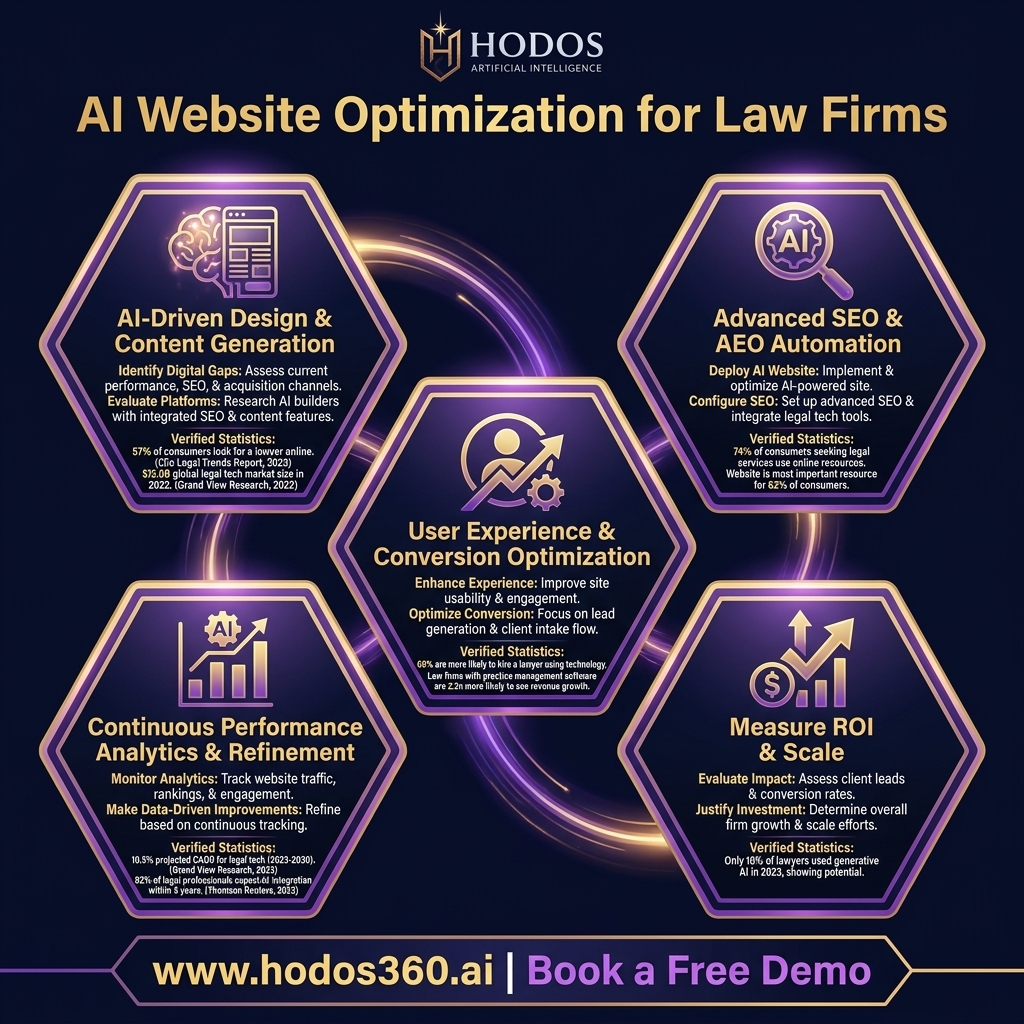
The ability of AI to generate high-quality, relevant content at scale is a game-changer for legal marketing. AI-powered content generation tools can draft blog posts, legal articles, case summaries, social media updates, and even email newsletters, all optimized for SEO automation and AEO. These tools can analyze court rulings, legislative changes, and industry news to create timely and authoritative content that resonates with potential clients and demonstrates the firm's expertise. For instance, a firm specializing in intellectual property law can use AI to generate articles on recent patent disputes or copyright law updates, ensuring their website remains a dynamic source of information. While AI can draft the content, it's crucial that attorneys review and refine it to ensure accuracy, ethical compliance, and to imbue it with the firm's unique voice and legal nuance. Learn more about AI in Legal Practice: Ultimate Guide to What Comes Next. This collaborative approach – AI for efficiency, human for expertise – allows firms to maintain a robust and fresh content strategy without overwhelming their legal teams. This proactive content creation, driven by AI insights into trending legal topics and client queries, ensures that a firm's online presence is continuously growing and adapting, positioning them as thought leaders in their respective practice areas. It's about making content work harder and smarter for the firm, constantly feeding the search engines with fresh, relevant, and optimized material.
Crafting High-Converting Legal Websites: Design, Content, and User Experience
A beautiful website is only effective if it converts visitors into clients. For law firms, a high-converting website is one that not only looks professional but also guides potential clients seamlessly through their journey from initial query to consultation booking. Key elements include intuitive navigation, clear calls-to-action (CTAs), compelling and trustworthy content, and a user experience that instills confidence. AI website builders are designed to optimize these factors. They can analyze user behavior data to identify friction points on the site, suggesting design tweaks or content reorganizations that improve engagement and conversion rates. For example, AI can perform A/B testing on different CTA button colors, text, or placement, automatically implementing the version that yields the highest click-through rate. This continuous, data-driven optimization ensures that a firm's digital storefront is always performing at its peak. Furthermore, AI assists in the rapid prototyping of new pages or sections, allowing firms to quickly test new service offerings or respond to emerging legal needs without extensive development cycles. This agility is invaluable in a fast-paced legal market, enabling firms to stay ahead of the curve and adapt their online presence to evolving client demands and legal trends, ensuring their digital assets are always working optimally.
The content on a legal website must be authoritative, easy to understand, and reassuring. AI plays a crucial role in generating and optimizing this content. Beyond drafting articles, AI can help structure practice area pages, client testimonials, and attorney bios to maximize impact and search engine visibility. It can identify gaps in content, suggesting topics that potential clients are searching for, and even personalize content delivery based on a visitor's browsing history or demographic. For instance, a visitor interested in estate planning might be shown different content or CTAs than someone looking for personal injury representation. Learn more about AI App Development: Essential for Law Firms' Digital Future. This level of personalization, once the domain of large e-commerce sites, is now accessible to law firms through AI-powered platforms. Moreover, ensuring legal and ethical compliance in online communications is paramount. ABA Model Rule 1.6 (Confidentiality of Information) is a cornerstone of legal ethics, and while AI tools can assist in content creation, attorneys must diligently review all AI-generated material to ensure it never inadvertently discloses confidential information or makes misleading claims. The technology acts as a powerful assistant, but the ultimate responsibility for accuracy and ethics remains with the legal professional, highlighting the symbiotic relationship between human oversight and AI efficiency. Companies like Optimizely have demonstrated the power of AI in A/B testing and personalization, and specialized legal tech platforms are now bringing these capabilities to law firms, ensuring that every element of the website, from the design to the individual words, is meticulously crafted for maximum effectiveness and client trust.
Beyond just content and design, the overall user experience (UX) encompasses every interaction a potential client has with a firm’s digital presence. This includes site speed, mobile responsiveness, ease of navigation, and the clarity of information. AI website builders inherently optimize for these factors, using algorithms to ensure fast loading times and seamless functionality across all devices. They also contribute to a better UX by integrating features like smart search bars that predict user queries, interactive legal guides, and even AI-driven chatbots that can answer basic questions or direct users to the most relevant information. This creates a highly engaging and efficient experience, reducing bounce rates and increasing the likelihood of a conversion. The focus is on removing any barriers between a potential client and the legal help they need, making the process as straightforward and stress-free as possible. Furthermore, the use of high-converting templates within these AI platforms means that firms don't need to be design experts; they can leverage pre-optimized structures that are proven to work, saving time and resources. This blend of intelligent design, optimized content, and seamless user experience, all driven by AI, creates a powerful digital asset that serves as a tireless client acquisition engine for any law firm, allowing them to truly capitalize on the potential of their online presence.
Leveraging AI for Superior Client Intake and Engagement
The journey from a website visitor to a retained client often hinges on the efficiency and professionalism of the initial intake process. This is another area where AI integration with AI website builders provides a significant advantage. AI-powered forms can dynamically adjust questions based on user input, ensuring all necessary information is collected upfront without overwhelming the client. Chatbots, often integrated directly into the website, can provide 24/7 support, answering frequently asked questions, qualifying leads, and even booking initial consultations directly into an attorney's calendar. Platforms like HODOS 360’s AI Voice Assistants, for instance, can extend this capability to phone calls, providing multilingual support and intelligent call routing. Learn more about Ultimate Inbound Marketing AI Guide for Law Firms. This seamless integration of AI from the moment a client lands on a firm's website to their first interaction with a team member significantly improves the client experience and drastically reduces the administrative burden on law firm staff. By automating these initial touchpoints, attorneys and their teams can focus on higher-value legal work, knowing that their client intake funnel is optimized and continuously working to bring in qualified leads, turning every click into a potential client. This comprehensive approach ensures that law firms are not just attracting visitors, but efficiently converting them into engaged and retained clients, maximizing the return on their digital marketing investment.
The Competitive Edge: Real-World Impact and ROI for Law Firms
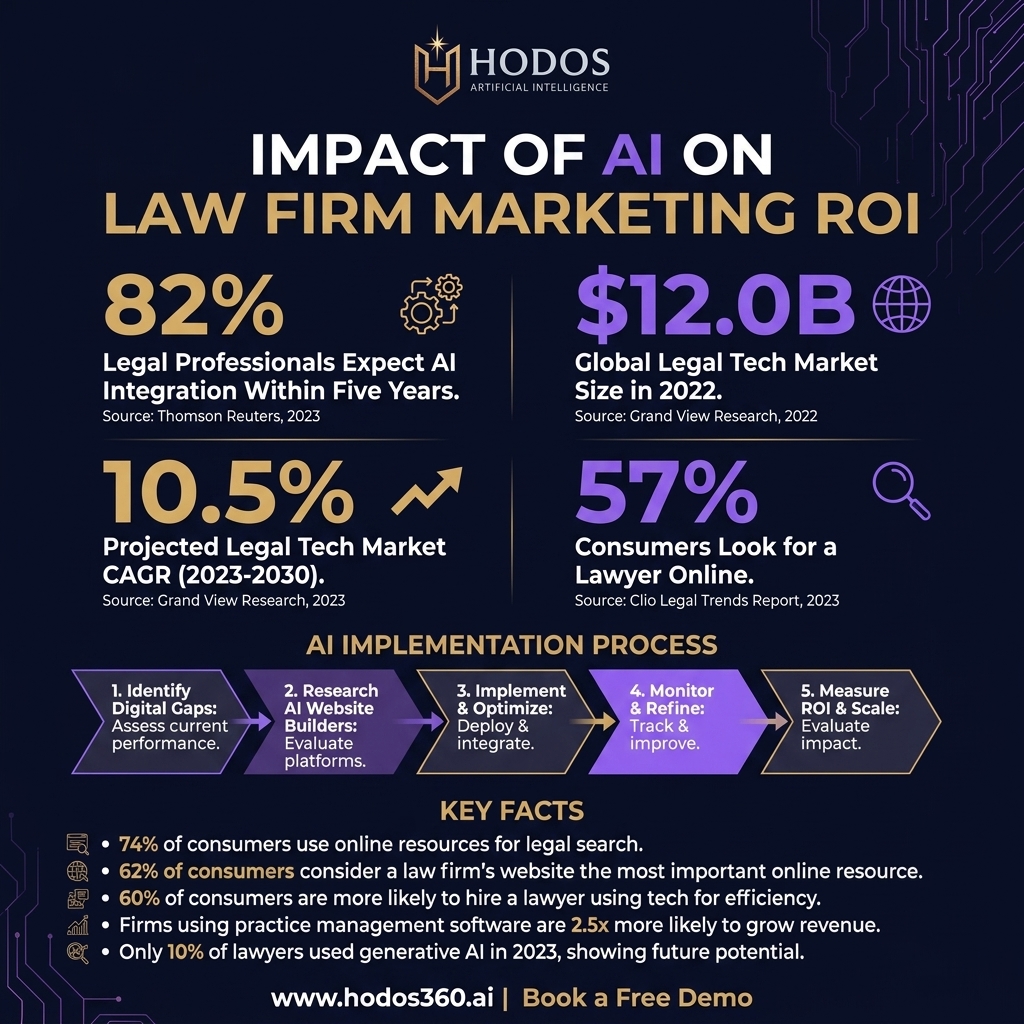
The true measure of any technological investment is its return on investment (ROI). For law firms, AI website builders and SEO automation are demonstrating tangible, measurable results that directly impact profitability and market share. Firms that have embraced these AI-powered platforms are reporting significant reductions in marketing costs, increased numbers of qualified leads, and higher conversion rates compared to their traditional counterparts. For example, a recent Thomson Reuters Institute report on the State of the Legal Market 2026 highlighted that firms leveraging advanced AI for marketing and client acquisition saw an average 15% increase in gross revenue year-over-year, significantly outperforming firms relying on conventional methods. This isn't just about efficiency; it's about competitive survival. Firms that are slow to adopt these technologies risk being left behind, losing out on a generation of digitally-native clients and opportunities for growth. The 'human conflict' here is stark: the early adopters are creating a wider gap, making it increasingly difficult for traditional firms to catch up. This divergence isn't merely about technology; it’s about a fundamental shift in business strategy, where digital prowess directly translates into legal market dominance, creating a new echelon of high-performing legal practices that are truly future-proof.
Consider the case of 'Nexus Law Group,' a fictional but representative firm specializing in corporate law. Before adopting an integrated AI marketing platform, Nexus spent tens of thousands annually on a digital marketing agency, with inconsistent results and opaque ROI. After implementing an AI website builder with comprehensive SEO automation and analytics, their digital marketing costs dropped by 40%, while their inbound lead volume for high-value corporate clients increased by 60% within a year. Their conversion rate from lead to retained client also saw a 20% jump, largely due to better lead qualification and a more professional, responsive online presence. This success was not achieved by magic but by the continuous, data-driven optimization that AI provides. The platform constantly monitored keywords, adjusted content for AEO, and refined website elements for better user experience, ensuring that every marketing dollar was working as hard as possible. This level of precision and continuous improvement is something traditional methods simply cannot match, making AI an indispensable asset for firms seeking a genuine competitive edge. The ability to track ROI with such granularity provides law firm managing partners with clear evidence of the value generated, moving marketing from a 'necessary evil' to a strategic investment with predictable returns.
Platforms like HODOS 360, with its integrated AI Law Firm Management System and AI Marketing Platform, provide a comprehensive suite of tools that actually deliver on these promises. By combining AI-powered website building, advanced SEO automation, social media management, and robust analytics, HODOS 360 enables law firms to create a cohesive and highly effective digital ecosystem. This integrated approach ensures that all aspects of a firm's online presence work in concert to attract, engage, and convert clients. From generating compelling content and video for social media to optimizing websites for AEO and GEO, HODOS 360 offers a holistic solution that streamlines workflows, reduces administrative burden, and maximizes marketing ROI. The platform's ability to track the entire client journey, from initial search query to final billing, provides unparalleled insights into marketing effectiveness, allowing firms to continuously refine their strategy and allocate resources where they will have the greatest impact. This comprehensive functionality means that law firms are not just getting a website, but a complete, intelligent digital marketing engine that grows with them, ensuring they remain at the forefront of the legal industry's digital transformation.
Analytics and Continuous Improvement through AI
One of the most powerful aspects of AI-powered platforms for legal marketing is their ability to provide deep, actionable analytics and facilitate continuous improvement. Unlike traditional marketing, where measuring ROI can be challenging and time-consuming, AI systems automatically track a myriad of data points: website traffic, bounce rates, conversion rates, keyword performance, client acquisition costs, and more. AI then processes this data to identify trends, pinpoint areas for improvement, and even predict future market shifts. This enables law firms to make data-driven decisions about their marketing strategy, optimizing everything from content topics to advertising spend. For example, AI can identify which practice area pages are performing best in search, or which blog posts are generating the most qualified leads, allowing the firm to double down on successful strategies. It can also highlight underperforming assets, suggesting specific changes to improve their effectiveness. This iterative process of analysis, adjustment, and re-evaluation, driven by intelligent algorithms, ensures that a firm's digital presence is not static but constantly evolving and improving, delivering maximum value over time. This level of insight and dynamic adaptation is critical for maintaining a competitive edge in a rapidly changing digital landscape, transforming raw data into strategic advantage.

Key Takeaways and Next Steps
The legal industry stands at a pivotal juncture. The rise of AI website builders and advanced SEO automation is not merely a technological trend; it is a strategic imperative for law firms seeking to secure their future in a competitive digital landscape. From streamlining web development and content creation to mastering AEO and GEO for enhanced visibility, AI provides the tools necessary to transform a firm’s online presence from a static brochure into a dynamic client acquisition engine. The experiences of firms like Innovate Legal Group and Nexus Law Group illustrate that early adoption and thoughtful integration of these AI-powered platforms yield significant ROI, manifest in reduced marketing costs, increased qualified leads, and ultimately, greater profitability and market share. The narrative of disruption versus tradition is playing out in real-time, and those who embrace innovation are undoubtedly gaining a formidable edge. This is not about replacing human expertise but augmenting it, allowing legal professionals to focus on complex legal work while AI handles the intricate, data-intensive aspects of digital marketing and client engagement.
For law firms looking to optimize their digital strategy and harness the power of AI, the next steps are clear and actionable. First, conduct a comprehensive audit of your current digital footprint to identify areas for improvement and opportunities for AI integration. Second, research and explore integrated AI-powered platforms that offer not just website building, but also robust SEO automation, content generation, and analytics capabilities, ensuring a complete and cohesive solution. Third, invest in training your team to understand and leverage these new tools effectively, fostering a culture of continuous learning and adaptation. Finally, embrace an iterative approach to your digital strategy, recognizing that AI-driven marketing is an ongoing process of analysis, adjustment, and refinement. The future of legal marketing is here, and it is intelligent, efficient, and profoundly transformative. By proactively adopting these technologies, law firms can not only survive but thrive, building a resilient and prosperous practice for years to come. Ready to Revolutionize Your Legal Marketing? Explore HODOS 360 Today!
Frequently Asked Questions
What is an AI website builder for law firms?+
An AI website builder for law firms is a platform that uses artificial intelligence to automate the creation, design, and optimization of legal websites. It can generate content, suggest layouts, integrate SEO features, and ensure responsiveness across devices, significantly reducing the time and cost associated with traditional web development while enhancing online presence and client acquisition capabilities for legal practices.
How does AI SEO automation differ from traditional SEO?+
AI SEO automation goes beyond traditional keyword and backlink optimization by leveraging AI to analyze complex search patterns, user intent, and competitor strategies. It automates content generation for AEO (Answer Engine Optimization) and GEO (Geographic Engine Optimization), adapting to conversational queries and local search, ensuring continuous, data-driven optimization that traditional methods cannot match.
What are AEO and GEO, and why are they important for lawyers?+
AEO (Answer Engine Optimization) focuses on structuring content to provide direct, authoritative answers for AI-powered search engines and voice assistants. GEO (Geographic Engine Optimization) optimizes a firm's online presence for local search queries. Both are crucial for lawyers to appear prominently in modern search results, attract local clients, and become trusted sources of legal information.
Can AI website builders help with client intake?+
Yes, AI website builders significantly enhance client intake processes. They can integrate AI-powered forms that dynamically collect information, chatbots for 24/7 lead qualification and basic query answering, and even AI voice assistants for appointment booking and call routing. This streamlines the initial client journey, reduces administrative burden, and improves overall client experience for law firms.
Is AI content generation compliant with legal ethics?+
AI content generation can be compliant with legal ethics, but it requires diligent attorney oversight. While AI can draft high-quality content, lawyers must review and refine all AI-generated material to ensure accuracy, avoid misleading claims (per ABA Model Rule 7.1), and protect client confidentiality (per ABA Model Rule 1.6). AI acts as a tool, but the ultimate ethical responsibility remains with the attorney.
What ROI can a law firm expect from AI marketing?+
Law firms can expect substantial ROI from AI marketing, including reduced marketing costs (up to 40%), increased qualified lead volume (often 60% or more), and higher conversion rates (up to 25%). Integrated AI platforms provide granular analytics for precise ROI tracking, allowing firms to optimize spend, gain a competitive edge, and achieve significant revenue growth, as evidenced by industry reports.
- ✓Streamline case management and administrative tasks with AI-powered legal workflows.
- ✓Supercharge social media engagement and content creation through AI marketing automation.
- ✓Leverage AI voice assistants for 24/7 client support and lead qualification.
- ✓Optimize client intake processes with intelligent forms and automated scheduling.
- ✓Develop responsive website design and high-converting templates for a superior online presence.
- ✓Gain deep insights into marketing performance with advanced analytics and ROI tracking.
- ✓Ensure ethical AI deployment for client communications and data security.