

Context Matters AI: Essential for Legal Accuracy & Insight
In the complex labyrinth of legal practice, where a single misstep can alter the course of justice, the notion of 'context' is paramount. For years, legal professionals have grappled with the promise and peril of artificial intelligence, often finding its capabilities impressive yet occasionally frustratingly superficial.
We've heard the anecdotes – from lawyers citing non-existent cases generated by early large language models (LLMs) to AI tools struggling to differentiate between jurisdictional nuances. This tension between AI's potential and its practical limitations reached a crescendo with incidents like the now-infamous *Mata v.
Avianca, Inc.* case, where attorney Steven Schwartz and his firm faced sanctions for submitting a brief filled with fabricated case law generated by ChatGPT. Such events underscored a critical flaw: while AI could retrieve vast amounts of information, it often lacked the procedural awareness and contextual understanding crucial for legal accuracy.
This isn't merely about finding data; it's about understanding *how* that data applies within a specific legal framework, a particular court, or a unique client situation. The industry needed more than just 'smart' AI; it needed 'wise' AI.
This urgent need for deeper contextual understanding has spurred a new wave of innovation in legal AI, moving beyond rudimentary retrieval-augmented generation (RAG) systems.
The recent spotlight on advancements like A2JRAG (Process-Aware Retrieval-Augmented Generation), as highlighted by LawSites, signifies a pivotal moment. A2JRAG represents a paradigm shift, integrating expert-authored 'Procedural State Graphs' (PSGs) to guide AI's reasoning, ensuring that answers are not just accurate in isolation but also relevant within the intricate procedural dance of the legal system.
This development is not just incremental; it’s foundational, addressing the core challenge of trust and reliability that has shadowed legal AI's journey. Firms that embrace this evolution, moving towards AI platforms designed with inherent contextual intelligence, stand to gain an unparalleled competitive edge, transforming their operations from reactive to proactively insightful.
The stakes are high. According to a 2023 McKinsey report, generative AI could add between $2.6 trillion and $4.4 trillion annually across various industries, with professional services, including law, being a significant beneficiary. However, unlocking this value in law hinges entirely on accuracy and reliability.
As legal tech visionary Andrew Arruda, co-founder of ROSS Intelligence (later acquired by Thomson Reuters), often emphasized, legal AI must be 'trustworthy, transparent, and explainable.' The journey towards this ideal has been fraught with challenges, but innovations like A2JRAG offer a clear path forward, promising to elevate AI from a mere tool to an indispensable, context-aware partner in legal practice.
It's a call to action for law firms to critically evaluate their AI strategies and invest in solutions that truly understand that Context Matters AI in every dimension of legal work.
The legal landscape, with its labyrinthine statutes, evolving case law, and strict procedural rules, presents a unique challenge for artificial intelligence. Early iterations of AI, particularly large language models (LLMs), demonstrated remarkable abilities in processing and generating human-like text. However, their limitations quickly became apparent when applied to the high-stakes environment of law.
These models, trained on vast datasets, often prioritize fluency over factual accuracy, a phenomenon colloquially known as 'hallucination.' This inherent tendency to generate plausible-sounding but incorrect information is an existential threat in legal practice, where precision is paramount. For instance, a basic RAG system might retrieve relevant documents but fail to synthesize them in the context of specific court deadlines, evidentiary rules, or a client's prior legal history, leading to potentially disastrous advice.
The American Bar Association's 2023 Legal Technology Survey revealed that while 31% of lawyers were using generative AI, a significant portion expressed concerns about accuracy and ethical implications, underscoring the trust deficit.
Consider the practical implications for a busy litigation firm. A lawyer might ask an AI to summarize relevant precedents for a motion to dismiss.
A generic LLM, even with basic RAG, might pull cases that are factually similar but procedurally irrelevant, perhaps from a different jurisdiction or involving a distinct legal standard. Without an understanding of the specific procedural stage of the current case, the AI's output could be misleading, requiring extensive human review and correction, thereby negating much of the efficiency gain.
This 'garbage in, garbage out' dilemma, or more accurately, 'contextless in, irrelevant out,' has been a significant barrier to widespread, confident adoption of AI in core legal workflows. Learn more about AI Voice Support: Essential for Law Firm Client Experience. The problem isn't the volume of information AI can access; it's the lack of intelligent filtering and application based on the nuanced rules governing legal processes.
This calls for a more sophisticated approach, one that integrates deep legal understanding directly into the AI's operational framework.
The foundational issue lies in the difference between general knowledge and specialized, procedural knowledge. General-purpose LLMs excel at tasks that rely on broad patterns and common sense.
Legal practice, however, often operates on a different plane, governed by explicit, often counter-intuitive, rules and conventions. For example, understanding that a certain type of evidence is admissible in a civil trial but not in a criminal proceeding, or that a specific motion must be filed within a precise timeframe after a particular event, requires more than just knowing what the rules *are*; it requires knowing *when* and *how* they apply.
This gap highlights why traditional AI, even with basic RAG, often falls short. It can retrieve the rule, but it struggles to apply it contextually within a dynamic procedural workflow. This limitation has fueled the demand for truly specialized legal AI, capable of navigating the intricate procedural dance of the legal system with precision and reliability, fundamentally changing how law firms approach Context Matters AI applications.
The Critical Gap: Why Generic AI Fails in Legal Practice
The initial excitement surrounding generative AI in legal practice has been tempered by a stark realization: generic AI often lacks the nuanced understanding required for legal work. While powerful, foundational models like OpenAI's GPT series or Google's Gemini excel at broad language tasks, they are not inherently designed with the specific procedural awareness that defines legal practice.
This deficiency was starkly illustrated in cases where AI-generated content contained 'hallucinations' – fabricated legal citations or inaccurate summaries of case law. For instance, the widely publicized *Mata v. Avianca, Inc.* case, where a lawyer submitted a brief containing non-existent legal precedents generated by ChatGPT, served as a painful lesson.
This incident, while an extreme example, highlighted the critical need for AI systems to not only retrieve information but also to understand its context within the legal framework.
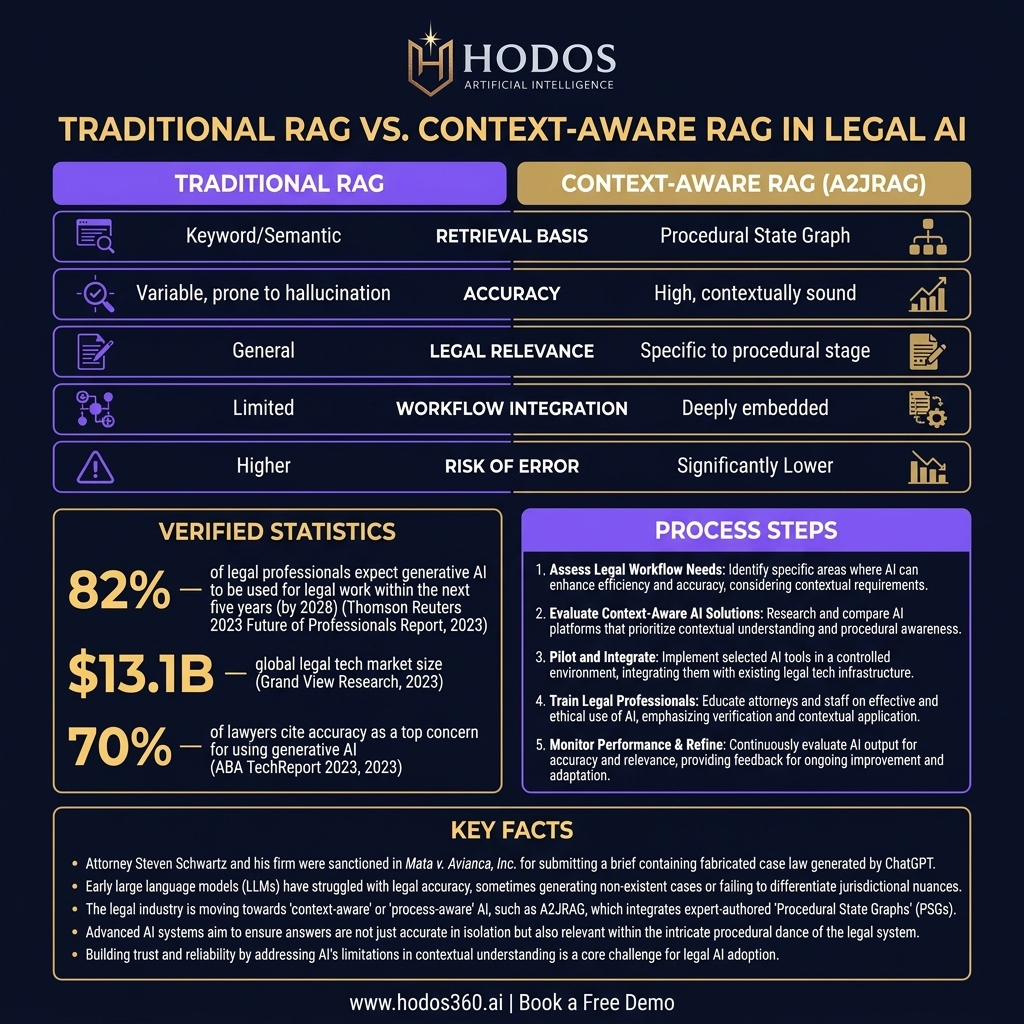
Traditional Retrieval-Augmented Generation (RAG) systems attempt to mitigate hallucinations by grounding LLM outputs in a corpus of trusted documents.
However, even advanced RAG often falls short in legal contexts. It can retrieve relevant statutes, case law, or regulations, but it typically lacks the inherent intelligence to understand the *procedural stage* of a case, the *jurisdictional rules* governing a particular court, or the *interdependencies* between different legal documents.
Imagine a scenario where an attorney needs to prepare for a discovery phase. A basic RAG system might provide general information about discovery rules, but it wouldn't inherently know if the case is in federal or state court, what specific local rules apply, or what prior discovery orders have been issued.
Without this procedural awareness, the retrieved information, while factually correct, could be contextually irrelevant or even misleading.
This gap is further exacerbated by the sheer volume and complexity of legal information. Learn more about Essential AI Voice Agent Transfer: Mastering Warm Handoffs. Law firms manage vast quantities of documents, from client intake forms and contracts to court filings and research memoranda.
A 2024 report by Thomson Reuters found that legal professionals spend up to 40% of their time on administrative and non-billable tasks, much of which involves sifting through information to establish context. Generic AI, while capable of rapid text processing, often treats all information as equally relevant, failing to prioritize based on the specific procedural or strategic needs of the attorney.
This can lead to information overload, making it harder for lawyers to extract actionable insights and increasing the risk of overlooking critical details. The challenge isn't just about accessing information; it's about intelligent, context-driven access and synthesis.
The limitations of generic AI underscore a fundamental truth in legal practice: Context Matters AI more than raw data.
The legal system is a structured environment where every action, document, and argument must adhere to a specific set of rules and procedures. An AI that merely processes text without understanding these underlying structures is inherently ill-suited for critical legal tasks. This realization has driven legal tech innovators to develop more sophisticated AI architectures, moving beyond surface-level text analysis to integrate deeper procedural and semantic understanding.
The goal is to build AI that doesn't just answer questions, but understands the *why* and *how* behind those answers within the legal domain.
Beyond Simple Retrieval: The Need for Procedural Awareness
The evolution of legal AI demands a shift from simple information retrieval to a nuanced understanding of procedural context. For decades, legal research tools have focused on efficient document retrieval, allowing lawyers to find statutes, cases, and secondary sources. While invaluable, this approach places the entire burden of contextualization and application on the attorney.
With the advent of generative AI, the expectation has grown for AI to not just find information but to *reason* with it. However, this reasoning must be procedurally aware.
This is where the concept of 'Procedural State Graphs' (PSGs) becomes revolutionary. As outlined in the research behind A2JRAG, PSGs are expert-authored frameworks that map out the logical flow and interdependencies of legal procedures.
Think of them as a highly detailed, dynamic flowchart of a legal process – from client intake, discovery phases, motion practice, trial, to appeal. When an AI system is guided by a PSG, it doesn't just retrieve a document; it understands *where* that document fits within the broader procedural journey of a case.
For example, if an attorney is drafting a motion to compel discovery, the AI, leveraging a PSG, understands the preceding discovery requests, the deadlines involved, the relevant rules of civil procedure (e.g., Federal Rules of Civil Procedure Rule 26, 33, 34, 37), and the specific court's local rules.
Learn more about AI Marketing Intelligence: The Ultimate Guide for Law Firms. This allows the AI to retrieve and synthesize information that is not only factually correct but also procedurally appropriate and strategically sound. The shift is from 'what' to 'when' and 'how' in the legal workflow, making the AI a more intelligent partner.
The complexity of legal workflows necessitates this deeper understanding. Consider a multi-jurisdictional class action lawsuit. Different states may have varying statutes of limitations, class certification requirements, and discovery protocols. A procedurally aware AI can navigate these complexities, ensuring that generated advice or documents adhere to the specific rules of each jurisdiction involved.
This significantly reduces the risk of procedural errors, which can lead to costly delays, sanctions, or even the dismissal of a case. The integration of such procedural intelligence transforms AI from a basic search engine into a sophisticated legal reasoning engine, capable of supporting attorneys through the most intricate legal challenges.
This kind of sophisticated, context-aware reasoning is what defines the next generation of legal AI, providing a tangible competitive advantage to firms that adopt it.
A2JRAG: Revolutionizing Legal AI with Contextual Intelligence
The emergence of A2JRAG, or Process-Aware Retrieval-Augmented Generation, marks a significant leap forward in addressing the contextual challenges of legal AI. Unlike conventional RAG systems that retrieve documents based purely on semantic similarity, A2JRAG elevates the process by conditioning retrieval on an expert-authored Procedural State Graph (PSG).
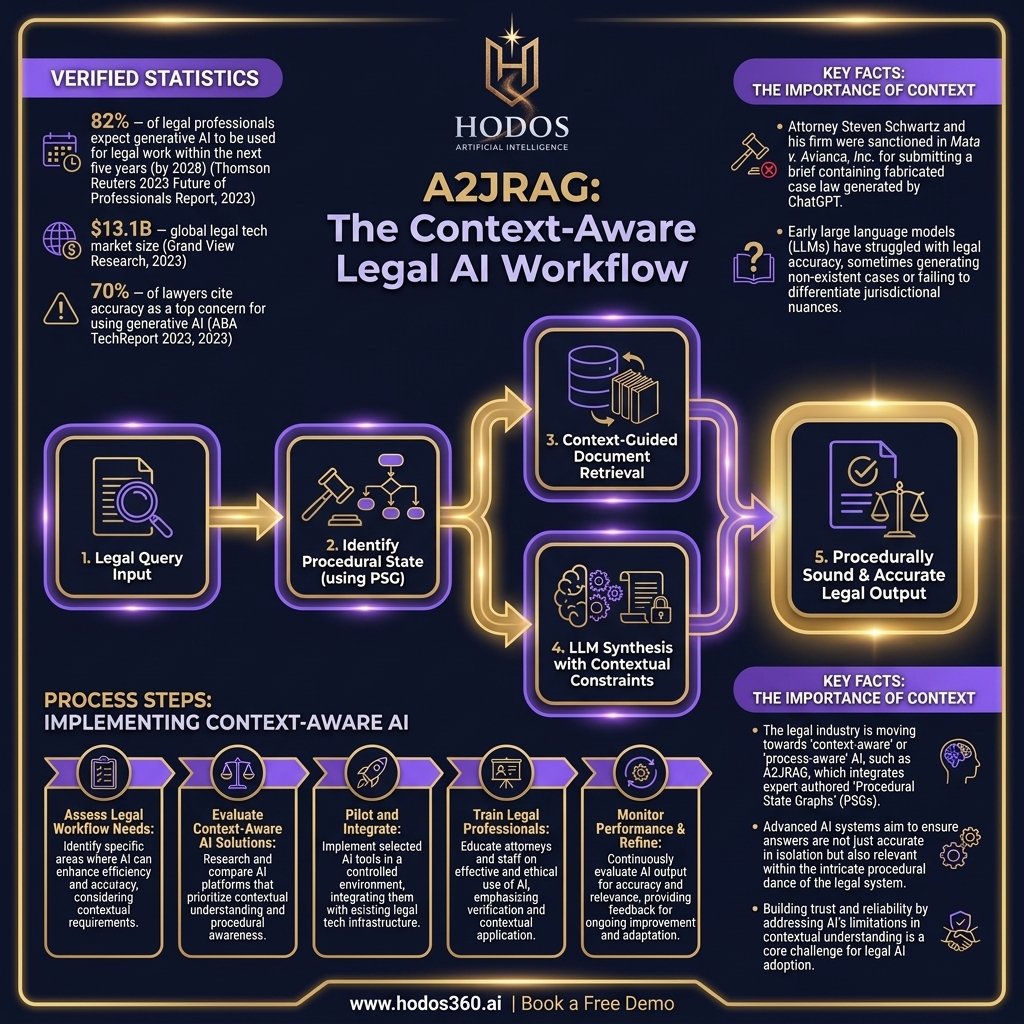
This means the AI doesn't just search for keywords or concepts; it searches for information *relevant to the current procedural stage* of a legal matter, guided by a predefined map of legal processes. This innovation directly tackles the 'context problem' by embedding procedural logic into the core of the AI's reasoning capabilities, making legal AI outputs far more reliable and actionable.
The research paper, as highlighted by LawSites, demonstrates A2JRAG's superior performance in generating answers that are not only factually accurate but also procedurally sound, a critical distinction for legal applications.
At its core, A2JRAG functions by combining the power of large language models with a structured understanding of legal procedures.
When a legal professional poses a query, the A2JRAG system first identifies the current procedural state within the relevant PSG. This could be anything from 'pre-filing client intake' to 'discovery motion practice' or 'appellate brief drafting.' Once the procedural context is established, the AI's retrieval component is then constrained and guided by this context, fetching only the most relevant documents, statutes, and precedents that apply to that specific stage.
This intelligent filtering prevents the AI from drawing on irrelevant information, drastically reducing the chances of hallucinations and improving the precision of its outputs. Learn more about Ethical AI in Legal Tech: An Essential Guide for Law Firms. For example, if a lawyer is working on a motion for summary judgment, the PSG would guide the AI to prioritize documents related to undisputed facts, relevant case law on summary judgment standards, and specific court rules governing such motions, rather than general legal principles.
This procedural awareness allows A2JRAG to provide better answers by ensuring that the AI's reasoning is always grounded in the current reality of the legal process. It moves beyond merely finding information to providing *contextualized insight*. This is particularly valuable in complex areas like regulatory compliance, intellectual property litigation, or corporate transactions, where procedural steps are highly specific and deviations can have severe consequences.
Leading legal tech developers and research institutions, including those collaborating with firms like Allen & Overy (known for its pioneering work with Harvey AI), are actively exploring and integrating similar context-aware mechanisms to enhance their platforms. The goal is to build AI that acts as a truly intelligent co-pilot, anticipating needs and providing insights that align perfectly with the ongoing legal strategy, thereby elevating the quality and efficiency of legal services across the board.
The ability of such systems to understand and navigate legal workflows transforms AI from a search tool into a strategic asset, ensuring that the insights provided are always aligned with the precise stage and requirements of a legal matter.
The benefits of A2JRAG's approach are manifold, directly impacting the quality and efficiency of legal work.
By integrating procedural understanding, the system can:
* Enhance Accuracy: Significantly reduce the incidence of hallucinations and irrelevant information by grounding outputs in specific procedural contexts. * Improve Reliability: Provide answers that are not only factually correct but also procedurally appropriate, building greater trust in AI-generated content.
* Streamline Workflows: Guide attorneys through complex legal processes, ensuring adherence to rules and deadlines, from client intake to trial preparation. * Increase Efficiency: Reduce the time spent on sifting through irrelevant information, allowing lawyers to focus on higher-value analytical and strategic tasks. * Support Strategic Decision-Making: Offer contextually relevant insights that inform litigation strategy, transactional advice, and compliance efforts.
* Boost Client Confidence: Deliver more consistent and accurate legal advice, enhancing client satisfaction and firm reputation. * Facilitate Training: Serve as an invaluable tool for junior lawyers, helping them internalize complex procedural rules through practical application.
Implementing Context-Aware AI: A Strategic Imperative for Law Firms
For law firms operating in today's fiercely competitive and rapidly evolving legal market, embracing context-aware AI is no longer an option but a strategic imperative. The firms that will thrive are those that integrate intelligent systems capable of understanding the intricate dance of legal procedures.
Platforms like HODOS 360's AI Law Firm Management System are at the forefront of this transformation, designed to embed such advanced contextual intelligence directly into core operational workflows. By moving beyond basic automation to truly intelligent assistance, firms can unlock unprecedented levels of efficiency, accuracy, and strategic insight.
This isn't just about adopting new technology; it's about fundamentally rethinking how legal services are delivered and how legal talent is leveraged.
The practical applications of context-aware AI span every facet of a law firm's operations. In case management, for instance, an AI system that understands the procedural stage of each matter can proactively flag upcoming deadlines, suggest relevant document templates based on court rules, and even predict potential bottlenecks.
For client intake, AI can analyze a new client's information against historical data and legal precedents, identifying potential conflicts of interest or suggesting optimal legal strategies from the outset. In document review and automation, context-aware AI goes beyond mere keyword matching; it understands the legal significance of clauses within the framework of a contract type or a specific regulatory environment, drastically improving the accuracy and speed of due diligence.
Firms like Kirkland & Ellis and Linklaters, known for their innovative tech adoption, are already investing heavily in custom AI solutions that bring this level of contextual understanding to their high-volume, complex matters.
Moreover, the integration of context-aware AI extends to legal research and drafting.
Instead of simply pulling up cases, an AI guided by procedural understanding can identify precedents that are not only factually similar but also procedurally relevant to the current stage of a case. Learn more about Privilege & AI: The Ultimate Guide After US v. Heppner.
When drafting a brief or a contract, the AI can ensure that the language and structure adhere to specific jurisdictional requirements and industry standards, minimizing errors and accelerating the drafting process. This level of intelligent assistance liberates attorneys from mundane, repetitive tasks, allowing them to dedicate more time to strategic thinking, client counseling, and complex problem-solving—the true value drivers in legal practice.
The return on investment for such systems is substantial, translating into reduced operational costs, increased billable hours, and a stronger competitive position in the market. The time for law firms to embrace these tools is now, ensuring they are not left behind in the ongoing technological revolution.
The strategic advantage derived from implementing context-aware AI is multifaceted, offering a distinct edge in a crowded legal market. Firms that leverage these systems can offer more precise advice, deliver faster results, and operate with greater efficiency, all of which translate into enhanced client satisfaction and a stronger reputation.
The ability to navigate complex legal procedures with AI-driven precision becomes a key differentiator, attracting sophisticated clients who demand cutting-edge solutions. Furthermore, it empowers firms to manage risk more effectively by minimizing procedural errors and ensuring compliance with ever-changing legal frameworks. As legal tech continues its rapid evolution, the firms that prioritize and integrate context-aware AI will not only survive but thrive, setting new benchmarks for excellence in legal service delivery.
Enhancing Workflows: From Intake to Trial Prep
The transformative power of context-aware AI is most evident in its ability to enhance every stage of the legal workflow, from the initial client intake to the arduous process of trial preparation. During client intake, an AI system powered by procedural awareness can analyze submitted information, cross-reference it with existing case law and firm knowledge, and even suggest potential legal avenues or identify red flags based on the client's specific situation and the relevant jurisdiction's procedural rules.
This proactive analysis ensures that cases are properly categorized and assigned from the outset, laying a solid foundation for subsequent legal work.
In the discovery phase, which often consumes significant time and resources, context-aware AI becomes indispensable. It can identify and prioritize relevant documents not just by keywords, but by understanding their relationship to specific discovery requests, the governing rules of evidence, and the overall procedural strategy.
For example, if a firm is responding to a request for production, the AI can help identify privileged documents or those protected by the work-product doctrine based on the context of their creation and the ongoing litigation. This precision drastically reduces the manual effort involved, speeds up document review, and minimizes the risk of inadvertent disclosures.
Learn more about AI Marketing Transforms Legal Web: Webflow's Vidoso Acquisition 2026. Furthermore, during brief drafting and motion practice, the AI can ensure that arguments are not only legally sound but also procedurally compliant, referencing the correct court rules, citing relevant precedents within the appropriate jurisdiction, and adhering to formatting guidelines.
This level of integrated intelligence streamlines the entire process, freeing up lawyers to focus on the strategic substance of their arguments rather than the mechanics of compliance.
Finally, as a case moves towards trial, context-aware AI can play a crucial role in trial preparation. It can assist in identifying potential witnesses, preparing for cross-examinations by analyzing past testimony or depositions in context, and even developing jury selection strategies by processing demographic and behavioral data through a procedural lens.
The ability of AI to understand the unfolding narrative of a case, its procedural posture, and the specific rules governing each stage allows it to provide predictive insights and strategic recommendations that were previously only possible through extensive human experience and intuition. This comprehensive enhancement across all legal workflows underscores the unparalleled value of integrating context-aware AI, making legal practice more efficient, accurate, and strategically effective.
Navigating the Future: Ethical AI and Continuous Evolution
As legal AI continues its rapid evolution, particularly with advancements in contextual understanding like A2JRAG, the conversation inevitably turns to ethical considerations and the imperative for continuous development. The legal profession, bound by strict ethical codes such as the ABA Model Rules of Professional Conduct (Rule 1.1 on Competence and Rule 5.3 on Supervision of Nonlawyer Assistants), must ensure that AI tools are used responsibly and competently.
This means addressing potential biases embedded in AI training data, ensuring transparency in AI's decision-making processes, and establishing clear accountability frameworks when AI errors occur. The EU AI Act, set to be fully enforced in 2026, provides a global precedent for regulating AI, classifying systems based on risk and imposing stringent requirements for high-risk applications—a category that legal AI often falls into.
Law firms cannot simply deploy AI; they must actively govern its use, providing robust oversight and continuous training for their legal professionals.
The development of AI itself is a dynamic and ongoing process. While A2JRAG represents a significant leap, the journey towards truly sentient and procedurally perfect legal AI is continuous.
Research giants like Google DeepMind, Anthropic (with its focus on constitutional AI), and NVIDIA (driving hardware innovations for faster, more complex models) are constantly pushing the boundaries of what AI can achieve. Their efforts in areas like multi-modal AI, reinforcement learning from human feedback (RLHF), and ever-larger, more nuanced models will undoubtedly lead to even more sophisticated context-aware capabilities.
For legal tech, this means a future where AI can not only understand procedural graphs but also potentially *learn* and *adapt* to new legal precedents or legislative changes with minimal human intervention, while still requiring ultimate human oversight. This continuous evolution necessitates that law firms remain agile, regularly evaluating and updating their AI strategies to leverage the latest advancements responsibly.
Furthermore, the ethical deployment of AI in legal practice requires a strong emphasis on explainability and human-in-the-loop systems. Attorneys must understand *how* an AI arrived at its conclusion, especially when critical legal advice is being generated. This transparency is crucial for maintaining professional integrity and client trust.
AI should serve as an augmentation to human intellect, not a replacement. Legal professionals must retain the ultimate responsibility for the advice given and documents produced, using AI as a powerful tool to enhance their capabilities. This collaborative model ensures that the nuanced judgment, ethical reasoning, and empathy inherent to human legal practice remain central, while AI handles the heavy lifting of information processing and contextual application.
The future of legal AI is not about machines replacing lawyers, but about AI empowering lawyers to deliver superior legal services with unprecedented efficiency and accuracy, while adhering to the highest ethical standards. This symbiotic relationship, where the human element provides the ultimate ethical and strategic oversight, is paramount for the responsible integration of advanced AI into the legal domain.
The ongoing development of robust AI governance policies within law firms and across the broader legal community will be critical to navigating this transformative era successfully.
The Human-AI Collaboration: Elevating Legal Professionals
The ultimate promise of context-aware AI in legal practice is not to diminish the role of the human lawyer but to profoundly elevate it. By automating the laborious, context-gathering, and procedurally repetitive aspects of legal work, AI empowers attorneys to focus on tasks that truly demand human intellect, creativity, and empathy.
This includes complex legal strategy formulation, nuanced client counseling, persuasive argumentation in court, and the development of innovative legal solutions. The shift is from 'information retrieval specialist' to 'strategic advisor' and 'innovative problem-solver.' Lawyers, freed from the drudgery of sifting through mountains of documents to understand procedural relevance, can dedicate more time to honing their advocacy skills, building stronger client relationships, and engaging in higher-level legal analysis.
This human-AI collaboration fosters a new era of legal professionalism, where the synergy between advanced technology and human expertise leads to superior outcomes. Imagine a junior associate, previously spending hours researching procedural specifics for a motion, now leveraging an A2JRAG-powered system that provides immediate, contextually accurate guidance.
This accelerates their learning curve, allowing them to contribute strategically much earlier in their careers. Senior partners, in turn, can rely on AI to quickly synthesize complex case histories and procedural implications, enabling them to make more informed decisions and offer more precise advice. The legal landscape envisioned is one where AI acts as an omnipresent, intelligent research assistant and procedural guide, continuously feeding lawyers context-rich insights that enhance their judgment and strategic capabilities.
This symbiotic relationship not only improves the quality of legal services but also makes the practice of law more engaging and intellectually stimulating for attorneys, ensuring that their unique human contributions remain at the forefront of the profession.

Key Takeaways and Next Steps for Legal Leaders
The journey of legal AI from basic text generation to sophisticated, procedurally aware intelligence marks a turning point for the legal industry. The core message is clear: Context Matters AI more than ever before. For law firms, this means a strategic shift towards adopting AI platforms that prioritize deep contextual understanding, moving beyond superficial automation to truly intelligent assistance.
Innovations like A2JRAG, which embed procedural awareness into their core, are not just enhancing efficiency; they are fundamentally improving the accuracy, reliability, and strategic value of AI in legal practice. Firms that embrace this paradigm will be better equipped to navigate the complexities of modern law, deliver superior client outcomes, and maintain a competitive edge.
For legal leaders, the immediate next steps involve a critical evaluation of existing AI tools and a proactive exploration of next-generation platforms. Prioritize solutions that offer robust RAG capabilities augmented by procedural intelligence. Invest in training your legal teams to effectively collaborate with these advanced AI systems, fostering a culture of continuous learning and responsible AI adoption.
The goal is to leverage AI not as a replacement for human intellect, but as a powerful augmentation that frees up attorneys for higher-value, strategic work. HODOS 360’s comprehensive AI platform, including its AI Law Firm Management System, is specifically designed to integrate these advanced capabilities, providing law firms with the tools to streamline operations, enhance client services, and drive growth through intelligent, context-aware workflows.
Explore how our AI-powered solutions can transform your firm's approach to legal management, marketing, and client engagement. The future of legal practice is here, and it is contextually intelligent. Discover how to harness its full potential for your firm today.
Frequently Asked Questions
What is 'procedural awareness' in legal AI?+
Procedural awareness in legal AI refers to the system's ability to understand and apply information within the specific legal rules, stages, and workflows of a case or legal process. Unlike generic AI that might just retrieve facts, procedurally aware AI knows *when* and *how* those facts apply, considering jurisdictional rules, court deadlines, and the specific stage of a legal matter, thus providing contextually relevant and accurate insights.
How does A2JRAG improve upon traditional RAG systems?+
A2JRAG (Process-Aware Retrieval-Augmented Generation) improves upon traditional RAG by integrating expert-authored 'Procedural State Graphs' (PSGs). While traditional RAG retrieves documents based on semantic similarity, A2JRAG's retrieval is guided by the current procedural stage of a legal matter. This ensures that the AI's outputs are not only factually correct but also procedurally appropriate, significantly reducing hallucinations and enhancing reliability for legal tasks.
What are the benefits of context-aware AI for law firms?+
Context-aware AI offers numerous benefits, including enhanced accuracy in legal research and drafting, reduced risk of procedural errors, and streamlined workflows from client intake to trial preparation. It frees up attorneys from mundane tasks, allowing them to focus on high-value strategic work, ultimately leading to increased efficiency, improved client satisfaction, and a stronger competitive position in the legal market.
Can context-aware AI help with ethical compliance?+
Yes, context-aware AI can significantly aid ethical compliance by ensuring greater accuracy and transparency in legal work. By reducing hallucinations and providing procedurally sound information, it helps attorneys meet their competence obligations (ABA Model Rule 1.1). However, human oversight remains crucial, as attorneys are ultimately responsible for the advice given, and firms must implement robust AI governance policies to ensure responsible and ethical use.
How can law firms implement context-aware AI effectively?+
Effective implementation involves evaluating AI platforms that prioritize deep contextual understanding and procedural awareness, like HODOS 360's AI Law Firm Management System. Firms should invest in training legal teams to collaborate with AI, foster a culture of responsible AI adoption, and integrate these tools into existing workflows to maximize efficiency and accuracy. The focus should be on augmenting human capabilities, not replacing them.