


Legal AI Models: Essential for Law Firm Autonomy
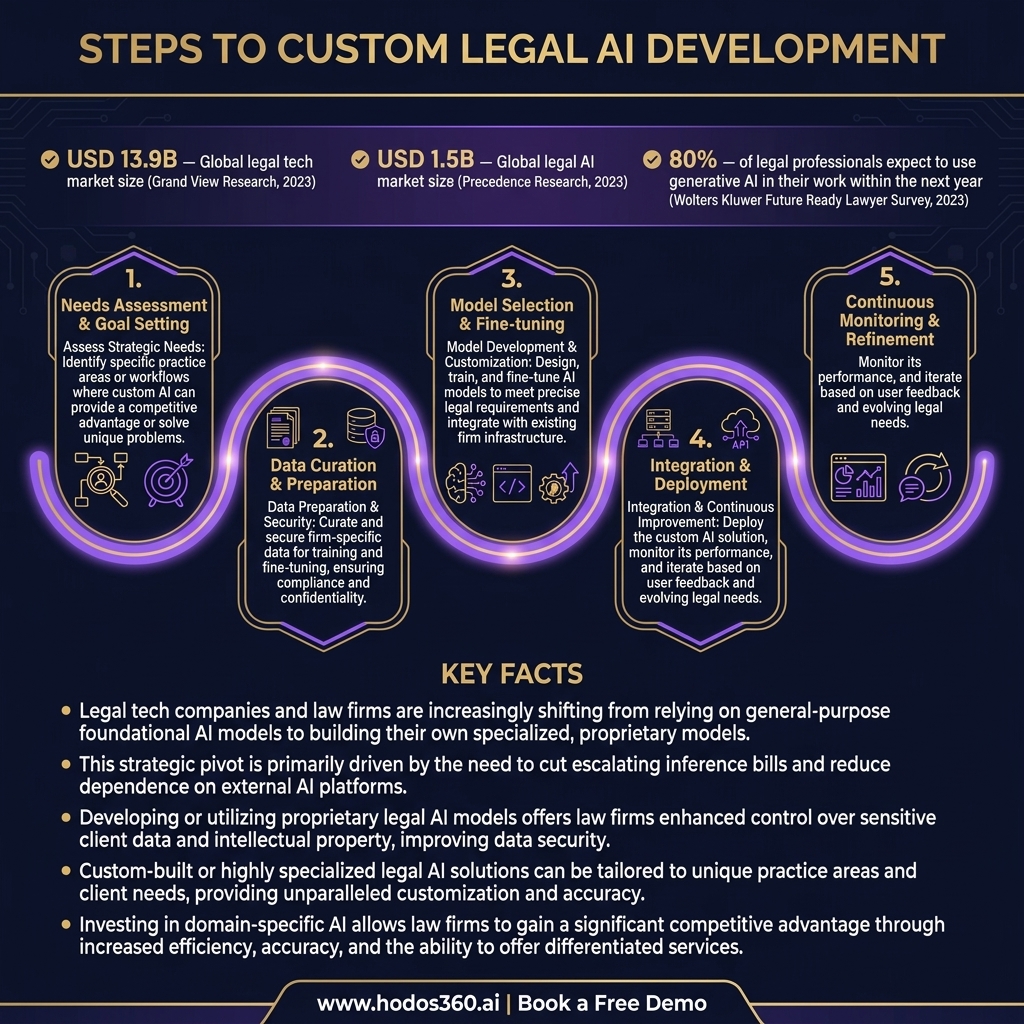
The legal technology ecosystem is at an inflection point, marked by a significant strategic pivot among its key players. For years, legal tech companies and law firms largely relied on general-purpose foundational models from titans like OpenAI and Anthropic, leveraging their immense capabilities for tasks ranging from document review to legal research. However, this reliance came with a hidden cost: escalating inference bills and a growing dependence on external platforms. The recent news from MarketScale, highlighting that "Legal AI vendors are building their own models to cut inference bills and reduce platform dependence," underscores a fundamental shift in how the industry views AI — moving from a 'rent-and-adapt' mindset to a 'build-and-own' philosophy. This trend, observed across the tech sector and now deeply permeating legal, signifies a maturing market where specialized, proprietary solutions are becoming a critical differentiator.
This movement isn't merely about cost-cutting; it’s a profound reassertion of control over core technological infrastructure and intellectual property. For law firms, the implications are vast: greater data security, unparalleled customization, and a competitive edge derived from truly domain-specific AI. Imagine a scenario where a firm like Allen & Overy, known for its early adoption of AI, decides to deepen its investment in custom models, perhaps in collaboration with partners like Harvey AI, moving beyond mere fine-tuning to developing bespoke architectures tailored to their unique practice areas and client needs. This quest for autonomy is fueled by the desire to mitigate the long-term financial drain of per-query inference costs, which, as NVIDIA CEO Jensen Huang has often pointed out, can quickly become prohibitive at scale. Firms and vendors are increasingly recognizing that while foundational models offer a powerful starting point, true efficiency and strategic advantage lie in tailoring these powerful engines to the intricate, often idiosyncratic demands of legal practice.
The Strategic Imperative: Why Legal AI Models are Shifting In-House
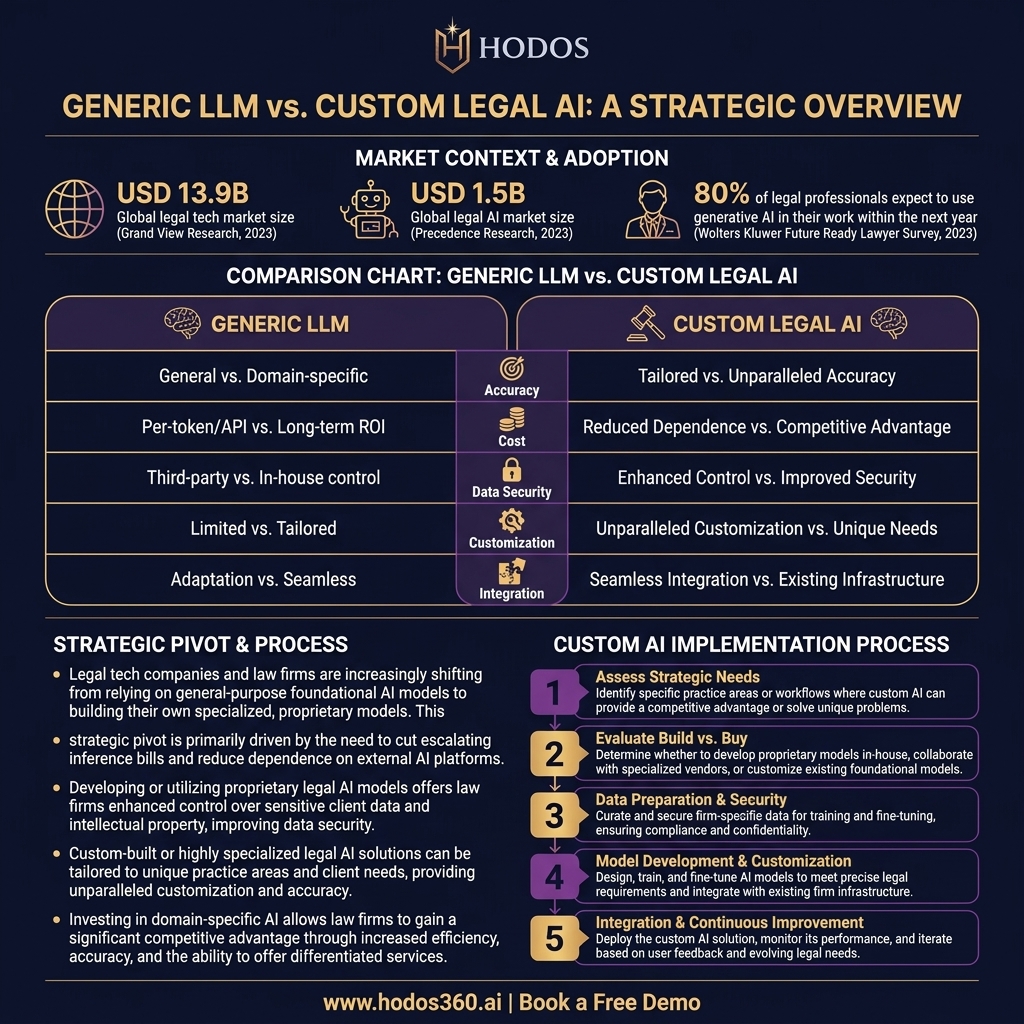
The decision for legal AI vendors and, increasingly, large law firms, to develop their own models is driven by a multifaceted strategic imperative. At its core, this shift addresses the unsustainable economics of relying solely on third-party foundational models. While powerful, these models typically operate on a pay-per-token or pay-per-query basis, leading to 'inference bills' that can quickly balloon for high-volume users. For a legal tech platform processing millions of documents or queries annually, these costs represent a significant operational overhead that erodes profit margins and limits scalability. As industry analyst Sarah Gupta from LexisNexis Legal & Professional noted at LegalTech NYC 2026, "The unit economics of AI inference are forcing a reckoning. Legal tech companies can't simply pass on ever-increasing API costs to their clients indefinitely without impacting market competitiveness." This financial pressure is compelling vendors to invest in proprietary solutions that, over the long term, offer a more predictable and controllable cost structure, much like a manufacturer opting to build a critical component in-house rather than sourcing it externally.
Beyond cost, the pursuit of greater customization and domain specificity is a powerful driver. General-purpose large language models (LLMs), while impressive, often struggle with the extreme nuances, specific terminology, and complex logical structures inherent in legal documents and reasoning. A model trained primarily on a broad internet corpus may misinterpret highly specific legal jargon, overlook subtle statutory distinctions, or fail to accurately summarize a complex appellate court ruling. By building or extensively fine-tuning their own legal AI models, vendors can imbue these systems with a deeper understanding of legal context, improving accuracy and reducing the 'hallucination' rate that plagues generic models. For instance, a custom model developed for contract analysis can be trained on millions of specific contract clauses, precedents, and jurisdictional variations, far surpassing the performance of a generic LLM in identifying critical terms, risks, and compliance issues. This level of specialization is not just an enhancement; it's a necessity for tools that attorneys will trust with high-stakes legal work.
The drive for platform independence and enhanced data security also plays a crucial role. Learn more about Email Marketing AI: Essential Strategies for Law Firms. Relying on external AI providers means entrusting sensitive client data, even if anonymized or pseudonymized, to a third party. While these providers have robust security protocols, the legal profession's ethical obligations regarding client confidentiality are exceptionally stringent, as articulated in ABA Model Rule 1.6. Developing in-house models, or at least hosting and managing the inference process on private infrastructure, offers law firms and legal tech vendors greater control over their data's lifecycle, security, and compliance with various regulatory frameworks, including the EU AI Act now coming into full effect. This independence reduces the risk of vendor lock-in, where switching providers becomes prohibitively expensive or technically complex. It also allows for greater agility in adapting to new legal tech trends and integrating AI capabilities directly into proprietary systems, such as HODOS 360's AI Law Firm Management System, without being constrained by external API limitations or service changes.
Finally, the competitive landscape itself is pushing this shift. In a rapidly evolving market, proprietary AI models can become a significant competitive advantage. Companies that master the art of building and deploying specialized legal AI can offer services that are demonstrably superior, faster, or more cost-effective than those relying on generic, off-the-shelf solutions. This isn't just about outperforming rivals; it's about defining the next generation of legal service delivery. As Daniel Katz, a prominent legal tech scholar at Chicago-Kent College of Law, often emphasizes, "The firms and tech companies that truly understand and internalize AI at a foundational level will be the ones shaping the future of legal practice, not just reacting to it." This internal development fosters a culture of innovation, attracting top talent and positioning these entities as leaders in the legal AI revolution, setting new benchmarks for efficiency, insight, and client service.
Navigating the Build vs. Buy Dilemma for Law Firms
For law firms, the decision to 'build' their own legal AI models versus 'buy' existing solutions is a complex strategic calculus that balances immediate needs against long-term vision and resource allocation. Historically, the 'buy' option has been the default, offering quick access to powerful tools without the hefty upfront investment in R&D, specialized talent, and infrastructure. Platforms like Clio and MyCase provide comprehensive practice management, often integrating third-party AI features. However, as firms grow in size and specialization, and as their data volumes increase, the limitations of generic solutions become apparent. Managing Partner Emily Chen of Sterling & Partners, a mid-sized litigation firm, articulated this challenge at a recent ABA conference: "We started with off-the-shelf AI for e-discovery, but as our caseload became more complex and our data volume exploded, we realized we needed something that truly understood the nuances of environmental litigation. The generic tools were a good start, but they couldn't handle the bespoke nature of our work, leading to higher review times and occasional inaccuracies." This highlights a critical threshold where the benefits of customization begin to outweigh the costs of development.
Building an in-house AI model for a law firm isn't about creating a foundational LLM from scratch – a task requiring billions in capital and immense computing power, as seen with OpenAI's GPT-4 or Anthropic's Claude. Instead, it typically involves extensive fine-tuning of existing open-source or commercially available models with proprietary, domain-specific legal data. This process, often referred to as 'knowledge distillation' or 'retrieval-augmented generation' (RAG), allows firms to leverage the core intelligence of a powerful base model while imbuing it with their unique institutional knowledge, client precedents, and preferred legal styles. This approach requires a dedicated team of data scientists, legal engineers, and subject matter experts, as well as significant investment in secure data infrastructure. For instance, a firm might fine-tune an open-source model like Llama 3 on its entire archive of M&A contracts to create an AI assistant specifically trained to identify unique clauses, potential risks, and negotiation points relevant to their specific client base. Learn more about Legal AI Content: Essential for Modern Contract Workflows. This bespoke capability offers a distinct competitive advantage, allowing the firm to deliver more precise, efficient, and tailored legal advice.
Moreover, the 'build' approach offers unparalleled control over data privacy and security, a paramount concern in legal practice. Under ABA Model Rule 1.6, attorneys have a strict duty of confidentiality regarding client information. While reputable vendors offer robust security, hosting and processing data on a firm's private cloud or on-premise infrastructure provides an additional layer of assurance. This is particularly relevant as regulatory frameworks like the EU AI Act and various state data privacy laws (e.g., California Consumer Privacy Act) impose increasingly stringent requirements on how AI systems handle personal and sensitive data. By developing and deploying custom models within their own secure environments, law firms can ensure complete compliance and mitigate the risks associated with third-party data access. This strategic independence not only protects client interests but also enhances the firm's reputation as a secure and forward-thinking legal entity. The decision to build, therefore, becomes a calculated investment in long-term security, efficiency, and a truly competitive edge in a rapidly evolving legal landscape. For firms considering this path, a thorough audit of internal capabilities, data assets, and strategic objectives is essential to determine the optimal balance between leveraging existing tools and investing in bespoke solutions. HODOS 360 can assist firms in assessing their needs and integrating custom AI solutions seamlessly into their existing workflows.
Ready to explore custom AI for your firm? Discover how HODOS 360's AI Law Firm Management System can integrate specialized models to revolutionize your operations. Book a Free Demo Today
Beyond Generics: The Power of Custom Legal-Specific AI
The true promise of legal AI lies not in general-purpose intelligence, but in the power of custom, legal-specific models designed to excel at the nuanced and often idiosyncratic demands of legal practice. While foundational models like GPT-4 or Claude can perform impressive feats of language generation and summarization, their broad training data lacks the depth required for consistently accurate and reliable legal analysis. This limitation becomes acutely apparent in tasks requiring precise interpretation of statutes, identification of specific case law, or drafting of highly specialized legal documents. As Professor Gillian Hadfield of the University of Toronto, a leading expert on AI and law, has often articulated, "Legal work is not just about language; it's about context, precedent, and the subtle interplay of rules and facts. Generic AI can mimic language, but it rarely grasps the underlying legal reasoning with the consistency required for professional practice." This critical gap is precisely what custom legal AI models aim to bridge.
Custom legal-specific AI models are built or fine-tuned using vast datasets of proprietary legal information, including case briefs, judicial opinions, legislative histories, transactional documents, and internal firm knowledge bases. This specialized training allows the AI to develop a deep understanding of legal terminology, common contractual clauses, jurisdictional variations, and the unique patterns of legal argumentation. For example, a custom model designed for intellectual property law can be trained on millions of patent applications, trademark filings, and infringement litigation documents, enabling it to identify relevant prior art with greater accuracy, assess patentability more effectively, and even predict litigation outcomes based on historical data. This level of granular understanding is virtually impossible for a generic LLM, which, despite its vastness, cannot replicate the targeted expertise of a system meticulously crafted for a specific legal domain.
Moreover, custom models can be engineered to integrate seamlessly with existing legal workflows and firm-specific applications, enhancing efficiency and reducing the learning curve for attorneys. Imagine an AI model that not only drafts initial pleadings but also automatically cross-references them with the firm’s internal knowledge management system for relevant precedents, flags potential conflicts of interest, and integrates directly with the firm's billing and case management software. Learn more about AI Legal Revolution: Corporate Use Jumps 87% by 2026. This holistic integration, a core feature of advanced platforms like HODOS 360's AI Law Firm Management System, transforms AI from a standalone tool into an embedded, intelligent assistant that augments every stage of legal practice. This contrasts sharply with generic models that often require significant manual effort to adapt their outputs to specific firm styles or integrate them into complex operational pipelines. The result is not just improved accuracy, but a dramatic increase in overall operational efficiency and a reduction in the time attorneys spend on repetitive, low-value tasks, allowing them to focus on strategic client counsel.
The development of custom legal AI also addresses the critical challenge of ethical AI deployment in the legal sector. By controlling the training data and model architecture, firms and vendors can implement robust bias detection and mitigation strategies, ensuring that AI outputs are fair, unbiased, and compliant with ethical guidelines. This is particularly important in areas like sentencing prediction or immigration law, where algorithmic bias can have profound real-world consequences. Furthermore, custom models can be designed with explainability features, allowing attorneys to understand the reasoning behind an AI's output, a crucial requirement for maintaining professional responsibility and client trust. This transparency, combined with enhanced accuracy and seamless integration, positions custom legal AI not just as a technological advancement, but as a foundational pillar for a more ethical, efficient, and client-centric legal profession, ultimately reshaping how legal services are delivered and consumed in the 21st century.
Data Security and Client Confidentiality in AI Development
The development and deployment of legal AI models inherently involve the processing of vast amounts of data, much of which is highly sensitive and confidential client information. For law firms, upholding the sacred duty of client confidentiality, enshrined in ethical rules like ABA Model Rule 1.6 and various state bar regulations, is paramount. This makes data security and privacy not merely a technical concern, but a fundamental ethical and professional obligation. When firms leverage third-party AI solutions, they implicitly trust those vendors with their data. While many commercial AI providers offer robust security protocols and compliance certifications, the ultimate responsibility for client data protection rests with the attorney. This inherent tension is a significant driver for legal tech vendors and forward-thinking law firms to explore building their own models or at least managing the AI infrastructure in-house, thereby retaining maximum control over their data footprint.
Developing custom legal AI models allows for the implementation of security measures tailored precisely to the firm's risk profile and compliance requirements. This includes robust encryption protocols for data at rest and in transit, strict access controls, data anonymization or pseudonymization techniques, and secure, isolated environments for model training and inference. For instance, a firm might choose to host its custom AI models on a private cloud server or even on-premises, minimizing exposure to external networks. This approach aligns with best practices for handling electronically stored information (ESI) as outlined in Federal Rules of Civil Procedure, particularly Rule 26, which mandates proportionality and careful management of discoverable data. By bringing AI development and deployment closer to home, firms can ensure that their data governance policies, disaster recovery plans, and incident response procedures are fully integrated with their AI operations, providing a more comprehensive and auditable security posture than often achievable with purely external solutions.
Moreover, the evolving global regulatory landscape for AI and data privacy, notably the enforcement of the EU AI Act and the proliferation of state-level privacy laws in the U.S., places increasing demands on data stewardship. Learn more about AI SaaS Builders: The Ultimate Blueprint for Law Firms. These regulations often impose strict requirements on how AI systems are designed, trained, and deployed, particularly concerning fairness, transparency, and the protection of personal data. Firms developing their own legal AI models can proactively build these compliance requirements into the model's architecture and training methodology from the ground up. This 'privacy by design' approach helps mitigate legal and reputational risks associated with non-compliance. For example, a firm could implement differential privacy techniques during model training to prevent the re-identification of individuals from training data, or build in auditing mechanisms to track data lineage and model decisions, thereby demonstrating accountability and transparency to regulators and clients alike.
In essence, the move towards custom legal AI development is as much about fortifying data security and ensuring client confidentiality as it is about technological innovation. It represents a strategic investment in the firm's ethical integrity and its ability to navigate an increasingly complex digital and regulatory environment. By taking ownership of their AI infrastructure, firms can not only tailor solutions to their unique legal needs but also construct an impenetrable fortress around their most valuable asset: client trust. This proactive stance on data governance and security is not just good practice; it's becoming an indispensable component of responsible legal AI adoption, setting a new standard for excellence in the digital age. Firms must prioritize a comprehensive data strategy that integrates legal, ethical, and technical considerations at every stage of AI development.
The Evolving Regulatory Landscape for AI in Law
The rapid advancement of AI in legal practice has prompted a corresponding surge in regulatory scrutiny and ethical considerations. The EU AI Act, which began its phased enforcement in late 2025, serves as a global benchmark, categorizing AI systems by risk level and imposing stringent requirements on high-risk applications, many of which are relevant to legal tech. This includes obligations for data governance, human oversight, transparency, and robustness. In the U.S., while a comprehensive federal AI law is still nascent, individual states and professional bodies like the American Bar Association (ABA) are actively developing guidelines. The ABA's updated Model Rules of Professional Conduct, particularly Comment 8 to Rule 1.1 on Competence, explicitly states that attorneys must keep abreast of changes in the law and its practice, including the benefits and risks associated with relevant technology. Learn more about AI Email Marketing: The Ultimate Guide for Law Firms. This implies a duty for lawyers to understand the AI tools they use or develop, especially concerning their ethical implications for client data and fairness. This evolving landscape means that legal AI developers, whether vendors or in-house firm teams, must build systems with compliance as a core design principle. Failure to do so could result in significant legal and reputational penalties, underscoring the need for careful, ethically informed AI development. The conversation around ethical AI in legal practice was a dominant theme at the recent 'Future of Law' summit, emphasizing the need for proactive engagement rather than reactive compliance.
Curious about AI compliance? Learn how HODOS 360’s AI solutions are built with ethical guidelines and data security in mind. Request a Consultation
Integrating Proprietary AI into Law Firm Operations
The true value of developing proprietary legal AI models for law firms is realized through their seamless integration into daily operations, transforming theoretical capabilities into tangible efficiencies and strategic advantages. This integration goes far beyond merely using an AI tool; it involves embedding AI into the very fabric of the firm’s workflows, from client intake and case management to document generation and legal research. For example, a firm that has developed a custom AI model for initial case assessment can integrate it directly into its client intake process. As new client information is entered, the AI can automatically analyze the facts, identify relevant legal precedents from the firm's knowledge base, estimate potential litigation costs based on historical data, and even suggest optimal staffing for the case. This level of integration, often facilitated by sophisticated platforms like HODOS 360's AI Law Firm Management System, ensures that AI is not an add-on but an indispensable component of every operational step.
Successful integration of proprietary AI also necessitates a cultural shift within the firm, moving from skepticism or passive acceptance to active collaboration between human legal professionals and AI systems. This means training attorneys and staff not just on how to use AI tools, but how to effectively 'partner' with them, understanding their strengths and limitations. For instance, a custom AI model designed to draft initial discovery requests can significantly reduce an attorney's time commitment, but the attorney remains crucial for reviewing, refining, and strategizing based on the AI’s output. This human-in-the-loop approach ensures quality control and leverages the unique strengths of both human intelligence (creativity, ethical judgment, client empathy) and artificial intelligence (speed, data processing, pattern recognition). Firms like Greenberg Traurig have been at the forefront of this integration, investing in internal legal innovation labs to foster such collaboration and develop bespoke AI solutions that address specific practice group needs.
Furthermore, the integration of proprietary AI extends to leveraging its analytical capabilities for strategic business intelligence. Learn more about AI Patent Tools: The Ultimate Guide for IP Lawyers. Custom models can analyze internal firm data – billing records, case outcomes, client satisfaction surveys – to identify trends, forecast future demand for specific legal services, optimize resource allocation, and even predict client churn. This data-driven insight, powered by a firm's unique operational data, provides a competitive edge in market positioning and business development. For example, an AI might identify that clients in a particular industry consistently require assistance with a specific regulatory compliance issue, prompting the firm to proactively develop new service offerings or marketing campaigns targeting that niche. This transformation from reactive service delivery to proactive strategic planning demonstrates the profound impact of deeply integrated, proprietary AI on a law firm's overall business strategy, moving beyond mere efficiency gains to genuine market leadership.
Finally, the technical aspects of integration involve ensuring interoperability between the custom AI models and the firm's existing IT infrastructure. This often requires robust APIs, secure data pipelines, and a scalable cloud architecture. Firms must invest in IT talent or partner with legal tech providers that specialize in complex system integration to ensure that the custom AI models can communicate effectively with various databases, document management systems, and communication platforms. The goal is to create a unified, intelligent ecosystem where information flows seamlessly, and AI-powered insights are accessible where and when they are needed most. This thoughtful and comprehensive approach to integration is what truly unlocks the transformative potential of proprietary legal AI, making it an indispensable asset for modern law firms navigating the complexities of the 21st-century legal landscape.
The Future of Legal AI: Autonomy, Efficiency, and Innovation
The trajectory of legal AI points towards an increasingly autonomous, efficient, and innovative future, largely driven by the strategic development of custom, proprietary models. This shift signifies a maturation of the legal tech market, moving beyond generic tools to highly specialized applications that profoundly reshape legal practice. We are entering an era where AI will not just assist lawyers but will increasingly take on complex tasks, analyze vast datasets with superhuman speed, and even generate sophisticated legal arguments, all while adhering to firm-specific standards and ethical guidelines. The focus will be on creating 'expert systems' within specific legal domains, where AI can perform tasks that traditionally required extensive human expertise, thereby freeing up legal professionals for more strategic, client-facing, and creative endeavors. This vision aligns with insights from legal futurists like Richard Susskind, who has long predicted the unbundling of legal services and the rise of technology-driven solutions, emphasizing that AI will enable lawyers to do 'more for less,' while simultaneously enhancing the quality and accessibility of legal services. The firms that embrace this future, by investing in and integrating proprietary AI, will not only survive but thrive, setting new benchmarks for legal excellence and innovation.
This future will be characterized by several key advancements:
- ✓Hyper-Specialized AI Agents: Development of AI models trained on extremely narrow legal domains (e.g., specific clauses in M&A, patent litigation in biotech) to achieve near-human or superhuman accuracy.
- ✓Proactive Legal Intelligence: AI systems that can monitor regulatory changes, court filings, and market trends to provide proactive legal advice and identify emerging risks or opportunities for clients.
- ✓Enhanced Predictive Analytics: More sophisticated models that can predict case outcomes, judge behaviors, and settlement probabilities with greater reliability, informing litigation strategy.
- ✓Automated Legal Workflows: AI seamlessly integrated into every stage of legal operations, automating repetitive tasks like document review, contract drafting, and compliance checks, thereby maximizing efficiency.
- ✓Personalized Legal Education & Training: AI-powered platforms that provide custom learning paths for attorneys, keeping them updated on specific legal developments and firm practices.
- ✓Unprecedented Data Security & Compliance: Proprietary AI systems built with 'privacy by design' principles, ensuring the highest standards of client confidentiality and regulatory adherence.
- ✓Competitive Differentiation: Law firms leveraging custom AI to offer unique, high-value services that are faster, more accurate, and more cost-effective than competitors relying on generic solutions.

Key Takeaways and Next Steps for Legal Professionals
The shift towards legal AI vendors and law firms building their own models is not a fleeting trend but a fundamental recalibration of the legal tech landscape. It's a strategic move driven by the imperative to reduce escalating inference costs, ensure unparalleled data security, achieve deep customization, and gain a decisive competitive edge. For legal professionals, this means moving beyond a passive consumption of AI tools to a more active, informed engagement with how these powerful technologies are developed and integrated. The future of legal practice will increasingly belong to those who understand the nuances of AI, not just as users, but as strategic partners in its evolution. Firms that fail to adapt risk being outmaneuvered by more agile competitors who leverage proprietary AI to deliver superior client outcomes and operational efficiencies.
To navigate this evolving landscape successfully, law firms must undertake a rigorous self-assessment. Evaluate your firm’s unique needs, the volume and sensitivity of your data, and your long-term strategic goals. Consider the 'build vs. buy' dilemma not as an either/or proposition, but as a spectrum, where elements of both approaches can be combined. Investing in custom legal AI, or partnering with providers who offer robust, customizable, and secure AI solutions, is no longer a luxury but a strategic necessity. This journey requires careful planning, investment in specialized talent, and a commitment to continuous innovation. The benefits – from significant cost savings and enhanced data privacy to superior accuracy and unparalleled operational efficiency – are poised to redefine what’s possible in legal service delivery. Embrace this transformation to secure your firm's future at the forefront of the legal profession. HODOS 360 stands ready to empower your firm with cutting-edge AI-powered solutions, from AI Law Firm Management to AI Voice Assistants, designed to meet the demands of this new era.
Frequently Asked Questions
Why are legal AI vendors building their own models?+
Legal AI vendors are developing their own models primarily to reduce escalating inference costs associated with using third-party foundational models, enhance data security and client confidentiality, and achieve deeper customization. This strategic shift allows them to create more accurate, domain-specific tools tailored to legal nuances, thereby gaining a competitive advantage and reducing platform dependence, aligning with the industry's broader move towards proprietary solutions for long-term sustainability.
What are the benefits of custom legal AI models for law firms?+
Custom legal AI models offer numerous benefits, including superior accuracy in legal tasks due to specialized training data, enhanced data security and compliance with ethical obligations like ABA Model Rule 1.6, and significant cost reductions over time by cutting inference bills. They also provide unparalleled customization, allowing firms to integrate AI seamlessly into their unique workflows and gain a competitive edge by delivering more efficient and precise legal services tailored to their specific practice areas.
Is it feasible for a law firm to build its own AI model?+
While building a foundational LLM from scratch is beyond most law firms, it is feasible for firms to 'build' their own AI models through extensive fine-tuning of existing open-source or commercially available models. This involves training these models with the firm's proprietary legal data to create highly specialized, domain-specific tools. This approach requires investment in legal engineering talent and secure data infrastructure, but offers significant advantages in customization, security, and competitive differentiation.
How do custom legal AI models address data security concerns?+
Custom legal AI models enhance data security by allowing firms to retain maximum control over their data. By developing and deploying models on private cloud infrastructure or on-premises, firms can implement tailored encryption, access controls, and data anonymization techniques. This reduces reliance on third-party security protocols, ensures compliance with strict regulations like the EU AI Act, and directly addresses the ethical duty of client confidentiality, providing a more robust and auditable security posture.
What role does HODOS 360 play in this evolving legal AI landscape?+
HODOS 360 provides AI-powered platforms, including an AI Law Firm Management System, that enable law firms to leverage advanced AI solutions. While we don't expect every firm to build foundational models, HODOS 360 facilitates the integration of custom legal AI, offers tools for AI-powered legal workflows, and provides secure, efficient platforms that address the needs for cost-cutting, data security, and operational autonomy. We empower firms to adapt to this shift by providing robust, customizable, and compliant AI solutions.