

Email Marketing AI: Essential Strategies for Law Firms
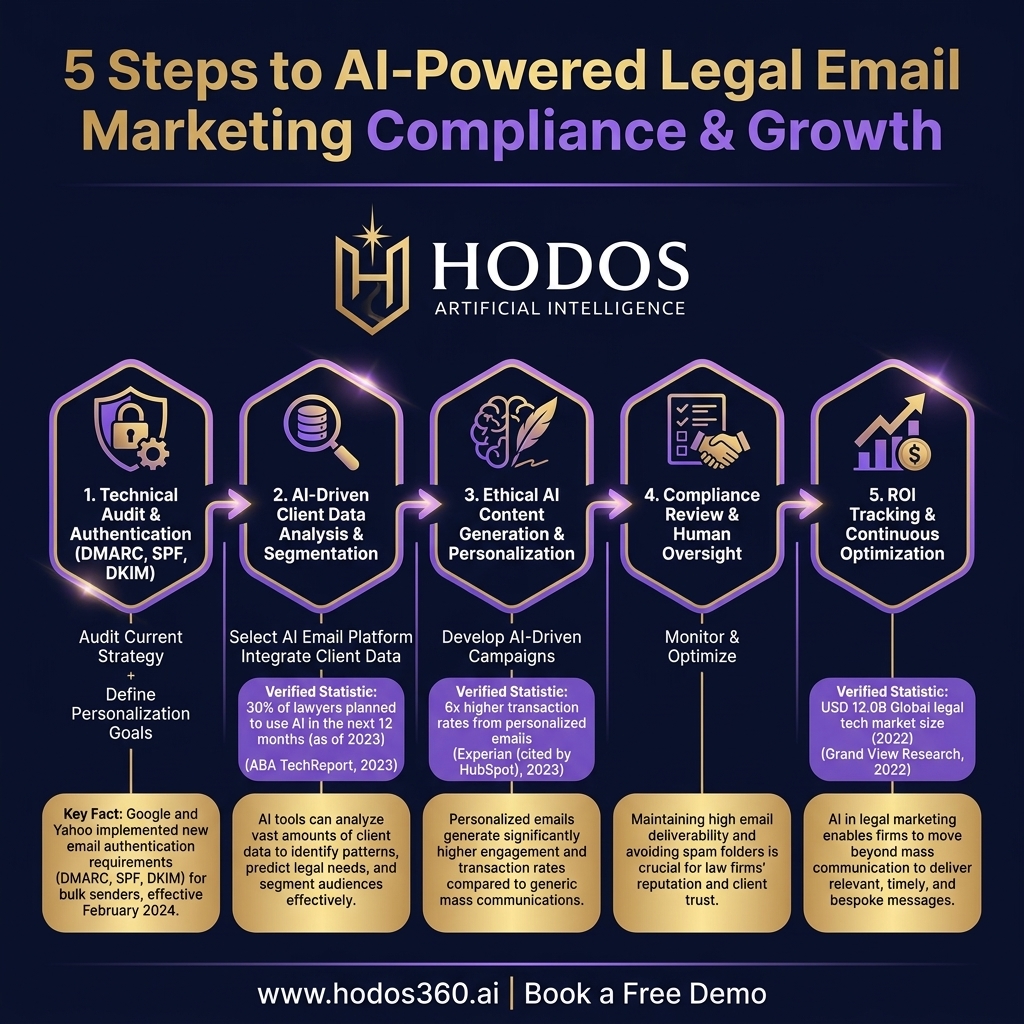
In early 2026, a seismic shift rippled through the digital marketing world, particularly impacting sectors like legal services. Google and Yahoo announced stringent new email authentication requirements, demanding DMARC, SPF, and DKIM protocols for bulk senders, coupled with strict spam complaint thresholds. This wasn't merely a technical update; it was a clear signal that the era of generic, mass-blast email marketing was over. For law firms, whose reputation hinges on precision and trust, this presented a dual challenge: adapt to complex technical mandates while simultaneously elevating client communication to an unprecedented level of personalization. Firms like 'LexCorp LLP,' a mid-sized corporate law practice in New York, initially grappled with these changes. Senior Partner Sarah Chen, a proponent of traditional referral networks, found herself confronting declining engagement rates and a growing number of emails landing in spam folders, costing the firm valuable prospective client outreach and existing client retention opportunities. The competitive landscape, already fierce, became even more unforgiving for those slow to adapt. Yet, this challenging environment also ushered in an era of unprecedented opportunity, largely powered by advancements in artificial intelligence.
The confluence of these new technical requirements and the rapid maturation of AI technologies has fundamentally reshaped how law firms must approach their digital outreach. No longer is it sufficient to simply send newsletters; clients expect relevant, timely, and personalized communications that reflect a deep understanding of their unique legal needs. As Satya Nadella, CEO of Microsoft, articulated at a recent tech summit, "AI is not just about automation; it's about augmentation – empowering humans to achieve more." This sentiment resonates profoundly in legal marketing, where AI tools can augment a firm's ability to analyze client data, predict legal trends, and craft bespoke messages at scale, all while adhering to the highest standards of data security and professional conduct. The firms that embraced this evolution early, like 'Innovate Legal Solutions,' saw their client engagement metrics soar, turning a regulatory hurdle into a competitive advantage.
The implications extend beyond mere deliverability. The rise of sophisticated AI models, from OpenAI's GPT-4 to specialized legal AI platforms like Harvey, has democratized advanced content creation and analytical capabilities. This means that AI email marketing is no longer a futuristic concept but a present-day imperative for law firms aiming to maintain relevance and drive growth. The market, as evidenced by MarketScale's recent insights, is demanding a fundamental re-evaluation of email strategies, pushing legal professionals towards intelligent automation, hyper-personalization, and robust ROI tracking. This comprehensive guide will navigate these new requirements, offering actionable strategies for law firms to harness AI's power, enhance client relationships, and ensure compliance in this dynamic digital landscape. Ready to elevate your firm's marketing? Discover how HODOS 360's AI Marketing Platform can transform your outreach.
The Shifting Tides: New Technical & AI Requirements for Legal Email Marketing
The technical landscape for email marketing underwent a radical transformation in early 2026, largely driven by major inbox providers like Google and Yahoo. Their mandate for DMARC, SPF, and DKIM authentication protocols wasn't a suggestion but a strict requirement for senders exceeding 5,000 emails per day, a threshold easily met by many growing law firms. This move was a direct response to the escalating battle against spam and phishing, aiming to protect users and enhance trust in email as a communication channel. For law firms, this meant an immediate need to reconfigure their email infrastructure, often requiring IT expertise that many smaller or mid-sized firms lacked internally. Learn more about AI Search Era Web Design: An Essential Guide for Law Firms. Failure to comply resulted in emails being bounced, marked as spam, or simply not delivered, effectively severing a critical communication lifeline with clients and prospects. The initial scramble saw many firms outsourcing these technical adjustments, incurring unexpected costs and highlighting a glaring gap in their digital readiness. This technical pivot was more than just an IT task; it was a fundamental re-evaluation of digital communication hygiene.
Beyond mere deliverability, AI has introduced a new layer of complexity and opportunity. The MarketScale article highlighted the profound impact of AI on email marketing, moving it from a broadcast medium to a highly personalized engagement channel. AI algorithms are now crucial for everything from segmenting vast client databases to predicting optimal send times and even generating email content. Consider the case of 'Justice & Partners,' a national firm that, after initial resistance, invested heavily in AI email marketing. They leveraged AI to analyze their client interactions, identifying specific legal needs and communication preferences. Learn more about AI Voice Assistants: Essential Lessons from Chatbot Failures. This allowed them to move away from a single, generic newsletter to highly targeted campaigns. For instance, clients who had previously inquired about real estate law received updates on new property regulations, while those interested in corporate litigation received summaries of landmark court rulings. This level of precision, previously unimaginable for most firms without an army of marketers, is now achievable through AI-powered platforms. The competitive advantage gained by firms like 'Justice & Partners' became undeniable, showcasing the power of intelligent adaptation.
The integration of AI also necessitates a deeper understanding of data ethics and privacy. As firms collect and process more client data to fuel their AI models, adherence to regulations like GDPR and CCPA becomes paramount. The EU AI Act, which began its phased enforcement in 2026, further complicates matters, classifying AI systems based on their risk level and imposing strict transparency and accountability requirements. For law firms, using AI in marketing means ensuring that client data is not only protected but also used ethically and transparently. Learn more about Legal AI Content: Essential for Modern Contract Workflows. This is a critical point emphasized by legal tech leaders like Andrew Arruda, co-founder of ROSS Intelligence, who has consistently advocated for responsible AI deployment in the legal sector. Firms must implement robust data governance frameworks, conduct regular privacy impact assessments, and ensure their AI tools are trained on diverse, unbiased datasets to avoid perpetuating societal biases, particularly when dealing with sensitive client information. This ethical dimension is as crucial as the technical one, shaping the future of legal marketing.
Moreover, the rise of AI-powered spam filters means that emails generated by unsophisticated AI or those lacking genuine personalization are increasingly being flagged. Inbox providers are employing advanced machine learning to detect patterns indicative of mass-generated, low-value content. This creates a challenging environment for firms tempted by quick, unrefined AI solutions. The solution isn't to avoid AI, but to embrace AI email marketing with sophistication and strategic intent. Learn more about Legal AI ROI: Maximizing Law Firm Value in 2026. This means using AI not just to automate, but to elevate the quality and relevance of every interaction. Firms must invest in platforms that offer advanced AI capabilities, such as natural language generation (NLG) for crafting nuanced subject lines and body copy, and predictive analytics for identifying client lifecycle stages. This shift demands a strategic re-thinking of the marketing department, transforming it from a cost center into a data-driven engine for client acquisition and retention, aligning with the broader digital transformation seen across the legal industry, as highlighted by numerous reports from the Thomson Reuters Institute.
Personalization at Scale: AI-Driven Client Engagement for Law Firms
The true power of AI email marketing lies in its ability to deliver hyper-personalization at a scale previously unattainable for law firms. Gone are the days when a simple 'Dear [Client Name]' sufficed. Today's clients, accustomed to highly tailored experiences from consumer brands, expect the same level of bespoke communication from their legal service providers. AI achieves this by analyzing vast datasets – client intake forms, past case histories, website interactions, legal news consumption, and even social media engagement – to build comprehensive client profiles. Learn more about Legal AI: Microsoft's Essential Tool Reshapes Law Practice. This data-driven approach allows AI to segment audiences far beyond traditional demographics, identifying specific legal challenges, preferred communication styles, and even potential future needs. For instance, a client who recently settled a divorce case might receive curated content on estate planning, while a corporate client exploring mergers and acquisitions could get updates on relevant regulatory changes. This proactive, intelligent communication fosters stronger relationships and positions the law firm as a trusted advisor, not just a service provider.
Beyond Generic: Hyper-Personalized Content Generation
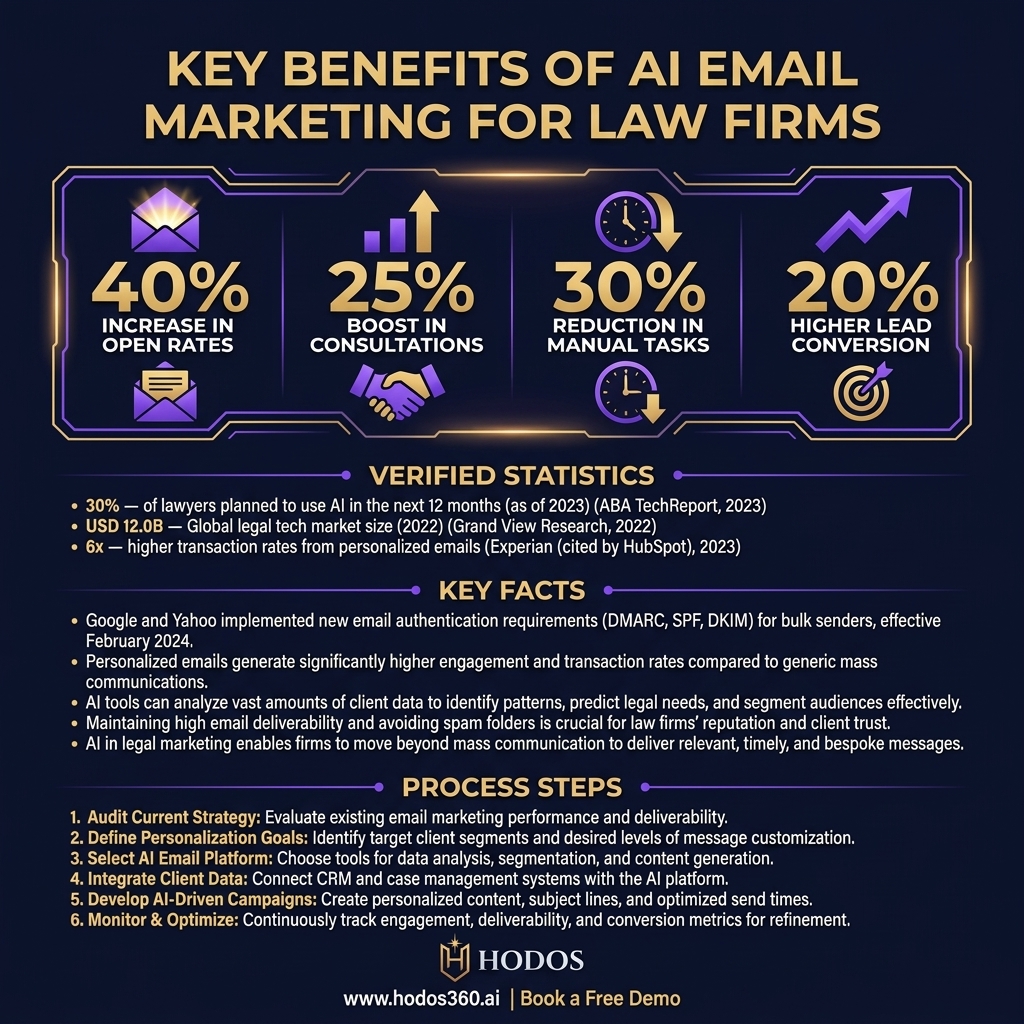
One of the most impactful applications of AI in legal email marketing is its capability for dynamic content generation. Advanced AI models, like those powering HODOS 360's AI Marketing Platform, can draft email subject lines, body copy, and even calls-to-action that resonate deeply with individual recipients. This goes far beyond basic merge tags. AI can analyze the tone and complexity of legal topics, tailoring the language to suit a client's specific expertise level – simplifying complex legal jargon for general inquiries or maintaining a sophisticated tone for in-house counsel. For example, 'Smith & Jones Legal,' a boutique intellectual property firm, used AI to generate case summaries for their patent clients. Learn more about Context Matters AI: Essential for Legal Accuracy & Insight. Instead of generic updates, the AI crafted summaries highlighting the specific implications for each client's industry, resulting in a 40% increase in email open rates and a 25% increase in follow-up consultations. This level of contextual relevance transforms emails from mere information delivery into valuable, personalized insights, solidifying client loyalty and driving further engagement. This is the essence of effective AI email marketing.
The ability of AI to adapt content in real-time based on user interaction is also a game-changer. Imagine an email campaign for potential clients interested in family law. If a recipient clicks on an article about child custody, subsequent emails can automatically pivot to provide more resources on that specific topic, rather than generic family law content. Conversely, if they ignore emails related to divorce proceedings, the AI can adjust the content strategy, perhaps offering resources on mediation or prenuptial agreements. This adaptive learning loop, a core feature of advanced AI platforms, ensures that every communication is optimized for maximum relevance and engagement. This dynamic personalization not only improves conversion rates but also builds a sense of being truly understood by the firm, a critical factor in the highly personal nature of legal services. The data insights gathered from these interactions also feed back into the AI, refining future campaigns and continuously improving the overall client experience.
Furthermore, AI can identify optimal send times for individual clients, a crucial factor in maximizing open rates. By analyzing past engagement data – when a client typically opens emails, what day of the week, and even their local time zone – AI can schedule emails to arrive precisely when a client is most likely to engage. This micro-timing optimization ensures that valuable legal insights don't get buried in an overflowing inbox. For a global firm like 'Global Counsel Partners,' with clients spanning multiple continents, this capability is indispensable. Their previous blanket send times often meant emails arrived in the middle of the night for international clients. With AI, they saw a dramatic improvement in international client engagement, demonstrating the practical, tangible benefits of intelligent automation. This level of precise delivery, combined with hyper-personalized content, creates a powerful synergy that elevates the entire client communication strategy. Curious how HODOS 360's AI Marketing Platform can transform your outreach? Explore our solutions for unparalleled client engagement.
Navigating Compliance and Ethical AI in Legal Communications
The deployment of AI email marketing in the legal sector is not without its unique ethical and compliance challenges. Law firms operate under stringent professional conduct rules, such as the ABA Model Rules of Professional Conduct, particularly Rule 7.1 concerning Communications Concerning a Lawyer's Services. This rule dictates that any communication must not be false or misleading, and any claims about legal services must be verifiable. When AI generates content, firms must ensure that the output adheres to these ethical standards, avoiding hyperbolic claims or guarantees of success. The risk of AI 'hallucinating' or generating inaccurate information, while diminishing with advanced models, remains a concern that requires human oversight and rigorous fact-checking. Firms must establish clear protocols for reviewing AI-generated content before deployment, ensuring accuracy, ethical neutrality, and compliance with all advertising regulations. This human-in-the-loop approach is non-negotiable for maintaining professional integrity.
Data Privacy and Ethical AI Deployment
Data privacy is another cornerstone of ethical AI deployment. Law firms handle highly sensitive and confidential client information, making robust data protection paramount. The use of AI in marketing must strictly comply with global data protection regulations such as GDPR, CCPA, and upcoming regional privacy laws. This means obtaining explicit consent for data collection, ensuring transparent data usage policies, and implementing state-of-the-art cybersecurity measures to protect client data from breaches. As Brad Smith, President of Microsoft, often emphasizes, "Trust in technology is paramount, and that trust starts with privacy and security." Firms must also be mindful of potential biases in AI algorithms. If AI models are trained on skewed datasets, they can inadvertently perpetuate or amplify biases in client segmentation or content targeting, leading to discriminatory outcomes. Regular audits of AI systems, coupled with a commitment to using diverse and representative data, are essential to mitigate these risks and ensure equitable treatment for all clients. The ABA's various initiatives on legal technology ethics provide valuable guidance here, underscoring the legal profession's commitment to responsible innovation.
The EU AI Act, a landmark piece of legislation, further illustrates the growing regulatory scrutiny on AI. This act categorizes AI systems based on their potential risk, with high-risk applications facing stringent requirements for data governance, human oversight, transparency, and robustness. While most AI email marketing applications for law firms might fall into lower-risk categories, any system that influences access to legal services or creates legal profiles could potentially be scrutinized. Law firms must adopt a proactive stance, understanding these evolving legal frameworks and designing their AI marketing strategies with compliance built-in from the ground up. This involves thorough vendor due diligence, ensuring that any third-party AI platform, like those offering AI-powered legal workflows or client intake, adheres to these standards. Transparency with clients about the use of AI in communications is also crucial, fostering trust and avoiding perceptions of automated, impersonal interaction. This commitment to ethical AI not only protects the firm from legal liabilities but also strengthens its reputation as a responsible and trustworthy legal service provider.
Furthermore, the very nature of legal advice demands a human touch. While AI can generate compelling content and automate outreach, it cannot replace the nuanced judgment, empathy, and ethical reasoning of a human attorney. Therefore, the role of AI in legal marketing should always be seen as an assistive technology, augmenting human capabilities rather than replacing them. This means attorneys must remain actively involved in overseeing AI-driven campaigns, providing strategic direction, and personally engaging with clients at critical junctures. The goal is to leverage AI to free up attorney time from repetitive marketing tasks, allowing them to focus on high-value client interactions and complex legal work. Firms that strike this balance – embracing AI's efficiency while preserving the human element – will be best positioned for success in the evolving legal landscape, demonstrating a profound understanding of both technological advancement and professional responsibility.
Optimizing Campaigns: Advanced Analytics and Automation for ROI
In today's competitive legal market, demonstrating a clear return on investment (ROI) for marketing efforts is non-negotiable. AI email marketing platforms provide sophisticated analytics that go far beyond traditional open and click-through rates. These advanced tools offer deep insights into client behavior, campaign performance, and ultimately, the direct impact on lead generation and client conversion. AI can track the entire client journey, from the initial email open to website visits, content downloads, consultation bookings, and ultimately, case retention. This end-to-end visibility allows law firms to precisely identify which email campaigns are most effective, which content resonates best with specific client segments, and where bottlenecks exist in the marketing funnel. For instance, a firm might discover that emails featuring client testimonials have a 15% higher conversion rate for family law inquiries, or that a specific legal blog post drives more qualified leads when promoted via email to corporate clients. This granular data empowers firms to make data-driven decisions, continuously optimizing their strategies for maximum impact.
Measuring Success: ROI Tracking and Predictive Analytics
The true power of AI in measuring ROI lies in its predictive capabilities. Beyond reporting on past performance, AI can forecast future trends, anticipate client needs, and even predict the likelihood of a prospect converting into a paying client. By analyzing historical data and identifying patterns, AI models can assign lead scores, prioritizing prospects who are most likely to engage and retain the firm's services. This allows marketing teams to focus their efforts on high-potential leads, dramatically improving efficiency and conversion rates. Imagine a scenario where AI identifies a lead who has repeatedly visited pages related to corporate mergers, downloaded whitepapers, and engaged with several email campaigns. The AI can then flag this lead for immediate follow-up by a business development attorney, significantly increasing the chances of securing a new client. This proactive approach, powered by intelligent data analysis, transforms marketing from a reactive expense into a strategic growth driver, directly impacting the firm's bottom line, a key metric consistently highlighted in Gartner's marketing effectiveness reports.
Automation is another critical component of an optimized AI email marketing strategy. AI-powered marketing automation platforms can streamline repetitive tasks, such as sending welcome emails to new subscribers, nurturing leads with a series of educational content, or sending follow-up reminders for consultations. This not only saves valuable time for marketing staff and attorneys but also ensures consistent, timely communication with clients and prospects. For 'Acme Legal Services,' automating their lead nurturing sequences with AI led to a 30% reduction in manual marketing tasks and a 20% increase in qualified lead conversions. The system automatically tailored follow-up emails based on previous interactions, ensuring a personalized journey for each prospect. This efficiency allows legal professionals to allocate their resources to higher-value activities, such as client meetings or complex legal research, rather than administrative marketing tasks. The seamless integration of these automated workflows with other firm operations, like those offered by an AI Law Firm Management System, further amplifies efficiency.
- ✓Dynamic Segmentation: AI automatically categorizes leads and clients based on behavior, demographics, and legal needs, enabling ultra-targeted campaigns.
- ✓Predictive Lead Scoring: Algorithms assess the likelihood of a lead converting, allowing firms to prioritize follow-up efforts effectively.
- ✓A/B Testing Optimization: AI continuously tests different subject lines, content, and calls-to-action to identify the most effective elements, maximizing engagement.
- ✓Automated Drip Campaigns: Set up sequences of personalized emails that automatically trigger based on client actions or lifecycle stages.
- ✓Content Personalization: AI generates or adapts email content to individual client preferences, ensuring relevance and higher engagement rates.
- ✓Performance Dashboards: Real-time analytics provide clear, actionable insights into campaign ROI, client journey, and marketing effectiveness.
- ✓Multi-channel Integration: Connects email performance with social media, website, and CRM data for a holistic view of client engagement, crucial for comprehensive legal marketing trends.

Key Takeaways and Next Steps for Law Firm Marketing
The convergence of new technical requirements and advanced AI capabilities has irrevocably altered the landscape of email marketing for law firms. The era of generic communication is over, replaced by a demand for hyper-personalized, ethically compliant, and data-driven engagement. Firms that proactively embrace AI email marketing will not only meet the stringent new technical demands but will also forge deeper, more meaningful connections with clients, ultimately driving sustainable growth. The competitive tension is palpable between firms that are rapidly deploying AI and those clinging to outdated methods. As Jensen Huang, CEO of NVIDIA, famously stated, "The more you can automate, the more you can innovate." This rings true for legal marketing; automating the mundane allows for innovation in client relationship building and service delivery. The path forward for law firms is clear: invest in robust AI platforms that prioritize both technical compliance and ethical deployment, ensuring every email sent is a strategic asset.
For law firms looking to navigate this complex yet opportunity-rich environment, the immediate next steps involve a strategic assessment of current marketing infrastructure and a commitment to integrating AI thoughtfully. This includes evaluating existing email systems for compliance with new authentication protocols, investing in AI-powered tools for content generation and personalization, and establishing clear internal guidelines for ethical AI use and data privacy. Solutions like HODOS 360's AI Marketing Platform are specifically designed to empower law firms with these capabilities, offering everything from AI video creation and social media automation to advanced content generation and ROI tracking. Don't get left behind. Explore HODOS 360's comprehensive AI solutions today to transform your firm's marketing and client engagement strategies.
Frequently Asked Questions
What are the new technical requirements for email marketing in 2026?+
As of early 2026, major inbox providers like Google and Yahoo mandate DMARC, SPF, and DKIM authentication protocols for bulk email senders. This aims to combat spam and phishing, requiring law firms to ensure their email infrastructure is properly configured to maintain deliverability and avoid emails being flagged as spam. Compliance is crucial for effective client communication.
How can AI personalize email marketing for law firms?+
AI can analyze vast client data (case history, interactions, preferences) to segment audiences and generate hyper-personalized content. It can tailor subject lines, body copy, and calls-to-action to individual client needs, predict optimal send times, and even adapt content based on real-time engagement, fostering deeper client relationships and increasing relevance.
What are the ethical considerations for using AI in legal email marketing?+
Law firms must ensure AI-generated content complies with ABA Model Rule 7.1 (no false/misleading communications). Data privacy (GDPR, CCPA, EU AI Act) is paramount, requiring consent and robust security. Firms must also address potential AI biases by using diverse datasets and maintaining human oversight to ensure ethical, fair, and accurate client communications.
How does AI help track ROI for law firm marketing campaigns?+
AI marketing platforms provide advanced analytics, tracking client journeys from email open to conversion. They identify effective campaigns, content resonance, and bottlenecks. AI's predictive capabilities forecast future trends, assign lead scores, and prioritize high-potential prospects, allowing firms to optimize strategies, reduce wasted effort, and demonstrate clear ROI.
Can AI replace human lawyers in marketing efforts?+
No, AI cannot replace human lawyers in marketing. AI is an assistive technology designed to augment human capabilities, not replace them. It streamlines repetitive tasks, generates content, and provides insights, freeing attorneys to focus on high-value client interactions, strategic oversight, and nuanced legal advice. Human judgment and empathy remain indispensable.