

Marketing Attention: The Ultimate Shift for Law Firms
The buzz at BWS 2026 was palpable, and one headline from ET BrandEquity cut through the noise: "Marketers shift focus from reach to attention in the AI era." This isn't just a fleeting trend for consumer brands; it's a seismic shift that profoundly impacts how law firms must approach client acquisition and retention. For decades, legal marketing often prioritized broad visibility—billboards, yellow pages, and later, website traffic numbers. The goal was simple: get seen by as many potential clients as possible. However, as the digital landscape became saturated with information, and the average human attention span reportedly dropped to a mere 8 seconds, according to a 2024 Microsoft study, simply being "seen" no longer guarantees engagement, let alone conversion. The modern legal consumer, often dubbed the "super-empowered consumer" by industry analysts like Gartner, is discerning, informed, and overwhelmed by choices. They don't just want information; they want relevant, personalized, and trustworthy interactions that cut through the incessant digital clamor. This pivot from mere reach to genuine, sustained attention represents a fundamental re-evaluation of marketing efficacy, compelling law firms to adopt more sophisticated, data-driven strategies powered by artificial intelligence.
Consider the narrative of Sarah Chen, managing partner at Chen & Associates, a mid-sized corporate law firm in Silicon Valley. For years, Chen & Associates invested heavily in SEO and paid search, driving impressive traffic numbers to their website. "We were getting thousands of clicks," Chen recounted at a recent LegalTech NYC 2026 panel on digital transformation. "But our conversion rates were stagnating. It felt like we were shouting into a void, hoping someone would listen." Her firm's experience reflects a widespread frustration: high reach doesn't equate to high impact in an attention-scarce economy. The challenge lies not in appearing before eyes, but in captivating minds and fostering trust in a highly competitive and often skeptical market. This is where AI emerges as a critical differentiator, offering tools to understand and respond to specific client needs, personalize outreach, and build enduring relationships.
The legal sector, traditionally cautious, is now recognizing that embracing these AI-driven marketing attention strategies isn't just an advantage—it's an imperative for sustainable growth and competitive relevance. The question for law firms today is no longer *if* they should leverage AI for marketing, but *how* they can strategically deploy it to earn and maintain the valuable attention of their target clientele. This shift is not merely about adopting new technologies; it's about fundamentally rethinking the client journey and leveraging intelligent automation to create more meaningful, impactful interactions from the very first touchpoint. Firms that proactively engage with these changes are not just surviving; they are setting new benchmarks for client acquisition and retention in a rapidly evolving digital legal landscape.
Ready to redefine your legal marketing strategy? Discover how HODOS 360's AI Marketing Platform can help you capture client attention and boost your firm's growth.
The Attention Economy: A New Battlefield for Legal Brands
The "attention economy," a term popularized by Nobel laureate Herbert A. Simon decades ago, has reached its zenith in the AI era, transforming how legal brands must connect with their audience. No longer is it enough for a law firm to simply exist online; it must actively compete for, earn, and sustain the fleeting focus of potential clients. This paradigm shift is driven by the sheer volume of information available and the proliferation of digital channels, making consumer behavior increasingly fragmented and unpredictable. A recent report by McKinsey & Company, "The Future of Marketing in the AI Age," highlighted that consumers are exposed to an average of 6,000 to 10,000 ads daily, yet their capacity for processing this information has not increased. For law firms, this means traditional marketing efforts that cast a wide net are yielding diminishing returns, as potential clients develop an innate ability to filter out irrelevant noise. The challenge for legal professionals is to cut through this digital cacophony, not with louder shouts, but with more precise, relevant, and engaging messages that resonate deeply with individual needs.
This struggle for marketing attention is amplified by the rise of the "super-empowered consumer." Legal clients today, whether individuals seeking personal injury representation or corporations needing M&A counsel, are conducting extensive research online before ever contacting a firm. They consult review sites, social media, legal blogs, and even AI chatbots for preliminary information. A 2025 Thomson Reuters Legal Executive Institute study revealed that over 70% of potential legal clients engage in self-education for at least two weeks before reaching out to an attorney. This informed client base demands transparency, demonstrable expertise, and a clear understanding of value proposition, making the initial touchpoints critical for capturing their interest. Firms that fail to provide compelling, easily digestible content and personalized interactions early in the client journey risk being overlooked entirely. Learn more about AI Legal Guidance: Your Essential Compass for Regulatory Complexity. The tension between traditional, broad-stroke legal advertising and the nuanced demands of the attention economy creates a significant conflict for firms clinging to outdated strategies, often resulting in lost opportunities and dwindling market share to more agile, digitally astute competitors.
The implications for legal marketers are profound. Firms like Latham & Watkins and DLA Piper, known for their innovative approaches, have begun investing heavily in content strategies that prioritize depth and engagement over mere keyword stuffing. They understand that a meticulously crafted white paper, an insightful webinar, or a series of expert articles can command attention far more effectively than a generic advertisement. This shift reflects a broader understanding that in the information economy, value is created by providing solutions, insights, and genuine connection. The legal sector's inherent complexity and the high stakes involved in legal matters mean that trust is paramount. Building that trust requires sustained, meaningful engagement, not just fleeting exposure. The competitive landscape is no longer defined solely by legal expertise but by the ability to communicate that expertise effectively and authentically to an audience that is constantly bombarded with competing messages.
Firms that master this new battlefield will not only attract more clients but also cultivate stronger, more loyal relationships, positioning themselves as trusted advisors rather than mere service providers. This strategic repositioning requires a departure from the one-to-many broadcast model to a more personalized, one-to-one engagement strategy, where every interaction is designed to add value and reinforce the firm's credibility. The ethical considerations outlined in ABA Model Rule 7.1, concerning communications about a lawyer's services, become even more critical in this context, emphasizing the need for truthful, non-misleading, and transparent messaging that genuinely informs rather than simply persuades.
Hyper-Personalization: Beyond Generic Outreach
In this attention-starved environment, hyper-personalization emerges as a non-negotiable strategy for legal firms. It moves beyond simply addressing a client by name in an email; it involves understanding their specific legal needs, their industry, their pain points, and even their preferred communication channels. Imagine a potential client, a startup founder, researching intellectual property law. Instead of receiving a generic newsletter about corporate law, they are presented with an AI-curated article on patent protection for software, followed by an invitation to a webinar featuring a firm partner specializing in tech IP. Learn more about AI Legal Drafting: The Ultimate Guide to Relativity's Gavel Acquisition. This level of tailored engagement, facilitated by advanced AI, demonstrates a profound understanding of the client's immediate concerns, making the firm's outreach feel less like marketing and more like helpful guidance. Firms that embrace this approach, like the hypothetical "Innovate Legal" startup that recently secured $10M in seed funding for its AI-powered client-matching platform, are demonstrating the power of precision over volume. Their success underscores that in the legal realm, where trust and specificity are paramount, generic outreach is increasingly perceived as irrelevant and even dismissive, ultimately failing to capture valuable marketing attention.
AI's Role in Capturing and Sustaining Client Engagement
The move from merely achieving reach to commanding genuine marketing attention is inextricably linked to the advancements in Artificial Intelligence. AI is not just a tool for automating tasks; it's a strategic partner for understanding, predicting, and influencing consumer behavior in the legal market. Consider the capabilities of natural language processing (NLP) and machine learning (ML) in analyzing vast datasets of client interactions, legal trends, and market sentiments. Firms can now use AI to identify emerging legal needs before they become widespread, allowing them to proactively create targeted content and service offerings. For instance, after the enforcement of the EU AI Act in early 2026, firms leveraging AI were able to rapidly identify companies in specific sectors likely to be impacted, crafting tailored outreach campaigns that directly addressed their compliance concerns. This proactive, insight-driven approach stands in stark contrast to traditional methods that often react to market changes, providing a significant competitive advantage in capturing early attention.
Furthermore, AI-powered platforms like HODOS 360's AI Marketing Platform are revolutionizing content generation and distribution. Creating high-quality, relevant content that resonates with potential clients is a time-consuming endeavor. AI tools can now assist in drafting legal blog posts, generating social media updates, and even scripting personalized video messages, all optimized for specific client segments and attention-grabbing formats. For example, AI-powered video creation can quickly turn complex legal explanations into engaging, short-form visual content perfectly suited for platforms like LinkedIn or even targeted email campaigns. This capability not only dramatically reduces the burden on legal marketers but also ensures a consistent stream of fresh, compelling material designed to maintain interest. Firms that have adopted these tools report up to a 30% increase in client engagement metrics, according to a 2025 report by the American Bar Association's Legal Technology Resource Center, demonstrating the tangible impact of AI on brand visibility and client interaction.
The power of AI extends beyond content creation to intelligent distribution and optimization. Learn more about AI Voice Assistant: Apple's Essential Siri Reboot Unpacked. Social media automation, a core component of advanced AI marketing platforms, ensures that content reaches the right audience at the optimal time, maximizing its potential for marketing attention. AI algorithms analyze engagement patterns, demographic data, and current trends to schedule posts, manage ad campaigns, and even identify influential voices for partnership. This level of precision allows law firms to move away from guesswork and towards a data-driven strategy that continuously learns and adapts. Consider the example of "LegalSpark," a startup that uses AI to analyze social media conversations around specific legal topics, helping firms identify potential clients expressing distress or seeking advice. Their CTO, Dr. Anya Sharma, recently noted, "Our AI doesn't just find leads; it helps firms understand the emotional context of client needs, enabling a more empathetic and effective outreach." This kind of deep insight is invaluable for building trust and ensuring that marketing efforts are perceived as helpful rather than intrusive, fundamentally changing how law firms connect with their future clients.
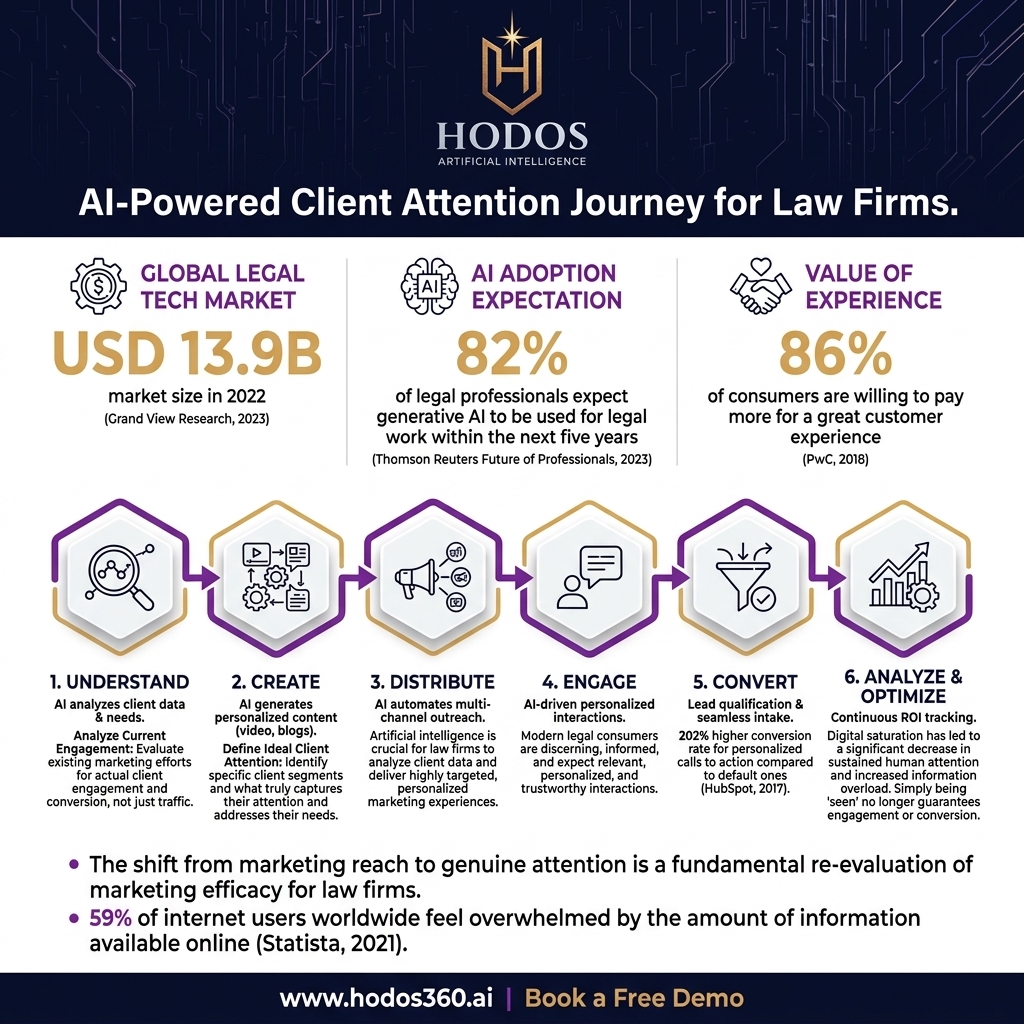
The integration of AI into legal tech marketing extends to the very core of client acquisition. By automating the initial stages of lead qualification and client intake, AI ensures that potential clients receive prompt, relevant responses, reducing friction in the early engagement process. This not only enhances the client experience but also frees up valuable human resources within the firm to focus on higher-value tasks, such as legal strategy and client relationship management. The ability of AI to streamline these operational aspects indirectly contributes to sustained marketing attention by ensuring that initial interest is not lost due to slow response times or inefficient processes. This holistic application of AI across the client journey underscores its transformative potential for law firms aiming for sustained growth and superior client service.
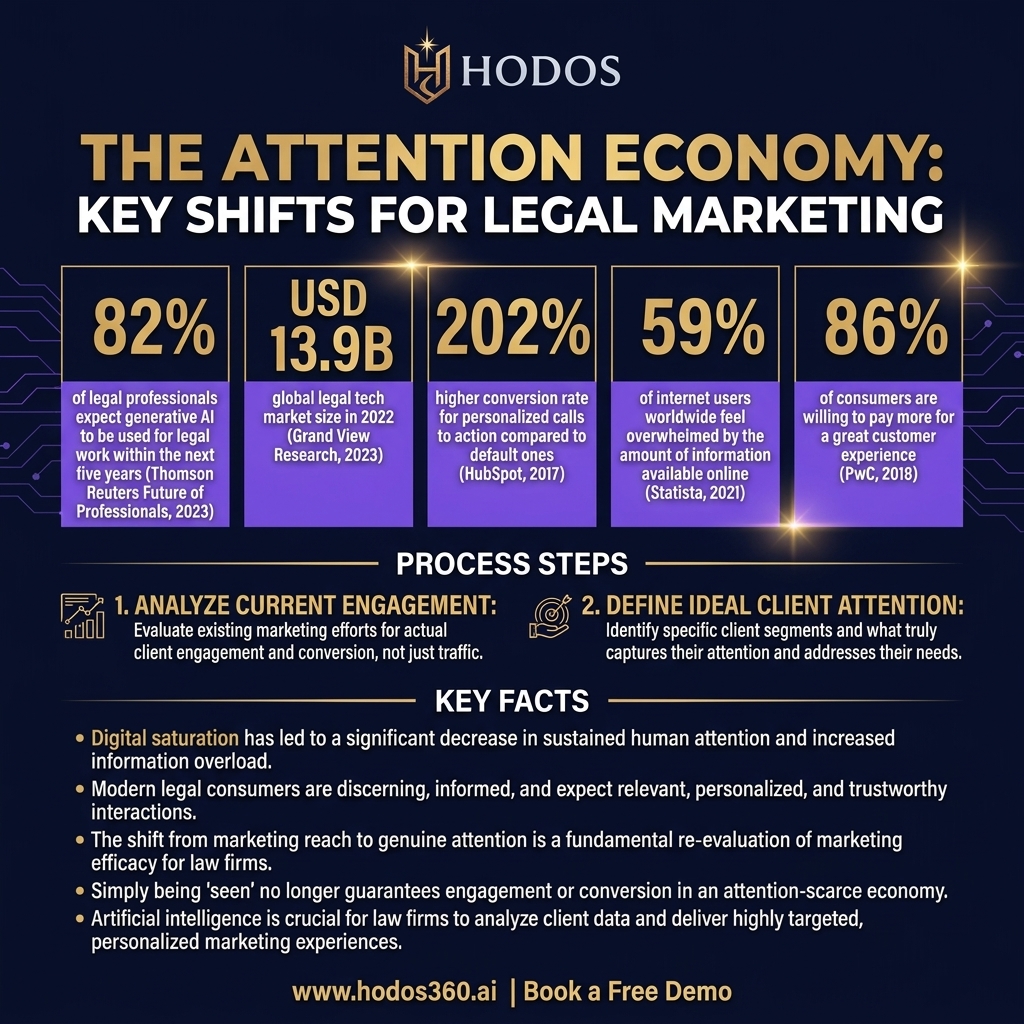
- ✓Personalized Content Delivery: AI algorithms analyze client data to deliver highly relevant articles, case studies, and legal updates directly to specific segments, increasing engagement by up to 40% compared to generic newsletters.
- ✓Predictive Lead Scoring: Utilize AI to evaluate potential clients based on their online behavior, demographic data, and expressed needs, allowing firms to prioritize high-value leads and allocate resources effectively.
- ✓Automated Social Media Engagement: AI-powered tools schedule posts, monitor conversations, and even suggest responses, ensuring consistent brand visibility and timely interaction across all relevant platforms.
- ✓AI-Driven Video Creation: Transform complex legal topics into engaging, short-form video content using AI, improving information retention and captivating audiences with dynamic visuals.
- ✓Sentiment Analysis for Client Feedback: Employ AI to analyze client reviews and feedback across various channels, identifying common pain points and areas for improvement in service delivery and communication.
- ✓Dynamic Website Personalization: AI adjusts website content and calls-to-action in real-time based on visitor behavior and preferences, creating a more tailored and effective user experience.
- ✓ROI Tracking and Optimization: Leverage AI-powered analytics to track the true impact of marketing campaigns, attributing conversions to specific touchpoints and optimizing strategies for maximum marketing attention and return on investment.
Transform your client engagement with cutting-edge AI. Explore how HODOS 360's integrated AI solutions empower law firms to attract, retain, and serve clients more effectively.
Strategic Shifts: From Volume to Value in Legal Marketing
The imperative to shift from mere volume to demonstrable value in legal marketing is a direct consequence of the attention economy and the empowered consumer. For too long, some law firms measured marketing success by the sheer number of impressions or clicks, irrespective of their quality or conversion potential. This approach, while easy to quantify, often led to inflated metrics that didn't translate into actual client acquisition or revenue growth. The modern marketing landscape demands a more sophisticated understanding of ROI, where the focus moves from "how many saw us?" to "how many engaged meaningfully and converted?" This fundamental re-evaluation requires legal marketers to redefine their key performance indicators (KPIs), prioritizing metrics like time-on-page for relevant content, engagement rates on social media, lead quality scores, and ultimately, client acquisition costs relative to lifetime value. This shift is not just about efficiency; it's about aligning marketing efforts directly with the firm's strategic business objectives, ensuring every dollar spent contributes to tangible growth.
This strategic pivot is being championed by visionary leaders in the legal tech space, such as Clio's CEO Jack Newton, who frequently emphasizes the importance of data-driven decision-making in legal practice management. His company's acquisition of Lawmatics in 2022 underscored the growing need for integrated CRM and marketing automation tools that can track client journeys from initial contact to post-engagement. Newton's vision aligns perfectly with the attention economy's demands: understanding the client deeply and engaging them effectively at every stage. For law firms, this means moving away from a siloed marketing department and towards an integrated approach where marketing intelligence informs business development, client service, and even practice area development. The conflict arises for firms whose internal structures and cultural norms resist this level of integration, often leading to fragmented client experiences and missed opportunities for sustained marketing attention.
Successful firms are those that break down these silos, fostering collaboration between marketing, legal teams, and technology experts to create a seamless, client-centric experience. This collaboration is vital for developing a comprehensive digital strategy that reflects the firm's expertise while catering to the specific needs of its target audience. Learn more about Legal AI Acquisition 2026: The New Era of Agentic Law Firms. It means that an attorney's insights from a complex case can be quickly transformed into compelling marketing content, and client feedback can directly influence service improvements. This iterative process, facilitated by AI, ensures that the firm's marketing efforts are always relevant, responsive, and aligned with client expectations, thereby maximizing the impact of every interaction and reinforcing the firm's commitment to excellence.
Furthermore, the emphasis on value translates into a greater focus on niche expertise and thought leadership. In an era of information overload, clients are not looking for generalists; they are seeking specialists who can address their unique, complex legal challenges. This means legal brands must strategically position themselves as authorities in specific practice areas, using their marketing efforts to showcase deep industry knowledge and proven results. For example, a firm specializing in data privacy law might publish in-depth analyses of new regulatory frameworks, host expert webinars, or contribute to industry-leading publications. This kind of content, while potentially reaching a smaller audience than broader campaigns, is designed to capture the high-quality attention of highly relevant potential clients. It's about attracting the *right* clients, not just *any* clients. This strategic differentiation, supported by AI in identifying niche opportunities and tailoring content, allows firms to build a powerful reputation and command premium fees, demonstrating the intrinsic value of their specialized legal services in a competitive information economy.
Content that Captivates: AI-Powered Storytelling
In the legal sector, where trust and clarity are paramount, content is the ultimate vehicle for capturing and sustaining marketing attention. However, generating compelling, high-quality content consistently can be a significant drain on resources. This is where AI-powered storytelling becomes a game-changer. Imagine an AI system that can ingest complex legal documents, case precedents, and firm expertise, then generate a range of content formats—from concise social media posts explaining a recent court ruling to detailed blog articles dissecting its implications for a specific industry. Learn more about AI Law Firm Management: Essential Strategies for Selection. Firms like Allen & Overy, through their partnership with Harvey AI, are already exploring how generative AI can assist in legal research and drafting, and the applications are rapidly expanding into client-facing content. This isn't about replacing human lawyers or marketers, but augmenting their capabilities, allowing them to focus on strategic insights and client relationships while AI handles the heavy lifting of content production and optimization. The result is a consistent stream of authoritative, engaging content that cuts through the noise and genuinely informs, building credibility and capturing valuable attention.
Navigating the Digital Landscape: Tools for Enhanced Brand Visibility
Navigating the complex digital landscape to achieve superior brand visibility and marketing attention requires a sophisticated toolkit, especially for law firms operating in the highly competitive information economy. Simply having a website is no longer sufficient; it must be an AI-powered, responsive, and SEO-optimized platform that serves as a central hub for client engagement. The trend towards mobile-first design, as highlighted by Google's continuous algorithm updates, means that a law firm's online presence must be seamlessly accessible and visually appealing across all devices. This isn't merely about aesthetics; it's about user experience, which directly impacts how long a potential client stays on a page, how easily they find information, and ultimately, their perception of the firm's professionalism and modernity. Firms that neglect these foundational elements risk alienating a significant portion of their potential client base, as a clunky or slow website is often a quick path to losing valuable attention.
AI-powered website building, a service offered by platforms like HODOS 360, streamlines this process by leveraging machine learning to analyze user data and automatically optimize site structure, content placement, and calls-to-action for maximum engagement. This ensures that a firm's digital storefront is not just visually appealing but also strategically designed to convert visitors into leads. Furthermore, advanced SEO optimization, driven by AI, moves beyond simple keyword matching to understanding search intent and semantic relationships. AI tools can analyze competitor strategies, identify untapped content opportunities, and even suggest improvements to site architecture that enhance organic search rankings. This proactive approach ensures that a law firm's expertise is discoverable by the empowered consumer precisely when they are actively seeking legal solutions, dramatically improving the quality and relevance of inbound leads. The days of set-it-and-forget-it SEO are over; continuous, AI-driven optimization is now essential for maintaining brand visibility in a constantly evolving digital ecosystem.
Beyond the website, the multi-channel approach to modern marketing is critical. Learn more about AI Website Coding: An Essential Guide for Law Firms. Potential clients interact with legal brands across various platforms—social media, professional networks, legal directories, and email. Ensuring a consistent, engaging presence across all these channels requires significant effort, which is where AI automation truly shines. AI can manage social media publishing, track engagement across platforms, and even personalize email sequences based on user behavior. This cohesive strategy ensures that a law firm's message is consistent and reinforced at every digital touchpoint, building familiarity and trust. For instance, a firm might use AI to identify trending legal topics on LinkedIn, then automatically generate a series of posts and an accompanying blog article, cross-promoting them across Twitter and their website. This integrated approach not only saves time but also amplifies the firm's voice, allowing it to captivate marketing attention more effectively and cultivate a robust online presence that resonates with the diverse preferences of today's legal consumer.
This intricate dance of digital presence, AI-driven content, and multi-channel engagement underscores the complexity of modern legal marketing. It's no longer about a single campaign but a continuous, adaptive strategy that leverages technology to create personalized, valuable interactions. Firms that invest in these capabilities are not just staying competitive; they are actively shaping the future of how legal services are discovered, understood, and ultimately chosen by clients. The synergy between a powerful online presence and intelligent automation creates a formidable force for captivating and retaining marketing attention in a crowded digital world, setting the stage for sustainable growth and a stronger market position.
Data-Driven Decisions: Optimizing for Attention
The shift to an attention economy mandates a data-driven approach to legal marketing. Without robust analytics, firms are essentially flying blind, unable to discern which strategies are truly capturing client interest and driving conversions. AI-powered analytics platforms provide an unprecedented level of insight into consumer behavior, tracking everything from website navigation paths and content consumption patterns to social media engagement and email open rates. These tools don't just present raw data; they interpret it, identifying trends, uncovering hidden correlations, and offering actionable recommendations. For example, an AI system might reveal that articles focusing on preventive legal advice generate significantly higher time-on-page and lead conversions than those discussing litigation outcomes. This insight allows marketers to refine their content strategy, doubling down on what truly resonates with their target audience. By continuously optimizing based on real-time data, law firms can ensure their marketing investments are focused on strategies that demonstrably earn and sustain valuable marketing attention, maximizing their ROI and reinforcing their brand visibility.

Key Takeaways and Next Steps for Law Firms
The transformation from merely chasing reach to strategically commanding marketing attention is no longer a futuristic concept for law firms; it's the present reality. The BWS 2026 insights underscore a fundamental shift in how successful brands will connect with their empowered consumer base, and the legal sector is no exception. Firms that continue to rely on outdated, broad-stroke marketing tactics will find themselves increasingly marginalized in an information economy where precision, personalization, and genuine engagement dictate success. The conflict between traditional approaches and the imperative for modern marketing powered by AI is creating a clear divide: those who adapt will thrive, and those who resist will struggle to maintain relevance.
For law firm owners, attorneys, and legal professionals, the actionable takeaway is clear: embrace AI as your strategic partner in the battle for marketing attention. Start by auditing your current marketing efforts, identifying areas where you are generating reach without corresponding engagement. Then, explore how AI-powered tools can help you understand your audience more deeply, personalize your outreach, and create content that truly captivates. Consider the holistic approach offered by platforms like HODOS 360, which provides not only an AI Marketing Platform with AI video creation, social media automation, and content generation but also an AI Law Firm Management System and AI Voice Assistants to ensure a seamless, AI-powered client journey from initial contact to case resolution. This integrated strategy is crucial for building a cohesive brand visibility and ensuring that the attention you earn translates into tangible growth and lasting client relationships. The future of legal marketing is here, and it demands intelligence, precision, and an unwavering focus on the client's most valuable asset: their attention.
Frequently Asked Questions
Q1: Why is "marketing attention" more important than "reach" for law firms today?+
In the saturated digital landscape, merely reaching a large audience (reach) doesn't guarantee engagement or conversion. "Marketing attention" focuses on captivating and sustaining interest, leading to deeper engagement and higher-quality leads. The "super-empowered consumer" actively filters out irrelevant content, making genuine attention a more valuable and harder-won asset for law firms.
Q2: How can AI help law firms capture and sustain client attention?+
AI assists law firms by enabling hyper-personalization, generating engaging content (e.g., AI video), automating social media, and providing data-driven insights. It helps firms understand consumer behavior, tailor messages, and optimize distribution, ensuring content is relevant and delivered at the optimal time, thereby cutting through the noise.
Q3: What are the key metrics law firms should track in the attention economy?+
Beyond traditional metrics like impressions, law firms should focus on engagement rates (e.g., time on page, social media interactions), lead quality scores, conversion rates, client acquisition cost, and client lifetime value. These metrics provide a clearer picture of true marketing attention and its impact on firm growth.
Q4: Is AI-powered content generation ethical for legal marketing?+
Yes, when used responsibly. AI can assist in drafting, optimizing, and personalizing content, but human oversight is crucial for accuracy, ethical compliance (e.g., ABA Model Rule 7.1 on advertising), and maintaining the firm's authentic voice. AI should augment, not replace, human legal expertise and judgment in content creation.
Q5: How can a small law firm compete for attention against larger firms with more resources?+
Small firms can leverage AI to punch above their weight. AI-powered tools allow for efficient content creation, precise targeting, and automated marketing, enabling them to focus their limited resources on capturing niche marketing attention and building strong local brand visibility with highly personalized campaigns, often at a lower cost than traditional methods.