
AI Chatbot Development: Essential for Law Firm Communication
For years, the evening phone calls were a source of both opportunity and frustration for Sarah Chen, managing partner at LexCorp Legal, a bustling mid-sized firm in Chicago. Each after-hours ring could be a desperate new client, but more often, it was a misdirected query or a follow-up that could wait until morning. The firm was missing critical leads and struggling to maintain the 24/7 responsiveness modern clients demanded. This tension, a common dilemma across the legal sector, highlights a pervasive challenge: how to scale client communication without sacrificing personalized service or overwhelming staff. The answer, increasingly, lies in the intelligent application of AI chatbot development.
The recent report from Nasscom, titled "AI Chatbot Development: Transforming Business Communication with Intelligent AI Solutions," underscores a seismic shift not just in general business, but profoundly within specialized fields like law. The report illuminates how these intelligent systems are moving beyond rudimentary FAQs, evolving into sophisticated conversational partners capable of nuanced interactions. For law firms, this isn't merely about adopting new technology; it's about redefining client engagement, optimizing operational workflows, and securing a competitive edge in an increasingly digital world. Firms like LexCorp Legal, once grappling with the limitations of traditional communication channels, are now leveraging advanced AI to capture leads, streamline preliminary consultations, and ensure no client query goes unanswered, regardless of the hour.
This transformation isn't confined to a few tech-forward outliers. Across the globe, from Silicon Valley startups to established legal giants, the conversation around AI chatbot development has shifted from speculative to strategic. The legal industry, historically cautious, is now witnessing a rapid acceleration in AI adoption, driven by the tangible benefits of enhanced client experience and significant operational efficiencies. Firms that embrace this wave are finding themselves better equipped to handle the demands of a complex legal landscape, offering superior service while optimizing their internal resources. This evolution is not just about automation; it's about empowering legal professionals to focus on high-value work, confident that routine inquiries and initial client interactions are handled with precision and intelligence.
The Evolution of AI Chatbots in Legal: Beyond Basic FAQs
The journey of AI chatbots, from simple rule-based systems to the sophisticated generative AI models we see today, mirrors the broader advancements in artificial intelligence. Early chatbots, often deployed on websites, could answer predefined questions but faltered with any deviation from their script. They were a novelty, not a solution for complex industries. However, the advent of large language models (LLMs) spearheaded by companies like OpenAI with their GPT series, and Anthropic with Claude, has fundamentally altered this landscape. These models, trained on vast datasets, can understand context, generate coherent and human-like text, and even engage in complex reasoning. This leap means that AI chatbot development can now create systems capable of handling the intricate and often ambiguous nature of legal inquiries, moving far beyond mere FAQs to become genuine conversational partners.
Consider the impact of this evolution: In 2023, the ABA TechReport revealed a significant uptick in law firms exploring or adopting AI tools, a trend that has only accelerated into 2026. Firms like Allen & Overy, a global legal powerhouse, made headlines with their partnership with Harvey AI, an AI platform built on OpenAI's technology. This collaboration demonstrated that generative AI could assist lawyers with contract analysis, due diligence, and even preliminary legal research, tasks previously thought to be exclusive to human intellect. While Harvey AI primarily focuses on internal legal workflows, the underlying technology—the ability to process and generate nuanced legal language—is directly transferable to client-facing applications. Learn more about Marketing Automation: Powering Law Firm Growth & Efficiency in 2026. This shift signals a new era where AI isn't just a backend tool but a frontline ambassador for legal services.
The competitive landscape for AI innovation is also driving this rapid advancement. The intense rivalry between tech giants, often personified by figures like OpenAI's Sam Altman and Anthropic's Dario Amodei, pushes the boundaries of what these intelligent systems can achieve. NVIDIA's Jensen Huang, a visionary in AI hardware, frequently emphasizes the exponential growth in computational power that underpins these breakthroughs, making ever more complex AI chatbot development feasible and cost-effective. This fierce competition, coupled with substantial funding rounds—such as OpenAI's reported multi-billion dollar raises—ensures that the capabilities of conversational AI will continue to expand at an astonishing pace, offering law firms increasingly powerful tools for communication and service delivery. The question is no longer if AI will transform legal communication, but how quickly firms can adapt to leverage its full potential.
This rapid technological progression also means that what happens when your project knowledge base approaches context limits? is a question that developers are constantly addressing, pushing for larger context windows and more efficient data retrieval methods. For law firms, this translates to AI systems that can handle more extensive client histories, complex case details, and a broader range of legal knowledge without losing coherence or accuracy. This continuous improvement ensures that the utility of AI-powered communication tools in the legal sector will only deepen, offering unparalleled opportunities for firms to enhance their service offerings and operational resilience.
From Rule-Based Bots to Generative AI: A Paradigm Shift
The paradigm shift from rigid, rule-based chatbots to flexible, generative AI represents the most significant leap in AI chatbot development. Rule-based systems, while useful for highly structured inquiries, were prone to breaking down when faced with unscripted questions or colloquial language. They operated on a decision tree, limited by the programmer's foresight. Generative AI, however, learns patterns and relationships from vast datasets, allowing it to generate novel, contextually appropriate responses. This capability is particularly crucial in law, where client inquiries are rarely boilerplate. Learn more about AI Officer: The Essential Role for Modern Law Firms. A client calling about a personal injury case might start with, "I was in an accident last week," which a rule-based bot might struggle with, but a generative AI can immediately process and prompt for more specific details like date, location, and type of injury, much like a human intake specialist would. This ability to engage in dynamic, natural language conversations is what truly transforms the client experience, making interactions feel less like talking to a machine and more like speaking with an informed assistant. This evolution is central to the value proposition of modern AI voice assistants, enabling them to understand and respond to the nuances of human speech in a way that was previously unimaginable.
Transforming Client Engagement: The AI Voice Assistant Advantage
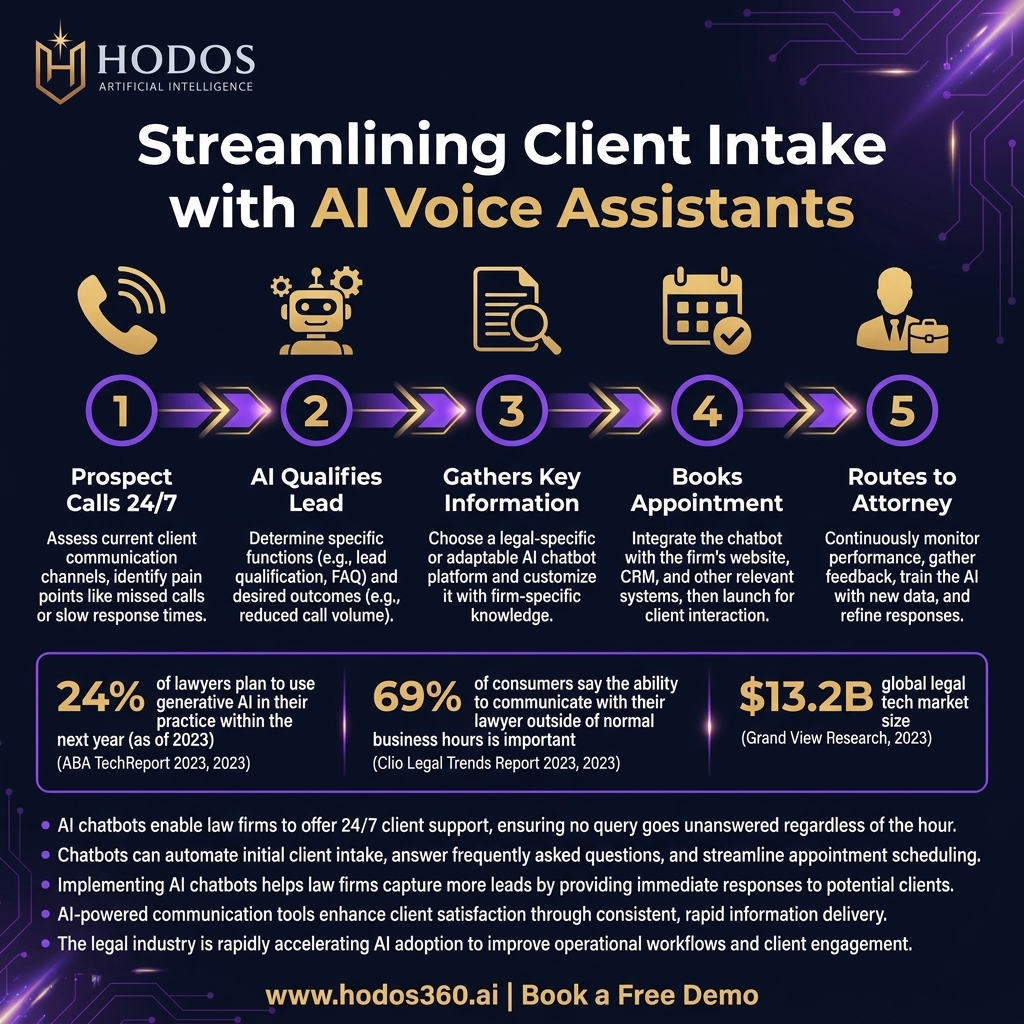
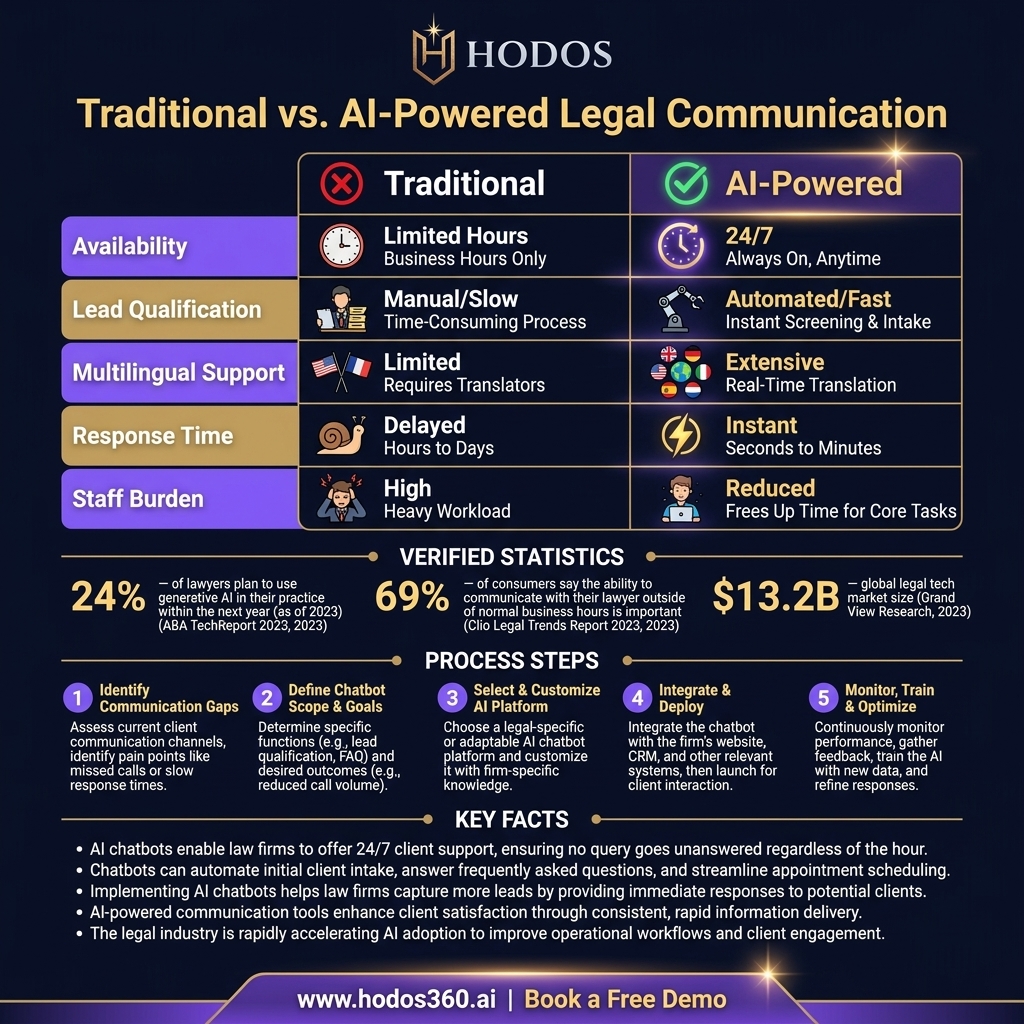
The immediate and most tangible benefit of advanced AI chatbot development for law firms is the profound transformation of client engagement. In an era where client expectations for immediate responsiveness are at an all-time high – with a 2023 Clio Legal Trends Report indicating that 79% of clients expect an immediate response from their lawyer – traditional phone systems and email queues often fall short. This is where AI voice assistants, like those offered by HODOS 360, become indispensable. They provide 24/7 phone answering, ensuring that every potential client call is handled promptly, regardless of time zones or office hours. This continuous availability not only prevents missed opportunities but also significantly enhances the client experience, conveying a sense of attentiveness and professionalism that sets a firm apart. Imagine the relief of a client facing an urgent legal matter, knowing they can connect with an intelligent system that can understand their initial query and guide them through the next steps, even at 2 AM.
Beyond mere answering, these sophisticated AI voice assistants excel at lead qualification. They can engage prospective clients in a natural conversation, asking targeted questions to ascertain the nature of their legal need, gather essential background information, and determine if their case aligns with the firm's practice areas. This intelligent filtering ensures that attorneys and paralegals spend their valuable time on qualified leads, rather than on initial screening calls that may not materialize into billable work. This efficiency gain is critical for law firms looking to optimize their resources and improve their client intake processes. The ability to automatically collect detailed information, such as the specifics of a case or relevant dates, before a human ever intervenes, drastically reduces administrative overhead and speeds up the onboarding process.
Furthermore, the power of AI voice assistants extends to critical tasks like appointment booking and multilingual support. Learn more about AI Lead Flow: Essential Strategies for Law Firm Growth. A prospective client can schedule a consultation directly through the AI, integrating seamlessly with the firm's calendar system. This removes friction from the client journey and frees up administrative staff from repetitive scheduling tasks. For firms operating in diverse communities or dealing with international clients, multilingual support is a game-changer. AI voice assistants can converse fluently in multiple languages, breaking down communication barriers and making legal services accessible to a broader demographic. This inclusivity not only expands a firm's potential client base but also demonstrates a commitment to serving all members of the community, a powerful differentiator in today's competitive legal market.
Finally, the strategic implementation of call routing ensures that complex or urgent matters are immediately escalated to the appropriate human professional, while routine inquiries are efficiently managed by the AI. This intelligent triage system guarantees that clients receive the right level of support at the right time, optimizing both client satisfaction and internal resource allocation. The integration of these capabilities into a comprehensive AI chatbot development strategy means that law firms can build a truly responsive, efficient, and client-centric communication infrastructure. This proactive approach to client engagement is no longer a luxury but a necessity for firms aiming for sustained growth and reputation in the modern legal landscape.
Seamless Client Intake and 24/7 Responsiveness
The core of effective client engagement in law firms rests on seamless intake and unwavering responsiveness. Historically, this has been a bottleneck, with potential clients often facing voicemail mazes or long waits for callbacks. A 2024 survey by Thomson Reuters found that firms with faster response times and more streamlined intake processes reported significantly higher client satisfaction scores and conversion rates. AI chatbot development directly addresses this by providing instant, intelligent interaction. Imagine a potential client, perhaps distressed after an incident, calling your firm. Learn more about AI Legal Research: The Ultimate Guide for Law Firms. Instead of reaching an answering machine, they are greeted by an empathetic AI voice assistant that can immediately understand their situation, collect critical details, and even initiate the necessary paperwork or schedule an urgent consultation. This immediate engagement not only captures leads but also builds trust and confidence from the very first touchpoint, setting a positive tone for the entire client relationship. This level of service, available around the clock, is fundamentally reshaping how law firms acquire and retain clients, ensuring that no opportunity is lost due to communication delays.
Operational Efficiency and Growth: The Strategic Imperative
Beyond client-facing interactions, the strategic imperative for AI chatbot development extends deeply into a law firm's operational efficiency and growth trajectory. A McKinsey report from early 2024 highlighted that businesses adopting AI for administrative and communication tasks could see productivity gains of 15-20%, translating directly into reduced operational costs and increased capacity for higher-value work. For law firms, this means automating numerous repetitive tasks that currently consume valuable attorney and paralegal time. Think about the countless hours spent on initial client screenings, scheduling, or answering common procedural questions. By offloading these to an AI voice assistant, legal professionals are freed to concentrate on complex legal analysis, strategy development, and courtroom advocacy – the work that truly requires human judgment and expertise.
This re-allocation of resources isn't just about saving money; it's about fostering an environment where legal talent can thrive. When attorneys are not bogged down by administrative minutiae, their job satisfaction increases, and their ability to innovate and deliver exceptional legal outcomes is enhanced. Moreover, the data collected by AI voice assistants during client interactions can feed directly into an AI Law Firm Management System, improving the accuracy of client intake, streamlining billing processes, and enhancing overall case management. The synergy between AI-powered communication tools and comprehensive practice management platforms creates a holistic approach to efficiency, ensuring that every piece of client information is captured and utilized effectively from the outset.
The impact on growth is equally significant. By handling a larger volume of initial inquiries and qualifying leads more effectively, firms can expand their client base without necessarily increasing headcount at the same rate. Learn more about Voice AI Agents: The Ultimate Guide to Law Firm Transformation. This scalability is a crucial advantage in a competitive market. Furthermore, the robust data analytics capabilities inherent in advanced AI platforms allow firms to track the ROI of their marketing efforts with unprecedented precision. An AI Marketing Platform, for instance, can leverage insights from AI voice assistant interactions to refine content generation, optimize social media automation, and tailor AI video creation, ensuring that marketing spend is directed towards the most effective channels. This data-driven approach allows firms to identify trends in client inquiries, understand service demand, and make informed decisions about future growth strategies, turning raw communication data into actionable business intelligence.
Ultimately, the integration of AI chatbot development into a firm's operational strategy is not just about adopting a new tool; it's about embedding intelligence into the very fabric of its business model. It's about building a resilient, scalable, and client-centric practice that can navigate the complexities of the modern legal landscape with agility and foresight. Firms that recognize this strategic imperative are positioning themselves for sustained success, transforming challenges into opportunities for growth and innovation. The question of what can you do with a published artifact? in the context of AI tools extends to how firms leverage the outputs of their AI systems—from transcribed calls to qualified lead data—to continuously refine their operations and service delivery, ensuring every interaction contributes to a smarter, more efficient practice.
The ROI of Intelligent Automation in Legal Operations
Measuring the Return on Investment (ROI) of intelligent automation in legal operations is crucial for firms considering AI chatbot development. The benefits extend beyond mere cost savings. A 2025 report by Gartner predicted that by 2028, enterprises leveraging conversational AI would reduce customer service costs by 30%. For law firms, this translates to significant savings on administrative staff hours dedicated to phone answering, lead screening, and appointment setting. Learn more about AI in Legal Tech: The Ultimate Guide to Modern Firm Management. Beyond direct cost reduction, the ROI manifests in higher lead conversion rates due to 24/7 availability and faster response times, increased client satisfaction leading to better retention and referrals, and improved attorney productivity. For example, a firm might see a 20% increase in qualified leads processed per month, or a 15% reduction in time spent on initial client consultations, allowing attorneys to bill more hours on complex legal work. These quantifiable gains underscore that investing in AI voice assistants is not an expenditure, but a strategic investment in the firm's future profitability and competitive standing.
Navigating Ethical AI & Future Frontiers for Law Firms
As law firms increasingly adopt AI chatbot development, particularly for client-facing roles, navigating the ethical implications becomes paramount. The legal profession is bound by strict rules of professional conduct, which extend to the use of technology. Central to this is the duty of competence (ABA Model Rule 1.1), requiring lawyers to stay abreast of the benefits and risks associated with relevant technology. This means understanding how AI systems function, their limitations, and crucially, their potential for bias or error. Firms must ensure that their AI voice assistants are trained on diverse, unbiased data and that their responses are regularly reviewed for accuracy and appropriateness. The European Union's AI Act, set to be fully enforced in the coming years, provides a regulatory framework for AI systems, categorizing them by risk level and imposing stringent requirements for high-risk applications. While not directly applicable in all jurisdictions, it sets a global precedent for responsible AI deployment that legal professionals cannot ignore.
Perhaps the most critical ethical consideration is data privacy and confidentiality. Legal professionals have an unwavering duty to protect client information (ABA Model Rule 1.6). When deploying AI voice assistants, firms must ensure that all data collected – from initial inquiries to sensitive case details – is handled with the highest level of security and compliance. This includes robust encryption, secure data storage, and strict adherence to data protection regulations like GDPR and CCPA. Law firms must thoroughly vet their AI vendors, ensuring they have transparent data handling policies and robust cybersecurity measures in place. This also includes understanding what data can Claude access through connectors? (a common query regarding LLMs), ensuring that only authorized and necessary data is shared and processed, and that client consent is explicitly obtained where required. The reputation of a law firm is built on trust, and any perceived lapse in data security due to AI deployment could have devastating consequences.
Another significant ethical frontier revolves around the human element. While AI can automate many tasks, the inherent value of human empathy, nuanced judgment, and the attorney-client relationship remains irreplaceable. AI chatbot development should be viewed as an augmentation, not a replacement, for human interaction. Firms must establish clear guidelines for when an AI hands off a call to a human, particularly for sensitive or complex legal issues that require a lawyer's direct involvement. The goal is to leverage AI to enhance human capabilities, allowing lawyers to focus on the strategic, emotionally intelligent aspects of their work, rather than delegating the entirety of client interaction to a machine. This balance is key to maintaining professional standards and delivering truly client-centric legal services.
Looking ahead, the future frontiers for AI in law firms are boundless. We'll see further integration of AI across all aspects of legal practice, from predictive analytics in litigation to sophisticated AI-powered website building that adapts to user behavior. The ongoing developments in fields like quantum computing and explainable AI (XAI) promise even more powerful and transparent AI systems. Firms that proactively engage with these trends, understanding both the immense potential and the critical ethical guardrails, will be best positioned to thrive. The narrative arc of legal tech is still unfolding, marked by both disruption and incredible opportunity, and those who embrace intelligent AI chatbot development will be writing its most compelling chapters.
Addressing Data Privacy, Confidentiality, and Professional Responsibility
The ethical obligations of data privacy and confidentiality are non-negotiable for law firms, and the deployment of AI chatbot development adds new layers of complexity. ABA Model Rule 1.6 mandates that lawyers shall not reveal information relating to the representation of a client unless the client gives informed consent, the disclosure is impliedly authorized, or falls under specific exceptions. When using AI voice assistants, firms must ensure that the technology and its underlying data handling processes fully comply with these duties. This means implementing robust data anonymization techniques where appropriate, securing vendor contracts that guarantee data protection, and regularly auditing AI systems for vulnerabilities. Furthermore, clients must be fully informed about how their data is being used and processed by AI, ensuring transparency and maintaining their trust. Failure to address these concerns can lead to severe reputational damage, regulatory penalties, and potential malpractice claims, highlighting the critical importance of a proactive and informed approach to AI governance within the legal sector.

Key Takeaways and Next Steps
The transformation brought about by AI chatbot development is not a distant future for law firms; it is a present reality shaping the competitive landscape. From enhancing client engagement through 24/7 responsiveness and intelligent lead qualification to driving unprecedented operational efficiencies, AI voice assistants are proving to be an indispensable asset. Firms that proactively invest in these intelligent solutions are not just adopting technology; they are strategically positioning themselves for sustainable growth, superior client satisfaction, and a more streamlined, profitable practice. The ability to automate routine tasks, provide multilingual support, and route calls intelligently frees up valuable human capital, allowing legal professionals to focus on the nuanced, high-value work that only they can perform.
However, this powerful technological advancement comes with a clear mandate for ethical deployment. Law firms must remain vigilant regarding data privacy, confidentiality, and their professional responsibilities. Thorough due diligence of AI vendors, transparent communication with clients, and a commitment to continuous oversight are not merely best practices but ethical imperatives. The human element in legal services remains paramount, and AI should always serve as an augmentation, enhancing the capabilities of lawyers rather than replacing the critical human connection.
For law firms ready to embrace this transformative era, the next steps are clear: explore the capabilities of advanced AI platforms. Solutions like HODOS 360's AI Voice Assistants offer a comprehensive suite of tools designed specifically for the legal sector, ensuring seamless integration, robust security, and unparalleled performance. By leveraging such platforms, firms can navigate the complexities of modern legal practice with confidence, deliver exceptional client experiences, and unlock new levels of efficiency and growth, setting the stage for a future where intelligent automation empowers legal excellence. This commitment to innovation ensures that your firm remains at the forefront of the legal industry, ready for any challenges or opportunities that ai news today might bring.
Frequently Asked Questions
What specifically can AI voice assistants do for a law firm?+
AI voice assistants can provide 24/7 phone answering, qualify leads by asking targeted questions, book appointments directly into calendars, offer multilingual support, and intelligently route calls to the appropriate human professional for complex matters. They streamline client intake, ensure no leads are missed, and free up administrative staff from repetitive tasks, significantly enhancing client experience and operational efficiency.
How do AI chatbots handle sensitive client information securely?+
Reputable AI chatbot development prioritizes data security. Firms should choose vendors with robust encryption, secure data storage protocols, and compliance with regulations like GDPR and CCPA. It's crucial to understand the vendor's data handling policies, ensure client consent for data processing, and implement internal safeguards to protect confidentiality as mandated by ABA Model Rule 1.6.
Will AI voice assistants replace human staff in law firms?+
No, AI voice assistants are designed to augment, not replace, human staff. They handle routine, high-volume tasks, allowing legal professionals to focus on complex legal analysis, strategy, and client relationships that require human judgment, empathy, and expertise. AI enhances efficiency and client satisfaction by taking over repetitive administrative duties, freeing up staff for more valuable work.
What is the typical ROI for investing in AI chatbot development for a law firm?+
The ROI for AI chatbot development in law firms is multifaceted. It includes significant cost savings from automating administrative tasks, increased lead conversion rates due to 24/7 availability, higher client satisfaction leading to better retention and referrals, and improved attorney productivity. Firms often report a substantial reduction in operational overhead and an increase in qualified leads and billable hours.
How can a law firm get started with implementing AI voice assistants?+
To get started, law firms should first assess their current communication bottlenecks and client pain points. Then, research reputable AI solution providers specializing in legal tech, like HODOS 360. Schedule a demo to understand specific features, discuss integration with existing systems, and start with a pilot program to evaluate performance before full-scale deployment. Prioritize solutions that offer robust security and customization.