
AI-Driven Marketing: Essential Strategies for Law Firms
In early 2026, a story circulated among legal tech circles that perfectly encapsulated the shifting sands of law firm client acquisition. A mid-sized corporate law firm, Sterling & Hayes, a bastion of traditional networking and referrals, found itself losing ground to newer, more agile competitors.
Their digital presence was an afterthought, their outreach generic. Meanwhile, firms like LegalTech Innovators LLP, under the visionary leadership of Managing Partner Anya Sharma, were reporting unprecedented growth, attributing much of it to a strategic embrace of AI-driven marketing. This stark contrast highlights the urgent 'new reality' that MITechNews recently underscored: AI is no longer a luxury but an essential component of B2B marketing, especially for law firms navigating a fiercely competitive digital landscape.
The pressure on law firms to not only maintain but expand their client base has intensified. Traditional marketing channels, while still valuable, are increasingly insufficient to capture the attention of sophisticated B2B clients who expect personalized, data-informed engagement. The chasm between firms like Sterling & Hayes, clinging to legacy methods, and those like LegalTech Innovators, leveraging platforms like HODOS 360’s AI Marketing Platform, is widening.
This isn't just about adopting new tools; it's about fundamentally rethinking how legal services are positioned, discovered, and consumed in an increasingly AI-driven world. The question is no longer *if* AI will transform legal marketing, but *how quickly* firms can adapt to harness its power for sustainable growth and competitive advantage.
The Strategic Imperative: Why Law Firms Need AI-Driven Marketing Now
The legal industry's evolution demands a strategic overhaul of marketing efforts. According to the ABA's 2023 TechReport, only 35% of law firms actively use marketing automation, a figure that pales in comparison to other B2B sectors. This gap represents both a challenge and an immense opportunity.
Firms that proactively integrate AI into their marketing strategies are not just improving efficiency; they are fundamentally transforming their client acquisition funnels, moving beyond reactive measures to predictive engagement. This shift is critical for small to medium-sized firms (SMBs) that often lack the extensive marketing departments of their larger counterparts, yet face the same pressures to attract and retain high-value clients.
The competitive landscape is further complicated by the rise of legal tech startups and alternative legal service providers (ALSPs) that are inherently digital-first. These entities often outmaneuver traditional firms in online visibility and client engagement by leveraging advanced analytics and automated outreach. For instance, the rapid expansion of companies like Clio, which in 2021 acquired Lawmatics to bolster its CRM and marketing automation capabilities, signals a clear market trend: technology is paramount for client relationship management.
Law firm leaders, such as Brad Karp, Chairman of Paul, Weiss, have publicly acknowledged the imperative of technological adoption to remain competitive, emphasizing that firms must invest in innovation to meet evolving client expectations and operational demands.
AI-driven marketing addresses several core pain points for law firms: identifying niche markets, creating hyper-targeted content, and optimizing marketing spend for maximum ROI.
Learn more about Voice AI: Essential Revenue Protection for Law Firms. McKinsey's 2023 report on B2B marketing indicated that companies using AI for personalization saw a 10-15% increase in revenue. For law firms, this translates into more qualified leads, reduced client acquisition costs, and stronger client relationships built on tailored communication.
The ability of AI to analyze vast datasets, predict client needs, and automate routine tasks frees up legal professionals to focus on high-value legal work, making a compelling business case for immediate adoption.
Firms that delay this transition risk being left behind in a market increasingly dominated by digital proficiency.
The 'state of AI in B2B marketing' is one of rapid acceleration, where early adopters are cementing their market positions. The human conflict here is palpable: the tension between the comfort of traditional methods and the undeniable pressure to innovate. Firms must ask themselves if their current marketing strategies are truly capable of driving the growth and client engagement required for the future, or if they are merely treading water while competitors surge ahead with intelligent, AI-powered systems.
Beyond the Hype: Practical AI Strategies for Legal Content and SEO
One of the most immediate and impactful applications of AI for law firms lies in content generation and search engine optimization (SEO). Generative AI tools, powered by large language models like those developed by OpenAI and Google, have revolutionized the speed and scale at which high-quality legal content can be produced.
Instead of spending countless hours drafting blog posts, articles, or social media updates, attorneys can leverage AI to generate drafts, research complex topics, and even adapt content for different platforms and audiences. This doesn't replace human expertise but augments it, allowing firms to maintain a consistent, authoritative voice across all digital channels.
Apoorv Agarwal, CEO of Harvey AI, has repeatedly emphasized how generative AI can empower legal professionals to focus on strategic thinking rather than routine drafting. For marketing teams, this means AI can assist in crafting compelling narratives that resonate with specific client segments. Imagine an AI analyzing legal trends, competitor content, and client queries to suggest article topics that address real-world pain points, then drafting an initial piece that a lawyer can review and refine.
This significantly boosts productivity, allowing firms to publish more frequently and maintain relevance in a fast-moving digital landscape.
Furthermore, AI is transforming SEO strategies for law firms by providing deeper insights into keyword research, competitor analysis, and on-page optimization. AI algorithms can identify long-tail keywords with high conversion potential, analyze search intent, and even suggest structural improvements to website content to improve rankings.
Learn more about AI Meeting Privacy: Essential Governance Lessons for Law Firms. This goes 'beyond the hype' of basic keyword stuffing, enabling a sophisticated, data-driven approach to attracting organic traffic. For example, AI tools can track SERP features, analyze voice search queries, and identify content gaps where a firm can establish authority, ensuring their legal expertise is discoverable by potential clients.
To drive real ROI with AI in B2B marketing, firms must integrate these tools thoughtfully. This involves training AI models on firm-specific data and ensuring human oversight to maintain accuracy and ethical standards. AI isn't just about creating content; it's about optimizing its distribution and ensuring it reaches the right audience at the right time.
By combining generative AI for content creation with advanced AI for SEO, law firms can significantly enhance their online visibility, position themselves as thought leaders, and attract a steady stream of qualified leads. The future of legal marketing is intrinsically tied to these intelligent content and SEO strategies, moving firms towards better, more impactful digital engagement.
Crafting Compelling Narratives with Generative AI
The ability of generative AI to produce nuanced and contextually relevant text is a game-changer for legal storytelling. Law firms can now use these tools to develop detailed case studies, client success stories, and thought leadership pieces that resonate deeply with their target audience. This isn't about generic output; it's about leveraging AI to quickly synthesize complex legal information into accessible, engaging narratives that demonstrate expertise and build trust.
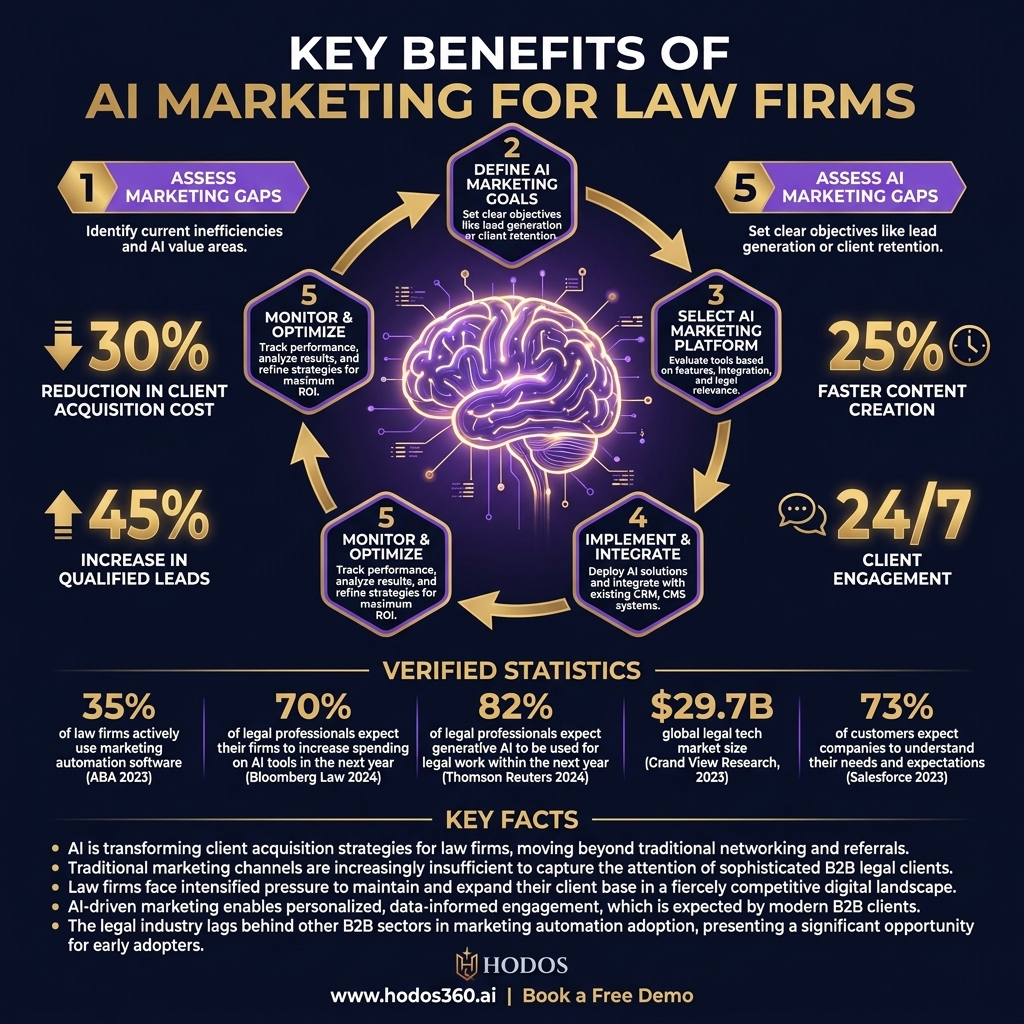
Learn more about AI Mistakes: Ultimate Guide to Lawyer Liability & Safeguards. By inputting key facts and desired outcomes, an AI can outline, draft, and even optimize content for specific platforms, such as LinkedIn articles or detailed practice area pages. This allows legal marketers to scale their content efforts exponentially while maintaining a high standard of quality, which is crucial for establishing authority and driving engagement in specialized legal fields.
AI-Powered Client Engagement: From Lead Qualification to Personalized Outreach
The transformation wrought by AI extends deeply into client engagement, redefining how law firms interact with prospective and existing clients. AI voice assistants, such as those offered by HODOS 360, are leading this revolution, providing 24/7 phone answering, lead qualification, and appointment booking capabilities. This ensures that no potential client inquiry goes unanswered, offering immediate, intelligent support that traditional receptionists simply cannot match around the clock.
These assistants can pre-screen callers based on specific legal needs, gather essential information, and route qualified leads directly to the appropriate attorney, significantly streamlining the client intake process and improving the overall client experience from the very first touchpoint.
Beyond initial contact, AI enables hyper-personalized outreach through sophisticated data analytics.
By analyzing client demographics, behavioral signals, and past interactions, AI platforms can segment audiences and deliver tailored marketing messages. This moves away from mass email blasts to individualized communication, whether it's a personalized email about a new regulatory change relevant to a client's industry or a targeted ad campaign for a specific legal service.
Gartner's 2024 marketing report highlights that personalization, driven by AI, is crucial for improving customer loyalty and conversion rates, with businesses seeing up to a 20% uplift in sales from highly personalized campaigns.
The competitive drama in this space is intense, with legal tech innovators constantly pushing boundaries.
Learn more about AI Website Builder: The Ultimate Guide for Law Firms. For example, while Clio acquired Lawmatics to integrate CRM, other startups are focusing purely on advanced AI for lead management and automated follow-ups. Firms that adopt these AI voice assistants and personalized marketing platforms gain a significant edge, not just in efficiency but in perceived responsiveness and client-centricity.
This level of AI-driven engagement transforms the sales funnel, allowing law firms to nurture leads more effectively and convert them into loyal clients, demonstrating a superior understanding of client needs and a commitment to modern service delivery.
Moreover, AI-powered platforms can predict which leads are most likely to convert, allowing marketing and sales teams to prioritize their efforts.
This intelligent allocation of resources ensures that attorneys spend their valuable time engaging with high-intent prospects, maximizing the return on marketing investment. The future of client engagement is one where AI acts as an intelligent layer, enhancing every interaction and making it more efficient, personalized, and ultimately, more successful for law firms aiming for sustainable growth.
- ✓24/7 Responsiveness: AI Voice Assistants ensure no lead is missed, providing instant, intelligent support day or night.
- ✓Lead Qualification: Automatically pre-screen potential clients, collecting vital information and assessing their legal needs before attorney involvement.
- ✓Personalized Communication: Leverage AI to segment audiences and deliver hyper-targeted messages, improving engagement and conversion rates.
- ✓Automated Appointment Booking: Streamline scheduling by allowing AI to book consultations directly into attorneys' calendars.
- ✓Data-Driven Prioritization: Use AI analytics to identify and prioritize high-intent leads, optimizing attorney time and resources.
- ✓Multilingual Support: Expand reach with AI voice assistants capable of communicating in multiple languages, catering to a diverse client base.
Revolutionizing Client Intake and Communication
The initial client intake process, often a bottleneck for law firms, is fundamentally transformed by AI. Instead of manual data entry and repetitive questioning, AI-powered systems can automate the collection of client information, conflict checks, and preliminary case assessments. This not only reduces administrative burden but also significantly speeds up the onboarding process, providing a seamless experience for new clients.
Furthermore, AI-driven communication tools can manage routine client queries, provide status updates, and send automated reminders, ensuring consistent and timely communication without requiring constant attorney intervention. Learn more about AI Legal Partnership: The Ultimate Guide to Enterprise AI. This enhances client satisfaction, builds trust, and allows legal professionals to dedicate their expertise to complex legal analysis and representation, rather than administrative tasks.
It's a strategic move towards greater productivity and better client service.
Measuring Success: AI Analytics and ROI Tracking in Legal Marketing
In the past, measuring the precise return on investment (ROI) for legal marketing efforts was often an imprecise art. Today, AI analytics has turned it into a quantifiable science, providing law firms with unprecedented clarity into their marketing performance. AI platforms can ingest vast amounts of data from various sources—website traffic, social media engagement, email campaigns, ad spend, and client conversion rates—to identify patterns and correlations that human analysts might miss.
This allows firms to understand exactly which strategies are yielding the best results and where resources might be misallocated, driving better, quicker decisions about their marketing spend.
Consider the challenge of attributing a new client to a specific marketing channel. Was it a blog post, a social media ad, a referral from a partner firm, or a combination?
AI-driven attribution models can provide multi-touch attribution, giving credit to every touchpoint in the client journey. This level of detail is critical for optimizing future campaigns. For instance, a report by Thomson Reuters on legal business trends emphasized the growing importance of data analytics in firm management, noting that firms leveraging advanced analytics consistently outperform their peers in profitability and client retention.
This highlights the competitive tension: firms that invest in robust analytics gain a clear advantage in understanding and optimizing their market position.
AI also enables predictive analytics, allowing law firms to forecast future marketing performance and adjust strategies proactively. Learn more about Legal AI Content: Essential for Modern Contract Workflows.
By analyzing historical data and market trends, AI can predict the likelihood of success for different campaigns, identify emerging client needs, and even anticipate competitive moves. This proactive approach ensures that marketing efforts are always aligned with the firm's strategic goals and are continuously optimized for maximum impact.
The 'where' and 'when' of marketing become data-driven decisions, rather than educated guesses.
Ultimately, AI analytics empowers law firms to move beyond vanity metrics and focus on what truly drives growth and profitability. It ensures accountability for marketing investments and provides actionable insights that can be used to refine strategies, personalize client experiences, and achieve measurable ROI.
Firms can track everything from lead generation costs to client lifetime value, making their marketing more strategic, efficient, and effective. The state of AI in B2B marketing is such that data-driven decision-making is no longer optional but a fundamental requirement for sustainable success, transforming how legal services are marketed and delivered.
Data-Driven Decisions for Sustainable Growth
The ability to make informed decisions based on comprehensive data is the bedrock of sustainable growth in legal marketing. AI analytics provides law firms with a 360-degree view of their marketing ecosystem, from initial client contact to case closure. This granular insight allows firms to identify high-performing channels, optimize budgets, and tailor their messaging with precision.
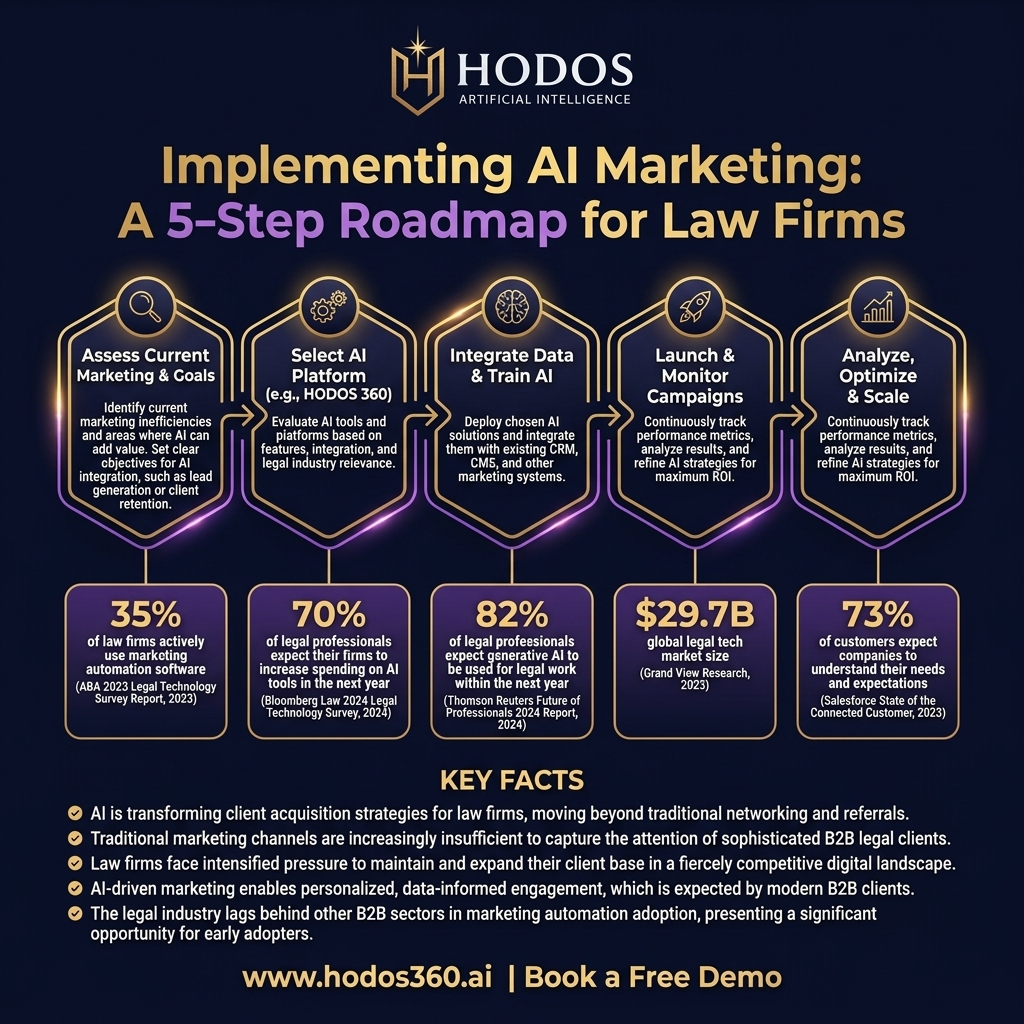
By continuously monitoring and analyzing performance metrics, firms can adapt their strategies in real-time, ensuring maximum efficiency and effectiveness. This proactive, data-driven approach not only boosts productivity but also cultivates a culture of continuous improvement, positioning the firm for long-term success in a competitive market.
Ethical AI in Legal Marketing: Navigating Bias and Transparency
As law firms delve deeper into AI-driven marketing, ethical considerations become paramount. The legal profession is bound by stringent rules of professional conduct, including those related to advertising and client solicitation. The ABA Model Rules of Professional Conduct, Rule 7.1 (Communications Concerning a Lawyer's Services), dictates that a lawyer shall not make a false or misleading communication about the lawyer or the lawyer's services.
This rule applies directly to AI-generated marketing content and AI-powered client interactions. Firms must ensure that any content created by AI is accurate, truthful, and does not inadvertently mislead potential clients. The responsibility for ethical compliance ultimately rests with the attorneys and the firm, necessitating robust oversight mechanisms for AI deployments.
One significant concern is the potential for algorithmic bias. If AI models are trained on biased data, they can perpetuate or even amplify those biases in their marketing outputs, leading to discriminatory targeting or communication. For example, an AI might inadvertently exclude certain demographics from receiving marketing messages, raising ethical and potentially legal issues.
Jensen Huang, CEO of NVIDIA, has frequently spoken about the critical need for ethical AI development, emphasizing the importance of diverse datasets and human-in-the-loop validation to mitigate bias. Law firms must proactively audit their AI systems and data sources to ensure fairness and inclusivity, reflecting the profession's commitment to justice and equality.
Transparency is another cornerstone of ethical AI marketing. Clients and prospective clients should be aware when they are interacting with an AI, such as a chatbot or voice assistant, rather than a human. While not explicitly codified in current ABA rules for AI, the spirit of transparency aligns with the duty of candor and honest communication.
The EU AI Act, which began its phased enforcement in 2024, sets a precedent for regulatory oversight of AI systems, particularly those deemed high-risk. While legal marketing AI might not always fall into the highest risk category, its principles of transparency and accountability will likely influence best practices globally, compelling firms to be open about their use of AI.
Ultimately, ethical AI in legal marketing requires a commitment to human oversight, continuous monitoring, and adherence to professional standards. Firms must establish clear policies for AI content review, data privacy (especially concerning client data under regulations like CCPA or GDPR), and bias detection. The goal is to leverage AI's transformative power while upholding the legal profession's core values of integrity, fairness, and client protection.
Navigating these complexities will define the ethical future of AI-driven marketing in the legal sector, ensuring that innovation serves justice responsibly.
Ensuring Compliance and Mitigating Risk
To effectively manage the risks associated with AI in legal marketing, law firms must implement comprehensive compliance frameworks. This includes regular audits of AI-generated content for accuracy and adherence to advertising rules, as well as scrutinizing AI algorithms for potential biases. Training legal staff on ethical AI usage and data governance is also crucial.
By proactively addressing these concerns, firms can safeguard their reputation, avoid regulatory penalties, and maintain client trust. This diligent approach ensures that the benefits of AI-driven marketing are realized without compromising the legal profession's ethical obligations, transforming potential pitfalls into opportunities for responsible innovation and better client service.

The Future of Legal Marketing: Embracing Innovation with HODOS 360
The 'new reality' of AI-driven B2B marketing is here, and for law firms, it represents not just a technological shift but a fundamental redefinition of competitive advantage. From content creation and SEO optimization to hyper-personalized client engagement and precise ROI tracking, AI offers unprecedented opportunities for growth and efficiency.
Firms that embrace these innovations are not merely adopting tools; they are investing in a future where their marketing efforts are more intelligent, more targeted, and significantly more effective at attracting and retaining clients. The tension between traditional approaches and the imperative for digital transformation is resolving itself in favor of those who innovate.
The narrative arc of legal marketing is clear: the most successful firms will be those that strategically integrate AI into their operations. This means moving beyond generic marketing to a data-driven approach that understands client needs, anticipates market shifts, and communicates value with precision. The stories of firms like LegalTech Innovators LLP, thriving amidst disruption, serve as powerful testaments to the efficacy of AI.
The choice confronting law firm leaders today is not whether to adopt AI, but how to do so comprehensively and ethically to secure their firm’s future in a digitally advanced legal landscape.
To navigate this transformative era, law firms need robust, integrated solutions. HODOS 360's AI Marketing Platform provides a complete suite of services designed specifically for the legal sector, including AI video creation, social media automation, content generation, and sophisticated analytics for ROI tracking.
By leveraging such a platform, firms can streamline their marketing operations, enhance their digital footprint, and build stronger, more profitable client relationships. It's about empowering legal professionals to focus on law, while AI handles the complexities of modern marketing, ensuring productivity and better outcomes.
Frequently Asked Questions
What is AI-driven marketing for law firms?+
AI-driven marketing for law firms involves using artificial intelligence technologies to automate, optimize, and personalize marketing efforts. This includes AI-powered content creation, SEO optimization, targeted advertising, client lead qualification through AI voice assistants, and advanced analytics for tracking ROI. Its goal is to enhance efficiency, attract more qualified leads, and improve client engagement through data-informed strategies.
How can AI improve client acquisition for my law firm?+
AI improves client acquisition by enabling hyper-targeted campaigns, generating engaging content faster, and providing 24/7 client interaction through AI voice assistants. It helps identify high-intent leads, personalize outreach messages, and optimize marketing spend for maximum impact. This leads to more efficient lead nurturing, higher conversion rates, and ultimately, a stronger pipeline of new clients for your law firm.
Are there ethical concerns when using AI in legal marketing?+
Yes, ethical concerns include ensuring AI-generated content is accurate and not misleading (per ABA Model Rule 7.1), mitigating algorithmic bias in targeting, and maintaining transparency with clients about AI interactions. Law firms must implement human oversight, conduct regular audits, and adhere to data privacy regulations to ensure AI use aligns with professional conduct and ethical standards, safeguarding firm reputation.
What kind of ROI can law firms expect from AI marketing?+
Law firms can expect significant ROI from AI marketing through reduced client acquisition costs, increased lead conversion rates, and optimized marketing spend. AI analytics provides precise attribution and predictive insights, allowing firms to identify and scale high-performing strategies. McKinsey reports B2B companies see 10-15% revenue increases from AI personalization, indicating substantial financial benefits for legal practices.
How does AI help with content creation and SEO for legal practices?+
AI assists content creation by generating drafts for blogs, articles, and social media, significantly boosting productivity. For SEO, AI analyzes keywords, competitor strategies, and search intent to optimize website content, improve rankings, and identify content gaps. This ensures legal expertise is discoverable and positions the firm as a thought leader, attracting organic traffic and qualified leads more effectively.