


AI Marketing Tools: Ultimate Guide to Turbocharge Your Flywheel
In the competitive landscape of legal services, the adage "build it and they will come" no longer holds true. Firms are locked in an intense battle for client attention, and traditional marketing methods often feel like shouting into a void. This was the challenge facing Sarah Chen, Senior Partner at LexCorp Legal, a reputable mid-sized firm in Chicago.
For years, LexCorp relied on established networks and modest advertising, but client intake had plateaued. "We were excellent lawyers," Chen recounted at a recent LegalTech NYC 2026 panel, "but our marketing felt stuck in the last century. We saw younger, digitally savvy firms outperforming us, and we knew we needed a radical shift."
Her revelation came after reading an inc.com article titled "It’s Time to Turbocharge Your Flywheel. These Are the Best AI Marketing Tools, According to Experts," which crystallized the need for an AI-driven marketing overhaul.
LexCorp Legal's journey mirrors a growing trend across the legal industry: the strategic adoption of advanced AI marketing tools to not just compete, but to dominate.
The concept of the 'marketing flywheel'—a self-sustaining cycle where satisfied clients drive referrals and repeat business—is being dramatically amplified by artificial intelligence. Firms that have embraced this transformation are seeing unprecedented growth in lead generation, client engagement, and ultimately, revenue. As venture capitalist and AI thought leader Andrew Ng often emphasizes, "AI isn't just about automation; it's about augmentation, giving humans superpowers."
For law firms, these superpowers translate into hyper-targeted outreach, personalized communication, and data-driven decision-making, moving beyond scattershot campaigns to a precision-engineered approach that attracts, engages, and delights clients more effectively than ever before.
This comprehensive guide explores how law firms can harness the power of AI marketing tools to turbocharge their own growth flywheels.
We will delve into specific technologies, ethical considerations, and strategic implementations, offering a roadmap for legal professionals ready to redefine their client acquisition and retention strategies. From AI-powered content generation to sophisticated ROI tracking, the insights herein are designed to equip you with the knowledge to build a marketing engine that not only runs but accelerates, ensuring your firm remains at the forefront of the legal industry.
The shift is no longer optional; it's an imperative for sustainable growth.
Table of Contents
- ✓The Unstoppable Flywheel: Reimagining Legal Marketing with AI
- ✓Beyond Buzzwords: Concrete AI Marketing Tools for Law Firms
- ✓Crafting a Data-Driven Narrative: Analytics and ROI in AI Marketing
- ✓Navigating the AI Frontier: Ethical Considerations and Future Trends
- ✓Building Your AI Marketing Powerhouse: A Strategic Roadmap
- ✓Frequently Asked Questions (FAQ)
- ✓Key Takeaways and Next Steps
The Unstoppable Flywheel: Reimagining Legal Marketing with AI
The concept of a marketing flywheel, popularized by HubSpot, posits that customer success drives growth, creating a virtuous cycle where momentum builds over time. In legal services, this means that excellent client experiences lead to referrals, positive reviews, and repeat business, fueling the firm's growth with less friction than traditional funnel models.
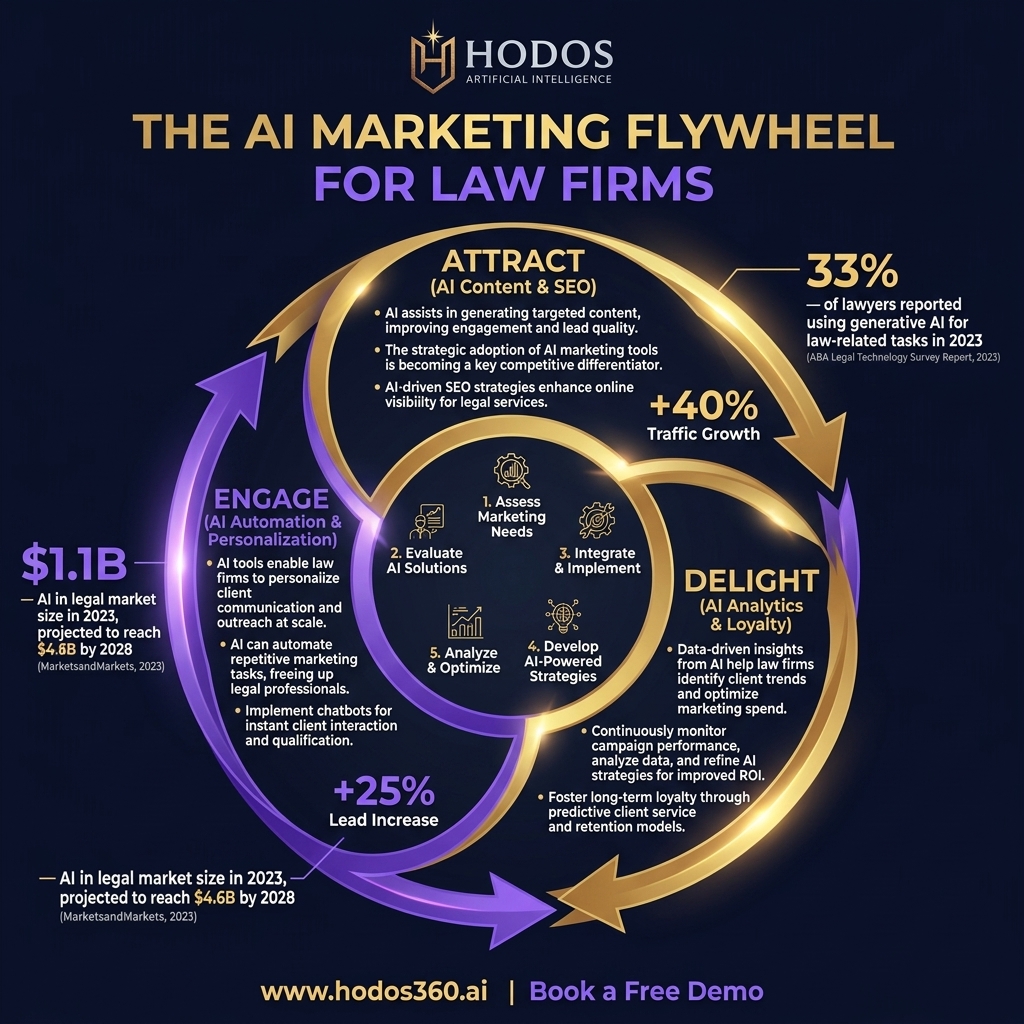
However, the initial push to get this flywheel spinning and keep it accelerating requires significant effort. This is precisely where AI marketing tools become indispensable, acting as powerful accelerators at every stage. Consider the competitive dynamics: a 2024 report by Thomson Reuters highlighted that firms adopting advanced technology saw a 15% higher revenue growth rate compared to their less tech-savvy counterparts.
This stark contrast underscores the conflict between traditionalists and innovators in the legal market, where the former risk stagnation while the latter seize market share.
AI's role in the legal marketing flywheel is multifaceted, enhancing the 'attract,' 'engage,' and 'delight' phases. In the 'attract' phase, AI-powered SEO and content generation tools ensure that potential clients find your firm when searching for legal solutions.
Firms like AmLaw 100 giant Hogan Lovells, for instance, have invested heavily in AI-driven insights to understand market trends and client needs, informing their content strategy. For the 'engage' phase, AI powers personalized communication, automated lead nurturing, and responsive client intake systems, ensuring every interaction moves prospects closer to conversion.
Learn more about AI Voice Assistants: Essential for Modern Law Firms. Finally, in the 'delight' phase, AI-driven feedback loops, sentiment analysis, and proactive communication foster client loyalty, turning them into advocates for your firm. This continuous feedback and improvement mechanism is what truly makes the flywheel unstoppable, demonstrating the immense business power of integrated AI.
The human drama in this transformation is palpable. Many managing partners, accustomed to decades of traditional client acquisition, initially resisted the shift, viewing AI as an existential threat rather than a strategic ally. Yet, the success stories of early adopters, often spearheaded by tech-forward partners or CTOs, are hard to ignore.
Take the example of Sarah Chen's LexCorp Legal: after implementing an integrated AI marketing platform, their website traffic increased by 40% within six months, and qualified lead generation jumped by 25%. This wasn't just about new tools; it was about a fundamental change in how they perceived and executed their marketing strategy, allowing them to effectively turbocharge their operations.
The firm's ability to leverage AI not only optimized their marketing spend but also freed up valuable human resources to focus on complex legal work, a strategic advantage in a talent-scarce market.
Beyond Buzzwords: Concrete AI Marketing Tools for Law Firms
The term 'AI' can often feel abstract, but its application in legal marketing is increasingly concrete and actionable. Leading AI marketing tools are not just theoretical concepts; they are practical solutions that address specific challenges faced by law firms. From optimizing search visibility to automating client interactions, these tools are redefining the operational benchmarks for legal professionals.
For example, the HODOS 360 AI Marketing Platform offers a comprehensive suite designed specifically for law firms, integrating AI video creation, social media automation, content generation, analytics, and ROI tracking into a single, cohesive system. This integrated approach stands in stark contrast to piecemeal solutions, offering firms a unified strategy to enhance their digital footprint and client engagement.
### AI-Powered Content and SEO Mastery At the core of attracting new clients in the digital age is high-quality, relevant content that ranks well on search engines. AI content generation tools, powered by large language models from companies like OpenAI (whose GPT-4o model, overseen by CEO Sam Altman, continues to push boundaries) and Anthropic (led by Dario Amodei), can draft blog posts, articles, and social media updates at an unprecedented speed.
While human oversight remains crucial for legal accuracy and nuanced tone, AI significantly reduces the time and cost associated with content creation. Furthermore, AI-driven SEO tools analyze vast datasets to identify high-value keywords, monitor competitor strategies, and suggest optimizations for website content, ensuring that a firm's expertise is visible to those actively seeking legal help.
This includes identifying long-tail keywords relevant to specific practice areas, a task that would be prohibitively time-consuming for human marketers. By leveraging these AI Marketing Tools, firms can achieve a level of digital presence that was previously only accessible to much larger, well-resourced organizations. Firms can also leverage AI-powered website building offered by HODOS 360 to ensure their content is presented on an optimized, high-converting platform.
### Automated Client Engagement and Lead Nurturing Once a potential client lands on a firm's digital doorstep, the next challenge is to engage them effectively and nurture them through the client journey. Learn more about Essential AI Voice Assistant Development for Law Firms. AI excels here, offering personalized interactions at scale.
AI voice assistants, like those offered by HODOS 360, can provide 24/7 phone answering, qualify leads, and even book appointments, ensuring no potential client is left waiting. This capability is particularly crucial for smaller firms that may lack dedicated intake staff around the clock. Social media automation tools utilize AI to schedule posts, engage with comments, and even identify trending topics relevant to a firm's practice areas, maintaining a consistent and engaging online presence.
Moreover, AI-powered email marketing platforms personalize communications based on prospect behavior and demographics, delivering the right message to the right person at the right time. This level of personalized engagement is key to building trust and converting leads into loyal clients, significantly improving the efficiency of the marketing flywheel.
Consider the impact of these tools on a firm's operational efficiency. Rather than dedicating hours to drafting social media posts or manually responding to initial inquiries, attorneys and marketing staff can focus on higher-value tasks. This shift aligns with the insights shared by industry leaders like Jensen Huang, CEO of NVIDIA, who consistently highlights AI's role in augmenting human capabilities across various sectors.
The integration of these advanced AI marketing tools not only streamlines operations but also enhances the overall client experience, a critical differentiator in today's competitive legal market. Law firms can also integrate these marketing efforts with an AI Law Firm Management System for seamless lead tracking and client conversion.
Crafting a Data-Driven Narrative: Analytics and ROI in AI Marketing
The true power of AI in marketing extends beyond content creation and automation; it lies in its unparalleled ability to collect, analyze, and interpret vast quantities of data, transforming guesswork into strategic foresight. For law firms, this means moving away from anecdotal evidence of marketing success to a precise, data-driven understanding of what truly drives client acquisition and retention.
AI-powered analytics platforms can track every touchpoint in the client journey, from initial website visits to conversion rates and even post-engagement satisfaction. This granular data allows firms to identify bottlenecks, optimize campaigns in real-time, and allocate resources more effectively. A recent McKinsey & Company report indicated that companies leveraging AI for marketing analytics achieve a 10-20% improvement in marketing ROI, a significant figure for any business, let alone a law firm operating with stringent budget considerations.
This ability to measure and refine performance is a core component of truly turbocharging the marketing flywheel.
### Measuring Impact: From Clicks to Clients Understanding the return on investment (ROI) for marketing efforts has historically been a challenge for many law firms. Traditional metrics often failed to capture the full picture, making it difficult to justify marketing spend.
AI changes this by providing sophisticated ROI tracking capabilities. By integrating data from various sources—website analytics, social media performance, CRM systems, and even billing data—AI can attribute specific marketing activities to actual client conversions and revenue generation. Learn more about AI Legal Practice Management: The Ultimate Firm Advantage.
For instance, a firm can pinpoint which blog post, social media campaign, or AI Voice Assistants for law firms interaction directly led to a new client case. This level of attribution empowers firms to double down on what works and quickly pivot away from ineffective strategies, ensuring every marketing dollar is spent wisely.
The conflict between perceived value and measurable value is resolved by AI's objective data analysis.
Beyond simple attribution, AI can also provide predictive analytics, forecasting future client trends and market opportunities. By analyzing historical data and external factors, AI models can anticipate demand for certain legal services, allowing firms to proactively tailor their marketing messages and even develop new service offerings.
This proactive stance, driven by intelligent insights, offers a substantial competitive advantage. Firms that embrace these advanced analytics are not just reacting to the market; they are shaping it, building a more resilient and growth-oriented business. The ability to forecast and adapt is a testament to the transformative potential of these AI Marketing Tools.
Integrating this with AI-powered legal workflows further enhances the efficiency from lead to case management.
Navigating the AI Frontier: Ethical Considerations and Future Trends
As law firms increasingly adopt AI marketing tools, it becomes paramount to navigate the ethical and regulatory landscape with diligence. The legal profession is bound by strict rules regarding advertising, client solicitation, and data privacy, which AI applications must respect. ABA Model Rule 7.1 (Communications Concerning a Lawyer's Services), for example, prohibits false or misleading communications about a lawyer's services.
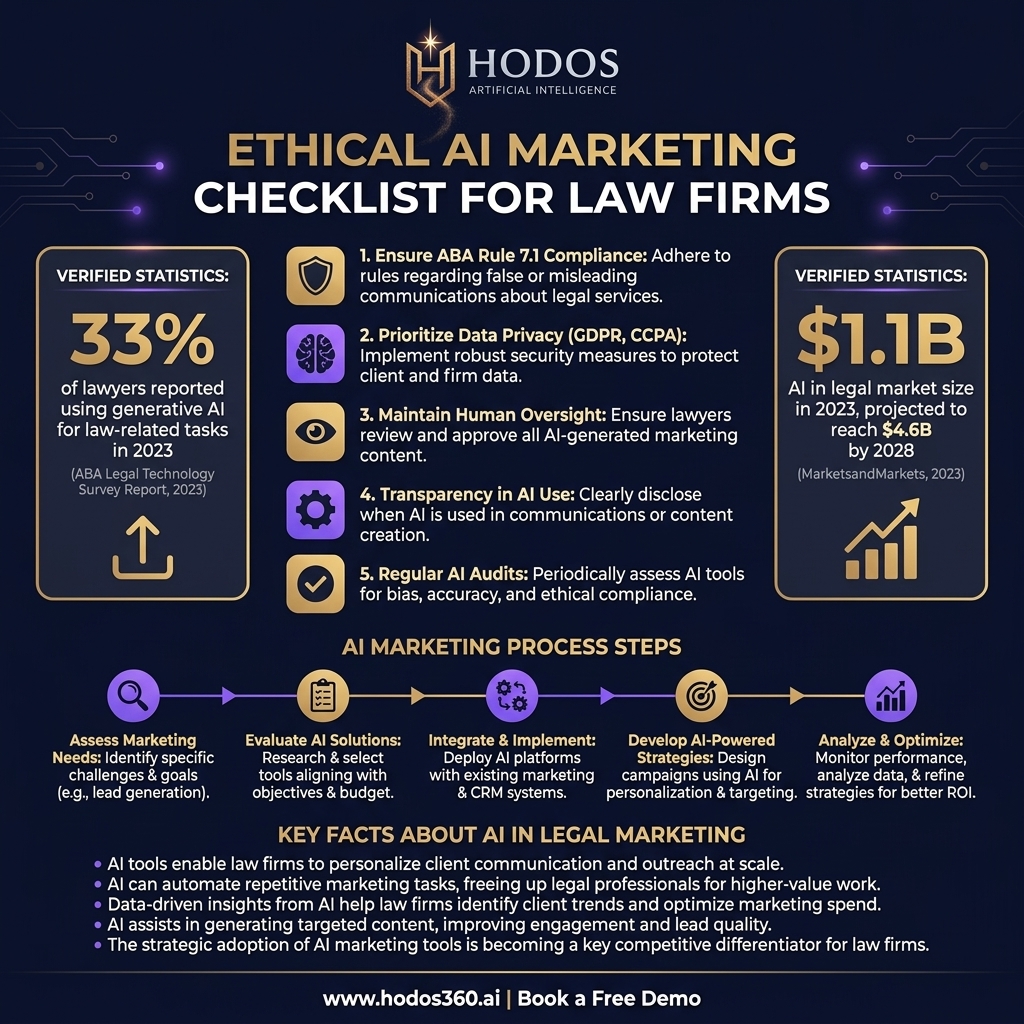
This rule extends to AI-generated content and automated marketing messages, requiring firms to ensure transparency and accuracy. The European Union's AI Act, enacted in early 2024, sets a global precedent for regulating AI, classifying systems by risk and imposing stringent requirements for high-risk applications. While legal marketing AI might not always fall into the 'high-risk' category, its principles of transparency, fairness, and human oversight are universally applicable and crucial for maintaining public trust and professional integrity.
The rapid advancements from companies like Google and Meta in AI-driven advertising also necessitate a vigilant approach to compliance, ensuring that firm marketing practices do not inadvertently cross ethical lines.
Another significant ethical consideration is data privacy. AI marketing tools often rely on collecting and analyzing vast amounts of personal data to personalize content and target audiences.
Law firms must ensure compliance with regulations like GDPR, CCPA, and evolving state-specific privacy laws. Misuse or inadequate protection of client data, even in a marketing context, can lead to severe reputational damage and legal penalties. Learn more about AI Studio Update: Essential Web App Creation for Law Firms.
Firms must implement robust data governance policies, conduct regular privacy impact assessments for their AI tools, and ensure that client consent is explicitly obtained where necessary. The tension between leveraging data for marketing efficacy and safeguarding client privacy is a critical area that requires ongoing attention and responsible innovation.
The rivalry between major AI developers, such as OpenAI and Anthropic, often centers on ethical AI development, highlighting the industry's focus on responsible deployment.
Looking ahead, the future of AI marketing in law firms promises even more sophisticated capabilities. We can anticipate hyper-personalization, where AI creates truly unique client experiences tailored to individual needs and preferences, potentially even generating synthetic media (like AI-created video testimonials with consent) for marketing purposes.
The rise of AI-driven legal marketplaces could also redefine how clients find and engage with legal services, creating new avenues for firms to attract business. Furthermore, AI's integration with virtual and augmented reality could lead to immersive client consultations and interactive marketing materials. However, these advancements will undoubtedly bring new ethical challenges, demanding that law firms stay abreast of technological developments, regulatory changes, and best practices in responsible AI deployment.
Continuous education and strategic partnerships with legal tech providers like HODOS 360 will be essential for navigating this evolving frontier.
Building Your AI Marketing Powerhouse: A Strategic Roadmap
For law firms looking to integrate AI marketing tools and turbocharge their growth flywheel, a strategic, phased approach is key. The journey doesn't require an immediate, wholesale overhaul but rather a series of deliberate steps designed to build momentum and demonstrate tangible ROI. First, begin with an audit of your current marketing efforts: identify pain points, areas of inefficiency, and opportunities for automation.
This initial assessment will help pinpoint where AI can deliver the most immediate impact, whether it's in content generation, lead qualification, or social media management. Many firms find success by starting with pilot programs in specific practice areas or with particular marketing channels, allowing them to test, learn, and refine their approach before broader implementation.
This agile methodology minimizes risk and builds internal confidence in the technology.
Next, invest in the right technology and talent. While off-the-shelf AI tools are abundant, an integrated platform designed for legal professionals, such as the HODOS 360 AI Marketing Platform, offers a distinct advantage.
Its comprehensive suite of services ensures seamless data flow and consistent branding across all marketing touchpoints. Simultaneously, focus on upskilling your existing marketing team and attorneys. Learn more about AI Legal Research: The Ultimate Evolution of Legal Analysis. Training programs on AI literacy, prompt engineering for content creation, and data interpretation are crucial.
The goal isn't to replace human talent but to augment it, empowering your team to leverage these powerful AI Marketing Tools effectively. As Harvey AI's partnership with Allen & Overy demonstrated with their AI-powered legal research, successful AI adoption is a collaborative effort between technology and human expertise.
Finally, foster a culture of continuous improvement and data-driven decision-making. The legal landscape is constantly evolving, and so too are AI capabilities. Regularly review your marketing performance using AI-powered analytics, solicit client feedback, and adapt your strategies accordingly. This iterative process ensures that your marketing flywheel not only spins but gains speed, delivering sustained growth and competitive advantage.
By embracing these AI Marketing Tools, law firms can move beyond generic marketing to a precision-engineered strategy that attracts, engages, and delights clients, securing their position at the forefront of the legal industry. The future of legal marketing is here, and it's powered by intelligent automation, strategic insights, and an unwavering commitment to client success.

Key Takeaways and Next Steps
The legal industry stands at a pivotal moment, where the strategic adoption of AI marketing tools is no longer a luxury but a necessity for sustained growth and competitive differentiation. By reimagining the traditional marketing funnel as a dynamic, AI-turbocharged flywheel, law firms can create a self-perpetuating cycle of client attraction, engagement, and advocacy.
From AI-powered content generation and SEO mastery to automated client engagement and sophisticated ROI tracking, the capabilities of modern AI marketing platforms offer an unprecedented advantage. Ethical considerations, particularly around data privacy and compliance with professional rules like ABA Model Rule 7.1, must remain at the forefront of any implementation strategy, ensuring responsible and trustworthy AI deployment.
The firms that proactively embrace these technologies, understand their ethical implications, and invest in both the tools and the training will be the ones that thrive in the coming decades.
Your firm's next steps should involve a thorough assessment of your current marketing infrastructure, identifying key areas where AI can deliver immediate and measurable impact.
Learn more about AI Adoption: The Essential Shift for Modern Law Firms. Consider piloting integrated solutions that offer a holistic approach to marketing automation and analytics. Prioritize platforms that are designed with the unique needs of law firms in mind, ensuring compliance and seamless integration with existing systems.
Investing in AI marketing is not just about adopting new technology; it's about making a strategic commitment to innovation, efficiency, and client-centric growth. By doing so, you will not only turbocharge your marketing flywheel but also solidify your firm's position as a forward-thinking leader in the legal profession.
Frequently Asked Questions
What are AI marketing tools for law firms?+
AI marketing tools for law firms are advanced software solutions that leverage artificial intelligence to automate, optimize, and personalize marketing efforts. This includes AI for content creation, SEO optimization, social media management, lead qualification, client communication, and performance analytics. These tools aim to increase efficiency, enhance client engagement, and provide data-driven insights to improve marketing ROI.
How can AI turbocharge a law firm's marketing flywheel?+
AI turbocharges a law firm's marketing flywheel by enhancing each stage: Attract, Engage, and Delight. It attracts clients through optimized content and SEO, engages them with personalized communication and automated lead nurturing, and delights them through efficient service delivery and feedback loops. This creates a self-sustaining cycle where satisfied clients become advocates, driving referrals and repeat business more effectively.
What are the ethical considerations when using AI in legal marketing?+
Ethical considerations include ensuring compliance with professional conduct rules like ABA Model Rule 7.1 regarding truthful communication, safeguarding client data privacy (e.g., GDPR, CCPA), and avoiding bias in AI-generated content or targeting. Transparency about AI use, maintaining human oversight, and ensuring the accuracy of information are crucial to uphold professional integrity and client trust.
Can AI marketing tools help with SEO for law firm websites?+
Absolutely. AI marketing tools are highly effective for SEO. They can conduct advanced keyword research, analyze competitor strategies, optimize website content for higher search rankings, and even generate SEO-friendly blog posts and articles. This ensures that your law firm's expertise is easily discoverable by potential clients actively searching for legal services online, significantly boosting organic traffic.
How does AI track the ROI of marketing campaigns for law firms?+
AI tracks ROI by integrating data from various marketing channels (website, social media, email, CRM) and attributing specific marketing activities to client conversions and revenue. It analyzes interactions, lead sources, and client journeys to determine which campaigns are most effective. This data-driven approach allows firms to optimize their marketing spend, focus on high-performing strategies, and accurately measure the financial return on their investment.