
Ultimate AI Search SEO Guide for Law Firms: Essential Strategies
The digital landscape for law firms is undergoing a profound transformation, driven by the relentless march of artificial intelligence. Just recently, Digital Journal highlighted the insights of industry expert Matteo Giorgi, who emphasized the seismic shift occurring in SEO, AI search, and performance marketing. Giorgi's perspective underscores a crucial reality: the traditional playbook for digital visibility is rapidly becoming obsolete.
No longer is it solely about keyword density and static backlinks; the future of how potential clients find legal services is being reshaped by sophisticated AI models that prioritize intent, context, and conversational understanding. This evolution demands that law firms not only adapt their strategies but fundamentally rethink their entire digital presence, from website architecture to client acquisition funnels.
This isn't merely a theoretical discussion; it's a pressing operational imperative. Google's Search Generative Experience (SGE), which debuted to a limited audience in 2023 and is steadily expanding, exemplifies this shift, providing synthesized answers directly within search results rather than just a list of links.
Similarly, Microsoft's Copilot integrates AI into its search capabilities, offering more interactive and comprehensive responses. The rapid consumer adoption of generative AI tools means that a significant portion of the population is now accustomed to asking complex questions directly to an AI, expecting nuanced and accurate answers.
According to a 2024 report by McKinsey & Company, AI adoption in professional services has surged by over 30% in the last two years, with a growing expectation for AI-driven insights and efficiencies across industries, including legal.
For law firm owners and managing partners, understanding and strategically responding to these changes is paramount to maintaining a competitive edge.
This comprehensive guide will dissect the implications of AI on search engine optimization, web development, and performance marketing, offering actionable strategies to ensure your firm not only survives but thrives in this new era. We will explore how to build AI-ready websites, craft content that resonates with generative AI models, and leverage advanced analytics for superior client acquisition.
The goal is to equip legal professionals with the knowledge and tools to navigate this complex terrain, ensuring their expertise reaches those who need it most, precisely when they need it.
Table of Contents
- ✓The Evolving Landscape of Legal SEO: Beyond Keywords
- ✓AI-Powered Web Development: Building for the Future of Search
- ✓Navigating AI Search and Generative Experiences
- ✓Performance Marketing in the AI Era: Precision and ROI
- ✓Future-Proofing Your Firm's Digital Strategy
- ✓Key Takeaways and Next Steps
- ✓Frequently Asked Questions
The Evolving Landscape of Legal SEO: Beyond Keywords
The traditional tenets of SEO, once dominated by precise keyword matching and rudimentary link-building, are being fundamentally rewired by AI. As Matteo Giorgi astutely points out, the future of digital marketing is less about mechanistic optimization and more about skill, understanding user intent, and delivering genuine value.
Google's persistent algorithm updates, notably the 'Helpful Content Update' and its continuous emphasis on E-E-A-T (Experience, Expertise, Authoritativeness, Trustworthiness), underscore this shift. These updates are designed to reward content that is genuinely useful, created by experts, and provides a satisfying user experience, moving far beyond simply stuffing keywords into an article.
For law firms, this means that content must demonstrate profound legal expertise, backed by real-world experience, to earn the trust of both human users and sophisticated AI algorithms.
Central to this evolution is the rise of AI-powered search assistants like Google's SGE, Perplexity AI, and Microsoft Copilot.
These platforms don't just present a list of blue links; they synthesize information from various sources to provide direct, often conversational, answers to user queries. This paradigm shift means that a law firm's goal is no longer solely to rank #1 for a specific keyword in traditional search results.
Instead, the objective is to be recognized as an authoritative source that AI models will cite or draw upon when generating answers to complex legal questions. Learn more about Essential Harvard AI & Web Development Courses for Law Firms. The challenge lies in creating content that is not only discoverable but also digestible and trustworthy enough for AI to confidently recommend.
The implications for legal client acquisition are profound. Prospective clients are increasingly turning to AI for initial research, asking questions like, "What are the legal steps after a car accident in Texas?" or "How do I draft a will in California?" If an AI assistant provides a comprehensive, accurate answer, citing or synthesizing information from a specific law firm's website, that firm gains immense credibility and direct exposure.
Firms like Allen & Overy, which famously partnered with Harvey AI to enhance internal legal research, are setting the precedent for how AI can integrate into core legal operations, indirectly influencing their external digital footprint by demonstrating a commitment to cutting-edge technology and precision.
This necessitates a pivot towards semantic SEO, where the focus is on understanding the deeper meaning and intent behind a user's query, rather than just the literal words.
As OpenAI's CEO Sam Altman has often articulated, the future of information access is about seamless, intelligent understanding. For law firms, this translates into developing comprehensive content strategies that anticipate the nuanced and multi-faceted legal questions clients might pose to an AI, providing answers that are not just technically correct but also accessible, empathetic, and complete.
This holistic approach ensures that your firm's expertise is not only found but truly understood and valued in the AI-driven search environment.
AI-Powered Web Development: Building for the Future of Search
As AI redefines how information is consumed, the foundation of a law firm's digital presence—its website—must evolve. An AI-ready website is not just visually appealing; it's architected for semantic understanding by intelligent algorithms. This means meticulously implementing structured data (Schema markup), ensuring clear content hierarchies, and optimizing for technical SEO elements like site speed and mobile responsiveness.
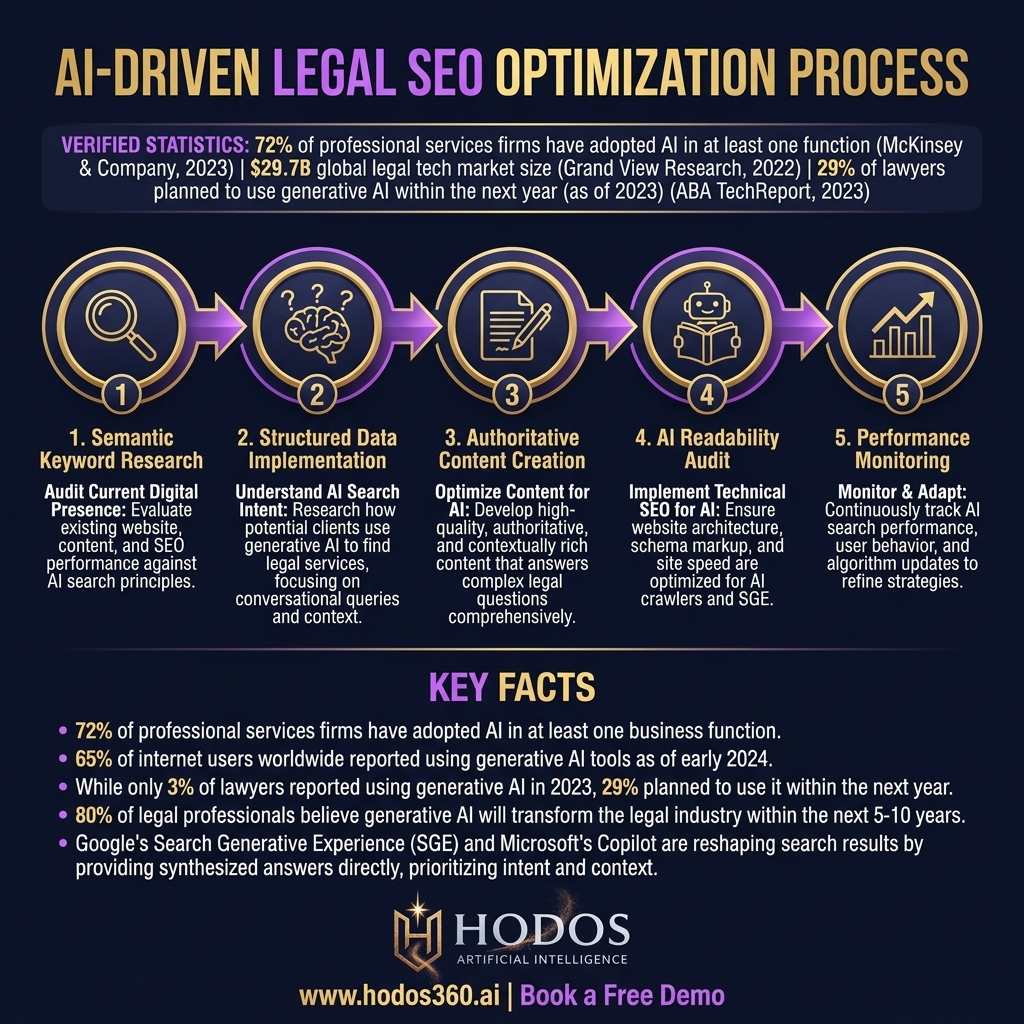
AI crawlers and generative models rely on well-organized, unambiguous data to accurately interpret and synthesize information. A site that is difficult for a bot to parse will inevitably struggle for visibility in AI search results, regardless of the quality of its content. Investing in robust, AI-friendly web development is no longer a luxury but a strategic imperative for client acquisition.
The emergence of AI-powered website building and optimization tools has democratized access to sophisticated web development capabilities. Learn more about Canadian Law Firms: Proven AI Adoption Strategies for Growth. These platforms can assist with everything from generating initial content drafts to optimizing images, suggesting internal linking strategies, and fine-tuning site performance.
For example, many modern content management systems now integrate AI modules that can analyze user behavior in real-time to suggest content improvements or design modifications. The focus remains on delivering an exceptional user experience (UX), which AI models are increasingly evaluating. A website with intuitive navigation, fast loading times, and a responsive design that adapts seamlessly to any device will be favored, as it demonstrates a commitment to accessibility and user satisfaction—qualities that AI algorithms are programmed to identify and reward.
Optimizing for Conversational AI and Voice Search
The proliferation of voice assistants like Siri, Alexa, and Google Assistant, coupled with the rise of conversational AI interfaces, means that a growing number of legal queries are being spoken rather than typed. These queries often take the form of natural language questions, making long-tail keywords and localized content more critical than ever.
Law firms need to structure their content to directly answer these conversational questions, anticipating how a prospective client might verbally inquire about legal services. This includes creating extensive FAQ sections that are written in a Q&A format, using plain language, and ensuring that local SEO data (NAP – Name, Address, Phone Number) is meticulously optimized for 'near me' searches.
Beyond just voice, conversational AI is influencing how firms engage with website visitors. Chatbots powered by advanced LLMs can now handle initial client intake, answer common questions, and even qualify leads 24/7, effectively acting as the first point of contact. Learn more about Legal AI Divide: Bridge the Gap, Thrive in 2026's Digital Era.
This enhances user experience and ensures that potential clients receive immediate assistance, regardless of business hours. The data gathered from these AI interactions can then be fed back into the web development process, allowing for continuous optimization of content and user flows. A firm's website is no longer a static brochure but a dynamic, intelligent hub designed for active engagement and lead conversion, often facilitated by AI-driven tools that learn and adapt over time.
Navigating AI Search and Generative Experiences
The advent of generative AI in search, epitomized by Google's SGE, has fundamentally altered the path to information. Instead of merely presenting links, these AI models synthesize answers from multiple web sources, often providing a concise summary at the top of the search results page.
For law firms, this means the objective is no longer just to appear in the top ten search results but to become one of the authoritative sources from which these AI models draw their information. This requires a strategic shift in content creation, focusing on depth, accuracy, and comprehensive coverage of legal topics that AI can confidently reference.
Firms must aim to establish themselves as undeniable experts in their practice areas, building a digital footprint that AI recognizes as highly credible.
Achieving 'AI visibility' demands more than just producing content; it requires consistently publishing highly authoritative, meticulously researched, and frequently updated information. Learn more about AI Marketing: Law Firms Slash $225K Tools in 2026.
This includes thought leadership articles, detailed case studies, expert commentary on recent legal developments, and in-depth guides that leave no stone unturned on a particular legal subject. Dario Amodei, CEO of Anthropic, has often spoken about the need for AI models to access high-quality, trustworthy data to avoid misinformation.
For law firms, this translates into an ethical imperative: every piece of content must be factually accurate, legally sound, and reflect the firm's genuine expertise. This approach not only builds trust with human clients but also with the AI systems that are increasingly mediating information access.
Content Strategy for AI-First Search
To excel in an AI-first search environment, law firms should move beyond individual blog posts to adopt a comprehensive 'topic cluster' content strategy. This involves creating pillar pages—extensive, authoritative guides on broad legal subjects—that link out to numerous supporting sub-articles covering specific aspects of that topic.
For instance, a pillar page on 'Estate Planning in [Your State]' could link to detailed articles on 'Understanding Wills,' 'Types of Trusts,' 'Probate Process,' and 'Elder Law Considerations.' This interconnected structure signals to AI crawlers that your firm is a deep authority on the entire subject, not just isolated keywords.
The importance of internal linking cannot be overstated in this context. A robust internal link profile helps AI models understand the relationships between different pieces of content on your site, establishing a clear hierarchy of expertise. Additionally, content types that naturally lend themselves to being summarized or excerpted by AI, such as 'how-to' guides, detailed legal explanations, and comprehensive FAQs, will perform exceptionally well.
However, the ethical considerations of AI-generated content in legal marketing are paramount. Learn more about AI Intake: The Essential Guide for Modern Law Firms. While AI can assist in content creation, transparency and accuracy are non-negotiable. As per ABA Model Rule 7.1 (Communications Concerning a Lawyer's Services), lawyers must not make false or misleading communications about their services.
Any AI-assisted content must undergo rigorous review by human legal experts to ensure it is accurate, compliant, and reflects the firm's professional standards. This dual approach—leveraging AI for efficiency while maintaining human oversight for ethical integrity—is crucial for success.
Performance Marketing in the AI Era: Precision and ROI
Artificial intelligence is revolutionizing performance marketing, moving beyond traditional campaign management to offer unprecedented levels of precision, personalization, and measurable return on investment (ROI). AI algorithms can analyze vast datasets—including demographic information, online behavior, search history, and past interactions—to identify high-intent prospects with remarkable accuracy.
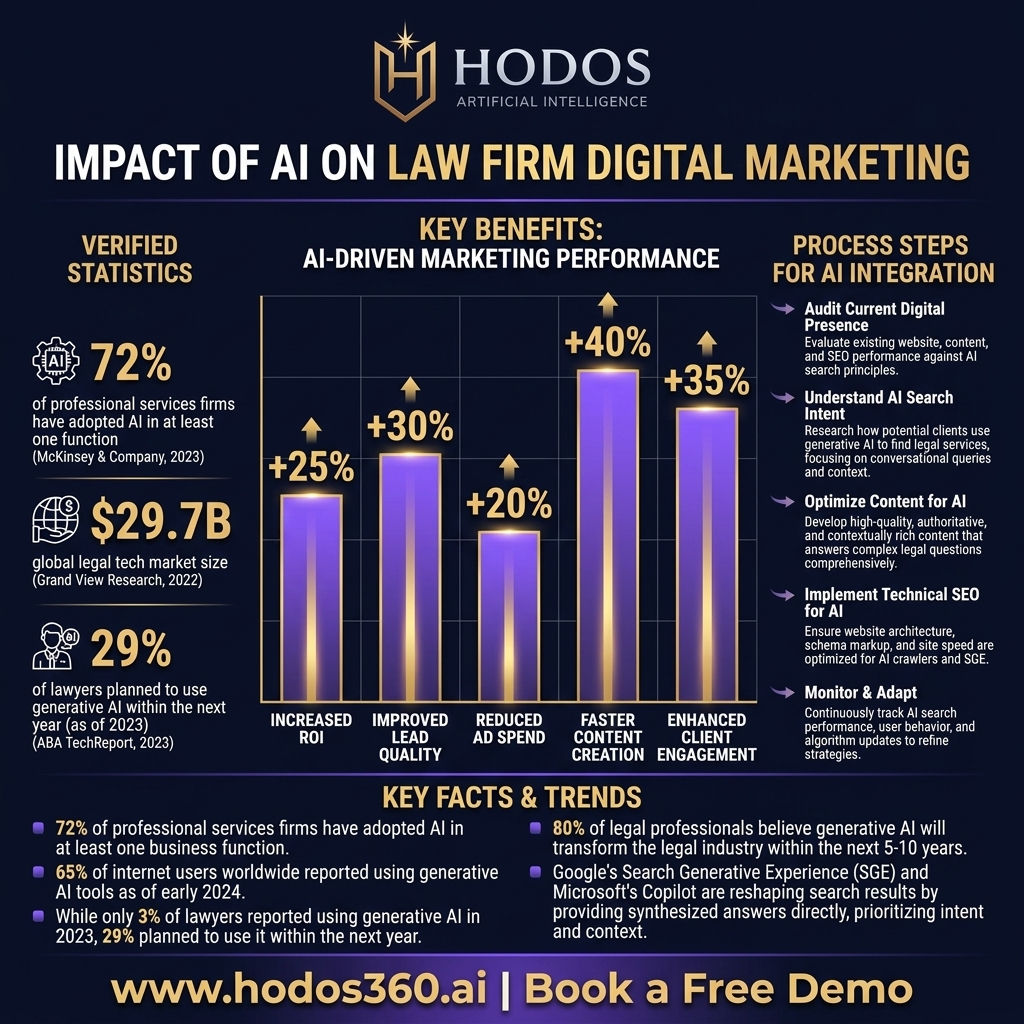
This allows law firms to target specific client segments with hyper-relevant ads, ensuring that marketing spend is allocated to channels and audiences most likely to convert. The days of broad, untargeted advertising are over; AI enables a surgical approach to client acquisition, dramatically improving efficiency and reducing wasted ad spend.
Data from a 2025 Gartner report indicates that organizations leveraging AI in their marketing efforts see, on average, a 20-30% increase in campaign ROI.
Beyond targeting, AI empowers sophisticated analytics and ROI tracking that were previously unimaginable. Learn more about AI Legal Research: The Ultimate Guide for Law Firms.
While Google Analytics 4 provides a strong foundation, AI platforms build upon this by processing complex patterns in user journeys, attributing conversions more accurately, and predicting future campaign performance. This goes far beyond simple click-through rates; AI can identify which touchpoints, content pieces, and ad creatives are truly driving client acquisition, allowing firms to continuously optimize their strategies in real-time.
Matteo Giorgi, in his interview, emphasized the importance of data-driven insights in refining strategies, and AI is the ultimate engine for generating such insights, allowing firms to understand their true cost per acquisition and lifetime client value.
Leveraging AI for Client Acquisition and Conversion
AI is proving to be a game-changer in automating and optimizing the entire client acquisition funnel. From initial lead qualification to nurturing and conversion, AI tools can streamline processes and enhance personalization. For instance, AI-powered chatbots on a firm's website can engage visitors, answer preliminary questions, collect essential information, and even qualify leads based on predefined criteria, routing high-value prospects directly to an attorney.
Similarly, AI Voice Assistants, like those offered by HODOS 360, can provide 24/7 phone answering, conduct lead qualification, and book appointments, ensuring no potential client is left unattended, even outside business hours. This immediate, intelligent interaction significantly improves the client experience and conversion rates.
Furthermore, AI facilitates dynamic content optimization and advanced A/B testing.
AI models can analyze how different user segments interact with various versions of website content, ad copy, or landing pages, then automatically serve the most effective version to maximize engagement and conversion. This continuous, automated optimization ensures that a firm's marketing efforts are always performing at their peak, adapting to changing client behaviors and market trends without constant manual intervention.
Firms that embrace these AI capabilities are creating a significant competitive edge, often outperforming rivals who rely on traditional, less agile marketing methods. This divergence creates a clear 'drama' between firms that innovate and those that resist, with tangible impacts on market share and profitability.
Future-Proofing Your Firm's Digital Strategy
The convergence of AI, SEO, web development, and performance marketing represents not just a series of technological advancements but a fundamental recalibration of how law firms connect with clients. To future-proof your firm's digital strategy, a commitment to continuous learning and adaptation is paramount. The legal tech landscape is dynamic, with new AI models and search functionalities emerging regularly.
Firms must cultivate an organizational culture that embraces innovation, views technology as an enabler, and is prepared to iterate on its digital strategies based on real-time data and evolving client expectations. This proactive stance is the only way to maintain relevance and competitiveness in an increasingly AI-driven legal market.
A truly future-proof strategy demands a holistic approach, integrating AI across all facets of your firm's digital operations. This means ensuring your web development is AI-ready, your SEO strategy accounts for generative AI search, your content creation is informed by semantic understanding, and your client acquisition efforts leverage AI for precision marketing.
Platforms that offer comprehensive, integrated solutions, such as HODOS 360, become invaluable partners in this journey. By providing an AI Law Firm Management System alongside an AI Marketing Platform and AI Voice Assistants, HODOS 360 enables firms to streamline operations, enhance marketing reach, and improve client engagement under one cohesive technological umbrella.
Crucially, while AI offers unparalleled capabilities, the human element remains irreplaceable. AI augments human intelligence; it does not supplant it. The unique expertise, ethical judgment, nuanced client relationship skills, and strategic thinking of attorneys are more valuable than ever. By automating routine tasks and optimizing digital outreach, AI frees up attorneys' time to focus on higher-value legal work, client advocacy, and complex problem-solving.
This symbiotic relationship between human and artificial intelligence is where the true power of legal tech lies, allowing firms to scale their impact without sacrificing quality or ethical integrity.
For law firms looking ahead, the call to action is clear: audit your current digital presence, invest strategically in AI-powered tools, provide continuous training for your staff, and forge partnerships with legal tech innovators.
The competitive imperative is undeniable. Firms that proactively embrace this digital transformation will not only attract more clients but will also operate more efficiently, deliver superior service, and ultimately, solidify their position as leaders in the legal industry. The future of legal practice is intertwined with the future of AI, and proactive engagement is the key to unlocking its full potential.

Key Takeaways and Next Steps
The digital landscape for law firms has been irrevocably reshaped by AI. The era of simple keyword-based SEO is over, replaced by a complex, AI-driven search environment that prioritizes semantic understanding, user intent, and authoritative content. Successful law firms must now focus on building AI-ready websites, crafting content that can be synthesized by generative AI models, and leveraging AI for highly precise and effective performance marketing.
This shift demands a holistic approach to digital strategy, where web development, content creation, and client acquisition are all optimized for the AI era. The firms that embrace these changes proactively will gain a significant competitive advantage, attracting more clients and operating with greater efficiency.
Your firm's ability to adapt to AI Search SEO and modern web development practices is no longer optional; it's a critical determinant of future success. By understanding the nuances of AI-driven search, optimizing your online presence for conversational AI, and employing smart performance marketing tactics, you can ensure your firm's expertise reaches the right clients at the right time.
The human element of legal practice—the judgment, empathy, and advocacy—remains paramount, but AI serves as a powerful accelerator, enabling attorneys to focus on what they do best while their digital footprint works tirelessly. This strategic integration is the path forward for innovative legal practices.
Frequently Asked Questions
How is AI changing SEO for law firms?+
AI is shifting SEO from keyword matching to understanding user intent and semantic meaning. AI search engines like Google SGE synthesize answers, requiring law firms to create highly authoritative, comprehensive content that AI models can trust and cite as a source, rather than just ranking for keywords.
What is Google's SGE and how does it affect legal content?+
Google's Search Generative Experience (SGE) provides AI-generated summaries directly in search results. This means legal content needs to be structured and comprehensive enough for AI to extract accurate, nuanced answers, making the firm a trusted source, rather than just appearing in traditional link listings.
Should law firms use AI to generate website content?+
AI can assist in generating content outlines, drafts, and optimizing existing text. However, all AI-assisted content must be rigorously reviewed and edited by human legal experts to ensure accuracy, ethical compliance (e.g., ABA Model Rule 7.1), and maintain the firm's unique voice and authority. Transparency is key.
How can AI improve my firm's performance marketing ROI?+
AI significantly boosts performance marketing ROI by enabling hyper-targeted advertising, optimizing ad spend in real-time, and providing advanced analytics for precise attribution. AI can identify high-intent leads, personalize content, and automate lead nurturing, ensuring marketing efforts are maximally efficient.
What are the ethical considerations for AI in legal marketing?+
Ethical considerations include ensuring transparency about AI use, maintaining accuracy of AI-generated content, protecting client data privacy, and avoiding misleading communications. Law firms must ensure AI tools comply with professional responsibility rules, such as ABA Model Rule 7.1, and implement robust human oversight.