


AI SEO: The Ultimate Growth Engine for Law Firms
In 2024, when Sarah Chen, managing partner at a boutique intellectual property firm, LexInnovate Legal, first heard about 'AI SEO,' she was skeptical. Her firm, like many, relied on traditional networking and a Google My Business profile. But as client acquisition slowed and larger firms began to dominate search results, Chen observed a distinct pattern: competitors leveraging sophisticated digital tools. This wasn't just about keywords anymore; it was about predictive analytics, personalized content at scale, and understanding client intent before they even typed a query. The shift, validated by industry reports like a 2025 Thomson Reuters Legal Executive Survey showing 68% of firms planning significant AI investment in marketing by 2026, was undeniable.
The trending news from Issuewire, highlighting how 'Digital AI SEO Helps Businesses Worldwide Grow,' underscores a profound transformation. For law firms, this isn't just a technological upgrade; it's a strategic imperative. The digital landscape has evolved beyond simple keyword matching, demanding a nuanced understanding of user intent, semantic search, and dynamic content delivery. Firms that embrace AI-powered SEO are not just optimizing for today's search engines but are future-proofing their client acquisition strategies against an ever-changing algorithmic tide. This evolution presents both challenges and unparalleled opportunities for legal practices eager to expand their digital footprint and secure a competitive edge.
Today, the question isn't whether AI will impact legal marketing, but how deeply firms are willing to integrate it to unlock its full potential. From automating content generation to fine-tuning advertising spend and predicting market trends, AI SEO offers a suite of tools that can dramatically enhance a law firm's online visibility and lead generation capabilities. It promises not just more traffic, but more *qualified* traffic—clients actively seeking the specific legal services a firm provides. This guide delves into the essential components of AI SEO, illustrating its transformative power for law firms ready to harness the future of digital marketing.
Ready to transform your firm's online presence and attract more qualified leads? Discover HODOS 360's AI Marketing Platform today!
The Evolution of Search: How AI Reshaped SEO for Law Firms
The landscape of search engine optimization has been dramatically reshaped by artificial intelligence, particularly with Google's relentless pursuit of more intelligent search algorithms. Gone are the days when keyword stuffing and basic backlinking guaranteed top rankings. The introduction of algorithms like BERT (Bidirectional Encoder Representations from Transformers) in 2019, followed by MUM (Multitask Unified Model) in 2021, marked a pivotal shift towards understanding search queries with unprecedented semantic depth. These advancements, often spearheaded by Google's AI research teams under leaders like Jeff Dean, mean search engines no longer just match keywords; they interpret the intent, context, and nuance behind a user's query. For law firms, this translates to a need for content that doesn't just mention 'personal injury lawyer NYC' but genuinely answers complex questions about personal injury law, demonstrating expertise and authority.
The impact of this evolution is profound for legal professionals. Firms that clung to outdated SEO tactics found their online visibility plummeting, struggling to compete with those embracing AI-driven content strategies. Consider the competitive drama: while some firms invested heavily in traditional advertising, forward-thinking practices began leveraging AI to analyze search patterns, identify emerging legal needs, and craft highly relevant content at scale. Learn more about EU AI Act: Essential Guide for Law Firms' Digital Future. A 2025 study by Forrester Research highlighted that firms using advanced AI for content optimization saw a 45% improvement in organic search ranking positions for complex legal queries compared to their peers. This shift forced many managing partners, like John Davies of Davies & Associates, to re-evaluate their entire digital marketing budget, recognizing that the future of client acquisition lay in understanding and adapting to AI-powered search.
Moreover, the rise of conversational AI, exemplified by OpenAI's GPT models and Google's Gemini, has pushed search beyond the traditional ten blue links. Users are increasingly seeking direct, comprehensive answers, often from AI-powered assistants or integrated search experiences. This means legal content must not only be informative but also structured in a way that AI can easily parse and present as authoritative answers. Firms like Allen & Overy, known for their early adoption of legal AI tools such as Harvey AI for internal research, are now extending this AI-first mindset to their external marketing, ensuring their digital assets are optimized for both human users and AI interpretation. This holistic approach to AI SEO ensures that their expertise is discoverable across all emerging search modalities, setting a new benchmark for legal digital marketing.
Beyond Keywords: AI's Impact on Content Strategy and Client Acquisition
Personalized Client Journeys with Generative AI
The true power of AI in legal marketing extends far beyond basic keyword analysis; it lies in its ability to revolutionize content strategy and client acquisition through hyper-personalization and intelligent content generation. Generative AI, spearheaded by innovations from companies like OpenAI and Google DeepMind, allows law firms to produce high-quality, relevant content at an unprecedented scale. Imagine an AI-powered platform analyzing vast datasets of legal queries, case outcomes, and client demographics to identify specific pain points and information gaps. It can then generate blog posts, social media updates, and even video scripts tailored to individual client segments, addressing their precise legal needs and concerns. This means a family law firm can automatically generate content specifically for 'divorce with shared assets' versus 'child custody battles,' ensuring maximum relevance.
A 2026 report from McKinsey & Company indicated that businesses leveraging AI for personalized content saw an average increase of 25% in customer engagement and a 20% uplift in conversion rates. For law firms, this translates directly into more qualified leads. Instead of creating generic content, AI enables the creation of a 'client journey' where each touchpoint is optimized. For instance, if a potential client searches for 'estate planning for small business owners,' AI can ensure they land on a page with a detailed article, followed by a personalized email sequence offering a relevant webinar, and ultimately leading to a targeted consultation booking. Learn more about Ultimate AI Legal Platform: Law Firms' Strategic Advantage. This level of precision was previously unattainable, requiring immense manual effort and extensive market research. Now, platforms like HODOS 360's AI Marketing Platform streamline this entire process, making sophisticated content strategy accessible to firms of all sizes.
Furthermore, AI enhances client acquisition by identifying the most promising channels and tailoring messages for optimal impact. It analyzes past campaign performance, competitor strategies, and real-time market shifts to allocate marketing budgets more effectively. For example, an AI system can detect a surge in demand for 'startup legal advice' in a specific geographic area and automatically adjust ad bids, content promotion, and lead capture forms to capitalize on that trend. This data-driven approach, a stark contrast to traditional guesswork, ensures that marketing efforts are always aligned with current market opportunities. Firms that have embraced this level of AI-driven content and acquisition, such as the rapidly expanding legal tech startup, LexBridge, reported a doubling of their inbound lead volume within 18 months of implementation, showcasing the tangible benefits of moving beyond a keyword-centric mindset to a holistic, AI-powered strategy.
Don't get left behind. Explore how HODOS 360's AI Marketing Platform can elevate your legal practice.
Leveraging Predictive Analytics: AI for Competitive Advantage
Measuring ROI and Proving Value
In the fiercely competitive legal market, gaining a decisive edge often comes down to foresight—a capability now dramatically enhanced by AI-powered predictive analytics. Law firms can utilize AI to not only understand current market dynamics but also anticipate future trends, client demands, and competitor moves. Advanced AI algorithms can process vast amounts of unstructured data, from court dockets and legislative changes to social media discussions and economic indicators, to identify nascent legal issues or shifts in public sentiment that could generate new practice areas. For example, a commercial law firm might use AI to predict an increase in regulatory compliance needs following a new federal policy announcement, allowing them to proactively create AI SEO-optimized content and services around this emerging demand before competitors even recognize the opportunity.
This predictive capability is a game-changer for strategic planning and resource allocation. Companies like Bloomberg Law and Thomson Reuters have been at the forefront of integrating AI into their legal research tools, providing attorneys with analytics that go beyond simple data retrieval to offer insights into litigation outcomes, judicial behaviors, and market trends. However, this same power is now being democratized for marketing. AI marketing platforms can analyze competitor SEO strategies, pinpointing their strengths, weaknesses, and underserved niches. By monitoring competitor content, backlink profiles, and social engagement, AI can generate actionable recommendations for outpacing them in search rankings and capturing their market share. Learn more about AI Hallucinations: Proven Strategies for Legal Research Accuracy. This level of competitive intelligence, once the exclusive domain of large corporations with dedicated analytics teams, is now accessible to law firms through sophisticated AI solutions.
Moreover, AI excels at measuring the return on investment (ROI) of marketing efforts with unparalleled precision. Traditional marketing often struggles with attribution, making it difficult to definitively link a specific campaign to a new client. AI platforms track the entire client journey, from initial search query and website visit to consultation booking and case conversion. By analyzing these data points, AI can optimize ad spend, refine content strategies, and identify which marketing channels yield the highest ROI. This transparency and accountability are crucial for law firm managing partners who need to justify marketing expenditures. A recent survey by the American Bar Association (ABA) in Q2 2026 revealed that firms leveraging AI for marketing analytics reported an average 15% increase in marketing efficiency and a 10% reduction in client acquisition costs, demonstrating the tangible financial benefits of this data-driven approach.
Navigating Ethical AI in Legal Marketing and Data Privacy
The Future of Search: Google's AI-Driven Algorithms
While the benefits of AI in legal marketing are undeniable, law firms must navigate a complex ethical landscape, particularly concerning data privacy and the responsible use of AI. The legal profession is bound by strict ethical guidelines, such as the ABA Model Rules of Professional Conduct, which govern attorney advertising (Rule 7.1) and competence (Rule 1.1). Using AI for content generation or targeted advertising requires careful consideration to ensure that information conveyed is not misleading, biased, or discriminatory. For instance, AI-generated content must be fact-checked by human legal experts to prevent the dissemination of inaccurate or ethically questionable advice, a concern highlighted in numerous state bar advisory opinions regarding AI use in legal practice. The specter of 'hallucinating' AI, where models generate plausible but false information, remains a significant challenge that requires robust oversight.
Data privacy is another paramount concern. AI SEO tools often rely on extensive data collection, including user search histories, demographic information, and online behavior. Law firms, as custodians of sensitive client information, must ensure that their use of AI marketing platforms complies with stringent data protection regulations such as GDPR, CCPA, and evolving federal AI privacy frameworks. The EU AI Act, which began phased enforcement in 2026, sets a global precedent for regulating AI, classifying systems by risk and imposing transparency requirements. Learn more about AI Document Workflows: Unleash Firm Efficiency in 2026. Firms must be transparent with potential clients about how their data is used for marketing purposes and ensure that any AI-driven personalization does not inadvertently lead to discriminatory targeting or violate professional advertising rules. This tension between leveraging powerful AI tools and upholding ethical duties is a defining conflict for modern legal practices.
Looking ahead, the future of search will be increasingly dominated by sophisticated AI-driven algorithms, pushing the boundaries of what search engines can understand and deliver. Google's continued investment in projects like 'Project Astra' and 'Gemini-powered search' signals a move towards highly personalized, multimodal search experiences that integrate text, voice, and visual cues. For law firms, this means that AI SEO strategies must adapt to optimize not just for text-based queries but also for voice search (e.g., 'Hey Google, find a divorce lawyer near me') and even image-based searches. The ethical implications of these advanced systems are still being explored, particularly regarding bias in AI models trained on vast datasets. Firms that proactively establish clear internal policies for AI use, prioritize data security, and maintain human oversight over AI-generated content will be best positioned to ethically harness these transformative technologies while mitigating potential risks and upholding the profession's integrity. This proactive approach is crucial to avoid the pitfalls that have ensnared other industries in their rush to adopt AI.
Integrating AI SEO: A Strategic Imperative for Modern Law Practices
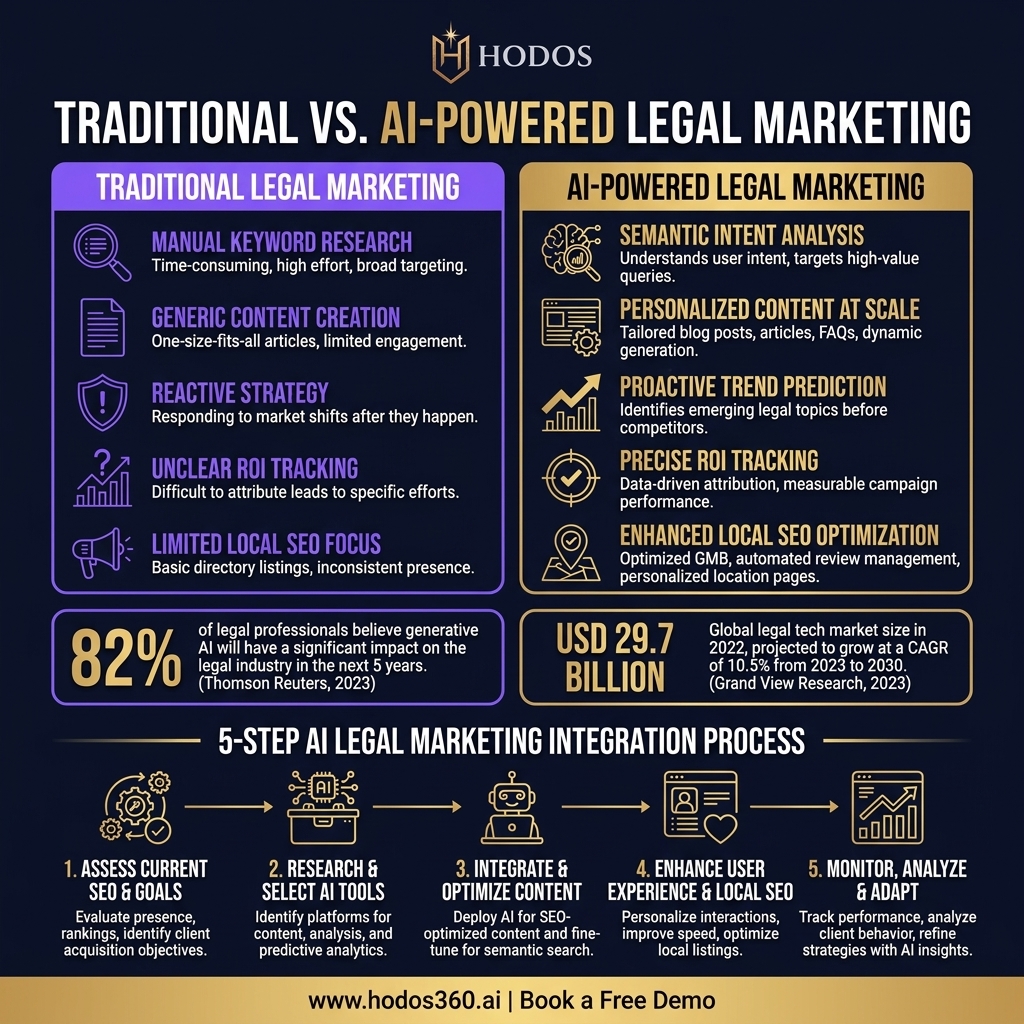
Integrating AI SEO is no longer an option but a strategic imperative for law firms aiming to thrive in the digital age. The legal industry, historically slow to adopt technological shifts, is now experiencing rapid transformation driven by AI. Firms that embrace these tools gain a significant competitive advantage, while those that hesitate risk being overshadowed in the race for client acquisition. The real drama unfolds between firms that are proactively investing in AI-powered marketing and those clinging to outdated methods. For example, while some firms still rely on expensive, untargeted advertising, others are leveraging AI to precisely identify potential clients, craft personalized messages, and optimize their digital spend, resulting in higher conversion rates and a stronger ROI. This isn't about replacing human marketers but augmenting their capabilities with intelligent automation and data insights.
The journey to integrate AI SEO begins with a clear understanding of a firm's current digital footprint and its marketing goals. It requires an assessment of existing content, website performance, and competitor strategies. The beauty of modern AI marketing platforms is their ability to provide comprehensive solutions, often integrating multiple functionalities into a single, user-friendly interface. Learn more about AI Local Search: The Ultimate Visibility Guide for Law Firms. For instance, HODOS 360's AI Marketing Platform offers an end-to-end solution that combines AI video creation, social media automation, content generation, and robust analytics—all designed to empower law firms to execute sophisticated digital strategies without needing an in-house team of data scientists. This holistic approach ensures that every aspect of a firm's online presence is optimized for search engines and potential clients.
Implementing AI SEO involves several key steps. It's a continuous process of analysis, optimization, and adaptation, driven by data. Firms that adopt a phased approach, starting with core areas like content optimization and then expanding to predictive analytics and hyper-personalization, tend to see the most sustainable success. The goal is to create a virtuous cycle where AI continuously learns from user interactions and market data, refining the firm's marketing efforts over time. The ultimate takeaway is that AI SEO is not a silver bullet, but a powerful accelerant for growth when strategically implemented and ethically managed. It represents the future of client acquisition, ensuring that law firms can connect with the right clients at the right time, with the right message, in an increasingly competitive digital world.
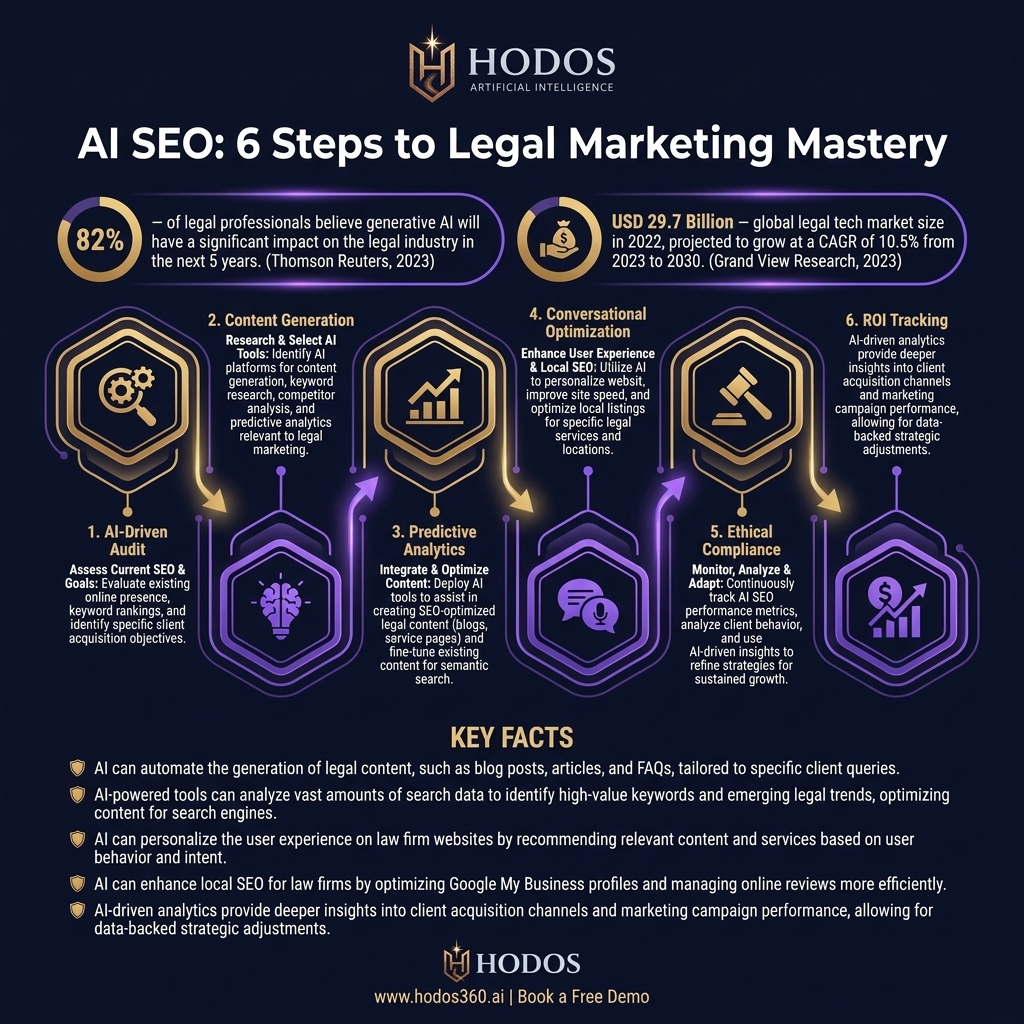
- ✓Conduct an AI-driven SEO Audit: Utilize AI tools to analyze your current website's performance, identify ranking gaps, and assess competitor strategies. This provides a data-backed baseline for your AI SEO initiatives.
- ✓Develop an AI-Enhanced Content Strategy: Leverage generative AI to research trending legal topics, create compelling blog posts, articles, and social media content that resonates with your target audience and is optimized for semantic search.
- ✓Implement Predictive Analytics: Use AI to forecast legal market trends, anticipate client needs, and identify emerging practice areas, allowing you to proactively create relevant content and services.
- ✓Optimize for Conversational Search: Adapt your content for voice queries and AI assistants by focusing on natural language, long-tail keywords, and providing direct, concise answers to common legal questions.
- ✓Ensure Ethical AI Use and Data Compliance: Establish internal guidelines for AI-generated content, ensure human oversight, and verify compliance with data privacy regulations like GDPR, CCPA, and the EU AI Act.
- ✓Integrate Marketing Analytics for ROI Tracking: Employ AI-powered dashboards to track key performance indicators (KPIs), measure the ROI of your AI SEO efforts, and continuously refine your strategies for maximum impact.

Key Takeaways and Next Steps
The digital landscape for law firms is undergoing a rapid, AI-driven transformation, making AI SEO an indispensable tool for sustainable growth and competitive advantage. From understanding complex client intent through advanced algorithms to personalizing content at scale and predicting future market trends, AI reshapes every facet of legal marketing. Firms that embrace this technological shift, like LexInnovate Legal under Sarah Chen's leadership, are not merely adapting; they are actively shaping their future, securing a stronger online presence and a more robust client pipeline. The imperative is clear: to remain relevant and competitive, law firms must strategically integrate AI into their marketing efforts, ensuring ethical practices and continuous optimization. Learn more about Essential AI Browser Extensions: Revolutionizing Legal Web Interactions. This shift is not just about technology; it's about a smarter, more efficient approach to connecting legal expertise with those who need it most. Take the first step towards a future-proof marketing strategy. Book a free demo of HODOS 360's AI Marketing Platform and see the difference.
Frequently Asked Questions
What is AI SEO and why is it crucial for law firms?+
AI SEO leverages artificial intelligence to optimize a law firm's online presence, going beyond traditional keyword matching to understand user intent, predict trends, and personalize content. It's crucial because it enhances online visibility, attracts highly qualified leads, and provides a competitive edge in a digital-first client acquisition environment, ensuring firms connect with clients actively seeking their specific legal services.
How does AI enhance content creation for legal marketing?+
AI enhances content creation by analyzing vast data to identify trending legal topics and client pain points. Generative AI can then assist in drafting blog posts, articles, and social media content that is highly relevant, personalized, and optimized for semantic search. This allows law firms to produce high-quality content at scale, addressing specific client needs efficiently and consistently.
What are the ethical considerations for using AI in legal marketing?+
Ethical considerations include ensuring AI-generated content is accurate, unbiased, and not misleading, aligning with ABA Model Rules of Professional Conduct. Data privacy is paramount, requiring compliance with regulations like GDPR and CCPA when collecting user data for personalization. Firms must maintain human oversight to prevent AI 'hallucinations' or discriminatory targeting, upholding professional integrity while innovating.
Can AI SEO help smaller law firms compete with larger ones?+
Absolutely. AI SEO democratizes sophisticated marketing capabilities, allowing smaller firms to leverage advanced analytics, personalized content generation, and precise targeting that were once exclusive to larger budgets. By efficiently identifying niche markets and optimizing digital spend, AI empowers smaller firms to compete effectively, attract specialized clients, and achieve significant growth on a more level playing field.
What initial steps should a law firm take to adopt AI SEO?+
Begin with an AI-driven SEO audit to understand your current digital performance and identify areas for improvement. Then, focus on developing an AI-enhanced content strategy, utilizing tools to research topics and generate optimized content. Simultaneously, implement basic predictive analytics for market trends and ensure robust data privacy compliance. Finally, integrate marketing analytics to track ROI and refine your strategy continuously.