

AI Voice Assistants: The Essential Upgrade for Law Firms
The legal landscape, traditionally rooted in precedent and meticulous documentation, is now experiencing an unprecedented wave of technological disruption. At the forefront of this transformation is the rapid evolution of artificial intelligence, particularly in the realm of voice capabilities. Imagine a bustling Monday morning at a mid-sized firm like Preston & Davies LLP, where partner Sarah Chen grapples with a deluge of missed calls from prospective clients over the weekend, each a potential case lost to voicemail. This scenario, a common pain point for many firms, highlights a critical gap in client engagement and operational efficiency. The recent trending article from صوت الإمارات, titled "A new race in artificial intelligence: 'Cloud' prepares for more advanced and intelligent voice capabilities," underscores a pivotal shift: the era of rudimentary chatbots and simple voice-to-text is over. We are now entering a sophisticated domain where AI voice assistants are not just responding, but understanding, anticipating, and proactively assisting.
This burgeoning cloud intelligence race, driven by tech giants and innovative startups alike, promises a future where legal professionals can offload repetitive tasks, enhance client communication, and streamline intricate workflows. The advancements in natural language processing (NLP) and generative AI are enabling voice systems to handle complex inquiries, qualify leads, and even book appointments with an accuracy and nuance previously unimaginable. For law firms, this isn't merely an incremental upgrade; it’s a fundamental rethinking of how services are delivered and how client relationships are forged. The stakes are high, as firms that embrace these cutting-edge AI voice assistants stand to gain a significant competitive advantage in an increasingly digital-first world, while those that lag risk falling behind in the race for efficiency and client satisfaction. This article will delve into the strategic imperative of adopting advanced AI voice technology, exploring its multifaceted benefits, ethical considerations, and future potential for legal practice.
The global investment in conversational AI is skyrocketing, with Gartner predicting that by 2027, a quarter of all customer service interactions will be handled by virtual assistants, up from less than 10% in 2023. This trajectory is profoundly impacting the legal sector, where client expectations for immediate, intelligent responses are at an all-time high. The AI voice assistants of today, powered by robust AI infrastructure and groundbreaking models developed by companies like OpenAI and Google DeepMind, are capable of more than just answering calls; they are becoming integral components of a firm's digital front office, ensuring no lead is missed, no inquiry goes unanswered, and every client feels heard. This evolution promises to redefine legal productivity and client engagement, transforming the very fabric of legal service delivery.
The Evolving Landscape of Voice AI in Legal Practice
The "cloud" race highlighted in the trending news article is not just about raw processing power; it's about the sophisticated algorithms and vast datasets that enable AI systems to comprehend context, infer intent, and generate human-like responses. Leaders like Microsoft CEO Satya Nadella have consistently championed the vision of conversational AI as the ultimate interface, emphasizing how products like Microsoft Copilot are integrating voice capabilities across enterprise solutions. Google's advancements, under CEO Sundar Pichai, with models like LaMDA and Gemini, have pushed the boundaries of natural language understanding, making voice interactions incredibly fluid and intuitive. Similarly, OpenAI, led by CEO Sam Altman, has made waves with its Whisper model for highly accurate speech-to-text and its GPT-4o voice mode, demonstrating truly multimodal AI interaction that blurs the lines between human and machine conversation. These developments are directly impacting legal tech, moving AI voice assistants far beyond simple IVR systems.
For law firms, the implications are profound. According to the 2024 ABA Legal Technology Report, only 15% of firms currently use AI for client intake, despite 65% acknowledging client acquisition as a top challenge. This disparity presents a significant opportunity for advanced AI voice assistants to bridge the gap. These systems can now engage in nuanced conversations, understanding the specific legal needs of a caller, identifying urgent matters, and even explaining basic legal processes in an accessible manner. Consider the case of Attorney Mark Thompson, managing partner at Innovate Legal Solutions, who recounts, "Before implementing an advanced AI voice assistant, our firm was losing an estimated 10-15% of potential new clients simply because we couldn't answer every call immediately. Now, our AI handles initial queries, qualifies leads, and schedules consultations, ensuring we capture every opportunity, even after hours." This shift is not just about efficiency; it's about competitive survival.
The underlying AI infrastructure supporting these advancements is becoming more powerful and accessible. Learn more about AI Marketing Stack: Essential Upgrades for Law Firms. The continuous innovation in GPU technology, spearheaded by companies like Nvidia under CEO Jensen Huang, is crucial. Nvidia news frequently highlights breakthroughs in parallel processing that accelerate the training and deployment of complex AI models. Understanding what is a GPU and its role in AI development reveals how these specialized processors are enabling the real-time, sophisticated conversational capabilities we see today. This hardware foundation, combined with scalable cloud services from AWS, Google Cloud, and Microsoft Azure, creates a robust ecosystem for deploying highly intelligent AI voice assistants that can operate 24/7 without geographical limitations, offering unparalleled multilingual support and ensuring constant availability for diverse client bases across America and globally.
The integration of generative AI into voice platforms means these assistants are no longer constrained by predefined scripts. They can dynamically generate responses, adapt to unexpected questions, and even infer emotional cues from voice patterns. This level of sophistication transforms client interactions from transactional to genuinely conversational, fostering a more positive first impression and building trust from the outset. Legal tech startups are leveraging this, with companies like Lexion and Harvey AI (which notably partnered with Allen & Overy for legal work) pushing the boundaries of what AI can do in legal research and document analysis, but the front-facing client experience via voice is rapidly catching up, powered by the very same underlying large language models. The synergy between these backend and frontend AI applications creates a holistic digital transformation for legal practices.
From Transcription to Intelligent Interaction
The evolution of voice AI is best understood as a journey from simple audio-to-text transcription to truly intelligent, interactive engagement. Early voice systems were often frustrating, struggling with accents, background noise, and complex legal terminology. Today's advanced AI voice assistants, however, leverage deep learning models trained on vast corpuses of conversational data, enabling them to achieve near-human levels of accuracy and comprehension. Learn more about Voice AI: Essential Evolution of the Legal User Interface. This means they can accurately transcribe and understand nuanced legal inquiries, identify the urgency of a situation, and even differentiate between various types of legal issues—from personal injury to corporate litigation—all without human intervention. This capability is critical for client intake automation, ensuring that potential clients receive immediate, relevant attention, thereby significantly improving the conversion rate of initial inquiries into billable cases, a key driver for legal productivity and firm growth in a competitive market.
Strategic Advantages for Law Firms in a Competitive Arena
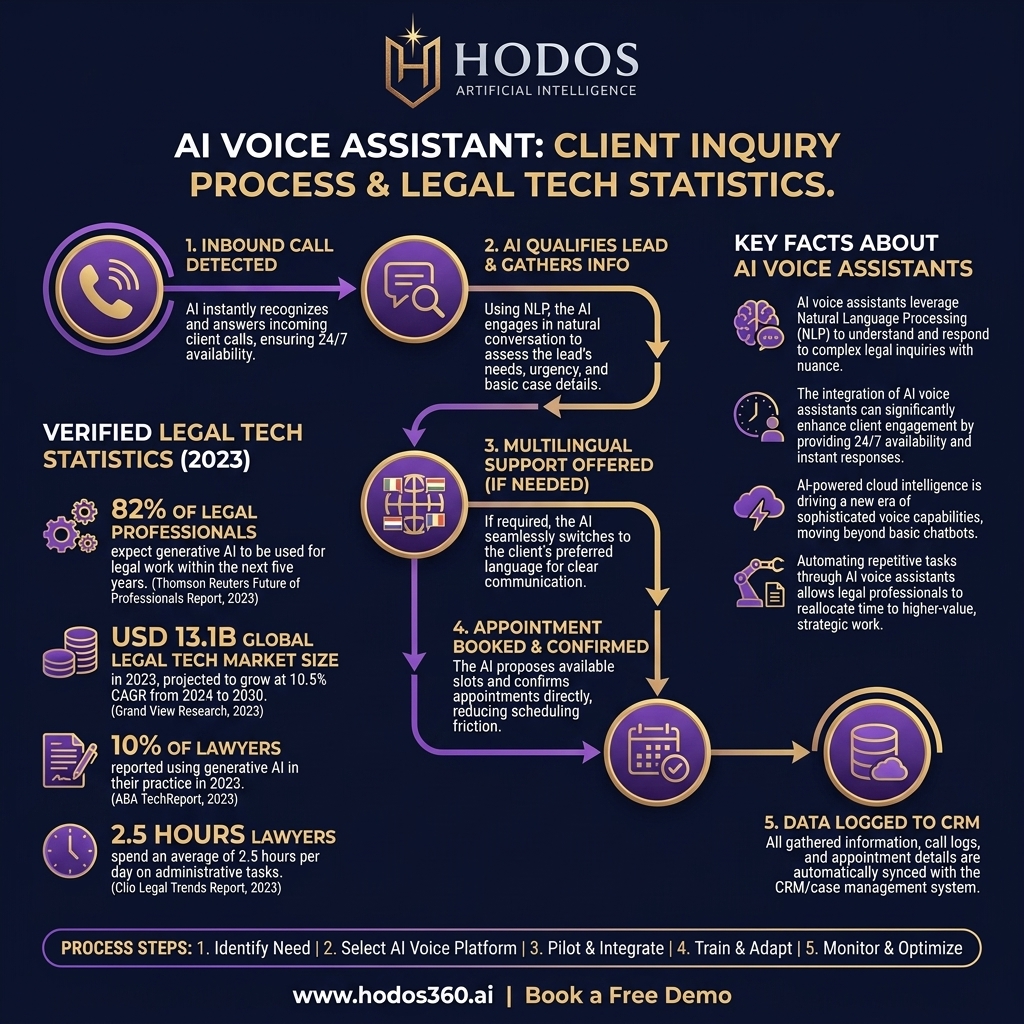
In today's hyper-competitive legal market, differentiation is key. Adopting advanced AI voice assistants provides a multi-faceted strategic advantage, impacting everything from client acquisition to operational overhead. Consider the challenge of 24/7 client availability: traditional firms struggle to maintain round-the-clock staffing, leading to missed calls and frustrated clients. An AI voice assistant, however, operates tirelessly, ensuring every call is answered, every inquiry logged, and every potential lead captured, regardless of time zones or office hours. This constant availability significantly boosts client satisfaction, a crucial factor in client retention and referrals. A Thomson Reuters report indicated that firms with higher client satisfaction rates experience 20% faster growth. By providing immediate, intelligent responses, firms meet modern client expectations, reinforcing their image as forward-thinking and client-centric organizations. This also frees up valuable paralegal and administrative staff to focus on more complex, high-value tasks, rather than routine call management.
Moreover, the ability of these AI systems to perform sophisticated lead qualification is a game-changer. Instead of simply taking a message, an AI voice assistant can engage in a dynamic conversation to gather essential information, pre-screen potential clients based on predefined criteria, and even route calls to the appropriate attorney or department. This intelligent routing ensures that attorneys only spend time on genuinely qualified leads, optimizing their schedules and increasing their billable hours. For example, if a caller needs assistance with a specific type of litigation, the AI can ask targeted questions to assess the case's viability and gather necessary background details before scheduling an appointment directly into the firm's calendar system. This level of automation significantly reduces the administrative burden associated with initial client contact, transforming a traditionally time-consuming process into a seamless, efficient workflow.
The cost-efficiency of deploying AI voice assistants is another compelling advantage. While initial investment is required, the long-term savings are substantial. Learn more about GenAI Governance: Essential Frameworks for Law Firms. Firms can reduce reliance on extensive administrative support for phone answering, particularly for after-hours and overflow calls. A study by McKinsey & Company in 2025 estimated that AI-powered automation could reduce operational costs for professional services firms by 15-20% within five years. Beyond direct cost savings, the enhanced client intake automation and improved lead conversion contribute directly to revenue growth, offering a compelling return on investment. Firms that embrace this technology are not just cutting costs; they are investing in scalable growth infrastructure that allows them to handle increased client volume without proportionally increasing staff, positioning themselves for sustainable expansion in a competitive market. Ready to transform your firm's client engagement and operational efficiency? Discover how HODOS 360's AI Voice Assistants can help your firm thrive. [Learn more today!]
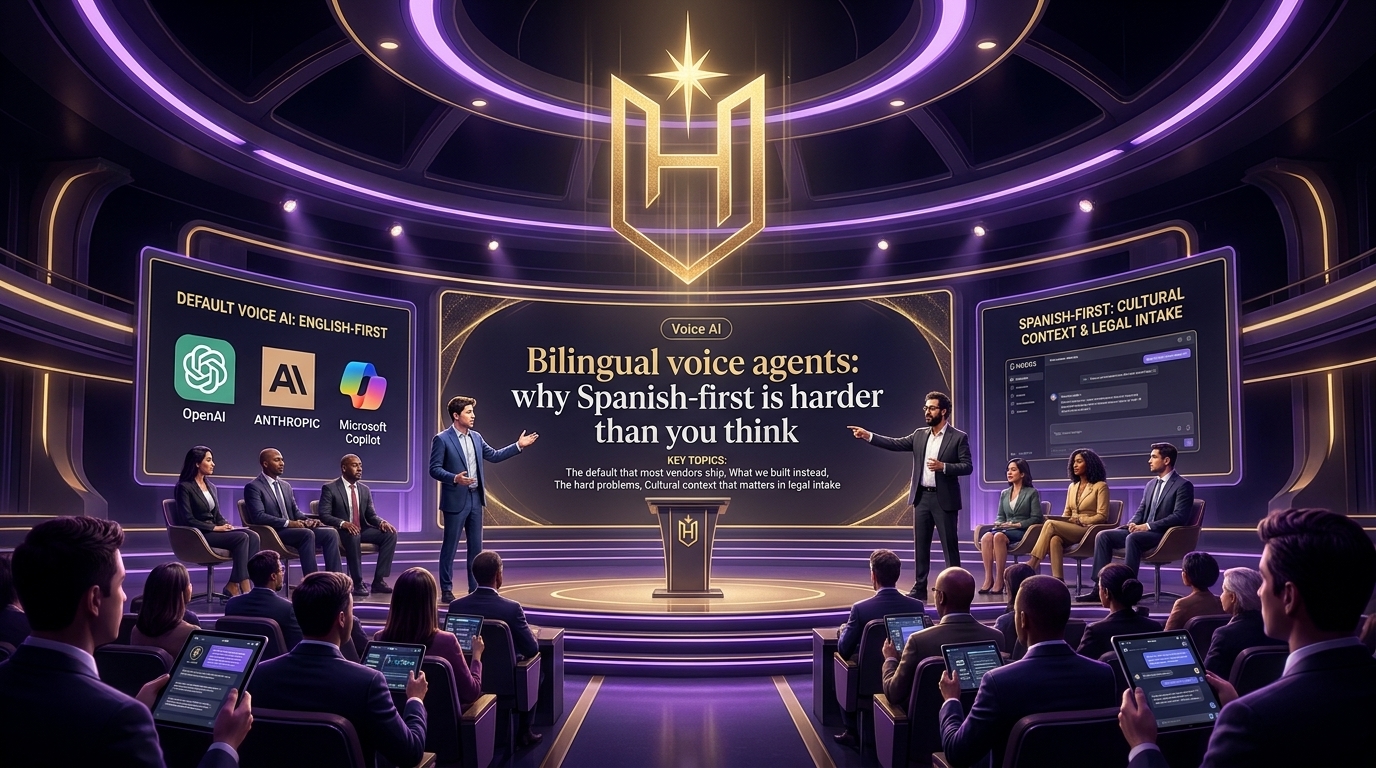
The multilingual capabilities of advanced AI voice assistants are particularly impactful in diverse markets. With the ability to communicate fluently in multiple languages, these systems eliminate language barriers, making legal services accessible to a broader demographic. This expands a firm's potential client base and enhances its reputation as an inclusive and globally-minded practice. For instance, a firm in a major metropolitan area with a large Spanish-speaking population can leverage an AI voice assistant to serve clients effectively in their native language, ensuring clarity and trust from the very first interaction. This level of accessibility is not merely a convenience; it's a strategic imperative for firms looking to serve and grow within diverse communities, aligning with ethical obligations under ABA Model Rule 1.1 (Competence) to provide effective representation, which includes clear communication. The ability to seamlessly switch between languages without human intervention represents a significant leap forward in client service, demonstrating true digital transformation.
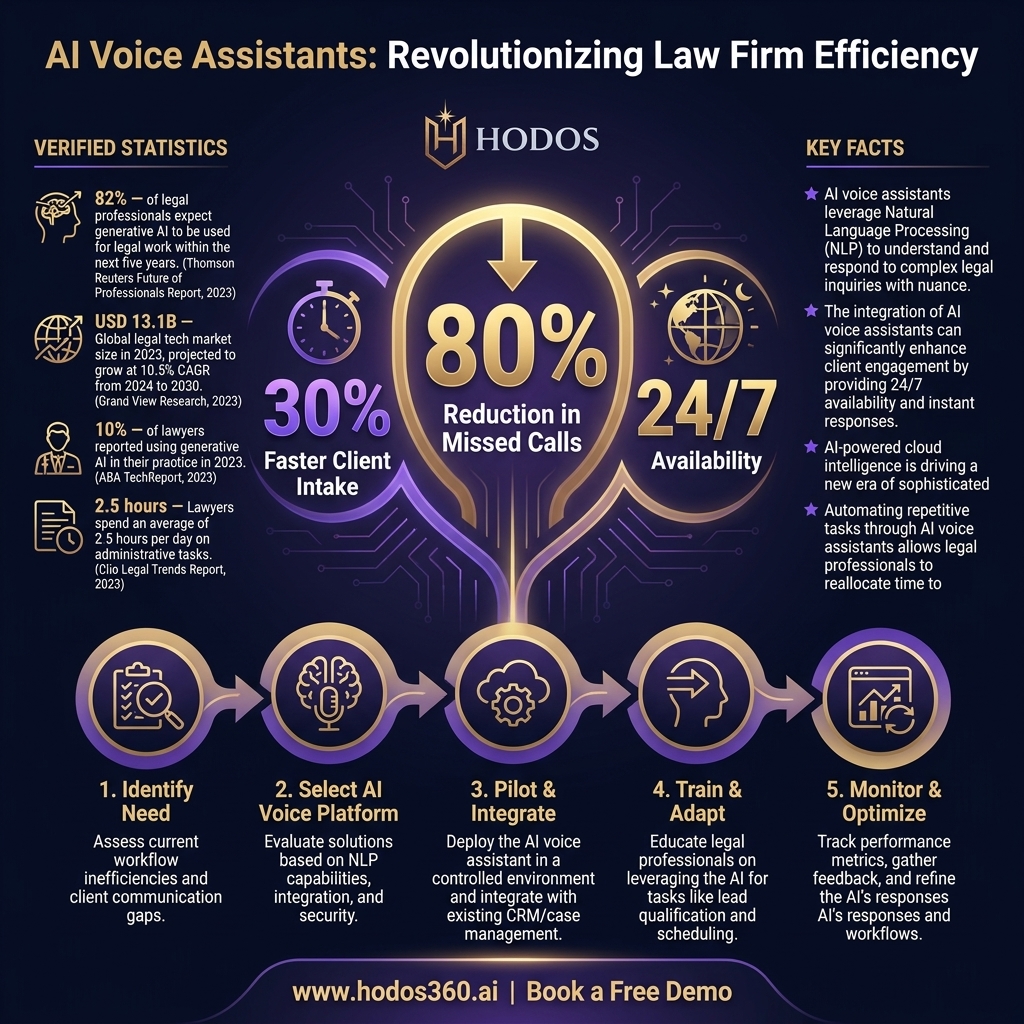
- ✓24/7 Client Availability: Ensures no potential client call is missed, regardless of time zones or office hours, significantly improving lead capture rates.
- ✓Intelligent Lead Qualification: AI systems dynamically interact with callers, gathering critical information and pre-screening potential clients to route only qualified leads to attorneys.
- ✓Automated Appointment Booking: Seamlessly integrates with firm calendars to schedule consultations, reducing administrative overhead and optimizing attorney schedules.
- ✓Multilingual Support: Provides immediate communication in multiple languages, broadening client accessibility and enhancing the firm's reach in diverse communities.
- ✓Reduced Operational Costs: Minimizes the need for extensive phone answering staff, especially for after-hours and overflow calls, leading to substantial long-term savings.
- ✓Enhanced Client Experience: Delivers immediate, personalized, and professional responses, fostering trust and improving client satisfaction from the initial contact.
- ✓Data-Driven Insights: Captures and analyzes call data, providing valuable insights into client needs, common inquiries, and lead conversion metrics for strategic decision-making.
Beyond Operational Efficiency: Enhancing Client Experience and Firm Growth
While operational efficiency is a compelling benefit, the true power of advanced AI voice assistants lies in their capacity to fundamentally elevate the client experience. In an age where consumers expect instant gratification and personalized service, a law firm's ability to respond promptly and intelligently can be a significant differentiator. According to a recent Clio Legal Trends Report, 70% of clients consider immediate responsiveness a critical factor when choosing a law firm. AI voice assistants deliver on this expectation, providing not just answers, but empathetic and understanding interactions that build rapport from the first touchpoint. This creates a positive initial impression, which is crucial for establishing trust and confidence in the firm's capabilities. Consider the narrative of a potential client, anxious about a legal issue, who receives a polite, informative, and helpful response from an AI, immediately easing their concerns and guiding them to the next step.
This enhanced client experience directly translates into tangible firm growth. Satisfied clients are more likely to refer new business and become repeat clients themselves. The seamless, professional interaction facilitated by AI voice assistants contributes to a firm's brand reputation, positioning it as modern, efficient, and client-focused. Furthermore, by automating initial client contact, attorneys and paralegals are freed from routine administrative tasks, allowing them to dedicate more time to complex legal work and strategic client relationships. This reallocation of human capital to higher-value activities not only improves attorney efficiency but also fosters a more engaged and productive legal team, ultimately driving profitability. The synergy with an AI Marketing Platform can be profound, as qualified leads generated by voice assistants can be seamlessly integrated into targeted marketing campaigns, ensuring a cohesive and effective client acquisition strategy.
Beyond direct interaction, AI voice assistants can gather valuable data on client inquiries, frequently asked questions, and pain points. Learn more about AI Innovations: Ultimate Guide to Transforming Legal CRM. This data, when analyzed, provides actionable insights that firms can use to refine their services, optimize their marketing messages, and even identify emerging legal trends. For example, if a firm notices a surge in inquiries about a specific regulatory change, they can proactively create content (e.g., blog posts, webinars) or develop new service offerings to address that demand. This data-driven approach to client engagement and service development ensures that the firm remains agile and responsive to market needs, fostering continuous growth. The ability to proactively adapt to client demands, informed by real-time voice interaction data, is a hallmark of truly innovative legal tech innovation.
However, implementing these sophisticated systems requires careful consideration of ethical boundaries and practical safeguards. Firms must ensure that the use of AI voice assistants aligns with professional responsibility rules, particularly concerning confidentiality and client communication. ABA Model Rule 1.6 (Confidentiality of Information) requires lawyers to protect client information, meaning any AI system handling client data must adhere to stringent security protocols. Transparency with clients about the use of AI is also paramount. While AI can handle many initial interactions, the final legal advice and critical decision-making always remain with human attorneys. Therefore, the implementation strategy must clearly define the AI's role as a support tool, not a replacement for human legal expertise, maintaining the necessary human oversight and ethical standards required in legal practice.
Navigating the Ethical and Practical Implementation
The ethical considerations surrounding AI in legal practice are as critical as the technological advancements themselves. As law firms increasingly rely on AI voice assistants for client interactions, ensuring data privacy, confidentiality, and accuracy becomes paramount. Firms must meticulously vet AI vendors to ensure their systems comply with stringent data security standards, such as those outlined in the EU AI Act (though primarily focused on high-risk AI, its principles resonate globally) or state-specific privacy laws. Transparency with clients about the use of AI is not just good practice but an ethical imperative, aligning with ABA Formal Opinion 498 on virtual practice and client communication. Learn more about Essential Website Accessibility Tools for Law Firms. While AI can streamline initial contacts and information gathering, the ultimate responsibility for legal advice and client trust rests firmly with the human attorney. Therefore, firms must implement clear protocols for human oversight, ensuring that complex or sensitive inquiries are promptly escalated to legal professionals, maintaining the integrity and ethical standards of the profession.
The Future of Legal Client Engagement: Predictive & Proactive AI
Looking ahead, the evolution of AI voice assistants promises even more transformative capabilities for legal client engagement. The next frontier involves predictive and proactive AI, where systems move beyond reacting to inquiries to anticipating client needs and initiating relevant interactions. Imagine an AI voice assistant, integrated with a firm's AI Law Firm Management System, analyzing client history and identifying patterns that suggest a potential need for a new legal service, such as estate planning updates after a major life event, or a regulatory compliance review for a corporate client based on recent legislative changes. The AI could then proactively reach out, offering relevant information or scheduling a consultation, effectively transforming client engagement from reactive problem-solving to proactive value creation. This level of predictive intelligence, powered by sophisticated machine learning algorithms and vast datasets, will redefine client relationship management in the legal sector.
This future is heavily reliant on advances in generative AI and the computational power supporting it. The ability of large language models to not only understand but also generate highly nuanced and contextually appropriate language is key. As OpenAI news continues to highlight breakthroughs in multimodal AI, the capacity for voice assistants to process and respond to complex legal scenarios will only grow. Furthermore, the continuous innovation in hardware, especially in what is a GPU and its role in accelerating AI computations, will enable these systems to operate with even greater speed and sophistication. Companies like Nvidia are constantly pushing the boundaries of AI chip design, making it possible to run increasingly complex models locally or with minimal latency in the cloud. This robust AI infrastructure is crucial for the real-time, intelligent interactions that will characterize the next generation of legal AI.
The integration of these advanced AI voice assistants with other legal tech innovation platforms will create a seamless digital ecosystem for law firms. Learn more about AI's Profound Impact: Essential Lessons for Legal Firms. Picture an AI voice assistant that not only books an appointment but also initiates the document automation process by collecting initial client information and populating intake forms, or seamlessly connects with the firm's AI Marketing Platform to deliver personalized content based on the client's expressed needs. This holistic approach to digital transformation will allow law firms to operate with unprecedented efficiency, providing a highly personalized and responsive experience that builds enduring client loyalty. The competitive edge will go to firms that can effectively weave these disparate AI services into a coherent, client-centric strategy, moving beyond siloed solutions to an integrated platform.
The ethical considerations will also evolve. As AI becomes more proactive, questions around consent, privacy, and the line between assistance and unsolicited advice will become more prominent. Firms will need to develop clear ethical guidelines and ensure their AI systems are designed with fairness, transparency, and accountability at their core. The ongoing dialogue around AI governance, exemplified by discussions at international forums and the development of frameworks like the NIST AI Risk Management Framework, will guide legal professionals in responsibly deploying these powerful tools. Ultimately, the future of legal client engagement with AI voice assistants is one of partnership – where AI amplifies human potential, allowing legal professionals to focus on the intricate legal strategy and empathetic client counsel that only humans can provide. Ready to lead the charge in legal tech? Explore HODOS 360's comprehensive suite of AI solutions. [Book a Free Demo]
The HODOS 360 Edge in Voice AI
In this rapidly advancing landscape, HODOS 360 stands at the forefront, offering an AI-powered platform specifically designed to empower law firms. Our AI Voice Assistants service embodies the cutting-edge capabilities discussed, providing 24/7 phone answering, sophisticated lead qualification, seamless appointment booking, and robust multilingual support. By leveraging the latest in cloud intelligence and generative AI, HODOS 360 ensures that your firm can meet the demands of modern client engagement, capture every opportunity, and streamline your operations without compromising on quality or ethical standards. We understand the unique needs of legal professionals and have engineered our solutions to integrate seamlessly into your existing workflows, enhancing legal productivity and fostering sustainable growth. Our platform is built to provide the strategic advantage your firm needs in this new era of AI-driven legal services.

Key Takeaways and Next Steps
The "new race in artificial intelligence" for advanced voice capabilities is not a distant future; it is the present reality shaping the legal industry. For law firms, embracing AI voice assistants is no longer an option but a strategic imperative for sustained growth and competitive differentiation. From ensuring 24/7 client availability and intelligent lead qualification to enhancing client experience and driving legal productivity, the benefits are profound and measurable. Firms that proactively integrate these advanced solutions will be better positioned to attract and retain clients, optimize their resources, and adapt to the evolving demands of the legal market. The transformation is already underway, driven by giants like Microsoft and Google, and accelerated by innovative startups and the foundational AI infrastructure powered by companies like Nvidia.
The journey toward adopting advanced AI voice assistants begins with a clear understanding of your firm's specific needs and identifying areas where automation can deliver the most impact. Start by evaluating current client intake processes, call volumes, and administrative bottlenecks. Seek out solutions that offer robust features like multilingual support, seamless integration with your existing case management systems, and a commitment to data security and ethical AI practices. Prioritize platforms that provide not just efficiency, but also enhance the human element of legal service by freeing up your team for more complex, empathetic client interactions. The goal is to augment, not replace, human expertise, ensuring that technology serves as a powerful enabler for delivering superior legal services.
Ultimately, the firms that thrive in this new era will be those that view AI not as a threat, but as an opportunity to innovate, optimize, and differentiate. By strategically deploying AI voice assistants, law firms can build a more resilient, efficient, and client-centric practice, ensuring they remain at the forefront of legal service delivery. The time to act is now, to ensure your firm is well-equipped to navigate the complexities and capitalize on the opportunities presented by this exciting chapter in legal tech innovation. Embrace the future of AI voice assistants and unlock unprecedented potential for your firm.
Frequently Asked Questions
What are AI voice assistants in the legal context?+
AI voice assistants for law firms are sophisticated AI-powered systems capable of understanding spoken language, responding intelligently, and performing tasks such as answering client calls 24/7, qualifying leads, booking appointments, and providing basic information. They leverage advanced natural language processing and generative AI to offer human-like interactions, enhancing client engagement and streamlining administrative workflows for improved legal productivity and operational efficiency.
How do AI voice assistants improve client intake?+
AI voice assistants revolutionize client intake by providing immediate, round-the-clock responsiveness to potential clients. They can intelligently converse, gather essential information, pre-screen leads based on firm-specific criteria, and automatically schedule consultations with the appropriate attorney. This client intake automation ensures no lead is missed, accelerates the conversion of inquiries into cases, and frees up human staff from repetitive administrative tasks, contributing to higher client satisfaction.
Can AI voice assistants handle multilingual communication?+
Yes, advanced AI voice assistants offer robust multilingual support, enabling law firms to communicate effectively with a diverse client base in their native languages. This capability breaks down language barriers, expands a firm's reach into new markets, and ensures clarity and trust from the initial interaction. It’s a strategic advantage for firms operating in multicultural environments, fostering inclusivity and enhancing client accessibility for legal services.
What are the ethical considerations for using AI voice assistants in law firms?+
Ethical considerations include data privacy, client confidentiality (per ABA Model Rule 1.6), and ensuring transparency with clients about AI usage. Firms must select secure AI solutions, clearly define the AI's role as a support tool, and maintain human oversight for legal advice and critical decision-making. Adherence to professional responsibility rules and industry best practices is crucial to uphold the integrity and trustworthiness of legal services when deploying AI voice assistants.
How does HODOS 360's AI Voice Assistant service stand out?+
HODOS 360's AI Voice Assistants are designed specifically for law firms, offering a comprehensive suite of features including 24/7 phone answering, intelligent lead qualification, seamless appointment booking, and robust multilingual support. Leveraging cutting-edge cloud intelligence and generative AI, our service integrates with your existing workflows to enhance legal productivity, elevate client experience, and provide a competitive edge. It’s a tailored solution for the unique demands of the legal profession.