


Ultimate AI Voice Assistants: Transforming Legal Client Intake
Just last month, Sarah Chen, a managing partner at Sterling & Hamilton LLP in San Francisco, found herself at a crossroads. Her firm, renowned for its complex litigation wins, was bleeding potential clients due to an overwhelmed front desk. Missed calls piled up after hours, promising leads were lost to competitors who responded faster, and the sheer administrative burden of client intake was stifling growth. "We were excellent lawyers," Chen lamented, "but terrible at answering the phone after 5 PM." This isn't an isolated incident; it's a narrative playing out in law firms globally, highlighting a critical gap in client accessibility and operational efficiency. The recent PCMag UK article, "The Best AI Chatbots for 2026," while celebrating the advancements in conversational AI, only scratches the surface of the transformative power truly specialized AI voice assistants bring to the legal sector.
The initial wave of AI chatbots, often perceived as glorified FAQs, certainly offered a glimpse into automated client interaction. Companies like OpenAI, with its ubiquitous ChatGPT, and Anthropic, pushing the boundaries with Claude's nuanced understanding, have democratized access to powerful large language models. However, the unique demands of legal practice — the need for empathy, precision, and adherence to strict ethical guidelines — require more than a generic chatbot. Firms like Sterling & Hamilton need a solution that can not only understand complex legal queries but also act as a sophisticated virtual front office, available 24/7, across multiple languages, and seamlessly integrated into their existing workflows. This is where the evolution from simple text-based chatbots to advanced AI voice assistants becomes not just an advantage, but a strategic imperative.
AI voice assistants are poised to redefine the very fabric of legal client engagement, moving beyond mere convenience to become an indispensable component of modern practice management. They offer a tangible solution to the perennial challenges of missed opportunities, inefficient lead qualification, and inconsistent client support. By automating the initial touchpoints, these intelligent systems free up invaluable human resources, allowing attorneys and paralegals to focus on high-value legal work. The dramatic shift isn't about replacing human interaction, but rather enhancing it, ensuring that every potential client receives a professional, immediate, and qualified response, regardless of when or how they reach out. This is the future Sarah Chen and countless other legal professionals are now embracing, turning a pain point into a competitive advantage.
The Evolution of Client Engagement: From Chatbots to Sophisticated AI Voice Assistants
The legal industry's journey with AI has been a fascinating one, marked by rapid technological leaps and cautious adoption. For years, the concept of a "chatbot" in a law firm conjured images of rudimentary scripts, often frustrating clients with their inability to grasp nuance. However, the landscape dramatically shifted with the advent of advanced Natural Language Processing (NLP) and Large Language Models (LLMs), pioneered by research labs like Google DeepMind and Microsoft's AI division. These breakthroughs have enabled AI systems to not only understand human language with remarkable accuracy but also to generate responses that are contextually relevant and surprisingly human-like. The PCMag UK article, in its review of 2026's top AI chatbots, points to a new generation defined by self-learning capabilities and deeper integration. Yet, for law firms, the true paradigm shift lies in moving beyond text and embracing the power of voice.
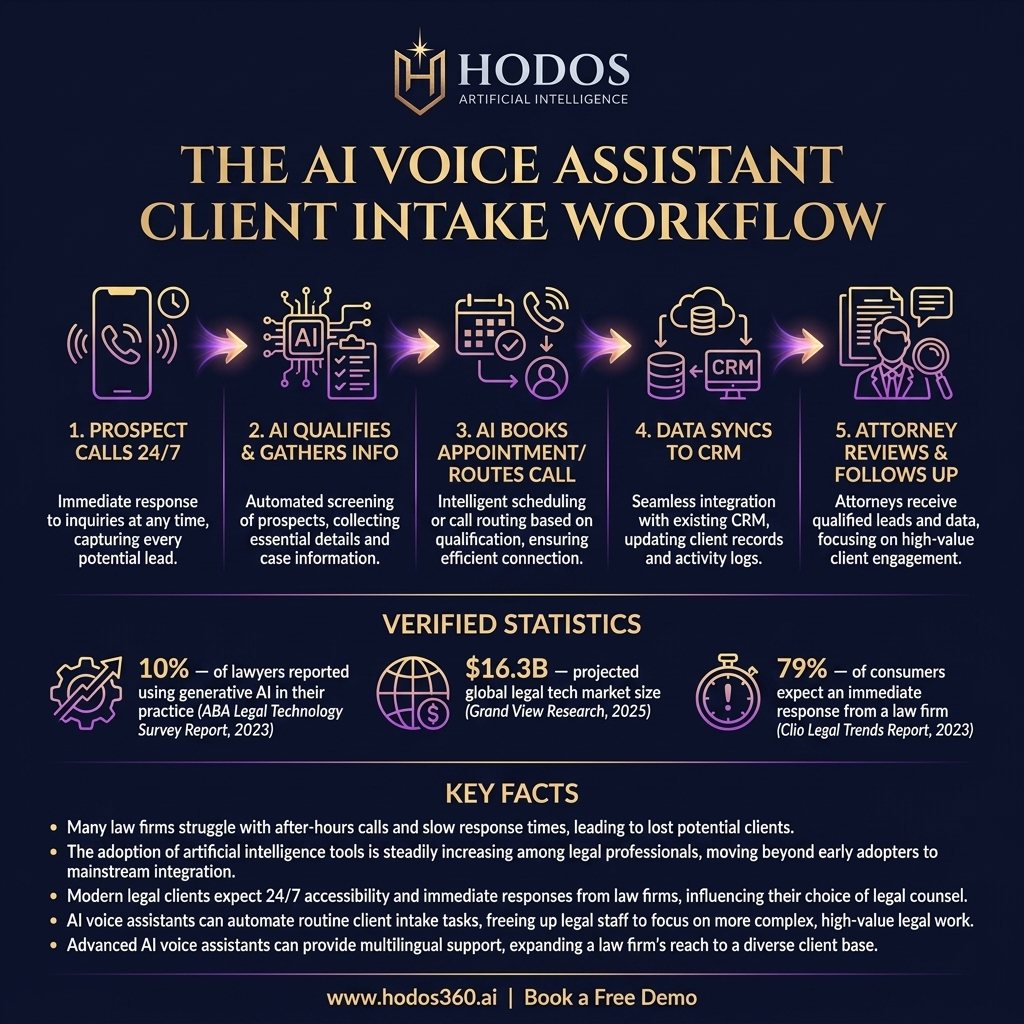
AI voice assistants leverage these advanced NLP capabilities, combining them with sophisticated speech-to-text and text-to-speech engines to create truly conversational experiences. Imagine a prospective client calling your firm at 2 AM, expecting only a voicemail. Instead, they are greeted by an AI voice assistant that sounds remarkably human, capable of understanding their urgent query, asking relevant qualifying questions, and even scheduling an initial consultation. Learn more about AI-Powered Web Development: The Essential Guide for Law Firms. This isn't science fiction; it's the reality for leading firms. Contrast this with the traditional model: an expensive, often unavailable human receptionist, prone to errors, and limited by working hours. According to the ABA TechReport 2025, 65% of small to mid-sized firms still struggle with administrative burdens, including inefficient phone answering and client intake processes, directly impacting their ability to convert leads into clients. This data underscores the critical need for scalable, intelligent solutions.
Firms that have embraced this shift, such as Allen & Overy's pioneering work with Harvey AI in legal research, are now looking to extend AI's reach to client-facing operations. The sophistication of modern AI voice assistants allows them to perform complex tasks: identifying the nature of a call, discerning urgency, extracting key information, and even offering basic informational responses without risking legal advice. This means a potential client calling about a personal injury claim can be quickly identified, their basic details collected, and an appointment booked directly into the attorney's calendar, all without human intervention in the initial stages. This level of automation not only boosts efficiency but significantly enhances the client experience, setting a new standard for accessibility and responsiveness in the legal sector.
Enhancing Lead Qualification and Client Triage
One of the most immediate and impactful benefits of deploying AI voice assistants in a law firm is their unparalleled ability to enhance lead qualification and client triage. Historically, attorneys and paralegals spend countless hours on initial calls, sifting through unqualified leads that ultimately don't fit the firm's practice areas or financial criteria. This is a significant drain on billable time and a source of frustration. An advanced AI voice assistant acts as a highly efficient virtual gatekeeper, programmed to ask a series of predefined, yet dynamically adaptive, questions. For instance, it can quickly ascertain the type of legal issue, the jurisdiction, the urgency of the matter, and even basic financial parameters, all while maintaining a professional and empathetic tone.
Consider the scenario where a firm specializes in corporate law but receives calls about family disputes. Learn more about Automate Client Lead Follow-Up: Proven Strategies for Law Firms. A human receptionist might spend valuable minutes understanding the query before redirecting it, or worse, the caller might be transferred to an attorney who is ill-equipped to help. An AI voice assistant, however, can instantly categorize the call, provide pre-approved general information, and intelligently route the caller to the appropriate department or even suggest a referral to another firm, all without consuming a single minute of an attorney's time. This precision in lead qualification means that by the time a human attorney engages, they are speaking with a pre-vetted prospect whose needs align perfectly with the firm's expertise. This translates directly into higher conversion rates and a more efficient allocation of legal talent, a critical advantage in today's competitive legal market.
Revolutionizing Law Firm Operations with Conversational AI
The scope of AI voice assistants extends far beyond mere call answering; they are comprehensive operational tools capable of deeply integrating with and transforming various aspects of law firm management. Think of the administrative tasks that consume countless hours each week: scheduling, document retrieval, client follow-ups, and even basic information dissemination. These are precisely the areas where conversational AI shines, offering an unprecedented level of automation and consistency. For example, Clio, a leader in cloud-based legal practice management, has consistently invested in AI integrations, demonstrating the industry's push towards more intelligent, automated workflows. The integration capabilities of modern AI voice assistants mean they don't operate in a silo but become an extension of your existing legal tech ecosystem, enhancing tools like case management, billing, and client intake platforms.
One of the most compelling aspects is the shift from reactive to proactive client service. Instead of waiting for clients to call with questions about their case status or billing, AI voice assistants can be programmed to provide secure, pre-approved updates, or direct clients to a secure portal for detailed information. This reduces inbound call volume for repetitive queries, allowing human staff to focus on complex client needs. Learn more about AI Voice Generator: The Ultimate Guide for Law Firms. The ability to handle a high volume of inquiries simultaneously, without sacrificing quality, is a game-changer for firms looking to scale. This efficiency directly impacts profitability, as non-billable administrative tasks are significantly reduced. Firms can reallocate resources from routine administrative work to strategic growth initiatives or deeper client engagement, fostering loyalty and expanding their market presence.
Furthermore, the data collected by these AI voice assistants provides invaluable insights into client behavior and firm performance. Every interaction, every query, every successful booking is a data point that can be analyzed to refine marketing strategies, identify common client pain points, and optimize service delivery. This data-driven approach, once the exclusive domain of large corporations, is now accessible to law firms of all sizes, empowering them to make informed decisions that drive growth and client satisfaction. The shift is not just about automation; it's about intelligent automation that learns and adapts, continuously improving the firm's operational efficiency and client service capabilities.
Streamlining Appointment Booking and Calendar Management
The manual process of scheduling appointments is a notorious time sink for law firms. Coordinating attorney availability, client preferences, and meeting logistics can involve multiple phone calls and email exchanges, leading to delays and potential double-bookings. AI voice assistants fundamentally transform this process. By securely integrating with attorneys' digital calendars – whether Google Calendar, Outlook, or specialized practice management software – these intelligent systems can instantly identify available slots. A prospective client can call, state their preferred time, and the AI can confirm an appointment in real-time, sending automated calendar invitations and reminders to both parties.
This seamless automation significantly reduces the administrative burden on support staff, allowing them to focus on more complex tasks. Learn more about Law Firm AI Funding: The Ultimate Insurer Debate. More importantly, it dramatically improves the client experience. Clients appreciate the immediate confirmation and the convenience of booking at their leisure, outside of traditional office hours. This not only minimizes no-shows but also ensures that the firm projects an image of modern efficiency and client-centricity from the very first interaction. The precision and speed offered by AI-driven appointment booking are powerful competitive differentiators in a market where client expectations for responsiveness are constantly rising.
- ✓24/7 Availability: Ensures no potential client call is missed, regardless of time zones or office hours, addressing a critical pain point for firms.
- ✓Multilingual Support: Instantly communicates in multiple languages, breaking down barriers and expanding a firm's potential client base significantly.
- ✓Automated Appointment Booking: Integrates with calendars to schedule consultations, reducing administrative overhead and client no-shows.
- ✓Intelligent Call Routing: Directs callers to the most appropriate department or attorney based on their specific legal needs, optimizing internal workflows.
- ✓Initial Consultation Scheduling: Gathers essential client information and sets up initial meetings efficiently, preparing attorneys for productive discussions.
- ✓Secure Document Retrieval Assistance: Guides clients through accessing secure portals or provides instructions for document submission, enhancing self-service options.
- ✓Client Feedback Collection: Gathers valuable insights post-interaction, allowing firms to continuously improve their services and client satisfaction.
Navigating the Ethical and Regulatory Landscape of Legal AI
While the benefits of AI voice assistants are clear, their deployment in the legal sector necessitates a rigorous approach to ethics and regulation. The legal profession is bound by stringent rules regarding client confidentiality, attorney-client privilege, and data privacy – principles that must not be compromised by technological innovation. The ABA Model Rules of Professional Conduct, particularly Rule 1.1 (Competence) and Rule 1.4 (Communication), implicitly demand that any technology used in practice maintains a high standard of care and effectively serves the client's best interests. Firms must ensure that their AI solutions are designed with these principles at their core, implementing robust security protocols and clear data governance policies.
Data privacy, in particular, is a paramount concern. With regulations like the California Consumer Privacy Act (CCPA) and the General Data Protection Regulation (GDPR) setting global benchmarks, law firms must ensure that any client data processed by AI voice assistants is encrypted, stored securely, and handled with explicit consent. Esteemed legal ethicists, such as Professor Frank Pasquale of Brooklyn Law School, have consistently warned against the 'black box' problem of AI, emphasizing the need for transparency and explainability. Firms must understand how their AI models are trained, what data they use, and how they arrive at their responses to avoid potential biases or errors that could have severe consequences for clients and the firm's reputation.
Furthermore, the ethical use of AI also extends to managing client expectations. Learn more about Voice Assist: Essential AI Scheduling for Law Firms. While AI voice assistants are sophisticated, they are not human attorneys. Firms must clearly communicate the role of the AI, ensuring clients understand they are interacting with an automated system for intake and information gathering, not receiving legal advice. Human oversight remains critical, not just for quality control but for ethical accountability. The evolving regulatory landscape, exemplified by the EU AI Act's comprehensive framework for high-risk AI systems, signals a global trend towards stricter governance. Law firms adopting AI voice assistants must remain vigilant, continuously assessing their systems against the latest ethical guidelines and legal requirements to ensure responsible and compliant innovation.
Ensuring Multilingual Accessibility and Inclusivity
In an increasingly globalized and multicultural society, the ability to communicate effectively with clients from diverse linguistic backgrounds is not just a courtesy, but a competitive necessity for law firms. Traditional firms often face significant challenges in providing consistent, high-quality support to non-English speaking clients, relying on interpreters or bilingual staff who may not always be available. This can lead to communication breakdowns, client frustration, and ultimately, lost business opportunities. AI voice assistants offer a powerful solution to this challenge, instantly bridging linguistic divides.
Advanced AI voice assistants are equipped with sophisticated multilingual capabilities, allowing them to seamlessly switch between languages in real-time. A client can call in Spanish, and the AI can understand and respond in Spanish, then switch to English if the client prefers, all within the same conversation. Learn more about AI Deposition Prep: The Ultimate Guide to Winning Strategies. This level of immediate, accurate, and consistent multilingual support ensures that every potential client feels valued and understood from the very first interaction. For firms operating in diverse metropolitan areas or handling international cases, this capability is transformative, expanding their reach and fostering inclusivity. It's a strategic investment that not only enhances client satisfaction but also positions the firm as forward-thinking and accessible in a competitive legal market.
The Future of Legal Client Engagement: A Strategic Imperative
The trajectory of AI voice assistants in legal client engagement points towards an increasingly sophisticated, personalized, and proactive future. We are moving beyond simple intake to predictive analytics, where AI can identify potential client needs based on initial queries and demographic data, offering tailored resources even before a human attorney intervenes. Imagine an AI voice assistant not only booking an appointment but also providing relevant case studies or informational articles based on the client's specific legal issue, thus enriching their understanding and building trust from the outset. This level of personalized service, once reserved for the largest firms with extensive resources, is becoming accessible to all through intelligent automation.
The real strategic imperative for law firms now is to recognize that AI voice assistants are not merely tools for cost reduction; they are catalysts for growth and competitive differentiation. Firms that embrace these technologies early are not just streamlining operations; they are fundamentally reshaping their client acquisition funnels, enhancing client satisfaction, and building a reputation for innovation and accessibility. The drama unfolds between firms clinging to traditional, reactive models and those boldly stepping into an AI-powered future, capturing market share and setting new industry benchmarks. The insights from industry reports, such as Thomson Reuters' "Future of Legal Report 2026," consistently highlight that client expectations for digital interaction and instant responsiveness are at an all-time high, making AI adoption less of an option and more of a necessity for survival and growth.
Platforms like HODOS 360 are at the forefront of this transformation, offering comprehensive AI Voice Assistants designed specifically for the nuanced demands of legal practice. Our solutions integrate seamlessly with existing firm infrastructure, providing 24/7 client answering, advanced lead qualification, automated appointment booking, and multilingual support. This strategic adoption of AI ensures that law firms can not only meet but exceed the evolving expectations of their clients, securing their position at the vanguard of the legal industry. The future of client engagement is conversational, intelligent, and always on.

Key Takeaways and Next Steps
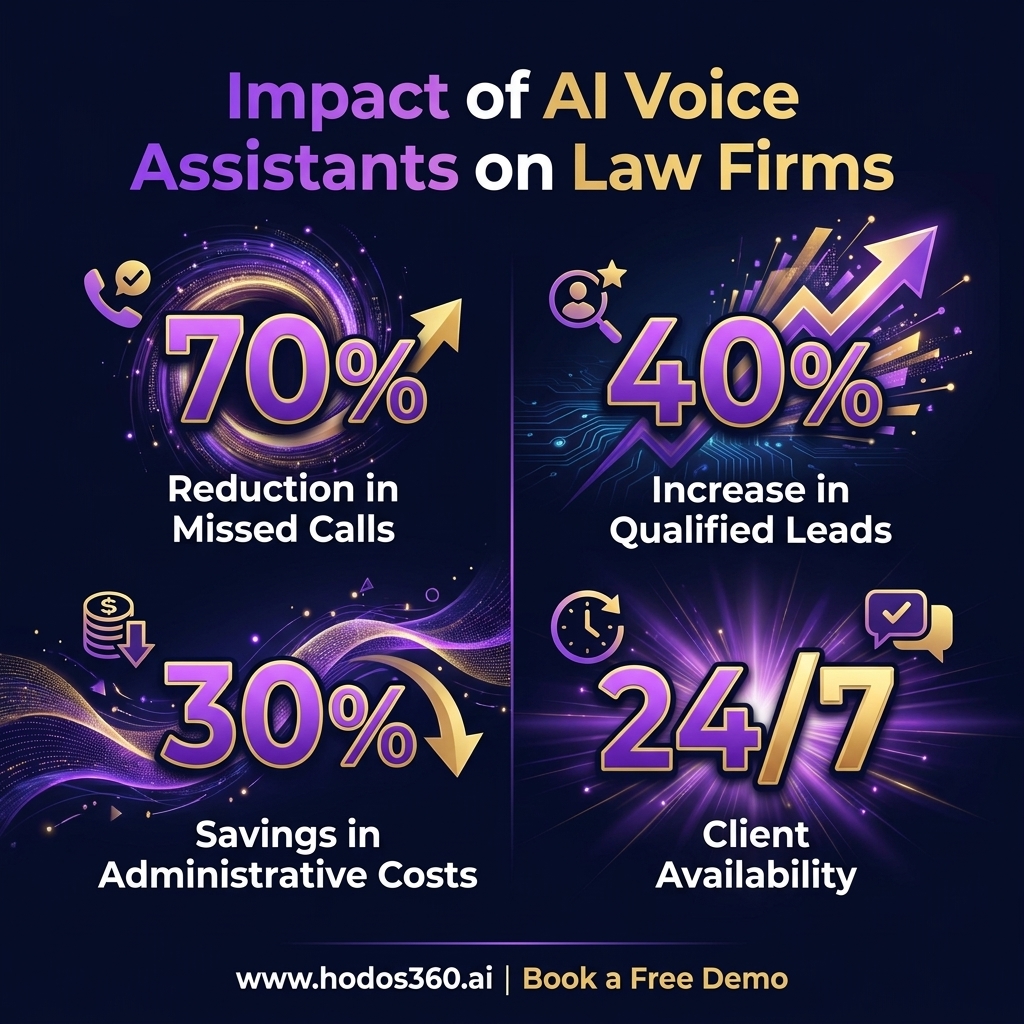
The legal industry stands at a pivotal moment, where the strategic adoption of AI voice assistants offers an unparalleled opportunity to redefine client engagement and operational efficiency. From mitigating missed opportunities and streamlining lead qualification to providing 24/7 multilingual support, these intelligent systems are proving to be indispensable. Firms that embrace this technology are not just investing in automation; they are investing in superior client experiences, enhanced practice management, and a significant competitive edge in a rapidly evolving market. The evidence from pioneering firms and industry trends is clear: the future of legal practice is inextricably linked to intelligent automation.
For law firm owners and attorneys looking to navigate this transformation, the next step is crucial. Evaluate your current client intake processes, identify bottlenecks, and explore how a tailored AI voice assistant solution can address these challenges. Focus on providers that understand the unique ethical and regulatory demands of the legal sector, ensuring compliance and data security. The time to act is now, to move beyond reactive solutions and embrace a proactive, AI-powered approach to client engagement. Embrace the future, enhance your firm's capabilities, and secure your competitive advantage.
Frequently Asked Questions
What is an AI voice assistant for law firms?+
An AI voice assistant for law firms is an intelligent, automated system designed to handle client communications via voice. It uses advanced AI to answer calls, qualify leads, book appointments, and provide information 24/7, mimicking human interaction while integrating with existing practice management software to streamline operations and enhance client service.
How do AI voice assistants improve client intake?+
AI voice assistants significantly improve client intake by providing immediate responses to inquiries, pre-qualifying leads based on firm-specific criteria, and automating appointment scheduling. This reduces missed opportunities, saves valuable staff time, and ensures that attorneys engage only with highly relevant prospective clients, leading to higher conversion rates and efficiency.
Are AI voice assistants compliant with legal ethics and privacy regulations?+
Yes, when properly implemented, AI voice assistants can be compliant. Reputable providers design their systems with robust security, encryption, and data governance features to adhere to privacy regulations like CCPA and GDPR. Firms must also ensure the AI clearly identifies itself as an automated system to maintain transparency and uphold ABA Model Rules regarding communication and competence.
Can AI voice assistants provide multilingual support?+
Absolutely. Modern AI voice assistants are equipped with sophisticated multilingual capabilities, allowing them to understand and respond in various languages in real-time. This feature is crucial for law firms serving diverse client bases, ensuring effective communication and inclusivity, thereby expanding the firm's reach and enhancing client satisfaction across different linguistic backgrounds.
What are the typical costs and ROI of implementing an AI voice assistant?+
Costs vary based on features and scale, but the ROI is typically high. Firms often see significant savings from reduced administrative overhead, decreased missed calls, and increased qualified lead conversion. The efficiency gains, improved client satisfaction, and competitive advantage often outweigh the initial investment, making it a strategic decision for long-term growth and profitability.