


AI Website Creation: Ultimate Guide for Law Firms
The digital landscape for legal professionals is undergoing a seismic transformation, propelled by the relentless march of artificial intelligence. Just as firms grapple with AI's impact on case management and legal research, a new frontier is emerging: AI website creation. The recent announcement by Yandex B2B Tech to launch its 'Vibecraft' AI service for creating websites and web applications without traditional development underscores a global trend that legal practices can no longer afford to ignore.
This isn't merely about automating a task; it's about fundamentally rethinking how law firms establish and maintain their crucial online presence, attract new clients, and project their brand in an increasingly competitive digital arena. The promise of generative AI platforms to build sophisticated, high-converting websites from simple text descriptions is a game-changer, threatening to disrupt conventional web development agencies and empower legal practices with unprecedented agility.
For law firms, the implications are profound. A robust, secure, and easily discoverable website is no longer a luxury but a fundamental pillar of client acquisition and professional credibility. Yet, the cost, complexity, and time associated with traditional web development often deter firms from keeping their digital storefronts cutting-edge.
The advent of AI website creation tools promises to democratize this process, offering bespoke solutions that are not only faster and more cost-effective but also inherently optimized for performance. As Jensen Huang, CEO of NVIDIA, frequently emphasizes, AI is not just a tool but a foundational shift, and its application in web development for specialized industries like law presents a unique opportunity for early adopters to gain a significant competitive advantage.
This guide delves into the transformative power of AI in web development, exploring how law firms can leverage these advanced platforms to build a formidable digital presence, streamline their operations, and secure their future in the AI-driven legal ecosystem.
The Dawn of AI-Powered Web Development: Beyond Yandex's Vibecraft
The announcement of Yandex's 'Vibecraft' is a clear signal of a broader technological wave sweeping across the global tech industry. Major players, from Google and Microsoft to agile startups, are pouring billions into generative AI, recognizing its potential to revolutionize creative and operational tasks. This investment isn't just in large language models (LLMs) like those powering OpenAI's ChatGPT or Anthropic's Claude, which Sam Altman and Dario Amodei have championed, but specifically in their application to design and development.
Gartner predicts that by 2027, 70% of new applications developed by enterprises will use low-code or no-code technologies, up from less than 25% in 2020. AI-powered website creation is at the forefront of this no-code revolution, allowing users to articulate their vision in natural language and have an AI construct a fully functional website, complete with design elements, content, and even basic functionalities, in minutes rather than months.
This shift fundamentally democratizes web development, moving it from the domain of specialized coders to the fingertips of business owners and professionals. Learn more about AI Marketing: Essential Statistics & Strategies for Law Firms. For law firms, this means bypassing the often-exorbitant costs and lengthy timelines associated with traditional agencies.
Instead of back-and-forth revisions over wireframes and mock-ups, attorneys can describe their ideal client portal, practice area pages, or blog section, and the AI generates initial drafts that can be refined with simple commands. This capability extends beyond mere aesthetics; advanced AI platforms can suggest optimal layouts for lead generation, integrate CRM functionalities, and even generate initial content drafts tailored to specific legal niches.
The competition among these AI solutions is fierce, with each vying to offer more intuitive interfaces, deeper customization, and more sophisticated generative capabilities, ultimately benefiting end-users by driving innovation and accessibility in digital design.
From Concept to Code: How Generative AI Transforms Design
The core of AI website creation lies in sophisticated generative models that understand context, design principles, and user intent. These models are trained on vast datasets of existing websites, design patterns, and user experience best practices. When a law firm inputs a prompt like "create a modern, trustworthy website for a personal injury law firm, emphasizing client testimonials and a clear contact form," the AI doesn't just pull a template; it synthesizes design elements, content structure, and even calls-to-action that align with these requirements.
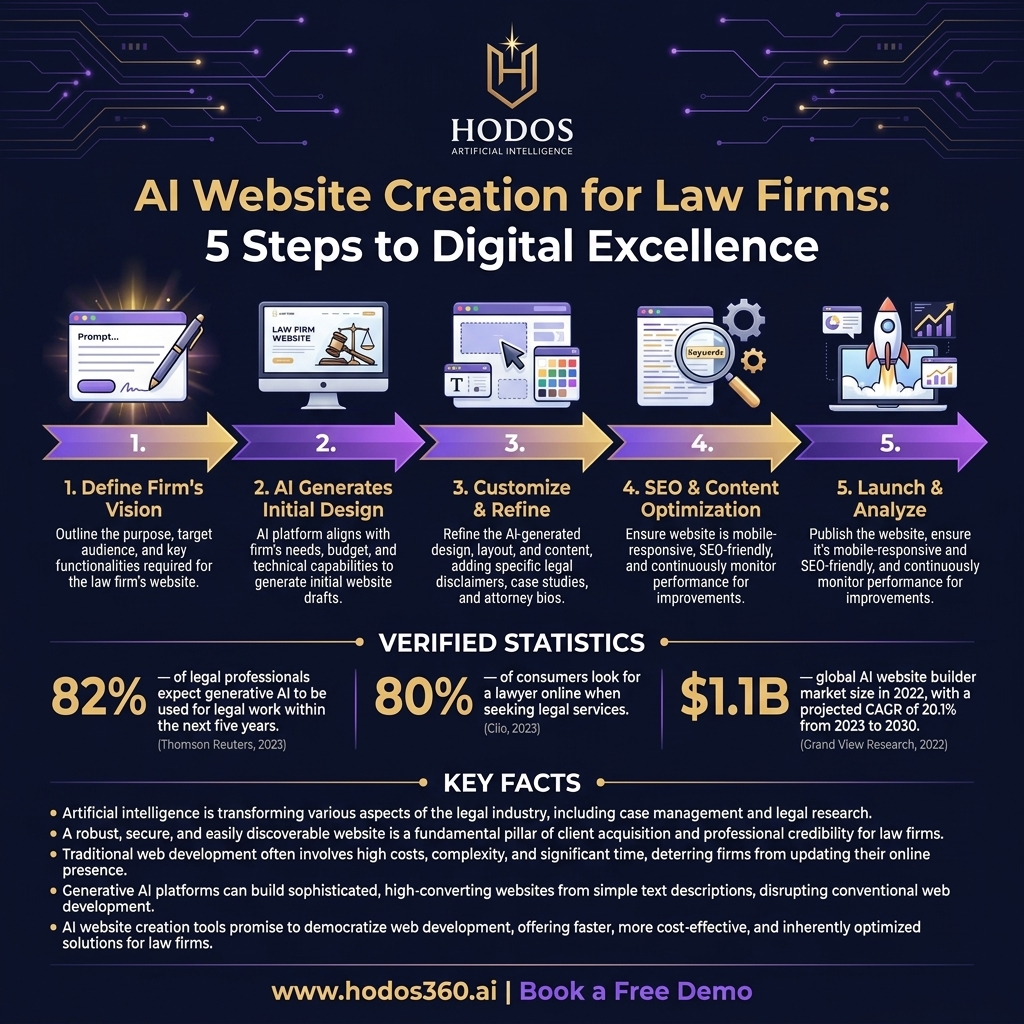
This process significantly reduces the initial design phase, allowing firms to iterate rapidly and focus on content and strategy rather than pixel-perfect alignment. Learn more about AI Legal Website Optimization: Essential Guide for Law Firms. Moreover, these platforms often incorporate AI-driven analytics, continually suggesting improvements based on user behavior data, ensuring the website remains a high-performing asset.
This iterative optimization, once a costly post-launch endeavor, becomes an inherent feature of the AI-powered development cycle, ensuring that a law firm's digital presence is not static but dynamically evolving to meet market demands.
Elevating Legal Digital Presence: Why AI Website Creation is Critical for Law Firms
For law firms, a website is far more than an online brochure; it's a critical client acquisition tool, a repository of professional credibility, and often the first point of contact for prospective clients. In 2023, the ABA TechReport indicated that over 80% of law firms maintain a website, but only a fraction truly leverage it for lead generation and client engagement.
The challenge for legal practices lies in creating a digital presence that not only looks professional but also adheres to ethical guidelines, manages sensitive client data securely, and ranks highly in search engine results for specialized legal queries. AI website creation addresses these challenges head-on.
Imagine an AI that can automatically generate disclaimers, privacy policies, and terms of service compliant with local bar association rules or even international regulations like the GDPR, or suggest content that resonates with specific client demographics while maintaining a dignified and authoritative tone.
Furthermore, the competitive landscape in legal services demands a dynamic online presence.
Firms that cling to outdated, static websites risk being overshadowed by more technologically adept competitors. Learn more about AI Litigation Workflows: Essential for Modern Law Firms. AI-powered platforms can integrate advanced SEO optimization directly into the building process, ensuring that practice area pages, attorney bios, and legal blogs are structured to rank for relevant keywords, driving organic traffic.
This proactive approach to SEO, combined with responsive design that ensures seamless viewing across all devices—a critical factor for mobile-first indexing by search engines—provides a significant edge. The tension between tradition and innovation is palpable in the legal sector; firms like Allen & Overy, known for their embrace of legal tech through initiatives like 'Fuse,' demonstrate that forward-thinking practices are already exploring how AI can enhance every facet of their operations, including their outward-facing digital identity.
This proactive adoption of AI website creation is not just about efficiency; it's about survival and growth in an increasingly digital-first legal marketplace.
- ✓Enhanced Professionalism & Trust: AI can generate designs that convey authority and build client confidence, crucial for legal services.
- ✓Streamlined Client Intake: Integrated forms and secure client portals simplify the onboarding process, reducing administrative burden.
- ✓Superior SEO Performance: AI optimizes content and site structure for legal-specific keywords, improving search engine rankings and visibility.
- ✓Cost & Time Efficiency: Significantly reduces development costs and launch times compared to traditional web agencies.
- ✓24/7 Digital Accessibility: Ensures a responsive, mobile-friendly site that is always available to prospective clients.
- ✓Data-Driven Optimization: AI continually analyzes user behavior to suggest improvements for higher conversion rates.
- ✓Compliance & Security: Can incorporate automated legal disclaimers and security features vital for handling sensitive legal information.
Navigating the AI Web Development Landscape: Features and Considerations
When evaluating AI website creation platforms, law firms must look beyond superficial aesthetics to core functionalities that genuinely serve their unique needs. Key features include robust responsive design capabilities, ensuring the site adapts flawlessly to desktops, tablets, and smartphones, which is essential given that over 50% of web traffic now comes from mobile devices.
Deep SEO optimization tools are paramount, not just for technical SEO (site speed, meta tags) but also for generating and structuring content rich in legal keywords. Integration with existing legal tech stacks, such as case management systems (like Clio or MyCase) or CRM platforms, is also vital for seamless lead capture and client management.
Furthermore, AI-powered content generation for blogs, FAQs, and service descriptions can significantly reduce the burden on attorneys, provided the output is reviewed for accuracy and tone. Analytics dashboards that track visitor behavior, conversion rates, and traffic sources offer invaluable insights, allowing firms to refine their digital strategy continuously.
However, the adoption of AI in web development for law firms is not without its considerations. Learn more about AI Legal Ethics: Essential Guide to Avoiding Blunders. Data security and privacy are paramount, especially when handling client inquiries or sensitive case information through web forms.
Firms must scrutinize the security protocols of any AI platform, ensuring compliance with data protection regulations such as HIPAA, GDPR, or state-specific privacy laws. Ethical AI use is another critical area; the content generated by AI must be factually accurate, avoid misrepresentation, and adhere to advertising rules set forth by bar associations, such as those outlined in the ABA Model Rules of Professional Conduct.
The balance between AI-driven automation and human oversight is crucial to maintain professional integrity and client trust. Firms must also consider the level of customization offered – while templates provide speed, the ability to inject unique branding and specific legal nuances is essential to stand out.
Ensuring Compliance and Security in AI-Built Legal Websites
The intersection of AI, web development, and legal ethics presents a complex but navigable terrain. The ethical duty of competence, as articulated in ABA Model Rule 1.1, extends to understanding the benefits and risks associated with technology. For AI-built websites, this means ensuring the platform chosen provides robust data encryption (e.g., SSL/TLS certificates), secure server infrastructure, and adherence to relevant data residency requirements.
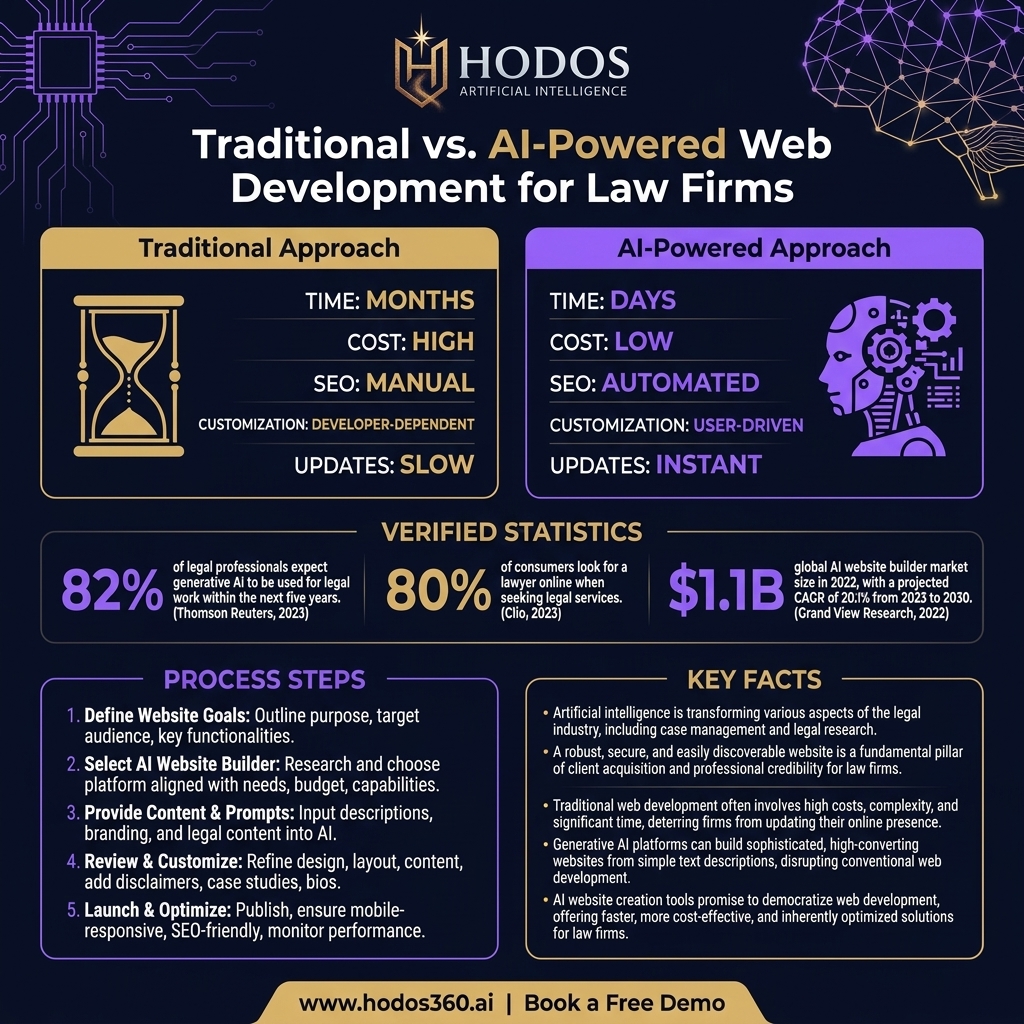
Furthermore, mechanisms for secure client communication, such as encrypted portals, must be seamlessly integrated. Firms must also be vigilant about the content generated by AI, particularly concerning attorney advertising rules. Learn more about Essential AI Vibe Coding: Elevate Law Firm Web Development. While AI can draft compelling narratives, final review by a human attorney is indispensable to prevent misleading statements or non-compliant claims.
The EU AI Act, though primarily focused on high-risk AI systems, signals a global trend towards greater regulation of AI, underscoring the need for proactive due diligence when selecting and deploying AI-powered web solutions. Prioritizing platforms that offer built-in compliance features and transparent data handling practices is not just good business; it's a professional imperative.
The Competitive Edge: How HODOS 360 Empowers Law Firms
In a market increasingly saturated with generic AI website builders, HODOS 360’s Web & Mobile Development service stands out by understanding the intricate demands of the legal sector. Our platform goes beyond simple drag-and-drop functionality, leveraging advanced AI to deliver a suite of features specifically tailored for law firms.
We recognize that a legal website requires more than just aesthetics; it needs to be a powerful engine for client acquisition, a beacon of trust, and a seamless extension of your firm’s professional identity. Our AI-powered website building capabilities are designed to interpret complex legal requirements and brand guidelines, translating them into responsive, SEO-optimized, and high-converting templates.
This means firms can launch sophisticated digital presences that are not only visually appealing but also strategically built to attract and convert prospective clients.
Unlike general-purpose AI platforms that might offer broad solutions, HODOS 360 focuses on the unique nuances of legal marketing and client engagement.
Learn more about AI Adoption: The Ultimate Guide for Law Firm Success. Our system incorporates AI-driven insights into legal SEO, ensuring your site ranks for critical practice area keywords and local searches. The templates are meticulously crafted to reflect the professionalism and gravitas expected in the legal field, while also being highly customizable to reflect your firm’s unique brand.
Whether it’s building a secure client portal, integrating lead qualification forms, or developing dynamic content sections, HODOS 360 provides the tools and intelligence needed for law firms to thrive online. This specialized approach ensures that your investment in an AI-powered website translates directly into tangible benefits: increased visibility, improved lead generation, and a stronger digital footprint in an ever-evolving legal landscape.

Key Takeaways and Next Steps
The emergence of AI website creation tools, exemplified by initiatives like Yandex's Vibecraft, marks a pivotal moment for law firms. The era of lengthy, expensive, and static web development is rapidly fading, replaced by dynamic, AI-powered solutions that promise unprecedented efficiency and effectiveness. For legal practices, this isn't just a technological upgrade; it's a strategic imperative to maintain relevance, attract new clientele, and solidify their digital footprint.
Firms that proactively embrace these technologies will be better positioned to navigate the competitive landscape, while those that hesitate risk falling behind. The shift toward no-code and AI-driven development empowers attorneys to have greater control over their digital presence, ensuring it accurately reflects their expertise and values.
To capitalize on this transformation, law firms should begin by assessing their current digital strategy and identifying areas where AI can provide immediate value. Explore platforms that offer specialized features for the legal industry, prioritizing security, compliance, and robust SEO capabilities. The goal is not just to build a website, but to create a dynamic, client-attracting digital asset that evolves with your firm's needs.
The future of legal marketing and client engagement is intertwined with AI, and leveraging these advanced web development tools is a crucial step towards building a resilient and prosperous practice in the digital age. Discover how HODOS 360 can elevate your firm's digital presence.
Frequently Asked Questions
What is AI website creation for law firms?+
AI website creation for law firms utilizes artificial intelligence to design, build, and optimize professional websites with minimal manual coding. These platforms interpret natural language prompts to generate layouts, content, and features tailored to legal practice needs, ensuring responsive design, SEO optimization, and secure client interactions. This streamlines the process, making sophisticated web presences more accessible and cost-effective for legal professionals.
How can AI-powered websites benefit my law firm?+
AI-powered websites offer numerous benefits, including faster deployment, reduced development costs, and enhanced SEO for legal-specific keywords. They ensure mobile responsiveness, integrate client intake forms seamlessly, and can even generate initial content drafts. This leads to increased online visibility, better lead generation, and a more professional digital footprint, allowing your firm to attract and convert more prospective clients efficiently.
Are AI-built websites secure and compliant for legal practices?+
Yes, reputable AI website platforms designed for the legal sector prioritize security and compliance. They incorporate features like SSL/TLS encryption, secure server infrastructure, and tools to generate privacy policies and disclaimers. However, firms must still exercise due diligence, review generated content for accuracy and ethical adherence, and ensure the chosen platform meets all relevant data protection regulations and bar association guidelines.
What kind of customization is possible with AI website builders?+
While AI website builders often start with templates, advanced platforms offer extensive customization. Users can refine designs, adjust layouts, integrate unique branding elements, and tailor content to specific practice areas. The AI acts as a smart assistant, allowing for iterative improvements based on user feedback and analytical insights, ensuring the final website truly reflects the firm's unique identity and strategic objectives.
How does AI website creation impact SEO for law firms?+
AI website creation profoundly impacts SEO by building sites with inherent optimization. These platforms can automatically generate meta descriptions, structure content with legal keywords, ensure fast loading speeds, and create mobile-friendly designs—all critical SEO factors. Some AI tools even analyze search trends to suggest optimal content strategies, helping law firms rank higher in search results and attract more organic traffic for specialized legal queries.