

Alexa Voice Assistant: Essential Evolution for Law Firm Efficiency
The landscape of artificial intelligence is continually reshaped by strategic collaborations and technological advancements, pushing the boundaries of what’s possible in both consumer and professional spheres. A recent development underscoring this pervasive shift is Amazon’s expansion of its Alexa+ voice assistant beyond its proprietary Echo devices, notably integrating with Bose audio devices.
This move, reported by Business Standard, marks a significant milestone: Alexa is no longer confined to Amazon's hardware ecosystem but is becoming a more ubiquitous, platform-agnostic presence. For legal professionals, this isn't merely a consumer electronics update; it signals a profound shift in how conversational AI will permeate daily operations, offering unprecedented opportunities for efficiency, client engagement, and strategic growth within law firms.
The transition of Alexa voice assistant from a niche smart speaker feature to a widely available, high-fidelity audio integration underscores a broader industry trend toward pervasive, intelligent assistance, a trend that law firms cannot afford to overlook.
This expansion signifies a maturation of voice AI technology, moving from novelty to fundamental utility.
Historically, the legal sector has often been cautious in adopting new technologies, prioritizing security and reliability above all else. However, the sheer ubiquity and increasing sophistication of voice AI, exemplified by this Amazon and Bose partnership, demand a re-evaluation of its potential impact. Firms that embrace this evolution stand to gain a significant competitive edge, streamlining everything from routine administrative tasks to complex client interactions.
As the capability of these devices expands, so too does the potential for specialized legal applications, allowing attorneys and support staff to leverage intuitive voice commands for case management, research, and communication. The challenge now lies in understanding how to securely and ethically integrate these powerful tools into the highly regulated environment of legal practice, transforming the way legal services are delivered and managed.
This article will explore the practical implications, benefits, and considerations for law firms looking to harness the power of advanced conversational AI.
The Pervasive Rise of Alexa Voice Assistant in a Connected World
The news of Amazon integrating Alexa+ into Bose audio devices, including new Lifestyle Ultra Speaker and Soundbar models, highlights a critical inflection point for voice AI. For years, Amazon's strategy, championed by leaders like Jeff Bezos and later Andy Jassy, focused on embedding Alexa deeply within its own ecosystem.
This latest move, however, signals a pivot towards broader interoperability, a strategy that recognizes the consumer demand for seamless AI experiences across various third-party hardware. This shift is not just about convenience; it’s about making intelligent assistants an invisible, yet integral, part of our digital lives.
Learn more about AI Legal Research: The Ultimate Evolution of Legal Analysis. As consumers become accustomed to interacting with AI through a multitude of devices, from their cars to their smart speakers, the expectation for similar intuitive interfaces in professional settings, including law firms, grows exponentially.
This pervasive adoption lays the groundwork for advanced alexa voice assistant capabilities to become a standard rather than an exception in legal operations.
This technological diffusion is backed by compelling market data. According to a 2023 report by Gartner, voice assistant adoption continues to surge, with an estimated 8.4 billion digital voice assistants in use globally, exceeding the world's population. This figure is projected to grow further, indicating a profound societal shift towards voice-first interactions.
For legal professionals, this trend translates into a workforce and client base increasingly comfortable and expectant of voice-enabled services. Learn more about AI Voice Assistants: The Essential Tool for Legal Context. Firms that fail to acknowledge this burgeoning trend risk falling behind competitors who proactively integrate such technologies.
The expansion of Alexa voice assistant capabilities into high-quality audio products like those from Bose means that the fidelity and reliability of voice interaction are also improving, making it more viable for professional use cases where clarity and accuracy are paramount. This isn't just about simple commands; it's about sophisticated natural language processing becoming accessible in more environments, opening doors for complex legal workflows.
The underlying advancements driving this ubiquity are equally significant. Companies like NVIDIA, under the leadership of Jensen Huang, are continuously pushing the boundaries of AI processing power, enabling more complex and real-time conversational AI. Similarly, firms like OpenAI and Anthropic, led by figures such as Sam Altman and Dario Amodei respectively, are refining large language models that power these assistants, making them more contextually aware and capable of nuanced understanding.
This technological backbone ensures that a voice AI for lawyers isn't just a gimmick but a robust tool capable of handling intricate legal terminology and processes. Learn more about AI Call Receptionist: Ultimate Guide for Law Firms. The integration with a diverse range of audio devices further enhances accessibility, allowing lawyers to interact with their systems hands-free, whether in their office, a courthouse, or even remotely.
The move beyond proprietary hardware signifies a broader, more inclusive future for voice AI, one where its power can be leveraged by a wider array of users across various professional settings.
This broad availability fosters an environment where innovation thrives beyond the tech giants themselves. Startup ecosystems are now building specialized applications atop these foundational voice AI platforms. For instance, while Amazon provides the core Alexa+ technology, third-party developers can create bespoke skills tailored to specific industries.
This modular approach allows for the development of legal tech innovation that directly addresses the unique needs of law firms, from legal research prompts to secure client communication. Learn more about Website Design Cost 2026: Strategic Investment for Law Firms. The implications for firms are clear: the time to explore and pilot voice AI solutions is now.
As the technology becomes more refined and integrated into everyday tools, the barrier to entry for adopting sophisticated AI legal workflows diminishes, making it an increasingly viable strategy for firms of all sizes looking to enhance their law firm efficiency and client service capabilities.
Transforming Law Firm Operations with Advanced Voice AI Solutions
The integration of Alexa voice assistant capabilities into a wider array of devices presents a transformative opportunity for law firm operations, particularly in areas like client intake, scheduling, and information retrieval. Imagine a busy partner, like Sarah Chen, a litigation specialist at DLA Piper, dictating notes directly into a case file, scheduling a deposition, or requesting a summary of recent case law, all through a secure voice interface.
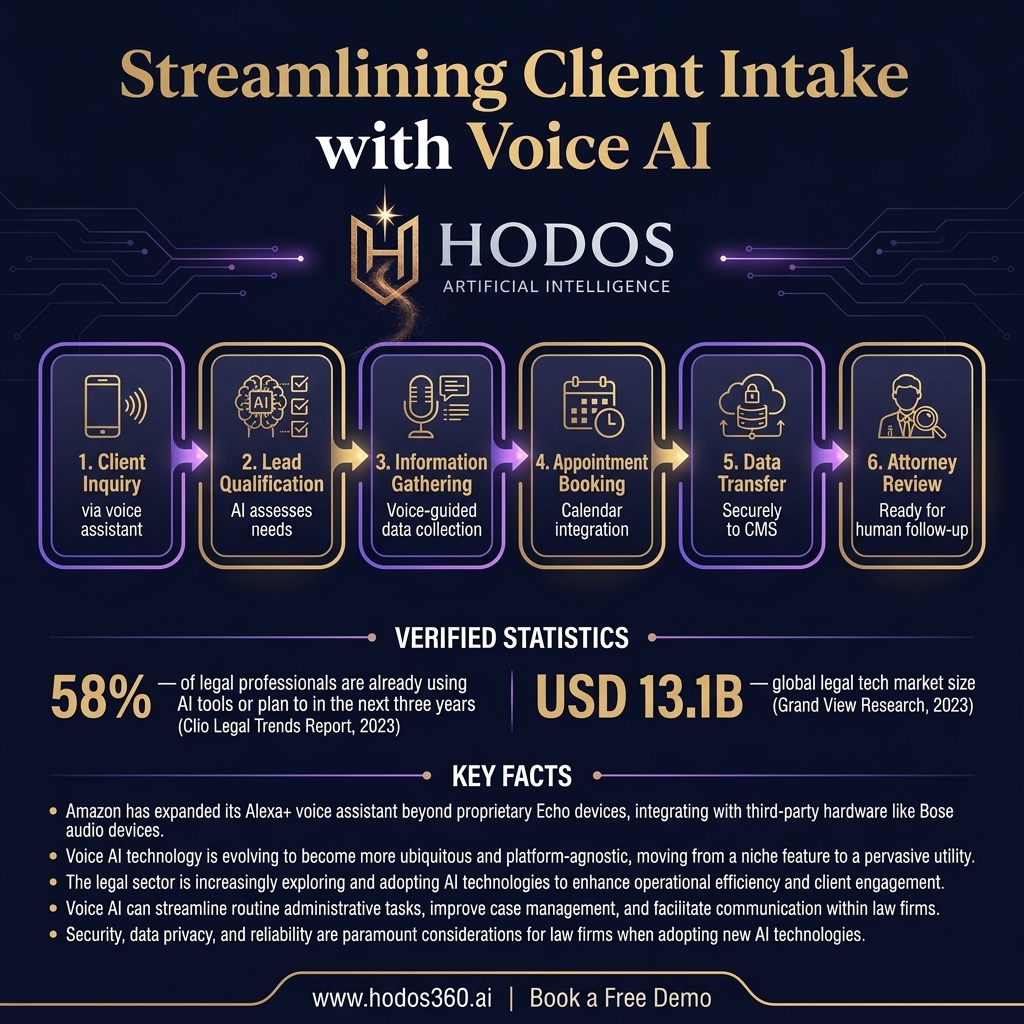
This hands-free interaction significantly reduces the time spent on administrative tasks, allowing legal professionals to focus on higher-value work. Learn more about AI Adoption: The Essential Shift for Modern Law Firms. Platforms like HODOS 360's AI Voice Assistants are specifically designed to meet these sophisticated demands, offering 24/7 phone answering, lead qualification, and appointment booking, which are critical for maintaining responsiveness in a competitive legal market.
The ability to route calls intelligently and provide multilingual support ensures that no potential client is missed, and every interaction is handled professionally, enhancing the firm's reputation and accessibility.
One of the most immediate impacts of advanced voice AI is in client intake automation. The traditional intake process can be time-consuming and prone to human error, often involving multiple forms and manual data entry. With an AI voice assistant, prospective clients can provide initial details, schedule consultations, and even receive answers to frequently asked questions in a conversational manner.
This not only improves the client experience by offering instant, round-the-clock service but also ensures that critical data is captured accurately and consistently. Learn more about AI Document Workflows: Unleash Efficiency & ROI in 2026. For example, a small firm like 'LexCorp Legal' in Austin, Texas, could leverage HODOS 360’s AI Voice Assistants to manage after-hours inquiries, qualify leads, and book initial appointments, effectively extending their operational hours without increasing overhead.
This level of automation, once a futuristic concept, is now a tangible reality, allowing firms to scale their client engagement efforts efficiently.
Enhancing Client Experience and Accessibility
Beyond internal efficiencies, conversational AI legal solutions significantly enhance the client experience. In an era where client expectations for instant gratification and personalized service are at an all-time high, a 24/7 AI voice assistant can be a game-changer. It provides immediate responses, directs clients to relevant resources, and ensures that sensitive inquiries are routed to the appropriate human professional without delay.
The multilingual support offered by platforms like HODOS 360’s AI Voice Assistants is particularly valuable in diverse markets, breaking down communication barriers and making legal services more accessible to a broader population. This proactive approach to client service not only builds trust and loyalty but also differentiates a firm in a crowded legal marketplace.
Firms like 'Global Legal Advisors' with international clientele find this feature indispensable, ensuring seamless communication across linguistic divides.
- ✓Automated Client Intake: Voice assistants can guide new clients through initial information gathering, scheduling consultations, and answering common queries 24/7, reducing staff workload.
- ✓Efficient Appointment Booking: Integrate directly with calendars to schedule and confirm meetings, sending automated reminders to reduce no-shows.
- ✓Intelligent Lead Qualification: AI can assess the urgency and nature of inquiries, prioritizing high-value leads and routing them to the appropriate attorney.
- ✓Multilingual Support: Break down language barriers, making legal services accessible to a diverse client base and expanding market reach.
- ✓Hands-Free Document Interaction: Dictate notes, request document drafts, or retrieve case information using voice commands, enhancing productivity during research or travel.
- ✓Streamlined Internal Communication: Facilitate quick information sharing among legal teams, set reminders for deadlines, and manage internal meeting schedules.
- ✓Enhanced Accessibility: Provide alternative interaction methods for legal professionals and clients with disabilities, promoting inclusivity.
The proliferation of smart speakers legal applications means that lawyers can also leverage voice AI for internal knowledge management. Imagine asking an AI for a summary of a specific contract clause, retrieving a precedent from the firm's internal database, or even initiating a document automation process with a simple voice command.
This reduces the friction associated with navigating complex software interfaces, allowing legal professionals to stay focused on their analytical tasks. For example, a junior associate could quickly access relevant statutes or firm policies without having to manually search through extensive digital libraries. This level of integration, especially when combined with a robust AI Law Firm Management System like HODOS 360's, can redefine daily workflows, making them significantly more agile and less prone to manual bottlenecks.
Discover how these voice-enabled tools can revolutionize your practice. [CTA: Learn how HODOS 360's AI Voice Assistants can transform your firm's client engagement today!]
Navigating the Ethical and Security Complexities of Voice AI in Legal Practice
While the benefits of Alexa voice assistant and other voice AI solutions are compelling, their deployment within the legal sector demands rigorous attention to ethical obligations and data security. Attorneys are bound by strict rules of professional conduct, particularly regarding client confidentiality and the safeguarding of sensitive information.
ABA Model Rule 1.6, for instance, mandates that a lawyer shall not reveal information relating to the representation of a client unless the client gives informed consent, or the disclosure is impliedly authorized. This rule extends to the use of technology; lawyers must make reasonable efforts to prevent the inadvertent or unauthorized disclosure of, or unauthorized access to, information relating to the representation of a client.
The expansion of voice AI into more devices means an increased attack surface and potential vectors for data breaches if not managed diligently. Firms must engage in thorough due diligence when selecting AI vendors, scrutinizing their data encryption protocols, privacy policies, and compliance certifications.
The very nature of voice interaction – converting spoken words into digital data – raises unique security concerns. Where is the data stored? Who has access to it? How is it protected from eavesdropping or unauthorized retrieval? These questions are paramount, especially when dealing with privileged client communications or confidential case details.
Firms must ensure that any voice AI for lawyers solution employs end-to-end encryption for both data in transit and at rest. Furthermore, the AI system should be designed with robust access controls, ensuring that only authorized personnel can retrieve specific information. Professor Rebecca Crootof, a leading scholar on AI and law at Yale Law School, has extensively written on the challenges of regulating AI, emphasizing the need for clear legal frameworks and accountability mechanisms.
Her work highlights that as AI becomes more integrated into critical sectors, the responsibility for ethical deployment rests heavily on both developers and users.
Compliance and Confidentiality in a Voice-Enabled Environment
Achieving compliance in a voice-enabled legal environment requires a multi-faceted approach. Firms must develop clear internal policies governing the use of voice AI, including guidelines on what types of information can be shared verbally with an assistant and under what circumstances. Training for all staff members on these policies and the secure operation of AI devices is essential.
Additionally, firms should consider conducting regular security audits and penetration testing of their voice AI systems to identify and mitigate potential vulnerabilities. Federal Rules of Civil Procedure, particularly those related to e-discovery, also imply a need for robust data governance, as voice interaction logs and transcribed data could become discoverable in litigation.
Therefore, firms need to understand how their AI legal workflows handle data retention, deletion, and retrieval to ensure compliance with legal hold requirements and other regulatory mandates.
The selection of a voice AI vendor is perhaps the most critical step in mitigating ethical and security risks. Reputable providers of legal tech innovation understand the unique demands of the legal industry and build their solutions with compliance in mind. They offer robust security features, transparent data handling practices, and often adhere to industry-specific certifications.
For instance, a vendor that offers dedicated, private cloud environments for legal data, rather than shared public cloud infrastructure, provides an added layer of security and control. The legal community, through organizations like the American Bar Association (ABA), is continuously developing guidelines and best practices for AI adoption, emphasizing the need for lawyers to understand the technology's capabilities and limitations.
Firms should consult these resources and engage with experts to ensure their voice AI strategy aligns with their professional obligations, safeguarding both client data and the firm's reputation.
Strategic Integration: Voice AI as a Catalyst for Law Firm Growth
Beyond operational efficiency and risk mitigation, the strategic integration of Alexa voice assistant and similar conversational AI legal solutions can serve as a powerful catalyst for law firm growth. In a competitive market, differentiation is key, and firms that leverage cutting-edge technology to enhance service delivery and client engagement will stand out.
For example, the ability to offer immediate, 24/7 client support via a multilingual voice assistant, as provided by HODOS 360, can attract a broader client base and improve client satisfaction scores. This superior service translates directly into positive word-of-mouth referrals and stronger client retention, both vital for sustainable growth.
The data collected from these interactions, when anonymized and analyzed, can also provide valuable insights into client needs and market trends, informing future business development strategies.
The competitive landscape in legal tech is heating up, with major players like Thomson Reuters and LexisNexis continuously integrating more advanced AI features into their offerings. However, the expansion of general-purpose AI platforms like Alexa into more devices creates new avenues for specialized legal tech innovation that even smaller firms can adopt.
This democratization of advanced AI tools levels the playing field, allowing agile firms to implement sophisticated solutions without the need for massive R&D budgets. The tension between traditional legal practices and technology-forward firms creates a dynamic environment where early adopters gain a significant advantage. Firms that invest in integrating AI legal workflows now, using solutions that are both powerful and secure, are not just keeping pace; they are actively shaping the future of legal service delivery and positioning themselves as industry leaders.
The Future of Legal Workflows with Conversational AI
The future of legal workflows with voice AI for lawyers envisions a highly augmented legal professional, where AI acts as a sophisticated co-pilot rather than a replacement. Imagine a legal assistant that not only schedules appointments but also proactively flags potential conflicts of interest based on a voice-dictated client intake, or suggests relevant legal precedents during a verbal brainstorming session.
This predictive and proactive assistance frees up lawyers to focus on the strategic, human-centric aspects of their work – client counseling, negotiation, and complex problem-solving. This shift is not about diminishing the role of the lawyer but elevating it, allowing them to leverage their expertise more effectively and efficiently.
Firms like Latham & Watkins are already exploring how AI can enhance their global practices, proving that even the largest and most established firms see the value in this evolving technology. Learn more about how integrated AI platforms can drive your firm forward. [CTA: Explore HODOS 360's AI Law Firm Management System and AI Marketing Platform to accelerate your firm's growth!]
Furthermore, the integration of smart speakers legal applications with other AI-powered platforms, such as HODOS 360's AI Marketing Platform, offers synergistic benefits. Voice AI can gather client sentiment and preferences, which can then feed into AI-driven content generation and social media automation strategies. This creates a holistic ecosystem where client interactions, operational efficiencies, and marketing efforts are seamlessly integrated and optimized.
The ability to track ROI for these digital initiatives provides law firm partners, such as managing partner Emily Carter of 'Innovate Legal Solutions,' with tangible data to justify technology investments. This comprehensive approach ensures that every aspect of the firm’s operations is geared towards maximum impact and sustainable growth, solidifying its position in a rapidly evolving market.
The expansion of alexa voice assistant to new devices is just the beginning of this integrated, intelligent future.

Practical Steps for Law Firms to Embrace Voice AI Innovation
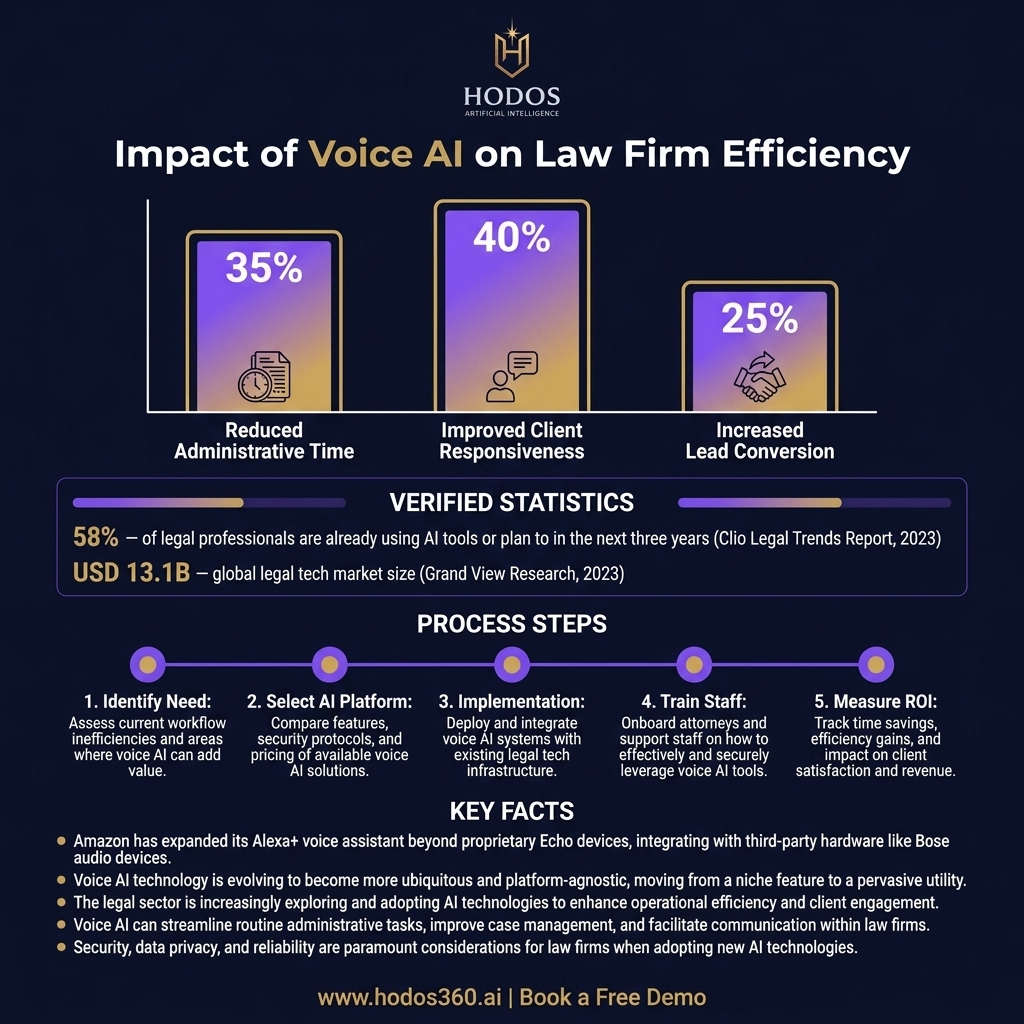
For law firms considering the adoption of Alexa voice assistant and similar AI legal workflows, a phased and strategic approach is crucial. The first step involves a thorough assessment of current pain points and identifying areas where voice AI can provide the most immediate and impactful benefits.
This could be in client intake, appointment scheduling, or internal knowledge retrieval. Firms should start with pilot programs in a controlled environment, perhaps with a small team or for specific, less sensitive tasks. This allows for testing the technology, gathering feedback from users, and refining processes before a broader rollout.
Investing in robust training for all staff members is equally important, ensuring they understand how to effectively and securely interact with the new devices and systems.
Selecting the right technology partner is paramount. Firms should seek out vendors with a proven track record in legal tech innovation and a deep understanding of the legal industry's unique compliance and security requirements. HODOS 360, for example, offers comprehensive AI-powered solutions including AI Voice Assistants and an AI Law Firm Management System, designed with the legal professional in mind.
Such platforms provide not only the core voice AI capabilities but also integrate seamlessly with other essential firm functions like case management, billing, and document automation. This holistic approach ensures that voice AI becomes an integrated part of the firm's digital infrastructure, rather than a standalone tool, maximizing its potential for law firm efficiency and overall impact.
By choosing a partner that prioritizes security, scalability, and legal-specific functionality, firms can confidently navigate the complexities of AI adoption.
Finally, continuous evaluation and adaptation are key to successful long-term AI integration. The field of artificial intelligence is rapidly evolving, with new breakthroughs and applications emerging constantly. Firms should establish mechanisms for regularly reviewing the performance of their voice AI for lawyers solutions, soliciting user feedback, and staying abreast of new developments.
This iterative process allows firms to optimize their AI strategies, unlock new functionalities, and ensure that their technology investments continue to yield tangible returns. As Amazon continues to expand the reach of Alexa voice assistant and other AI solutions, the legal industry's embrace of these tools will define the next generation of legal service delivery.
The journey into advanced legal AI is not a one-time implementation but an ongoing commitment to innovation and excellence. [CTA: Ready to integrate cutting-edge AI into your legal practice? Book a free demo with HODOS 360 today and discover your firm's potential!]
Frequently Asked Questions
How can voice AI improve client intake for my law firm?+
Voice AI, like HODOS 360's AI Voice Assistants, can automate initial client interactions 24/7. It can gather essential contact information, answer frequently asked questions, qualify leads based on predefined criteria, and even schedule consultations directly into your firm's calendar. This streamlines the process, ensures immediate responses, and frees up your staff to focus on more complex tasks, significantly enhancing efficiency and client satisfaction.
Is voice AI secure for handling sensitive legal information and client confidentiality?+
Yes, but security is paramount and requires careful vendor selection. Reputable legal AI solutions employ robust security measures, including end-to-end encryption for data in transit and at rest, secure cloud storage, and strict access controls. Firms must conduct due diligence, ensure compliance with ABA Model Rules and data privacy regulations, and implement clear internal policies for AI usage to safeguard client confidentiality effectively.
What's the difference between general voice assistants (like Alexa) and legal-specific AI solutions?+
General voice assistants, while powerful, are designed for broad consumer use. Legal-specific AI solutions, often built upon these foundational technologies, are tailored to the unique demands of law firms. They integrate with legal practice management systems, understand legal terminology, and are designed with legal compliance and confidentiality in mind. HODOS 360's AI Voice Assistants offer specialized features like advanced lead qualification and secure call routing for legal contexts.
How can small and mid-sized law firms afford to implement voice AI?+
Many AI legal tech solutions are now offered on a subscription basis, making them accessible to firms of all sizes. The ROI comes from increased efficiency, reduced administrative costs, improved client satisfaction, and enhanced lead generation. Starting with specific modules, like an AI voice assistant for client intake, allows firms to pilot the technology and scale as they see benefits, making it a cost-effective investment for growth.
Will voice AI replace legal professionals or paralegals?+
Voice AI is designed to augment, not replace, legal professionals. It handles repetitive, administrative tasks, allowing lawyers and paralegals to focus on higher-value activities that require human judgment, empathy, and strategic thinking. It acts as a powerful assistant, improving efficiency, accuracy, and accessibility, thereby elevating the role of human professionals rather than diminishing it. The goal is augmentation, not automation of the entire legal process.