
Autonomous AI Agents: Essential for Law Firms' Future
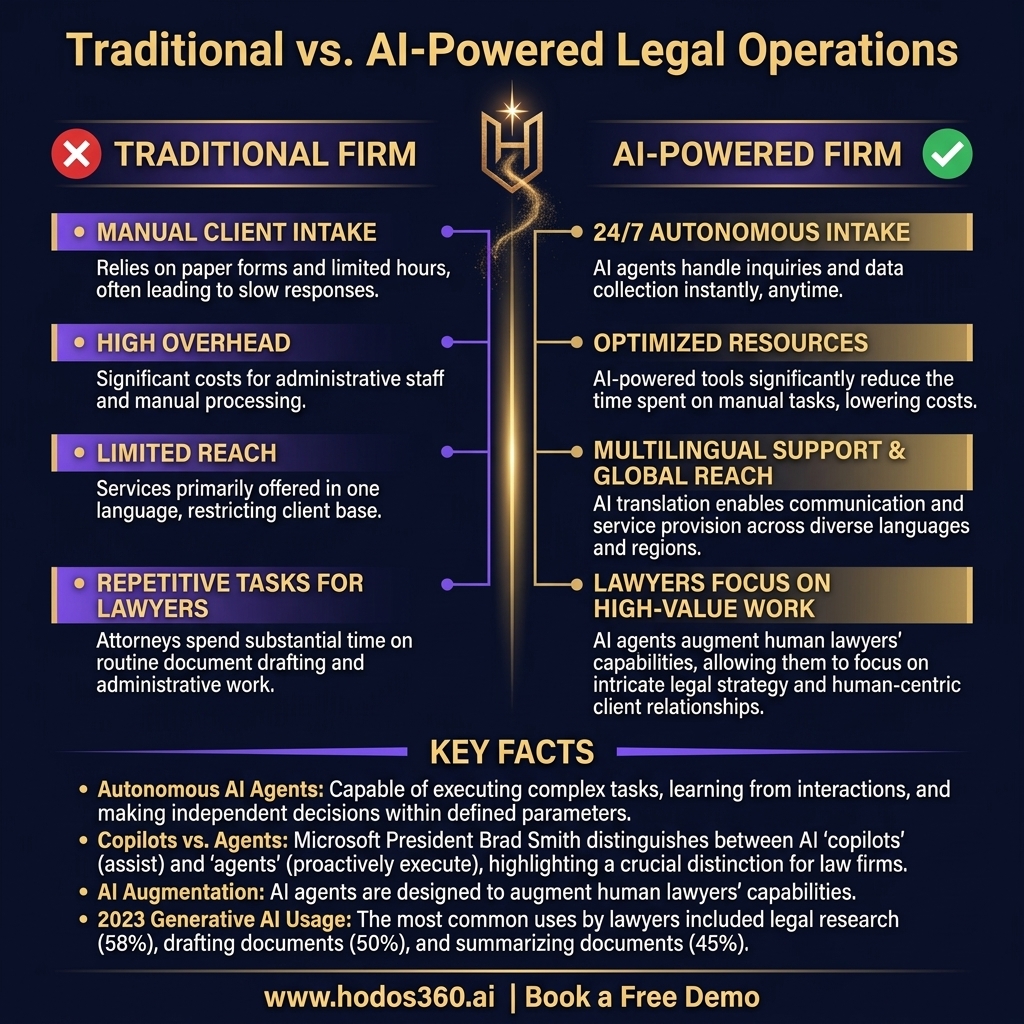
The legal industry, often characterized by its reliance on tradition and meticulous human oversight, stands at the precipice of a profound transformation. The concept of autonomous AI agents, once confined to the realm of science fiction, is now rapidly becoming a tangible reality, reshaping the very fabric of how law firms operate. These sophisticated AI entities, capable of executing complex tasks, learning from interactions, and making independent decisions within defined parameters, represent a paradigm shift far beyond mere automation. They are not just tools; they are evolving into integral members of the legal workforce, promising unprecedented levels of efficiency, accuracy, and scalability. This shift isn't about replacing human lawyers, but about augmenting their capabilities, freeing them from mundane, repetitive tasks to focus on the intricate legal strategy and human-centric client relationships that truly define their profession. The conversation around AI in law has moved from theoretical discussions to practical implementation, with firms globally exploring how these autonomous AI agents can integrate seamlessly into their workflows.
Consider the recent buzz from industry leaders and technological giants. At a recent tech summit, Microsoft President Brad Smith articulated the distinction between AI "copilots" and "agents," emphasizing that while copilots assist, agents proactively execute. This distinction is crucial for law firms contemplating their AI strategy. Firms like LexCorp Legal, a mid-sized practice in Seattle, found themselves grappling with an overwhelming volume of client inquiries and administrative burdens. Sarah Chen, a managing partner at LexCorp, recounted their initial skepticism: "We were drowning in paperwork and repetitive client calls. The idea of an AI handling critical client interactions felt risky, almost impersonal." However, as the demands of a competitive market intensified, LexCorp, much like many other firms, recognized the urgent need for innovation. The firm's journey reflects a broader industry trend where the adoption of advanced AI is no longer a competitive advantage but a strategic necessity, driven by the imperative to streamline operations, reduce costs, and deliver superior client experiences. The capabilities of these digital employees extend across various functions, promising a future where law firms can operate with unparalleled agility and focus on higher-value tasks.
This evolution is not without its challenges, yet the potential rewards are immense. The legal sector, according to a 2024 report by Deloitte, predicts that up to 40% of enterprise workflows could become "AI-autonomous" by 2030, a figure that underscores the speed and depth of this impending change. This isn't a distant future; it's a present reality being built by companies like HODOS 360, which offers specialized AI services designed to integrate these autonomous AI agents into the core operations of law firms. From managing intricate case details to automating client intake and marketing, these platforms are democratizing access to cutting-edge technology, enabling firms of all sizes to harness the power of AI. The transition to an AI-augmented legal practice requires careful planning, ethical considerations, and a clear understanding of the technology's capabilities and limitations. As we delve deeper, we will explore the tangible benefits, practical applications, and strategic imperatives for law firms looking to embrace this transformative era.
- ✓The Rise of Autonomous AI Agents in Legal Practice
- ✓Redefining Legal Operations: AI Workforce for Higher-Value Tasks
- ✓The Voice of Innovation: HODOS 360's AI Voice Assistants in Action
- ✓Navigating the Future: Ethical and Strategic Considerations for AI Agents
- ✓Building Your Autonomous Legal Workforce: A Strategic Imperative
- ✓Key Takeaways and Next Steps
The Rise of Autonomous AI Agents in Legal Practice
The legal industry is witnessing a profound shift, moving beyond basic automation to the sophisticated capabilities of autonomous AI agents. These agents are not merely tools that perform predefined tasks; they are intelligent systems designed to understand context, make decisions, and execute complex workflows with minimal human intervention. This evolution marks a significant departure from earlier generations of legal tech, which primarily focused on document review or rudimentary research. Today's AI agents, powered by advanced machine learning and natural language processing, can manage entire business functions, learn from vast datasets of legal precedents, and even engage in nuanced client interactions. This trend is amplified by the rapid advancements in large language models (LLMs) from pioneers like OpenAI and Anthropic, whose foundational models enable the development of highly capable and adaptable AI workforce solutions. The legal implications are far-reaching, promising to reshape everything from case management to client engagement, allowing legal professionals to focus on the strategic, human-centric aspects of their work.
The impact of these autonomous AI agents is perhaps best illustrated by their growing presence in areas traditionally demanding significant human effort. Take, for instance, the intricate process of client intake and lead qualification. Learn more about AI Officer: The Essential Role for Modern Law Firms. Historically, this involved countless hours of human labor, often leading to bottlenecks and missed opportunities. However, as noted by a recent survey from Thomson Reuters, firms that adopted AI for client-facing tasks reported up to a 30% reduction in intake processing time and a significant increase in qualified leads. This data underscores the potential for AI to act as a highly efficient digital employee, handling initial client contact, gathering essential information, and even scheduling appointments. The shift is not just about speed; it's about consistency and precision, ensuring that every potential client receives a prompt, professional, and accurate initial engagement. The ability of these agents to operate 24/7, across multiple languages, further enhances a firm's reach and responsiveness, transforming customer engagement and setting a new standard for service delivery in the legal sector.
Redefining Legal Operations: AI Workforce for Higher-Value Tasks
The integration of an AI workforce into law firms represents a strategic pivot towards operational excellence and a focus on higher-value tasks. Firms are no longer just looking to automate repetitive processes; they are aiming to deploy autonomous AI agents that can truly augment human legal expertise. Consider the example of Harvey AI, a legal AI startup that secured significant funding and entered into a groundbreaking partnership with global law firm Allen & Overy. This collaboration isn't about replacing lawyers with AI; it's about empowering A&O's attorneys with sophisticated AI tools that can perform complex legal research, draft preliminary documents, and analyze intricate contracts with unparalleled speed and accuracy. Such partnerships highlight a critical trend: the most forward-thinking firms are leveraging AI to elevate their human talent, enabling them to dedicate more time to strategic thinking, complex problem-solving, and direct client advocacy – areas where human judgment and empathy remain irreplaceable. This is the essence of the "human with AI teams" philosophy championed by industry thought leaders.
The transformation extends beyond research and drafting. An autonomous AI workforce can profoundly impact a firm's entire operational backbone. Learn more about Gemini 3.1 Flash TTS: Ultimate Voice AI for Law Firms. From managing intricate billing cycles and ensuring compliance with financial regulations to automating document generation for common legal procedures, these agents streamline essential administrative functions. A 2023 report by Gartner indicated that firms embracing intelligent automation could see a 25-35% improvement in overall operational efficiency within three years. This isn't merely about cutting costs; it's about unlocking capacity. By offloading the digital grunt work, legal professionals gain invaluable time to engage in more nuanced client strategy, develop innovative legal solutions, and foster deeper client relationships. This strategic reallocation of resources allows firms to expand their service offerings, take on more complex cases, and ultimately drive greater profitability. The focus shifts from the tedious execution of tasks to the strategic oversight and refinement of legal outcomes, ensuring that every minute spent by a human lawyer is dedicated to maximizing client value.
Ready to transform your law firm with cutting-edge AI? [Explore HODOS 360's AI Solutions Today]
The Voice of Innovation: HODOS 360's AI Voice Assistants in Action
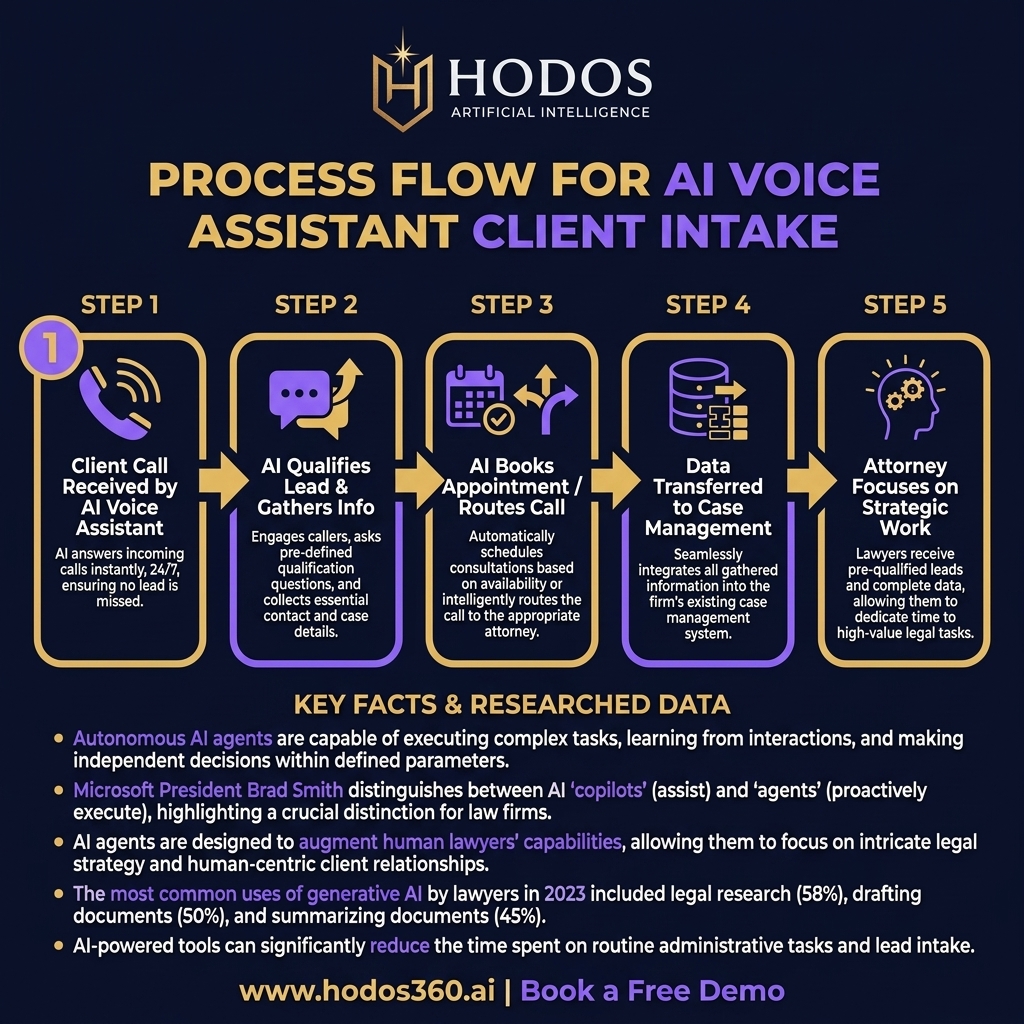
Among the most impactful applications of autonomous AI agents in the legal sector is the emergence of advanced AI Voice Assistants, a core service offered by HODOS 360. These aren't your typical chatbots; they are sophisticated digital employees designed to handle client interactions with remarkable nuance and efficiency. Imagine a law firm where every incoming call is answered instantly, 24/7, by an intelligent, multilingual assistant capable of understanding complex inquiries, qualifying leads, and even booking appointments directly into the firm's calendar. This capability was a game-changer for firms like LexCorp Legal, as Managing Partner Sarah Chen can attest. After implementing HODOS 360's AI Voice Assistants, LexCorp saw an immediate reduction in missed calls and an astonishing 40% increase in successfully qualified leads within the first six months. "It wasn't just about answering the phone," Chen remarked at a recent legal tech conference, "it was about providing a consistent, professional first impression that elevated our brand and allowed our human staff to focus on active cases."
The power of these AI voice assistants lies in their ability to perform critical customer engagement tasks autonomously. Learn more about AI Voice: Legal's 2026 Paradigm Shift & Innovation Catalyst. They can conduct initial client interviews, gather preliminary case details, explain standard legal processes, and even route calls to the appropriate human attorney based on the caller's specific needs, all without direct human intervention. This level of automation ensures that potential clients receive immediate attention, fostering trust and significantly reducing the time from initial contact to retaining legal services. Furthermore, the multilingual support capability breaks down barriers, allowing firms to serve a broader demographic and extend their market reach. This is particularly vital in diverse urban centers where language can often be an impediment to accessing legal aid. The integration of such autonomous AI agents ensures that a firm's digital presence is not just a website, but a fully functional, responsive extension of its human team, capable of delivering seamless and efficient service around the clock.
Enhancing Client Experience and Operational Efficiency
The deployment of AI voice assistants fundamentally redefines client experience. By providing immediate, intelligent responses and round-the-clock availability, law firms can significantly improve client satisfaction and retention. Clients today expect instant gratification and seamless digital interactions, a benchmark often set by consumer tech giants. Legal firms that meet these expectations through AI-driven solutions gain a distinct competitive edge. Beyond client satisfaction, the operational efficiency gains are substantial. Learn more about Essential AI Voice Assistant Strategies for Modern Law Firms. A recent study published by the American Bar Association (ABA) highlighted that firms leveraging AI for administrative tasks, including voice-based intake, reported reallocating an average of 15-20% of staff time from routine tasks to more strategic legal work. This translates directly into improved productivity, reduced overheads, and a stronger focus on core legal services. The ability to automate lead qualification and appointment booking also optimizes the sales funnel, ensuring that human attorneys spend their valuable time engaging with genuinely prospective clients rather than filtering inquiries.
Navigating the Future: Ethical and Strategic Considerations for AI Agents
As law firms increasingly embrace autonomous AI agents, critical ethical and strategic considerations come to the forefront. The legal profession, bound by stringent ethical rules such as the ABA Model Rules of Professional Conduct (e.g., Rule 1.1 on Competence and Rule 1.6 on Confidentiality), must ensure that the deployment of AI aligns with these foundational principles. A primary concern revolves around accountability: who is responsible when an AI workforce makes an error or provides incorrect information? This question was a central theme at LegalTech NYC 2026, where legal scholars and tech developers debated the need for clear guidelines and robust oversight mechanisms. Firms must establish protocols for human review and intervention, especially in areas involving legal advice or sensitive client data. The European Union's AI Act, currently being enforced, offers a glimpse into future regulatory landscapes, emphasizing transparency, data governance, and human oversight for high-risk AI systems. Law firms must proactively develop internal policies that address these issues, ensuring that their AI deployments are not only efficient but also ethically sound and compliant with evolving legal standards.
Another significant consideration is data privacy and security. Autonomous AI agents often process vast amounts of confidential client information, making them potential targets for cyber threats. Learn more about WordPress AI Unlocked: Legal Websites Mastered 2026. Firms must implement state-of-the-art cybersecurity measures, including encryption, access controls, and regular audits, to protect this sensitive data. Furthermore, the ethical implications of AI's decision-making processes, particularly concerning bias, require careful attention. If an AI agent is trained on biased historical data, it could inadvertently perpetuate or amplify those biases, leading to unfair or discriminatory outcomes. Firms must actively mitigate this risk by employing diverse training datasets, regularly auditing AI outputs, and ensuring human oversight in critical decision points. As Dario Amodei, CEO of Anthropic, often stresses, building "safe and helpful" AI is paramount, a principle that resonates deeply within the legal profession. The strategic implementation of AI is not merely a technological challenge but a governance and risk management imperative, requiring a holistic approach that balances innovation with responsibility.
Data Security and Compliance with AI Agents
The integration of autonomous AI agents necessitates a rigorous approach to data security and regulatory compliance. Law firms, as custodians of highly sensitive client information, face heightened responsibilities under various data protection laws, including HIPAA, GDPR, and state-specific privacy statutes. An AI workforce that handles client intake, document automation, or case management must operate within a secure framework that prevents unauthorized access, data breaches, and misuse of information. Firms should partner with AI providers that offer robust security architectures, regular penetration testing, and clear data governance policies. Learn more about AI Website Builders: Ultimate Growth for Law Firms. Furthermore, attorneys have a professional duty to protect client confidentiality, as outlined in ABA Model Rule 1.6. This duty extends to the technology they employ, meaning firms must conduct thorough due diligence on AI systems to ensure they meet or exceed industry-standard security protocols. Compliance is not a one-time check but an ongoing process, requiring continuous monitoring, updates, and training for both human staff and the AI agents themselves, safeguarding client trust and avoiding severe legal and reputational repercussions.
Building Your Autonomous Legal Workforce: A Strategic Imperative
The journey to building an autonomous legal workforce is a strategic imperative for law firms aiming to thrive in the evolving legal landscape. It begins with a clear vision and a phased implementation approach. Firms should identify specific pain points and repetitive tasks that are ripe for AI automation, such as initial client screenings, document generation for routine filings, or basic legal research queries. Starting with targeted applications allows firms to test the waters, gather data on efficiency gains, and build internal confidence in AI capabilities. This iterative approach minimizes disruption and allows for continuous refinement of AI workflows. Key to successful implementation is choosing the right technology partner. Platforms like HODOS 360 offer an integrated suite of services – from AI Law Firm Management Systems to AI Voice Assistants and AI Marketing Platforms – providing a comprehensive ecosystem for firms to gradually build and scale their AI workforce. This holistic approach ensures seamless integration across different operational areas, maximizing the synergistic benefits of AI.
Moreover, successful integration of autonomous AI agents requires significant investment in human capital. This means not only training existing staff to work alongside AI but also cultivating a culture of innovation and adaptability. Lawyers and paralegals need to understand how AI tools function, how to leverage them effectively, and critically, how to oversee their outputs to ensure accuracy and ethical compliance. This reskilling is vital to prevent a "humans versus AI" conflict and instead foster a collaborative environment where AI acts as an enabler for human excellence. Firms that prioritize this human-AI collaboration will be better positioned to attract and retain top talent, as legal professionals increasingly seek workplaces that offer cutting-edge tools and opportunities for higher-value work. The future of law is not about replacing human ingenuity but about augmenting it, creating a more efficient, equitable, and client-focused legal system powered by intelligent autonomous AI agents.

Key Takeaways and Next Steps
The era of autonomous AI agents is not just on the horizon; it is here, actively reshaping the legal profession. For law firms, embracing this transformation is no longer optional but an essential strategy for sustained growth, enhanced efficiency, and superior client service. From automating mundane administrative tasks to revolutionizing client intake through intelligent voice assistants, the capabilities of an AI workforce are vast and continually expanding. The key lies in strategic, ethical, and phased implementation, ensuring that AI serves to augment human expertise, allowing legal professionals to focus on the high-level strategy, complex problem-solving, and empathetic client relationships that define their value. Firms must prioritize robust data security, adhere to evolving ethical guidelines, and invest in training their teams to work effectively alongside these powerful digital employees. By doing so, law firms can navigate the complexities of this new frontier, turning technological disruption into a powerful catalyst for innovation and competitive advantage. Explore how HODOS 360's integrated AI solutions can empower your firm to build a truly autonomous and future-ready legal practice.
Frequently Asked Questions
What exactly are autonomous AI agents in the legal context?+
Autonomous AI agents in law are advanced software systems that can perform complex legal tasks, make decisions, and execute workflows independently within defined parameters. Unlike simple automation tools, they learn from data, adapt to new information, and can handle nuanced interactions, such as initial client intake, document drafting, or legal research, with minimal human oversight. They are essentially intelligent digital employees augmenting a firm's human workforce.
How do autonomous AI agents benefit law firms specifically?+
Law firms benefit significantly from autonomous AI agents by achieving enhanced operational efficiency, reduced administrative burdens, and improved client service. These agents can handle repetitive tasks like lead qualification, appointment booking, and initial document generation, freeing up attorneys for higher-value legal work. This leads to faster case processing, lower overheads, 24/7 client support, and ultimately, greater profitability and client satisfaction.
Are there ethical concerns with using autonomous AI agents in legal practice?+
Yes, ethical concerns are paramount. Key issues include accountability for AI errors, data privacy and confidentiality (ABA Model Rule 1.6), and potential biases in AI decision-making. Firms must implement robust human oversight, transparent AI protocols, stringent cybersecurity measures, and ensure compliance with professional conduct rules and evolving regulations like the EU AI Act to mitigate these risks.
Can autonomous AI agents replace human lawyers?+
No, autonomous AI agents are designed to augment, not replace, human lawyers. While they can automate routine and data-intensive tasks, they lack the nuanced judgment, empathy, ethical reasoning, and strategic thinking essential for complex legal strategy, client advocacy, and navigating unforeseen legal challenges. They serve as powerful digital assistants, enabling lawyers to focus on the truly human aspects of their profession.
What steps should a law firm take to integrate autonomous AI agents?+
Firms should start by identifying specific pain points for automation, then choose a reliable AI technology partner offering integrated solutions. A phased implementation, beginning with targeted applications, is recommended. Crucially, firms must invest in training their staff to collaborate effectively with AI, foster a culture of innovation, and establish strong ethical guidelines and data security protocols.
How do AI Voice Assistants fit into the autonomous AI agent ecosystem?+
AI Voice Assistants are a prime example of autonomous AI agents in action, specifically designed for client-facing interactions. They autonomously handle 24/7 phone answering, lead qualification, appointment booking, and multilingual support. By acting as the firm's frontline digital employee, they streamline client intake, improve responsiveness, and ensure a consistent, professional first impression, thereby enhancing overall operational efficiency and client experience.