


Legal AI Pricing: An Essential Guide for Modern Law Firms
The legal industry stands at a fascinating crossroads, a point where the transformative power of artificial intelligence meets the pragmatic realities of business operations. Just last year, at LegalTech NYC, Sarah Chen, a managing partner at LexCorp LLP, recounted her firm's initial exhilaration over an AI-powered contract review platform. The tool promised unprecedented efficiency, slashing review times by 70%. Yet, months into implementation, the firm faced an unforeseen challenge: a spiraling bill from a consumption-based pricing model that quickly outstripped their initial budget projections. This anecdote, far from isolated, echoes the widespread sentiment captured by Law.com's recent headline, "Pricing Fears Loom Amid the Increasing Ubiquity of Legal AI." As AI becomes an indispensable component of legal workflows, from advanced legal research to client intake and document automation, understanding its true cost and how to manage it strategically has become paramount for law firms globally.
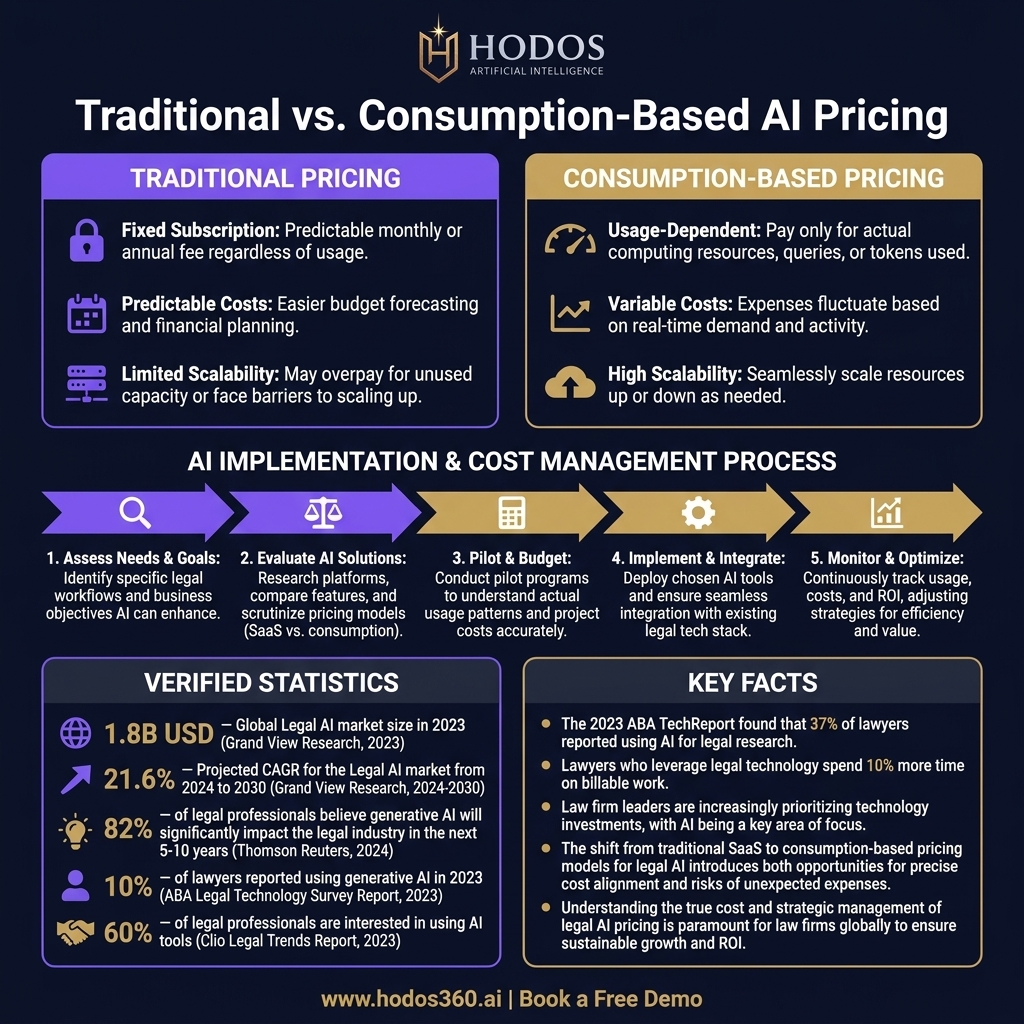
The increasing ubiquity of legal AI tools, while offering immense competitive advantages, introduces a new layer of complexity to financial planning and operational strategy. The traditional SaaS subscription model, once the norm, is rapidly giving way to more nuanced, often consumption-based pricing structures that tie costs directly to usage—be it data processed, API calls made, or 'tokens' consumed by sophisticated large language models (LLMs). This shift presents both opportunities for precise cost alignment with value and significant risks of unexpected expenses, creating a compelling imperative for law firms to develop sophisticated budgeting and utilization strategies. The challenge isn't merely adopting AI; it's mastering the economics of AI adoption to ensure sustainable growth and a clear return on investment. Firms that fail to adapt their understanding of legal AI pricing risk not only financial strain but also falling behind competitors who strategically harness these technologies.
Ready to master your firm's AI strategy and optimize costs? Discover how HODOS 360's AI Law Firm Management System can provide the clarity and control you need. Explore Our AI Solutions Today.
The Evolving Landscape of Legal AI Pricing Models
The journey of legal AI pricing has been a dynamic one, reflecting the rapid technological advancements in the field. Early iterations of legal tech, often rule-based automation tools, typically came with straightforward, flat-fee subscription models. Firms like Clio, a pioneer in cloud-based practice management, initially offered tiered subscriptions based on user count or feature sets. However, the advent of generative AI, spearheaded by breakthroughs from companies like OpenAI and Anthropic, has fundamentally reshaped this paradigm. These advanced AI systems, particularly large language models (LLMs), consume significant computational resources, leading to a natural shift towards usage-based billing. This move aligns with broader trends in cloud computing, where services are often priced per gigabyte stored, per compute hour, or per API call. As Brad Smith, President of Microsoft, has often emphasized, the ethical and economic implications of AI adoption are deeply intertwined, necessitating transparent and adaptable pricing structures.
This evolution is not merely a vendor preference; it's a reflection of the underlying technology. Learn more about Local SEO: Essential Strategies for Law Firm Web Development. When a legal research AI platform, powered by an LLM, processes thousands of documents for discovery or synthesizes complex legal arguments, it incurs real-time costs for processing power and data transfer. Industry analysts, including Gartner, predict a significant acceleration in this trend, forecasting that by 2028, over 35% of company legal departments' new spending on legal tech will be directly tied to their consumption of AI. This statistic underscores a critical shift: firms are no longer just paying for access to a tool, but for the actual work the AI performs. This necessitates a more granular understanding of how AI tools function and how their usage translates into direct costs, urging firms to move beyond simple budgetary line items to comprehensive cost-benefit analyses for their AI legal workflows. The firms that embrace this new reality, like Allen & Overy with their strategic partnership with Harvey AI, are not just adopting AI, but actively shaping their operational and financial models around it.
Understanding Consumption-Based Pricing in Legal Tech
Consumption-based pricing, while offering flexibility, introduces a new set of challenges for law firms accustomed to predictable monthly or annual fees. At its core, this model charges firms based on what they *use* rather than what they *access*. For generative AI, this often translates to 'token' costs – the smallest unit of data (like a word or part of a word) processed by an LLM. Every query, every generated response, every document analyzed contributes to these token counts. This can lead to what some, like Dario Amodei, CEO of Anthropic, have termed the 'token price problem,' where the cost of leveraging the latest, most powerful LLMs for extensive legal tasks can rapidly rise, creating fears of budget overruns. Law firms engaging in large-scale e-discovery or in-depth contractual analysis, for example, might find their AI legal research costs escalating far beyond initial estimates if not carefully monitored. The complexity of these models requires a deep dive into vendor contracts and a clear understanding of usage metrics.
The unpredictability inherent in consumption-based models is a primary source of concern for legal professionals. Learn more about Voice AI: Essential Evolution of the Legal User Interface. Unlike a fixed software license, where costs are known upfront, a firm's monthly AI bill can fluctuate significantly based on case volume, research intensity, and even the efficiency of user prompts. This makes budgeting AI solutions a more intricate task, demanding real-time monitoring and proactive management. For instance, a firm might initially adopt an AI tool for simple document review, but then expand its use to complex litigation strategy, inadvertently increasing its consumption tenfold. Without robust internal controls and clear guidelines for AI usage, firms risk encountering unexpected expenditures that can erode the perceived ROI of their AI investment. This tension between the transformative potential of AI and the practical challenges of managing its costs is a central theme in the ongoing dialogue about the future of legal pricing.
The Hidden Costs of AI Legal Workflows
- ✓Token/API Call Volume: The most direct cost. Each interaction with a generative AI model consumes 'tokens' (parts of words) or makes API calls, which are billed per unit. High-volume tasks like extensive legal research or document generation can quickly accumulate these units.
- ✓Data Storage and Transfer: While not directly AI pricing, the data feeding AI models (documents, case files) often incurs storage costs in cloud environments, and moving large datasets can incur transfer fees.
- ✓Integration & Customization: Integrating AI tools into existing legal tech stacks or customizing them for specific firm needs (e.g., fine-tuning an LLM on proprietary data) often involves significant upfront and ongoing development costs.
- ✓Training & Upskilling: Lawyers and staff need to be trained not just on how to use AI tools, but how to use them efficiently to minimize unnecessary consumption. This includes prompt engineering skills to get accurate results with fewer iterations.
- ✓Security & Compliance: Ensuring AI tools and the data they process meet stringent legal and ethical standards (e.g., client confidentiality, data privacy) requires investment in robust security measures and compliance audits.
- ✓Vendor Lock-in: Over-reliance on a single AI vendor's ecosystem can limit negotiation power and make switching costly, potentially impacting long-term pricing flexibility.
- ✓Maintenance & Updates: While often included in subscriptions, continuous maintenance, updates, and troubleshooting for complex AI systems can have indirect cost implications in terms of internal IT resources.

Strategies for Cost Optimization and ROI with Legal AI
Navigating the complexities of legal AI pricing requires a proactive and multi-faceted strategy focused on cost optimization and maximizing return on investment. The first step involves thorough due diligence during vendor selection. Firms must move beyond flashy demos and scrutinize pricing structures, understanding the granular details of consumption metrics, potential overage charges, and volume discounts. Leading firms are establishing internal AI governance committees, comprising partners, IT leads, and financial officers, to vet new tools and set usage policies. This ensures that AI adoption aligns with the firm's strategic objectives and budgetary constraints. For instance, a firm might pilot a new AI tool on a specific practice group or case type, meticulously tracking its actual usage and cost-savings before a broader rollout. This empirical approach, championed by many successful technology implementations, helps demystify the 'token price problem' and provides concrete data for informed decision-making.
Furthermore, optimizing AI usage within legal workflows is crucial. Learn more about AI for Real Estate Marketing: The Ultimate Legal Edge. This means training legal professionals not just on the functionality of AI tools, but on efficient prompting techniques and best practices to minimize unnecessary consumption. For example, structuring queries to retrieve precise information rather than broad searches can significantly reduce token usage in a legal research AI. Firms are also exploring hybrid approaches, leveraging AI for initial drafts or data synthesis, followed by human review and refinement, striking a balance between automation and expertise. This strategic integration ensures that AI complements human intelligence, enhancing productivity without incurring prohibitive costs. Platforms like HODOS 360's AI Law Firm Management System become invaluable here, providing comprehensive dashboards for tracking AI usage across cases and clients, enabling firms to monitor legal tech costs in real-time and identify areas for optimization, thereby turning potential pricing fears into predictable, manageable expenses.
Ready to transform your law firm's efficiency and client service? HODOS 360 offers AI-powered solutions to streamline operations, enhance marketing, and provide 24/7 support. Book a Free Demo Today.
Beyond the Billable Hour: Value-Based Pricing with AI
The rise of AI in legal practice is accelerating a long-anticipated shift away from the traditional billable hour towards value-based pricing models. As AI tools dramatically reduce the time required for tasks like document review, legal research, and due diligence, the direct correlation between hours worked and value delivered becomes increasingly tenuous. Clients are less willing to pay for hours spent when an AI can accomplish the same task in minutes. This forces firms to rethink their compensation structures, moving towards fixed fees, contingency fees, or success-based billing. The ABA Model Rules of Professional Conduct, specifically Rule 1.5 concerning Fees, emphasizes that fees must be reasonable. As AI makes legal services more efficient, what constitutes a 'reasonable' fee must evolve, taking into account the value created, not just the time expended. Firms that embrace this shift are finding new ways to articulate and monetize the enhanced speed, accuracy, and strategic insights provided by AI.
Implementing value-based billing with AI requires a clear understanding of the 'value' being delivered. Learn more about AI Mobile App Development: An Essential Guide for Law Firms. This involves transparent communication with clients about the efficiencies gained through AI and how those efficiencies translate into predictable costs and superior outcomes. For example, a firm might offer a fixed fee for a merger and acquisition due diligence project, confident that its AI-powered document analysis tools will complete the task efficiently, allowing them to deliver a high-quality service at a competitive price. This approach not only addresses client demand for cost predictability but also positions the firm as forward-thinking and client-centric. The data generated by AI legal workflows can also be leveraged for predictive analytics, allowing firms to more accurately scope projects and offer realistic fixed-fee proposals, further solidifying the transition from a time-centric to a value-centric pricing philosophy. The firms that champion value-based pricing with AI are not just managing legal tech costs; they are redefining the very economics of legal service delivery.
Ethical Considerations in AI-Driven Billing
The integration of AI into billing practices introduces critical ethical considerations that law firms must address. ABA Model Rule 1.4 (Communication), for instance, mandates that lawyers keep clients reasonably informed about the status of their matters and explain things to the extent reasonably necessary for the client to make informed decisions. When AI is used to perform tasks, clients must be informed about its role and how its use impacts the fee structure. Transparency is paramount. Charging clients for hours an AI spent on a task, rather than the actual cost or value derived, could be deemed unethical or misleading. Learn more about AI Marketing: An Essential Guide for Law Firm CMOs. Firms must develop clear policies on how AI-generated work is recorded and billed, ensuring that clients understand the cost efficiencies passed on to them. This might involve itemizing AI usage or incorporating it into a fixed-fee structure that reflects the overall value delivered. The challenge lies in balancing the firm's need to recover AI infrastructure costs with the ethical obligation to provide fair and transparent billing to clients. As AI's role in legal services expands, so too does the need for ethical frameworks that guide its economic application.
Navigating the Future: AI Adoption and Strategic Investment
The future of legal practice is inextricably linked to the strategic adoption of AI. Firms that approach AI investment with a clear understanding of its evolving pricing models and a commitment to optimizing its use will be best positioned for long-term success. This isn't merely about buying software; it's about fundamentally rethinking operational paradigms, from how legal tasks are performed to how services are priced. The competitive landscape is intensifying, with early adopters gaining significant advantages in efficiency, client acquisition, and service quality. Firms like Kirkland & Ellis and Latham & Watkins are reportedly investing heavily in internal AI capabilities, signaling a clear strategic direction for the industry. This creates a compelling dynamic of "disruption vs. tradition," where firms that cling to outdated models risk obsolescence. Learn more about AI Voice Generator: The Ultimate Guide for Law Firms. The path forward involves continuous learning, agile adaptation, and a willingness to experiment with new technologies and business models, always with an eye on both innovation and fiscal prudence.
Strategic investment in AI extends beyond merely purchasing tools; it encompasses building an AI-ready culture, investing in data infrastructure, and fostering a workforce capable of leveraging these technologies effectively. This also means staying abreast of global regulatory developments, such as the EU AI Act, which will increasingly influence the development and deployment of AI systems, potentially impacting compliance costs and operational frameworks. Firms must consider the scalability of their AI solutions, ensuring that their chosen platforms can grow with their needs without incurring prohibitive costs. This long-term perspective is crucial for budgeting AI solutions and ensuring that initial investments yield sustained ROI. By viewing AI not as a standalone expense but as an integral part of their strategic growth engine, law firms can transform the initial pricing fears into a robust competitive advantage, ensuring their relevance and profitability in an increasingly AI-driven legal world.
The Imperative of AI Governance and Scalability
Effective AI governance is no longer optional; it's an imperative for any law firm seeking to navigate the complexities of AI adoption and its associated costs. This includes establishing clear guidelines for AI usage, data privacy protocols, and ethical considerations, ensuring compliance with evolving regulations like the EU AI Act and national data protection laws. Firms must also prioritize scalability, selecting AI solutions that can grow with their practice without exponential cost increases. This means evaluating vendor roadmaps, understanding API limits, and considering the long-term total cost of ownership rather than just initial licensing fees. A robust governance framework, coupled with scalable technology choices, allows firms to confidently expand their AI capabilities, manage legal tech costs effectively, and ensure that their investment in AI delivers sustained value, rather than becoming a source of unpredictable expenditure. Without thoughtful governance, the promise of AI can quickly turn into operational chaos and financial drain.

Key Takeaways and Next Steps
The conversation around legal AI pricing is shifting from apprehension to strategic understanding. As AI becomes an integral part of modern legal practice, law firms must move beyond surface-level cost assessments and delve into the nuances of consumption-based models, token economies, and the true value generated. The insights from industry leaders, the evolving market landscape, and the increasing ubiquity of these tools all point to a future where successful firms are those that proactively manage their AI investments. This involves rigorous vendor evaluation, robust internal governance, continuous professional development for their teams, and a willingness to innovate their own pricing structures to align with client value.
Embracing AI is no longer a question of if, but how. By understanding the intricacies of legal AI pricing, law firms can unlock unprecedented efficiencies, enhance client service, and secure a significant competitive edge. The fears surrounding AI costs can be effectively mitigated through strategic planning, transparent communication, and the adoption of comprehensive management tools. HODOS 360 empowers law firms to navigate this complex terrain with confidence, offering an AI-powered platform that includes robust AI Law Firm Management capabilities—from case management and document automation to AI-powered legal workflows—designed to optimize operations and provide clear insights into legal tech costs. Don't let pricing fears hold your firm back; instead, transform them into an opportunity for growth and innovation.
Ready to take control of your firm's AI strategy and ensure predictable, value-driven growth? Schedule a HODOS 360 AI Law Firm Management Demo and discover how our integrated platform can help you thrive in the AI era.
Frequently Asked Questions
What is consumption-based pricing in legal AI?+
Consumption-based pricing charges law firms based on their actual usage of AI tools, such as the number of 'tokens' processed by an LLM, API calls made, or data analyzed. Unlike fixed subscriptions, costs fluctuate with usage, making careful monitoring essential for budgeting AI solutions and managing legal tech costs effectively.
How can law firms optimize legal AI pricing costs?+
Optimization involves thorough vendor due diligence, establishing internal AI governance policies, training staff on efficient AI usage (e.g., prompt engineering), and piloting tools before broad deployment. Tracking usage via integrated management systems is key to identifying cost-saving opportunities and ensuring ROI for legal AI pricing.
What are 'tokens' in the context of legal AI pricing?+
In generative AI, 'tokens' are small units of text (like words or sub-words) that large language models process. Many AI platforms bill based on the number of tokens consumed for inputs (prompts) and outputs (generated responses). Understanding token economics is vital for managing the 'token price problem' in legal AI pricing.
Can AI help law firms transition to value-based billing?+
Yes, AI significantly facilitates the shift to value-based billing. By automating time-consuming tasks and increasing efficiency, AI allows firms to offer fixed fees or alternative fee arrangements that reflect the value delivered, rather than hours billed. This aligns with client demands for predictability and can enhance a firm's competitive edge.
What ethical considerations should firms keep in mind regarding AI and billing?+
Firms must ensure transparency with clients about AI's role and how it impacts fees, adhering to ABA Model Rules on reasonable fees and communication. It's unethical to bill clients for human hours when AI performed the task, or to obscure AI costs. Clear policies on AI-driven work and billing are crucial for ethical legal AI pricing.