

AI for Real Estate Marketing: The Ultimate Legal Edge
Just last month, Sarah Chen, managing partner at Innova Legal, found herself at a crossroads. Her firm’s real estate practice was booming, yet their marketing efforts felt stuck in the past. Traditional methods of generating property listings, creating compelling flyers, and managing social media outreach were slow, costly, and increasingly ineffective against tech-savvy competitors. Then, a headline from Runway caught her eye: "What AI can do for real estate marketing." It wasn't just about pretty videos; it hinted at a fundamental shift, one that promised not only efficiency but a new frontier in legal service promotion.
Chen’s experience is not unique. Across the legal industry, law firms specializing in real estate are grappling with the rapid integration of artificial intelligence into every facet of business, particularly marketing. The days of generic brochures and static web pages are fading, replaced by dynamic, AI-powered campaigns that can generate stunning property videos, personalize client outreach, and automate social media content at scale. This isn't merely an upgrade; it’s a paradigm shift, demanding that legal professionals understand not just the 'how' but the 'why' and, critically, the 'what next' concerning compliance and ethical use. The promise of AI for real estate marketing is immense, offering law firms an unparalleled opportunity to refine their brand, attract high-value clients, and solidify their market position in an increasingly competitive digital landscape. Ignoring this transformation is no longer an option, as firms that embrace these tools are already seeing a distinct competitive advantage, revolutionizing how they connect with both potential clients and the broader market.
The Shifting Landscape: AI's Impact on Real Estate Marketing
The advent of generative AI has catalyzed a profound transformation in how real estate assets are marketed, directly influencing the strategies of law firms that serve this sector. Tools like Runway ML, highlighted in recent industry discussions, are empowering users to convert static images and data into dynamic AI video creation for property listings, virtual tours, and engaging social media snippets. This capability significantly reduces the time and cost associated with traditional video production, enabling firms to showcase properties or legal expertise related to real estate transactions with unprecedented speed and sophistication. According to a 2024 report by McKinsey & Company, AI is projected to generate an additional $2.6 trillion to $4.4 trillion in value across various industries annually, with marketing and sales being prime beneficiaries, underscoring the urgency for legal practices to integrate these technologies.
Beyond video, AI is revolutionizing content generation for everything from detailed property descriptions to blog posts on complex real estate law. Imagine an AI drafting nuanced legal disclaimers for a new commercial listing, or creating personalized email campaigns that target specific demographics interested in investment properties. The efficiency gains are staggering. For instance, a small legal team can now produce the volume of marketing materials that once required an entire agency, all while maintaining brand consistency and legal accuracy. This shift isn't just about doing more with less; it's about doing it smarter and faster, providing a distinct advantage in a market where information velocity is key. Law firms leveraging these advancements are not just keeping pace; they are actively setting new benchmarks for client engagement and market penetration.
However, this rapid adoption isn't without its challenges, particularly for legal entities. The competition to harness these tools effectively has led to significant investments and strategic partnerships. Learn more about AI Legal Research: The Ultimate Guide for Modern Law Firms. Consider Harvey AI's collaboration with Allen & Overy, which signaled a major move towards integrating AI for legal research and compliance. While not directly marketing-focused, it illustrates the broader trend of legal firms embracing advanced AI to enhance operational efficiency and maintain a competitive edge. This dynamic creates a "disruption vs. tradition" conflict, where firms either adapt quickly or risk falling behind. The pressure to innovate is palpable, pushing managing partners like Sarah Chen to explore platforms that offer comprehensive AI solutions, from AI for real estate marketing to sophisticated case management, to ensure their practice remains at the forefront of legal service delivery.
The implications for law firms are clear: ignoring the power of AI in real estate marketing is no longer a viable strategy. Firms must actively explore how AI for real estate marketing can enhance their outreach, streamline their processes, and ultimately drive client acquisition. The ability to quickly generate high-quality, legally compliant marketing assets, from captivating property videos to informative flyers, positions a firm as forward-thinking and client-centric. The question is no longer if AI will impact legal marketing, but how profoundly, and whether your firm is prepared to lead the charge. To truly streamline your operations and enhance client engagement, consider exploring [Streamlining Law Firm Operations with AI Automation].
Navigating Compliance: AI's Dual Role in Legal Real Estate Marketing
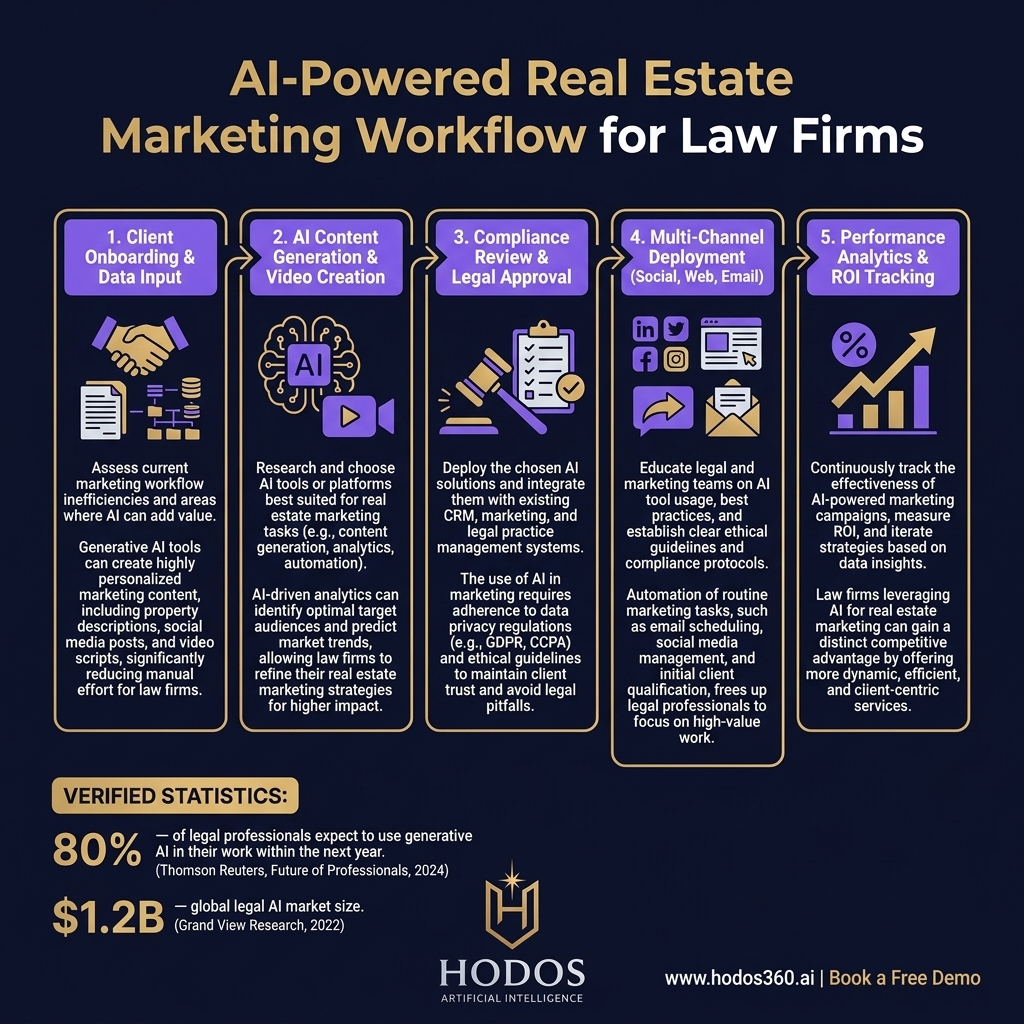
While the allure of AI-powered marketing is undeniable, law firms must tread carefully through the complex thicket of legal and ethical compliance. The very tools that promise efficiency, such as advanced AI video creation and content generation, can inadvertently create significant legal liabilities if not managed meticulously. Consider the burgeoning regulatory landscape: New York, for instance, has already enacted legislation stipulating that heavy use of AI in real estate media could be deemed deceptive marketing, potentially resulting in substantial fines. This reflects a growing global concern, echoed in discussions surrounding the EU AI Act, about the authenticity and transparency of AI-generated content, especially when it pertains to material representations of properties or legal services.
Law firms, by their very nature, are held to a higher standard of accuracy and truthfulness in advertising. The ABA Model Rules of Professional Conduct, specifically Rule 7.1 concerning communications about a lawyer's services, mandate that such communications "shall not make a false or misleading communication." This rule becomes particularly salient when AI is used to generate property images or videos that might enhance features, remove flaws, or create entirely fabricated elements. The ethical imperative demands that any AI-assisted marketing material must accurately reflect the truth and not create unreasonable expectations. Firms must implement rigorous review processes to ensure that AI-produced content, whether for a commercial listing or a residential estate promotion, adheres strictly to these professional obligations.
Moreover, the use of AI in marketing inevitably involves data collection and processing, introducing another layer of compliance challenges. Data privacy regulations like GDPR and CCPA are not just abstract concepts; they dictate how client data, even publicly available property information, can be used to personalize marketing efforts. Learn more about AI Voice Assistants: The Ultimate Guide for Law Firms. An AI marketing platform must have robust data governance protocols to prevent misuse or breaches. Firms must ensure that their AI tools do not inadvertently collect sensitive information or use it in ways that violate client confidentiality or privacy laws. This requires a deep understanding of the AI's data sources and algorithms, a task that often falls to legal tech specialists.
The dual role of AI in legal real estate marketing—as both an enabler of innovation and a source of compliance risk—necessitates a proactive and informed approach. Firms cannot simply adopt AI tools; they must integrate them with a comprehensive understanding of the legal and ethical frameworks that govern their practice. This includes developing internal policies for AI use, conducting regular audits of AI-generated content, and staying abreast of evolving regulations. The firms that will thrive are those that view AI not just as a technological tool, but as an integral part of their ethical and professional responsibility, ensuring that their innovative AI for real estate marketing strategies are also legally sound. This commitment to responsible AI use is critical for maintaining public trust and avoiding costly legal repercussions.
Ethical AI and Data Privacy in Marketing
The intersection of AI, marketing, and legal ethics is particularly acute when considering data privacy. As AI algorithms become more sophisticated in targeting potential clients and personalizing content for specific property types or investment profiles, the volume and sensitivity of data processed increase exponentially. Law firms have a fundamental duty to protect client information, enshrined in principles like attorney-client privilege and various data protection statutes. The challenge with AI lies in ensuring that these systems, often opaque in their data handling, comply with stringent regulations such as the General Data Protection Regulation (GDPR) in Europe or the California Consumer Privacy Act (CCPA) in the United States. A recent Thomson Reuters report highlighted that data privacy concerns remain a top challenge for legal professionals adopting new technologies.
The EU AI Act, set to be fully enforced, introduces a risk-based approach to AI systems, with certain high-risk applications facing strict compliance requirements. While direct marketing might not always fall into the 'high-risk' category, the underlying data processing activities and the potential for discriminatory outcomes could raise red flags. Learn more about AI Answering Service: The Ultimate Guide for Law Firms. Firms must conduct thorough due diligence on any AI marketing platform, scrutinizing its data sourcing, consent mechanisms, and anonymization capabilities. It's not enough to simply use a tool; firms must understand its ethical footprint. This commitment extends to ensuring that AI-generated flyers or personalized listing emails do not rely on unlawfully obtained data or perpetuate biases that could lead to discriminatory practices. The ethical use of AI in marketing is therefore not just about avoiding fines, but about upholding the core values of the legal profession. For further guidance on legal advertising ethics, consult the ABA Model Rules of Professional Conduct.
Beyond the Hype: Practical AI Applications for Property Listings and Outreach
Moving beyond the theoretical, the practical applications of AI for real estate marketing are already transforming how law firms service their clients and attract new business. Take the example of AI video creation for property listings. Platforms like Runway ML allow legal practices to quickly transform static photographs and property data into dynamic, engaging video walkthroughs or aerial-style overviews. This capability is invaluable for law firms advising developers or real estate agencies, enabling them to present properties in a visually compelling way that stands out in a crowded market. The process, from idea to finished AI video, can be executed in minutes, freeing up valuable attorney time that would otherwise be spent on coordinating traditional media production.
Beyond visual content, AI excels in generating high-quality written materials. For a new commercial listing, AI can quickly draft detailed descriptions, highlighting key features, zoning regulations, and potential investment returns, all while ensuring legal accuracy. This extends to creating personalized flyers and brochures tailored to specific client segments or property types. Imagine an AI analyzing market trends and automatically generating a series of social media posts for a particular estate, complete with relevant hashtags and calls to action. This level of automation ensures consistency across all social media channels and allows for rapid deployment of marketing campaigns, keeping a firm's real estate practice top-of-mind for potential clients.
Furthermore, AI-powered tools can significantly enhance client outreach and lead nurturing. Learn more about Legal AI: Ultimate Guide to Implementation for Law Firms. By analyzing client demographics and engagement patterns, AI can help firms identify the most promising leads and personalize communication. For instance, an AI could identify a potential client who has shown interest in several investment property listings and suggest a bespoke legal service package. This targeted approach not only increases conversion rates but also builds stronger client relationships based on relevant and timely information. The ability to automate these processes, from initial contact to follow-up, ensures that no opportunity is missed.
The integration of AI into these core marketing functions is not merely about efficiency; it's about strategic advantage. Law firms that embrace these practical applications of AI for real estate marketing can offer a more comprehensive and cutting-edge service to their real estate clients, distinguishing themselves from competitors. The transformation from manual, labor-intensive marketing to AI-driven, intelligent outreach is a critical step for any legal practice looking to thrive in the modern era. The competitive edge gained by these innovations is becoming increasingly evident across the industry.
- ✓AI-Powered Property Video Generation: Convert static images and data into cinematic property videos, virtual tours, and aerial footage for enhanced listing presentations, significantly reducing production time and cost.
- ✓Automated Content Creation for Listings: Utilize AI to generate legally precise and compelling property descriptions, blog posts, and articles detailing real estate law, ensuring accuracy and consistency.
- ✓Personalized Marketing Campaigns: Leverage AI to analyze client data and market trends, creating highly targeted email campaigns, flyers, and brochures that resonate with specific demographics interested in particular estate types.
- ✓Social Media Automation & Scheduling: Automate the creation and scheduling of engaging posts for all social media platforms, promoting new property listings or legal services, ensuring continuous online presence.
- ✓Lead Qualification & Nurturing: Implement AI to identify and score high-potential leads from marketing efforts, guiding them through the sales funnel with personalized communication and ensuring efficient follow-up.
- ✓Market Trend Analysis & Reporting: Use AI to analyze vast datasets of real estate market trends, providing law firms with actionable insights to better advise clients and tailor their marketing strategies.
- ✓Responsive Website & Mobile Development: Employ AI-powered tools for building and optimizing websites and mobile apps that showcase real estate services, ensuring responsive design and high conversion rates.
The Competitive Edge: How AI Elevates Law Firm Marketing Strategies
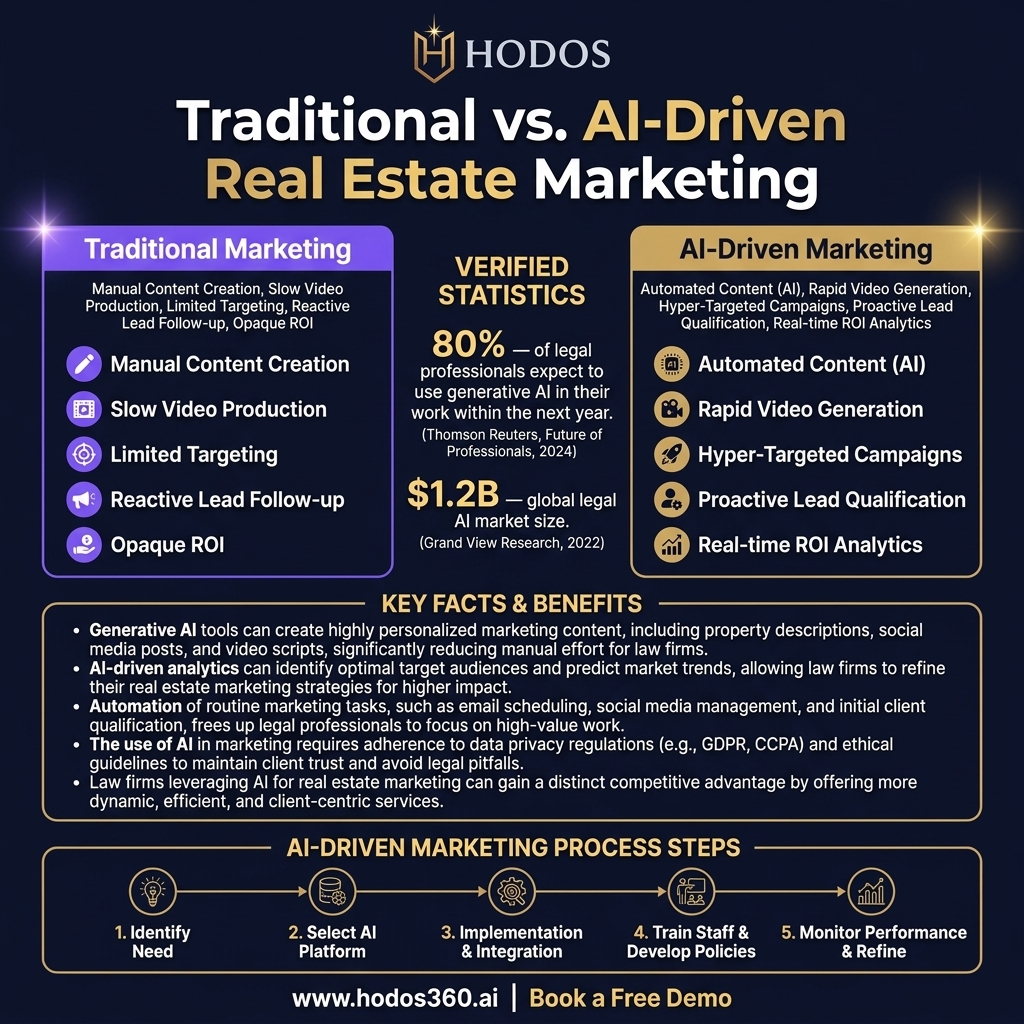
In today's fiercely competitive legal market, a distinct competitive edge is no longer a luxury but a necessity. For law firms specializing in real estate, AI for real estate marketing offers precisely that—a transformative advantage in client acquisition and retention. The ability to rapidly deploy sophisticated marketing campaigns, from crafting visually stunning AI video creation to generating nuanced legal content, allows firms to outpace competitors reliant on traditional, slower methods. Consider the firm that can launch a fully integrated marketing campaign for a new development within days, versus one that takes weeks. This speed translates directly into faster client engagement and quicker deal closures, enhancing a firm's reputation for efficiency and innovation.
Moreover, AI's analytical capabilities provide unprecedented insights into marketing effectiveness and ROI tracking. Platforms equipped with AI analytics can monitor campaign performance in real-time, identifying which channels and content types are most effective in attracting specific client segments. This data-driven approach allows firms to optimize their marketing spend, allocating resources to strategies that yield the highest returns. For example, a firm might discover through AI analytics that targeted social media campaigns featuring AI video creation for luxury listings generate significantly more qualified leads than print advertisements. Learn more about AI Legal Page Generators: The Ultimate Guide for Firms. This continuous feedback loop ensures that marketing efforts are not just creative, but also strategically sound and financially efficient, maximizing the impact of every marketing dollar.
Beyond direct marketing, AI enhances the entire client journey, from initial contact to long-term relationship management. Imagine an AI voice assistant, like those offered by HODOS 360, providing 24/7 phone answering, expertly qualifying leads based on their specific real estate needs, and even booking initial consultations directly into an attorney's calendar. This seamless integration of AI across marketing and client intake functions creates a superior client experience, making a firm more accessible and responsive. Firms that leverage such comprehensive AI solutions find themselves not just attracting more clients, but attracting the *right* clients—those whose needs perfectly align with the firm's expertise, leading to more productive engagements and higher client satisfaction.
Ultimately, the adoption of advanced AI for real estate marketing is about future-proofing a law firm. By embracing tools that automate routine tasks, provide deeper insights, and enable personalized outreach, firms can free up their legal professionals to focus on high-value legal work. This strategic shift not only improves operational efficiency but also positions the firm as a leader in legal innovation, attracting top talent and high-profile cases. The competitive landscape is evolving rapidly, and those law firms that actively integrate AI into their marketing strategies are not just adapting; they are defining the future of legal service delivery.
Automating Client Intake and Lead Qualification
One of the most immediate and impactful benefits of AI integration for law firms lies in the automation of client intake and lead qualification, directly enhancing the efficacy of AI for real estate marketing efforts. Consider the traditional bottleneck: a surge of inquiries from a successful property listing campaign, overwhelming receptionists and potentially leading to lost opportunities. AI voice assistants, such as those provided by HODOS 360, can act as a firm’s frontline, offering 24/7 multilingual support. These assistants can intelligently engage callers, qualify leads based on predefined criteria (e.g., specific legal needs related to commercial or residential real estate, budget, urgency), and even book appointments directly into an attorney's calendar. This significantly streamlines the initial client journey, ensuring that every promising lead from a marketing initiative is captured and efficiently routed.
The seamless transition from marketing to intake is crucial. When a prospective client responds to an AI-generated video or a targeted flyer, the next step must be equally efficient and professional. Learn more about Voice AI: Essential Guide to Scaling Safely for Law Firms. An AI-powered intake system can gather essential information, pre-screen cases for potential conflicts, and even initiate the document automation process for client agreements. This not only reduces the administrative burden on legal staff but also improves the client experience by providing immediate, knowledgeable assistance. By integrating these AI capabilities, law firms can ensure that their robust AI for real estate marketing efforts translate directly into a stronger pipeline of qualified clients, optimizing the entire business development lifecycle. For a deeper dive into how AI transforms the initial client experience, explore [Revolutionizing Client Intake with AI Voice Assistants].
Future-Proofing Your Practice: Leveraging AI for Sustainable Growth
The journey into advanced AI for real estate marketing is more than just adopting new tools; it's about fundamentally future-proofing your legal practice for sustainable growth. The legal industry is witnessing an accelerating pace of technological change, and firms that proactively integrate AI into their operational and marketing strategies are better positioned to adapt, innovate, and thrive. This involves not just embracing AI video creation or social media automation, but fostering a culture of continuous learning and technological adoption across the firm. The insights gained from AI-driven analytics, for example, provide a strategic compass, guiding decisions on market expansion, service offerings, and resource allocation, ensuring that growth is not just rapid but also resilient and well-informed.
Sustainable growth in the legal sector hinges on efficiency, client satisfaction, and the ability to attract and retain top talent. AI contributes to all these pillars. By automating tedious marketing tasks and streamlining client intake, AI frees up attorneys to focus on complex legal analysis and client advocacy, enhancing job satisfaction and reducing burnout. This also positions the firm as an attractive employer for new generations of legal professionals who expect cutting-edge technology in their workplaces. Furthermore, the enhanced client experience, driven by personalized outreach and efficient service delivery, naturally leads to stronger client relationships and valuable referrals, forming a virtuous cycle of growth.
As the legal landscape continues to evolve, the distinction between tech-forward and traditional firms will become increasingly stark. Those that invest in comprehensive AI platforms, like HODOS 360, which seamlessly integrate AI Law Firm Management, AI Marketing, and AI Voice Assistants, will be best equipped to navigate future challenges. These integrated systems provide a holistic approach, ensuring that marketing efforts are not isolated but are deeply connected to case management, billing, and client communication. This synergy maximizes the impact of AI for real estate marketing, transforming it from a standalone function into a core driver of overall firm success.
In conclusion, the integration of AI for real estate marketing is no longer a futuristic concept but a present-day imperative for law firms seeking to maintain a competitive edge and secure long-term viability. By strategically adopting AI tools, firms can unlock unprecedented efficiencies, elevate their marketing effectiveness, and foster a more responsive and client-centric practice. The firms that thoughtfully embrace this technological revolution will not only survive but will lead the charge in defining the future of legal services. Embrace the power of AI to transform your real estate practice. Discover how HODOS 360 can elevate your firm today by booking a free demo.

The Rise of Generative AI in Property Content
The emergence of generative AI, particularly in the realm of visual and textual content, marks a significant milestone for real estate marketing within the legal context. Tools like Runway ML are at the forefront, enabling users to transform initial concepts or raw data into finished AI video for property tours, or to generate compelling narratives for listing descriptions. This capability extends to creating entire marketing campaigns, from targeted social media advertisements to engaging blog posts, all with remarkable speed and consistency. For law firms representing real estate developers or agencies, this means a dramatic reduction in the time and resources needed to create high-quality, persuasive marketing materials. The human conflict often arises when firms grapple with the balance between speed and authenticity. While AI can create content rapidly, human oversight remains crucial to ensure accuracy and adherence to legal standards, particularly when dealing with property representations.
However, this powerful capability also brings increased scrutiny regarding originality and potential misrepresentation. The ease with which AI can create or modify photos and videos necessitates a robust framework of ethical guidelines and compliance checks within law firms. The Federal Trade Commission (FTC) guidelines on advertising, for instance, emphasize truthfulness and non-deceptiveness, principles that must be meticulously applied to AI-generated content. Firms must establish clear protocols for reviewing AI-produced marketing assets, ensuring that they accurately reflect the properties or services being promoted and do not inadvertently create false impressions. This proactive approach to managing generative AI is essential for leveraging its benefits while mitigating the inherent risks, ensuring that a firm's innovative marketing strategies remain firmly grounded in legal integrity. Refer to FTC Advertising and Marketing Basics for foundational principles.
Frequently Asked Questions
What is AI for real estate marketing?+
AI for real estate marketing involves using artificial intelligence technologies to automate, optimize, and personalize various marketing activities for properties and related legal services. This includes AI video creation, content generation for listings, social media automation, lead qualification, and data analytics to enhance outreach and client acquisition for law firms.
How can AI video creation benefit my law firm's real estate practice?+
AI video creation, using tools like Runway ML, allows law firms to quickly generate professional property videos, virtual tours, and engaging social media clips from static images and data. This enhances property listings, showcases legal expertise, attracts more attention from potential clients, and significantly reduces the time and cost associated with traditional video production.
What compliance challenges should law firms consider when using AI in real estate marketing?+
Law firms must navigate strict compliance challenges, including regulations against deceptive AI-generated content (e.g., New York laws), adherence to ABA Model Rules on truthful advertising, and data privacy laws like GDPR/CCPA. Ensuring AI-generated content is accurate, transparent, and ethically sourced is paramount to avoid legal liabilities and maintain professional integrity.
Can AI help with lead qualification for real estate clients?+
Yes, AI can significantly enhance lead qualification. AI voice assistants can provide 24/7 phone answering, intelligently screen callers based on specific real estate legal needs, and book appointments directly. This streamlines the intake process, ensures promising leads from marketing efforts are efficiently captured, and allows attorneys to focus on pre-qualified prospects.
How does AI impact content generation for property listings?+
AI revolutionizes content generation by automating the creation of detailed property descriptions, compelling blog posts, and tailored flyers for listings. It ensures consistency, legal accuracy, and allows for rapid deployment of diverse marketing materials. This frees up legal professionals from tedious writing tasks, enabling them to focus on high-value legal work while maintaining a robust online presence.
Is ROI tracking possible with AI marketing platforms?+
Absolutely. Modern AI marketing platforms include robust analytics and ROI tracking capabilities. They monitor campaign performance in real-time, identifying which strategies and content types yield the best returns. This data-driven approach allows law firms to optimize their marketing spend, allocate resources effectively, and demonstrate the tangible impact of their AI for real estate marketing investments.