


No-Code Review: The Ultimate Website Builder Guide for Law Firms
The legal landscape, often perceived as resistant to rapid technological shifts, is currently undergoing a profound transformation, spearheaded by the burgeoning no-code movement. Consider the cautionary tale of 'Sterling & Hayes,' a venerable mid-sized firm that, just five years ago, poured hundreds of thousands into a bespoke website, only to find it outdated and inflexible within two years.
Their frustration contrasts sharply with the agility of 'LexDigital,' a newer firm founded by partners fresh out of law school, who have rapidly launched and iterated their online presence for niche practices using cutting-edge, AI-powered no-code platforms. The allure of tools like Bolt.new, a name frequently appearing in tech discussions, promises a world where developers are obsolete, and anyone can build sophisticated applications – a sentiment that often makes users feel like a 'God,' as one recent 'Bolt no-code review' eloquently put it, before 'reality slapped' them.
This immediate gratification, however, often masks deeper complexities for a sector governed by stringent ethical and practical demands.
This tension between the promise of speed and cost-efficiency, and the immutable requirements of legal compliance, data security, and true customization, forms the crux of the current debate surrounding no-code adoption in law.
The 'Bolt no-code review' highlights a critical market sentiment: while the initial 'experience' of using such builders might be 'excellent' for basic 'website generation,' their true capabilities for complex, professional applications, especially in a regulated field like law, often fall short of the initial hype.
Law firms cannot afford a platform that goes 'off-script' or proves 'slower' when handling sensitive client data or critical client intake processes. The real challenge lies not just in finding a tool that can build a website, but one that can build a *compliant, secure, and effective* legal website that integrates seamlessly into a firm's operational backbone.
This article aims to provide a comprehensive and critical 'no-code review' specifically tailored for law firms, cutting through the marketing noise to identify genuine opportunities and potential pitfalls. We will explore how AI-powered web development is reshaping the digital presence strategies for legal practices, dissecting the true capabilities of these platforms beyond simple 'app builder' functionalities.
Our goal is to equip law firm owners, managing partners, and legal professionals with the insights needed to strategically leverage no-code solutions, ensuring their digital transformation initiatives are not just innovative, but also secure, scalable, and ultimately, profitable. Ready to transform your firm's digital footprint?
Discover how AI-powered web development can elevate your practice.
The Promise and Peril of No-Code for Legal Tech
The broader no-code movement has been a formidable force in democratizing technology, extending capabilities far beyond the traditional developer pool. Companies like Airtable and Zapier pioneered workflow automation, empowering business users to create sophisticated systems without a single line of code. This philosophy has naturally extended to web development, promising to unlock unprecedented agility for businesses.
Learn more about AI Future: Essential Insights for Law Firm Innovation. For law firms, this translates into the tantalizing prospect of rapidly deploying new marketing campaigns, creating bespoke client portals, or updating firm information without the typical bottlenecks of IT departments or external agencies. Gartner, a leading research firm, predicted that by 2025, 70% of new applications developed by enterprises will use low-code or no-code technologies, a testament to the undeniable market shift towards these 'builders.'
The 'promise' here is clear: speed, cost reduction, and greater control over a firm's digital assets, making 'website generation' an in-house capability rather than an outsourced burden.
Imagine 'Riverbend Legal,' a firm specializing in environmental law, needing to launch a new microsite overnight following a landmark legislative change. In the past, this would involve weeks of development, design, and testing, potentially missing the crucial window for media engagement and client outreach. With an AI-powered no-code platform, such a site could be conceptualized, designed, and deployed within days, complete with integrated lead forms and relevant content.
This agility is the core value proposition of no-code for law firms, offering a competitive edge in a fast-paced market. Learn more about Interactions API: Essential Gemini Interface for Legal Tech. However, this promise comes with inherent 'peril.' Security concerns, particularly regarding client data confidentiality (as stipulated by ABA Model Rule 1.6), vendor lock-in, and the limitations on deep customization, are significant hurdles.
Early 'reviews' of generic no-code platforms often highlight these limitations, revealing that while they excel at basic functionalities, they struggle with the intricate, legally compliant requirements of a professional services firm.
The "Bolt.new" Phenomenon and Market Expectations
The emergence of platforms like Bolt.new exemplifies the bleeding edge of AI-powered no-code. As an 'AI app builder' that transforms design mockups (often from tools like Figma) directly into functional code, Bolt.new has generated considerable buzz. Its appeal lies in its ability to bridge the gap between design and development, promising to turn abstract ideas into tangible web experiences with unprecedented speed.
This capability fundamentally reshapes expectations around 'website building,' suggesting that the future of digital presence is one where design intuition, augmented by AI, is paramount. Learn more about AI App Development: Essential for Law Firms' Digital Future. However, the market's 'reviews' of such tools often present a mixed bag, highlighting that while the 'presentation is excellent,' the actual 'experience using' them can sometimes be 'slower' or lead to results that go 'off-script' when confronted with complex requirements.
The 'pricing' models, often tied to AI token usage, also introduce new variables for cost management.
The competitive landscape for these AI-driven no-code solutions is intense, with numerous startups vying for market share. While some platforms excel at simple content websites, others, like those leveraging sophisticated AI, aim to tackle more complex application development. The prevailing sentiment among early adopters is that while these tools make 'website generation' accessible, the 'reality' of deploying a robust, enterprise-grade solution often 'slaps' users with the need for careful planning, rigorous testing, and an understanding of the platform's inherent limitations.
Learn more about Future Ready Lawyer: Essential AI Confidence for Legal Professionals. The industry 'thinks' of these tools as revolutionary, but the nuances of their application, especially in legal contexts where precision and compliance are non-negotiable, require a more discerning 'no-code review' than a simple feature comparison.
Law firms must look beyond the initial wow-factor to assess long-term viability, security, and integration capabilities.
Beyond the Hype: A Critical No-Code Review for Law Firms
For law firms, a website is far more than a digital brochure; it's a primary client acquisition channel, a secure portal for communication, and a repository for thought leadership. A critical 'no-code review' must therefore go beyond superficial aesthetics to evaluate functionality crucial for legal practice.
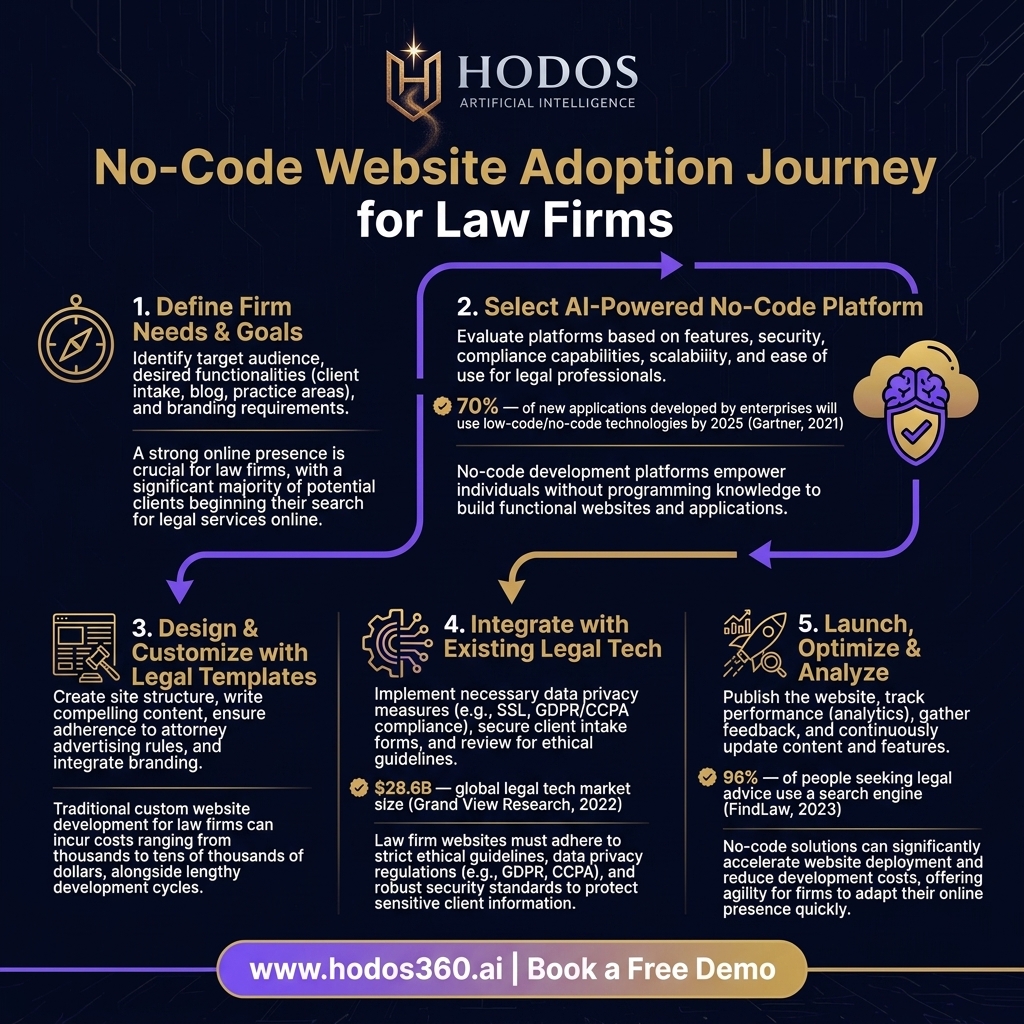
Firms require robust client intake forms that are secure and compliant with privacy regulations, easy-to-update content management systems for publishing timely legal insights, and powerful SEO capabilities to ensure visibility. The ABA TechReport consistently underscores the escalating importance of a firm’s online presence for client acquisition, with recent data indicating that over 60% of consumers begin their search for legal services online.
Learn more about Context Matters AI: Essential for Legal Accuracy & Insight. This necessitates a 'website builder' that supports sophisticated lead generation and conversion strategies, not just pretty pages. The 'experience' of a potential client navigating a firm's website often dictates their first impression and subsequent engagement.
AI's role in 'website generation' has moved beyond simple template selection. Modern AI tools can automate responsive design for various devices, optimize images and load times, and even suggest content improvements based on SEO best practices. However, for legal content, human oversight remains paramount. While AI can draft initial blog posts or social media captions, a lawyer must review and approve all public-facing legal information to ensure accuracy and avoid ethical missteps, such as those related to advertising and solicitation.
Learn more about AI-Native Law Firms: The Ultimate Guide to Thriving in a New Era. The 'reviews' of AI content generation tools often highlight their efficiency, but also caution against uncritical deployment in regulated industries. The security implications are equally critical; any platform handling client data must meet or exceed industry standards for data encryption, access controls, and compliance with regulations like HIPAA or GDPR, depending on the firm's jurisdiction and practice areas.
Generic 'AI app builder' solutions may not inherently provide the necessary safeguards.
- ✓Security & Compliance: Evaluate data encryption, privacy policies, and compliance certifications (e.g., ISO 27001, SOC 2) to protect sensitive client information. Ensure adherence to ABA Model Rule 1.6 on confidentiality.
- ✓Integration Capabilities: Assess seamless connections with existing legal tech, including CRM, practice management systems, and billing software. This is crucial for streamlining client intake and workflow automation.
- ✓Customization & Scalability: Determine if the platform allows for unique branding, bespoke functionalities, and the ability to grow with your firm's evolving needs, beyond basic templates.
- ✓SEO & Marketing Features: Look for built-in tools for search engine optimization, analytics, content management, and lead tracking to maximize online visibility and client acquisition.
- ✓Client Intake & Automation: Prioritize secure, customizable forms that can automate initial client data collection and integrate with internal processes for efficiency.
- ✓Support & Community: Research the vendor's support quality and the availability of a community forum for troubleshooting, especially for legal-specific use cases.
- ✓Pricing & Hidden Costs: Scrutinize 'pricing' models, including potential costs for additional features, AI token usage, storage, and bandwidth, to avoid unexpected expenses.
The distinction between a generic 'AI app builder' and a platform genuinely suitable for professional services firms is critical. While a tool might offer an 'excellent' interface, it must also provide enterprise-grade security, robust integration capabilities, and a clear pathway for scalability. Firms must prioritize platforms that understand the unique demands of legal practice – from maintaining attorney-client privilege in digital communications to ensuring accessibility for all potential clients under the Americans with Disabilities Act.
A thorough 'no-code review' for law firms means scrutinizing not just what a platform can build, but *how* it builds it, *where* data resides, and *who* controls access. This due diligence is essential to avoid the 'reality' of a seemingly efficient solution that ultimately compromises ethical obligations or operational integrity.
For example, a firm considering a new website must ensure the platform aligns with the firm's obligations under the Federal Rules of Civil Procedure concerning e-discovery, particularly if the website hosts client-facing documents or communications.
Architecting the Future: AI-Powered Website Building in Practice
The practical application of AI-powered no-code web development for law firms transcends simple brochure sites. It's about 'using' these tools to build high-converting, functionally rich digital assets that directly contribute to business growth. Platforms specifically designed for professional services, or those with robust customization, go beyond generic 'builders.'
They offer legal-specific templates for practice areas, integrated client intake forms, and secure client portals, all built with AI assistance. Imagine 'Edison Legal,' a personal injury firm, leveraging such a platform to create dozens of highly targeted landing pages for specific case types – 'car accident claims,' 'medical malpractice,' 'slip and fall injuries.'
Each page is optimized for local SEO, features compelling content generated with AI assistance (and attorney review), and includes a secure, AI-driven lead form that instantly qualifies potential clients and routes their information directly into the firm's case management system. This level of integrated 'website generation' ensures an 'excellent' client acquisition workflow.
The 'experience' of iterative design is another powerful benefit. No-code platforms empower firms to rapidly A/B test different website layouts, call-to-action placements, and content variations to optimize conversion rates. This agility allows for data-driven decision-making in 'legal marketing,' moving away from guesswork to empirically proven strategies.
For instance, a firm can test whether a video testimonial or a written one on their homepage generates more consultation requests, or if a specific color for the 'Contact Us' button yields higher clicks. This continuous optimization, often guided by AI analytics, ensures that the firm's website is a constantly improving asset, not a static expense.
Furthermore, the inherent capabilities for 'responsive design' mean that these AI-built sites perform flawlessly across all devices, from desktops to mobile phones, which is crucial given that a significant portion of potential clients access legal information on their smartphones.
Seamless Integration: Bridging No-Code with Existing Legal Workflows
The true power of no-code for law firms is unlocked through seamless integration with their existing legal tech ecosystem. A sophisticated no-code built website should not operate in a silo but should serve as the front end for a firm's operational backbone. This is where comprehensive platforms, like HODOS 360, demonstrate their value.
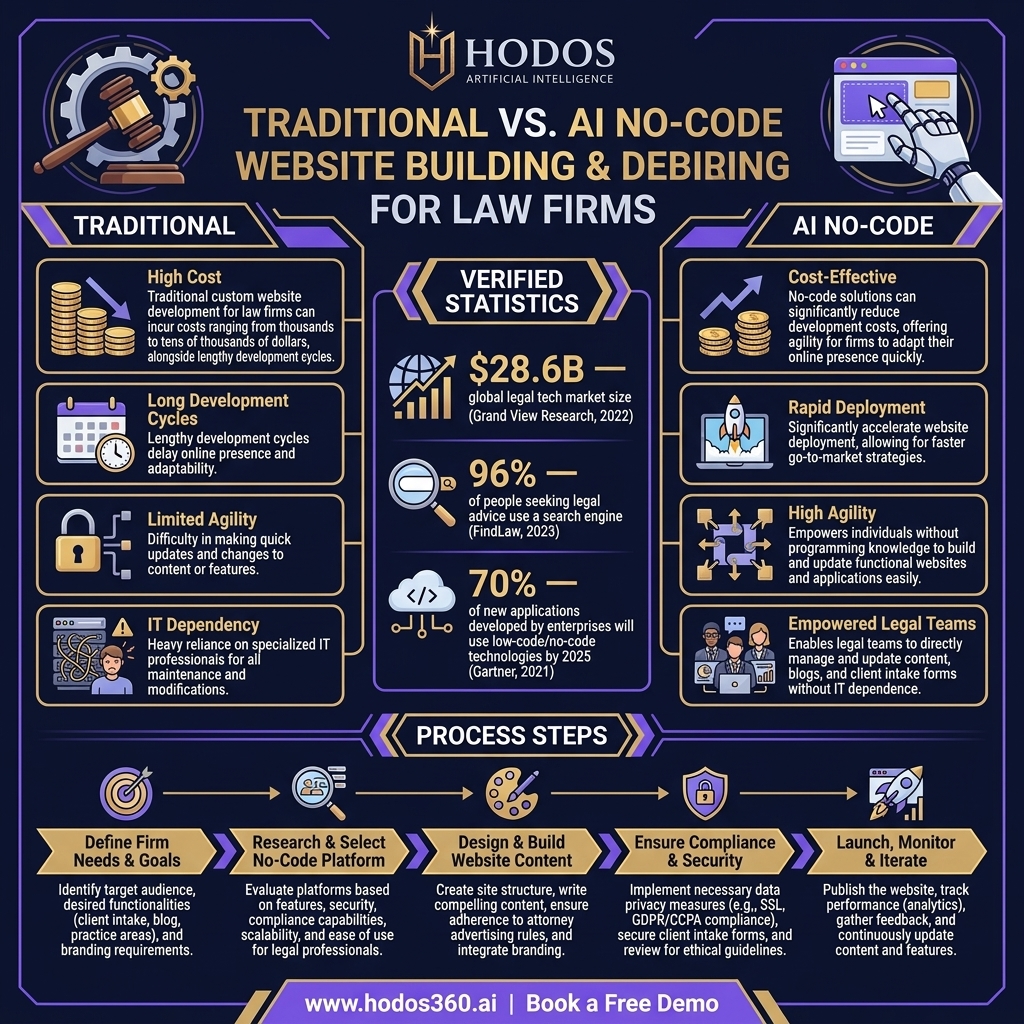
An AI-powered website builder, integrated within an 'AI Law Firm Management System,' can transform how firms handle client intake, document automation, and calendar management. When a potential client completes an intake form on the firm's website, that data can instantly populate a new client record, trigger an automated conflict check, and even initiate the generation of initial engagement letters.
This level of 'workflow automation' drastically reduces administrative overhead and ensures no lead falls through the cracks.
Further enhancing this integrated approach, the system can then leverage 'AI Voice Assistants' for lead qualification and appointment booking. If a lead requires a follow-up call, the AI assistant can engage the prospective client, gather additional information, and schedule a consultation directly into the attorney's calendar, all while maintaining a professional and multilingual demeanor.
This holistic integration, from the initial website interaction to the final client onboarding, represents the pinnacle of digital transformation for law firms. It's about creating an 'experience' that is not only efficient for the firm but also professional and responsive for the client, setting a new standard for legal service delivery.
Explore HODOS 360’s AI-powered Web & Mobile Development services and see how seamless integration can transform your firm.
Navigating Implementation: Best Practices for No-Code Adoption
Strategic adoption of no-code technologies requires more than just selecting a tool; it demands a firm-wide digital strategy. Progressive leaders, such as Maria Chen, Managing Partner at Innovate Law Group, advocate for incremental adoption, starting with pilot projects for specific use cases rather than attempting a full overhaul.
This allows firms to test the waters, understand the platform's nuances, and build internal expertise without disrupting core operations. The 'reality' is that even with no-code, successful implementation hinges on clear objectives, adequate training for staff, and robust governance frameworks. Firms must establish guidelines for content creation, data handling, and website maintenance, ensuring that all digital assets comply with ethical obligations and professional standards, consistent with the spirit of ABA Model Rule 1.1 on Competence, which increasingly includes technological competence.
Vendor due diligence is paramount. When selecting a 'no-code website builder' or any 'AI app builder,' firms must conduct thorough security audits, review service level agreements (SLAs) rigorously, and understand the vendor's data residency and backup policies. This includes scrutinizing how the platform handles sensitive client information and ensuring it meets the firm's ethical and regulatory obligations.
The market is saturated with options, and a superficial 'no-code review' can lead to significant long-term headaches. Firms should also consider the vendor's financial stability and long-term roadmap, as vendor lock-in can become a costly issue if a platform ceases to innovate or support its product.
The 'experience' with a vendor's support team is often as crucial as the features of the platform itself.
Measuring Success: ROI and Scalability in No-Code Legal Platforms
Measuring the return on investment (ROI) for no-code website initiatives involves tracking metrics beyond simple website traffic. Firms should focus on lead conversion rates, reductions in client acquisition costs, decreases in website development and maintenance times, and improvements in client satisfaction scores derived from enhanced online interactions.
For example, a firm might track how many leads generated through a no-code landing page convert into paying clients compared to traditional methods, or how much time is saved by automating client intake processes via the website. This data-driven approach allows firms to quantify the tangible benefits of their investment and refine their digital strategies.
Scalability is another critical factor. A truly effective no-code platform should be able to grow with the firm, accommodating increased website traffic, more complex content structures, and an expanding array of digital services without requiring a complete rebuild. This ensures that the initial investment continues to yield returns as the firm evolves.
The 'experience' should remain seamless, whether the firm is a solo practitioner or a multi-office enterprise. While no-code excels at providing the 80% solution for rapid development, firms must recognize its limitations for the highly bespoke 20% that might still necessitate traditional coding. The strategic use of no-code allows firms to allocate their developer resources more effectively, focusing on complex, differentiating features while leveraging no-code for speed and efficiency in core digital presence management.

Key Takeaways and Next Steps for Digital-First Law Firms
The landscape of web development for law firms is undeniably shifting, with no-code and AI-powered platforms offering immense potential for agility and efficiency. Our comprehensive 'no-code review' underscores that while the promise of rapid 'website generation' is compelling, a strategic and critical evaluation is essential.
It's not merely about the speed of deployment but about aligning these tools with the unique demands of legal practice – prioritizing security, compliance, and seamless integration with existing workflows. The 'experience' of adopting these technologies should be one of empowerment, allowing firms to focus on their core competency: delivering exceptional legal services, rather than grappling with complex coding.
For law firms looking to maintain a competitive edge, embracing a holistic approach to digital transformation is no longer optional. Your website is the firm's most visible digital asset, but its true power is unlocked when it acts as an integrated component of a broader legal tech ecosystem. This means connecting your AI-powered website to your client management, billing, and document automation systems. Firms that fail to adapt risk falling behind, losing out on potential clients who increasingly expect a streamlined, professional online 'experience' from their legal providers.
As you consider your firm's next steps, experiment with no-code tools for specific, well-defined use cases. Start with a microsite for a particular campaign, a secure client portal for document sharing, or an internal knowledge base. Evaluate the 'pricing' and scalability carefully, and ensure any platform selected meets your firm's stringent security and compliance requirements. Engage your team in the process, fostering a culture of innovation that embraces technological advancements while upholding ethical duties.
The future of legal practice is undeniably digital and AI-augmented. Firms that strategically leverage intelligent web development solutions, such as the comprehensive suite offered by HODOS 360, will not only enhance their online presence but also achieve unparalleled operational efficiency and deliver a superior client 'experience.' The time for a critical 'no-code review' and decisive action is now. Ready to build your firm's future? Schedule a free demo with HODOS 360 today.
Frequently Asked Questions
What is no-code web development for law firms?+
No-code web development allows law firms to build and manage websites without writing any code, using visual drag-and-drop interfaces. For legal practices, this means faster deployment of secure client portals, marketing landing pages, and firm websites, reducing reliance on traditional developers and enabling quicker responses to market demands and internal needs. It democratizes the 'website building' process, putting more control into the hands of legal professionals.
How does AI enhance no-code website builders for legal practices?+
AI significantly boosts no-code website builders by automating design elements, optimizing for SEO, suggesting content improvements, and personalizing user experiences. For law firms, this translates into AI-powered 'website generation' that can create responsive designs, integrate secure client intake forms, and even provide preliminary content drafts (subject to attorney review), ensuring a highly efficient and effective online presence that aligns with legal marketing goals.
What are the security considerations for no-code platforms in legal tech?+
Security is paramount for law firms using no-code platforms. Key considerations include data encryption, compliance with privacy regulations (e.g., ABA Model Rule 1.6, GDPR, CCPA), secure client portals, and robust access controls. Firms must conduct thorough due diligence on a platform's security architecture and vendor's policies to ensure sensitive client information is protected, mitigating risks associated with data breaches or non-compliance, as highlighted in many 'no-code review' discussions.
Can no-code platforms integrate with existing legal tech systems?+
Yes, many advanced no-code platforms offer robust integration capabilities, which are crucial for law firms. They can connect with existing legal tech systems such as CRM, practice management software, billing systems, and 'AI Law Firm Management Systems.' This allows for seamless 'workflow automation,' where data from website forms can instantly populate client records, automate scheduling, and streamline document generation, creating a unified and efficient operational 'experience' for the firm.
Is no-code suitable for all law firm website needs?+
No-code platforms are excellent for rapidly building and iterating standard websites, marketing landing pages, and secure client portals. However, for highly complex, bespoke functionalities, or deep system-level integrations that require unique code, traditional development might still be necessary. No-code excels at covering the majority of 'website building' needs efficiently, allowing firms to allocate specialized developer resources to truly unique or mission-critical applications, ensuring a balanced approach to digital infrastructure, as many 'reviews' suggest.