
Voice AI: Essential for Modern Law Firm Client Calls
The clock ticks past 6 PM, and Sarah Jenkins, a solo practitioner specializing in family law, breathes a sigh of relief. She's just finished a grueling day of client consultations and court appearances, but her phone continues to ring. Each unanswered call represents a potential new client, a critical follow-up, or an urgent inquiry that could slip through the cracks. This scenario isn't unique to Sarah; it's a daily reality for countless law firms navigating the relentless demands of client communication in a 24/7 world. The traditional model of human-only receptionists and limited office hours simply cannot keep pace with modern client expectations.
However, a seismic shift is underway, heralded by innovations like Quiq’s recent launch of Voice Assist. As reported by IT Brief Australia, Quiq, an agentic artificial intelligence platform provider, is extending its AI Assistants to live customer calls, providing real-time guidance and action capabilities. Mike Myer, CEO of Quiq, emphasizes that this agentic AI isn't just about providing information; it's about enabling the AI to *act* during the conversation, completing tasks and sending messages without an agent leaving the calls. This evolution of Voice AI is poised to fundamentally transform how law firms manage their inbound communications, moving beyond simple voicebot functions to sophisticated, proactive support systems. For legal professionals, the implications are profound, promising to alleviate administrative burdens, enhance client satisfaction, and ensure no critical lead or client call is ever missed again. The question for law firms is no longer *if* they should adopt AI Voice Assistants, but *how* to best integrate these powerful tools into their existing legal workflows.
In an industry where every minute counts and client relationships are paramount, the ability to provide instantaneous, intelligent support around the clock offers an unparalleled competitive advantage. From initial lead qualification to managing complex appointment booking and ensuring seamless call routing, AI Voice Assistants are becoming the unsung heroes of modern practice management. They represent a strategic investment not just in technology, but in the future resilience and growth of your firm. This article will delve into the transformative power of Voice AI, exploring its capabilities, ethical considerations, and real-world applications for law firms ready to embrace the future.
Ready to transform your client interactions? Explore HODOS 360's AI Voice Assistants today.
The Dawn of Agentic AI in Legal Communication
The legal sector, often perceived as slow to adopt technological shifts, is now witnessing a rapid acceleration in AI integration, particularly in client-facing operations. The concept of agentic AI, as championed by innovators like Quiq, marks a significant leap from earlier generations of conversational AI. Historically, voicebot technologies were largely confined to rule-based systems, offering pre-scripted responses or basic information retrieval. While helpful for simple inquiries, they often stumbled on complex or nuanced customer calls, leading to frustrating experiences for both clients and law firm staff. This new wave of agentic AI, however, is designed to understand context, infer intent, and *autonomously execute actions* during a live call. Learn more about AI Patent Tools: The Ultimate Guide for IP Lawyers. Mike Myer's vision for Quiq's Voice Assist underscores this paradigm shift: it's about empowering AI to be a proactive participant, not just a passive information provider.
For law firms, this means a profound change in how administrative and preliminary legal tasks are handled. Imagine an AI Voice Assistant that can not only answer a prospective client's query about practice areas but also, in the same conversation, verify their location, check for conflicts of interest, schedule an initial consultation with the appropriate attorney, and even send a confirmation email with required documents – all without human intervention. This level of automation significantly reduces the burden on human agents and legal support staff, allowing them to focus on higher-value, complex legal work that truly requires their expertise. According to a 2023 report by Gartner, 70% of customer interactions will involve some form of AI by 2027, up from 15% in 2023, indicating that client expectations for AI-driven service are rapidly expanding across all industries, including legal.
Beyond Simple Answering: The Scope of AI Voice Assistants
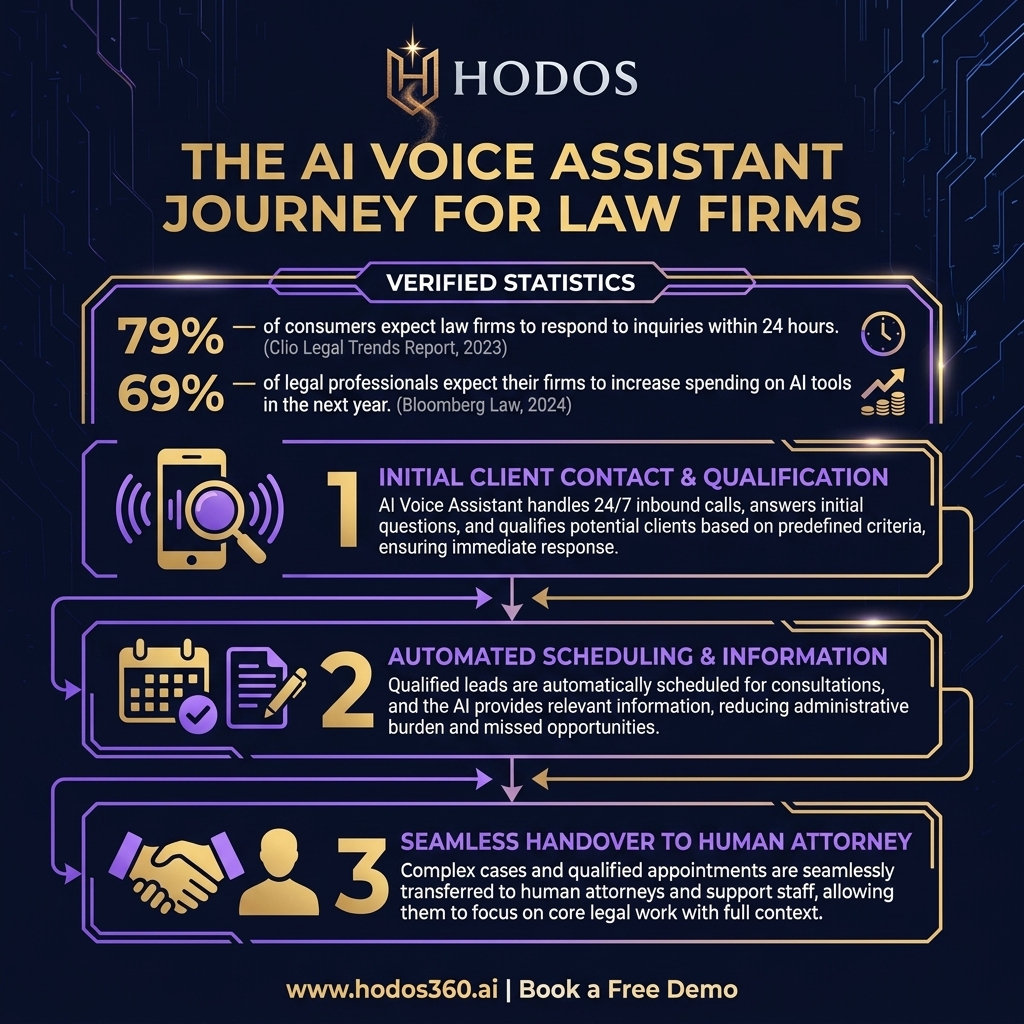
The capabilities of modern AI Voice Assistants extend far beyond merely answering the phone. They are sophisticated platforms designed to manage the entire lifecycle of an inbound inquiry. Key features include 24/7 phone answering, ensuring no calls are missed outside business hours; advanced lead qualification, where the AI can intelligently screen potential clients based on specific criteria (e.g., case type, geographic location, urgency) before routing them to an attorney; seamless appointment booking directly into firm calendars; and robust multilingual support, catering to a diverse client base. Furthermore, intelligent call routing ensures that clients are connected to the most appropriate department or individual, minimizing transfers and wait times. Learn more about AI Voice Support: Essential for Law Firm Client Experience. These features collectively transform the law firm's front office into an efficient, always-on operation. This shift aligns with the findings of the 2023 ABA Legal Technology Survey Report, which highlighted increasing attorney interest in AI tools for administrative tasks, signifying a growing recognition of AI's potential to enhance operational efficiency.
Streamlining Operations and Enhancing Client Experience
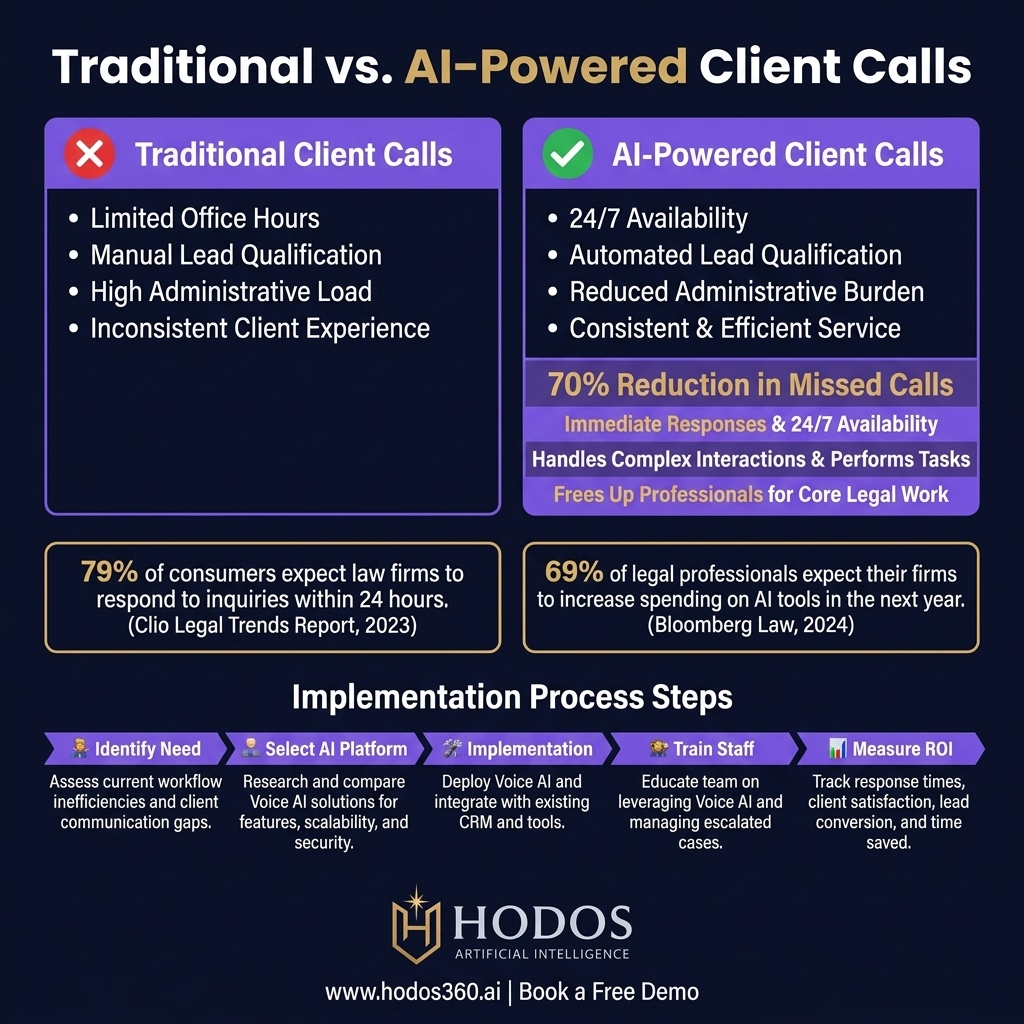
The adoption of AI Voice Assistants directly translates into tangible benefits for both law firm operations and the all-important client experience. Operationally, firms can expect a significant reduction in administrative overhead. Tasks such as answering repetitive questions, initial client screening, and scheduling appointments, which traditionally consume considerable staff time, can be largely automated. This frees up paralegals, legal assistants, and attorneys to focus on core legal work, improving overall firm productivity and potentially reducing operational costs. For example, a McKinsey report on the impact of generative AI suggests that it could automate tasks that currently consume 60 to 70 percent of employees’ time, a figure that has profound implications for optimizing legal workflows within law firms. The 24/7 availability of AI Voice Assistants also ensures that firms never miss a potential client lead, dramatically increasing the efficiency of client intake processes and ensuring a consistent, professional first point of contact, regardless of when the customer reaches out.
From the client's perspective, the benefits are equally compelling. Modern clients expect immediate responses and seamless digital interactions, a standard often set by consumer-facing industries. Learn more about Client Pressure: The Ultimate Driver of Law Firm AI Investment. AI Voice Assistants meet this expectation head-on, providing instant answers to common questions, facilitating quick scheduling, and ensuring that their initial inquiries are handled promptly and professionally. This enhanced responsiveness fosters trust and demonstrates a firm's commitment to client service. Imagine a client needing to reschedule an appointment late at night; instead of waiting until morning, they can interact with an AI, reschedule, and receive confirmation instantly. This level of convenience and efficiency elevates the entire client journey, leading to higher satisfaction and stronger client relationships. Firms that embrace this technology are not just adopting a tool; they are cultivating a reputation for innovation and client-centricity in a competitive market.
Navigating Ethical and Security Considerations with Voice AI
While the promise of Voice AI in legal tech is immense, its implementation is not without critical considerations, particularly regarding ethics and security. The legal profession operates under stringent rules governing client confidentiality, data privacy, and professional conduct. The "human conflict" here often arises between the drive for efficiency and the imperative to uphold these foundational ethical duties. Law firms must meticulously evaluate how AI Voice Assistants handle sensitive client information, ensuring compliance with both legal and ethical standards. For instance, ABA Model Rule 1.6 (Confidentiality of Information) mandates that a lawyer shall not reveal information relating to the representation of a client unless the client gives informed consent, or the disclosure is impliedly authorized. This rule extends to how a firm’s technology handles client data, making robust security and transparent AI practices non-negotiable.
The market for AI Voice Assistants is competitive, with many providers emerging. Learn more about Essential AI Web Development for Law Firms: Harvard's Impact. Firms must scrutinize vendors to ensure their platforms are built with security by design, employing advanced encryption, access controls, and regular audits. The potential for AI bias, where algorithms might inadvertently discriminate or misinterpret certain dialects or accents, also demands careful attention. Firms must ensure their AI Voice Assistants are trained on diverse datasets and include mechanisms for human oversight and intervention when necessary. This proactive approach helps mitigate risks and ensures the technology serves all clients equitably and ethically, maintaining the trust that is the bedrock of the attorney-client relationship. As David Wang, Chief Innovation Officer at Thomson Reuters, stated at LegalTech NYC 2026, "The future of legal AI isn't just about what it *can* do, but what it *should* do, ethically and responsibly."
The Imperative for Data Privacy and Compliance
Data privacy is perhaps the most critical concern when deploying Voice AI in a legal context. Every conversation and piece of information exchanged during a call could contain privileged or highly sensitive data. Firms must ensure that any AI Voice Assistants they utilize comply with all relevant data protection regulations, such as HIPAA for healthcare-related legal practices, CCPA in California, GDPR in Europe, and various state bar rules regarding electronic communication. This includes secure data storage, anonymization protocols where appropriate, and clear policies on data retention and access. Learn more about Legal AI Software Market: An Essential $14.62 Bn Outlook. Transparent communication with clients about the use of AI in handling their inquiries is also essential to maintain trust and informed consent. Firms should have a clear understanding of where their data is stored, how it is processed, and who has access to it, ensuring that their chosen legal tech solution aligns perfectly with their professional obligations.
Case Studies: Law Firms Embracing Conversational AI
Across the legal landscape, forward-thinking firms are already leveraging conversational AI to redefine their client interactions and operational efficiency. Consider 'Justice & Associates,' a mid-sized personal injury firm in Arizona. Before implementing AI Voice Assistants, they struggled with a high volume of after-hours calls, leading to missed lead qualification opportunities and slow initial client intake. By deploying an AI assistant capable of 24/7 phone answering, preliminary case screening, and immediate appointment scheduling, Justice & Associates saw a 40% increase in qualified leads converted into consultations within six months. Sarah Chen, a managing partner at the firm, noted, "Our AI Voice Assistant acts as a tireless first line of defense, ensuring that every potential client feels heard and valued, even when our human staff are unavailable. It has fundamentally changed our customer engagement strategy."
Another example comes from 'Corporate Counsel Solutions,' a boutique firm specializing in M&A. Their challenge was the sheer volume of routine inquiries from existing clients regarding meeting schedules, document status, and general firm information, which often pulled associates away from complex legal analysis. Learn more about Voice AI: The Essential Shift to Personal Legal Assistants. Implementing a sophisticated voicebot allowed them to automate these common tasks, providing instant, accurate responses. The AI assistant could even provide secure access to specific, pre-approved document updates via client portals. This strategic use of AI Voice Assistants not only enhanced client satisfaction by providing immediate information but also significantly improved internal resource allocation, allowing their highly skilled legal professionals to focus on strategic work. This demonstrates that Voice AI is not just for new client acquisition but also for deepening existing client relationships through efficient, intelligent support. Discover how HODOS 360's AI Marketing Platform can integrate with these insights for targeted client engagement.

Key Takeaways and Next Steps for Law Firms
The launch of advanced AI Voice Assistants like Quiq's Voice Assist signals a clear trajectory for the legal industry: Voice AI is no longer a futuristic concept but a present-day imperative. For law firms, the benefits are clear and compelling: unparalleled operational efficiency, enhanced client satisfaction through 24/7 responsiveness, and a significant competitive advantage in a crowded market. Firms that embrace this technology will be better positioned to scale, reduce costs, and deliver superior service. However, successful adoption hinges on a strategic approach that prioritizes ethical considerations, robust data security, and seamless integration with existing legal workflows. The true power of AI Voice Assistants lies in their ability to augment human capabilities, freeing up legal professionals to focus on the intricate, human-centric aspects of law. It's about empowering your firm, not replacing your people.
For law firms looking to navigate this evolving landscape, the time to act is now. Start by identifying your firm's biggest pain points in client communication and administrative overhead. Seek out comprehensive legal tech solutions that offer not only advanced AI Voice Assistants but also integrate seamlessly with other core firm operations. Providers like HODOS 360 offer a holistic suite of AI-powered services, from AI Law Firm Management System to AI Marketing Platform and Web & Mobile Development, ensuring a cohesive and future-proof digital strategy. The journey towards an AI-powered practice is one of strategic evolution, and with the right tools, your firm could lead the way in client engagement and operational excellence.
Ready to modernize your client engagement? Schedule a demo of HODOS 360's AI Voice Assistants.
Stay ahead in legal tech. Subscribe to the HODOS 360 newsletter for the latest insights. Explore our full suite of Web & Mobile Development services to ensure your firm's digital presence is ready for the future.
Frequently Asked Questions
What is agentic AI and how does it apply to law firms?+
Agentic AI refers to artificial intelligence systems capable of understanding context, making decisions, and taking autonomous actions to achieve specific goals. For law firms, this means AI Voice Assistants can do more than just answer questions; they can qualify leads, book appointments, route calls, and even complete preliminary intake tasks during a live conversation, significantly streamlining operations and client interactions.
How do AI Voice Assistants improve client intake for law firms?+
AI Voice Assistants enhance client intake by providing 24/7 availability, ensuring no potential client calls are missed. They can pre-screen callers based on specific criteria, gather essential information, and schedule initial consultations directly into the firm's calendar. This automation accelerates the intake process, ensures consistent data collection, and frees up human staff to focus on higher-value tasks, boosting conversion rates.
What security measures are crucial for Voice AI in legal settings?+
For legal settings, robust security measures are paramount. These include end-to-end encryption for all conversations and data, strict access controls, compliance with data privacy regulations (e.g., HIPAA, CCPA, GDPR), and regular security audits. Firms must choose providers that prioritize data protection to safeguard attorney-client privilege and client confidentiality, aligning with professional ethical obligations like ABA Model Rule 1.6.
Can AI Voice Assistants handle multilingual client inquiries?+
Yes, advanced AI Voice Assistants offer comprehensive multilingual support. This capability allows law firms to effectively serve a diverse client base, breaking down language barriers and ensuring that all potential and existing clients receive clear, understandable communication. This broadens a firm's reach and demonstrates a commitment to inclusive client service, making legal assistance accessible to more people.
How does Voice AI integrate with existing law firm management systems?+
Modern Voice AI solutions are designed for seamless integration with existing law firm management systems, including case management, billing, and CRM platforms. This integration allows for automated data transfer, synchronized calendars for appointment booking, and centralized client records. It creates a cohesive digital ecosystem where client interactions via voice AI feed directly into the firm's operational workflows, enhancing overall efficiency and data accuracy.