
Voice AI: The Ultimate Comeback for Legal Client Calls
The digital age, for all its convenience, often feels like it stripped away the personal touch from crucial interactions. For law firms, this has long translated into a dilemma: how to scale client communication without losing the human connection that defines trust and empathy in legal matters. Consider the experience of Sarah Chen, managing partner at Chen & Associates, a bustling mid-sized firm in Chicago. For years, her firm wrestled with missed calls, overflowing voicemails, and the sheer logistical nightmare of ensuring every potential client received a timely, professional response, especially outside business hours. This challenge, common across the legal sector, often meant lost leads and frustrated clients. However, recent advancements in artificial intelligence are poised to reverse this trend, ushering in a new era where the phone call, empowered by Voice AI, makes an ultimate comeback, not as a relic, but as a sophisticated tool for modern legal practice.
The sentiment captured by ecommercenews.com.au – "Voice AI is bringing the phone call back to business" – resonates deeply within the legal industry. It's a recognition that while email and chat have their place, the immediate, direct nature of a phone call remains unparalleled for complex inquiries, urgent matters, and the establishment of initial rapport. The shift isn't about replacing human lawyers but augmenting their capabilities, ensuring that no potential client feels unheard, and no critical information is missed due to capacity constraints. This technological evolution, driven by companies like OpenAI and Anthropic pushing the boundaries of conversational AI, is now mature enough to tackle the nuanced demands of legal client interaction.
This isn't just about efficiency; it's about competitive advantage and redefining client expectations. Firms that embrace this wave of innovation are finding themselves better equipped to handle inbound calls, qualify leads, and provide consistent, high-quality customer service around the clock. The era of the always-on, intelligently responsive law firm is here, and Voice AI is its primary conduit. To explore how your firm can leverage this transformative technology, we invite you to Book a Free Demo with HODOS 360 and witness firsthand the power of AI Voice Assistants.
The Resurgence of the Phone Call: Why Voice AI is Critical for Law Firms
For years, the legal industry, much like many others, saw a gradual decline in the prominence of the phone call, often replaced by less immediate forms of communication. However, recent trends, amplified by societal shifts and technological breakthroughs, indicate a powerful resurgence. Clients, particularly in sensitive legal matters, are increasingly seeking immediate, personalized interaction that only a direct conversation can provide. According to a 2023 Thomson Reuters report on legal trends, client satisfaction is directly correlated with communication responsiveness, with nearly 60% of clients citing "poor communication" as a primary reason for dissatisfaction with their legal counsel. This data underscores a critical gap that Voice AI is uniquely positioned to fill, offering an instant, intelligent touchpoint that traditional methods struggle to maintain 24/7. This isn't just about answering; it's about engaging.
The competitive landscape of the legal sector demands more than just legal acumen; it requires superior client engagement. Learn more about Voice AI for Law Firms: The Ultimate Client Experience. While legal tech innovations like advanced e-discovery and practice management systems have streamlined internal operations, the client-facing front has often lagged. The rise of sophisticated large language models (LLMs) from pioneers like Sam Altman's OpenAI and Dario Amodei's Anthropic has made natural, human-like conversations a reality for AI agents. This technological leap enables Voice AI to understand complex queries, process intent, and respond appropriately, mirroring human interaction without the latency. It resurrects the personal touch of a phone call, but with the scalability and consistency that modern law firms desperately need to manage growing client demands and global communication.
Intelligent Legal Call Handling: Beyond Basic Answering
Traditional answering services or basic interactive voice response (IVR) systems are often a source of frustration, leading to dropped calls and lost opportunities. Modern Voice AI transcends these limitations, acting as an intelligent AI assistant capable of dynamic, context-aware conversations. Imagine a potential client calling at 10 PM with an urgent query about a contract dispute. Instead of reaching voicemail, they are greeted by an AI voice assistant that can accurately qualify leads, gather essential information, provide basic procedural guidance, and even schedule an initial consultation directly into the firm’s calendar system. This level of intelligent legal call handling not only enhances the client experience but also significantly boosts the firm's efficiency by automating routine tasks and ensuring urgent matters are flagged appropriately.
Furthermore, these advanced systems offer robust multilingual support, breaking down communication barriers for diverse client bases. Learn more about Essential AI Chats Privacy: Safeguarding Client Data in Legal AI. This capability is particularly vital in today's globalized legal landscape, where firms often serve international clients or local communities with various linguistic needs. By providing seamless, instant communication in a client's native language, Voice AI platforms dramatically improve accessibility and trust, further cementing a firm’s reputation for client-centric service. This proactive approach to client service is a game-changer, turning initial inquiries into concrete opportunities and demonstrating a commitment to unparalleled client care, all while reducing operational costs.
Navigating the Legal Landscape: Ethics and Compliance with AI Voice Assistants
The integration of AI voice assistants into legal practice, while offering immense benefits, naturally raises critical ethical and compliance considerations. The legal profession is built on principles of confidentiality, privilege, and professional responsibility, making the deployment of any AI tool a matter of careful scrutiny. Firms must navigate these waters with diligence, ensuring that their Voice AI solutions uphold the highest standards of legal ethics. The American Bar Association (ABA) Model Rules of Professional Conduct, particularly Rule 1.6 on Confidentiality of Information, are paramount. Any system handling client communications must be designed with robust data privacy and security measures that prevent unauthorized disclosure of sensitive information. This is not merely a technical challenge but a professional obligation that shapes client trust.
The evolving regulatory landscape, exemplified by initiatives like the EU AI Act, further emphasizes the need for responsible AI deployment. Learn more about Essential AI Voice Assistants: Navigating ChatGPT's Sponsored Links. This legislation, expected to be fully enforced in the coming years, sets stringent requirements for high-risk AI systems, including those that interact with individuals. While the direct application to every legal AI agent might vary, the spirit of transparency, accountability, and human oversight is universally applicable. Law firms must engage with vendors who prioritize these compliance frameworks and offer solutions that are auditable and configurable to specific legal ethics guidelines. The tension between leveraging cutting-edge technology and adhering to established legal principles creates a dynamic, albeit complex, environment for innovation.
Data Security and Client Confidentiality in Voice AI
At the core of ethical Voice AI deployment in law firms is an unwavering commitment to data security and client confidentiality. Unlike generic ecommerce customer service bots, legal AI voice assistants process highly sensitive and privileged information. This necessitates advanced encryption protocols, secure data storage architecture, and strict access controls. Firms must ensure that any Voice AI platform they utilize adheres to industry-leading security standards (e.g., ISO 27001, SOC 2 Type II) and offers clear data retention and deletion policies. The potential for ai voice cloning also highlights the need for robust authentication and security measures to prevent malicious use or impersonation.
Moreover, the design of the Voice AI workflow itself must incorporate mechanisms to protect confidentiality. Learn more about AI Answering Service: Ultimate Guide for Law Firms. This could involve redacting sensitive details during transcription, automatically routing calls involving privileged information to human attorneys, or ensuring that all interactions are logged securely for review. The goal is to create an AI-powered communication channel that provides efficiency and accessibility without ever compromising the sacred trust between attorney and client. Firms like Allen & Overy, in their work with Harvey AI, demonstrate a commitment to leveraging AI responsibly, setting a precedent for security and ethical integration.
Strategic Advantages: Boosting Efficiency and Client Acquisition
Beyond ethical considerations, the strategic advantages of deploying Voice AI in law firms are compelling and quantifiable. The most immediate benefit is the dramatic improvement in operational efficiency. AI voice assistants can operate 24/7, fielding inquiries, answering common questions, and performing initial lead qualification without requiring human intervention. This frees up valuable time for paralegals and attorneys, allowing them to focus on complex legal work rather than administrative calls. A 2024 report by McKinsey & Company indicated that firms adopting AI tools for routine tasks could see a 20-30% increase in billable hours for legal professionals. This translates directly into higher productivity and increased revenue potential.
Furthermore, Voice AI significantly enhances client acquisition strategies. In a competitive market, responsiveness is often the deciding factor for potential clients. Learn more about Voice AI: The Essential Evolution Beyond Legal Dictation. An AI voice assistant ensures that every inbound call is answered instantly, providing a professional and helpful first impression, regardless of the time or day. This immediate engagement can dramatically improve conversion rates for new leads. Consider the firm that can instantly answer questions about their practice areas, provide fee structures for common services, or even pre-screen cases for suitability. This proactive client support and efficient call routing transforms the initial contact from a potential bottleneck into a powerful client acquisition tool. Transform your firm's client intake with HODOS 360’s AI Voice Assistants – Schedule a Consultation!
The Competitive Edge: Firms That Adopt vs. Firms That Don't
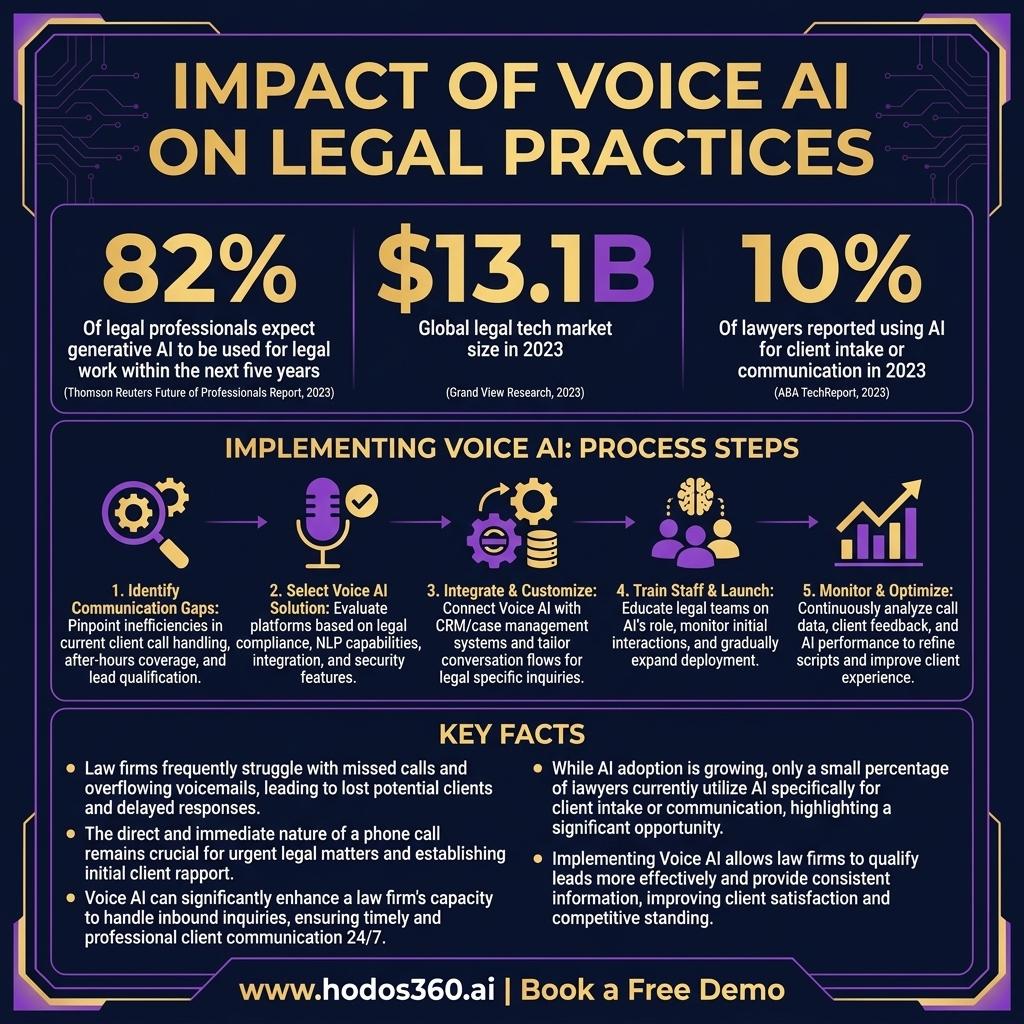
The legal industry is at an inflection point, with a clear divide emerging between firms that are proactively adopting advanced technologies and those that are hesitant. This isn't just about being "tech-savvy"; it's about survival and growth in an increasingly demanding market. Firms that leverage Voice AI gain a significant competitive edge by offering superior customer service, unparalleled responsiveness, and efficient resource allocation. While traditional firms struggle with staffing for after-hours phone calls or managing high call volumes, their AI-enabled counterparts are capturing leads, nurturing client relationships, and building a reputation for innovation and accessibility.
This divergence is evident in market performance. Learn more about Essential AI SMS Marketing: Drive Law Firm Growth. Firms that have invested in legal tech, including AI solutions, report higher client satisfaction scores and greater revenue growth, according to the latest ABA Legal Technology Survey. Conversely, those that cling to outdated communication methods risk alienating tech-savvy clients and falling behind competitors who embrace tools that reduce operational costs and enhance client experience. The narrative arc here is clear: innovation is no longer optional; it is essential for maintaining relevance and achieving sustained success in the modern legal landscape.
Implementing Voice AI: A Roadmap for Law Firms
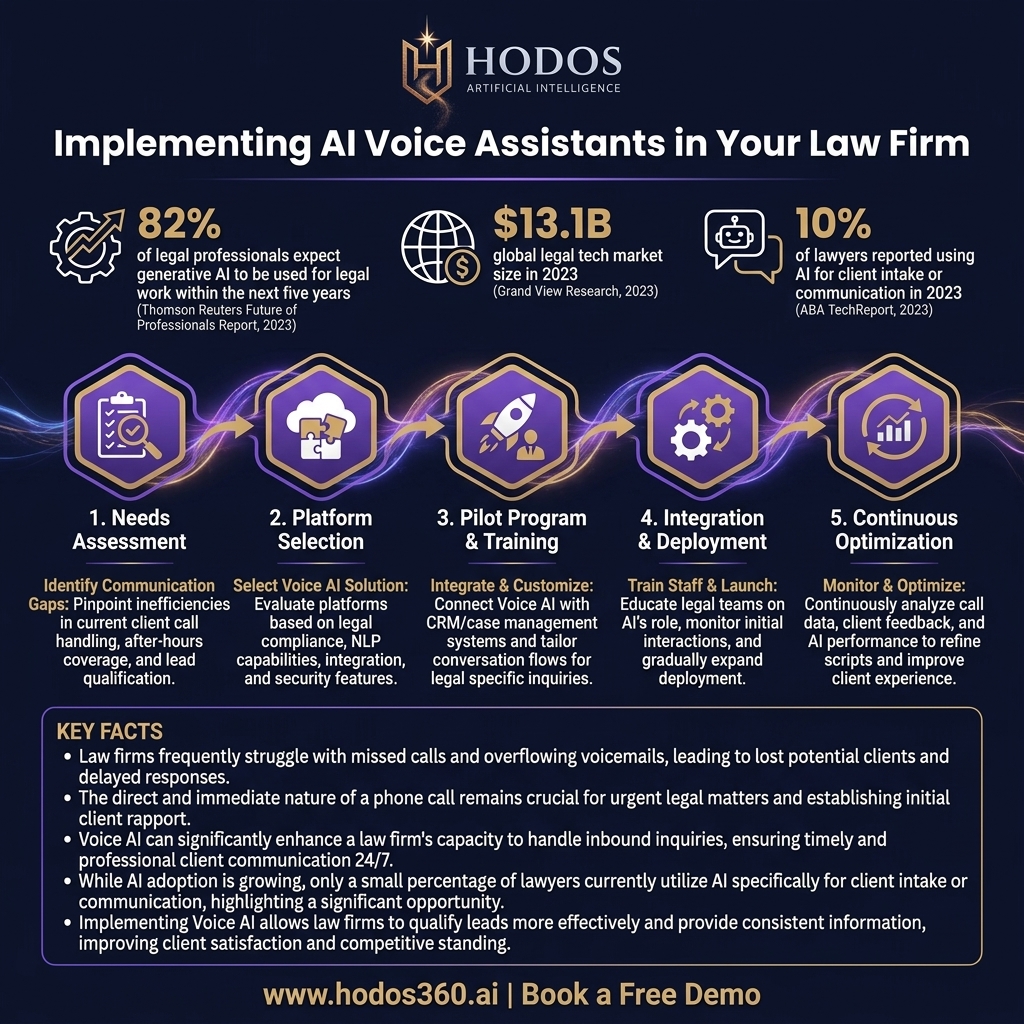
Successfully integrating Voice AI into a law firm requires a strategic, phased approach, moving beyond the initial excitement to practical deployment. The first step involves a comprehensive needs assessment: identifying specific pain points in client communication, understanding call volumes, and mapping out the most common client service inquiries. This diagnostic phase is crucial for tailoring the AI voice assistant to the firm's unique operational requirements and client demographics. For instance, a personal injury firm might prioritize lead qualification and immediate scheduling, while a corporate law firm might focus on routing complex inquiries to specialized attorneys. This detailed analysis forms the blueprint for a targeted implementation that maximizes ROI.
Next, firms should consider a pilot program, starting with a subset of functions or a specific practice area. This allows for iterative refinement, ensuring the AI voice assistant is trained effectively on legal terminology and firm-specific protocols. Choosing a robust, comprehensive platform like HODOS 360 is paramount. A system that offers not just AI Voice Assistants but also integrates seamlessly with case management, client intake, and document automation (as HODOS 360 does with its AI Law Firm Management System) provides a holistic solution. This integration is key to unlocking the full potential of AI, creating intelligent legal workflows that span from initial client contact to case resolution. The goal is to create a synergy where the technology enhances, rather than complicates, existing processes, ensuring that the firm remains agile and efficient.
- ✓Define Clear Objectives: What specific problems will Voice AI solve for your firm? (e.g., reduce missed calls, improve lead qualification, provide 24/7 client support).
- ✓Data Security & Privacy: Ensure the chosen platform meets stringent legal industry security standards and compliance requirements (e.g., ABA Model Rules, GDPR, CCPA).
- ✓Integration Capabilities: Select a solution that integrates smoothly with existing CRM, practice management, and calendaring systems.
- ✓Customization & Training: The AI should be trainable on your firm's specific legal terminology, common client questions, and preferred communication style.
- ✓Scalability: Choose a platform that can grow with your firm, handling increasing call volumes and expanding service offerings.
- ✓Human Oversight & Feedback Loop: Maintain human supervision, especially for complex or sensitive matters, and establish a feedback mechanism for continuous AI improvement.
- ✓Multilingual Support: Assess the need for multilingual support to cater to diverse client populations.

Key Takeaways and Next Steps
The narrative is clear: Voice AI is not a passing fad but a foundational shift in how law firms will interact with their clients and manage their operations. The "resurrection" of the phone call, powered by intelligent AI agents, offers an unparalleled opportunity for legal professionals to enhance client engagement, streamline workflows, and secure a significant competitive advantage. From ensuring 24/7 client support and efficient lead qualification to navigating the complexities of multilingual support and reducing operational costs, the benefits are profound. Firms that embrace this technology are not just modernizing; they are future-proofing their practice.
The journey towards an AI-powered legal future begins with strategic choices and a commitment to innovation. Platforms like HODOS 360 offer comprehensive AI Voice Assistants designed specifically for the legal sector, ensuring compliance, security, and seamless integration with existing legal tech ecosystems. As the legal landscape continues to evolve, driven by ai news today and rapid advancements from OpenAI and others, the ability to adapt and leverage cutting-edge tools will define success. Don't be left behind in the digital transformation. Explore HODOS 360’s AI Voice Assistants and elevate your firm’s client experience today!
Frequently Asked Questions
How does Voice AI differ from traditional answering services for law firms?+
Voice AI goes far beyond traditional answering services by offering intelligent, dynamic conversations. Instead of just taking messages, an AI voice assistant can understand context, qualify leads, answer complex questions, provide real-time information, and even book appointments directly into your calendar, operating 24/7 with multilingual support.
What are the primary benefits of implementing AI Voice Assistants for legal practices?+
The primary benefits include enhanced client service through 24/7 availability, improved lead qualification and conversion rates, significant reductions in operational costs by automating routine phone calls, and increased firm efficiency by freeing up staff for high-value legal work. It also provides a competitive edge.
How do HODOS 360's AI Voice Assistants ensure client confidentiality and data security?+
HODOS 360's AI Voice Assistants are built with enterprise-grade security, employing advanced encryption, secure data storage, and strict access controls compliant with legal industry standards. We prioritize data privacy, offer auditable logs, and design workflows to protect privileged information, adhering to ABA Model Rules and other relevant regulations.
Can Voice AI handle complex legal inquiries, or is it only for basic questions?+
While Voice AI excels at handling routine inquiries and lead qualification, advanced systems like HODOS 360 can be trained on your firm's specific knowledge base to address more complex legal questions. For highly sensitive or nuanced matters, the AI is programmed to intelligently route calls to a human attorney, ensuring no query goes unanswered or mishandled.
What are the initial steps for a law firm considering Voice AI adoption?+
Begin with a comprehensive needs assessment to identify specific communication pain points and objectives. Then, research and select a reputable vendor offering solutions tailored to the legal sector, like HODOS 360. Consider a pilot program to refine the AI voice assistant's training and integration before full-scale deployment.
How does Voice AI contribute to a law firm's client acquisition strategy?+
Voice AI significantly boosts client acquisition by ensuring instant, professional responses to all inquiries, 24/7. This immediate engagement improves the first impression, increases lead qualification efficiency, and allows for direct appointment booking, reducing response times and converting more prospects into actual clients.