


Voice AI: The Essential Evolution Beyond Legal Dictation
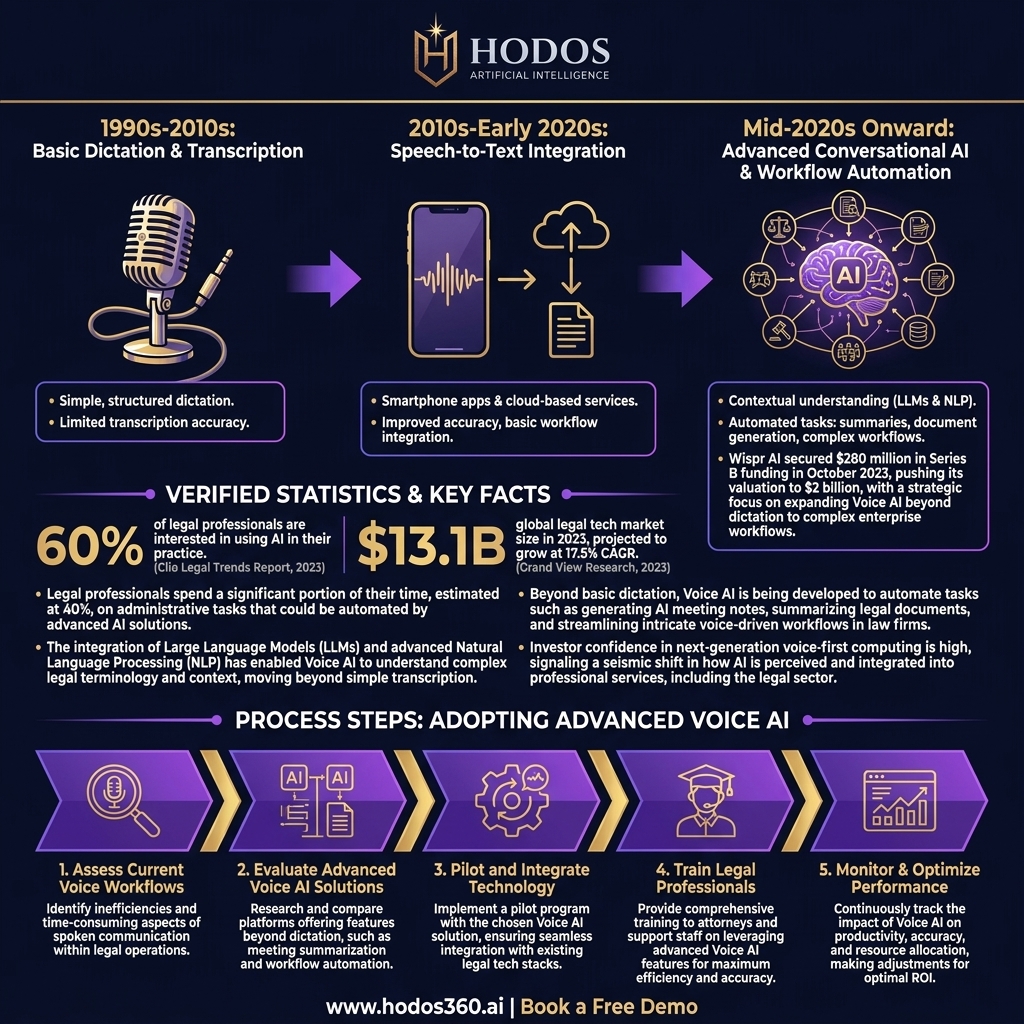
The legal landscape is experiencing a profound technological acceleration, and nowhere is this more evident than in the burgeoning field of Voice AI. Just recently, the industry buzzed with news of Wispr, a pioneering Voice AI startup, securing an astounding $280 million in a Series B funding round, pushing its valuation to a staggering $2 billion. This isn't merely another investment; it's a powerful signal from venture capitalists like Andreessen Horowitz and Sequoia Capital, indicating a seismic shift in how we perceive and interact with artificial intelligence. Wispr's ambition to expand Voice AI beyond dictation—targeting complex enterprise voice workflows and AI meeting notes—mirrors a broader industry movement that promises to revolutionize legal operations, client engagement, and strategic decision-making for law firms worldwide. This significant capital injection underscores investor confidence in the next generation of voice-first computing, moving well past the rudimentary transcription services many attorneys have reluctantly adopted over the years. This isn't about replacing the human element, but augmenting it, allowing legal professionals to focus on the nuanced legal work that truly requires their expertise, while AI handles the high-volume, repetitive tasks that often consume valuable time and resources.
For years, Voice AI in legal contexts was synonymous with dictation software—tools designed primarily to convert spoken words into text. While these tools offered a degree of convenience, their limitations in understanding context, handling complex legal terminology, or integrating seamlessly into sophisticated legal workflows often led to frustration rather than efficiency. However, the recent surge in large language models (LLMs) and advanced natural language processing (NLP) has fundamentally altered this paradigm. Companies like OpenAI, led by Sam Altman, and Anthropic, under Dario Amodei, have pushed the boundaries of what AI can comprehend and generate, directly impacting the capabilities of conversational AI. This evolution means that Voice AI is no longer a passive input device but an active, intelligent participant capable of complex interactions, lead qualification, and even legal research assistance. The implications for law firms are immense: imagine an AI voice assistant that can not only transcribe a client call but also identify key legal issues, flag potential conflicts of interest, and even draft initial follow-up communications, all while maintaining strict confidentiality and accuracy. This represents a leap from mere utility to strategic asset, fundamentally reshaping the operational blueprint of the modern law firm.
This shift is particularly critical for law firms grappling with mounting administrative burdens, the need for enhanced client responsiveness, and the constant pressure to optimize resource allocation. The investment in Wispr signifies that the market is ready for sophisticated AI voice assistant solutions that can tackle these challenges head-on. As law firms navigate a competitive landscape, the adoption of advanced legal technology becomes an essential differentiator. The ability to leverage Voice AI for functions such as 24/7 phone answering, automated client intake, appointment booking, and intelligent call routing can dramatically improve client satisfaction and operational efficiency. This blog post will delve into how these advanced Voice AI capabilities are reshaping legal practice, from enhancing client experience to streamlining internal operations, and what law firms need to know to harness this transformative power. Discover how embracing these innovations can position your firm at the forefront of the legal industry's evolution.
The New Frontier of Voice AI in Legal Workflows
The days of Voice AI being confined to simple dictation are rapidly becoming a relic of the past. Today's advanced AI voice assistants are integrated into complex legal workflows, performing tasks that were once exclusively human domains. Consider the initial client intake process, a critical yet often time-consuming bottleneck for many firms. Traditionally, this involves paralegals or administrative staff spending hours on the phone, gathering information, explaining procedures, and scheduling follow-ups. With modern Voice AI, this process can be largely automated. An AI voice assistant can engage prospective clients in natural language conversations, qualify leads based on predefined criteria, collect essential case details, and even initiate the creation of a new client file within a firm's case management system. This isn't just about efficiency; it's about providing immediate, consistent, and high-quality service, a stark contrast to the often-delayed human response. Firms that have adopted these tools, such as Linklaters, which has been exploring various AI applications, understand the competitive edge gained by automating these foundational interactions. The tension here lies between firms willing to invest in cutting-edge legal technology and those clinging to traditional, labor-intensive methods, risking being outpaced in client acquisition and satisfaction.
This evolution extends beyond dictation to more nuanced applications within day-to-day legal practice. Imagine an attorney asking their AI voice assistant to summarize recent case law pertinent to a specific legal issue, identify relevant clauses in a complex contract, or even draft initial responses to routine client inquiries, all through natural spoken commands. This is no longer science fiction. Companies like Harvey AI, which recently partnered with Allen & Overy, are demonstrating the power of generative AI in legal research and drafting. Learn more about Agentic Marketing: Essential Data Foundation for Law Firms. While Harvey AI focuses on text-based generative models, the underlying large language model technology is precisely what empowers advanced Voice AI to understand and generate sophisticated legal language. The key is the ability of these systems to interpret intent, access vast databases of legal information, and synthesize responses in a coherent and legally sound manner. This capability transforms the AI voice assistant from a simple transcriber into a powerful research and drafting aid, significantly reducing the time spent on preliminary legal tasks and allowing attorneys to focus on strategic analysis and client advocacy. This paradigm shift enables a more proactive and agile legal practice, moving away from reactive, manual processes.
Furthermore, the integration of Voice AI into internal firm management is streamlining operations that extend far beyond dictation. Think about scheduling meetings, managing calendars, setting reminders for court dates, or even initiating document automation processes—all through voice commands. For example, an attorney could simply state, “Schedule a discovery deadline reminder for the Miller v. Jones case for October 15th,” and the AI voice assistant would integrate this into the firm's calendar and case management system. The American Bar Association's (ABA) 2023 TechReport consistently highlights the administrative burden faced by attorneys, often citing a significant portion of their time spent on non-billable administrative tasks. By offloading these routine, yet critical, functions to AI voice assistants, law firms can reclaim valuable billable hours and enhance overall productivity. This strategic deployment of Voice AI ensures that the firm's resources are optimized, with human talent directed towards higher-value activities. The financial implications are substantial; reducing overheads while increasing capacity directly impacts the firm's bottom line, making the case for investment in this essential legal technology undeniable.
Enhancing Client Experience and Operational Efficiency with Conversational AI
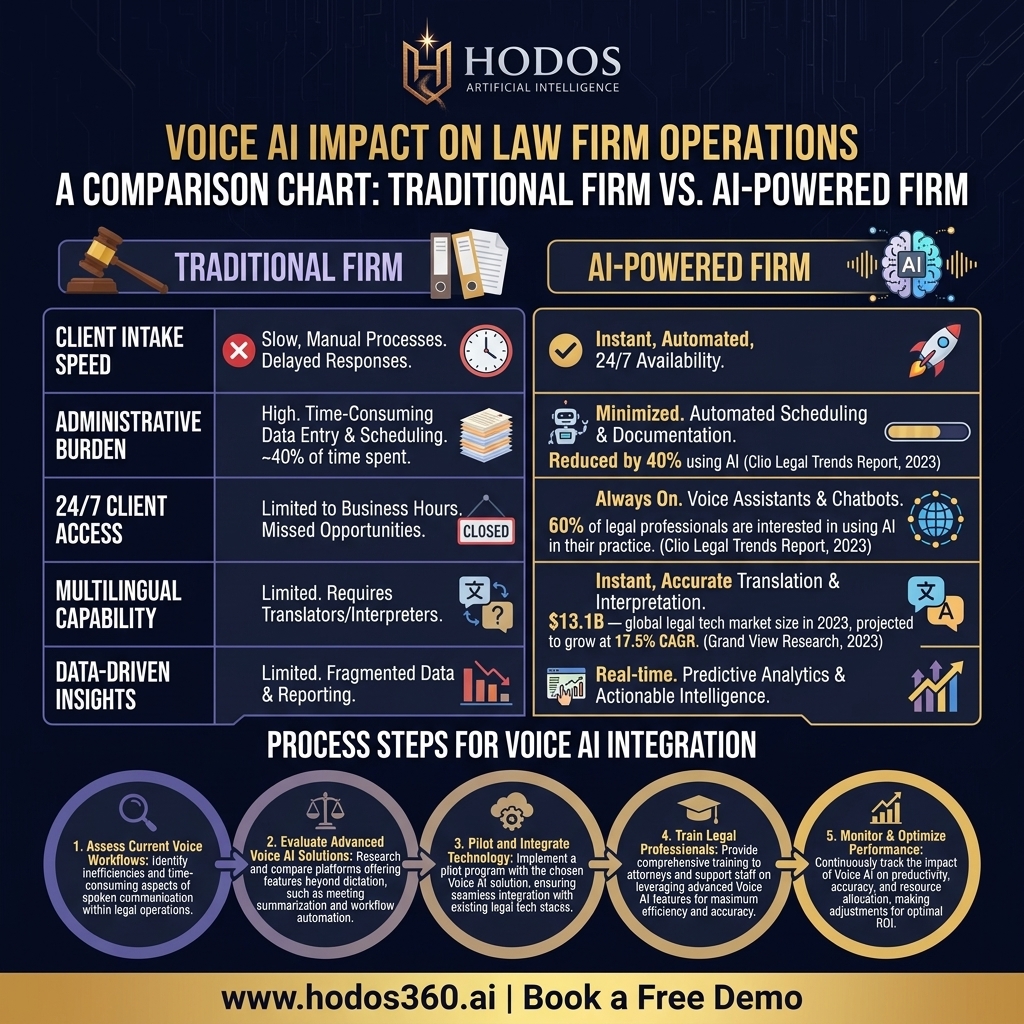
In today's client-centric legal market, responsiveness and accessibility are paramount. An unanswered call or a delayed response can mean the difference between securing a new client and losing them to a competitor. This is where advanced conversational AI and AI voice assistants truly shine, offering an unparalleled enhancement to the client experience. Imagine a prospective client calling your firm at 10 PM on a Sunday. Instead of reaching an answering machine, they are greeted by an intelligent AI voice assistant that can answer common questions, provide information about the firm's services, conduct initial lead qualification based on the caller's needs, and even book an appointment for a consultation at their convenience. This 24/7 availability ensures that no lead is lost due to timing or staffing limitations. A 2023 survey by Thomson Reuters found that client expectations for immediate service and digital interaction are at an all-time high, with firms that embrace technology seeing higher client retention rates. The ability of these systems to offer multilingual support further expands a firm's reach, catering to a diverse client base and breaking down communication barriers, which is an essential feature in many markets. This level of continuous, intelligent engagement significantly elevates the perception of a firm as modern, client-focused, and highly accessible, directly impacting its brand reputation and growth trajectory.
Beyond external client interactions, the operational efficiencies gained from sophisticated AI voice assistants are transformative for internal workflows. One of the most significant benefits is the reduction of administrative burden on legal staff. Tasks such as call routing, appointment reminders, and even basic information retrieval can be handled autonomously by Voice AI. This frees up paralegals, legal secretaries, and even junior attorneys from repetitive, low-value tasks, allowing them to dedicate their time to more substantive legal work that directly impacts client outcomes and revenue generation. Learn more about AI Marketing: The Ultimate Guide for Law Firms to Dominate Digital. For instance, instead of an assistant manually calling clients to confirm appointments, the AI voice assistant can send automated voice or text reminders, handling any rescheduling requests. According to a McKinsey report on AI adoption in professional services, firms leveraging AI for administrative tasks can see a 20-30% increase in operational efficiency. This not only streamlines daily operations but also contributes to a more engaged and satisfied workforce, as employees are empowered to focus on the intellectual challenges of law rather than mundane administrative chores. The strategic implementation of Voice AI thus becomes a cornerstone of a modern, efficient, and profitable law firm, moving them beyond dictation to true operational excellence.
Moreover, the data collected by AI voice assistants during client interactions provides invaluable insights for law firm management and marketing strategies. Every qualified lead, every booked appointment, and every client query handled by the Voice AI system generates actionable data. This information can be analyzed to identify peak call times, common client needs, effective lead qualification criteria, and even areas where the firm’s services could be expanded. For example, if the AI voice assistant frequently receives queries about a specific niche area of law, this could signal an unmet market demand that the firm could capitalize on. This level of granular data, previously difficult and time-consuming to collect manually, empowers law firms to make data-driven decisions about resource allocation, service offerings, and marketing campaigns. It provides a feedback loop that continually refines the firm’s approach to client acquisition and service delivery, ensuring that it remains agile and responsive to market demands. This analytical capability is a powerful competitive advantage, allowing firms to proactively adapt and thrive in a rapidly evolving legal landscape, further solidifying the case for adopting advanced legal technology.
Beyond Basic Call Answering: The Power of Contextual Understanding
The true power of modern Voice AI extends far beyond dictation or simple call answering; it lies in its ability to understand context and intent. Unlike rudimentary IVR systems, today's conversational AI can engage in dynamic, multi-turn dialogues, adapting its responses based on the nuances of the conversation. For a law firm, this means an AI voice assistant can distinguish between a new client inquiry, an existing client seeking an update, or a vendor call, and route them appropriately or provide relevant information. This contextual understanding is powered by sophisticated machine learning models that have been trained on vast datasets, allowing them to grasp the complexities of human language, including legal jargon and emotional cues. Learn more about AI Chatbot Builders: Transform Your Law Firm in 2026. This capability ensures a seamless and personalized experience for every caller, reducing frustration and increasing satisfaction. It's a significant leap from rigid scripts to fluid, intelligent interaction, making the AI voice assistant a genuine extension of the firm's professional image. This level of intelligent interaction is what sets advanced legal technology apart, offering a truly transformative experience for both clients and internal staff.
The Strategic Imperative: Funding, Innovation, and Market Disruption
The recent news of Wispr's monumental $280 million Series B funding round, which propelled its valuation to $2 billion, is not an isolated event but a clear indicator of a broader trend: the massive investment flowing into AI companies that are poised to disrupt traditional industries. This substantial raise signals a profound confidence from leading venture capital firms in the potential of Voice AI to move beyond dictation and into complex, high-value enterprise applications. The competition in this space is intense, with established tech giants like Microsoft and Google continually enhancing their own voice recognition and conversational AI capabilities, while innovative startups like Wispr are attracting significant capital to carve out their niche. This market dynamic creates a tension between the incumbent players and agile newcomers, pushing the boundaries of what legal technology can achieve. For law firms, this means a rapidly evolving marketplace of solutions, offering increasingly sophisticated tools to enhance their operations. The sheer scale of this funding also highlights the perceived market opportunity; investors believe that the ROI for businesses adopting these advanced Voice AI solutions will be substantial, making it an essential area for law firms to monitor and engage with.
This influx of funding into Voice AI startups is reminiscent of other major investment waves in legal technology. For example, Clio's strategic acquisitions and significant funding rounds have allowed it to dominate the practice management software market, while companies like Thomson Reuters and LexisNexis continually invest billions into their legal research and analytics platforms. The difference with Voice AI is its pervasive nature; it touches nearly every aspect of a law firm's operation, from initial client contact to internal administrative tasks and even substantive legal work. The success of companies like Wispr, which are specifically focused on expanding Voice AI beyond dictation, demonstrates that the market is ready for tailored, intelligent voice solutions. This isn't just about general-purpose AI; it's about specialized AI that understands the unique language, workflows, and ethical considerations of the legal profession. Learn more about AI SEO Marketing: Ultimate Guide for Law Firm Growth. Law firms that recognize this strategic imperative and proactively seek to integrate these innovations will be best positioned to thrive in an increasingly competitive environment, leveraging these advancements as a true differentiator in the market. The drama unfolds as firms decide whether to be pioneers or laggards in this technological race.
Furthermore, the aggressive funding of Voice AI startups like Wispr underscores the potential for significant market disruption. As these companies expand their capabilities, they offer solutions that can fundamentally alter the cost structures and efficiency models of law firms. The ability to automate tasks that previously required human intervention, whether it's initial client screening, scheduling, or even preliminary legal research, translates directly into reduced operational costs and increased capacity. This creates a competitive dynamic where firms that embrace these technologies can offer more competitive rates, provide faster service, and handle a higher volume of cases without compromising quality. The tension between traditional law firm models and the emerging tech-enabled practice is palpable. Firms that resist this evolution risk falling behind in terms of efficiency, client satisfaction, and ultimately, profitability. The prudent approach for law firm leaders is to view these funding rounds and technological advancements not just as news items, but as direct signals for strategic planning. The market is clearly indicating that Voice AI is not a passing trend but an essential component of future-proof legal practice, offering the tools to move beyond dictation to truly transformative capabilities.
- ✓Enhanced Client Intake: Automate initial client queries, lead qualification, and appointment booking 24/7, ensuring no potential client is missed.
- ✓Streamlined Legal Workflows: Integrate Voice AI into case management for hands-free task management, calendar updates, and document initiation.
- ✓Improved Operational Efficiency: Reduce administrative overhead by automating routine calls, reminders, and data entry, freeing up legal professionals.
- ✓Multilingual Support: Offer service in multiple languages, expanding your firm's reach and catering to a diverse client base.
- ✓Data-Driven Insights: Capture and analyze interaction data to identify trends, optimize services, and inform marketing strategies.
- ✓Competitive Advantage: Differentiate your firm by providing cutting-edge, responsive, and efficient services that exceed client expectations.
- ✓Cost Reduction: Minimize staffing costs for repetitive tasks and reallocate resources to higher-value legal work, boosting profitability.
Integrating Voice AI: Practical Steps for Law Firms
For law firms looking to leverage the power of advanced Voice AI and move beyond dictation, a strategic and measured approach to integration is essential. The first step involves a comprehensive assessment of current pain points and areas where an AI voice assistant can provide the most immediate and impactful relief. This might include analyzing call volumes, client intake efficiency, and time spent on administrative tasks. Once these areas are identified, selecting the right legal technology platform is crucial. Firms should look for solutions that offer robust AI voice assistant capabilities, seamless integration with existing case management and billing systems, and strong data security protocols. Platforms like HODOS 360 offer a full suite of AI-powered services, including a sophisticated AI Law Firm Management System and AI Voice Assistants designed specifically for legal environments, covering everything from 24/7 phone answering and lead qualification to appointment booking and multilingual support. This holistic approach ensures that the Voice AI solution is not just a standalone tool but an integrated component of the firm's entire technological ecosystem, maximizing its effectiveness and minimizing disruption. Implementing these tools requires careful planning and a phased rollout to ensure staff adoption and optimal performance, focusing on specific workflows before expanding across the entire firm.
Training and customization are equally vital for successful Voice AI integration. While many AI voice assistants are highly capable out-of-the-box, tailoring them to a firm's specific terminology, client base, and ethical guidelines will unlock their full potential. This involves customizing scripts for client interactions, training the AI on specific legal jargon relevant to the firm's practice areas, and configuring call routing rules. Firms must also address the ethical considerations inherent in using AI, particularly concerning data privacy and confidentiality. The ABA Model Rule 1.6 on Confidentiality of Information mandates that lawyers make reasonable efforts to prevent the inadvertent or unauthorized disclosure of, or unauthorized access to, information relating to the representation of a client. Learn more about AI Legal Management: The Essential Build vs. Buy Strategy. This means ensuring that any AI voice assistant platform complies with stringent data encryption, access controls, and privacy regulations. Firms should conduct thorough due diligence on vendors, inquiring about their data handling practices, compliance certifications, and incident response plans. Proactive engagement with these ethical frameworks ensures that the adoption of legal technology enhances client service without compromising trust or professional obligations.
Finally, ongoing monitoring and iterative refinement are essential for maximizing the long-term benefits of Voice AI. Technology is not static, and neither are client needs or legal regulations. Firms should regularly review the performance of their AI voice assistants, analyzing metrics such as lead conversion rates, client satisfaction scores, and operational efficiency gains. Feedback from both clients and internal staff is invaluable for identifying areas for improvement or new opportunities for AI deployment. This continuous improvement cycle ensures that the Voice AI solution remains aligned with the firm's strategic objectives and continues to deliver value. For example, if data analytics reveal a recurring client query that the AI struggles with, the system can be retrained or its knowledge base expanded. Embracing this iterative approach transforms Voice AI from a one-time implementation into a dynamic, evolving asset that consistently enhances client experience and optimizes legal workflows. The goal is not just to adopt technology, but to master it, making it an indispensable part of the firm's competitive advantage and pushing the boundaries of what is possible beyond dictation.
Seamless Integration with Case Management
A true game-changer for law firms is the seamless integration of AI voice assistants with their existing case management systems. This synergy transforms the Voice AI from a simple communication tool into a powerful workflow automation engine. Imagine an AI voice assistant handling an initial client intake call, and as it gathers information, it automatically creates a new client file in the firm's case management software, populating fields with the caller's details, case type, and initial notes. This eliminates manual data entry, reducing errors and saving significant administrative time. Learn more about AI Website Builders vs. Traditional: Proven Edge for Law Firms. Furthermore, the Voice AI can update case statuses, schedule follow-up tasks, or even trigger document automation processes based on spoken commands or detected client needs. This level of integration, moving far beyond dictation, ensures that all client interactions and administrative actions are immediately captured and acted upon within the firm's central operational hub. This is an essential step towards a truly paperless, highly efficient, and integrated legal practice, maximizing the return on investment in legal technology and streamlining daily operations.

Key Takeaways and The Future of Voice-Enabled Legal Practice
The recent $280 million funding round for Wispr, propelling its valuation to $2 billion, serves as a powerful testament to the transformative potential of Voice AI in the enterprise, a revolution that is undeniably impacting the legal sector. This isn't merely about incremental improvements to existing tools; it's about a fundamental redefinition of how law firms operate, engage with clients, and manage their complex legal workflows. The move beyond dictation to sophisticated conversational AI and intelligent AI voice assistants is an essential evolution, offering unparalleled opportunities for efficiency gains, enhanced client satisfaction, and competitive differentiation. Firms that embrace this wave of legal technology will be better positioned to attract and retain clients, optimize their resources, and navigate the challenges of a rapidly changing legal market. Ignoring these advancements is no longer a viable strategy; it's a risk that could leave firms struggling to keep pace with more technologically agile competitors. The narrative arc of legal tech is clear: innovation rewards the bold, and Voice AI stands as a pivotal chapter in this story.
For law firm owners and attorneys, the actionable takeaway is clear: it's time to strategically evaluate and integrate advanced Voice AI solutions into your practice. Start by identifying specific pain points where an AI voice assistant can deliver immediate value, whether it's automating client intake, providing 24/7 client support, or streamlining internal administrative tasks. Research reputable legal technology providers that offer comprehensive, secure, and customizable Voice AI platforms, ensuring they align with your firm's ethical obligations, particularly regarding data confidentiality as per ABA Model Rule 1.1 (Competence) and 1.6 (Confidentiality of Information). The future of legal practice is increasingly voice-enabled, promising a more efficient, responsive, and client-centric approach to law. By proactively adopting these innovations, law firms can not only stay competitive but also redefine what it means to deliver exceptional legal services in the 21st century. The time to act is now, to ensure your firm is at the forefront of this essential evolution.
Frequently Asked Questions
What is the difference between traditional dictation and modern Voice AI?+
Traditional dictation primarily converts spoken words to text, often requiring manual corrections. Modern Voice AI, however, utilizes advanced natural language processing (NLP) to understand context, intent, and engage in multi-turn conversations. It can perform complex tasks like lead qualification, data entry, and workflow automation, moving far beyond dictation to become an intelligent assistant capable of nuanced interactions.
How can Voice AI enhance a law firm's client intake process?+
Voice AI can revolutionize client intake by providing 24/7 automated phone answering, lead qualification, and appointment booking. An AI voice assistant can gather initial client details, identify the nature of their legal need, and even create a preliminary case file, ensuring no potential client is missed and providing immediate, professional service, streamlining the entire process for the firm.
What are the ethical considerations for law firms using Voice AI?+
Ethical considerations include data privacy, confidentiality (ABA Model Rule 1.6), and maintaining attorney-client privilege. Law firms must ensure their Voice AI solutions comply with stringent security protocols, including data encryption and access controls. It's essential to vet vendors thoroughly and understand their data handling practices to protect sensitive client information and uphold professional obligations.
How does Voice AI improve operational efficiency in law firms?+
Voice AI improves operational efficiency by automating repetitive administrative tasks such as call routing, scheduling, appointment reminders, and even preliminary data entry. This frees up legal professionals to focus on higher-value, substantive legal work, increasing billable hours and overall productivity. It streamlines legal workflows, reduces human error, and optimizes resource allocation, moving beyond dictation to comprehensive automation.
Why is there such significant funding in Voice AI startups like Wispr?+
The substantial funding in Voice AI startups like Wispr (e.g., $280 million at a $2 billion valuation) reflects investor confidence in the technology's ability to move beyond dictation and disrupt various enterprise sectors. Investors see immense market potential in AI voice assistants that can handle complex tasks, improve efficiency, and enhance customer experience, leading to significant ROI for businesses that adopt these innovative solutions, making it an essential investment area.