
Essential AI Chats Privacy: Safeguarding Client Data in Legal AI
The digital whispers of artificial intelligence, once thought to be confined to private interactions, recently erupted into a public outcry when it was discovered that numerous Claude AI chats were exposed on Google through simple searches. "Think before you prompt," warned *The Eastleigh Voice*, detailing how Reddit users uncovered a vulnerability allowing search engines to index shared conversations via specific site:claude.ai/share operators. This revelation sent shockwaves, revealing deeply personal information—from medical reports to API keys—that users had inadvertently left accessible. Dario Amodei, CEO of Anthropic, the company behind Claude, acknowledged the issue, stating their commitment to user privacy, yet the damage was done, igniting a crucial global dialogue about the true meaning of 'private' in the age of generative AI.
For law firms, the incident is more than a cautionary tale; it's a stark reminder of the precarious tightrope walked between leveraging AI for efficiency and upholding the sacrosanct duty of client data security and confidentiality. Lawyers are bound by stringent ethical obligations, such as ABA Model Rule 1.6 (Confidentiality of Information), which mandates protecting all information relating to the representation of a client. The idea that sensitive legal discussions, case details, or client PII could be inadvertently indexed by a search engine is not just alarming—it represents a profound professional and ethical breach. Firms adopting AI without rigorous privacy safeguards risk not only their reputations but also severe legal repercussions, including malpractice claims and regulatory fines under statutes like HIPAA or state data privacy laws.
This incident underscores a critical imperative: legal professionals must not only understand the power of AI but also its inherent vulnerabilities and the robust measures required to mitigate them. As AI continues to integrate into every facet of legal practice, from AI Law Firm Management System to AI Voice Assistants, the focus must shift from mere adoption to secure, compliant implementation. This post delves into the implications of such privacy breaches for the legal sector, explores the complex landscape of AI data security, and outlines proactive strategies law firms can employ to safeguard sensitive information, ensuring that the promise of AI doesn't come at the cost of AI chats privacy.
--- [CTA 1: Explore Secure AI Solutions for Your Law Firm Today. Visit HODOS 360.] ---
The Peril of Publicly Exposed AI Conversations: A Legal Perspective
The Claude AI chats incident illuminated a critical flaw in how some AI platforms handle shared conversations, exposing a vulnerability that allowed Google to index links that were never intended for public consumption. Reddit users, by merely typing specific search operators, were able to access thousands of conversations, some containing highly sensitive personal and professional data. The implications for the legal industry are profound; imagine a scenario where confidential attorney-client communications, strategy documents, or settlement details, inadvertently processed by an insecure AI, become publicly searchable. Such an event would not only constitute a catastrophic data breach but also a direct violation of the lawyer’s fundamental duty of confidentiality.
Law firms, by their very nature, are custodians of immense amounts of sensitive data. From intricate financial records to deeply personal client narratives, the information entrusted to legal professionals demands the highest level of protection. Learn more about AI Intake: The Essential Guide for Modern Law Firms. The exposed chats from Claude, which reportedly included everything from medical diagnoses to proprietary code snippets, demonstrate the breadth of data that can be compromised. For a law firm, a similar exposure could lead to irreparable damage to client trust, hefty fines under regulations like the Health Insurance Portability and Accountability Act (HIPAA) if health information is involved, and severe professional sanctions from bar associations. The incident highlights that the 'private by default' assumption often associated with AI tools can be dangerously misleading when sharing functionalities are not meticulously secured and audited.
Navigating the Complex Web of AI Data Security and Compliance
The rapid proliferation of generative AI tools presents an evolving landscape of data security challenges for law firms. Unlike traditional software, AI models often learn from vast datasets, and their outputs can sometimes inadvertently reveal patterns or information derived from their training data or even user inputs. This 'black box' nature, combined with the ease of sharing features, creates new vectors for data leakage and privacy breaches. A 2024 report by Thomson Reuters indicated that while AI adoption in law firms is accelerating, a significant percentage of firms still struggle with understanding and implementing robust AI governance frameworks, leaving them susceptible to the kind of exposure seen with Claude AI chats.
The regulatory environment is struggling to keep pace with AI's rapid advancements. While comprehensive federal AI privacy legislation in the United States is still nascent, existing laws like HIPAA, CCPA, and state bar ethical rules provide a patchwork of obligations. Learn more about AI-Native Law Firms: The Ultimate Guide to Thriving in a New Era. Globally, initiatives like the EU AI Act are attempting to establish clearer guidelines for AI development and deployment, particularly concerning data protection and human oversight. However, law firms cannot afford to wait for perfect legislation. They must proactively interpret existing mandates through an AI lens, ensuring that every AI tool, whether for AI Law Firm Management System or AI Marketing Platform, adheres to the strictest interpretations of client data security and confidentiality.
Ethical AI Use and Client Confidentiality: A Mandate for Law Firms
For legal professionals, the ethical imperative to protect client data is paramount. The ABA Model Rule 1.6 (Confidentiality of Information) serves as the cornerstone of this duty, extending to all information relating to the representation of a client, regardless of its source. When AI is integrated into legal workflows, lawyers must ensure that the use of these tools does not compromise this fundamental obligation. As Jack Newton, CEO of Clio, a leading legal tech company, often emphasizes, "Trust is the currency of the legal profession." Any incident, like the Claude AI chats exposure, that erodes this trust by compromising client data can have devastating consequences for individual practitioners and the profession as a whole.
The tension between innovation and ethical compliance is a defining challenge for modern law firms. While AI offers unprecedented opportunities for efficiency and insight, firms must approach its adoption with a 'privacy-by-design' mindset. Learn more about AI Website Builders: The Ultimate Guide to Legal SEO Automation. This means vetting AI solutions not just for their capabilities but, critically, for their data protection mechanisms, encryption standards, and adherence to legal and ethical guidelines. Firms like Allen & O'very, in their partnership with Harvey AI, exemplify the careful consideration required, focusing on secure, private deployments that maintain client confidentiality above all else. The goal is to harness AI's power without creating new vulnerabilities for sensitive conversations or documents.
--- [CTA 2: Transform Your Firm with Secure AI. Get a Free HODOS 360 Demo.] ---
Proactive Strategies for Safeguarding AI Chats and Client Data
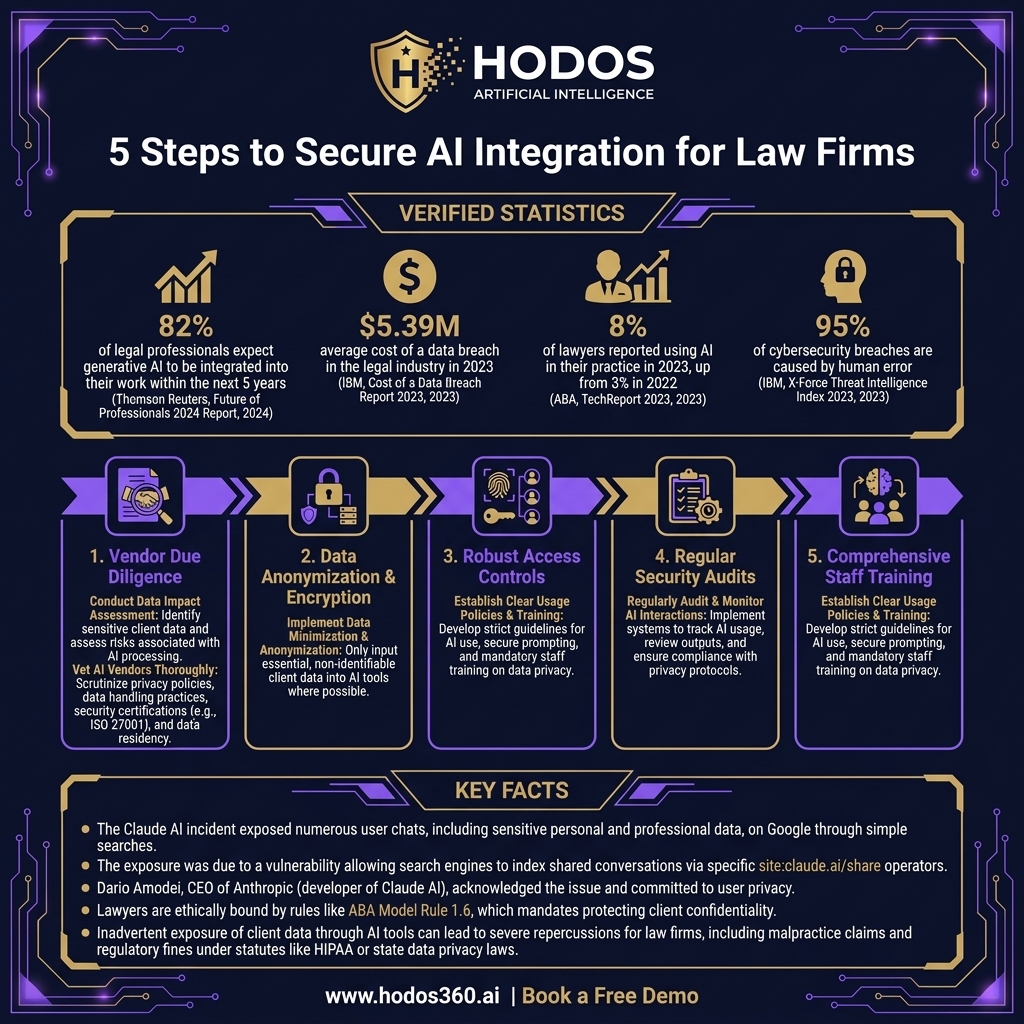
Protecting AI chats privacy and client data in the age of generative AI requires a multi-faceted and proactive approach. Law firms must establish stringent internal policies governing the use of all AI tools, particularly those involving client interactions or sensitive data processing. This includes clear guidelines on what information can be input into general-purpose AI models versus specialized, secure legal AI platforms. Data anonymization and pseudonymization techniques should be employed whenever possible, especially when experimenting with new AI applications. Regular training for all staff on these protocols, emphasizing responsible prompting and recognizing potential data leakage risks, is indispensable. This proactive stance ensures that every member of the firm understands their role in upholding client data security.
Critical to this strategy is robust vendor vetting. Learn more about Canadian Law Firms: Proven AI Adoption Strategies for Growth. Before integrating any AI solution, law firms must conduct thorough due diligence, scrutinizing the vendor's data protection policies, encryption standards, data residency, access controls, and audit trails. Questions about how the AI model is trained, whether client data is used for further model training, and the vendor's incident response plan are paramount. A 2023 ABA Legal Technology Survey Report revealed that while AI adoption is growing, many firms still lack comprehensive vendor assessment protocols for new tech. This gap must be closed to prevent incidents akin to the Claude AI chats exposure from occurring within the legal sphere. Firms should seek out partners who specialize in legal tech compliance solutions and demonstrate a deep understanding of legal ethical obligations.
Implementing Robust AI Governance Frameworks
Developing and implementing a comprehensive AI governance framework is no longer optional but a strategic imperative for law firms. This framework should encompass an AI ethics committee to guide responsible AI use, clear data retention policies for AI interactions and outputs, and a schedule for regular security audits to identify and rectify vulnerabilities. Furthermore, a well-defined incident response plan tailored to AI-related data breaches is crucial, ensuring swift and effective action in the event of a compromise. Learn more about AI Litigation Workflows: Essential for Modern Law Firms. The NIST AI Risk Management Framework offers a useful template for organizations to assess, manage, and mitigate risks associated with AI technologies, providing a structured approach to data protection.
Key components of secure AI integration for law firms include: * Vendor Due Diligence: Rigorous evaluation of AI providers' security, privacy, and compliance certifications. * Data Minimization: Only inputting the absolute necessary data into AI tools. * Encryption: Ensuring all data in transit and at rest, especially AI chats, is end-to-end encrypted. * Access Controls: Implementing strict role-based access to AI tools and their outputs. * Audit Trails: Maintaining comprehensive logs of AI interactions and data access for accountability. * Employee Training: Continuous education on AI ethics, data security, and firm-specific AI policies. * Regular Security Audits: Proactive scanning and penetration testing of AI systems and integrations.
The Role of AI Voice Assistants in Secure Client Interaction
While the Claude AI chats incident highlighted the risks of general-purpose AI, specialized AI tools, when designed with privacy-by-design principles, offer immense benefits for law firms. Consider the transformative potential of AI Voice Assistants in managing client interactions. Unlike generic chatbots, purpose-built legal AI voice assistants can be engineered with specific security protocols to handle sensitive information. For instance, in secure client intake processes, these assistants can gather initial client data, qualify leads, and book appointments, all while ensuring that the conversations are securely processed, encrypted, and stored in compliance with legal and ethical standards.
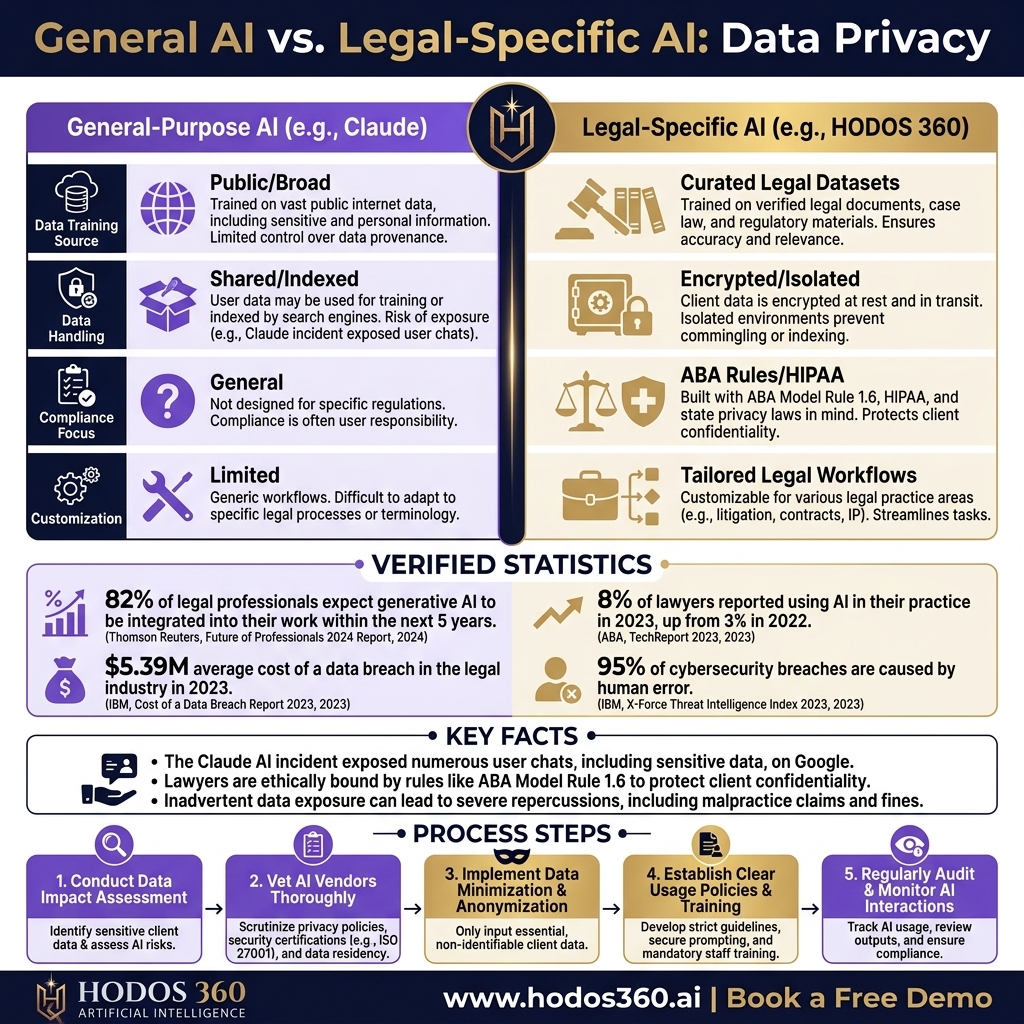
These advanced AI Voice Assistants offer 24/7 availability, multilingual support, and intelligent call routing, significantly enhancing client service and operational efficiency. Crucially, their architecture can be designed to prevent the kind of public exposure that plagued Claude. Learn more about Agentic AI: The Ultimate Marketing Edge for Law Firms. This means implementing features like secure, encrypted call recording, isolated data environments (e.g., private cloud deployments), strict access controls, and transparent data handling policies. By leveraging such specialized AI, law firms can embrace innovation without compromising the bedrock of their practice: client confidentiality and data protection. This contrasts sharply with the risks associated with using consumer-grade AI tools not designed for the stringent demands of the legal sector. HODOS 360’s AI Voice Assistants, for example, are built with these legal-specific requirements at their core, ensuring secure and compliant client interactions.
HODOS 360's Commitment to AI Chats Privacy and Data Protection
At HODOS 360, we understand that trust is non-negotiable in the legal profession. Our suite of AI-powered services, including AI Law Firm Management System, AI Marketing Platform, AI Voice Assistants, and Web & Mobile Development, is built with an unwavering commitment to AI chats privacy and client data security. We employ end-to-end encryption for all data, ensure strict access controls, and adhere to industry-best practices for data residency and compliance. Unlike the general-purpose AI tools whose chats were exposed, our platforms are engineered specifically for the legal sector, meaning every feature, from document automation to AI Voice Assistants handling sensitive client calls, is designed with confidentiality as a foundational principle. We believe that AI should be an asset, not a liability, empowering law firms to innovate securely.

Key Takeaways and Next Steps for AI-Powered Law Firms
The Claude AI chats incident serves as a critical wake-up call, emphasizing that the promise of AI in the legal sector is inextricably linked to robust AI chats privacy and data protection. For law firms, the imperative is clear: embrace AI, but do so with vigilance, strategic planning, and a deep understanding of the ethical and regulatory landscape. The risks of publicly exposed conversations are too high to ignore, demanding a proactive approach to client data security and legal tech compliance solutions. This means conducting thorough AI risk assessments, establishing comprehensive AI governance frameworks, and continuously educating legal professionals on responsible AI use.
Moving forward, law firms must prioritize partnerships with technology providers who demonstrate an explicit commitment to legal-specific data protection and confidentiality. Invest in purpose-built AI solutions that are designed from the ground up to meet the stringent demands of the legal profession, rather than adapting general-purpose tools. Platforms like HODOS 360 offer a comprehensive suite of AI-powered services—from secure AI Law Firm Management System to privacy-centric AI Voice Assistants—that empower firms to harness the full potential of AI without compromising their ethical obligations or client data security. The future of legal practice is AI-powered, but only if it's securely powered.
--- [CTA 3: Secure Your Firm's Future with HODOS 360's AI Solutions. Contact Us Today!] ---
Frequently Asked Questions
What happened with Claude AI chats and why is it relevant to law firms?+
Claude AI chats were inadvertently indexed by Google, making some private user conversations publicly searchable. This is highly relevant to law firms because it underscores the critical risks of data exposure in AI tools, highlighting the potential for confidential client information to be compromised if similar vulnerabilities exist in their legal tech, violating ethical duties like ABA Model Rule 1.6.
What specific ethical obligations do law firms have regarding AI chats privacy?+
Law firms are bound by strict ethical obligations, primarily ABA Model Rule 1.6 on confidentiality, which requires safeguarding all client-related information. Using AI necessitates ensuring that these tools maintain attorney-client privilege and data security, preventing unauthorized access or disclosure of sensitive AI chats and documents, and complying with data protection laws like HIPAA or state privacy acts.
How can law firms prevent their AI-driven client conversations from being exposed?+
To prevent exposure, law firms must implement robust AI governance frameworks, including strict internal policies for AI use, thorough vendor due diligence on all AI tools, data anonymization, and comprehensive staff training. Utilizing purpose-built legal AI solutions with privacy-by-design principles, end-to-end encryption, and secure data storage is crucial to maintaining AI chats privacy and client data security.
What role do AI Voice Assistants play in enhancing client data security for law firms?+
AI Voice Assistants, when designed specifically for legal applications, can enhance client data security by providing secure, encrypted channels for client intake, lead qualification, and appointment booking. Unlike general-purpose AI, these specialized assistants can be configured with strict access controls, compliant data storage, and audit trails, ensuring that client conversations are handled confidentially and in accordance with legal ethical standards.
What should law firms look for in a legal AI provider to ensure data protection?+
Law firms should seek legal AI providers who offer end-to-end encryption, robust access controls, transparent data handling policies (e.g., no client data used for model training), and compliance certifications relevant to the legal industry. The provider should also have a clear incident response plan and demonstrate a deep understanding of legal tech compliance solutions, ethical obligations, and AI chats privacy.