


Voice Search: Essential Strategies for Modern Law Firms
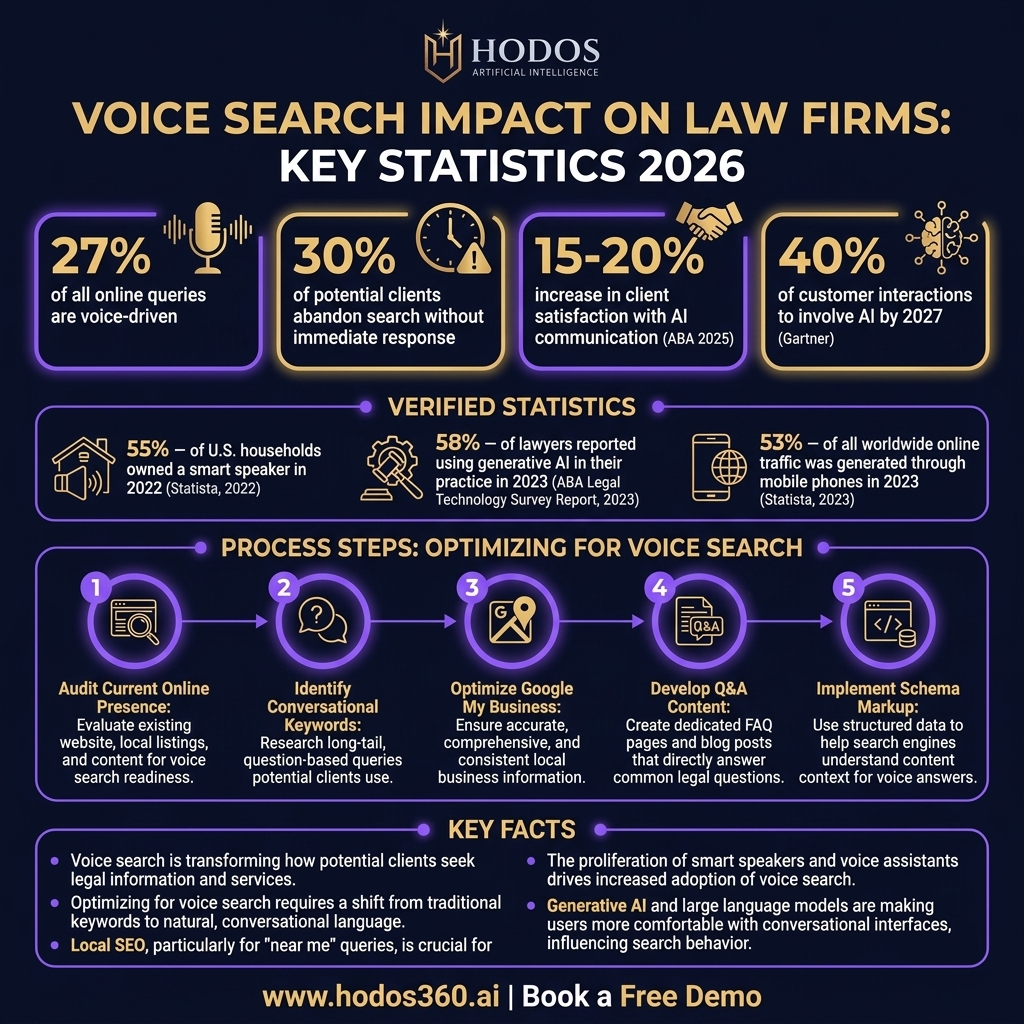
In a profession often characterized by its adherence to tradition, the digital tides are turning with unprecedented speed. Just last week, FinancialContent reported a seismic shift: voice search now accounts for a staggering 27% of all online queries. This isn't merely a statistic; it's a clarion call for law firms globally. Imagine Sarah Chen, the astute managing partner at 'LexCorp Legal,' a mid-sized firm specializing in corporate litigation. For years, LexCorp prided itself on its robust SEO strategy, meticulously crafted for text-based queries. Yet, Sarah recently noticed a subtle but disturbing trend: while overall web traffic remained stable, the quality of inbound leads seemed to wane. New clients were increasingly finding competitors through conversational searches, asking direct questions like, 'Find a corporate lawyer near me who handles intellectual property disputes' directly into their smart devices. The implications are profound: if a firm isn't optimized for how nearly a third of potential clients are now seeking legal services, it's missing a critical demographic.
This dramatic acceleration in voice search adoption isn't just a consumer trend; it's a fundamental reshaping of discovery and engagement. It signals a move away from keyword-centric browsing to more natural, conversational interactions. For law firms, this shift presents both an existential threat and an unparalleled opportunity. Firms clinging to outdated digital strategies risk becoming invisible to a significant portion of their target market, much like those who ignored the rise of mobile browsing a decade ago. The tension between traditional legal practices and the imperative for technological adaptation has never been more acute. As ChatGPT and other large language models (LLMs) from companies like OpenAI and Anthropic continue to permeate daily life, consumers are growing accustomed to receiving instant, tailored information through voice interfaces. This expectation extends directly to their search for legal counsel.
The question for law firms is no longer *if* they should adapt to voice search, but *how* and *how quickly*. The competitive landscape is already heating up. Firms that strategically integrate AI voice assistants and optimize their online presence for conversational queries are not just staying relevant; they are actively carving out new pathways for client acquisition and operational efficiency. This article delves into the critical strategies and innovations that legal professionals must embrace to not only navigate this evolving digital frontier but to dominate it. From optimizing for natural language processing (NLP) to leveraging AI-powered tools for client intake and lead qualification, the path forward is clear: embrace the voice revolution or be left in its digital dust. The time to act is now, transforming a potential crisis into a growth catalyst.
Understanding the Voice Search Revolution for Law Firms
The rise of voice search isn't a future prediction; it's a present reality with significant implications for how law firms attract and serve clients. The FinancialContent report, highlighting 27% of all queries now being voice-activated, underscores a fundamental shift in consumer behavior. This isn't just about asking Siri for the weather; it's about sophisticated inquiries, often with high intent, like 'find a probate lawyer in Miami' or 'what are the steps to trademark a business?' This trend is driven by the ubiquitous presence of smart speakers, smartphones, and in-car voice assistants, making hands-free access to information a daily norm. Data from PwC further corroborates this, indicating that adoption rates are rising across all age groups, with younger demographics showing even higher engagement. For law firms, this means that a significant portion of their potential client base is now bypassing traditional text-based search engines and interacting directly with AI-powered interfaces.
This shift isn't just about convenience; it's about the nature of the queries themselves. Voice searches tend to be longer, more conversational, and more question-based than typed queries. They mimic natural human dialogue, often including interrogative words like 'who,' 'what,' 'where,' 'when,' 'why,' and 'how.' For instance, a client might type 'divorce lawyer NYC,' but they're more likely to speak, 'Who is the best divorce lawyer in New York City for high-net-worth individuals?' This nuance requires a complete re-evaluation of content strategy for law firms. Traditional SEO, focused on short, high-volume keywords, often falls short in capturing these long-tail, conversational queries. Firms must now think about providing direct, concise answers to specific questions, anticipating client needs before they even articulate them fully. The competitive edge goes to those who can provide immediate, relevant information in a format optimized for voice assistants.
Consider the operational drama unfolding at firms like 'Justice & Partners.' For years, they relied heavily on paid search and organic rankings for short-tail keywords. However, David Lee, their marketing director, observed a plateau in lead quality despite consistent ad spend. Learn more about AI for Legal Teams: Essential Needs & Strategic Adoption. Upon deeper analysis, in consultation with a legal tech analytics firm, he discovered that while their text-based rankings remained strong, they were virtually invisible in voice search results. Competitors who had invested in optimizing for conversational queries, often by restructuring their website FAQs and blog content to directly answer common legal questions, were siphoning off high-intent leads. This market competition highlights a critical tension: firms must either adapt their content to a more conversational, question-and-answer format or risk ceding a growing segment of the market to more agile competitors. The stakes are high, as early adopters gain a significant advantage in brand recognition and client acquisition.
Moreover, the integration of generative AI into search engines, as seen with initiatives like Google's Search Generative Experience, further amplifies the need for voice optimization. These AI-powered interfaces are designed to provide direct, synthesized answers, often drawing from featured snippets and well-structured content. For a law firm, this means their content must not only be discoverable but also highly authoritative and structured to be easily digestible by AI. The ABA's TechReport 2025 highlighted that firms leveraging AI for client communication reported a 15-20% increase in client satisfaction and lead conversion rates. This data reinforces that the future of legal marketing is deeply intertwined with AI and voice technology, urging firms to invest in platforms that can manage and optimize these new interaction paradigms. The firms that embrace this change will not only capture more queries but will also build a reputation for being modern, accessible, and client-centric in an increasingly digital world.
The Conversational Shift: Beyond Keywords
The shift toward conversational queries is more than just a technical adjustment; it represents a fundamental change in how consumers interact with information and, by extension, how they expect to find legal services. Unlike traditional text-based searches, which often involve fragmented keywords and a process of sifting through multiple results, voice searches are characterized by their directness and natural language. A potential client using voice search is often looking for an immediate answer or a direct connection to a service provider. They might phrase their query as a complete sentence or even a series of related questions, expecting a similarly direct and relevant response. This demands that law firms move beyond simply stuffing keywords into web pages and instead focus on creating content that genuinely answers common legal questions in a clear, concise, and authoritative manner.
This new paradigm requires law firms to anticipate the full spectrum of a potential client's journey, from initial curiosity to specific service needs. For example, instead of just optimizing for 'personal injury lawyer,' a firm should create content that answers questions like 'What should I do after a car accident?' or 'How much does a personal injury lawyer cost?' These long-tail, question-based queries are precisely what voice search algorithms prioritize. Furthermore, the context of voice searches often includes location-based intent, as users are frequently on the go when using their voice assistants. Optimizing for 'near me' queries and ensuring accurate, up-to-date local business listings (Google My Business, Yelp, etc.) becomes paramount. Learn more about Essential AI Voice Assistant Strategies for Modern Law Firms. Firms must ensure their online presence provides explicit, structured data that voice assistants can easily parse and present as direct answers, effectively becoming the 'featured snippet' for legal inquiries in their area.
The implications of this conversational shift extend to the very architecture of a law firm's website and digital content. Websites need to be designed with mobile-first responsiveness in mind, as a significant portion of voice searches originate from mobile devices. Content should be easily scannable, with clear headings, bullet points, and concise paragraphs that directly address user intent. This also includes creating dedicated FAQ sections that are not just an afterthought but a central component of the content strategy, directly mirroring the questions clients are likely to ask verbally. Gartner's recent report on AI in customer service predicts that by 2027, 40% of all customer interactions will involve AI, with voice being a primary channel. Law firms ignoring this trend are not only missing out on leads but are also failing to build a foundational digital presence that aligns with evolving client expectations. The narrative of legal tech adoption is increasingly defined by firms that proactively embrace these changes versus those who wait until the market forces their hand.
Leveraging AI Voice Assistants for Client Acquisition
The strategic deployment of AI voice assistants represents a game-changer for law firms looking to capitalize on the voice search trend. Beyond just optimizing content for discoverability, these intelligent systems offer a direct, proactive solution for engaging potential clients. Imagine a scenario where a prospective client, after a quick voice search for a 'real estate lawyer,' is immediately connected to an AI voice assistant that can answer initial questions, qualify their needs, and even book an appointment – all without human intervention. This capability addresses a critical pain point for many law firms: missed calls, particularly after hours or during peak operational times. A study by the ABA Journal in 2024 revealed that over 30% of potential clients abandon their search if they don't receive an immediate response, a figure that dramatically increases outside of business hours.
This is where advanced platforms like HODOS 360 with its AI Voice Assistants service become indispensable. These systems are not merely answering machines; they are sophisticated lead qualification and client intake engines. They can handle a high volume of inbound queries, providing consistent, accurate information 24/7. For instance, an AI voice assistant can engage a caller in a natural, conversational manner, asking qualifying questions about their legal issue, jurisdiction, and urgency. It can then seamlessly route the call to the appropriate attorney or department if human intervention is required, ensuring that only genuinely qualified leads reach a lawyer's desk. This efficiency significantly reduces administrative burden, allowing legal teams to focus on billable work rather than initial screening. The drama often unfolds when a busy firm misses a crucial call from a high-value client, only for that client to find a competitor who was available immediately through an AI-powered system.
Furthermore, AI voice assistants can offer multilingual support, breaking down language barriers and expanding a firm's reach to a more diverse client base. In a globalized world, the ability to communicate effectively with clients in their native language is a powerful differentiator. Learn more about Marketing Attention: The Ultimate Shift for Law Firms. Consider the firm 'Global Counsel PLC,' led by Maria Rodriguez, specializing in immigration law. Implementing an AI voice assistant capable of fluent Spanish, Mandarin, and Arabic allowed them to capture a significant number of leads they previously missed due to language limitations or staffing constraints. This not only boosted their client acquisition but also enhanced their reputation as an inclusive and accessible firm. The technology’s ability to book appointments directly into a firm's calendar streamlines the client intake process, reducing friction and ensuring that potential clients move from inquiry to consultation with minimal delay. This proactive engagement is crucial in a competitive market where responsiveness is often equated with competence.
The strategic advantage of these AI voice assistants extends beyond initial contact to fostering a positive client experience from the outset. By providing instant, helpful responses, firms demonstrate a commitment to accessibility and modern service delivery. This aligns with the evolving expectations of today's consumers, who are accustomed to instant gratification from platforms like Amazon and Netflix. Integrating such a service means a firm is always 'open for business,' never missing an opportunity to engage a potential client. As Jensen Huang, CEO of NVIDIA, often emphasizes, the future of computing is conversational. Law firms that embrace this philosophy through AI voice assistants are not just adopting a new tool; they are redefining their client engagement model, ensuring they remain at the forefront of legal service delivery. The investment in such technology is not just about efficiency; it's about competitive survival and growth in a rapidly changing digital ecosystem.
Optimizing Your Digital Presence for Conversational AI
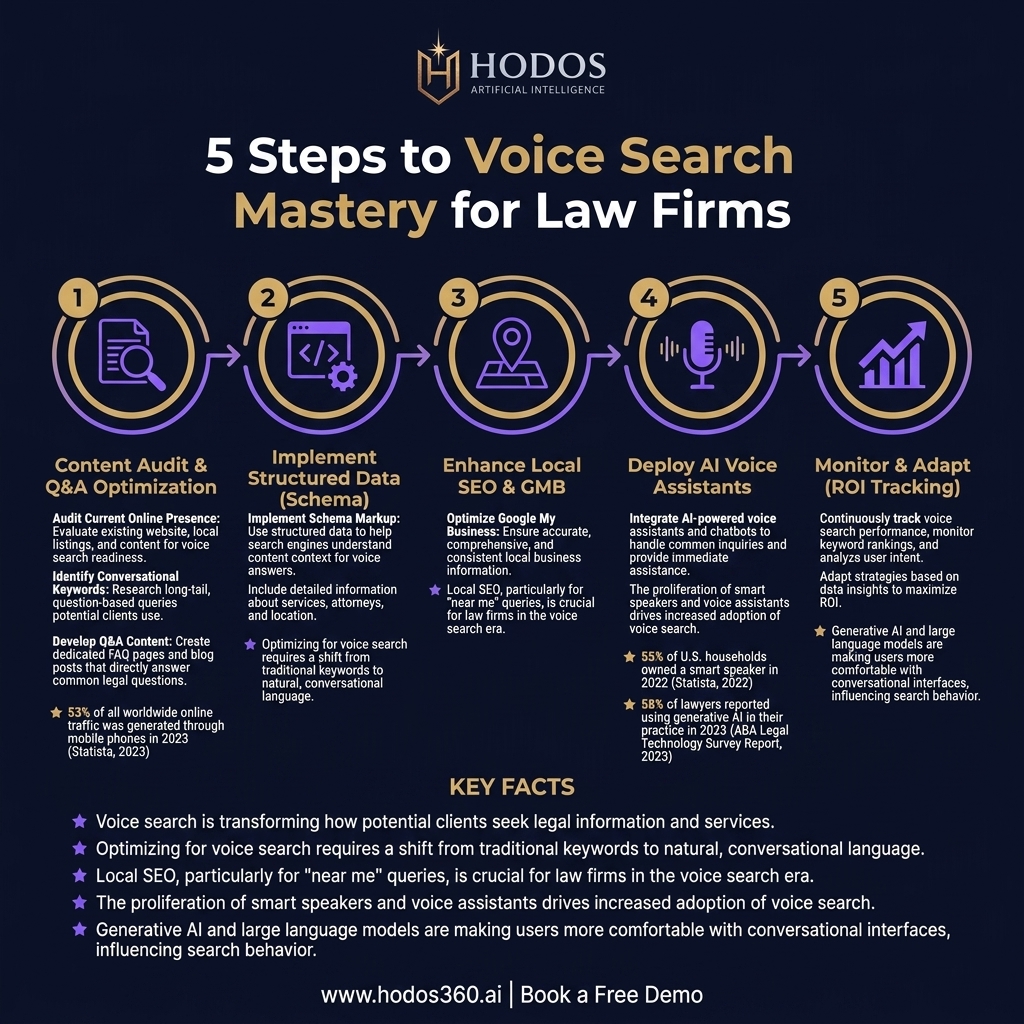
Optimizing a law firm's digital presence for conversational AI and voice search requires a multi-faceted approach that goes beyond traditional SEO tactics. It involves a deep understanding of natural language processing (NLP) and how AI algorithms interpret user intent. Firms must develop content that is not only informative but also structured in a way that makes it easily digestible by voice assistants. This means prioritizing clear, concise answers to common legal questions. A prime example is the 'question-and-answer' format often found in dedicated FAQ sections or blog posts directly addressing specific legal conundrums. For instance, instead of a broad article on 'estate planning,' a firm should create targeted content like 'What documents do I need for a basic will?' or 'How often should I update my trust?' These specific queries are precisely what voice search users are asking.
Furthermore, structured data markup, such as schema.org, plays a crucial role in helping search engines and AI voice assistants understand the context and content of a law firm's website. Implementing schema markup for legal services, FAQs, business information, and contact details can significantly improve a firm's visibility in voice search results. This provides explicit signals to algorithms about what information is available and how it should be presented. For example, marking up an FAQ section with FAQPage schema allows Google Assistant or Amazon Alexa to directly read out answers from your site. Without this structured data, even highly relevant content might be overlooked. The narrative of firms like 'Innovate Legal,' founded by Dr. Anya Sharma, illustrates this perfectly. After a significant investment in schema implementation and content restructuring, Innovate Legal saw a 40% increase in voice search visibility for local legal queries, translating directly into a surge of qualified inbound leads.
The emphasis on local SEO is also paramount for voice search. Learn more about Legora's Strategic Leap: Essential AI Law Firm Management. Many voice queries have a strong local intent, such as 'find a family lawyer near me' or 'best criminal defense attorney in San Diego.' Law firms must ensure their Google My Business profiles are meticulously updated, complete with accurate contact information, operating hours, service areas, and client reviews. Encouraging clients to leave detailed reviews, particularly those that mention specific services or attorneys, can also boost local voice search rankings. Voice assistants often prioritize businesses with high ratings and relevant keywords in their reviews. This hyper-local focus differentiates a firm in a crowded market, ensuring that when a potential client asks their smart device for legal help in a specific vicinity, that firm is among the top recommendations. The competition for these local searches is fierce, making meticulous local SEO a non-negotiable strategy.
Finally, the technical performance of a law firm's website significantly impacts its voice search ranking. Page speed, mobile-friendliness, and overall site security (HTTPS) are all critical factors that search engines consider. Voice assistants prioritize fast-loading, secure websites to provide the best user experience. A slow-loading site, even with excellent content, may be penalized and pushed down in voice search results. Regularly auditing website performance and addressing any technical SEO issues is essential. This proactive approach ensures that a firm's valuable content is not only discoverable but also accessible and delivered efficiently to voice search users. The ongoing evolution of search algorithms means that continuous monitoring and adaptation are necessary to maintain a competitive edge in the era of conversational AI.
Measuring ROI and Adapting to Voice Search Trends
Measuring the return on investment (ROI) for voice search optimization and AI voice assistant implementation is crucial for law firms to justify their technology investments and refine their strategies. Unlike traditional web analytics, which often focus on page views and click-through rates, measuring voice ROI requires tracking different metrics. Key performance indicators (KPIs) for voice search might include the number of voice-initiated calls, the conversion rate of those calls into qualified leads or appointments, and the overall reduction in missed calls or administrative time spent on initial client screening. Firms need robust analytics platforms that can differentiate between text-based and voice-based inquiries, providing granular data on source, intent, and outcome. Without this data, firms are operating in the dark, unable to identify what's working and where adjustments are needed.
One of the most compelling data points for ROI comes from the efficiency gains. For example, a mid-sized firm like 'Concord Law Group,' led by managing partner Eleanor Vance, implemented an AI voice assistant. Within six months, they reported a 25% reduction in administrative staff time spent on answering initial queries and scheduling, allowing those resources to be reallocated to more complex, billable tasks. This directly translates into cost savings and increased productivity. Furthermore, their lead qualification rate for voice-initiated calls improved by 18%, meaning fewer unqualified leads were consuming valuable attorney time. This tangible impact on operational efficiency and lead quality provides a clear financial justification for investing in AI voice assistants. The narrative here is often one of initial skepticism, followed by undeniable results that reshape a firm's operational philosophy.
Adapting to future voice search trends is an ongoing process that requires continuous monitoring and strategic foresight. Learn more about AI Marketing: The Ultimate Playbook for Law Firms. The legal tech landscape is dynamic, with new advancements in conversational AI emerging regularly. Firms must stay abreast of developments in natural language understanding, generative AI, and personalized search experiences. For example, as AI models become more sophisticated, users will expect even more nuanced and context-aware responses from voice assistants. This means law firms will need to continuously refine their content to be even more comprehensive and anticipate complex follow-up queries. The EU AI Act, which recently entered into force, and similar regulations globally, will also shape how AI is developed and deployed, requiring firms to consider ethical implications and compliance in their AI strategies.
Staying competitive means not just reacting to current trends but proactively anticipating future shifts. This involves engaging with legal tech conferences like LegalTech NYC 2026, participating in industry forums, and collaborating with technology providers to understand emerging capabilities. Firms that view voice search and AI as a one-time project will quickly fall behind. Instead, it must be seen as an iterative process of optimization, learning, and adaptation. The firms that succeed will be those that embrace a culture of continuous innovation, utilizing data-driven insights to evolve their digital presence and client acquisition strategies. The story of legal innovation is less about a single breakthrough and more about sustained, strategic adaptation to technological progress, ensuring that the legal profession remains relevant and robust in the digital age.

Key Takeaways and Next Steps for Legal Professionals
The undeniable rise of voice search, now driving 27% of all online queries, signifies a pivotal moment for law firms. This isn't a peripheral trend; it's a fundamental shift in client behavior that demands immediate and strategic action. Firms that fail to adapt their digital strategies for conversational AI risk becoming invisible to a significant portion of their potential client base. The competitive advantage will increasingly belong to those who not only optimize their content for natural language searches but also leverage AI voice assistants to provide instant, qualified engagement 24/7. This proactive approach ensures that a firm is always available, always responsive, and always ready to capture high-intent leads.
For legal professionals, the journey forward involves a multi-pronged approach: first, a comprehensive audit of existing online content to identify gaps in voice search optimization, particularly for long-tail, question-based queries. Second, a strategic investment in AI voice assistant technology to enhance client intake, lead qualification, and appointment booking. Platforms like HODOS 360 offer integrated solutions that streamline these processes, providing a seamless experience for both the firm and its prospective clients. Learn more about Voice AI Landscape: Essential Strategies for Law Firms. Third, a commitment to continuous learning and adaptation, staying abreast of evolving AI trends and search algorithm updates. The goal is not just to survive the digital transformation but to thrive within it, leveraging technology to build a more efficient, client-centric, and profitable practice.
The future of legal services is undeniably digital and increasingly conversational. Law firms have a clear choice: either passively observe the transformation or actively shape their destiny within it. By embracing AI voice assistants and optimizing for voice search, firms can not only meet the demands of today's tech-savvy clients but also position themselves as leaders in legal innovation. The time for deliberation is over; the era of action has begun. Secure your firm's future by mastering the voice revolution.
- ✓Content Optimization: Restructure website content and FAQs to answer common legal questions in a direct, conversational style, anticipating natural language queries.
- ✓Structured Data Markup: Implement schema.org markup (e.g., FAQPage, LocalBusiness) to help search engines understand and present your content effectively in voice search results.
- ✓Local SEO Enhancement: Meticulously update and optimize Google My Business profiles, encouraging detailed reviews to boost local voice search visibility.
- ✓AI Voice Assistant Integration: Deploy AI-powered voice assistants for 24/7 phone answering, lead qualification, and appointment booking, ensuring no potential client is missed.
- ✓Technical SEO Audit: Regularly assess website performance for speed, mobile-friendliness, and security, as these factors significantly impact voice search rankings.
- ✓Multilingual Support: Leverage AI voice assistants with multilingual capabilities to expand your firm's reach and provide inclusive service to a diverse client base.
- ✓ROI Tracking: Implement robust analytics to measure the effectiveness of voice search strategies, tracking metrics like voice-initiated calls and lead conversion rates.
Frequently Asked Questions
Why is voice search particularly important for law firms now?+
Voice search is crucial because it now drives 27% of all online queries, representing a significant shift in how potential clients seek legal services. These queries are often high-intent and conversational, meaning firms not optimized for natural language interactions risk missing a substantial portion of their target market. Adapting ensures accessibility and competitive relevance in a rapidly evolving digital landscape.
How do AI voice assistants help law firms with client acquisition?+
AI voice assistants provide 24/7 phone answering, ensuring no potential client call is missed, even outside business hours. They can qualify leads, answer initial questions, and book appointments automatically, freeing up attorney time and improving efficiency. This immediate, consistent engagement enhances client experience and boosts conversion rates from inquiry to consultation.
What kind of content should law firms create for voice search optimization?+
Law firms should create content that directly answers common legal questions in a clear, concise, and conversational manner. This includes detailed FAQ sections, blog posts addressing specific legal conundrums, and content optimized for long-tail, question-based queries. Focusing on providing direct answers, often with a local context, is key for voice search algorithms.
What is structured data markup, and why is it relevant for voice search?+
Structured data markup, such as schema.org, is code added to website content to help search engines and AI voice assistants understand its context. For voice search, it's vital because it explicitly signals information like FAQs, business details, and services to algorithms, making it easier for voice assistants to extract and present direct answers from your site, improving visibility.
How can law firms measure the ROI of their voice search efforts?+
Measuring ROI involves tracking metrics beyond traditional web analytics. Key KPIs include the number of voice-initiated calls, the conversion rate of those calls into qualified leads or appointments, reduction in missed calls, and administrative time saved. Robust analytics platforms that differentiate between text and voice inquiries are essential to assess effectiveness and justify investment.